Friday, April 25, 2025

Technical Change and Triple-Switching in the Corn-Tractor Model

Abstract: With triple-switching, each of two techniques are cost-minimizing in two disjoint intervals of the wage or rate of profits. Technology that supports multiple switch points between two techniques can only be a temporary phenomenon, as one technique supplants another with technical progress. A perturbation analysis of a triple-switching example in the corn-tractor model illustrates this claim. A parameter space, defined by two selected coefficients of production, is partitioned by loci corresponding to fluke switch points. The analysis of the choice of technique does not qualitatively vary within each of the resulting regions. Technical progress corresponds to specific trajectories through this parameter space. The assertion, common among some economists of the Austrian school, that more roundabout processes are more capital intensive is demonstrated to be unsustainable.

This post and these four posts make a draft paper. A draft abstraction is above. A draft of the introduction and conclusion follows.

The reswitching of techniques is probably the most surprising result from the Cambridge capital controversy. Kurz & Salvadori (1995) is a standard textbook presentation of the analysis of prices of production and of the choice of technique. Switch points, in which two techniques are both cost-minimizing at a given wage or rate of profits, are found as the zeros of certain polynomials of high degree. Reswitching occurs when two techniques have multiple switch points on the wage frontier at economically meaningful rates of profits. These zeros can be complex and, if real, need not be positive and below the maximum rate of profits. Nevertheless, no obvious rationale exists for not expecting many economically feasible switch points to exist. Then one technique will be cost-minimizing in at least two disjoint intervals of the rate of profits, if more than one switch point is on the wage frontier.

Empirical research indicates, however, that the reswitching of techniques is rare. Kurz (2020) argues that these empirical investigations, although impressive, still suffer from limitations not overcome in data collection. Only circulating capital is assumed. Heterogeneous commodities are produced in each industry, and the input coefficients vary among processes operated in an industry. Accounting conventions may assign a firm to different industries in different years, depending on the mix of products produced by each firm. Still, it is not clear why reswitching should be common, if these and other limitations in data are overcome in future work.

Schefold (2023) uses simulation to investigate the rarity of reswitching and other capital- theoretic phenomena. He randomly generates coefficients of production for alternate techniques. Wage curves are nearly affine functions. Only one, two, or maybe a few more techniques contribute their wage curves to the frontier, except near extremes for the rate of profits. The continuous variation in the cost-minimizing technique with distribution, as postulated in marginalist theory, is difficult to sustain. The reswitching of techniques does not seem likely on the wage frontier.

This article argues that reswitching can be empirically hard to observe for complementary reasons. A numerical example is created, for the corn-tractor model, that is just barely an instance of triple-switching. Fluke switch points are on the wage axis and the axis for the rate of profits. A switch point is a fluke if it is a knife edge case in which almost all perturbations of model parameters destroy its defining properties. A perturbation analysis partitions the parameter space with fluke switch points. The intersections of such partitions are double-fluke cases. For instance, the wage curves, with such parameters, are tangent at a switch point that is also on the wage axis. A picture of how triple-reswitching can arise emerges from an analysis of how the parameter space is divided into regions by these partitions. Technical innovation in the production of one type of tractor leads to certain trajectories through the parameter space. The emergence of triple-switching requires specific evolutions of coefficients of production. Further evolution of technology removes the possibility of triple-switching. The example also illustrates that the roundaboutness of a technique is independent of the capital-intensity of a technique.

The corn-tractor model is an extension of the Samuelson-Garegnani model. Samuelson (1962) attempts to provide a rigorous defense of aggregate marginalist theory, as in the Solow-Swan model of economic growth. Samuelson’s model consists of any number of techniques, each associated with a different type of capital good, called a ‘tractor’ here. Labor and tractors can produce a new tractor, or they produce the consumption good, called ‘corn’. Garegnani (1970), in his general treatment of an economy in which multiple commodities are produced, considers only the case of circulating capital. He shows that Samuelson’s conclusions depend decisively on the critical assumption that, for each type of tractor, coefficients of production do not vary, other than by a scale factor, between the tractor and corn industries. Steedman (2019) extends the model to a special case of fixed capital. He treats depreciation as in Sraffa’s model of joint production, instead of as radioactive decay, as in Samuelson’s approach.

An original contribution of this article is to refine the argument in Vienneau (2025b) with a more perspicacious example. It argues that coefficients of production supporting multiple switch points between two techniques can arise only temporarily, as one technique replaces another with technical progress. It also validates assertions in Steedman (2019) with numerical examples. In contrast to Samuelson (1962), double-switching can arise when each capital good is produced with the same physical capital intensity as when it is used to produce the consumption good. Triple- switching can arise when this assumption is relaxed. As an aside, the claim common among some economists of the Austrian school that more roundabout processes are more capital intensive is demonstrated to be unsustainable. This demonstration identifies a more roundabout technique with the production and use of a capital good that lasts for more time in the corn-tractor model.

The remainder of this article consists of two sections and an appendix. The next section analyzes an example in the corn-tractor model. The technology is specified for a numeric example. The system of equations for prices of production is specified and solved. A selected part of the parameter space is partitioned by fluke switch points. Switch points occurring with perturbations of coefficients of production are used to demonstrate certain aspects of capital theory. An analysis of structural economic dynamics shows how triple-switching can appear and disappear with technical progress. The final section concludes. The appendix modifies the example to partition the parameter space in a case in which double-switching, but not triple-switching, can occur.

Steedman, as in many of his papers, seems to be setting a homework problem for the advanced student:

“We therefore urge Sraffa-inspired authors to pay more attention to the analysis of fixed capital in simple models of production and hope that enough has been said here to provide a systematic basis for such further analysis.” (Steedman 2019)

This article is my answer, with the solution extended to consider perturbations of coefficients of production and a kind of structural economic dynamics. It validates the claim that triple-switching can arise in a simple example of the corn-tractor model. The physical capital-intensity varies between industries for a type of tractor that last more than one production period in this example. It also validates the possibility of double-switching, even when, for each type of tractor, the physical capital-intensity is constant across industries. This result contradicts Samuelson (1962).

The critique of Austrian roundaboutness is extended. A lower rate of profits around a switch point may be associated with the adoption of a more or a less roundabout technique. A lower rate of profits around a switch point may also be associated with more or less net output per worker. Example switch points with all four possible combinations are presented above.

An illustration is given of how parameter spaces are partitioned with fluke switch points. The resulting qualitative structure of regions is claimed to be generic. The example illustrates that in a process of technical change, with one technique replacing another, parameters corresponding to cases of multiple switch points can only be transient. The question of how prices of production relate to market prices is left unaddressed.

Monday, April 21, 2025

When Did The Marginalist Theory Of Labor Markets Become Obsolete?

Chemists once believed, before Lavoisier and Priestly discovered oxygen, in the theory of phlogiston. Physicists, before Galileo, believed in the impetus theory of motion. Academic economists once believed that, in competitive markets, wages and employment tend to the point of intersection of supply and demand curves. The supply curve is supposed to slope up, showing that with a higher real wage, the hours offered for employment increase. The demand curve slopes down, modeling a smaller quantity demanded of labor services at higher wages. A short-run and long-run version of the theory existed.

When did this theory become obsolete? Some candidates:

Empirical work went along with this timeline, whether that includes the discovery that firms use markup pricing or the use of natural experiments showing that minimum wages do not decrease employment.

Oh, what’s that you say? You have not heard that the theory of supply and demand is obsolete? Well, not everybody can be expected to understand the periodic table or laws of motion.

Thursday, April 17, 2025

Technological Progress In The Production Of Type II Tractors

Figure 1: Variation in the Choice of Technique with Technical Progress

This post is a continuation of an analysis of an example in the corn-tractor model.

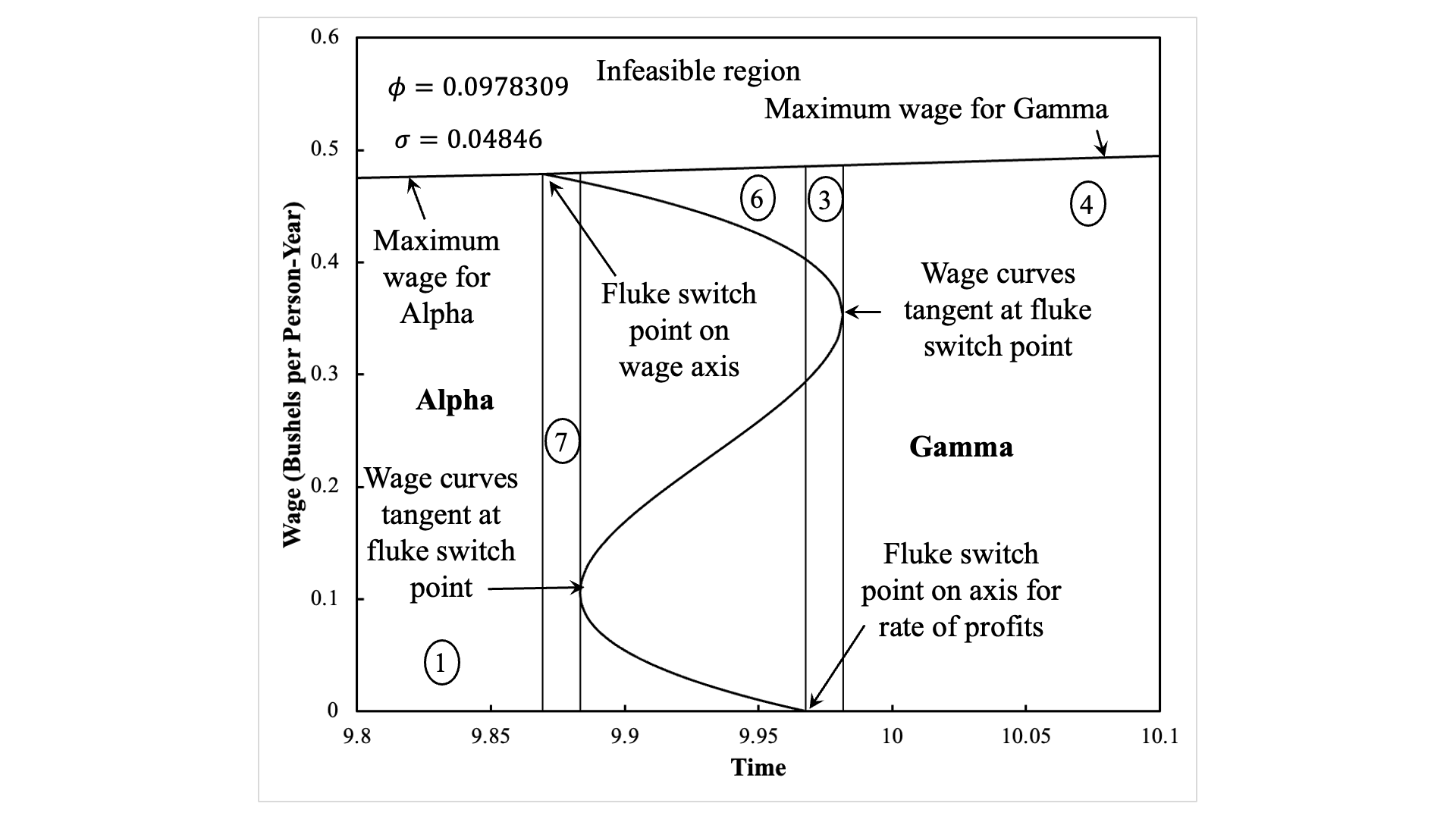
An analysis of technical change is another application of this partitioning of parameter space by fluke switch points. In this context, the change in properties of the wage frontier is the result of structural economic dynamics (Pasinetti 1993). A movement from the upper right to the lower left in Figure 2 reflects a specific kind of technical progress in producing tractors of type II. The quantity of type II tractors needed to manufacture a new type II tractor decreases with a movement to the left. The maximum rate of profits for the technique with type II tractors increases. The quantity of type II tractors needed to make a bushel corn decreases with a downward movement. The maximum wage increases.

Figure 1 depicts the variation in the analysis of the choice of technique along a specific line in Figure 2. The coefficients of production for inputs of type II tractors, in both industries, fall together in travelling from the upper-right to the lower-left in the graph. Switch points and the maximum wage are plotted. Four fluke switch points provide vertical divisions in the diagram. The cost-minimizing technique is labeled among ranges of the wage. From right to left, the diagram shows how technical progress in producing type II tractors results in the corresponding technique ultimately replacing the technique with type I tractors.

Region 6, with triple-switching, arises in the midst of this transition. It can be preceded by a region with a single switch point, as it is in this diagram. Or triple-switching can be preceded by region 3, in which double-switching occurs. The region with triple-switching can be followed by region 7, with a single switch point, or by region 5, with double-switching. A region with triple-switching might not occur at all, as in a path through regions 3, 2, and 5. The appendix provides an example in which double-switching can occur, but not triple-switching. Double-switching might also not occur at all, with a path from region 4, through region 2, and into region 1.

This example therefore suggests that a technology in which the corresponding prices of production exhibit triple-switching will appear only as a transient phenomenon, as one technique replaces another due to technical change. This conclusion also applies to double-switching. Presumably, the same result applies to multiple switching with four or more switch points.

How multiple switching manifests in market prices depends on many determinations not considered in this article. The speed at which coefficients of production evolve with technical change, compared to the speed at which market prices approach prices of production, if they do, seems of some importance. Robinson (1975) argues the latter process should be analyzed in historical time, not with a mechanical process in logical time. The stability of wages and the rate of profits is another issue. Accounting conventions for depreciation and for allocating overhead costs might impact these processes. The size of extra profits obtained by being first to adopt a new process or technique is another consideration. Nevertheless, no theoretical basis seems to exist for the idea, for example, that a rise in wages or a fall in the interest rate is associated with a drop in employment due to the adoption of a less labor-intensive or more capital-intensive technique of production, out of a given and known book of blueprints.

Wednesday, April 16, 2025

Publicly Available Matlab Code For The Analysis Of The Choice Of Technique

I have created a project on GitHub: SraffianAnalysis.

This directory contains Octave code to support the analysis of the choice of technique.

I have examples of code to specify discrete technologies for small economies and to plot wage curves and switch points for them. Techniques in these economies produce one, two, three, or four commodities. Switch points, which are found as the roots of certain polynomial equations, can be found exactly. I allow the techniques to be specified as general joint production and with persistent differentials in the rate of profits. (The cost-minimizing technique in general joint production is not necessarily found as on the outer envelope of wage curves.)

I also have some main programs to find fluke switch points, like a switch point that is an intersection of more than two wage curves. A Microsoft Excel spreadsheet and PowerPoint slide decks illustrate what can be done with this capability.

Monday, April 14, 2025

Recent Work On The Economic Calculation Problem

This post is mostly a bibliography. I know that Ludwig Von Mises' argument that socialist central planning will not work is invalid.

Many have put forth plans for post-capitalist societies. W. Paul Cockshott and Allin Cottrell's Towards a New Socialism is interesting in that they consider issues of computational complexity. I also once read some work of their colleagues Greg Michaelson and Ian Wright.

Apparently, a flurry of recent research investigates whether or not improvements in computing technology refute the Austrian argument against central planning. I have read hardly anything in the following list:

Friday, April 11, 2025

Austrian Capital Theory And Triple-Switching In The Corn-Tractor Model

Table 1: Lower Rate of Profits around a Switch Point
Tradional Marginalist Story'Perverse' Marginalist Story
Traditional Austrian StoryGreater net output per workerSmaller net output per worker
More roundabout techniqueMore roundabout technique
Switch pt. in region 2, 1st in region 52nd switch point in region 3, 2nd in region 6
'Perverse' Austrian StoryGreater net output per workerSmaller net output per worker
Less roundabout techniqueLess roundabout technique
1st in region 3, 1st and 3rd in region 6, switch point in region 72nd switch point in region 5

My examination of triple-switching in the corn-tractor model allows for drawing some conclusions about Austrian capital theory.

The corn-tractor model, like the Samuelson-Garegnani model, is useful for investigating certain aspects of capital-theory. In obsolete theory from economists of the Austrian school, capital-intensity is associated with roundaboutness (Hennings 1987). A more roundabout technique is identified here with the use of a tractor with a longer lifetime. Only cases in which each type of tractor lasts for the same time in both industries are considered in this article. Thus, the degree of roundaboutness is unambiguous here. In the Austrian theory, a more roundabout technique, in a comparison of stationary states, is supposed to result in a greater net output per worker.

In a stationary state, tractors of each age are operated in parallel, both in the tractor industry and in the corn industry. At the end of each year, the oldest tractors are discarded and the appropriate number of new tractors are added to the stock. The sum of the prices of production of the stock of tractors is the value of capital. Following Steedman, I take a non-physical measure of capital-intensity to be the ratio of the value of capital to the value of net output. The capital-output ratio is a dimensionless number, while the units for the ratio of the value of capital to employment depends on the choice of the numeraire. In a stationary state, net output consists solely of corn, which is consumed. Net output per worker is an unambiguous physical quantity here.

For completeness, I repeat my summary (Table 2) of the analysis of the choice of technique in various regions.

Table 2: Cost-Minimizing Techniques by Region
RegionCost-Minimizing TechniqueNotes
1Type IINo switch point. Type II tractors are dominant with sufficiently low coefficients of production in producing Type II tractors.
2Type II, Type IAround the switch point, a lower rate of profits is associated with a more roundabout technique, a greater capital-output ratio, and more consumption per person-year.
3Type I, Type II, Type IAround the first switch point, a lower rate of profits is associated with a less roundabout technique, a higher capital-output ratio, and more consumption per person-year. Around the second switch point, a lower rate of profits is associated with a more roundabout technique, a lower capital-output ratio, and less consumption per person-year.
4Type INo switch point. Type I tractors are dominant with sufficiently high coefficients of production in producing Type II tractors.
5Type II, Type I, Type IIAround the first switch point, a lower rate of profits is associated with a more roundabout technique, a greater capital-output ratio, and more consumption per person-year. Around the second switch point, a lower rate of profits is associated with a less roundabout technique, a lower capital-output ratio, and less consumption per person-year.
6Type I, Type II, Type I, Type IIAround the first and third switch point, a lower rate of profits is associated with a less roundabout technique, a greater capital-output ratio, and more consumption per person-year. Around the second switch point, a lower rate of profits is associated with a more roundabout technique, a smaller capital-output ratio, and less consumption per person-year.
7Type I, Type IIAround the switch point, a lower rate of profits is associated with a less roundabout technique, a greater capital-output ratio, and less consumption per person-year.

Marginalist economists typically thought of prices as scarcity indices. A higher price of an input into production supposedly signals to mangers of firms to adopt processes in which now cheaper resources are substituted for that input.

"Assume that somewhere ... a new opportunity for the use of some raw material, say, tin, has arisen, or that one of the sources of supply of tin has been eliminated. It does not matter for our purpose ... which of these two causes has made, tin more scarce. ... If only some of [the users of tin] know directly of the new demand, and switch resources over to it, and if the people who are aware of the new gap thus created in turn fill it from still other sources, the effect will rapidly spread throughout the whole economic system and influence not only all the uses of tin but also those of its substitutes and the substitutes of these substitutes, ... without the great majority of those instrumental in bringing about these substitutions knowing anything at all about the original cause of these changes... The mere fact that there is one price for any commodity ... brings about the solution which (it is just conceptually possible) might have been arrived at by one single mind possessing all the information which is in fact dispersed among all the people involved in the process.” (Hayek 1948: 85-86)

This concept of the role of prices is undermined by the Cambridge capital controversy

Bliss (1975), in arguing for general equilibrium theory as an apposite response rejects this role of prices, at least when comparing equilibria:

"Even people who have made no study of economic theory are familiar with the idea that when something is more plentiful its price will be lower, and introductory courses on economic theory reinforce this common presumption with various examples. However, there is no support from the theory of general equilibrium for the proposition that an input to production will be cheaper in an economy where more of it is available. All that the theory declares is that the price of the use of an input which is more plentiful cannot be higher if all other inputs, all other outputs and all other input prices are in constant proportions to each other."

Suppose the rate of profits were an index for the scarcity of capital. A lower rate of profits would indicate that capital was more plentiful, in some sense, as compared to labor. Following the ideas of economists of the Austrian school, managers of firms would be encouraged to adopt more roundabout processes at a lower rate of profits around a switch point (Table 1). According to traditional marginalist reasoning, they would adopt a technique, at a lower rate of profits, with a higher capital-output ratio and more consumption per worker. The switch point in region 2 and the first switch point in region 5 are the only switch points that conform to these outdated ideas.

Other switch points illustrate that these ideas cannot be sustained in general. Consider the first switch point in region 3, the first and third switch points in region 6, and the switch point in region 7. Around these switch points, a lower rate of profits is associated with a higher capital-output ratio and more consumption per worker. Traditional marginalist reasoning is still validated. But, contrary to the expectations of economists of the Austrian school, a less roundabout technique is adopted. As shown in region 7, the disconnection between roundaboutness and capital-intensity does not even require reswitching for its demonstration.

The second switch points in regions 3 and 6, on the other hand, conform to Austrian but not to marginalist reasoning. Around these switch points a lower rate of profits is associated with a more roundabout technique, a lower capital-output ratio, and less consumption per person-year. More roundabout techniques need not be associated with greater capital-intensity or greater net output per worker.

Yeager (1979), in trying to justify Austrian theory with a concept of waiting, expresses puzzlement:

"One paradox not cleared up to my full satisfaction concerns consumption… Since this consumption paradox is a direct arithmetical implication of paradoxes already cleared up, and in particular of capital reversal or perversity, one might contend that no paradox remains. Yet this remark is not wholly satisfying."

The second switch point in region 5 contradicts both Austrian and marginalist reasoning. Around this switch point, a lower rate of profits is associated with a less roundabout technique. And it is associated with a lower capital-output ratio and less consumption per person-year. Perturbing parameters for a single example of triple-switching illustrates a variety of the so-called paradoxes discovered during the Cambridge capital controversy.

Monday, April 07, 2025

Robert Lucas On Recessions As Workers Choosing To Take Long Vacations

Why, under capitalism, do periods of persistent unemployment arise? Robert Lucas says the problem is to explain why workers do not to want to work:

"A theory that does deal successfully with unemployment needs to address two quite distinct problems. One is the fact that job separations tend to take the form of unilateral decisions - a worker quits, or is laid off or fired - in which negotiations over wage rates play no explicit role. The second is that workers who lose jobs, for whatever reason, typically pass through a period of unemployment instead of taking temporary work on the 'spot' labor market jobs that are readily available in any economy. Of these, the second seems to me the more important: it does not 'explain' why someone is unemployed to explain why he does not have a job with company X. After all, most employed people do not have jobs with company X either. To explain why people allocate time to a particular activity - like unemployment - we need to know why they prefer it to all other available activities: to say that I am allergic to strawberries does not 'explain' why I drink coffee. Neither of these puzzles is easy to understand within a Walrasian framework, and it would be good to understand both of them better, but I suggest we begin by focusing on the second of the two." -- Robert E. Lucas, Jr. 1987.Models of Business Cycles. Basil Blackwell: 53-54.

I suppose Lucas is to be commended that a regular, recurring relationship between employer and emplyee does not exist in the Walrasian model. Workers are auctioning off a supply of labor services at specific points in time, and no reason exists in the Arrow-Debreu model why those buying a specific agent's labor services today will have any tendency to hire the same agent's labor services tomorrow. But that bit about workers choosing to remain unemployed?

Other economists offer explanations as imperfections and frictions interfering in the operation of 'free' markets. George Akerlof explains unemployment by a social custom that wages must be 'fair'. Oliver Hart and others explain unemployment through employers having a better understanding of the worker's marginal product than the worker does. Others point to principal agent problems and information asymmetries.

John Maynard Keynes had a different approach. He explicity rejected explaining unempoyment by frictions:

"the classical theory has been accustomed to rest the supposedly self-adjusting character of the economic system on an assumed fluidity of money-wages; and, when there is rigidity, to lay on this rigidity the blame of maladjustment...

...The generally accepted explanation is, as I understand it, quite a simple one. It does not depend on roundabout repercussions, such as we shall discuss below. The argument simply is that a reduction in money-wages will cet. par. stimulate demand by diminishing the price of the finished product, and will therefore increase output and employment up to the point where the reduction which labour has agreed to accept in its money-wages is just offset by the diminishing marginal efficiency of labour as output (from a given equipment) is increased...

It is from this type of analysis that I fundamentally differ; or rather from the analysis which seems to lie behind such observations as the above. For whilst the above fairly represents, I think, the way in which many economists talk and write, the underlying analysis has seldom been written down in detail." -- John Maynard Keynes. 1936. The General Theory of Employment, Interest, and Money

To make sense of Keynes, a need arises for a price theory that is consistent with non-clearing labor markets. As some have been saying for decades, prices of production provide such a theory.

Thursday, April 03, 2025

Perturbations Of Selected Parameters In The Corn-Tractor Model

Figure 1: Partitioning a Part of the Parameter Space with Fluke Cases
1.0 Introduction

This post is a continuation of the first example here. I examined a perturbation of two parameters of that example. I ended up with a more perspicacious partition of the parameter space than here.

2.0 Technology

Table 1 merely repeats the parameters for the fluke case that I started with. This case has switch points on the axis for the rate of profits and on the wage axis. A third switch point exists at an intermediate rate of profits.

Table 1: Parameters for Technology for First Example
ParameterType I TractorsType II Tractors
Tractor input per tractor (a)≈ 0.3062262/5
Labor input per tractor (b)≈ 233.696720
Years tractors last in tractor industry (n)12
Tractor input per bushel corn (α)120
Labor input per bushel corn (β)αI bI/aI850
Years tractors last in corn industry (ν)12

3.0 Perturbations of Selected Parameters

Almost any perturbation of the model parameters destroys fluke properties of the example in the previous section. Figure 1 illustrates perturbations in aII and αII. A switch point is on the axis for the rate of profits only for a specific value of aII. Likewise, a switch point is on the wage axis only for the depicted partition of the parameter space, of, for instance, regions 1 and 7. The example in the previous post has parameters found at the intersection of these two partitions. The two other partitions occur for parameter values at which a switch point is repeated and the two wage curves are tangent at this switch point. The regions bounded by these partitions of the selected part of the parameter space are numbered.

The dashed line depicts the combination of coefficients of production for which the ratio of labor to tractors does not vary between industries for tractors of type II. To the left and above this line the physical capital-intensity of production is less, for type II tractors, in producing new tractors than it is in producing corn. To the right and below, the tractor industry for type II tractors has a larger physical capital-intensity than corn production.

I would have liked to have drawn the partitions as three-dimensional manifolds in a four-dimensional space, where (aII, bII, αII, βII) is a point in the space. But I can visualize a tesseract only momentarily, if at all (Heinlein 1941). Figure 1 is constructed by selecting only two parameters to perturb.

Double-fluke cases arise at intersections of the partitions. The partition between regions 2 and 3 is tangent to the partition between regions 3 and 4 at their point of intersection. Similarly, the partition between regions 1 and 5 is tangent to the partition between regions 2 and 5. The two partitions between regions 6 and 7 are tangent at their point of intersection, as well.

This last double-fluke switch point can perhaps admit of some elaboration. Figure 2 shows the rate of profits and the wage at switch points for each of two fluke cases. The solid lines correspond to the partition between regions 1 and 5 and the lower partition in Figure 2 between regions 6 and 7. The dashed lines correspond to the partition between regions 3 and 4 and the upper partition. Three switch points exist for the parameters along these two partitions. Two of these switch points are repeated roots, which is the fluke case under consideration. All three switch points coincide on the wage frontier at the double-fluke switch point to the extreme left.

Figure 2: The Rate of Profits at Switch Points with Tangent Wage Curves

Table 2: Cost-Minimizing Techniques by Region
RegionCost-Minimizing TechniqueNotes
1Type IINo switch point. Type II tractors are dominant with sufficiently low coefficients of production in producing Type II tractors.
2Type II, Type IAround the switch point, a lower rate of profits is associated with a more roundabout technique, a greater capital-output ratio, and more consumption per person-year.
3Type I, Type II, Type IAround the first switch point, a lower rate of profits is associated with a less roundabout technique, a higher capital-output ratio, and more consumption per person-year. Around the second switch point, a lower rate of profits is associated with a more roundabout technique, a lower capital-output ratio, and less consumption per person-year.
4Type INo switch point. Type I tractors are dominant with sufficiently high coefficients of production in producing Type II tractors.
5Type II, Type I, Type IIAround the first switch point, a lower rate of profits is associated with a more roundabout technique, a greater capital-output ratio, and more consumption per person-year. Around the second switch point, a lower rate of profits is associated with a less roundabout technique, a lower capital-output ratio, and less consumption per person-year.
6Type I, Type II, Type I, Type IIAround the first and third switch point, a lower rate of profits is associated with a less roundabout technique, a greater capital-output ratio, and more consumption per person-year. Around the second switch point, a lower rate of profits is associated with a more roundabout technique, a smaller capital-output ratio, and less consumption per person-year.
7Type I, Type IIAround the switch point, a lower rate of profits is associated with a less roundabout technique, a greater capital-output ratio, and less consumption per person-year.

The analysis of the choice of technique is qualitatively invariant in each numbered region. Table 2 lists the cost-minimizing technique, in order of an increasing rate of profits, in each region. One technique is cost-minimizing, whatever the distribution of income, in regions 1 and 4. One switch point exists in regions 2 and 7. Double-switching occurs in regions 3 and 5. Finally, triple-switching occurs in region 6. Perturbations of the parameters for an example in the previous post can result in each type of tractor being cost-minimizing in two discrete ranges of the wage or the rate of profits. This partitioning is not unique to this model.

4.0 Conclusions

I can examine specific properties of the switch points in each region, and maybe draw some more conclusions. But that will be for future posts.

Monday, March 31, 2025

Duncan Foley On Why General Equilibrium Maybe Is Not Neoclassical Economics

Duncan Foley participated in a 2003 conference comparing and contrasting general equilibrium theory with long period models developed by advocates of the Cambridge capital critique. This is from the wrap-up discussion on the last day.

"I am in a somewhat peculiar position because due to certain idiosyncrasies of my education I never learned 'neoclassical economics'. The economic theory that I learned wasfrom Herbert Scarf and it was couched entirely in terms of the abstract general equilibrium model with n commodities, abstract production sets, and so forth. Someone has defined economic intuition as what you learn in your first course in economics, and since I did not learn the same things as many other people, my intuition is not the same. My economic intuition was always that there were no theorems of the following kind: suppose you increase the supply of labour, as a result the equilibrium real wage will fall. I knew there were no such theorems available in general equilibrium theory. I also knew, and maybe this became clearer because of Scarf's mathematical point of view, that once you took the step to a simultaneous general equilibrium vision, you had to give up hope of sustaining some traditional ideas. For one thing, you lost any sense of causality. In a general equilibrium model there is no real sense in which one factor causes another: everything is determined simultaneously by the whole collection of relationships... And I never thought there was any hope of proving general stability theorems, because Herbert Scarf had showed that you could not prove stability, at least tatonnement stability, without unacceptably strong hypotheses on aggregate demand functions. So these things are not counterintuitive to me, these are just facts of the matter. I see them as inherent defects of the general equilibrium point of view. I tend to read this as a case where neoclassical economics, in an attempt to purify itself logically, leached out all of the substance, the concrete substance and content, of what it had to say about the world. And it raises the question in my mind whether it is really fair to talk about general equilibrium theory as if it were neoclassical economics, precisely because it does not have that content of substitutability, well-behaved stability properties and well-behaved comparative statics properties. In fact, when I was at MIT it became apparent to me that for, say, Solow and Samuelson, who are perhaps closest to being true believers in the old neoclassical rules, general equilibrium theory was just as much a threat as the Cambridge controversy to their point of view." -- Duncan Foley (2003) final discussion, in: General Equilibirum: Problems and Propsoects (ed. by Fabio Petro and Frank Hahn), London: Routledge.

I have not looked at the American Economic Review, for example, in quite some time. But I have long lost an ability to make sense of mainstream economics. Doubtless, market power of employers, search costs for employees in finding new jobs, montoring costs and principal agent problems for employers, and the suggestion that an employee is a 'lemon' if they offer to work for a lower wage than many are all of empirical importance. But why must they be invoked to explain persistent unemployment or the failure of a rise in the minimum wage to create disemployment? The rigorous theory, in both the comparison of intertemporal general equilibrium paths and in comparisons of long period positions does not yield downward-sloping demand functions for labor. Likewise, rigorous theory does not yield regular supply and demand relations for other markets either.

Do mainstream economists even have an articulated, overall vision for microeconomics? Neither general equilibrium theory or game theory seem to provide one. Is it sufficient to just have lots of little models? This seems to be the position of mainstream economics for decades.

Thursday, March 27, 2025

Double Fluke Cases For Triple-Switching In The Corn-Tractor Model

Figure 1: Wage Curves for an Example With Tractors Lasting One and Two Years
1.0 Introduction

This post presents two examples in the corn-tractor model. These examples are double fluke cases. Each has three switch points. One is on the wage axis, and another is on the axis for the rate of profits. Perturbations of parameters of each example can result in triple-switching.

The corn-tractor model is a fixed capital model, an adaption of the Samuelson-Gargenani model. The consumption good, corn, can be produced by labor working with any one of a number of different types of tractors. Each type of tractor is produced by labor with an input of that type of tractor. Each type of tractor lasts for a specified number of years in the production of new tractors and of corn. Its lifetime can vary between industries, and these lifetimes can vary among types of tractors. This is an example of joint production. Every process for producing a new tractor, except the last, also produces tractors one year older than the tractors used as inputs. The production of corn also yields a joint product of tractors one year older. Each type of tractor works with constant efficiency, whether in producing new tractors or in producing corn. With these assumptions, no choice of the economic life of a machine arises. The tractor will be used for its full physical life in each industry.

2.0 An Example with One and Two-Year Old Tractors

A technique is identified with a type of tractor. Six parameters (Table 1) specify a technique. The numerical example consists of a choice between two types of tractors. The first lasts only one year. That is, the production and operation of the first type of tractor is an example of circulating capital. The second type lasts two years in both the production of new tractors and of corn. The ratio of labor to tractors does not vary between industries for the first type of tractors. In other words, physical capital-intensity does not vary between industries. The production of corn is more capital-intensive than the production of new tractors for the initial parameters for the second type of tractors. As Steedman (2019) notes, this special case is sufficient to yield triple-switching.

Table 1: Parameters for Technology for First Example
ParameterType I TractorsType II Tractors
Tractor input per tractor (a)≈ 0.3062262/5
Labor input per tractor (b)≈ 233.696720
Years tractors last in tractor industry (n)12
Tractor input per bushel corn (α)120
Labor input per bushel corn (β)αI bI/aI850
Years tractors last in corn industry (ν)12

I chose the parameters in Table 1 to illustrate a double-fluke case. The parameters for type II tractors are arbitrary, but such that the convexity of the corresponding wage curve changes once along its length. The convexity cannot vary more than once for tractors that last two years. The parameters for type I tractors are constrained to provide switch points on the wage axis and the axis for the rate of profits. These constraints result in a knife-edge case in which certain perturbations of parameters result in triple-switching.

Figure 1, at the top of the post, illustrates the wage curves in this case. They are hard to see by eye. Type II tractors are cost-minimizing at high wages, low positive rates of profits. Type I tractors are cost-minimizing at low positive wages, high rates of profits.

For what it is worth, I also include a graph (Figure 2) of the variation in the capital-output ratio, with the rate of profits, in this example. In a stationary state, tractors of each age are operated in parallel, both in the tractor industry and in the corn industry. After each year, the oldest tractors are discarded and the appropriate number of new tractors are added to the stock in each industry. The sum of the prices of production of these tractors is the value of capital. Following Steedman, I take a non-physical measure of capital-intensity to be the ratio of the value of capital to the value of net output. The capital-output ratio is a dimensionless number, while the units for the ratio of the value of capital to employment depends on the choice of the numeraire.

Figure 2: Capital-Output Ratio an Example With Tractors Lasting One and Two Years

In the numerical example, the capital-output ratio is a constant, independent of the rate of profits, for type I tractors. It increases and then decreases, with the rate of profits, for type II tractors. Since a switch point exists on the wage axis, the capital-output ratio does not vary, with the type of tractors, at the two switch points with a positive rate of profits. In the jargon, real Wicksell effects are zero at these switch points (Harris 1973). Around the switch point at approximately 45 percent, a lower rate of profits, is associated with the adoption of a more roundabout technique, even though this increases, across stationary states, neither the capital-output ratio nor consumption per worker. I here identify roundaboutness with the number of years a tractor lasts.

3.0 An Example with One and Three-Year Old Tractors

I also created a double-fluke case (Table 2) for an example in which one type of tractors lasts one year, and the other type lasts three years. Figure 3 shows the wage curves for this case. Figure 4 is the corresponding graph for the capital-output ratio.

Table 2: Parameters for Technology for Second Example
ParameterType I TractorsType III Tractors
Tractor input per tractor (a)≈ 0.239137731/100
Labor input per tractor (b)≈ 82.7233747
Years tractors last in tractor industry (n)13
Tractor input per bushel corn (α)121
Labor input per bushel corn (β)αI bI/aI400
Years tractors last in corn industry (ν)13

Figure 3: Wage Curves for an Example With Tractors Lasting One and Three Years

Figure 4: Capital-Output Ratio for an Example With Tractors Lasting One and Three Years

4.0 Conclusion

This post has validated Steedman's claim that triple-switching can arise in the corn-tractor model as he claims. In both examples, one type of tractor lasts for one-year. In that circulating capital case, the process for producing more tractors is as capital-intensive as the process for producing corn. The corresponding wage curve is a straight line, the price of new tractors does not vary with the rate of profits, and the capital-output ratio is also constant.

In both examples, the other type of tractor lasts more than one year. It lasts the same amount of time in producing new tractors and in producing corn. Tractors operate with constant efficiency over their lives in both industries. Consequently, the price of an old tractor of a specified age is the same in each industry. Production of the consumption good is more physcially capital-intensive than production of capital good. By this, I mean the ratio of tractors (of a given age) to labor is greater in the corn industry than in the tractor industry. Consequently, the price of new tractors of the second type varies with the rate of profits, and non-zero price Wicksell effects exist.

Nevertheless, these examples do not have visually appealing wage frontiers. Perturbing parameters will show that my prior claims about how parameter spaces are partitioned are qualitatively replicated here.

Reference
  • Gargenani, Pierangelo. 1970. Heterogeneous capital, the production function and the theory of distribution. Review of Economic Studies 37 (3): 407-436.
  • Samuelson, Paul A. 1962. Parable and realism in capital theory: the surrogate production function. Review of Economic Studies 29 (3): 193-206.
  • Steedman, Ian. 2020. Fixed capital in the corn-tractor model. Metroeconomica 71: 49-56.

Monday, March 24, 2025

Gunnar Myrdal Sounding Like Tony Lawson?

This passage suggests to me that, in economics, one cannot expect to find event regularities from surface level data:

"The really important difference between us and our natural science colleagues is illustrated by the fact that we never reach down to constants like the speed of light and of sound in a particular medium, or the specific weights of atoms and molecules. We have nothing corresponding to the universally valid measurements of energy, voltage, amperes, and so on. The regularities we find do not have the firm, general, and lasting validity of 'laws of nature.'

If we economists, for instance, establish by observation the income or price elasticity for, say, sugar, our findings are valid for only a specific group of consumers in a single community or region at a particular time - not to mention the fact that the concept elasticity itself loses what I call adequacy to reality, and thereby analytical usefulness, in underdeveloped countries that have no, or very imperfect, 'markets,' in the sense given to this term by the economists." -- Gunnar Myrdal, Against the Stream: 138-139.

Myrdal wrote a lot about methodology. He was intererested in how unacknowledged valuations enter into economic theory. And he thinks social scientists should explicitly state their valuations. But he does not write about ontology.

I don't know how this applies to me. I suppose you can say that my focus on distribution, especially wages, reflects some valuations. I think, though, that I am mostly focusing on mathematics. And by looking for structures in parameter spaces for open models of prices of production, I am not making claims about event regularities at surface levels. I leave to others to relate movements in market prices to prices of production. Really, though, when I first learned about Robinson and Sraffa, I was astonished that a serious reason exists to think intermediate microeconomics, as widely taught, is nonsense, not even wrong.

Wednesday, March 19, 2025

The Emergence of Triple Switching and the Rarity of Reswitching Explained

I have written up a series of post as a research paper: first post, second, third, fourth, fifth, sixth, seventh. Here I present the abstract and most of the introduction.

Abstract: Empirical research indicates that the reswitching of techniques, as well as multiple switching with more switch points, is rare. This article explores parameter spaces in the analysis of the choice of technique to suggest why reswitching and triple-switching might be hard to find in empirical data. An example illustrates that the emergence of triple-switching requires specific evolutions of coefficients of production. Further evolution of technology removes the possibility of triple-switching. The example also illustrates that the roundaboutness of a technique is independent of the capital-intensity of a technique.

Introduction

Consider the analysis of the choice of technique in post-Sraffian price theory. Kurz & Salvadori (1995) is a standard textbook presentation. Switch points, in which two techniques are both cost-minimizing at a given wage or rate of profits, are found as the zeros of certain polynomials of high degree. These zeros can be complex and, if real, need not be positive and below the maximum rate of profits. Nevertheless, theory suggests that multiple switch points between techniques are common. Han & Schefold (2006) and Zambelli (2018) are the most comprehensive empirical works to date, looking at switch points in comparing techniques drawn from Leontief matrices constructed from actual national income and product accounts. Reswitching and capital reversing, never mind multiple switching with more switch points, seem to be rare in empirical data. How can this discrepancy between expectations from theory and empirical results be resolved?

Kurz (2020) points out some difficulties with the empirical results. Often fixed capital is not taken into account. Only circulating capital is assumed, and the production of heterogeneous commodities, with varying input coefficients, in each industry is abstracted from. Some of these heterogeneous processes in an industry can be expected to be obsolete in the year in which data is gathered. Obsolete plant is operated in an economy side-by-side with more recent vintages. Firms often produce multiple products, and accounting conventions may assign a firm to different industries in different years. Heterogeneity in labor, changes in labor mixes, and changes in relative wages over time, are also ignored in this empirical work. The empirical research to date, although impressive still suffers from limitations that ought to be taken into account when assessing how rare reswitching is likely to be.

Nevertheless, Schefold (2023) investigates the supposed rarity of certain capital-theoretic phenomena, found surprising by marginalist economists. He randomly generates coefficients of production for alternate techniques. The resulting wage curves are near linear, that is, nearly affine functions. A small number of techniques, only one or two, contribute their wage curves to the frontier, except near extremes for the rate of profits. The continuous variation in the cost-minimizing technique with distribution, as postulated in marginalist theory, does not seem defensible. The reswitching of techniques does not seem likely on the wage frontier.

Changes of techniques in practice seem not to be a matter of choosing a cost-minimizing technique from an existing and well-known book of blueprints, following price signals. Rather, as Joan Robinson frequently remarked, new techniques are a matter of technical innovation, with reduced coefficients of production and perhaps with processes using new capital goods, not previously produced.

This article explores parameter spaces for technology with a different method. An example of triple-switching from Schefold (1980), to illustrate roundabout production, is extended with technological change. This particular model of structural economic dynamics (Pasinetti 1993) is not claimed to be realistic. Rather, it provides a two-dimensional parameter space that is partitioned by fluke switch points. A switch point is a fluke if it is a knife edge case in which almost all perturbations of model parameters destroy its defining properties. This article identifies points in the parameter space that are double-fluke cases. For instance, the wage curves at such a point are tangent at a switch point that is also on the wage axis. Each double-fluke case occurs for parameters that are intersections of two partitions in the parameter space. A picture of how triple-reswitching can arise emerges from a synthesis of local perturbations around these double-fluke cases. This extension of the analysis of the choice of technique suggests why triple-switching, for example, might be hard to find in empirical data. The example illustrates that the emergence of triple-switching requires specific evolutions of coefficients of production. Further evolution of technology removes the possibility of triple switching.

Monday, March 17, 2025

Two Sad Stories About Great Mathematicians

Here is a story about David Hilbert torwards the end of his career:

"Otto Neugebauer, now an associate professor, was placed at the head of the Mathematical Institute. He held the famous chair for exactly one day, refusing in a stormy session in the Rector's office to sign the required loyalty declaration. The position of the head of the Mathematical Institute passed to Weyl. Although his wife was part Jewish, he was one of those who thought that something might yet be salvaged. All during the bitter uncertain spring and summer of 1933 he worked, wrote letters, interviewed officials of the government. But nothing could be changed.

By late summer nearly everyone was gone. Weyl, vacationing with his family in Switzerland, still considered returning to Göttingen in the hope that somehow he could keep alive the great scientific tradition. In America, his many friends worried about him and wrote long letters, advising, urging, begging that he leave Germany before it was too late. Abraham Flexner offered him a position at the Institute for Advanced Study. Finally Einstein, who had already been at the newly created Institute for several years, prevailed upon the younger man to come and join him there.

In Göttingen, Hilbert was left almost alone. He kept Bernays on as his assistant at his own expense. The Foundations of Mathematics, which he and Bernays had written in collaboration, was almost ready for publication. He put away his general mathematical books and became progressively more distant. With Bernays's help, he saw Arnold Schmidt and Kurt Schütte through the doctorate. Schütte was the last of 69 mathematicians (40 of them during the years from 1900 to 1914) to receive their degrees from Hilbert. In actuality, however, all of Schütte's contacts were through Bernays. He saw Hilbert only once.

'When I was young,' Hilbert said to young Franz Rellich, one of the few remaining members of the old circle, 'I resolved never to repeat what I heard the old people say - how beautiful the old days were, how ugly the present. I would never say that when I was old. But, now, I must.'

Sitting next to the Nazis' newly appointed minister of education at a banquet, he was asked, 'And how is mathematics in Gottingen now that it has been freed of the Jewish influence?'

'Mathematics in Göttingen?' Hilbert replied. 'There is really none any more.'" -- Constance Reid. 1996. Hilbert

Here is Kurt Gödel becoming an American citizen:

"Morgeristern had many stories to tell about Gödel. One concerned the occasion when, in April 1948, Gödel became a U.S. citizen, with Einstein and Morgenstern as witnesses. Gödel was to take the routine citizenship examination, and he prepared for it very seriously, studying the United States Constitution assiduously. On the day before he was to appear, Gödel came to Morgenstern in a very excited state, saying: 'I have discovered a logical-legal possibility by which the U.S.A. could be transformed into a dictatorship.' Morgenstern realized that, whatever the logical merits of Gödel's argument, the possibility was extremely hypothetical in character, and he urged Godel to keep quiet about his discovery at the examination. The next morning, Morgenstern drove Gödel and Einstein from Princeton to Trenton, where the citizenship proceedings were to take place. Along the way Einstein kept telling one amusing anecdote after another in order to distract Gödel, apparently with great success. At the office in Trenton, the official was properly impressed by Einstein and Morgenstern, and invited them to attend the examination, normally held in private. He began by addressing Gödel: 'Up to now you have held German citizenship.' Gödel corrected him, explaining that he was Austrian. 'Anyhow', continued the official, 'it was under an evil dictatorship... but fortunately, that's not possible in America.' 'On the contrary,' Gödel cried out, 'I know how that can happen!!' All three had great trouble restraining Gödel from elaborating his discovery, so that the proceedings could be brought to their expected conclusion." -- Solomon Feferman. 1986. Gödel's life and work. In Kurt Gödel Collected Works: Volume I. Oxford University Press.

I wish these stories had no current relevance. I suppose it is encouraging of what others in the past had to overcome.

Thursday, March 13, 2025

Recap For A Triple -Switching Example

Figure 1: Actual and Stylized Partitions of Parameter Space with Triple-Switching

This post is a continuation of this series of posts.

The partitioning of the parameter space by fluke switch points in these posts can be combined into one picture. The left pane in Figure 1 illustrates. The dashed line is a ray from the origin, discussed below. I find this complete picture for this example hard to perceive by eye. The right pane provides a highly stylized presentation of the partitions, rotated and stretched. The partitions are not straight lines on the left. The boundary between regions 1 and 5 is tangent to the boundary between regions 1 and 2 at the point of intersection. The boundary between regions 3 and 4 is likewise tangent to the boundary between regions 2 and 4 where they intersect. The two boundaries between regions 6 and 7 become tangent at their point of intersection. Region 6 is for triple-switching. It adjoins regions 3, 5, and 7. Regions 3 and 5 are examples of reswitching. Their borders with region 6 have fluke switch points on the axis for the rate of profits and on the wage axis, respectively. The borders between regions 6 and 7 are associated with fluke switch points in which two wage curves are tangent. Reswitching in regions 3 and 5 appears in a fairly generic fashion. Reswitching can also appear from perturbations of coefficients of production, where the region in parameter space corresponding to reswitching is not adjacent to a region in which triple-switching occurs.

Table 1: Cost-Minimizing Technique by Region
RegionCost-Minimizing TechniqueNotes
1AlphaNo switch point.
2Alpha, GammaAround the switch point, a lower rate of profits is associated with a LESS round-about technique and greater output per worker.
3Gamma, Alpha, GammaAround the second switch point, a lower rate of profits is associated with a LESS round-about technique and LOWER output per worker.
4GammaNo switch point.
5Alpha, Gamma, AlphaAround the first switch point, a lower rate of profits is associated with a LESS round-about technique. Around the second switch point, a lower rate of profits is associated with LOWER output per worker.
6Gamma, Alpha, Gamma, AlphaAround the second switch point, a lower rate of profits is associated with a LESS round-about technique and LOWER output per worker.
7Gamma, AlphaAround the switch point, a lower rate of profits is associated with a more round-about technique and greater output per worker.

The example demonstrates that an increase in the roundaboutness of the cost-minimizing technique is independent of its capital-intensity. For the traditional marginalist story, a lower rate of profits around a switch point is associated with a choice of technique with greater capital-intensity and greater output per worker. For the traditional story from the Austrian school, a lower rate of profits around a switch point is associated with the adoption of a more roundabout technique.

Yet all four entries in the grid in Table 2 are populated by switch points in the example. Consider the switch point in region 2 or the first switch point in region 5. Around these switch points, a lower rate of profits is associated with the adoption of a more capital-intensive, but a LESS roundabout technique. The less roundabout and more capital-intensive technique has a greater output per worker. These switch points populate the lower left entry in the table. The second switch point in region 5 populates the upper right entry. Around this switch point, a lower rate of profits is associated with the adoption of a more roundabout technique with LOWER output per worker. The first switch point in region 3 and the switch point in region 7 populate the upper left entry. They happen to be consistent with these old theories. The second switch point in region 3 fills the entry in the lower right in the table. Roundaboutness and capital-intensity move together, but against the intuition of outdated marginalist and Austrian school economists. A lower rate of profits is associated with a LESS round-about technique and LOWER output per worker. The first and third switch points in region 6, in which triple-switching occurs, are like the switch point in region 7. The second switch point is like the second switch point in region 3. Roundaboutness and capital-intensity do not seem to have much to do with one another.

Table 2: Lower Rate of Profits around a Switch Point
Traditional Marginalist Story'Perverse' Marginalist Story
Traditional Austrian StoryGreater net output per workerSmaller net output per worker
More roundabout techniqueMore roundabout technique
'Perverse' Austrian StoryGreater net output per workerSmaller net output per worker
Less roundabout techniqueLess roundabout technique

Figure 2: Structural Dynamics for an Example of Triple-Switching

These posts explore structures in parameter spaces that might not be immediately visible in empirical regularities at surface levels. Since distribution is not specified, the model of the choice of technique is open. The impact on the dynamics of market prices of coefficients of production supporting triple-switching is not clear. Such temporal dynamics, one might expect, depend on the speed with which capitalists adopt processes adapted to new technology and distribution, as compared to the speed with which technology improves. Market dynamics might depend on the history of such adjustments, as reflected in fixed capital remaining from previous adjustments. The size of the extra profits obtainable by these adjustments is another consideration. Even if triple-switching were quickly manifested in struggles over the distribution of income and in market dynamics, the partitioning of parameter spaces by fluke switch points suggests that triple-switching might be rare. It only occurs in specific examples of structural dynamics.

These posts demonstrate that triple-switching can arise through innovations in technology. The illustrated traversal of the parameter space is not the only way. Reswitching can arise as here and as adjacent to a triple-switching example. Likewise, triple-switching can arise adjacent to an instance of quadruple-switching. One can see this by considering generalizations of Figure 2. Each instance with more switch points is less likely to correspond to a region in the parameter space formed by coefficients of production or related parameters. At any rate, the number of partitions in parameter space increases, and their configurations are more complicated. In the example, triple-switching arises from technological innovation. But further innovation in the same direction removes the possibility of triple-switching. This result applies to reswitching, and generalizes to quadruple-switching, and so on. Regions with multiple switch points are transient, arising as one technique replaces another as dominant, whatever the distribution of income.

The example examined in the main text has also demonstrated that the degree of roundaboutness is independent of the capital-intensity of a technique. Keynes had a point:

"It is true that some lengthy or roundabout processes are physically efficient. But so are some short processes... Moreover there are all sorts of reasons why various kinds of services and facilities are scarce and therefore expensive relatively to the quantity of labour involved. For example, smelly processes command a higher reward, because people will not undertake them otherwise. So do risky processes. But we do not devise a productivity theory of smelly or risky processes as such." -- Keynes (1936)

This series of posts re-iterates that the rate of profits is not an index for the relative scarcity of capital. A lower rate of profits need not be associated with a technique that is either more capital-intensive or more roundabout. Likewise, the wage is not an index for the relative scarcity of labor.

Previous research suggests that perturbations in relative markups can also bring about the same variations in the analysis of the choice of technique as those that result from perturbations in coefficients of production (Vienneau 2024a). Hence, triple-switching also seems to be possible as a result of long-lasting variations in relative markups.

Monday, March 10, 2025

Some Works Of Mainstream Economics?

Apparently, many mainstream economists assert that anything worthwhile in economics will be published in one of a few journals. The following is a selection of some articles from these well-respected journals, as I understand it:

What I get out of this is that much of what is taught in mainstream microeconomics and macroeconomics is without theoretical and empirical foundation. Alternatives, such as Post Keynesianism, exist. Karl Marx's work is of interest to modern economists. These results were established decades ago.

Wednesday, March 05, 2025

A Sixth Double-Fluke Switch Point For A Triple-Switching Example

Figure 1: Extra Profits at Gamma Prices for the Sixth Double-Fluke Switch Point

This post is a continuation of this series of posts.

In the last double-fluke case, the three switch points between Alpha and Gamma coincide as a ingle switch point. Figure 1 illustrates, while Figure 2 depicts how the parameter space is partitioned around this double-fluke case. Region 7, in which one switch point occurs, is connected. At the point corresponding to the double-fluke case, the two boundaries between regions 6 and 7 are tangent. Schefold's example is at a point, (φ t, σ t)=(1,1⁄2), in the thin wedge for region 6 in Figure 2. I did not find that points in the parts of region 6 in previous posts had more visually compelling wage frontiers than the point that Schefold found

Figure 2: Partitions of the Parameter Space Sixth Double-Fluke Switch Point

Table 1: Cost-Minimizing Technique byRegion
RegionCost-Minimizing TechniqueNotes
1AlphaNo switch point.
2Alpha, GammaAround the switch point, a lower rate of profits is associated with a LESS round-about technique and greater output per worker.
3Gamma, Alpha, GammaAround the second switch point, a lower rate of profits is associated with a LESS round-about technique and LOWER output per worker.
4GammaNo switch point.
5Alpha, Gamma, AlphaAround the first switch point, a lower rate of profits is associated with a LESS round-about technique. Around the second switch point, a lower rate of profits is associated with LOWER output per worker.
6Gamma, Alpha, Gamma, AlphaAround the second switch point, a lower rate of profits is associated with a LESS round-about technique and LOWER output per worker.
7Gamma, AlphaAround the switch point, a lower rate of profits is associated with a more round-about technique and greater output per worker.

The partitions of parameter space show that two values of σ t can be found as functions of φ t, where the corresponding wage curves are tangent at a switch point. Figure 3 plots the rate of profits and the wage for the switch points for these combinations of parameters. One set of three switch points is shown as a solid line and the other as a dashed line. The non-repeating switch point, for each set, is not a fluke except when on an axis or at the extreme right. The switch points for each set of parameters converges to a single switch point, with an increasing φ t. The convergence is complete at the double-fluke case.

Figure 3: Rate of Profits and the Wage at Certain Fluke Switch Points

Monday, March 03, 2025

The History Of No-Longer-Existing Socialism Validates Marx

Marx, like Adam Smith and Walt Rostow, had a stages theory of history. Feudalism was succeeded by capitalism, and capitalism is to be succeeded by socialism. Socialism is to arise first in the most advanced capitalist countries. (The theory of history is not my favorite part of Marxist theory.)

Russia, in 1917, was a semi-feudal country with peasants as the largest class. I guess China was the same, before Mao. A Marxist would not expect socialism to be successful in either country.

I think Lenin and the Bolsheviks agreed with this thesis when they first came to power. They expected their revolution to kick off revolutions elsewhere in Europe. And their expectations seemed to be initially met, what with the Spartacist uprising in Germany, Hungary, and so on.

Lenin, knowing that Russia was not ripe for socialism, talked about state capitalism even before the October revolution. Stalin invented the doctrine of socialism in one country. Economic development in the USSR and, I guess, in China, was amazing, albeit with much brutality. But eventually, further development required some semblance of capitalism

Is this not just what a Marxist would expect?

References