Friday, August 17, 2012

How To Attack Marx's Theory Of Value

Figure 1: Capitalism
1.0 Introduction

Before one can criticize a theory, one must first restate it. I take Marx to have:

  1. Developed a theory of value as an aid to demonstrating that returns to propertied classes exist only through the exploitation of labor.
  2. Argued that:
    • The net national product, when evaluated at labor values, is equal to the net national product, when evaluated at prices of production.
    • The total labor value of the commodities expropriated by the propertied classes is equal to the total exchange value of these same commodities, when evaluated at prices of production.
    • The rate of profits in the system of labor values is equal to the rate of profits in the system of prices of production.

I take Matias Vernengo, Fabio Petri, and others to be arguing1 over whether or not one must accept (2) to defend the conclusion in (1) that labor is exploited. In particular, many of those working with formalizations of a revived classical theory of value and distribution seem to defend (1) while noting that, in general, all three invariants in (2) cannot hold.

2.0 An Empirical Sraffian Defense of the Invariants

I start with another defense of the invariants, closer to Sraffa and different from the defenses that Petri argues cannot stand. Consider large aggregates of commodities mentioned in the invariants: the capital stock used throughout the economy, net national income, the total of all wage goods, luxury consumption bought by the capitalists out of their income, etc. One might expect an individual commodity to be highly capital-intensive2 or labor-intensive. But would not such extreme cases average out in these aggregates? So cannot one assume, as a first approximation at least, that such aggregates have an average capital intensity, in some sense?

Sraffa's standard commodity formalizes this argument. The standard commodity is a commodity of average capital intensity for the production technology expressed in the ruling Leontief input-output matrix. Consider the circulating capital case, in which:

  • All production processes produce one commodity as an output, and
  • Abstract, homogeneous labor is the only non-produced input for all production processes.

Furthermore, assume that net national output consists of the standard commodity and that wages are measured in units of the standard commodity. Then all of Marx's invariants hold. Labor value accounting seems to be prior to and revealing of fundamental features of value and distribution under capitalism.3

I have a question about this approach. It seems to introduce an empirical element into Marxism where neither Marx nor his followers might accept such an element4. Are claims about exploitation of the worker being the source of profits dependent on how close the composition of national output is to that of the standard commodity? Would the truth or falsity of these claims be altered by technological innovations or change in consumption patterns that result in some aggregate becoming more or less capital-intensive?

3.0 The Fundamental Theorem of Marxism

I here consider another rationale for paying attention to labor value accounting, while accepting that all three invariants cannot be expected to hold in general. I refer to the so-called fundamental theorem of Marxism, that profits are positive in the system of prices of production if and only if labor is exploited.

The theorem is perfectly valid in the circulating capital case. But Ian Steedman, quite some time ago, produced an example with fixed capital in which profits are positive even though surplus value is negative5. Mishio Morishima's reaction was to redefine labor values in the case of joint production6. My reaction to this redefinition is much like Petri's to the New Interpretation and the Temporal Single System Interpretation (TSSI). It seems to retain Marx's invariants as uninteresting tautologies while muddying up how labor value accounting can be explanatory of price phenomena7.

4.0 Rectangular Input-Output Matrices

I next want to consider a more fundamental mathematical objection to the surplus approach, at least as reconstructed by Sraffa. Under what cases might the Leontief matrix corresponding to prices of production turn out to be non-square8? In other words, when might the number of cost-minimizing processes be more or less than the number of produced commodities? Under these cases, a unique standard commodity does not exist. If the number of processes is less than the number of commodities, the system does not yield a solution for prices of production, given the wage. Furthermore, if the number of processes is more than the number of commodities, the system does not provide a degree of freedom for distribution.

First, consider cases when requirements for use become more important because of the lack of enough processes to specify prices of production, given the wage. Suppose inputs into production include more than one non-produced input (for example, labor and different kinds of land). And suppose the marginal land9 happens to be fully employed (that is, not in excess supply). Then the marginal land may have a positive rent10. Prices of production now have, at least, a second degree of freedom.

At a switch point, the number of cost-minimizing processes is one more than the number of produced commodities. Michael Mandler imposes an arbitrary assumption that labor markets clear in one example. This assumption then results in distribution being fixed at a switch point in the example.

I believe there are other cases of rectangular Leontief input output matrices associated with joint production. The golden rule of growth considers smoothly expanding growth paths in which:

  • Prices of production prevail, and
  • The rate of profits equals the rate of growth.

As I understand it, a theorem about the Von Neumann model states that the cost-minimizing technique yields a square matrix along such a path. So, I guess, rectangular matrices can arise along such a growth path when the rate of profits differs from the rate of growth.

5.0 Conclusion

I have considered above different ways of complicating the story even more. My conclusion is that Marxist political economy should remain a live and exciting field of scholarly research.

Footnotes
  1. The argument extends to what other aspects of Marx's thought depends on labor value accounting. For example, does his doctrine of commodity fetishism still retain an interest without such accounting? How about the distinction between classical and vulgar political economy? I have trouble seeing how historical materialism is implicated in these discussions.
  2. As measured by labor values or by prices of production at a given rates of profits, for example.
  3. Notice how under this reading, Sraffa's book, unlike, arguably, the Cambridge Capital Controversies, is not confined to an internal critique of neoclassical theory. By reconstructing classical and Marxist economic theory, Sraffa puts forward an (unmet) external critique of neoclassical theory.
  4. I am not saying that Marxist economics cannot be empirically tested or does not have empirical implications. A lot of work has been performed looking at how close labor values and prices of production are to actual prices. And Marx directs one to look at struggles over wages, variations in the quality of wage goods, struggles over the length of the working day and working conditions, the formation of industrial reserve army, etc.
  5. Gustavo Lucas and Franklin Serrano have recently commented on Steedman's example.
  6. Under joint production, the output of some production processes consists of more than one commodity. Fixed capital and non-produced land-like natural resources can be analyzed as special cases of joint production.
  7. John Roemer has proposed an even more radical definition of exploitation, using game theory concepts and, I guess, dropping labor value accounting.
  8. One can consult the work of, for example, Christian Bidard, Michael Mandler, and Bertram Schefold to find quite different perspectives on these issues.
  9. Which kind of land is marginal is determined endogenously.
  10. I am not at all sure that this corresponds to the case of Marx's absolute rent. Anyways, if one accepts the existence of another degree of freedom here, has one located another potential contradiction between Volumes 1 and 3 of Capital?

Monday, August 13, 2012

Phyllis Deane, An Editor Of The Modern Cambridge Economics Series

Matias Vernengo has noted the passing of Phyllis Deane.

I think of Deane as a historian of economics, based on her 1978 book The Evolution of Economic Ideas. In it, she portrays economics as a succession of struggles between competing paradigms, in Thomas Kuhn's sense of the word. Economics was in a pre-paradigm state before Adam Smith. She contrasts this approach to history with an approach emphasizing refinements of analysis, as in Joseph Schumpeter's posthumous history.

But I want to point out another role she took on. Her book was the first in the Modern Cambridge Economics series. And she was co-editor, with Joan Robinson, of that series. She was later co-editor with Geoffrey Harcourt and Jan Kregel. As of Asimakopulos 1991 book, the series consisted of:
  • Phyllis Deane, The Evolution of Economic Ideas
  • Joan Robinson, Aspects of Development and Underdevelopment
  • A. K. Bagchi, The Political Economy of Underdevelopment
  • Éprime Eshag, Fiscal and Monetary Policies and Problems in Developing Countries
  • Michael Ellman, Socialist Planning
  • Colin Rogers, Money, Interest and Capital
  • A. Asimakopulos, Keynes's General Theory and Accumulation
Here is the original introduction to this series of books:

"The modern Cambridge Economic series...is designed in the same spirit and with the similar objectives to the series of Cambridge Economic Handbooks launched by Maynard Keynes soon after the First World War. Keynes' series, as he explained in his introduction, was intended 'to convey to the ordinary reader and to the uninitiated student some conception of the general principles of thought which economists now apply to economic problems'. He went on to describe its authors as, generally speaking, 'orthodox members of the Cambridge School of Economics' drawing most of their ideas and prejudices from 'the two economists who have chiefly influenced Cambridge thought for the past fifty years, Dr. Marshall and Professor Pigou' and as being 'more anxious to avoid obscure forms of expression than difficult ideas'.

This series of short monographs is also aimed at the intelligent undergraduate and interested general reader, but it differs from Keynes' series in three main ways: first in that it focuses on aspects of economics which have attracted the particular interest of economists in the post Second War World era; second in that its authors, though still sharing a Cambridge tradition of ideas, would regard themselves as deriving their main inspiration from Keynes himself and his immediate successors, rather than from the neoclassical generation of the Cambridge school; and third in that it envisages a wider audience than readers in mature capitalist economies, for it is equally aimed at students in developing countries whose problems and whose interactions with the rest of the world have helped to shape the economic issues which have dominated economic thinking in recent decades.

Finally, it should be said that the editors and authors of this Modern Cambridge Economics series represent a wider spectrum of economic doctrine than the Cambridge School of Economics to which Keynes referred in the 1920s. However, the object of the series is not to propagate particular doctrines. It is to stimulate students to escape from conventional theoretical ruts and to think for themselves on live and controversial issues."

-- Joan Robinson and Phyllis Deane

Sunday, August 05, 2012

Not Necessarily. I Could Be Arguing In My Spare Time

"... that cooperation must be of a certain kind in order to be effective. It must, for example, obey the principles of discourse ethics. Where there is no opportunity to challenge accepted hypotheses by criticizing the evidence upon which their acceptance was based, or the application of the norms of scientific inquiry to that evidence, or by offering rival hypotheses, and where questions and suggestions are systematically ignored, then the scientific enterprise always suffers. When relations among scientists become relations of hierarchy and dependence, or when scientists instrumentalize other scientists, again the scientific enterprise suffers." -- Hilary Putnam (1995).

Most mainstream teaching in economics has been known for generations to be some combination of incoherent, empirically false, and theoretically unfounded. A central problem posed by economics these days is to explain how and why so many economists persist for so long in promoting ignorance and error. Historians of ideas, philosophers of science, and sociologists might explore this issue; and some have.1.

In some sense, we are not having a debate2 on the correctness or not of particular theories or propositions in economics. Generally speaking, mainstream economists3 do not read the critical literature4, do not respond to it, and do not attempt to accurately represent it. I consider it rude to continually spout lies and nonsense, whatever tone one may adopt. In other words, mainstream economists are socialized to be unable and unwilling to conform to civilized discourse ethics5. Should those who talk about economists adopt a tone where they pretend that this is not so?6

Perhaps it distracts from my point to give examples of propositions mainstream economists refuse to teach. Nevertheless, I will briefly list some in micoeconomics7:

  • Manufacturing firms do not face U-shaped cost curves8.
  • Pricing for the output of such firms is explained by theories of administrative (also known as full-cost) prices.
  • Wages and employment cannot be explained by the supply and demand for labor.
  • People are not utility-maximizers9.
  • Pareto optimization is not a value-neutral maxim for evaluating policy proposals.
  • General equilibrium theory is not a description of a decentralized capitalist economy in which commodities are purchased and sold with and for money.
  • Equilibrium prices are not indices of relative scarcity10.
Footnotes
  1. Contemporary practitioners in these disciplines tend to be descriptive, not prescriptive.
  2. Frederick Lee and Matias Vernengo, on one side, and David Colander, Richard Holt, and J. Barkley Rosser, on the other are having a debate. Their thesis, polemically stated is: Resolved: Heterodox economists should knowingly teach as fact and develop ideas that they believe to be false so as to have professional standing and an influential audience for the true propositions that they may be able to advance from time to time.
  3. I can think of exceptions.
  4. I am talking about more than the heterodox literature. Studies show that heterodox economists cite both heterodox and mainstream literature, while mainstream economists do not cite heterodox literature. But what is heterodox about Alan Kirman on the Sonnenschein-Mantel-Debreu theorem or Franklin Fisher on the stability of General Equilibrium? Those are merely two examples of mainstream critical literature that challenge broad categories of mainstream teaching.
  5. Notice that Krugman adopted behavior in his debate with Keen that he rightfully castigates in the Republican party.
  6. I can see how others may answer this question differently. A candid look at the history of economics might lead you to wonder how that will work out for you.
  7. Benicourt and Guerrien (2008), Lee and Keen (2004), and Varoufakis (2011) are, to some extent, surveys of such mistakes. I want to remember to look up these lecture and slides from James Mirrlees.
  8. Milton Friedman wrote his incoherent essay on method specifically to rule out the early empirical evidence on this point. Lawrence Boland published an essay in 1979 considering why mainstream textbook authors recommended the methodological approach of Friedman and ignored the many refutations in the literature.
  9. I am sure that you can find some discussion in undergraduate textbooks of behavioral laboratory experiments. How has the take-up been on theories of divided minds and multiple selves?
  10. Daniel Hausman wrote a book on the Cambridge Capital Controversy in 1981 that addresses my question. I remained amused by the mainstream ignorance of what the mainstream defense concluded in that supposed controversy.
Selected References
  • Benicourt, Emmanuelle and Bernard Guerrien (2008). Is Anything Worth Keeping in Microeconomics? Review of Radical Political Economics, V. 40, N. 3 (Summer).
  • Lee, Frederic S. and Steve Keen (2004). The Incoherent Emperor: A Heterodox Critique of Neoclassical Microeconomic Theory. Review of Social Economy, V. 62, N. 2 (June).
  • Varoufakis, Yanis (2011). The Dance of the Meta-Axioms: On the Dynamic Mechanism by Which the Inescapable Theoretical Failures of Neoclassical Economics Reinforce Its Dominance.

Tuesday, July 31, 2012

Nick Rowe, Fool Or Knave?

I take the following as given:

  • Contemporary heterodox economists are continuing communities that have been around for generations in leading universities. And they are and have been publishing in scholarly peer reviewed journals.
  • Many in these communities accept theories of endogenous money, that a central monetary authority cannot control the quantity of money in use in the economy.
  • Many in these communities reject the loanable funds theory of interest in all runs. Interest rates cannot be explained by the interaction of supply and demand, savings and investment.
  • These perspectives are not taught in mainstream textbooks (which are almost all a matter of shedding darkness).

Nick Rowe demonstrates the truth of the last proposition while pretending the opposite. To appreciate Rowe's refusal to honestly state that he and the mainstream textbooks do not teach the existence of the heterodox perspectives on money I list above, one must read the comments to the linked post. For example, Nick Rowe states, "The idea that banks just act as intermediaries between savers/lenders and spenders/borrowers is about long run equilibrium." Nowhere does he state that this idea is controversial.

One sees a lot of other ignorance and stupidity on display in the comments:

  • One W. Peden pretends that a "majority" of heterodox critiques of economics are, like climate change denialism, "by outsiders to the discipline".
  • Ian Lippert pretends "there is [an] unified methodology to ... microeconomics", even though commentators earlier in the thread demonstrated that heterodox economists severely criticize microeconomics, just as well as macroeconomics.
  • DavidN also pretends that "micro and the various subfields" do not get critiques from the heterodox.
  • Stephen Gordon, after being told more than once of specific political programs associated with Modern Monetary Theory (MMT), such as a program for an Employer of Last Resort (ELR), continues to pretend MMT has "No policy implications/recommendation". (For his gross stupidity and illiteracy, he owes the commentator DeusDJ an apology.)
I realize that I should not get angry about those who refuse to engage a large number of their fellow economists and who rudely tell lies, maybe first to themselves, about what economists teach. For there will always be many vulgar fools and knaves.

Thursday, July 26, 2012

Amartya Sen And The Second Phase Of The Classical Revival

Adam Smith and David Ricardo exemplify classical economics. Economists lost and forgot many good ideas in classical economics with the advent of marginalism.

The first phase of the classical revival clarified the classical theory of value and distribution. Scholars achieved this clarification by building on Piero Sraffa's work. Amartya Sen, a student of Maurice Dobb, Piero Sraffa, and Joan Robinson, has commented (e.g., Sen 1974, Sen 2003) a couple of times on Sraffa. He's even had something appreciative to say of the labor theory of value.

Ricardo and Smith have different writing styles, with Ricardo more formal and Smith treating a wider range of material. Furthermore, the theory of value and distribution is only a component, albeit an essential one, of classical economics. In Smith, individuals are not exclusively self-interested utility-maximizers. They exhibit a variety of types of motivations, including sympathy and a regard to social conventions. Furthermore, Smith's statements cannot be partitioned into statements of facts and statements of values. Smith's judgements on what is desirable are multidimensional, not based solely on increasing, for example, income per head.

I have been reading Sen's Development as Freedom and related literature. Like Smith, Sen treats a wider ranges of ideas than are dealt with in the classical theory of value. Sen argues that economic development must be considered along many dimensions, not just income per head. Some of the goals he considers, such as the empowerment of women, are good in themselves. But his consideration of the interconnected instrumental roles of many of these goods provides a rich empirical research program. As examples, I cite the role of decreased income inequality in raising life expectancy, the role of democracy of preventing famine even when crops fail, and the role of increased female literacy in decreasing infant mortality for girls.

Vivian Walsh, while drawing on Hilary Putnam, points out that facts, values, and conventions are, as in Smith, impossible to separate in Sen's work. He looks to Sen as exemplifying the "second phase" of a revival of classical economics. This second phase is less formal than the first, and it treats a wider range of issues.

Perhaps a historian of ideas would find it of interest to research Wittgenstein's role in all of this. Putnam drew on the later Wittgenstein in developing his pragmatic anti-dualism. And, of course, Wittgenstein acknowledges Sraffa's influence. Perhaps a study along these lines would strengthen claims of the complementary nature of Sraffa's and Sen's economics.

(I want to recall that I have commented before on a limited amount of Sen's early work on choice. I also want to recall Daniel Little's post on the second phase of the classical revival.)

(It seems to me that Sen's work already answers the concerns raised in some recent discussions of propertarian confusions about freedom.)

References
  • Nuno Martins (2011). "The Revival of Political Economy and the Cambridge Tradition: From Scarcity Theory to Surplus Theory" Review of Political Economy, V. 23, N. 1 (January): pp. 111-131
  • Hilary Putnam (2004). The Collapse of the Fact/Value Dichotomy and Other Essays, Harvard University Press. [To read.]
  • Hilary Putnam and Vivian Walsh (2009). "Entanglement through Economic Science: The End of a Separate Welfare Economics", Review of Political Economy, V. 21, N. 2 (April): pp. 291-297.
  • Hilary Putnam and Vivian Walsh (editors) (2011). The End of Value-Free Economics, Routledge. [To read; a collection that includes some of my other references.]
  • Amartya Sen (1974). "On Some Debates in Capital Theory", Economica, V. 41, Iss. 163 (August): pp. 328-335.
  • Amartya Sen (1997a). "Maximization and the Act of Choice", Econometrica, V. 65, N. 4 (July): pp. 745-779.
  • Amartya Sen (1997.) "Dobb, Maurice Herbert", in The New Palgrave: A Dictionary of Economics (ed. by J. Eatwell, M. Milgate, and P. Newman), Macmillan Press.
  • Amartya Sen (1999). Development as Freedom, Alfred A. Knopf.
  • Amartya Sen (2003). "Sraffa, Wittgenstein, and Gramsci", Journal of Economic Literature, V. 41 (December): pp. 1240-1255.
  • Amartya Sen (2005). "Walsh on Sen after Putnam", Review of Political Economy, V. 17, N. 1 (January): pp. 107-113
  • Amartya Sen (2010). "Adam Smith and the Contemporary World", Erasmus Journal for Philosophy and Economics, V. 3, Iss. 1 (Spring): pp. 50-67.
  • Vivian Walsh (2000). "Smith After Sen", Review of Political Economy, V. 12, No. 1.
  • Vivian Walsh (2003). "Sen After Putnam", Review of Political Economy, V. 15, No. 3 (July).
  • Vivian Walsh (2008). "Freedom, Values and Sen: Towards a Morally Enriched Classical Economic Theory", Review of Political Economy, V. 20, N. 2 (April): pp. 199-232.

Sunday, July 08, 2012

Vocabulary For Marxism

I am unsympathetic with this view:
"[Marxists] seem to talk in a dense jargon that (presumably) requires years of Marxist study to comprehend. Not weird, just obscurantist." -- Noah Smith
Mainstream economists have their own technical terms. I see nothing odd about expecting people interested in Marx to, at least, recognize the following vocabulary:
  • absolute rent
  • absolute surplus value
  • base
  • bourgeois
  • circulating capital
  • class for itself
  • class in itself
  • classical political economy
  • commodity fetishism
  • constant capital
  • department I
  • department II
  • dialectics
  • differential rent
  • expanded reproduction
  • exchange value
  • fixed capital
  • historical materialism
  • industrial reserve army
  • labor power
  • labor value
  • law of value
  • laws of motion (of capitalism)
  • market price
  • means of consumption
  • means of production
  • mode of production
  • negation of the negation
  • object
  • organic composition of capital
  • overdetermination
  • praxis
  • prices of production
  • primitive accumulation
  • proletariat
  • rate of exploitation
  • rate of surplus value
  • reification
  • relations of production
  • relative surplus value
  • realization problem
  • scientific socialism
  • simple commodity production
  • simple reproduction
  • Socially Necessary Abstract Labor Time (SNALT)
  • subject
  • superstructure
  • surplus value
  • transformation problem
  • use value
  • utopian socialism
  • value
  • variable capital
  • vulgar political economy

Saturday, July 07, 2012

Steve Keen Aims At A Stationary Target

"Unlearning Economics" has been posting on Steve Keen's Debunking Economics: The Naked Emperor Dethroned? The second edition was published in 2011 and the first edition in 2001. As far as I can see, the major substantive changes in the second edition consist of:
  • More on macroeconomics, especially so-called Dynamic Stochastic General Equilibrium (DSGE) models.
  • More on Keen's own dynamic systems approach, building on Minsky, to macroeconomic modeling.
  • Connecting up the intellectual bankruptcy of mainstream economics to the current global macroeconomic disaster
But I want to concentrate here on microeconomics.

A common mainstream response to Keen is to say that the cutting edge of mainstream researchers have transcended the issues Keen raises. At best, he is only attacking undergraduate teaching.

In the course of a decade, one might expect introductory teaching to have changed to incorporate some of this advanced research, at least if economics resembled many other academic disciplines. My sense, though, is that Keen had no need to update the sections on microeconomics, except to attempt other tactics in exposition, if he so chose. Am I correct?

Are mainstream economists more willing to teach General Equilibrium theory to undergraduates, including the proofs of the "near emptiness" of the theory? Do they teach that downward-sloping demand curves cannot be justified on the basis of individual utility maximization? Do they argue for downward-sloping demand curves on some other basis - perhaps because differences in characteristics among consumers balance out non-substitution effects in the aggregate (as in Werner Hildenband's research)? Has the absence of a chapter on game theory in Keen's book become more glaring, as it would be if David Kreps' textbook were more popular? Is the teaching of the theory of the perfectly competitive firm still vulnerable to Piero Sraffa's 1925 and 1926 papers? Is Robert Aumann's approach with a continuum of agents taught to undergraduates? Or, perhaps, teaching could become more focused on the empirical facts of behavioral economics, increasing returns to scale, markup pricing, and the structure of inter-industry flows and less focused on mistaken a priori neoclassical theory.

Mainstream economists are trained to be ignorant, including of the history of subject. This willful ignorance on history, as far as I know, has only become worse in the period between Keen's editions. Thus, if mainstream economics can ignore a criticism for about a decade, they can then relegate it to the (unstudied) history of thought. As I understand it, most of the arguments in Debunking Economics are decades old.

Will mainstream teaching in economics ever be worth taking seriously?

Saturday, June 30, 2012

Market For Numéraire Capital In General Equilibrium Models

"It is sometimes suggested that, because in the Walrasian model the existence of heterogeneous capital goods is recognized, Walras's analysis must be free of the error of employing the concept of quantities of 'capital in general'; but that is not so. In Walras's theory, the rate of interest is determined as the price which equates the quantity demanded and the quantity supplied of 'commodity E'. Commodity E represents the value of a certain set of producers' goods; ownership of commodity E is a title to the return on these items. Saving (demand for E), a function of the rate of interest, is represented as the purchase by rentiers of a quantity of commodity E (entitlement to the return on real assets of corresponding value); commodity E is issued by firms (supply of E) wishing to raise funds for the purchase of capital goods to the value of E issued; the quantity of E issued is also a function of the rate of interest. This is merely a version of the neoclassical productivity and thrift theory of interest." -- Roy H. Grieve, (2012). The Marginal Productivity Theory of the Price of Capital: An Historical Perspective on the Origins of the Codswallop, Real-World Economics Review, Issue no. 60.

I liked the recent article from which the above quote is taken. In this post, I make a few observations on the market for "capital in general". Grieve refers to, most specifically, the following passage:

"242. In order to efect the introduction of this new element rationally, we need only imagine a commodity (E) consisting of perpetual net income of which both the price pe = 1/i and quantity demanded de are expressed in units of numéraire. i is the rate of perpetual net income. If the net income were not perpetual, its price would be pe' < 1/i, which would [still] be a function of i.

A fairly exact counterpart of the ideal commodity (E) is to found in the perpetual net income whose variable rate i, once it has been determined for a certain period of time, serves as a basis for the computation of life insurance rates. Insurance companies are intermediaries between those who create savings, positive or negative, and the market for capital goods. Thus insurance companies require net income in order to pay death benefits and endowments to some; while they supply net income by paying annuities to others. If, all things considered, their reserves increase, the country is producing new capital goods; in the contrary case it is consuming existing capital goods.

In speaking here of the price of (E), I am simply reviving the old concept of number of years' purchase (twenty years' purchase, twenty-five years' purchase), which is the reciprocal of the more recent concept of rate (5 per cent = 1/20, 4 per cent = 1/25). I find it helpful to use these two concepts concurrently in developing a scientific theory of capital formation. Now, in light of these definitions, we may regard every member of an exchange economy as having, over a given period of time, a certain want for (E), that can be expressed by a function r = φe(q) which decreases as q increases, and as possessing a certain quantity of (E),

qe = qtpt + ... + qpπp + ... + qkπk + qk'πk' + qk''πk'' + ...

which, within certain limits can be increased by demand, or decreased by offer, so that

φe(qe + de) = peφa(da)

is the condition of maximum satisfaction... This condition combined with the equation of exchange

otpt + ... + oppp + ... + okpk + ok'pk' + ok''pk'' + ...
= da + dbpb + dcpc + ddpd ... + depe

and with the other equations of maximum satisfaction, gives us the following [individual] demand for net income...:

de = fe(pt,...,pp,...,pk,pk',pk'',...,pb, pc, pd,...,pe)
The sum total of all individual demands for net income will be
De = Fe(pt,...,pp,...,pk,pk',pk'',...,pb, pc, pd,...,pe)

This sum, De, is positive and equal to Ed for pe = 0; and then it decreases as pe increases while all other prices of services and products are assumed to be determined and constant, until it falls to zero for pe = Ep; after which [as pe increases still further], it becomes negative, first increasing and then decreasing (in absolute value) until it returns to zero again at pe = ∞. Moreover, the algebraic sum of the individual excess of income over consumption will be

E = Depe
= Fe(pt,...,pp,...,pk,pk',pk'',...,pb, pc, pd,...,pe)pe
= Fe(pt,...,pp,...,pk,pk',pk'',...,pb, pc, pd,...,i)

which is subtracted from income and added to capital ['au fonds'], thus constituting positive savings. As 1/i increases from zero to Ep, or alternatively as i decreases from ∞ to 1/Ep, E first increases from zero and decreases to zero again. Since we have chosen to put the offers of services on the left-hand side of the equation of equation when they are considered as positive quantities, and to put the demand for products on the right-hand side when they too are considered as positive quantities, we shall add the demand for new capital goods to the latter items and always assume it to be positive. In making this assumption we are restricting ourselves to a study of the production of new capital goods in a progressive society; and we are neglecting the study of consumption of existing capital goods in a retrogressive society.

If we let Dk, Dk', Dk'', ... designate the respective quantities of new capital goods (K), (K'), (K'') ... produced, we have the equation

DkPk + Dk'Pk' + Dk''Pk'' + ... = E."
-- Léon Walras, Element of Pure Economics or the Theory of Social Wealth (Translated by William Jaffé), Lesson 23, Section 242.

A lot of Walras is like these "thickets of algebra". (See the appendix below for some guidance to the notation taken from previous sections of the book.) Walras' book contains many concepts not explored by neoclassical economists until much later. For example, he is fairly explicit about the idea of human capital earlier in this chapter.

This section is part of a model of static equilibrium, not a steady state. Capital accumulation is going on at the instant in time for which the equilibrium is defined, but capital goods are not necessarily being produced in proportions to allow this equilibrium to be reproduced, either on the current or an expanded scale. The given data for this model include the initial quantities and distribution of land, population, and capital goods. At this point in his exposition of a succession of models, Walras has not yet introduced money into his exposition. Furthermore, he takes coefficients of production as givens. In later models, he relaxes both these assumptions. (For Walras, the values that variable coefficients take on is to be explained by the theory of marginal productivity.)

But what does it matter that Walras has a model in which a market for capital in general is included? For his model is logically overdetermined and therefore inconsistent, in general. The problem arises from given initial quantities of capital goods, the possibility that these capital goods must be themselves among the produced commodities, and an equilibrium condition that the same rate of profits must be earned for all commodities being produced.

A more apposite question might be how can a market for capital in general be included in the Arrow-Debreu model of intertemporal equilbria or in the Hicksian model of temporary equilibrium. I think the aggregation needed to specify the numéraire quantities of savings and investment at each time does not yield new independent equations in these models. On the other hand, agents must be willing to own all capital goods in equilibrium. And, some have claimed, that looking at savings and investment can tell us something about (in)stability in such models, either of tâtonnement or of equilibrium paths. Is this currently a live topic of debate?

But, in my opinion, none of these neoclassical models of General Equilibrium can possibly describe actually existing capitalist economies. They cannot possibly describe processes set in historical time, where the plans of separate agents do not exhibit a tendency to become coordinated. I find weird some of the defenses I have seen of General Equilibrium against Sraffians. Some have claimed that capital-reversing is neither necessary nor sufficient to demonstrate instability. One proves this by showing examples of instability without capital-reversing and of stability with capital-reversing. But, since the analysis demonstrates that instability can arise in general, no reason has been given to think actual capitalist economies will exhibit tendencies towards a General Equilibrium. Why study states in a model that will never be realized?


Appendix
  • φe(q) is the marginal utility ("rareté") that a given individual obtains from the quantity q of perpetual net income.
  • (A), (B), (C), ... denote different produced commodities.
  • da denotes the quantity demanded by a given individual of the commodity (A).
  • pb denotes the (relative) price of the commodity (B) in terms of the numéraire (A).
  • (T), (T'), (T''), ... denote different qualities of land.
  • qt denotes the (yearly) services provided by the (given) acres of land of the tth quality that a given individual owns.
  • ot denotes the (yearly) services offered by a given individual on the market for the acres of land of the tth quality that the individual owns.
  • pt denotes the rental price of an acre of the tth quality of land.
  • (P), (P'), (P''), ... denote different qualities of labor.
  • qp denotes the (yearly) labor available of the pth quality from a given individual.
  • op denotes the labor offered on the market by a given individual for the pth quality of labor.
  • pp denotes the (gross) wage for a person-year for the pth quality of labor.
  • πp denotes the wage for a person-year for the pth quality of labor, net of, for example, education expenses needed to maintain the human capital.
  • (K), (K'), (K''), ... denote the (yearly) services of different kinds of capital goods.
  • qk denotes the (yearly) services available for the kth kind of capital goods owned by a given individual.
  • ok denotes the (yearly) services offered by a given individual on the market for the kth kind of capital good.
  • pk denotes the (gross) rental price for the services of the kth kind of capital good.
  • πk denotes the rental price for the services of the kth kind of capital good, net of depreciation and insurance charges.
  • Pk denotes the price for a (physical) unit (not its services) of the kth kind of capital good.

Friday, June 22, 2012

Americans Don't Know What They Have Or How To Get What They Want


I think I would rather have seen this distribution with income distribution, not wealth. Maybe if the distribution was not so extreme, some might estimate it better. Anyways, Americans think that wealth is distributed more evenly in their country than is the case. But they would like it even more evenly distributed than they believe it is. The above is based on "a nationally representative online sample..., randomly drawn from a panel of more than 1 million Americans." The survey contained 5,522 responses, completed in December of 2005.

(When you buy a book - namely Chris Hayes' new book - the week it comes out, some of the URLs might still work.)


Reference

Tuesday, June 19, 2012

Elsewhere

Some conversations I have been following:

Friday, June 15, 2012

Labor Intensities In Producing Capital And Consumer Goods

Figure 1: Rate of Profits Versus Capital Per Worker

1.0 Introduction

If you study mainstream economics, you get used to economists making arbitrary special-case assumptions. For example, assume that more labor-intensive processes are used in producing capital goods than in producing consumer goods. Less means of production are used, in some sense, in producing means of production than in producing commodities directly for the consumer. Or assume the opposite, that less labor-intensive processes are used in producing capital goods. I do not care; either assumption is ad hoc. One can find textbook authors aware of the arbitrary nature of their assumptions:

"Thus, if the consumer good is more capital intensive, ... If the consumer good is more labour-intensive, i.e. the investment good is more capital intensive ... Rybczynski’s theorem ...

It must be admitted that the condition on relative capital-intensities is not very plausible, not very intuitive, and not really verified or refuted empirically."

-- A. K. Dixit, The Theory of Equilibrium Growth (Oxford, 1976): 127-130.

This post explores, in a simple two-sector model, the consequences of these different assumptions. I here emphasize the direction of price Wicksell effects. I have explored price Wicksell effects before. I find the possibility of positive real Wicksell effects more intriguing. Perhaps, however, variations in the direction of price Wicksell effects leads to the impossibility of being able to impose any well-founded limitation on the direction of real Wicksell effects.

2.0 The Technique In Use

Consider an economy in which two commodities, steel and corn, are produced. Steel is a capital good. It’s only use is as an input in the production of commodities. Corn is a consumer good. The entrepreneurs know only one process for producing each. That is, the technique of production is given in this model. Table 1 defines the coefficients of production, a0,1, a0,2, a1,1, and a1,2. Assume each process exhibits Constant Returns to Scale (CRS). In each process, a certain amount of labor works with steel to produce the output. Doubling, say, the inputs of labor and steel doubles the output.

Table 1: The Technology
Steel
Industry
Corn
Industry
Labora0,1 person-yearsa0,2 person-years
Steela1,1 tonsa1,2 tons
Outputs1 ton steel1 bushel corn

The assumptions explored in this post can be stated in terms of relative ratios of coefficients of production (Table 2). One compares the ratio of physical inputs of labor and the capital good in each industry in producing one unit, gross, of the output of that industry. Three special cases thereby arise. For notational convenience below, define the following function of the coefficients of production:

d(r) = a0,2 - (a0,2a1,1 - a0,1a1,2)(1 + r)
Table 2: Arbitrary Special Cases
Case DescriptionAssumptionConsequence
1Corn More
Labor-Intensive
a0,1/a1,1 < a0,2/a1,2Positive Price
Wicksell Effect
2Equal Organic
Compositions of Capital
a0,1/a1,1 = a0,2/a1,2Zero Price
Wicksell Effect
3Steel More
Labor-Intensive
a0,1/a1,1 > a0,2/a1,2Negative Price
Wicksell Effect


3.0 Quantity Flows

The given coefficients of production can be used to calculate the scale at which each industry must be operated to produce a given net output. Table 3 shows the quantity flows needed to produce one bushel of corn, net. For these quantity flows, the steel, a1,2/(1 - a1,1) tons, productivity consumed in producing steel and corn is replaced at the end of the year by the output of the steel industry. The total labor input across industries is d(0)/(1 - a1,1) person-years per bushel corn produced.

Table 3: Quantity Flows to Produce Net Output of One Bushel Corn
Steel
Industry
Corn
Industry
Labora0,1a1,2/(1 - a1,1) person-yearsa0,2 person-years
Steela1,1a1,2/(1 - a1,1) tonsa1,2 tons
Outputsa1,2/(1 - a1,1) ton steel1 bushel corn


4.0 Prices

Consider steady states prices. This system of prices is consistent with the smooth reproduction of the economy. The assumption that the same rate of profits is realized in both industries yields the following system of price equations:

a1,1ps(1 + r) + a0,1w = ps
a1,2ps(1 + r) + a0,2w = 1
where:
  • ps is the price of steel (in units of bushels per ton).
  • w is the wage (in units of bushels per person-year).
  • r is the rate of profits

I have chosen a bushel corn, that is, a unit of the consumer good, as the numeraire. It is assumed that wages are paid out of the harvest at the end of the year, not advanced at the beginning of the year.

The price equations comprise a system of two equations in three variables. For a given rate of profits, the system is linear. Consequently, the system can be inverted:

w(r) = [1 - a1,1(1 + r)]/d(r)
ps(r) = a0,1/d(r)

In effect, the price equations have one degree of freedom.

The downward-sloping wage-rate of profits curve (Figure 2) is one manifestation of the class struggle between workers and capitalist. The maximum rate of profits, (1 - a1,1)/a1,1, corresponds to a wage of zero. When the workers receive the entire net output, they get the maximum wage, (1 - a1,1)/d(0). (In drawing the graphs in this post, I have chosen numerical values to fix the intercepts in Figure 2.) The convexities of the wage-rate of profits curves in Figure 2, however, follow from the special-case assumptions. The curve is a straight line for a generic numeraire only in the case of constant organic compositions of capital. It is concave to the origin when the production of consumer goods is more labor-intensive, in some sense, than the production of means of production. It is convex in the third case. (In the general n-good case, the concavity of the wage-rate of profits curve for a technique varies along its extension.)

Figure 2: Wage-Rate of Profits Curves

According to capitalist apologetics, that is, vulgar political economy, capital goods represent deferred consumption ("waiting" or a lengthened "period of production", depending on your taste). At any rate, a physical quantity of capital goods can be evaluated in numeraire units. Capital per worker, k(r), in the production of a unit of the consumer good (Figure 1) is thus:

k(r) = ps(r)a1,2/d(0)

The value of capital per worker is independent of the distribution of income only for constant organic compositions of capital. The slopes, whether increasing or decreasing, follow from the special case assumptions. I gather that the convexities shown in Figure 1 are also not consequences of the specific numeric examples. The variation in the price, with the distribution of income, of a given set of capital goods is known as the price Wicksell effect. A curve sloping upward to the right in Figure 1 is a positive Wicksell effect. A curve sloping downward to the right is a negative Wicksell effect.


5.0 Conclusion

The above analysis can be used to recount various fables. For example, suppose a large part of the workforce spontaneously decides to emigrate. One might expect that labor has become relatively scarcer, with respect to capital, whatever that means. In other words, there is more capital per worker. And that, given diminishing marginal productivity of labor, the real wage, when adjusted to changed conditions, will be higher. In this two-good model, a higher wage is associated with a higher price for the commodity produced by the relatively more labor-intensive industry. Which commodity that is, if any, depends on the special case assumptions.

But does this story make sense? In the first case, more capital per worker is associated with a higher rate of profits and, thus, a lower wage. One requires arbitrary ad-hoc assumptions for price signals to inform entrepreneurs of relative factor scarcities.

Obviously, more than one commodity is consumed in, say, the United States, and some consumer goods may also be used as capital goods. I leave it for others to explore whether National Income and Product Accounts (NIPA) can be used for some sort of notional vertical integration. Can which special case obtains, at a given time in a given country, be determined? If so, what does that tell one?

Saturday, June 09, 2012

Quelle Merde

I will not be surprised if my translations are bad. Some Austrian fanboys brought up my name in comments on a blog in French:

"You would like me to say, where you can find the same criticism as put forward by Hazlitt? Well, not to my knowledge. Where Keynes Went Wrong, by Hunter Lewis mentions Hazlitt several times, but I haven’t read the book. (Minarchiste, he’s read it.)

About Hazlitt, I do not know of many critiques of his book. The only one that I know, and that seems to be frequently cited (at least, on my voyages on blogs in the U.S.) is that of Robert Vienneau. I am just going to read it. He (Vienneau) says that Hazlitt did not know anything of the theory that he defends, nor does he understand Keynes in his book containing his landmark criticism."

-- Meng Hu, 11 April 2012 at 20:41.
A thank you follows:

"(Thank you for your link to ’robertvienneau’)..."

-- Baraglioul, 11 April 2012 at 21:40.
An attempt at a substantial comment follows:

"As for me, I did not understand where Vienneau was coming from. When he says:

’Obviously, then, the equality of the wage and the marginal productivity of labor is not enough to determine either wages or employment. ’

He continues saying that the adjustment of wages to productivity does not determine employment or wages. I thought that as productivity increases, so does the wage, and that a wage higher than productivity leads to unemployment. Thus, he has a need to review the foundations, or he is intellectually dishonest.

Then, he continues:

’In neoclassical theory, this schedule "is the wage-rate that employers are willing to offer workers" at each level of employment within the possible range of levels. The "first postulate" can, at best, determine the schedule, but not the location at which the labor market is in equilibrium.’

Again, it seems to me that he has strayed completely. Hazlitt was entirely correct. The fact is that the first postulate (’The wage equals the marginal productivity of labor’) indicates precisely the spot where the labor market is in equilibrium. Why? Because as Hazlitt himself explains (and cited elsewhere by Vienneau, ironically) the increase in marginal productivity, in line with the wage rate, leads to the reduction in what Keynes calls the marginal disutility of work.

Finally, earlier he wrote:

’Keynes’ qualifications are obviously getting at imperfections of competition. For example, if the firm is a monopolist in the product market, the wage, when the firm is in equilibrium, is equal to the marginal value product of labor, not the value of the marginal product of labor.’

I wonder again at what he does not express. Why build his reasoning from a hypothesis of a monopoly situation? What monopoly? How? Why? In principle, markets (really free) lead to neither monopoly nor sustainable cartels. In fact, according to Keynesian logic, the market is always failing, and they base their reasoning on this failure, without at first explaining why or how it fails. ’The market fails because human nature is also’ unbalanced. In short, a dogma."

-- Meng Hu, 12 April 2012 at 00:25.

Another commenter tries to say something substantial:

"It seems to me that Hazlitt’s remarks actually present some weaknesses, but

  1. Keynes’ reasoning is even more fallacious
  2. Vienneau does not correctly identify Hazlitt’s weaknesses
  3. Vienneau supports a theory that is also erroneous
  4. Vienneau writes in bad faith, since, even if he were entirely correct on his point, it has no relevance to the extremely severe criticism that Hazlitt addresses to the General Theory.

Two small examples follow for ensuring that one is clear on the idea of the disutility of labor.

Example 1: If the best remuneration proposed to you is 10 euros per hour, and if you would prefer to do nothing rather than take the trouble to work for such a meager salary, your disutility of labor would exceed 10 euros.

Example 2: If someone offers you a wage rate of 100 euros per hour and they engage themselves to pay you for all the hours that you have done, without limitation, well, you are going to work more hours in a day ... In consequence, when the marginal utility of a gain of 100 euros becomes less than an hour of leisure, you stop working.

More observations:

  • In contrast to what Keynes says, the utility of the wage does not become equal but less than the disutility of work when a person decides to stop laboring.
  • The (marginal) disutility of work, in contrast to (marginal) productivity, depends on the volume of labor that has been provided by oneself, and not on the aggregate quantity of labor. I truly have the impression that Keynes, at certain moments, slips from one to the other. It seems to me that Vienneau is playing with the same sophistical fallacy, in particular when he writes that the amount of employment is fixed at the point where the utility of the marginal product balances the disutility of the marginal employment: he mixes up the idea of a volume of individual labor with another idea concerning the aggregate volume of labor.
  • In reality, this question rarely arises for employees since employment contracts do not permit the wage to be molded to how many hours one will provide for himself. For example, if you are considering an employment contract of 35 hours at 5,000 euros per month, to take or leave, all that one can say is that for you, the marginal utility of 5,000 euros is more than the marginal disutility of 35 hours of work.

That having been said, I believe, Hazlitt’s text presents three weaknesses.

On the one hand, his critique of Keynes is not severe enough. He writes, Disutility is here so broadly defined as to be almost meaningless. But Keynes’ definition cannot properly be said to be ’too large’. It is at best extremely misleading. (see the reference to the volume of labour actually employed).

On the other hand, although he is critical of the definition given by Keynes, he fails to state what is the correct definition.

Finally, at times, Hazlitt seems to totally deny that the disutility of labor plays a role in the marginalist theory (Yet it may be seriously questioned whether this ’second postulate’ is representative of any substantial body of thought, particularly in the complicated form that Keynes states it.)

In fact, one would say that this notion plays an essential role, but that that role is subordinate to that of the ’first postulate’, since the measure of disutility affects the [reservation?] demand for labor by employees, which is one of the factors considered in the ’first postulate’. The ’second postulate’ is somehow included in the first. Vienneau is correct to say that the ’second postulate’ plays a part, but he fails to specify that that role is already integrated in the ’first postulate’. He is thus formally wrong when he writes, Obviously, then, the equality of the wage and the marginal productivity of labor is not enough to determine either wages or employment."

-- Baraglioul, 12 April 2012 at 16:18.
Somewhere below, one of these commenters continues:

" ’(By the way, if you could provide references.)’

I know of no empirical study that has contradicted the Austrian theory [of the business cycle], but Vienneau has attempted a theoretical refutation, if you are interested.

’It is that most of these people, being economic professors at an university, are supposed to produce work regularly.’

I had a similar discussion on an old forum. Some tried to explain why the Austrians are so marginalized, where they suspected that the reason comes from the fact that when a school (here, the Austrian school) has nothing new to say, it stagnates and has reached its limits. Like you, I think that this is due to economists considering economics to be a science like other sciences, and not a human science. In science it is imperative to produce new research - this is a little myth of progress.

The article from Daniel Sanchez (which I had not known) is interesting. The passage that I especially concentrated on is:

’If economic data do not seem to demonstrate the playing out of a certain market process described by economic theory (assuming the theory is sound and the data are correct), that would indicate that circumstances must have been dominated by another market process (also described by pure economic theory), another set of factors, or the interplay of several market processes/sets of factors.

The economic historian uses data to determine which economic laws are most relevant in any given episode. If, for example, the economic historian discovers trustworthy data that show that after an increase in the supply of a certain good the price for that good increased, instead of falling, that would not testify against the law of supply. That would instead be an indication that other relevant factors are at work, like perhaps a precipitous drop in the supply of another good for which the first good can serve as a substitute.’

Human action is effectively very complex, never mechanical An earlier regularity cannot predict a subsequent regularity except under a hypothetical invariant uniformity that prevails in the succession of natural phenomena. This condition cannot exist. There is no regularity or constant relation in human action. It is in this sense that the author differentiates between an economist and an economic historian.

Certainly, the mainstream sees things differently, and what they call ’empirical studies’ is perhaps pretention that reduces free will to a giant equation and thus human action to a constant variable. Even a non-economist knows that such an equation does not exist. When certain Austrians have begun to use empiricism, it is perhaps an attempt to reconcile with the mainstream.

As for the fiscal stimulus, I found [via Mario Rizzo] this quotation from Keynes. This is troubling:

’Organized public works, at home and abroad, may be the right cure for a chronic tendency to a deficiency of effective demand. But they are not capable of sufficiently rapid organisation (and above all cannot be reversed or undone at a later date), to be the most serviceable instrument for the prevention of the trade cycle’"

-- Meng Hu, 14 April 2012 at 22:52
After many comments, one of the above fools writes:

"A little rude? He [Michael Brady] deserves it. How many times has he belittled the Austrians in his unreadable sentences with the words: ’ignorant’, ’idiot’, ’nonsensical’, ’absurd’, ’incompetent’, etc., etc. It is exactly like that other clown, as already shown, yes, Robert Vienneau, who when he devotes time to posting on the Austrians, in practically each sentence, you find adjectives like ’stupid’, ’scam’, etc. With these people here, I do not hold back.

I think that the myth that has developed among non-Austrians that Austrians never know mathematics is explained by the reluctance of the Austrians to use models to ’validate’ their theories. As I told you the other day, it is always the case that they are stuck in theory."

-- Meng Hu, 7 May 2012 at 15:51.

Thursday, June 07, 2012

What is Schlefer Talking About Here?

Recent Books for the Current Conjuncture
"One problem is that, following Jevons, I have been discussing goods in isolation... The problem with this story is that the marginal utility you derive from an additional gallon of gasoline depends not only in the amount of gasoline you already have but also on the other goods you own. An additional gallon of gasoline gives you far more utility if you own an Airstream camper than if you own only a motorcycle.

Once economic theory accepts this principle, Jevons's assumption of declining marginal utility no longer seems persuasive, and - trust me, again - it does not even guarantee that individuals maximize utility40. Theorists patched up this problem by inventing a more intricate assumption about preferences. (I'll spare readers by not delving into it.)

40 This result is well known, but, for example, see Nicholson 1989, 90, footnote 10."
--Jonathan Schlefer, The Assumptions Economists Make (Harvard University Press, 2012): pp. 87.

I do not have ready access to Nicholson's microeconomics textbook. Is Schlefer talking about diminishing marginal rates of substitution? Complementary goods? Is there a reference showing how choosing goods such that marginal rates of substitution and prices ratios are equated (other than at corners) does not maximize utility? What is this more intricate assumption? I'm fairly sure that he is not talking about Giffin goods here; that's the next page.

I was surprised to find that this was a Post Keynesian book.

Saturday, June 02, 2012

A Poincaré Return Map

Figure 1: Definition of A Poincaré Return Map

1.0 Introduction

Poincaré return maps are a useful tool for analyzing the local stability of limit cycles of a dynamical system. In this post, I explain how I define such a map for the Kaldor model of business cycles. I use the Poincaré return map to explain both the existence of a certain limit cycle with saddle-point stability and aspects of a sequence of bifurcations in the model. (My analysis of the Kaldor model also includes these two posts.) I have questions both about the rigorous definition of the Poincaré return map for a discrete-time system and about the consistency of my results with those in Agliari et al. (2007).

2.0 The Domain

The domain of the Poincaré return map, as I define it for the Kaldor model, is a line segment in the phase space. The upper left part of Figure 1 illustrates the phase space. The abscissa is the normalized value of the capital stock, and the ordinate is national income. Notice the line segment sloping upward to the right. It starts at the fixed point at the origin, and goes through the fixed point in the first quadrant. The domain for the map, as illustrated, is the line segment starting at this fixed point and continuing the ray from the origin an arbitrary distance upward. The argument of the Poincaré return map is then the distance along this line segment, with a value of zero corresponding to the fixed point.

Aside: The domain of the Poincaré return map can be used to define a split function1, useful in locating a homoclinic bifurcation of the origin, in the Kaldor model. (See Figure 3 here.) Let

  • xs be the point in the domain of the Poincaré return function for the first crossing of the stable set of the origin with this domain, when the orbits comprising the stable set are followed backward in time.
  • xu be the point in the domain of the Poincaré return function for the first crossing of the unstable set of the origin with this domain, when the orbits comprising the stable set are followed forward in time.
Define:
β = xu - xs
β is a function of the parameters of the Kaldor model. This is a split function, and its value is zero when a homoclinic bifurcation of the origin occurs. End of aside.

3.0 Definition of the Value of the Function

The Poincaré return map defines a discrete time dynamical system with one dimension less than the dynamical system, either continuous or discrete time, for which it is defined. The argument defines a point on the line segment in phase space corresponding to the domain of the map. Imagine an orbit in phase space starting at that point. Follow this orbit until, in this case, it crosses the extended line segment, defining the domain, from above. The point of intersection for this first crossing defines the value of the Poincaré return map for the given argument. It is the distance along this line segment from the fixed point in the first quadrant.

Since the Kaldor model is a discrete time dynamical system, an orbit starting on the line segment defining the domain of the map will likely not have a point on this line segment for the first crossing of the domain. This is not a problem for the numerical computation of the map; the computer program can calculate the intersection of the domain with the two points on the orbit straddling the line segment for the domain. I think this calculation of such intersections is the cause of the small wave-like ripples in the plot of the Poincaré return map in Figure 1. This likely failure of the points on an orbit to lie on the line segment defining the domain for a given positive number of crossing does raise a question in my mind about how to rigorously define the Poincaré return map for a discrete time dynamical system. Perhaps the map is only well-defined for a discrete set of parameter and argument values. I also wonder if the map will miss interesting orbits in phase space2.

A line sloping upward at 45 degrees is plotted in red in Figure 1 along with the Poincaré return map. Intersections of the map with this line are fixed points for the Poincaré return map. A fixed point corresponds to a limit cycle in phase space. The slope of the map at these intersections reflects the stability of the corresponding limit cycle:

  • If the Poincaré return map is tangent to the 45o line, the corresponding limit cycle in phase space has the stability of a saddle-point.
  • If the Poincaré return map slopes upward steeper than the 45o line at the point of intersection, the corresponding limit cycle is unstable.
  • If the 45o line slopes upward steeper than the Poincaré return map at the point of intersection, the corresponding limit cycle is stable.
4.0 A Fold Bifurcation

I ignored my qualms about the definition of the Poincaré return map and proceeded with an analysis of limit cycles in the Kaldor model. Figure 2 shows the location of fixed points of the map for an increasing savings rate and certain specified values of the remaining model parameters. No limit cycles exist for small values of the savings rate. A business cycle with the stability of a saddle point appears at a certain value of the savings rate. This limit cycle bifurcates into a stable and an unstable business cycle for higher values of the savings rate. Thus, Figure 2 is a bifurcation diagram for a fold bifurcation of the dynamical system defined by the Poincaré return map.

Figure 2: A Fold Bifurcation of The Poincaré Return Map

5.0 Questions

It seems to me that the above explains3 how a stable and unstable limit cycle arise in the Kaldor model, for example in Figure 3. Agliari et al. (2007) give a different explanation involving Arnold tongues and homoclinic bifurcations of the points comprising certain low-period orbits in phase space with saddle point stability. They claim that a number of such low-period orbits, with changing stability, appear in a sequence of bifurcations in the Kaldor model4. I do not see such orbits in the Poincaré return map for the region of parameter space that I have analyzed here. Figure 2 illustrates a local stability analysis, and homoclinic bifurcations seem to be only apparent in a global analysis. I do not understand how my analysis relates to theirs, albeit Agliari et al. state that much of the complexity that they analyze disappears in a final bifurcation in the sequence they describe.

Figure 3: A Stable and Unstable Limit Cycle in the Kaldor Model

Footnotes

  1. Figure 6.4, p. 198, in Section 6.1 of Kuznetsov (1998) illustrates a split function.
  2. Figure 4.10, p. 129, in Section 4.6 of Kuznetsov (1998) illustrates points in a low-period stable limit cycle and a saddle cycle alternating in a orbit arising in a Neimark-Sacker bifurcation. It is not clear to me how both orbits would show up in my numerically-calculated plots of the Poincaré return map.
  3. Figure 5-13, in Section 5.3 of Kuznetsov (1998) illustrates a fold bifurcation of a Poincaré return map and its connection with limit cycles in phase space.
  4. These bifurcations, I guess, are related to a Neimark-Sacker bifurcation of the fixed point at the origin.
References
  • Agliari, A.; R. Dieci; and L. Gardini (2007). "Homoclinic Tangles in a Kaldor-Like Business Cycle Mode", Journal of Economic Behavior & Organization. V. 62: 324-347.
  • Kuznetsov, Y. A. (1998). Elements of Applied Bifurcation Theory, Second edition. Springer-Verlag.

Monday, May 28, 2012

Greg Mankiw As Trofim Lysenko

In speculating who will be the Treasury secretary if Mitt Romney wins the presidency, Felix Salmon writes, "[John Taylor and Glenn Hubbard], I think, would be dreadful: you really don't want your Treasury to be a political hack." A pseudonymous commentator then says:
"Is Felix really calling the creator of the Taylor rule a political hack? He’s more accomplished as an academic than anyone else mentioned in this post – arguably more accomplished as an academic than all of them put together..."
In economics, one can both continually spout lies and nonsense in the public sphere and be a very successful academic.

Noah Smith, just starting an academic career, on the other hand, characterizes the knavish Greg Mankiw as "grumpy". One needs a wide-range of euphemisms to talk about (some) supposedly leading economists.

How can economics be reformed so one would have some default reason to give economists any credibility? (Obviously, I think some economists are worth listening to.)

Sunday, May 20, 2012

And I know that soon the sky will split And the planets will shift

Figure 1: A Business Cycle
I have been reporting some results from a bifurcation analysis of a formalization of Kaldor's 1940 model of the business cycle. Figures 1 and 2 illustrate the appearance of a business cycle with saddle-point stability in the Kaldor model. Suppose orbits like this arose in the dynamical system governing the solar system. Then the planets might form out of a nebular cloud. And the planets would whirl around their orbits for, maybe, millions of millenia. But then the planets will move away from their orbits, as the solar system falls apart.
Figure 2: National Output in The Business Cycle

By the way, my evidence for the existence of a limit cycle with saddle-point stability consists of graphical representations like these. I have not yet been able to find a sequence of (presumably 62) points that exactly repeat. Each of these points along such a limit cycle would have a corresponding stable and unstable set. And the possibility arises of these stable and unstable sets intertwining in a complicated fashion away from the limit cycle. The title of Agliari et al.'s paper refers to such homoclinic tangles of the stable and unstable sets of points along a limit cycle with saddle point stability. The title is not referring to a homoclinic bifurcation of a limit point at the origin, albeit they point out that bifurcation also.

References

  • Agliari, A.; R. Dieci; and L. Gardini (2007). "Homoclinic Tangles in a Kaldor-Like Business Cycle Model", Journal of Economic Behavior & Organization. V. 62: 324-347.

Wednesday, May 16, 2012

You Cannot Win. You Cannot Break Even. You Cannot Get Out Of The Game.

Lars Syll has recently posted about the lack of intellectual engagement of mainstream economists with the later work of Nicholas Georgescu-Roegen. (I rely on Google Translate.) Here his a quote from an article of which Georgescu-Roegen did not think highly:
"If it is very easy to substitute other factors for natural resources, then there is in principle 'no problem.' The world can, in effect, get along without natural resources, so exhaustion is just an event, not a catastrophe." -- Robert M. Solow (1974)
Not all passages in that article are equally absurd. Who would object to the following:
"There is a limiting case, of course, in which demand goes asymptotically to zero as the price rises to infinity, and the resource is exhausted only asymptotically. But it is neither believable nor important." -- Robert M. Solow (1974)
I think the above is consistent with Solow's later view of new growth theory. Much of such work is about the behavior of models when parameters are just so. If the parameters are shifted just a bit off the knife-edge, the model does not exhibit the behavior being emphasized.

I find Georgescu-Roegen intriguing, but maybe too advanced for me. As far as the economic analysis of finite stocks of a natural resource, I also like Paul Davidson's deployment of Keynes' concept of user cost for such analysis.

I have previously noted Georgescu-Roegen's severe criticism of Brown and Robinson's 1972 paper. I now provide a link below to that paper so you can consider yourself whether or not it is just idle mathematics.

Update: Lars Syll's now has a translation of his post, "Nicholas Georgescu-Roegen and the Nobel Prize in economics".

References

  • Donald J. Brown and Abraham Robinson (1972). "A Limit Theorem on the Cores of Large Standard Exchange Economies", Proceedings of the National Academy of Sciences, V. 68, N. 5: 1258-1260.
  • Paul Davidson (1979). "Natural Resources", in A Guide to Post-Keynesian Economics. M. E. Sharpe.
  • Robert M. Solow (1974). "The Economics of Resources or the Resources of Economics", American Economic Review, V. 64, Iss. 2: 1-14.

Thursday, May 03, 2012

A Homoclinic Bifurcation

Figure 1: Ascending and Descending
I have been presenting some results from an analysis of formalizations of Kaldor's 1940 model of the business cycle. This post illustrates some possible behaviors qualitatively similar to those already reported in the literature.

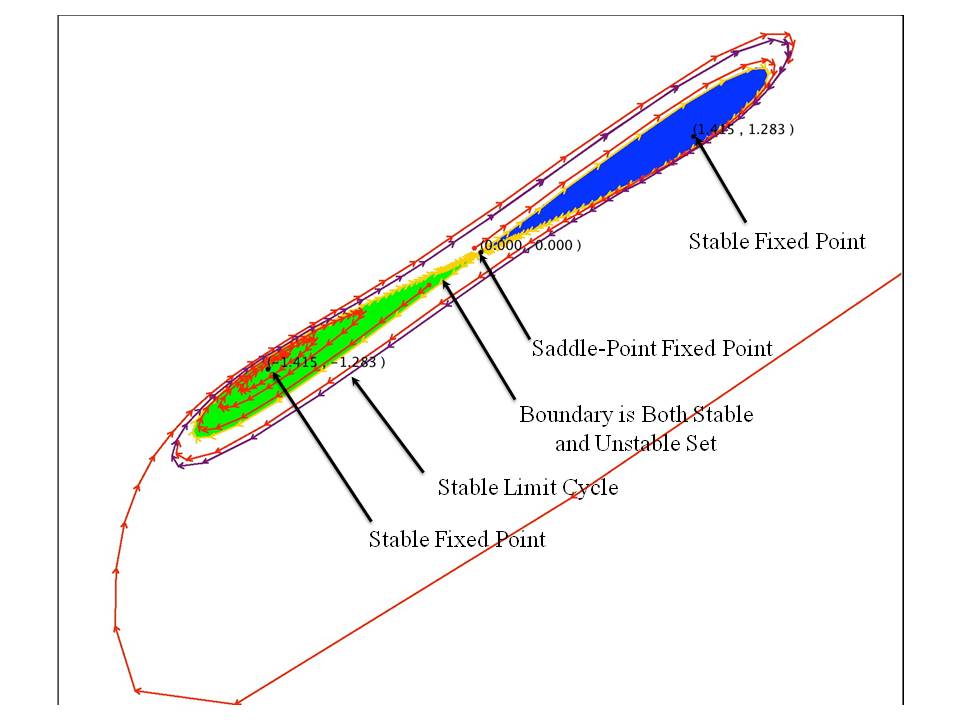
Figures 2, 3, and 4 display some orbits in the (normalized) state space of the Kaldor model, with variations in one parameter determining variations in the topology of these particular phase portraits. In each figure, a movement to the right along the x axis corresponds to an increase in the value of the economy's stock of capital. A movement upward along the y axis corresponds to an increase in the national income. The propensity to save is higher for each figure in the series, but the propensity to save is always small enough that three fixed points exist for the model. In all cases, the middle fixed point has the (in) stability of a saddle point.

Figure 2: Kaldor's Model without a Business Cycle

Figure 3: A Homoclinic Bifurcation in Kaldor's Model

Figure 4: A Business Cycle in Kaldor's Model

A saddle point is such that a ball starting in the direction of the horse's head or tail rolls downward to the center. The bright yellow orbit in each of the three figures represents such a trajectory. The yellow line is known as the stable set of the corresponding fixed point. A ball would have to be balanced just so to achieve such a trajectory on an actual saddle. A ball perturbed from the center of the saddle would tend to roll downward to either side of the horse. The light blue (cyan) orbit in Figures 2 and 4 represent such a trajectory, called the unstable set of the corresponding fixed point.

A bifurcation analysis identifies qualitative changes in the phase portraits for a dynamical system with variations in the system parameters. Several bifurcations exist between Figures 2 and 3, and, I think, two bifurcations arise between Figures 3 and 4. The stable and the unstable sets of the fixed point at the origin, in some sense, have switched roles in the illustrated bifurcations. In Figure 2, the unstable set shown flows from the origin to the other two fixed points. In Figure 4, the stable set flows backwards in time from the origin to the other two fixed points. Of course, some other global behavior is an important difference among these figures. For example, a business cycle does not exist in Figure 2, while Figures 3 and 4 both display a stable business cycle. In the language of dynamical systems, this business cycle is known as a (stable) limit cycle.

The stable and the unstable sets of the origin correspond in Figure 3. Such correspondence of these sets for a given fixed point (or, say, limit cycle) is known as a homoclinic bifurcation. Homoclinic bifurcations are global phenomena and cannot be identified by a merely local stability analysis of the given fixed point. Can you see why one might draw an analogy between a homoclinic bifurcation and the M. C. Escher etching I choose to head this post with?

References

  • Agliari, A.; R. Dieci; and L. Gardini (2007). "Homoclinic Tangles in a Kaldor-Like Business Cycle Mode", Journal of Economic Behavior & Organization. V. 62: 324-347.
  • Bischi, G. I.; R. Dieci; G. Rodano; and E. Saltari (2001). "Multiple Attractors and Global Bifurcations in a Kaldor-type Business Cycle Model", Journal of Evolutionary Economics. V. 11: 257-554.

Sunday, April 29, 2012

Institutions For Learning From Economists' Mistakes

"...the functioning of even the best institutions will always depend, to a considerable degree, on its personnel... Democracy provides the institutional framework for the reform of political institutions (other than the framework). It makes possible the reform of institutions without using violence, and thereby the use of reason in the designing of new institutions and the adjusting of old ones..." -- Karl Popper (1945). The Open Society and Its Enemies, V. I, p. 110-111.
People who make a career advocating some set of ideas often find it difficult to change their minds, even when events demonstrate that consequences of those ideas are mistaken. In a democracy, various parties contend for power based on different ideas about what policies are preferable in the current situation. Turning one party out and installing another is a means to alter what ideas guide society, while allowing for the difficulties prominent advocates have in switching sides. (I think I take this idealization of the possibilities of democracy from Karl Popper. But I could not find a more appropriate quote than the above offhand.)

I take it that the global financial crisis demonstrates certain ideas about economics to be mistaken. Many seem to agree, including, notoriously, the Queen of England. I've recently read Murray Milgate noting such mistakes:

"These instances of the [International Monetary] Fund's responses to crises of various kinds reveal a seemingly unalterable instinct of Fund staff to do the nearly the exact opposite of what is required. Faced with crisis, the Fund blames the patient for the malaise and seeks solutions in terms of monetary and fiscal austerity. That the problem might reside in the nature (and regulatory framework) of international monetary and financial arrangements seems never to pass through the minds of the Fund's staff." -- John Eatwell and Murray Milgate (2012). The Fall and Rise of Keynesian Economics, Oxford University Press. Chapter 15, p. 322.
Maybe a large turnover of personnel, as Dean Baker has called for, at such organizations as the IMF and the World Bank would be desirable. And maybe a movement for new international regulatory institutions should be gaining influence.

In academia, we should perhaps be seeing a change in the relative rankings of economics departments and journals. Maybe, say, Harvard should be thought less well of, and places like the New School, the University of Massachusetts at Amherst, and the University of Utah should be gaining prominence. If this were happening, one could see the signs in citation patterns, in what experts were being quoted in the press, and in trends in the hiring patterns for recent graduates from different economic departments.

I realize Karl Popper's views on how science and democracy work often seem not to be historically accurate descriptions of incidents universally considered progress. To me, though, they provide heuristics practitioners might adopt. Are we seeing the changes we perhaps should have expected in the last few years?