Saturday, November 26, 2022

An Extensive Rent Example

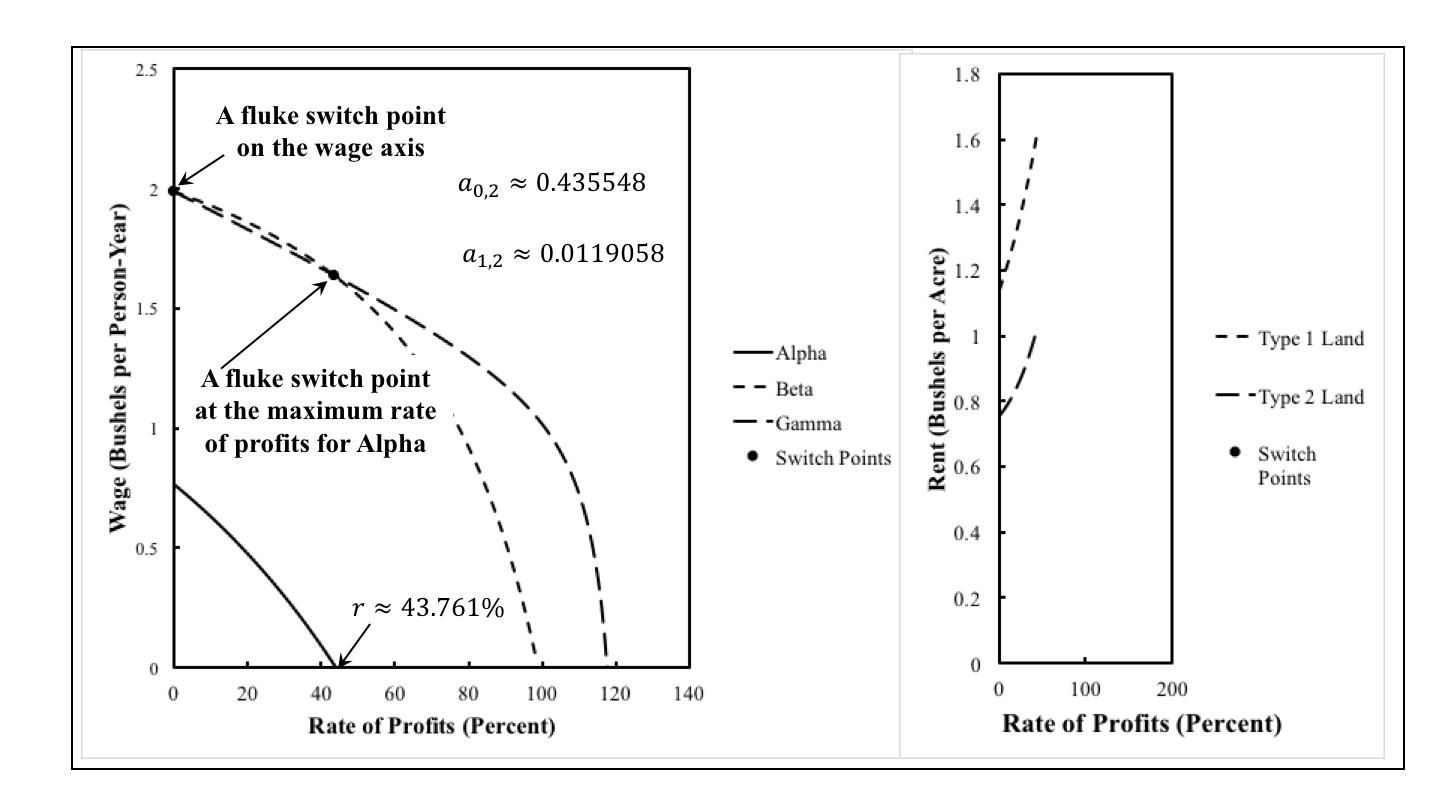
Figure 1: A Wage Curves and Rent for an Example of Extensive Rent

This post is a rewrite of this. It is the third in a series, with the first here and the second here.

The analysis of the choice of technique in models of extensive rent can be based on the construction of wage curves, even though the outer envelope does not represent the cost-minimizing technique. The orders of fertility and rentability are emphasized here. The order of fertility is defined for specified techniques, in which a single quality of land is used in each technique and that land pays no rent. At a given rate of profits, the qualities of land are ordered by wages, with the most fertile land paying the highest wage. The order of rentability specifies the sequence of different qualities of lands from high rent per acre to low rent per acre. Both orders may vary with the wage or the rate of profits. Table 1 presents coefficients of production for an example.

Table 1: The Coefficients of Production
InputIron IndustryCorn Industry
IIIIIIIV
Labor1a0,291/25067/100
Type 1 Land049/10000
Type 2 Land0059/1000
Type 3 Land0009/20
Iron9/20a1,29/1000067/1000
Corn26/12527/1003/20

How much corn can be produced is constrained by the available quantities of each type of land. Endowments of land and requirements for use must be among the givens to analyze the choice of technique in this example. Suppose one hundred acres of each type of land are available, and net output is somewhere between 321 and 443 bushels of corn. Then all three types of land must be farmed with the parameters specified in Figure 1. One type will be only partially farmed. The iron-producing process must be operated in each of the three economically viable techniques. Table 2 describes which type of lands are fully cultivated and which type of land is left partially fallow in each of the Alpha, Beta, and Gamma techniques.

Table 2:
TechniqueLand
Type 1Type 2Type 3
AlphaFully farmedFully farmedPartially farmed
BetaPartially farmedFully farmedFully farmed
GammaFully farmedPartially farmedFully farmed

For a given technique, the rent on a type of land only partially farmed is zero since it is not scarce. The wage curves in the left pane in Figure 1 are constructed, for each technique, from the price equations provided by the iron-producing process and the corn-producing process for the land that pays no rent. The choice of technique depends on both income distribution and requirements for use (Quadrio-Curzio 1980). Suppose the rate of profits is taken as given. Then the r–order of efficiency or fertility is the order of the wage curves downwards, until requirements for use are satisfied. Since all three types of land must be somewhat cultivated in the example, the wage frontier is the inner envelope of the wage curves. For the illustrated parameters, Alpha is cost-minimizing, and the order of fertility between the switch points is Type 1, Type 2, and Type 3 lands.

One can calculate the cost of capital goods at the given rate of profits and the cost of labor inputs for corn-producing processes on each of Type 1 and Type 2 lands. Since coefficients of production are specified per bushel corn produced, the revenues from each of these processes, at a unit level, are the same as the process operated on Type 1 land. Rent is the difference between revenues and non-land costs on Type 1 and Type 2 lands. Rent per acre is plotted in the right pane for Figure 1. The order of rentability is the order of lands by rent per acre. The order of rentability is the same as the order of fertility between switch points for the given parameters.

The two fluke switch points in Figure 1 do not lie on the (inner) wage frontier. The maximum rate of profits for the wage curve for Alpha is the maximum rate of profits for this example. One of the switch point for the wage curves for the Beta and Gamma techniques is at this maximum rate of profits. As seen in Figure 2, this is another edge case, a fluke that arises in models of extensive rent. By the way, at other parameter ranges the curves for rent per acre as a function of the rate of profits in the right pane in Figure 1 can intersect. The order of rentability can vary with distribution, and fluke cases in which these curves intersect at a maximum rate of profits or a rate of profits of zero can arise.

Figure 2: The Parameter Space for an Example of Extensive Rent

To the southwest in Figure 2, one switch point between the wage curves for Beta and Gamma has vanished over the wage axis, and the other is at a rate of profits exceeding the maximum rate of profits for Alpha. The order of fertility matches the order of rentability. The northeast is of a reswitching example. For such small perturbations, the order of rentability does not change in this example. Thus, the order of fertility matches the order of rentability only at intermediate rates of profits with reswitching here. The northwest and southeast also illustrate parameters for which the order of fertility varies with the rate of profits. The order of fertility varies from the order of rentability at one or the other extreme, as indicated.

Tuesday, November 22, 2022

Fixed Capital And The Emergence Of Reswitching

Figure 1: A Wage Frontier With A Fluke Switch Point

This post is a rewrite of this, without the attempt to draw a connection to structural economic dynamics. This is the second post in a series, starting with this.

A fluke example with fixed capital illustrates the emergence of the reswitching of techniques. Table 1 presents coefficients of production in a perturbation of an example from Schefold (1980). With the first process, workers, under the direction of mangers of firms, manufacture new machines. The remaining two processes are used to produce corn. The last process requires an input of an old machine, which is jointly produced with corn by the second process. Corn is both a consumption good and a capital good, insofar as it is an input into all three processes.

Table 1: The Coefficients of Production
InputMachine IndustryCorn Industry
One ProcessAnother Process
Labor1/5a0,27/5
Corn1/8a1,27/20
New Machines010
Old Machines001
Output
Corn011
New Machines100
Old Machines010

The choice of technique corresponds here to the choice of the economic life of the machine. This lifetime is truncated to one year for the Alpha technique, while the machine is operated for its full physical life of two years under the Beta technique. In a pure fixed capital model, the choice of technique can be analyzed by the construction of the wage frontier. The cost-minimizing technique at a given rate of profits has a wage curve on the outer frontier, as illustrated by Figure 1 for a specified parametrization. Managers of firms are willing to operate the machine for two years for any feasible rate of profits. At the maximum wage or a rate of profits of zero, the Alpha technique is also cost-minimizing. The single switch point is a fluke in two ways. First, it lies on the wage axis. Second, the wage curves are tangent at the switch point.

Figure 3 depicts a part of the parameter space for this example. A thin wedge between two partitions extends to the southeast of the point for the parameters corresponding to Figure 1. At the upper edge of this wedge, the two wage curves for the techniques are tangent at a switch point. The example is of reswitching below this partition and within this wedge. At the lower edge of this wedge, the switch point with the lower rate of profits is on the wage axis.

Figure 2: The Parameter Space for an Example with Fixed Capital

Reswitching, in this example of fixed capital, is connected to the economic life of a machine. The economic life is the full two years here for a low and high rate of profits. Truncation occurs for a range of intermediate rates of profits. The specification of which technique is cost-minimizing can be consistent with vastly different functional distributions of income, with another technique being cost-minimizing for less extreme distributions

The switch point at the higher rate of profits in the reswitching region of the parameter space illustrates capital-reversing. Around this switch point, a lower rate of profits is associated with the adoption of a less capital-intensive cost-minimizing technique. At any rate of profits, inputs into production in a stationary state can be evaluated at prices of production, and these evaluations can be summed for each technique. The ratio of capital per worker, for example, is an index of the capital intensity of a technique. A more capital-intensive technique produces more output per worker, but its adoption is not necessarily encouraged by a lower rate of profits or interest rate (Harris 1973). In other words, a higher wage is associated with the adoption of a technique that requires a greater input of labor per bushel corn produced net throughout the economy. Capital-reversing has been shown to occur in other examples without reswitching on the wage frontier. Harcourt (1972) surveys the controversy in which economists, such as Paul Samuelson and Robert Solow, in Cambridge, Massachusetts, struggled to accept these conclusions drawn by other economists, such as Joan Robinson and Piero Sraffa, at the University of Cambridge.

Consider the region to the southwest in Figure 2. A single switch point exists on the wage frontier. Around this switch point, a lower rate of profits is associated with the adoption of a technique with a greater value of capital per person-year and a greater output per worker. Nevertheless, truncating the operation of the machine for one year is associated with a more capital-intensive technique. The demonstration of the invalidity of Austrian capital theory does not even need the phenomena of reswitching and capital-reversing.

Thursday, November 17, 2022

The Emergence Of The Reverse Substitution Of Labor

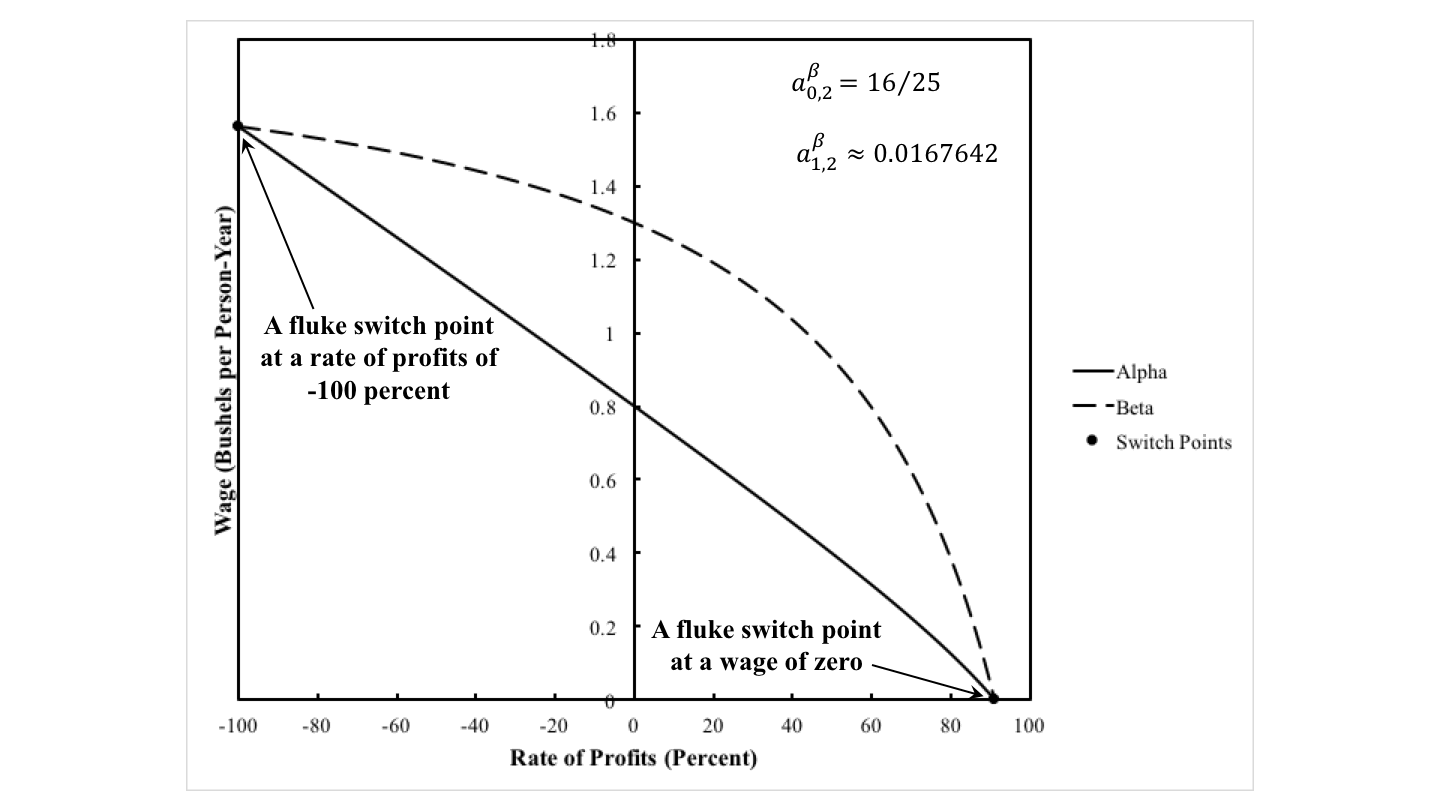
Figure 1: A Wage Frontier With Two Fluke Switch Points

This post is a rewrite of this, without the attempt to draw a connection to structural economic dynamics.

This post presents an example with circulating capital alone. Table 1 presents the technology for an economy in which two commodities, iron and corn, are produced. Managers of firms know of one process for producing iron and two for producing corn. Each process is specified by coefficients of production, that is, the required physical inputs per unit output. The Alpha technique consists of the iron-producing process and the first corn-producing process. Similarly, the Beta technique consists of the iron-producing process and the second corn-producing process. At any time, managers of firms face a problem of the choice of technique.

Table 1: The Coefficients of Production
InputIron IndustryCorn Industry
AlphaBeta
Labora0,1 = 1a0,2α = 16/25a0,2β
Irona1,1 = 9/20a1,2α = 1/625a1,2β
Corna2,1 = 2a2,2α = 12/25a2,2β = 27/400

Two parameters are not given numerical values in this specification of technology. The approach taken here is to examine a local perturbation of parameters in a two-dimensional slice of the higher dimensional parameter space defined by the coefficients of production in particular numeric examples. With wages paid out of the surplus product at the end of the period of production, the wage curves for the two techniques are depicted in Figure 1 for a particular parametrization of the coefficients of production. The Beta technique is cost-minimizing for any feasible distribution of income. If the wage is zero and the workers live on air, the Alpha technique is also cost-minimizing.

A switch point is defined in this model of circulating capital to be an intersection of the wage curves. These switch points, for the particular parameter values illustrated in Figure 1, are fluke cases. Almost any variation in the model parameters destroys their interesting properties. A switch point exists at a rate of profits of -100 percent only along a knife edge in the parameter space (Figure 2). Likewise, a switch point exists on the axis for the rate of profits only along another knife edge. The illustrated example, with two fluke switch points, arises at a single point in the parameter space, where these two partitions intersect.

Figure 2: The Parameter Space for the Reverse Substitution of Labor

Figure 2 depicts a partition of the parameter space around the point with these two fluke switch points. Below the horizontal line, the switch point on the axis for the rate of profits has disappeared below the axis. The Beta technique is cost-minimizing for all feasible non-negative rates of profits. Above this locus, the Alpha technique is cost-minimizing for a low enough wage or a high enough feasible rate of profits.

In the northwest, the switch point at a negative rate of profits occurs at a rate of profits lower than 100 percent. Around the switch point at a positive rate of profits, a lower wage is associated with the adoption of the corn-producing process with a larger coefficient for labor. That is, at a higher wage, employment is lower per unit of gross output in the corn industry.

In the northeast of Figure 2, the switch point for a positive rate of profits exhibits the reverse substitution of labor. Around this switch point, a higher wage is associated with the adoption of a process producing the consumer good in which more labor is employed per unit of gross output. The other switch point exists for a rate of profits between -100 percent and zero. Steedman (2006) presents examples with this phenomenon in models with other structures.

Qualitative changes in the wage frontier exist in the parameter space away from the part graphed in Figure 2. The analysis presented here is of local perturbations of the depicted fluke case.

Tuesday, November 15, 2022

Scholarly Socialists During The Second International

Socialism became a mass movement in many European countries about the time of the heyday of the Second International. Many leaders of these movements and those struggling for leadership produced works of scholarship, albeit often with an activist spirit. I think of, for example:

  • Eduard Bernstein. The Preconditions of Socialism and the Tasks for Social Democracy.
  • Nikolai Bukharin. The Economic Theory of the Leisure Class.
  • Richard B. Day and Daniel F. Guido (eds.). 2018. Responses to Marx's Capital. Brill
  • Rudolph Hilferding. Böhm-Bawerk's Criticism of Marx.
  • Rudolph Hilferding. Finance Capital.
  • Karl Kautsky. The Social Revolution.
  • Karl Kautsky. The Path to Power.
  • Antonio Labriola. Essays on the Materialist Conception of History.
  • Rosa Luxemburg. The Accumulation of Capital.
  • G. V. Plekhanov. The Development of the Monist Theory of History.
  • George Bernard Shaw (ed.). Fabian Essays in Socialism.
  • Georges Sorel. Reflections on Violence.

I do not give copyright dates because I am unsure of the publication dates of some in the original german, italian, or russian. The Day and Guido work is a collections of essays from the time. This is hardly a comprehensive list of the literature of the period. All of these works, published before the October revolution, take Marx as serious and important. The authors were not academics, but I am not sure that there was a solid border between academia and politics at the time. Socialists, in works of scholarship, engaged with those developing the then new-fangled marginalist economic theory.

Collections
  • Jukka Gronow. 2016. On the Formation of Marxism. Brill.
  • M. C. Howard and J. E. King. 1989. A History of Marxian Economics, vol. 1. Princeton.
  • Ian Steedman (ed.). 1995. Socialism and Marxism in Economics: 1870 - 1930. Routledge.

Saturday, November 12, 2022

Events Without Probability

1.0 Introduction

In a common model, probability theory assigns a number between zero and one to events. But some events cannot be assigned a probability, even zero. Nobody understands probability, in some sense.

This post is not about economics, although these ideas do have an application in mainstream economics. It is not at all novel. This is one of my favorite proofs in all of math, typically taught sometimes after an introductory mathematical analysis class. My undergraduate class in probability and statistics only alluded to measure theory.

2.0 An Introduction to Probability and a Overview

Suppose one has some sort of repeatable experiment, like rolling a pair of dice, dealing out a five-card poker hand, or spinning a spinner. The set of all possible outcomes is the sample space. Consider a subset of the sample space, such as all rolls in which the pair add up to seven, the hand is a straight flush, or the spinner stops at an angle between zero and 180 degrees. That subset is called an event. If all points in the sample space have the same probability of outcome, the probability is the ratio of the size of the subset for the event to the size of the sample space. (I suppose, more generally, this definition works for non-uniform distributions where the "size" includes weights, so to speak.) Probability is a set function, that is it maps each set in some sort of collection of subsets of the sample space into the real numbers.

This definition works well when the sample space contains a finite number of points. The "size" of a set is then just the number of points in the set. But consider the spinner example, where, with appropriate scaling of angles, the sample space is any real number in the interval [0, 1]. The number of points in a range of scaled angles [a, b] and in the sample space is, in both cases, uncountably infinite. Clearly, one needs some other concept of size here. And the concept of a probability measure provides the needed notion.

The demonstration of the existence of a non-measurable set validates the claim in the introduction. In the proof, the interval [0, 1] is partitioned into an uncountably infinite number of sets, each with only a countably infinite number of points in each set. The axiom of choice is used to "construct" from this partition another partition of the interval into a countably infinite number of sets, each with an uncountably infinite number of points. All of these sets have the same measure, and that measure must add up over the countably infinite number of sets to unity. But that measure can thus be neither zero nor non-szero. So some events exist, given the axiom of choice, without a probability.

3.0 Some Properties of a Measure

I use m(S) to denote the measure of a set. For this post, I consider measures with the following properties:

  • The measure of an interval is merely the length of the interval:
m([a, b]) = b - a
  • The measure of the empty set is zero:
m(∅) = 0
  • The measure of any set S is non-negative. For all S
m(S) ≥ 0
  • The measure of a set is translation invariant. Let S * x denote the set formed by adding x to each element S modulo one. (This definition keeps the translation of a set in the unit interval within the unit interval.) For all S and x:
m(S * x) = m(S)
  • The measure of a set is countably additive. Let S1, S2, S3, ... be a sequence of disjoint sets. That is, for any ij, SiSj = ∅. Then:
m(S1S2S3 ...) = m(S1) + m(S2) + m(S3) + ...

I have above selected the properties of specific kinds of measures. But they are all that is needed for the proof of the existence of unmeasurable sets.

In the spinner example, some non-empty sets have a measure of zero. For example, the probability that the spinner will stop at any given real number in the interval is zero. So is the probability that the spinner will stop at any element in a countably infinite set.

4.0 A Partition of the Unit Interval into Uncountably Infinite Equivalence Classes

Define an equivalence relation as follows. Let two real numbers x1, x2 be equivalent if and only if x2 - x1 is a rational number. Partition the real numbers into equivalence classes by this equivalence relation. The rational numbers is one such equivalence class. The set of real numbers that differ from the square root of two by a rational number is another equivalence class. The set of real numbers differing from the square root of three by a rational number is a third equivalence class. The number π generates a third equivalence class. In fact, there are an uncountable infinite number of equivalence classes, and each such class can be put into a one-to-one mapping to the set of rational numbers.

Consider the collection of sets formed by the intersections of these equivalence classes with the unit interval. This is now a partition of the unit interval. I guess this is easy to understand, as compared to what comes next in this proof.

5.0 An Application of the Axiom of Choice

I now apply the axiom of choice. Let S be a set that contains one and only one point from each of the equivalence classes. Thus, S is a subset of the unit interval containing an uncountably infinite number of points. The difference between any two points in S is an irrational number.

For each rational number r in the unit interval, form the translation S * r. The set of rational numbers in the unit interval is countably infinite. That is, these rational numbers can be ordered in a sequence r1, r2, r3, ...

Corresponding to this sequence is a sequence of sets S*r1, S*r2, S*r3, ... Each one of these sets is a translation of the set S. They all contain an uncountably infinite number of points, and they are all subsets of the unit interval. The intersection of any two of these sets is the empty set. Furthermore every point in the unit interval is in exactly one of these sets.

6.0 Finishing the Proof

The union of these disjoint sets is the unit interval, and the measure of the unit interval is unity. Thus:

m(S*r1S*r2S*r3 ...) = m([0, 1]) = 1 - 0 = 1

By countable additivity:

m(S*r1S*r2S*r3 ...) = m(S*r1) + m(S*r2) + m(S*r3) + ...

By translation invariance:

m(S*r1S*r2S*r3 ...) = m(S) + m(S) + m(S) + ...

Therefore:

1 = m(S) + m(S) + m(S) + ...

Suppose the measure of S were zero. Then we would have proven that zero equals one, an obvious contradiction. But suppose the measure of S were positive. Then the right hand size of the above equality would be infinity, another contradiction. So no measure can be assigned to the set S. In the model of a spinner, the set S represents an event, and no probability can be assigned to this event.

7.0 Conclusion

Has anybody proved the existence of an unmeasurable set with a proof that is not a variation of the above? Can such existence be proven without relying on a proof by contradiction? How would you show that all proofs of such existence must use the axiom of choice? I believe it is also the case that the existence of an unmeasurable set implies the axiom of choice, although I have never seen this proven.

Probabilities cannot be assigned to some events. You will almost certainly never encounter such events in practical applications.

Appendix A. Some Mathematical Background

The above post presumes knowledge that the rationals are countable, that the reals constitute an uncountable infinity, and that an equivalence relation yields equivalence classes that partition a set into nonoverlapping subsets.

A.1 The Rationals are Countable

A countably infinite set can be ordered to be in one-to-one correspondence with the natural numbers, {1, 2, 3, ... }. (Sometimes I begin with zero.) Consider the ordering of positive fractions in Table A-1. The subscripts in parantheses show the order. The fractions are the ratio of the column index to the row index. Obviously, this sequence can be repeated forever. But some rational numbers are repeated. For example, the third fraction in the sequence is 1/2. But r(12) is 2/4. So when enumerating the positive rationals, throw out these repeats. Call the resulting sequence r1, r2, r3, and so on.

Table A-1: Ordering the Rational Numbers
12345...
1r(1) = 1/1r(2) = 2/1r(6) = 3/1r(7) = 4/1r(15) = 5/1...
2r(3) = 1/2r(5) = 2/2r(8) = 3/2r(14) = 4/2..
3r(4) = 1/3r(9) = 2/3r(13) = 3/3...
4r(10) = 1/4r(12) = 2/4...
5r(11) = 1/5...

So at least the positive rational numbers are countable. Then consider the sequence 0, r1, -r1, r2, -r2, ... Thus, the rational numbers are countable.

A.2 The Reals are Uncountable

The uncountability of the reals are demonstrated by Cantor's diagonizability argument. It is a proof by contradiction.

I think it easiest to think of the proof with real numbers in binary notation. And it is sufficient to show the real numbers between zero and one are uncountable. Accordingly, suppose somebody claims to have a sequence of all the real numbers between zero and one, as in Table A-2. One constructs a new real number as follows. Let the first digit to the right of the binary point be 0, if the corresponding digit in x1 is 1; 1, if the corresponding digit is 0. Let the second digit to the right of the binary point in this new number be 0, if the corresponding digit in x2 is 1; 1, if the corresponding digit is 0. And so on. Given some arbitary sequence, I have now constructed a new real number that cannot appear in the sequence. For it differs from every number in the sequence by at least one digit. So no such sequence can be constructed for the real numbers.

Table A-2: A Purported Ordering of the Real Numbers Between 0.0 and 1.0
x10.1001010...
x20.0001000...
x30.1010010...
x40.0111000...
......

This mathematics demonstrates there are different sizes infinities. Nobody know whether or not there is another size infinity between the rationals and the reals. I am not even sure what this question would mean. But, if you accept that the above makes sense, you probably accept that there are an infinity of sizes of infinity bigger than the reals.

A.3 Equivalence Relations

A relation on a set S is a set of ordered pairs of elements in the set. Informally, the ordered pairs denote the subset of the Cartesian product S x S where the relation is true. Let a ˜ b denote an equivalence relation. That is:

  • The relation is reflexive. For all a in S:
a ˜ a
  • The relation is symmetric. For all a, b in S:
If a ˜ b, then b ˜ a
  • The relation is transitive. For all a, b, c in S:
If a ˜ b and b ˜ c, then a ˜ c

In a sense, an equivalence relation is a generalization of equality. Every equivalence relation generates an equivalence classes, and vice versa. An equivalence class C is a subset of S such that for all a, b in C, a is equivalent to b. Equivalence classes partition a set. Every point in the set is in one equivalence class and only in one equivalence class. Any two equivalence classes are disjoint; their intersection is the empty set.
Thursday, November 03, 2022

External Influences On Academic Economics?

1.0 Introduction

A question has arisen elsewhere. Why, except for an interlude during the post war golden age, has a nineteenth century orthodoxy dominated economics departments and treasury departments around the world? Here I do not investigate the details of this orthodoxy or if it does dominate.

2.0 An Authoritarian Point of View

Some people believe that some are better than others. They want to live in a world where those at the top tell those below what to do, and those below jump.

One might think that it would be hard to find people willing to explicitly articulate these feelings in public. But you can find, if you look, Republican candidates for elected offices saying it was a mistake to allow woment to vote or that interracial marriage should be outlawed.

Some who support plutocracy, maybe unknowingly, would rather claim they are for meritocracy. The extreme distribution of wealth and income in, say, the United States is a difficulty for this view. The rewriting of laws over decades to (p)redistribute income upwards is another inconvenience for this point of view. Advocates for such may be in the grip of a reification in which they naturalize political choices. If a meritocracy was ever momentary established, those at the top could still be expected to try to structure society for their advantage and to attempt to get the best for their spawn.

The reproduction of society is a focus of my favorite schools of economics. Persistent high unemployment and a weak social safety net are useful for sustaining plutocracy. Those at the top want those at the bottom worried about how to feed themselves, not in whether they can participate in governing themselves. Those in middling positions should be economically anxious and worry about falling down. A lack of solidarity between those at your level or with those below is useful for plutocrats. Divisions between workers of various sorts, between races, between men and women, between sexual majorities and minorities are all to be encouraged.

3.0 A Humane Point of View

Human beings do not exist for the economy, but the economy, if it exists, exists for human beings. One assesses how well an economy works by how well it elevates those at the bottom. Are they able to feed, clothe, and shelter themselves? Do they have some share in the necessaries and conveniences of life? Do they participate in improvements brought about by innovations and increases in productivity? Are those at the margins increasingly brought into society?

Before and during the industrial revolution, people needed to work to produce the commodities needed to sustain the population. "For even when we were with you, this we commanded you, that if any would not work, neither should he eat" (2 Thessalonians 10).

This attitude is outdated when productivity is raised so high that, with appropriate distribution, all can have enough. Nor is there are virtue in producing what can be sold on the market. Somewhere, Joan Robinson said something like that the distinction between what can be marketed and what cannot is a technical accident. The expansion of national income provides employment, and, under the current system, employment is a source of income and self-esteem.

Doubtless, in a country with an Universal Basic Income, some would devote to themselves to dissipated living. From the standpoint of political economy, I do not have a problem with this.

But if the economy was structured to serve humanity, many would not feel obligated to spend all their days grubbing for a living. One might have more voluntary neighborhood associations beautifying their area. More young people might organize sports leagues and be playing pickup games. Many would spend more time in community theater or music events. Much more could be done by community groups, charities, and other voluntary civic groups. (In my personal life, I am more a patron or donor for such organizations, mostly not local, than a participant.)

The development of point of views consistent with these ideas and their implementation is and should be a threat to plutocracy.

4.0 Some Speculation

If one looks at the funding of academic economic departments, one can certainly identify promotors of authoritarianism and plutocracy.

Saturday, October 29, 2022

An Overview Of Game Theory

An Experiment in Game Theory

Game Theory provides a formal treatment of well-specified situations in which the outcome depends on the choices of several agents who may have conflicting interests.

Abstractly, a player chooses a strategy, where a strategy specifies the player's move in every situation that may arise in the game. For example, a strategy for white in chess specifies, roughly white's move for every board configuration in which it is his turn. This example is rough because white's play will prevent certain configurations from arising, and his strategy need not provide a move for those unreachable configurations. A game tree is a useful representation for a game in extensive form. I think this definition of a strategy elides important issues of algorithms and computational complexity.

A game in normal form lists the players, the strategies for each player, and the expected payoffs to each player for each combination of strategies (the payoff matrix). Table 1 gives an example for what may be the most famous game designed by game theorists. The first entry in each ordered pair is the payoff to player A when A plays the strategy indicated by the row label and B plays the strategy indicated by the column label. The second entry shows the payoff to player B.

Table 1: A Prisoner's Dilemma
Player A's StrategyPlayer B's Strategy
CooperateDefect
Cooperate(1/2, 1)(-1, 2)
Defect(1, -1)(0, 1/2)

Suppose the payoffs, in each entry in the payoff matrix, sum over all players to zero. Then the game is a zero sum game. The prisoner's dilemma is not a zero-sum game.

Consider simple two-person zero-sum games like "Odds and Evens" or "Rock, Scissors, Paper". The best strategy is not to play the same simple strategy over and over, but to randomly mix strategies. This is an interesting insight from game theory - that randomness in economics can come from optimal choices even in games with completely deterministic rules. The probabilities that the players should choose depend on the payoff matrix. One can formulate a Linear Program for each player to solve for these probabilities. Each player assumes that the other player chooses his probabilities to minimize the other player's loss, given the first player's probabilities. A minimax problem arises. The neat thing about the two Linear Programs is that they are dual problems. Although von Neumann helped develop Linear Programming, vN and Morgenstern don't point out this connection. However, both vN's paper on activity analysis and vN and M's book used a fixed point theorem in the proof of the most important relevant theorems.

How to extend the concept of a solution to more than two players, or to non-constant sum games, is an interesting question. vN and M introduced "fictional players", so to speak, to make the general game like a two-person zero-sum game. A dummy player with one strategy can absorb the losses and winnings in a non-zero sum game. Thus, the game, with this dummy appended, becomes a zero-sum game. The multiplayer game can be thought of as a two player game between a winning coalition and the remaining players, thus becoming equivalent to a two-person game. vN and M emphasize that how the players in a coalition will split up their winnings is indeterminate, in general. Threats of players to leave a coalition and join the other side, though, impose constraints on the range of variability in the set of solution imputations.

Economists nowadays say that the vN and M solution applies to what are known as cooperative games. Players can discuss how to share winnings beforehand, and agreements are enforcable by some external institution. vN and M, had a different perspective:

"21.2.3. If our theory were applied as a statistical analysis of a long series of plays of the same game - and not as the analysis of one isolated play - an alternative interpretation would suggest itself. We should then view agreements and all forms of cooperation as establishing themselves by repetition in such a long series of plays.

It would not be impossible to derive a mechanism of enforcement from the player's desire to maintain his record and to be able to rely on the on the record of his partner. However, we prefer to view our theory as applying to an individual play. But these considerations, nevertheless, possess a certain signiificance in a virtual sense. The situation is similar to the one we encountered in the analysis of the (mixed) strategies of a zero-sum two-person game. The reader should apply the discussions of 17.3 mutatis mutandis to the present situation." -- John Von Neumann and Oscar Morgenstern (1953) p. 254.

John Williams, one of the participants in Flood and Dresher's original experiment was puzzled why Armen Alchian did not behave according to this way of thinking. On the 50th iteration, he wrote, "He's a shady character and doesn't realize we are playing a 3rd party, not each other."

John Forbes Nash extended the two-person zero-sum solution in another manner. He defined the Nash equilibrium. In a Nash equilibrium each player's mixed strategy yields that player the maximum payoff, given that all other players are choosing their optimal strategy by the same rule. A Nash equilibrium is not necessarily unique for a given game. Nash also redefined vN and M's approach to be applied to cooperative games. The Nash equilibrium is said to apply to non-cooperative games.

Lots of questions arose from this work. How can the players decide on which Nash equilibria to choose? Can this indeterminacy be narrowed? Researchers have proposed a whole slew of refinements and variations - subgame perfect equilibria, trembling hand equilibria, etc. - the details of which I forget. This looks like a different approach to economics than Walrasian General Equilibrium theory. Are they related? Well, the proofs of the existence of Arrow-Debreu equilibria grew out of the mathematics of game theory. Furthermore, the equivalence principle, which M. never accepted, states that game theoretic solutions will approach Arrow-Debreu equilibria as the number of players increases.

It seems many mathematicians and economists have decided that, in practice, one can usually not set up the game and solve it. Nevertheless, game theory provides a language to talk about such situations. Discussions in this language have dissected "rationality" until, perhaps, the concept has fallen apart. You can view Survivor or the Weakest Link as laboratories to test game theory. In fact, experimental economics grew up with game theory, including experiments in which the players are computer code.

References
  • Philip Mirowski. 2002. Machine Dreams: Economics Becomes a Cyborg Science. Cambridge University Press.
  • John Von Neumann and Oscar Morgenstern. 1953. Theory of Games and Economic Behavior, 3rd ed. Princton University Press

Saturday, October 22, 2022

A Short History

William Petty began classical political economy in the 17th century. Classical economics was developed through the work of the physiocrats and such writers as Adam Smith, David Ricardo, and Karl Marx. Marx was also a critic.

About a century and a half ago, economists mistakenly accepted the marginal revolution. Jevons, Menger, and Walras had precursors, but they were regarded as cranks. Marx, however, posed a political problem. Some might mention Henry George here, or maybe even Silvio Gesell. Better have an imitation of physics than talk about the ideas of those opposed to capitalists.

Lionel Robbins made clear in the 1930s, when the theory plainly did not apply, that marginalist economics is about the allocation of scarce resources. Land and labor can be taken as given at a moment in time, but capital cannot.

About half a century ago, economists came to recognize that they were mistaken. By the way, this mistake was also noted in the Heckscher–Ohlin-Samuelson (HOS) model of international trade. The demonstration that marginalism is fundamentally wrong was pushed by Joan Robinson and Piero Sraffa.

So some economists returned to elaborating classical economics. Even in the marginal interregnum, some, such as Leontief and Von Neumann, elaborated classical themes.

But most economists have been spinning in a widening gyre, ignoring the incoherence of their teaching. If a sufficient political movement develops outside of academic economics, maybe more economists will return to serious work. If so, they may even find elements to repurpose in this half century of dissolution and confusion.

Saturday, October 15, 2022

Elsewhere

  • Anton Pichler, Marco Pangallo, R. Maria del Rio-Chanona, François Lafond, and J. Doyne Farmer have an article Forecasting the propagation of pandemic shocks with a dynamic input-output model. This is a non-equilibrium, simulation model applying Leontief's input-output analysis. I suppose this is applied Sraffianism.
  • For the use of Leontief input-output models in modeling natural disasters, one could do worse than look at the work of Adam Rose.
  • Steve Keen responds to this year's Nobel prize. Diamond and Dybvig (1983) is a well-referenced thought experiment with mathematics. The lessons it teaches are wrong.
  • Matt McManus writes about Ludwig von Mises. He does not say much about the socialist calculation debate.
  • Jan Toporowski writes about Oscar Lange.

Saturday, October 08, 2022

On Equilibrium

I have found a common misrepresentation from many, including mainstream economists, is that critics of their models do not understand them or the role of the assumptions. Those mainstream economists rely on an incoherent essay from Milton Friedman to dismiss criticism of the realism of assumptions.

My favorite criticism, though, is that their conclusions do not follow from their assumptions. I like to show this by constructing numerical examples that contradict their teaching.

On the other hand, some do criticize the realism of assumptions. I have seen some complain that the economy is never in equilibrium. It is unrealistic to assume equilibrium. I often find this unconvincing.

One can go back at least as far as Adam Smith, the distinction he draws between market prices and 'natural' prices, and his metaphor of a gravitational process. At any given time, some commodities may remain unsold on the market, and the quantity demanded for some may exceed the quantity supplied at a moment in time. The rate of profits may vary among firms and industries more than one might expect because of differences in risk, the desirability of certain industries, and so on. A leveling process that may never be completed exists at a given moment in time. Capitalists, reacting to price signals, will be disinvesting in some industries and expanding in other industries.

One who studies 'natural' prices, that is, the system of prices of production, is investigating tendencies, not making a claim that equilibrium exists. Even after the marginalists started constructing an incorrect theory, they kept this approach. Alfred Marshall wrote about, market prices, the short run, and the long run. Here is Walras:

Finally, in order to come still more closely to reality, we must drop the hypothesis of an annual market period and adopt in its place the hypothesis of a continuous market. Thus, we pass from the static to the dynamic state. For this purpose, we shall now suppose that the annual production and consumption, which we had hitherto represented as a constant magnitude for every moment of the year under consideration, change from instant to instant along with the basic data of the problem... Every hour, nay, every minute, portions of these different classes of circulating capital are disappearing and reappearing. Personal capital, capital goods proper and money also disappear and reappear, in a similar manner, but much more slowly. Only landed capital escapes this process of renewal. Such is the continuous market, which is perpetuating tending towards equilibrium without ever actually attaining it, because the market has no other way of approaching equilibrium except by groping, and, before the goal is reached, it has to renew its efforts and start over again, all the basic data of the problem, e.g. the initial quantities possessed, the utilities of goods and services, the technical coefficients, the excess of income over consumption, the working capital requirements, etc., having changed in the meantime. Viewed in this way, the market is like a lake agitated by the wind, where the water is incessantly seeking its level without ever reaching it. But whereas there are days when the surface of a lake is almost smooth, there never is a day when the effective demand for products and services equals their effective supply and when the selling price of products equals the cost of the productive services used in making them. The diversion of productive services from enterprises that are losing money to profitable enterprises takes place in various ways, the most important being through credit operations, but at best these ways are slow. It can happen and frequently does happen in the real world, that under some circumstantces a selling price will remain for long periods of time above the cost of production and continue to rise in spite of increases in output, while under other circumstances, a fall in price, following upon this rise, will suddenly bring the selling price below cost of production and force entrepreneurs to reverse their production policies. For, just as a lake is, at times, stirred to its very depths by a storm, so also the market is sometimes thrown into violent confusion by crises, which are sudden and general disturbances of equilibrium. The more we know of the ideal conditions of equilibrium, the better we shall be able to control or prevent these crises." -- Walras (1954: Lesson 35, Section 322).

So Walras did not think any economy would ever be in equilibrium. On the other hand, many may incorrectly think Austrians, like Ludwig von Mises, dispensed with the assumption of equilibrium. But here he is asserting that the assumption of equilibrium is necessary for economic theory:

One must not commit the error of believing that the static method can be used only to explain the stationary state of an economy, which, by the way does not and never can exist in real life, and that the moving and changing economy can be dealt with only in terms of a dynamic theory. The static method is a method which is aimed at studying changes; it is designed to investigate the consequences of a change in one datum in an otherwise unchanged system. This is a procedure which we cannot dispense with." -- Ludwig von Mises, 1933. Intervention. (quoted by Kurz and Salvadori)

I do think, however, one can criticize the Arrow-Debreu model as not being consistent with this approach and always assuming that equilibrium exists. Any time to reach equilibrium in the Arrow-Debreu is too long. Any such equilbirum that might have a tendency to be approached cannot be expected to be consistent with the data. Many supposed dynamic models in economics are still subject to this old objection.

Many questions remain about how to analyze whatever tendencies to equilbrium that may exist. I have barely even touched on the distinction between logical and historical time, a distinction commmon to Joan Robinson and Ludwig Lachmann.

Friday, September 30, 2022

Elsewhere

Richard Wolff Interviews George DeMartino (About 15:15)

Sunday, September 25, 2022

Sowell, Kolakowski, Baumol, Schumpeter: Böhm Bawerk Was Mistaken

Empirically, prices are fairly close to proportional to labor values. But that is neither here nor there as far as the correctness of Marx's theory of value. To see that, you have to get to the last footnote in chapter 5 of Capital. (Most "refutations" of Marx are based on ignorance of the first few pages of chapter 1.)

From the foregoing investigation, the reader will see that this statement only means that the formation of capital must be possible even though the price and value of a commodity be the same; for its formation cannot be attributed to any deviation of the one from the other. If prices actually differ from values, we must, first of all, reduce the former to the latter, in other words, treat the difference as accidental in order that the phenomena may be observed in their purity, and our observations not interfered with by disturbing circumstances that have nothing to do with the process in question. We know, moreover, that this reduction is no mere scientific process. The continual oscillations in prices, their rising and falling, compensate each other, and reduce themselves to an average price, which is their hidden regulator. It forms the guiding star of the merchant or the manufacturer in every undertaking that requires time. He knows that when a long period of time is taken, commodities are sold neither over nor under, but at their average price. If therefore he thought about the matter at all, he would formulate the problem of the formation of capital as follows: How can we account for the origin of capital on the supposition that prices are regulated by the average price, i. e., ultimately by the value of the commodities? I say 'ultimately', because average prices do not directly coincide with the values of commodities, as Adam Smith, Ricardo, and others believe.

-- Karl Marx. 1887. Capital, first english edition.

Only volume 1 was published in Marx's lifetime. But the question of the validity of Marx's theory, say, the value theory of labor, cannot be discussed without looking at volume 3, unpublished in Marx's lifetime.

Wicksteed had an early discussion of the validity of Marx's theory from a marginalist standpoint. Eugen von Böhm Bawerk's Karl Marx and the Close of his System is problably better known. His book is definitely important from a historical perspective. But its content is not all that insightful. Some anti-Marxists agree with me.

"The classic 'refutation' of Capital was made by a leading figure in the new economics, Eugen von Bohn-Bawerk. His refutation repeatedly misunderstood what it was refuting, and unknowingly repeated criticisms that Marx had made of Ricardo in manuscripts still unpublished at that time. Bohm-Bawerk also made the claim, often echoed since then, that in his discussion of value Marx had attempted 'a stringent syllogistic conclusion allowing of no exception,' that Marx attempted 'a logical proof, a dialectical deduction.' As already noted, Marx considered the idea of proving a concept to be ridiculous. Moreover, Engels had asserted, long before Bohm-Bawerk, that one only proves one's ignorance of dialectics by thinking of it as a means by which things can be proved. This was typical of a tragi-comedy of errors that has plagued the interpretation of Marx ever since.

Contrary to some interpretations, Marx did not change his mind about value and price between volumes of Capital. He explicitly worked out the analysis to be followed in Volume III in a letter to Engels written several years before publication of Volume I."

-- Thomas Sowell. 1985. Marxism: Philosophy and Economics, Routledge.

Sowell refers to Marx's letter of 2 August 1862. I have all sorts of disagreements with Sowell, which I forget. In some, I am probably critical of Marx than Sowell. One should probably ignore the final chapter of this book.

My next example is not from an economist:

"Marx of course knew that prices are determined in practice by various factors, including labour productivity, supply and demand, and the average rate of profit. If he disregarded these in the first volume of Capital, it was for methodological reasons and not because he thought value and price were the same thing; thus he cannot be reproached with inconsistency as between Volume I and Volume III, which deals inter alia with the average rate of profit."

-- Leszek Kolakowski. 1978. Main Currents of Marxism: The Founders (Book 1), Chapter XIII, Section 6.

I turn back to an economist:

"Writers on 'the transformation problem' since L. Bortkiewicz have focussed on an issue that is largely periperal; and others like E. Bohm-Bawerk have asserted that there is a contradiction between the analyses of Volumes I and III which is certainly not to be found there unless one reads into them an interpretation different from that which Marx repeatedly emphasized."

-- William J. Baumol. 1974. The transformation of values: what Marx 'really' Meant (An Interpretation). Journal of Economic Literature 12 (1): 51-62.

Even one of his students was not too impressed by Böhm Bawerk on Marx:

"As it was, most critics felt no hestitation in convicting him of having by the third volume flatly contradicted the doctrine of the first. On the face of it that verdict is not justified. If we place ourselves on Marx's standpoint, as it is our duty in a question of this kind, it is not absurd to look upon surplus value as a 'mass' produced by the social process of production considered as a unit and to make the rest a matter of distribution of that mass

Joseph A. Shumpeter, Chapter III. Marx the Economist, Capitalism, Socialism, and Democracy. Third Edition, New York: Harper and Brothers, 1942, 1947, 1950.

Valid, non-outdated criticisms of Marx exist. Böhm Bawerk does not have one.

Saturday, September 24, 2022

Saul Kripke (1940 - 2022)

I want to write an inadequate appreciation of Saul Kripke, a great analytical philosopher. The Guardian has an obituary.

I start from an example of a pratical use of his work. Chin and Older (2011) use modal logic to specify and reason about the security properties of (computer) systems. One wants to be able to assert who (or what) has access to certain data and who can grant access. Certain states of a system should never arrive.

A Kripke structure, as presented in Chin and Older (2011), is a three-tuple consisting of:

  • A set W, known as the set of all possible worlds.
  • An interpretation I, that maps each proposition to a subset of W. Informally, I(p) is the set of worlds in which the proposition p is true.
  • A function J that maps the name of each principal to a set of ordered pairs of possible worlds. Consider J(A), the set of ordered pairs (W1, W2) mapped to by this function. This is intended to be such that if the current world is W1, A believes the world might be W2.

For the above definition to be completely formal, one needs to specify the language for propositions p. In propositional logic, operators such as "and", "or", and "not" combine atomic propositions. Predicate calculus introduces such notions as "for all" and "there exists". Model theory is used to characterize semantics, to specify models in which a set of sentences is true. I guess a Kripke structure is a kind of structure, as structures are defined in model theory. Modal logic uses the apparatus of model theory to characterize propositions as "necessarily true", "possibly true", and so on. The textbook I have available for model theory, which I cannot get very far into, does not go into this.

Misleading talk, some of that by Kripke, about possible worlds raises the question of "transworld identification". Consider a proposition p(a) about an individual a. How do we identify a across possible worlds? If one uses the name Nixon to identify the winner of the 1968 U.S. presidential election, are we not requiring one to call Humphrey "Nixon" in some possible worlds? Amusingly, Kripke also raises the question of why we might say that 9 is necessarily greater than 7, but be unwilling to say that the number of planets is neccessarily greater than 7. In the current world, the number of planets is now eight. Pluto is now, by stipulation, not a planet. Kripke argues, in Naming and Necessity that Frege and Russell had mistaken theories about reference.

I will probably not be able to wrap my head around the idea of necessary contingent truths in a couple of weeks. Consider the length of a certain rod in Paris back when that was the definition of a meter. It was a necessary truth that a meter is that length. In some possible worlds, the room it is stored in might possibly be hotter. A meter would still be a meter in all possible worlds, according to Kripke, but the length of the standard meter might possibly be different.

I find Kripke (1982) to be easier to understand, maybe. I know that Kripke says that he is presenting an argument from Wittgenstein, not his own. If I try to orally summarize it, I tend to bring in Goodman's "grue" and "bleen", Putnam's "twater" on twin earth, or Wittgenstein's beetle in a box. The topic seems to be how words mean, not epistemology or ontology. How do you know that when talking to people they do not mean "grue" when they say "green"? Even more troublesome, how do you know you did not mean "grue" every time you said "green" in the past? By postulation in the argument, there does not seem to be any empirical fact one can point to. Meaning is not in an individual's mind.

References
  • Shiu-Kai Chin and Susan Older. 2011. Access Control, Security, and Trust: A Logical Approach. CRC Press.
  • Nelson Goodman. 1983. Fact, Fiction, and Forecast, 4th ed. Harvard University Press.
  • Wilfrid Hodges. 1997. A Shorter Model Theory. Cambridge University Press.
  • Saul A. Kripke. 1980. Naming and Necessity, 2nd ed. Harvard University Press.
  • Saul A. Kripke. 1982. Wittgenstein on Rules and Private Language: An Elementary Exposition. Harvard University Press.
  • Hilary Putnam. 1983. Reason, Truth, and History. Cambridge University Press.

Tuesday, September 20, 2022

Karl Marx To Abraham Lincoln On His Re-Election

Apparently, Lincoln responded to this congratulations from the International Workingmen's Association:

Sir,

We congratulate the American people upon your re-election by a large majority.

If resistance to the Slave Power was the reserved watchword of your first election, the triumphant warcry of your re-election is, Death to Slavery.

From the commencement of the Titanic-American strife the working men of Europe felt instinctively that the star-spangled banner carried the destiny of their class. The contest for the territories which opened the dire epopee, was it not to decide whether the virgin soil of immense tracts should be wedded to the labour of the emigrant, or prostituted by the tramp of the slave-driver?

When an oligarchy of 300,000 slave-holders dared to inscribe, for the first time in the annals of the world, "slavery" on the banner of Armed Revolt; when on the very spots where hardly a century ago the idea of one great Democratic Republic had first sprung up, whence the first Declaration of the Rights of Man was issued, and the first impulse given to the European revolution of the 18th century; when on those very spots counter-revolution, with systematic thoroughness, gloried in rescinding "the [...] ideas entertained [...] at the time of the formation of the old Constitution", and maintained "slavery to be a beneficent institution", indeed the only solution of the great problem of "the relation of labour to capital", and cynically proclaimed property in man "the cornerstone of the new edifice", then the working classes of Europe understood at once, even before the fanatic partisanship of the upper classes for the Confederate gentry had given its dismal warning, that the slave-holders' rebellion was to sound the tocsin for a general holy crusade of property against labour, and that for the men of labour, with their hopes for the future, even their past conquests were at stake in that tremendous conflict on the other side of the Atlantic. Everywhere they bore therefore patiently the hardships imposed upon them by the cotton crisis, opposed enthusiastically the pro-slavery intervention, importunities of their betters - and, from most parts of Europe, contributed their quota of blood to the good cause.

While the working men, the true political power of the North, allowed slavery to defile their own republic; while before the Negro, mastered and sold without his concurrence, they boasted it the highest prerogative of the white-skinned labourer to sell himself and choose his own master; they were unable to attain the true freedom of labour or to support their European brethren in their struggle for emancipation, but this barrier to progress has been swept off by the red sea of civil war.

The working men of Europe feel sure that, as the American War of Independence initiated a new era of ascendancy for the middle class, so the American Anti-Slavery War will do for the working classes. They consider it an earnest of the epoch to come that it fell to the lot of Abraham Lincoln, the single-minded son of the working class, to lead his country through the matchless struggle for the rescue of an enchained race and the reconstruction of a social world.

Signed on behalf of the International Working Men's Association

The Central Council

I have noted before parallels between Marx and an American creed.

Friday, September 16, 2022

Three Quotations: Rousseau, Adam Smith, Engels

Here is Jean Jacques Rousseau:

"...whether those who command are necessarily better than those who obey, and if strength of body or of mind, wisdom or virtue are always found in particular individuals, in proportion to their power or wealth: a question fit perhaps to be discussed by slaves in the hearing of their masters, but highly unbecoming to reasonable and free men in search of the truth." -- Jean Jacques Rousseau, Discourse on Inequality (1755).

Early developers of political economy were not slavish. Here is Adam Smith explaining that returns to capital and land are the result of value added by labor not paid out in wages.

"In the early and rude state of society... the whole produce of labour belongs to the labourer; and the quantity of labour commonly employed in acquiring or producing any commodity, is the only circumstance which can regulate the quantity of labour which it ought commonly to purchase, command, or exchange for.

As soon as stock has accumulated in the hands of particular persons, some of them will naturally employ it in setting to work industrious people, whom they will supply with materials and subsistence, in order to make a profit by the sale of their work, or by what their labour adds to the value of the materials. In exchanging the complete manufacture either for money, for labour, or for other goods, over and above what may be sufficient to pay the price of the materials, and the wages of the workmen, something must be given for the profits of the undertaker of the work, who hazards his stock in this adventure. The value which the workmen add to the materials, therefore, resolves itself in this case into two parts, of which the one pays their wages, the other the profits of their employer upon the whole stock of materials and wages which he advanced. He could have no interest to employ them, unless he expected from the sale of their work something more than what was sufficient to replace his stock to him; and he could have no interest to employ a great stock rather than a small one, unless his profits were to bear some proportion to the extent of his stock...

...As soon as the land of any country has all become private property, the landlords, like all other men, love to reap where they never sowed, and demand a rent even for its natural produce. The wood of the forest, the grass of the field, and all the natural fruits of the earth, which, when land was in common, cost the labourer only the trouble of gathering them, come, even to him, to have an additional price fixed upon them. He must then pay for the licence to gather them, and must give up to the landlord a portion of what his labour either collects or produces. This portion, or, what comes to the same thing, the price of this portion, constitutes the rent of land, and in the price of the greater part of commodities, makes a third component part." -- Adam Smith, The Wealth of Nations, Book I, Chapter VI (1776).

Many read the above as an account of how labor is exploited under capitalism. I find something similar in an essay a young Engels wrote before his life-long partnership with Marx:

"We have seen that capital and labour are initially identical; we see further from the explanations of the economist himself that, in the process of production, capital, the result of labour, is immediately transformed again into the substratum, into the material of labour; and that therefore the momentarily postulated separation of capital from labour is immediately superseded hy the unity of both. And yet the economist separates capital from labour, and yet clings to the division without giving any other recognition to their unity than by his definition of capital as "stored-up labour". The split between capital and labour resulting from private property is nothing but the inner dichotomy of labour corresponding to this divided condition and arising out of it. And after this separation is accomplished, capital is divided once more into the original capital and profit-the increment of capital, which it receives in the process of production; although in practice profit is immediately lumped together with capital and set into motion with it. Indeed, even profit is in its turn split into interest and profit proper. In the case of interest, the absurdity of these splits is carried to the extreme. The immorality of lending at interest, of receiving without working, merely for making a loan, though already implied in private property, is only too obvious, and has long ago been recognised for what it is by unprejudiced popular consciousness, which in such matters is usually right. All these subtle splits and divisions stem from the original separation of capital from labour and from the culmination of this separation- the division of mankind into capitalists and workers-a division which daily becomes ever more acute, and which, as we shall see, is bound to deepen. This separation, however, like the separation already considered of land from capital and labour, is in the final analysis an impossible separation. What share land, capital and labour each have in any particular product cannot be determined. The three magnitudes are incommensurable. The land produces the raw material, but not without capital and labour. Capital presupposes land and labour. And labour presupposes at least land, and usually also capital. The functions of these three elements are completely different, and are not to be measured by a fourth common standard. Therefore, when it comes to dividing the proceeds among the three elements under existing conditions, there is no inherent standard; it is an entirely alien and with regard to them fortuitous standard that decides— competition, the cunning right of the stronger. Rent implies competition; profit on capital is solely determined by competition; and the position with regard to wages we shall see presently." -- Friedrich Engels, Outlines of a Critique of Political Economy (1844).

I think one can discard the conjectural history and moral overtones of the above and freely play in the mathematics of Leontief matrices. But many academic economists nowadays are imposing mind-forged manacles onto another generation.

Saturday, September 10, 2022

Marx On The Transformation Problem In 1847

This is the start of Section 5, "Strikes and combinations of workers", in the second chapter of The Poverty of Philosophy:

"'Every upward movement in wages can have no other effect than a rise in the price of corn, wine, etc., that is, the effect of a dearth. For what are wages? They are the cost price of corn, etc.; they are the integrant price of everything. We may go even further: wages are the proportion of the elements composing wealth and consumed reproductively every day by the mass of the workers. Now, to double wages ... is to attribute to each one of the producers a greater share than his product, which is contradictory and if the rise extends only to a small number of industries, it brings a general disturbance in exchange; in a word, a dearth.... It is impossible, I declare, for strikes followed by an increase in wages not to culminate in a general rise in prices: this is as certain as that two and two make four.' (Proudhon, Vol. I, pp. 110 and 111)

We deny all these assertions, except that two and two make four.

In the first place, there is no general rise in prices. If the price of everything doubles at the same time as wages, there is no change in price, the only change is in terms.

Then again, a general rise in wages can never produce a more or less general rise in the price of goods Actually, if every industry employed the same number of workers in relation to fixed capital or to the instruments used, a general rise in wages would produce a general fall in profits and the current price of goods would undergo no alteration.

But as the relation of manual labour to fixed capital is not the same in different industries, all the industries which employ a relatively greater mass of capital and fewer workers, will be forced sooner or later to lower the price of their goods. In the opposite case, in which the price of their goods is not lowered, their profit will rise above the common rate of profits. Machines are not wage-earners. Therefore, the general rise in wages will affect less those industries, which, compared with the others, employ more machines than workers. But as competition always tends to level the rate of profits, those profits which rise above the average rate cannot but be transitory. Thus, apart from a few fluctuations, a general rise in wages will lead, not as M. Proudhon says, to a general increase in prices, but to a partial fall - that is a fall in the current price of the goods that are made chiefly with the help of machines.

The rise and fall of profits and wages expresses merely the proportion in which capitalists and workers share in the product of a day's work, without influencing in most instances the price of the product. But that 'strikes followed by an increase in wages culminate in a general rise in prices, in a dearth even' - those are notions which can blossom only in the brain of a poet who has not been understood." -- Karl Marx

You can see why after this, Marx and Proudhon were no longer drinking buddies. Anyways, Marx here considers a rise in wages. Echoing Ricardo, Marx argues that some prices drop and others rise. So even though the labor embodied in commodities does not alter, relative prices of production vary because of a variation of wages. I take this to be a statement of the so-called transformation problem.

An early statement of Marx's solution can be found in his 2 August 1862 letter to Engels.

I see in the above an idea Marx takes over from Ricardo. Think of the yearly net output of a capitalist economy as produced by the labor employed during that year. The 'real wage', in Ricardo's terminology, is the proportion of that labor that goes to produce the commodities purchased and thereby consumed by the workers. Suppose productivity increases, and total employment does not change. The workers can thereby obtain a greater quantity of 'necessaries and luxuries', while the real wage declines, depending on how the results of this increased productivity are divided among the classes making up society. The current usage among mainstream economists of the term 'real wage' is an obstacle to reading Ricardo, if one is not careful.

By the way, in a comment on one of my posts on the Temporal Single System Interpretation, Hedlund recommends Robert A. Bryer's "Marx's accounting solution to the 'transformation problem'". This is a chapter in his book Accounting for Value in Marx's Capital: The Invisible Hand

Wednesday, September 07, 2022

Standards Organization As Partly A Non-Capitalist Logic

This post draws attention to the existence of a vast web of existing organizations that, perhaps, operate partly outside and partly inside a capitalist logic. These standards organizations define technologies vital to keeping our society running. I think I would find it interesting for some scholar interested in council communism or syndicalism to look into these. The examples I list are perhaps idiosyncratic, out-of-date, and reflect my personal history with computing.

Here is a list of some of the organizations I have in mind:

  • American National Standards Institute (ANSI)
  • International Electrotechnical Commission (IEC)
  • Institute of Electrical and Electronics Engineers (IEEE)
  • Internet Engineering Task Force (IETF)
  • International Standards Organization (ISO)
  • International Telecommunications Union (ITU)
  • National Institute for Standards and Technology (NIST)

The IEEE is a professional organization that provides an umbrella for a wide range of specialized societies. They publish academic journals, organize conferences, define certain certification programs, and have a professional code of ethics. IEEE-STD-754 is an example of a standard I am often conscious of. It defines how floating point numbers are stored in your computer, where floating point numbers are a finitary representation, in some sense, of real numbers. This standard was developed and is maintained by a committee of academics, representatives of companies, etc. under the auspices of the IEEE. The original standard and each update is circulated for comment and for voting by the wider membership.

Sometime a standard is developed and maintained by such a committee under the auspices of a government agency. For example, consider the Interplanetary Overlay Network (ION), a delay-tolerant network (DTN), implementing an interplanetary internet. As I understand it, ION was developed by the Interplanetary Networking Special Interest Group, a committee set up by the National Aeronautics and Space Administration (NASA) and chaired by Vincent Cerf.

Sometimes a standard is replaced by another one. The Perry memo, issued under Bill Clinton, directed the Department of Defense to prefer commercial standards to their own military standards, where feasible. For example, MIL-STD-2167A was replaced by ISO/IEC 12207 Information Technology – Software life cycle processes. This standard describes documentation to be produced during software development lifecycles, such as design documentation, user manuals, and test plans.

Sometimes a single corporation develops a standard. For example, Java was developed by Sun, now by Oracle. As those who develop enterprise systems know, a vast set of tools are available for Java, including integrated development environments (IDEs), application servers, deployment tools such as Ant and Gradle, and even other languages that compile to execute on the Java Virtual Machine (JVM).

Corporations have an interest in having their internal developments recognized by a standards body. I am not sure that this is a good example, but C was developed by Bell Labs before becoming ANSI C.

Sometimes, a standard is developed as a contest. (Dean Baker might find this of interest.) The Ada programming language (ANSI/MIL-STD-1815A) had four qualifiers for the first round: CII Honeywell Bull (green), Intermetrics (red), Softech (blue), and SRI International (yellow). Eventually, the U.S. Department of Defense decided "green is Ada". More recently, NIST developed the Advanced Encryption Standard (AES) with a contest.

The technical feasibility of a standard is sometimes in question, and a reference implementation is often developed alongside the standard. For some reason, I associate the term "reference model" with the Open Systems Interconnection (OSI) layered model for the Internet. A standards body might impose some control on who can claim to have implemented the standard. Ada was accompanied with, for example, test suites for verifying implementations.

Even in a society of hierarchical organizations, a need exists for people to cooperate across such organizations.

Thursday, September 01, 2022

On Sraffian Subsytems And Labor Values

1.0 Introduction

I recently stumbled across McKiernan (2017), an Austrian response to Sraffa's book. This is a weird working paper. He works through Sraffa, with apparently no knowledge of all the textbooks explaining the book. McKiernan correctly notes that Sraffa provides little context about his points. And the mathematics is not always explicit. Naturally, McKiernan makes mistakes. If he ever revisits this, I think he would want to break it up into several papers. (Fabra (1991) is the strangest published response to Sraffians of which I know.)

I only want to focus on one point, Sraffian subsytems. But before doing that, let me at least point out something insightful in McKiernan's paper. He points out one of what I later call a fluke case:

However, Sraffa makes no note of cases in which a scarcity of land is offset by using a more expensive method of production, and that employment meets present desire for the product exactly when applied to all available land, so that only one method is used. In this case, two variables, pcorn and ρ, correspond to one equation. (p. 22)

I think I could also construct a fluke case with intensive rent, which is closer to his point.

2.0 A Criticism Of Subsystems

McKieran mistakenly asserts:

But consider the pricing of a commodity that were not produced in surplus, as could happen in these models with a purely infrastructural commodity. A sub-system for this commodity would have a net production of 0, but these models have all presumed a need for active renewal, so there would be an expenditure of labor. If returns to scale were co-incident, so that the sub-system might be embodied, that sub-system standing alone would produce a wage of 0, but wages are presumed to be shared across sub-systems (else Sraffa’s argument falls apart). Hence, it appears that prices of commodities of this infrastructural sort must be whatever one makes of division by 0. (p. 8)

(If McKieran ever revisits this, I wish he would give a more explicit and formal definition of co-incident returns. I think I get his point, but I do not think I have ever seen this notion in the economics literature.)

Anyways, if the net output of a commodity is zero, the decomposition of the given quantity flows into Sraffian subsytems, with nothing left over, will result in no labor being directed towards producing a net output of that commodity. So one rather gets a quotient of zero divided by zero, not a division of a positive quantity of zero. Nevertheless, one can still find a Sraffian subsystem for producing that commodity.

3.0 A Decomposition of One Set of Quantity Flows

I take an example from my FAQ on the Labor Theory of Value. Consider an economy with the observed quantity flows shown in Table 1. In this little model economy, wheat, iron, and labor are used to produce a net output of 500 quarters of wheat and 8 tons iron. From the postulated observations, one cannot tell whether iron is somehow consumed or whether this economy is undergoing steady growth. Given, say, the real wage, one can calculate prices of production. But many questions are not adressed here.

Table 1: Given Quantity Flows
InputsOutput
74 qr. wheat & 37 t. iron & 592 worker.->592 qr. wheat
18 qr. wheat & 3 t. iron & 48 workers->48 t. iron

I find Leontief coefficients of production useful. Table 2 results from dividing the first of Table 1 by 592 qr. wheat and the second row by 48 t. iron.

Table 2: Leontief Coefficients
InputsOutput
1/8 qr. & 1/16 t. & 1 workers->1 qr. wheat
3/8 qr. & 1/16 t. & 1 workers->1 t. iron

Suppose these coefficients of production are used to calculate inputs when gross outputs of are approximately 588.2 quarters wheat and 39.2 tons iron. Table 3 results. The net output of the wheat subsytem is 500 quarters wheat, produced from an input of 32000/51 workers. That is 64/51 ≈ 1.25 workers are embodied in each quarter of wheat.

Table 3: Wheat Subsystem
InputsOutput
1250/17 ≈ 73.5 qr. & 625/17 ≈ 36.8 t. & 10000/17 ≈ 588.2 workers10000/17 qr. wheat
250/17 ≈ 14.7 qr. & 125/51 ≈ 2.5 t. & 2000/51 ≈ 39.2 workers2000/51 t. iron

Table 4 shows the iron subsystem. In this subsystem, 640/51 ≈ 12.5 workers produce a net output of 8 tons iron. In other words, 80/51 ≈ 1.57 workers are embodied in each ton iron.

Table 4: Iron Subsystem
InputsOutput
8/17 ≈ 0.5 qr. & 4/17 ≈ 0.2 t. & 64/17 ≈ 3.8 workers64/17 qr. wheat
56/17 ≈ 3.3 qr. & 28/51 ≈ 0.5 t. & 448/51 ≈ 8.8 workers448/51 t. iron

The quantity flows shown in Tables 3 and 4 add up to the quantity flows in Table 1. In these subsystems are thought of as operating side-by-side, total quantity flows are as in the observed economy. No assumptions on returns to scale are needed for this decomposition into subsystems.

4.0 A Decomposition of Another Set of Quantity Flows

I now want to consider another set of quantity flows that might be observed. Suppose these quantity flows are as in Table 5. The net output of this economy consists of 500 quarters wheat. For ease of calculation, I have used the same coefficients of production as in Table 2. They very well could be different since gross outputs vary from those in Table 1. If coefficients of production vary, so do returns to scale. Anyways, in this example, the net output of iron is zero. But even so, one can find here a subsystem for producing iron.

Table 5: Another Set of Quantity Flows
InputsOutput
1250/17 ≈ 73.5 qr. & 625/17 ≈ 36.8 t. & 10000/17 ≈ 588.2 workers10000/17 qr. wheat
250/17 ≈ 14.7 qr. & 125/51 ≈ 2.5 t. & 2000/51 ≈ 39.2 workers2000/51 t. iron

Consider the quantity flows shown in Table 6. The net output is 500 quarters wheat and -8 tons iron. This is not a Sraffian subsystem. It is unbalanced. But these quantity flows are constructed from the same coefficients of production as manifested in Table 5.

Table 6: Unbalanced Quantity Flows
InputsOutput
1242/17 ≈ 73.1 qr. & 621/17 ≈ 36.5 t. & 9936/17 ≈ 584.5 workers9936/17 qr. wheat
194/17 ≈ 11.4 qr. & 97/51 ≈ 1.9 t. & 1552/51 ≈ 30.4 workers1552/51 t. iron

Now consider what quantity flows result from subtracting those in Table 6 from those in Table 5. Table 7 results. This is the same subsystem for producing iron as shown in Table 4. Even though the net output of iron in the observed quantity flows in Table 5 is zero, one can still find in them an iron subsystem.

Table 7: The Iron Subsystem Again
InputsOutput
8/17 ≈ 0.5 qr. & 4/17 ≈ 0.2 t. & 64/17 ≈ 3.8 workers64/17 qr. wheat
56/17 ≈ 3.3 qr. & 28/51 ≈ 0.5 t. & 448/51 ≈ 8.8 workers448/51 t. iron

5.0 Results

No assumptions on returns to scale are made in analytically decomposing the observed quantity flows into subsystems.

Given observed physical quantity flows, one can ask how much more labor would be employed if net output of the economy was increased by a small quantity of a specified commodity. In other words, each commodity has an employment multiplier, to use the jargon of Leontief analysis. If non-constant returns to scale do not prevail, the error in this calculation will become more pronounced as the specified quantity increases. An insight behind the differential calculus is that, for continuous functions, a small enough variation has an approximately linear effect.

Reference