Monday, January 08, 2007

A Post Keynesian Model of Growth and Distribution (Part 3 of 4)

2.5 The Valuation Ratio, Dividends, Capital Gains, and the Interest Rate

The previous part describes the corporate sector in a model of steady-state growth. The first part introduces the model. This part extends the model to consider how financial institutions mediate household ownership of corporations.

The value of the capital goods owned by corporations is K. Households do not own these capital goods. Rather, they own stock. The market value of stock is (v K). The ratio of the market value of stock to the value of the capital goods used by corporations (the "book value") is known as the valuation ratio, v. I assume that the valuation ratio is constant along a steady-state growth path; variations in the valuation ration reflect short-term speculation.

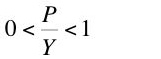
The steady-state valuation ratio cannot be below unity. Otherwise, corporations would expand by purchasing financial assets, rather than capital goods. Since households typically do not buy blast-furnaces and other real capital goods, the valuation ratio can exceed unity.

Profits not retained by the corporate sector are paid out to households in the form of dividends. By assumption, dividends are (1 - sc)P. The increase in the value at the end of a year of the capital goods owned by corporations is net investment, I. The increase in the value of all shares is v I, while the value of new shares sold is f I. This latter quantity is needed to finance that portion of net investment not covered by retained profits. The difference in these quantities (v - f) I, is the value of capital gains.

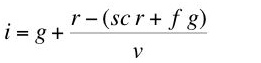
Interest payments on financial capital are such that one consume them entirely and leave one's capital value unaltered. Thus, interest payments in this model are equivalent to the sum of dividends and capital gains. The rate of interest, i, is then defined by Equation 23:
(23)
Some algebraic manipulations and the definitions of the rate of profits and the rate of growth given by Equations 3 and 2, respectively, yield Equation 24:
(24)
Substituting from Equation 8, I obtain:
(25)
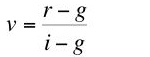
Or:
(26)
Assume that the rate of interest is greater than the rate of growth. Then, a valuation ratio greater than unity is equivalent to the rate of profits on industrial capital exceeding the rate of interest on financial capital along a steady state growth path.

2.6 Savings Decisions and Increases in Wealth

I assume the existence of a class of workers and a class of pure capitalists (rentiers) in the steady state. Members of both classes save, and therefore both obtain a share of profits. The rentiers obtain all their income from profits.

If both classes are to persist, the wealth of each class must grow at the steady-state growth rate, g. Equation 27 equates the rate of growth o rentier wealth:
(27)
where sr is the capitalists' (marginal and average) savings propensity and j is the proportion of stock owned by the workers. Equation 28 equates the steady-state rate of growth and the rate of growth of workers' wealth:
(28)
where sw is the workers' (marginal and average) savings propensity.

Equations 27 and 28 determine the valuation ratio and the proportion of stock owned by the workers. Some variables in these two equations have already been determined: wages, profits, net investment, and the value of capital. The rate of growth, the proportion of net investment financed by additional stock, the retention ratio, and the workers' and the capitalists' savings propensities of the model.

2.7 Parameter Ranges

Certain conditions must be met for a steady-state growth path to exist in the above model. Given a positive price of steel, Equation 29 follows from Equation 11:

(29)
Then the wage is positive if and only if:
(30)
Or:
(31)
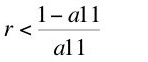
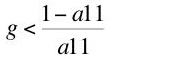
By similar reasoning based on Equation 19, outputs of corn and steel are positive if and only if the inequality in Display 32 holds:
(32)
Displays 31 and 32 show a limit on the rate of profits and on the rate of growth. This limit is imposed by a parameter of the chosen technique. The inequality in Display 33 must hold for the rate of profits and the rate of growth to be positive:
(33)

The model imposes a necessary condition on savings propensities. Define sh as a weighted savings propensities over households:
(34)
Table 1 uses the household savings propensity to show the sources of savings. The first three rows show savings out of profits, while the last row shows savings from wages. Since intended savings equals investment along a steady-state path, Equation 35 must hold:
(35)
Or:
(36)
I assume both profit and wage shares are positive:
(37)
Display 38 gives a necessary condition to ensure positive shares for both classes:
(38)

This condition is that the savings rate out of wages be less than the sum of the proportion of retained earnings and the savings rate out of profits distributed as dividends.
Table 1: Sources Of Savings
Savings From Dividendssh(1 - sc)P
Savings From Retained Earningssc P
Minus Consumption From Capital Gains- (1 - sh)(v - f)I
Savings From Wagessw(Y - P)

Sunday, January 07, 2007

A Post Keynesian Model of Growth and Distribution (Part 2 of 4)

2.0 THE MODEL

This part begins the exposition of the model introduced in the previous part. The exposition is organized into seven subsections in two parts. The first part, consisting of four subsections, describes the corporate sector. The two subsections at the beginning of the second part describe households and financial institutions. The last subsections describes some limitations on parameters that are necessary for the existence of a steady-state growth path in the model.

2.1 Some Accounting Identities

The corporations in this model economy, produce two commodities, steel and corn. Steel can be combined with labor to produce either more steel or corn. Corn is the consumption good. Steel is totally used up in the yearly production processes in the model. Thus, the output of the economy consists of steel to replace the steel used up in production, additional steel to support growth, and corn for consumption.

Let X represent tons steel used in a production cycle, and let p represent the price of steel. The value of capital, K, is given by Equation 1:
(1)
Let g be the steady-state rate of growth. Steel output, corn output, the employed labor force, and the value of capital all grow at this rate along a steady-state growth path. Thus, net investment, I, is related to the value of capital by Equation 2:
(2)
Equation 3 relates accounting profits, P, to the value of capital:
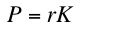
(3)
Equation 3 is a relationship characterizing the return to industrial capital. The returns to industrial capital and to financial instruments are distinguished in this model. It is convenient to follow tradition and refer to r as the rate of profits.

Let w be the wage, and let N be the number of employed person-years. Total wages, W, are then given by Equation 4:
(4)
There is no government and no foreign trade in this model. Net income, Y, is paid out in the form of wages and profits:
(5)
Equations 1 through 5 are basic identities in this model.

2.2 Finance and the Rate of Profits

The rate of growth is not determined within this model. It is the result of decisions by corporate managers, and it depends on their optimism or pessimism. In short, the rate of growth depends on the "animal spirits" of the corporate managers.

Investment has two sources of finance in the model, retained earnings and the issuing of new stock. Households purchase new stock in the model. Earnings that are not retained are paid out as dividends to stock owners. Let sc be the proportion of profits retained. Let f be the proportion of net investment financed by additional stock. Equation 6 follows:
(6)
Some algebraic manipulation yields Equation 7:
(7)
One obtains Equation 8 from Equations 2, 3, and 7:
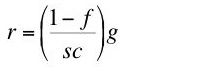
(8)
Notice that all the parameters on the right-hand side of Equation 8 are controlled by corporate managers. Thus, the rate of profits on a steady-state growth path is the result of corporate decisions about the rate of growth and the financing of investment.

2.3 Production

Production occurs in the corporate sector. Firms producing steel face the technology defined by the production function in Equation 9:
(9)
where a01 is the number of person years labor hired per ton steel produced, and a11 is the number of tons steel used as input per ton steel produced. The technology for producing corn is defined by the production function in Equation 10:
(10)
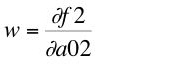
where a02 is the number of person years labor hired per bushel corn produced, and a12 is the number of tons steel used as input per bushel corn produced.

Production functions are assumed to exhibit Constant Returns to Scale and diminishing marginal returns. The inputs of steel are purchased at the start of the year, and the outputs of steel and corn become available at the end of the year. The corporations hire labor for use throughout the year and pay wages at the end of the year.

2.3.1 Price Equations

The same rate of profits is earned in each industry along a steady-state growth path:
(11)
(12)
Notice that corn is the numeraire in Equations 11 and 12, and relative prices are constant over time.

Given the coefficients of production, one can solve Equations 11 and 12 for the wage and the price of steel as a function of the rate of profits. Equation 13 gives the wage-rate of profits curve for the technique defined by a choice of the coefficients of production:
(13)
Equation 14 specifies the price of steel, given coefficients of production and the rate of profits:
(14)

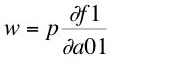
The choice of technique can be analyzed by appending marginal productivity equations to either the system of equations given by Equations 11 and 12 or by Equations 13 and 14. Marginal conditions follow from assuming that competitive firms minimize cost, given technology. Alternatively, one can assume that competitive firms maximize economic profits. Equation 15 shows that the wage is equal to the value of the marginal product of labor in producing steel:

(15)
The wage is also equal to the value of the marginal product of labor in producing corn:
(16)
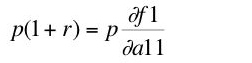
The price of steel, discounted to the end of the year when output becomes available, is equal to the value of the marginal product of steel used in producing steel:
(17)
Similarly, the discounted price of steel is equal to the value of the marginal product of steel in producing corn:
(18)

This analysis of the price equations shows that, given the rate of profits, coefficients of production, the wage, and prices of commodities are determined by cost-minimization. Notice no equation exists equating the marginal product of the value of capital, K, and the rate of profits. Marginal productivity conditions are part of the determination of the choice of technique. They do not determine distribution.

2.3.2 Quantity Equations

By assumption, X tons of steel and N person-years of labor are used as inputs in production in a single year. Since the rate of growth is g, (1 + g)X tons of steel are produced and available at the end of the year. Let c be the amount of corn produced per person-year. So c N is the amount of corn produced and available at the end of the year. Equation 19 equates the steel used as input to the sum of the steel inputs in the steel and corn industries:
(19)
Equation 20 equates the labor used as input to the sum of the labor inputs in the steel and corn industries:
(20)
One can solve Equations 19 and 20 for c and X/N as functions of the rate of growth and the coefficients of production. Equation 21 shows the trade-off between per-capita consumption and the rate of growth:
(21)
Notice this trade-off is of the same form as the wage-rate of profits curve (Equation 13). Steel per worker is given by Equation 22:
(22)
2.4 A Graphical Depiction of Elements of the Corporate Sector

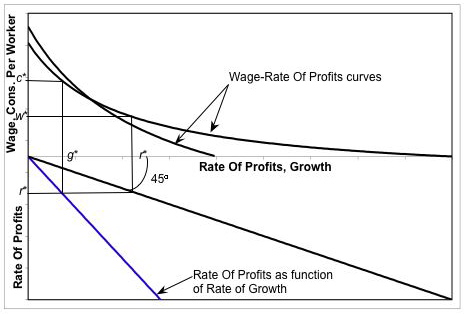
This completes the analysis of the corporate sector. I have shown how, in this model, the rate of profit, the wage, prices, coefficients of production, and quantities produced per worker are determined. Figure 1 summarizes some of this discussion. The blue line in the fourth quandrant plots (the reflection of) Equation 8. In steady state growth, corporate managers have chosen the rate of growth, shown as g* on the abscissa. The corresponding steady state rate of profits, r*, is plotted downward on the ordinate. The graph shows this rate of profits reflected by the 45 degree line back onto the abscissa. The wage-rate of profits curves (Equation 13) for each technique are plotted in the first quadrant. Figure 1 shows two, while the marginal productivity relationships are applicable when an uncountable infinity of such curves exist. The coefficients of production for the chosen technique correspond to the highest wage-rate of profits curve for the rate of profits r*. The corresponding wage, w*, along a steady state growth path is plotted on the ordinate. Likewise, consumption per person-year is plotted on the ordinate by projecting the steady state rate of growth upward to the wage-rate of profits curve for the chosen technique.
Figure 1: Some Variables Dependent on the Rate of Growth
Postulate, say, an initial quantity of capital goods along a steady state growth path. The evolution of this quantity over time is specified, once the rate of growth is known. Equation 22 can be used to determine the time series for employment. Equation 14 can be used to determine the price of steel. Accounting identities can be used to calculate the value of capital (Equation 1), net investment (Equation 2), the distribution between profits (Equation 3) and wages (Equation 4), and net income (Equation 5). The distribution of income between persons requires an analysis of the financial sector and households. This analysis is provided in the next part.

A Post Keynesian Model of Growth and Distribution (Part 1 of 4)

1.0 INTRODUCTION

This series of posts presents a model in which an economy grows smoothly at a steady rate. The model postulates a certain institutional setting, namely advanced capitalism. Households save in this model by purchasing financial assets. They do not own individual capital goods to lend to firms. Corporations choose the rate of growth. In some sense, investment decisions are exogeneous or autonomous. Steady-state rates of growth are demand-constrained, not supply-constrained.

In Joan Robinson’s formulation, the purpose of this type of model is not to predict the future path of a capitalist economy. Rather, it is an analytical tool depicting necessary conditions for a smoothly growing capitalist economy under certain assumptions about institutions. In addition to the assumptions mentioned above, the model postulates that decision-makers follow certain rules of thumb or heuristics. This type of model can be used to assist one in identifying contradictions or aspects of capitalist economies that prevent smooth growth from being achieved from a current position.

The particular formulation of the model I present is unoriginal. I draw heavily on a paper by Scott Moss. This paper clarifies the logic of the inclusion of a corporate sector in this family of models. I deviate from Moss’ formulation in that I assume continuously differentiable microeconomic production functions, rather than fixed coefficients. I do this to emphasize the consistency of this model with marginal productivity, properly understood. The references I give at the end of the last post in this series are highly selective.

Saturday, January 06, 2007

How To Argue Like A Reactionary

Suppose you want to argue knowledgeably about economics and political philosophy. Then the literature you should read seems unbounded. Here are three books I read years ago and still like:
  • Hirschman, Albert O. (1991). The Rhetoric of Reaction: Perversity, Futility, Jeopardy
  • Myrdal, Gunnar (1953). The Political Element in the Development of Economic Thought (Translated by Paul Streeten), Routledge and Kegan Paul
  • Popper, Karl R. (1945). The Open Society and Its Enemies (Two volumes), George Routledge & Sons
Popper is relevant to the use of "utopian" as a pejorative. Utopias are "recipes for the cook-shops of the future", as Karl Marx put in his preface to the second edition of Capital. Marx and Engels famously opposed their "scientific socialism" to a prior utopian socialism. (See the first and second chapter of the third section of Anti-Dühring, also issued as a pamplet.) Popper, although opposed to so much of what he took Marx's approach to be, agreed with Marx in this. It is not the role of intellectuals to draw up blueprints for some ideal society and then to convince some actual country to adopt them. Plato, in his Republic, was misdirected. Popper thinks we should be trying to ameliorate existing evils, not globally remaking society or mandating happiness.

Myrdal writes a history of economics. He thinks one cannot correctly derive concrete policy proposals from abstract norms, such as "the greatest good for the greatest number". Nevertheless, political economists have often claimed to do exactly that. Myrdal critiques their argument.

Hirschman also writes a history. He explores how those on the right have argued against progressive policies. He identifies three main arguments rightists tend to pull out always:
  • Perversity: attempts to improve matters will frustate themselves and only make matters worse. (Think of the incorrect neoclassical economics textbook argument about minimum wages.)
  • Futility: the matters that we want to change are so deep seated that they cannot be reached, despite all our efforts.
  • Jeopardy: We may be able to effect positive change, but we nevertheless put at risk other desirable features of society.
A slippery slope argument is a kind of jeopardy argument, I think. To express any skepticism about laissez-faire is not to advocate communism. But we are not presented with a choice between only government "non-intervention" and central planning as in no-longer-actually existing socialism.

Samuelson: "I Side With Sraffians"

"...One cannot match a proof like that of [the wage-interest rate frontier] by finding a valid proof for the stationary state conjecture [that consumption per head is not lower for a lower interest rate] (6). Why not? Because, as the next section will illustrate with numerical examples, such a conjecture is simply not true! ...

..Austrian novices and Nassau Senior's readers trumpet (in my paraphrase): 'Time itself is productive. Roundaboutness can be substituted for labor. The price of time is the interest rate. Aristotle, the Bible, the Koran, and St. Thomas Aquinas are wrong: competitive interest rate is not exploitation. The capitalist gets and needs to get the reward of positive interest rate. And to assuage him for his pains of (a) waiting to consume and (b) abstaining from eroding his capital by consuming more now rather than replacing the capital already in existence, he is properly being given part of the extra social product that his activity makes possible. It is a good bargain for the laborer: his wage product is fructified by what the capitalist provides as the real wage rate always rises when thrift and accumulation succeed in lowering the interest rate.'

But suppose time itself is not productive. Suppose the technical choices were between seven of labor two periods back and ten of labor three periods back. Incautious writings of Böhm's contemporaries declare, Humpty Dumpty-like: that is impossible; it contradicts a valid (a priori?) law of returns that more time means more product for the same total labor; read Jevons, read Böhm.

This is not cogent argumentation, as Hayek understands (1941, p. 60)...

...this defense does not validate an inverse [interest rate, consumption per worker] tradeoff in Equation (6) above. Adam Smith's Invisible Hand does ensure Equation (5) above but cares nought for Equation (6). This is why books entitled Economics in One Lesson must evoke from us the advice: 'Go back for the second lesson.'

Böhm was understandably tempted to say things like: 'Among the viable competitive time-phasing techniques, the technological law holds: Using more time, more roundaboutness, more complexity - when a lower interest rate motivates that competitively - must surely bring society a higher output from the same steady-state primary inputs of labor and land. Adam Smith's Invisible Hand must [sic] surely ensure that.'..

...in my dialogue with Sraffians, out of noblesse oblige I let them choose their weapons. By three well-chosen numerical examples, which Fisher (1907) might easily have fabricated, I side with Sraffians to show how and why there can be no universal measure of 'depth or duration of time-phased produced inputs' that can serve as simple apologetics for mainstream theories of interest. Unequivocal 'capital deepening' just cannot be defined...

...An economy's inventory of produced inputs is both complex and simple. Maintaining and improving upon congeries of productive inputs is an indispensible part of economic progress. All such time-phased processes will not evolve automatically: cave-people rose and fell in material well-being; eons passed without much cumulative change; great diversity of performance characterized geographically separated societies. Attempts to generalize simple family's or related-families' habit formation to large-group politics - a la utopian experimental cults or in the Lenin-Stalin and Mao pattern have not hitherto succeeded in organizing production with approximate Pareto-Optimality efficiency features. Gradual evolution toward near laissez-faire market mechanism responding to individual's self-interest, history suggests and advanced economic theory second guesses, will incur areas of market failure and will generate and perpetuate considerable degrees of economic and political inequalities. Just as there is no asymptotic communist utopia, neither is [there] an asymptotic laissez-faire utopia.

Böhm and Wicksell and Cassel and Wieser and Clark and Walras and Hayek and other economists before and after Sraffa, all must face what the role of intertemporal pricing must be in organizing technologies that are irreducibly time-phasing. When Joan Robinson and I discussed these matters face to face, I used to get nowhere with her by babbling about supply and demand. She already had seen through that tommy-rot. Things went better if I could keep the focus on Mao's China..." -- Paul Samuelson (2001). "A Modern Post-Mortem on Böhm's Capital Theory: Its Vital Normative Flaw Shared By Pre-Sraffian Mainstream Capital Theory". Journal of the History of Economic Thought V. 23, N. 3

Friday, January 05, 2007

Solow Japes

Robert Lucas changed the direction of mainstream macroeconomic research. David Warsh reminds me that Robert Solow is unhappy with this direction:
"Suppose somebody sits down where you are sitting now and announces to me that he is Napoleon Bonaparte. The last thing I want to do with him is to get involved in a technical discussion of cavalry tactics at the Battle of Austerlitz. If I do that, I'm getting tacitly drawn into the game that he is Napoleon Bonaparte." -- Robert M. Solow
I also like this quip:
"My impression is that the best and brightest in the profession proceed as if economics is the physics of society. There is a single valid model of the world. You could drop a modern economist from a time machine - a helicopter, maybe, like the one that drops the money - at any time, in any place, along with his or her personal computer; he or she could set up in business without even bothering to ask what time and which place. In a little while, the up-to-date economist will have maximized a familiar-looking present-value integral, made a few familiar log-linear approximations, and run the obligatory familiar regression. The familiar coefficients will be poorly determined, but about one-twentieth of them will be significant at the 5% level, and the other nineteen do not have to be published. With a little judicious selection here and there, it will turn out that the data are just barely consistent with your thesis advisor's hypothesis that money is neutral (or nonneutral, take your choice) everywhere and always, modulo an information asymmetry, don't worry, you'll think of one." -- Robert M. Solow (1984). "Economic History and Economics", Papers and Proceedings of the American Economic Association (Dec.): 330

Wednesday, January 03, 2007

Yes, Gabriel, He Must Be

Over on another blog, Gabriel Mihalache tries to cast doubt on econophysics:
"If Doyne Farmer thinks that there are systematic, exploitable, opportunities for profit... then he must be a very rich man, right?"
I turn to the Web site of the Prediction Company, where I find:
"Founded in 1991 by Doyne Farmer, Norman Packard and Jim McGill, Prediction Company quickly set out to take the financial world by storm. Based on their earlier work in chaos theory and complex systems Drs. Packard and Farmer felt the financial markets were an example of a highly complex system that would be amenable to predictive technology. They assembled a team of world class scientists and engineers to attack the problem.

In 1992 Prediction Company signed an exclusive five year deal to provide predictive signals and automated trading systems to O'Connor and Associates, a highly successful Chicago based derivatives trading firm. In 1994 O'Connor was purchased by Swiss Bank, one of the world's largest banks. Swiss Bank extended the exclusive relationship with Prediction Company for another two years. In 1998 Swiss bank and UBS merged to create the world's third largest financial institution. Prediction Company continues its ground breaking work with UBS AG, and in November, 2005, became a wholly-owned subsidiary of UBS AG."

Tuesday, January 02, 2007

References On Austrian Business Cycle Theory

In commenting on James' post, I mentioned I have already shown Austrian Business Cycle Theory to be false. If I ever revise this paper, I might want to make it shorter. I might also want to work in some additional references:
  • Hayek, Friedrich A. (1941). The Pure Theory of Capital, Chicago: University of Chicago Press
  • Kaldor, Nicholas (1942). "Professor Hayek and the Concertina-Effect", Economica, New Series, V. 9, N. 36 (Nov): 359-382
  • Klausinger, Hansjörg (2006). "'In the Wilderness': Emigration and the Decline of the Austrian School", History of Political Economy, V. 38, N4: 617-664. See especially p. 650:
  • "...the book [Hayek 1941] could not achieve its aim, because of Hayek's lack of formal and mathematical skills and the impossibility of the task itself. [Footnote:] as taught by the outcome of the Cambridge capital controversies; for a retrospective view, see Samuelson 2001."
  • Lachmann, L. M. (1940). "A Reconsideration of the Austrian Theory of Industrial Fluctuations", Economica, New Series, V. 7, N. 26 (May): 179-196
  • Siven, Claes-Henric (2006). "Monetary Equilibrium", History of Political Economy, V. 38, N. 4: 665-709
Also, one of last two numbers in the 2006 volume of the Quarterly Journal of Austrian Economics is on the ABCT.

Monday, January 01, 2007

Adam Smith On An Information Asymmetry

I think I once read Michael Perelman pointing out this parallel between Smith and Stiglitz:
"...In a country, such as Great Britain, where money is lent to government at three per cent. and to private people upon good security at four, and four and a half, the present legal rate, five per cent., is perhaps as proper as any.

The legal rate, it is to be observed, though it ought to be somewhat above, ought not to be too much above the lowest market rate. If the legal rate of interest in Great Britain, for example, was fixed so high as eight or ten per cent., the greater part of the money which was to be lent, would be lent to prodigals and projectors, who alone would be willing to give this high interest. Sober people, who will give for the use of money no more than a part of what they are likely to make by the use of it, would not venture into the competition. A great part of the capital of the country would thus be kept out of the hands which were most likely to make a profitable and advantageous use of it, and thrown into the those which were most likely to waste and destroy it. Where the legal rate of interest, on the contrary, is fixed but a very little above the lowest market rate, sober people are universally preferred as borrowers to prodigals and projectors. The person who lends money gets nearly as much interest from the former as he dares to take from the latter, and his money is much safer in the hands of the one set of people, then in those of the other. A great part of the capital of the country is thus thrown into the hands in which it is most likely to be employed with advantage." -- Adam Smith, Wealth of Nations, Book II, Chapter IV
Gavin Kennedy titles his blog, "Adam Smith's Lost Legacy". So he must be only joking in this post when he whines about Stiglitz advocating government action to counter imperfections in information. (Kennedy also goes off, as right-wingers tend to do, with strawpersons and irrelevancies about the former Soviet Union.)

Friday, December 29, 2006

Behavioral Economics In A Novel

"'Listen.' Harold fell into the agitated intensity of a scientist impatient with methodology. 'Can we try something here?'

'Of course. Name it.'

He looked sidelong at me. Not wanting to overstep. 'Kahneman and Tversky?'

I smiled. Funny: Harold would not be impressed with my matching the obscure tags, recent additions to my own neural library. He took that much for granted. Just your garden-variety marvel.

I improvised for Helen a personal variation on the now-classic test. 'Jan is thirty-two years old. She is well educated and holds two advanced degrees. She is single, is strong-minded, and speaks her piece. In college, she worked actively for civil rights. Which of these two statements is more likely? One: Jan is a librarian. Two: Jan is a librarian and a feminist.'

'It knows the word "feminist"?' Mina lit up, arcing into existence at the idea.

'I think so. She's also very good at extending through context.'

Once more, Helen answered with a speed that winded me, given the pattern-sorting she needed to reach home. 'One: Jan is a librarian.'

Harold and I exchanged looks. Meaning?

'Why is that more likely, Helen?'

'Helen? It has a name?'

'That is more likely because one Jan is more likely than two.'

Now Harold took a turn laughing like an idiot.

'Wait a minute,' Mina said. 'I don't get it. What's the right answer?'

'What do you mean, what's the right answer?' Harold, raging affronted fatherdom. 'Think about it for ten seconds.'

'Well, she has all these feminist things about her. So isn't it more likely that she would be a feminist librarian than just a ...?'

Mina, seeing herself about to label the part more likely than its whole, threw her hand over her mouth and reddened.

'I can't believe it. I've worked my mental fingers to the bone for you, daughter.'

Harold's growl was motley at best. Helen, choosing the right answer for the wrong reasons, condemned herself to another lifetime of machinehood. Harold's girl, in picking wrongly for the right reasons, leaped uniquely human.

He cuffed her mussed hair, the bear teaching the cub to scuffle. 'I'm deeply disappointed in you.'" -- Richard Powers (1995). Galatea 2.2, Farrar Straus Giroux (p. 221)

Thursday, December 28, 2006

Why No More Great "Libertarian" Economists?

"...What distinguishes the new generation [e.g., Joe Stiglitz, Paul Krugman, and Richard Freeman] of policy-relevant mainstream economists? They are not, alas, philosophical Keynesians. But they often arrive at Keynesian policies by elaborate neoclassical routes - by building asymmetric information or increasing returns or externalities into an otherwise orthodox model and tracing through the implications. They combine a facility with this method and an openness to empirical observation, the choice of important cases, and a willingness to tackle hard problems of policy design and to consider ingenious solutions to particular policy problems. Moreover, they are willing to devote time and energy to explaining the issues to a larger public - whether in economic policy journals like Challenge or broader public forums like The New York Times. In these respects they do resemble Keynes, who remains the ultimate example of a modern economist who could do it all.

So what is the problem over there on the libertarian side? Klein is right: there is a problem - the libertarians are strangely quiet these days. One might think that new libertarian voices would emerge in the Bush era, when many actual libertarians are closer to state power than ever before. But no. There are no new Friedmans, no Hayeks, no Wanniskis, no Gilders to chorus in the new regime, to lend it an air (badly needed one might add) of intellectual authority.

I think I know the reason. The libertarians, let me suggest, have lost the courage of their convictions. Libertarian followers of Lucas, unlike, say, those of Tullock, rarely speak on public questions for a simple and well-considered reason. What they do is, indeed, very implausible. It cannot be conveyed to the ordinary literate and sensible person because, once the assumptions are spelled out, the ordinary literate and sensible person will reject them.

Furthermore, no one any longer believes Milton Friedman's old methodological saw about false assumptions being irrelevant - so long as the 'implications' are valid. The point made against Friedman long ago by Tjalling Koopmans - that this allows one to escape difficulties by reclassifying unpersuasive implications as assumptions - is elementary enough to be grasped intuitively by those who will never read Koopmans. Better to be a scholastic, in short, than a figure of fun.

A second group of scholastics is silent on policy questions for a different reason: the scholasticism that is increasingly up-and-coming inside economics no longer supports the libertarian view. It would be quite dangerous for a serious student of, say, game theory or non-linear dynamics or of models with multiple equilibria to delve too deeply into the policy implications of such work. Such forms of modern economics simply no longer support the libertarian political viewpoint, and to make this too widely known would greatly jeopardize right-wing support for mainstream economic research..." -- James K. Galbraith (2001). "Response from an Economist who also Favors Liberty", Eastern Economic Journal, V. 27, Iss. 2: 227-299.
Galbraith's paper is part of a symposium. The symposium is organized around comments on a paper by Daniel B. Klein. Gordon Tullock, Deidre McCloskey, Israel Kirzner, Charles Goodhart, Robert Frank, and James Galbraith provide the comments.

Tuesday, December 26, 2006

Robbins Mistaken, Morgenstern Insightful

Mention of "Economics 101" or principles of economics seems to often call forth divergent attitudes, as in the comments to this Crooked Timber post. These attitudes go back at least fifty years.
"The efforts of economists during the last hundred and fifty years have resulted in the establishment of a body of generalisations whose substantial accuracy and importance are open to question only by the ignorant or the perverse." - Lionel Robbins (1945). An Essay on the Nature & Significance of Economic Science, Second Edition, Revised, Macmillan and Co.
Contrast Oskar Morgenstern (1941, "Professor Hicks on Value and Capital", Journal of Political Economy, V. 49, N. 3 (June): 361-393). Morgenstern notes that Hicks claims to have a new theory. This theory became the foundation for introductory or intermediate economics. Yet, as Morgenstern notes, Hicks ends up with the same conclusions. Morgenstern doubts that Hicks' work can stand up to a rigorous critique.

(Aside: I appreciate comments. I realize I am as slow in forming my thoughts into intelligible responses, including the acknowledgement of valid points, as DSquared is in posting promised book reviews.)

Friday, December 22, 2006

Conservative Paul Krugman

"In a saner political environment, the economic logic behind Rubinomics would have been compelling. Basic fiscal principles tell us that the government should run budget deficits only when it faces unusually high expenses, mainly during wartime. In other periods it should try to run a surplus, paying down its debt." -- Paul Krugman, "Democrats and the Deficit", New York Times, 22 December 2006
I thought principles tell us that we should use government to develop institutions (e.g., unemployment insurance) that provide automatic fiscal counter-cyclical stimulus.

Furthermore, I don't know why I should believe the economy is supply constrained in the long run.

Update: Added a couple more links. One, by exhibiting a different rightist brand, only reinforces my opinion that Krugman is an example of an intelligent conservative.

On "Marxism and the Left"

I tried to leave this as a comment on a Michael Greinecker post. But something must have gone wrong between the seat of my chair and my keyboard.

I was not inclined to argue about the first sentence, "I will not go into arguing what 'real' Marxism is or how well it is founded in the writings of Marx." Then I clicked on the links and saw they were all Analytical Marxists.

Anyways, why is the word "implicit" in the phrase "Concerning the implicit value judgements in Marxism"? Is it so that one can assert exploitation is a normative concept, despite explicit statements by Marxists and scholars of Marx otherwise? I don't disagree that an argument can be developed here.

I would think Marxist political parties around the world have by now developed views on ecology; on discrimination based on ethnic, gender, gender preferences, etc.; and on access issues. I assume the objection is whether such concerns can be coherently integrated into the theory Marxists use.

By the way, my reaction to Mankiw's comment on the core was also to think of John Roemer.

(You might want to fix the spelling of the post title.)

Tuesday, December 19, 2006

Heresy From J. A. Hobson

"Among the business and professional classes and their economic supporters the conviction holds that any property or income legally acquired represents the productive services rendered by its recipient, either in the way of skilled brain or hand work, thrift, risks, or enterprise, or as inheritance from one who has thus earned it. The notion that any such property or income can contain any payment which is excessive, or the product of superior bargaining power, never enters their minds. Writers to The Times, protesting against a rise in the Income Tax always speak of their 'right' to the income they have 'made', and regard any tax as a grudging concession to the needs of an outsider, the State.

So long as this belief prevails all serious attempts by a democracy to set the production and distribution of income upon an equitable footing will continue to be met by the organized resistance of the owning classes, which, if they lose control of the political machinery, will not hesitate to turn to other methods of protecting their 'rights'." -- J. A. Hobson, Confessions of an Economic Heretic, as quoted in C. E. Ayres's The Divine Right of Capital (Houghton Mifflin, 1946)

Income Inequality in the U.S.A.

I don't know Alan Reynolds. Apparently he writes for the funny pages of the Wall Street Journal. Thus, I assume, he must be a serial prevaricator. Anyway, apparently the other day he wrote:
"The incessantly repeated claim that income inequality has widened dramatically over the past 20 years is founded entirely on [Piketty and Saez's] seriously flawed and greatly misunderstood estimates of the top 1% alleged share of something or other"
I don't know what "20 years" has to do with anything. And Piketty and Saez's novel contribution was not the documentation of increased inequality.

A fundamental contrast in the Post (World) War (II) period in the United States is that between the staircase and the picket fence. During the Golden Age, income increased about the same rate for all quintiles. That is the picket fence. About 1970, maybe with the end of the Bretton Woods system, something changed. Then one sees the staircase pattern, shown below. As I understand it, this pattern holds across a wide variety of time series (e.g., individuals or families) on various types of data (e.g., income, wealth, or wages). Details differ, of course, depending on exact time periods or time series used. For example, the first step falls, instead of rising a small amount, only in some periods for some measures. (And income mobility did not improve during the staircase years, either.)

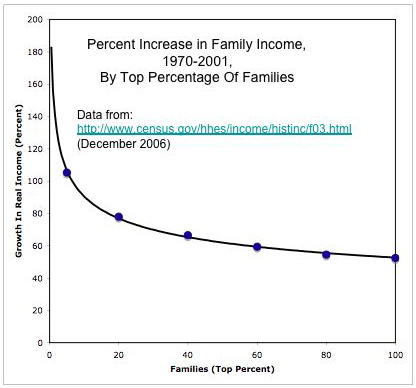
I could look for many references, other than Piketty and Saez, that draw the same basic picture. But I think I'll construct the staircase myself with some data from the U.S. Census Bureau. Figure 1 shows the staircase. Figure 2 shows the same data, analyzed a different way. It also shows a log-linear regression line, from which one can extrapolate how much the income of the top 1%, for example, has increased over the same period. If one wanted, one could fit a regression with each year. This would estimate a time series over the period.
Figure 1: Increase in Inequality Over 30 Year Span


Figure 2: Increase in Income In Top Percentiles

Monday, December 18, 2006

A Post Keynesian Blog

After exploring his site, I find I should recognize Thomas Palley's work. I may have even read one or another of his papers, since the Cambridge Journal of Economics and the Journal of Post Keynesian Economics are two journals I try to read fairly regularly. Certainly some of the views Palley expresses on his blog, such as about the role of power and institutions in income distribution, seem to me to reflect a Post Keynesian perspective on economics. I am adding Palley to my weblog.

Saturday, December 16, 2006

Bah, Humbug

1.0 Introduction
This post presents an argument I get from Shaikh (1974). During the post (World) War (II) "golden age", the share of profits in U.S. national income stayed fairly constant. As a matter of algebra, an aggregate Cobb-Douglas production function fits the data. One cannot legitimately cite the goodness of such a fit as empirical evidence for the aggregate marginal productivity theory of distribution. The theory has not passed any potentially falsifying empirical test.

Shaikh built on past work in developing his argument, and a body of more recent work has extended and generalized the argument. Why do economists continue to use measures of Total Factor Productivity and Solovian growth theory when they have neither theoretical nor empirical support?

2.0 A Common Version Of Aggregate Neoclassical Theory
Consider the Cobb-Douglas production function:
(1)
where Y(t) is national income at the indicated time, K(t) is the value of the capital stock, L(t) is labor services, A(t) represents technical progress, and
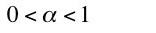
(2)
The Cobb-Douglas production function can be written in a per-worker form:
(3)
That is, Equation 1 is equivalent to Equation 4:
(4)
where y(t) is national income per worker and k(t) is the value of the capital stock per worker. Take natural logarithms of both sides:
(5)
I derive below the Cobb-Douglas production function, in the form of Equation 5, from the assumption that the profit share is constant, independently of whether competitive profit-maximizing firms follow marginal productivity theory or not. This derivation is also independent of whether or not production functions can be aggregated, either across firms or across industries.

Now impose further neoclassical assumptions. By the exploded aggregate neoclassical theory, competitive firms are maximizing profits when the interest rate is equal to the marginal product of capital:
(6)
where r(t) is the interest rate. That is, according to neoclassical theory, if the economy’s technology can be represented by an aggregate Cobb-Douglas production function and competitive firms maximize profits, then the share of profits in national income is constant:
(7)
where P(t) is total (accounting) profits.

3.0 Some Accounting Identitites
Begin anew. I start with the accounting identity that national income is the sum of total wages and total profits:
(8)
where W(t) is total wages and w(t) is the wage. It is convenient here to do the algebra with quantities expressed per worker:
(9)
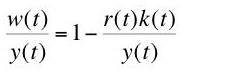
Below, I need the wage share in national income expressed as the difference between unity and the profit share:
(10)
Differentiate Equation 9 with respect to time to obtain Equation 11:
(11)
One performs some apparently unmotivated alebraic manipulations on Equation 11 to obtain Equation 12:
(12)
It is worth emphasizing that, so far in this section, all I have been doing is manipulating accounting identities. No additional theoretical or empirical structure has been imposed. I now assume that the profit share is constant, by whatever mechanism brings this constancy about. Equation 12 becomes Equation 13:
(13)
Equation 13 expresses a growth-accounting relationship. The left hand side is the rate of growth of national income. The quantities in square brackets on the right hand side are the rate of growth of the wage, the rate of growth of capital per worker, and the rate of growth of the interest rate, respectively.

Take integrals of both sides:
(14)
Equation 14 is a Cobb-Douglas production function, in the form of Equation 5, where technical progress is:
(15)
So much for Solow's "Nobel" prize.

Update: Originally posted on 5 August 2006. Updated to provide better formatted equations.

Reference
  • Shaikh, Anwar (1974). "The Laws of Production and Laws of Algebra: The Humbug Production Function", The Review of Economics and Statistics, V. 56, Iss. 1 (Feb.): pp. 115-120

Thursday, December 14, 2006

Silliness From Edward Prescott

Some bloggers have recently commented on an editorial in the funny pages of the Wall Street Journal. This is the same Edward Prescott, who, after co-winning the "Nobel" prize in economics in 2004, was interviewed by the Arizona Republic. And Prescott said then, "It's easy to get over $200,000 in income with two wage earners in a household."

The engineers I know, when designing filters and otherwise applying the theory of linear systems, have some reason to believe that sytems they are modeling are linear. I don't see the same practical concern in economics. Here's an article that I like on mistaken consensus beliefs among mainstream macroeconomists:
  • White, Graham (2004). "Capital, Distribution and Macroeconomics: 'Core' Beliefs and Theoretical Foundations", Cambridge Journal of Economics, V. 28: 527-547

A Plea for a Pluralistic and Rigorous Economics

Thomas Palley makes some assertions about "The Knowledge Police in Economics" (via Mark Thoma). One of the commentators on Mark Thoma's post points out some brouhaha over the American Economic Association (AEA) policy on common affirmative action language in job ads.

When encountering such contretemps, I try to recall that they are not unique in the recent history of the AEA. In this post, I recall some AEA committees I think relevant to the discussion. The Committee on the Status of Women in the Economics Profession (CSWEP) had an important role in the founding of the International Asociation for Feminist Economics (IAFFE). (I read Amartya Sen - who was a student of Joan Robinson - as supporting feminist economics.)

I recall reading the report of the AEA Commission on Graduate Education in Economics (COGEE). I guess this report is:
  • Krueger et al. (1991). "Report of the Commission on Graduate Education in Economics", Journal of Economic Literature, V. 29, N. 3: 1035-1053
But, if I recall correctly, that journal issue contained other related articles. For example, Robert Lucas pooh-poohed the concerns of other commission members. I don't recall reading W. Lee Hansen's article in the May 1990 issue of the American Economic Review.

A later AEA committee, headed by Thomas Schelling, looked into the openness of the AEA journals. I guess I want to read this:
  • Schelling, Thomas (2000). "Report on the AEA Committee on Journals", American Economic Review, V. 90, N. 2: 528-531.
The title of this post comes from a signed petition, published as a paid ad, in the May 1992 issue of the American Economic Review.

Tuesday, December 12, 2006

Krugman Gathers No Moss

In a recent article I otherwise like, Paul Krugman [1] writes:
"...last fall ...the House and Senate passed rival tax-cutting bills... The Senate bill was devoted to providing relief to middle-class wage earners: According to the Tax Policy Center, two-thirds of the Senate tax cut would have gone to people with incomes of between $100,000 and $500,000 a year. Those making more than $1 million a year would have received only eight percent of the cut." -- Paul Krugman
I think this can give the misleading impression that income between $100K and $500K is "middle income". I know that elsewhere in the article Krugman gives figures that show otherwise.

I found out about this article from this bit of silliness:
"Still recovering from the mild case of indigestion I developed after reading Paul Krugman's ignorant, communistic screed in the latest issue of Rolling Stone magazine..." -- Taylor

[1] I'm generally not all that happy with Krugman as an economist.

Hahn and Harcourt Amusing the Crowds

"During my time at Cambridge in the 1980s and 1990s I had a number of public debates with Frank Hahn, usually before the undergraduate Marshall Society, over the issues associated with different approaches to economics. The first was in the early 1980s and the room, a large one, was packed out. I as perceived to have had the better of the exchanges (there was a large Italian contingent present!). By the last exchange, though, the numbers had fallen considerably. Moreover, our arguments had not changed that much, but there was now much sympathy among the students for Hahn's views. I often clashed with Hahn in the Faculty coffee room. He has the makings of a splendid intellectual bully and he was always surrounded by acolytes, to which admiring crowd he could play shamelessly. Once he portrayed me falsely as a neo-Ricardian (I was actually attacking the way Hahn was caricaturing Pierangelo Garegnani's views, not defending the views as such) and he was delighted when in the end I lost my cool and became heated in my replies (when I could get a word in edgeways). He said something to the effect: 'Look at his red face and hear his incoherent utterings, he is mad like all neo-Ricardians'. As at much the same time Terry O'Shaughnessy and I were having vigorous debates with John Eatwell and Murray Milgate concerning the neo-Ricardian long-period interpretation of Keynes, this was a bit rich." -- G. C. Harcourt, "40 Years Teaching Post Keynesian Themes in Adeliade and Cambridge"

Sunday, December 10, 2006

Literature On Sen's Capabilities-Based Approach?

Can anybody recommend to me introductory literature on Amartya Sen's capabilities-based approach to economic welfare? Sen seems to have written a lot. Where should one start?

I need literature that suggests how to encapsulate aspects of Sen's theory in equations. Ultimately, I am interested in including a function in simulations, including asessing the effect of a well or ill fed population.

Saturday, December 09, 2006

Evan Jones on Galbraith Obits

According to Evan Jones, some obituaries of John Kenneth Galbraith
"tell us more about the economics profession than they do about Galbraith. They provide an indirect vehicle for understanding the peculiar character of that profession. The criticisms expose what is acceptable ‘conventional wisdom’ as Galbraith himself would have called it. The reader can also discern in these criticisms dishonesty and incoherence...

...Galbraith's lesson in death is that the successful reproduction of the capitalist socio-economic system requires the perennial obfuscation of how it works."

Presumably, my Galbraith obit is not included in Jones' critique.

Wages And Employment Not Determined By Supply And Demand

You will often find people fooled by incorrect teaching of introductory microeconomics into believing that minimum wages are a hindrance to increased employment.

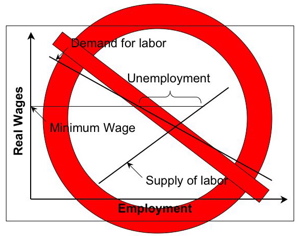
The invalid argument behind this position is shown in a simple diagram of the labor market. The x axis is the level of employment. (In other words, the x axis is the flow of labor services.) The y axis is the wage, that is, the price of labor services. We are only interested in the region where both employment and the wage are positive. The supply of labor is typically drawn as an upward-sloping line, showing more people want jobs at a higher wage. The demand for labor from firms is a downward-sloping line. The point of interestion shows the market-clearing wage (on the y axis) and the level of employment when the market clears. A law imposing a minimum wage is represented by a horizontal line above the level of the market-clearing wage. Since labor demand slopes down, this line intersects the demand curve at a level of employment less than the market-clearing level. Furthermore, the horizontal distance along this line between this point of intersection and the point of intersection of this horizontal line with the supply curve shows the level of unemployment ultimately created by the imposition of a minimum wage.
Figure 1: An Incorrect Model
But it has been known for at least a third of a century that wages and employment cannot be explained in competitive labor markets by the interaction of well-behaved supply and demand curves.

Consider firms in a vertially integrated industry producing some quantity of net output. The firms know of various processes for producing commodities in each sector of the industry. Given prices, including wages, they choose the cost-minimizing technique. In a situation of capital-reversing (also known as a positive real Wicksell effect) firms adopt a technique which employs more labor per unit output at a higher wage.

Now this adoption of a more labor-intensive technique might be swamped by the effect on the level of output. But, as far as I know, nobody thinks that the income effect of a higher wage can be relied upon to lead to a decrease in the quantity of final output sold. Nor do I see any reason to think those receiving non-wage income will systematically want to purchase more labor-intensive commodities than the commodities purchased by those receiving primarily wages.

A large literature explains the analysis of the choice of technique. The above explanation of the implications of the arithmetic of cost minimization is one (non-novel) element of some recent papers, for example:So much for the validity of the theory behind the claim that an increase in the minimum wage leads to a loss of employment at the bottom of the wage ladder.

Update: Originally posted 27 April 2006. Updated 9 December 2006 to reflect movement of White URL and inclusion of drawing.

Friday, December 08, 2006

Worldwide Distribution of Wealth

A new study, by the World Institute for Development Economics Research of the United Nations University, shows richest 2% own half of world's wealth.

Thursday, December 07, 2006

Keynesianism as the Economics of Robinson Crusoe

On the positive effect of workers' higher wages:
"If their wages were low and despicable, so would be their living; if they got little, they would spend but little, and trade would presently feel it; as their gain is more or less, the wealth and strength of the whole kingdom would rise or fall." -- Daniel DeFoe (1704). Giving Alms No Charity

Wednesday, December 06, 2006

Pasinetti On "Non-Substitution" Theorem

"...in a production context...it makes no sense to talk of 'endowments' of given physical quantities if these physical quantities, to be carried over from one period to another, are the unknowns to be determined. It makes no sense to talk of 'scarce' resources, if these resources can be produced in whatever quantities may be needed by the economic system...

When all inputs are themselves produced, a change in the composition of demand simply means that more of some inputs and less of other inputs will have to be produced, while the optimum technique remains the same. In other words, the process of adaptation to any given change in the composition of final demand is, in a production context, radically different from the one considered by traditional theory. Whereas, with given and fixed inputs (the traditional case), the only way to adapt is through a change of technique which may allow the substitution of some inputs for others, in a production context in which all inputs are themselves produced the obvious way to adapt is to produce the inputs which are needed and to cut down production of those which are no longer needed. There is no question of changing the technique. Input substitution, in a production context, has no role to play...

Another route which has been pursued to minimize the importance of the new results...consists in attributing the irrelevance of substitution to the 'very special' case of no joint production and constant coefficients [ = constant returns to scale -RLV ]. But the inconsistency of this contention is here brought into sharp relief by the very analysis of the previous pages...

As already pointed out...the joint production and nonconstant coefficients case is more complicated than, but not basically different from, the case concerning single products and constant coefficients. The complication arises from the fact that a change of the composition of demand may entail a change of the optimum technique and of the price structure. However, this does not enable us to say anything about the direction in which the input proportions will change.

...It is precisely the unambiguous direction in which relative prices and input proportions are related to each other that justifies talking of 'substitution.' But there is nothing of the sort in a production context. No general relation exists between the changes in the price structure and changes in the input proportions. More specifically, no monotonic inverse relation exists, in general, between the variation of any price, relative to another price, and the variation of the proportions among the two inputs to which these two prices refer. When this is so, to talk of 'substitution' among these inputs no longer makes any sense." -- Luigi L. Pasinetti, Lectures on the Theory of Production, Columbia University Press, 1977, pp. 186-188