Saturday, March 03, 2007

The Crisis of Vision in Neoclassical Economics

I think of the notion that prices act as scarcity indices and of the principle of substitution as central to the pre-analytic vision of neoclassical economics. (These principles should only be thought of acting reliably in the absence of imperfections in competition, complete knowledge, etc.) My view is not unique:
"The [Demand-and-Supply-based Equilibrium] theory visualizes the economy as an aggregate of atomistic individuals (producers and consumers) making their decisions autonomously, with no interference from the influence of 'externalities'. Relative prices and quantities are determined simultaneously in equilibrium as an outcome of the interplay of 'forces of demand and supply', generated by the optimizing behavior of individuals subject to their resource constraints. A certain symmetry characterizes the behaviour of producers and consumers. Each producer, given the technological possibilities, chooses the profit-maximizing activities and outputs, at the going prices; each consumer, given his budget constraints and scales of preferences, maximizes satisfaction at the going prices. It is through the operation of the 'fundamental' and 'universal' principle of substitution that individuals adjust their chosen quantities in response to the parametrically given prices...

Further, the notion of 'change' in the DSE theory gets restrictively predetermined by the theory in the following ways. First, all changes in quantities within the system are seen as the outcome of the ever-active principle of substitution. Thus the changes are primarily in relative quantities involving allocational variations. The role of prices as a scarce-resource allocator, given the resources, dominates the theory as contrasted with the resource-creational role of prices in classical theory... Secondly, all changes are explained as induced by changes in relative prices and operate through the decisions of individuals who are only 'quantity adjusters'; that is, all influences affecting quantities have to be necessarily mediated through relative prices or changes on the market and are outcomes of the atomistic responses of individuals. The relative prices acquire the all-powerful role of resource-allocation and the 'market' becomes the 'arena' of action." -- Krishna Bharadwaj (1989, p. 7-8)
Naturally, one can find many statements from advocates of neoclassical economics promulgating this vision. Here’s an example:
"It is indeed the great contribution of the Pure Logic of Choice that it has demonstrated conclusively that even such a single mind could solve this kind of problem only by constructing and constantly using rates of equivalence (or 'values' or 'marginal rates of substitution'), that is, by attaching to each kind of scarce resource a numerical index which cannot be derived from any property possessed by that particular thing, but which reflects, or in which is condensed, its significance in view of the whole means-end structure...

Fundamentally, in a system in which the knowledge of the relevant facts is dispersed among many people, prices can act to co-ordinate the separate actions of different people in the same way as subjective values help the individual to co-ordinate the parts of a plan. It is worth contemplating for a moment a very simple and commonplace instance of the action of the price system to see what precisely it accomplishes. Assume that somewhere in the world a new opportunity for the use of some raw material, say, tin has arisen, or that one of the sources of tin has been eliminated. It does not matter for our purpose - and it is significant that it does not matter - which of these two causes has made tin more scarce. All that the users of tin now need to know is that some of the tin they used to consume is now more profitably employed elsewhere and that, in consequence, they must economize tin. There is no need for the great majority of them even to know where the more urgent need has arisen, or in favor of what other needs they ought to husband the supply... The whole acts as one market, not because any of its members survey the whole field, but because their limited individual fields of vision sufficiently overlap so that through many intermediaries the relevant information is communicated to all. The mere fact that there is one price for any commodity - or rather the local prices are connected in a manner determined by the cost of transport, etc. - brings about the solution which (it is just conceptually possible) might have been arrived at by one single mind possessing all the information which is in fact dispersed among all the people involved in the process." -- F. A. Hayek (1945)
Here is an old textbook:
"Let us then suppose that...there is a strike on the part of one group of workers, say the plasterers, or that there is some other disturbance to the supply of plasterers' labour...The rise in plasterers' wages would be checked if it were possible either to avoid the use of plaster, or to get the work done tolerably well and at a moderate price by people outside the plasterers' trade: the tyranny, which one factor of production of a commodity might in some cases exercise over the other factors through the action of derived demand, is tempered by the principle of substitution." -- Alfred Marshall (1920, Book V, Chapter VI)
And here is exposed nonsense perhaps still being taught to some put-upon students:
"Suppose the number of carpenters suddenly increases, due to the immigration of thousands of new carpenters from Mexico. Both before and after the change, carpenters receive their marginal revenue product... But the wage after the migration is lower than the wage before. Since the supply of carpenters is higher than before, the equilibrium wage is lower.

...an increase in the supply of an input I own drives down its price (and marginal revenue product) and so decreases my income. The same is true for an increase in the supply of an input that is a close substitute for an input I own. If I happen to own an oil well, I will regard someone else's discovery of a new field of natural gas--or a process for producing power by thermonuclear fusion--as bad news." -- David Friedman (1990)
As leaders of mainstream economics know, this neoclassical vision has collapsed:
"Even people who have made no study of economic theory are familiar with the idea that when something is more plentiful its price will be lower, and introductory courses on economic theory reinforce this common presumption with various examples. However, there is no support from the theory of general equilibrium for the proposition that an input to production will be cheaper in an economy where more of it is available. All that the theory declares is that the price of the use of an input which is more plentiful cannot be higher if all other inputs, all other outputs and all other input prices are in constant proportions to each other." -- Christopher Bliss (1975).
I think the collapse of the underlying vision of neoclassical economics (Cohen 1993) leaves some questions open:
  • Can the Arrow-Debreu model of intertemporal equilibrium, in its current state, serve as a foundation for price theory, including in applications (Rizvi 1994)?
  • Can Sraffa effects be used, (and if so, how) to critique the Arrow-Debreu model?
  • If the Arrow-Debreu model fails, how can mainstream economists understand prices? (Game theory is an obvious answer to explore (Rizvi 1999). Sraffians and Post Keynesians have other answers.)
References
  • Bharadwaj, K. (1989). Themes in Value and Distribution: Classical Theory Reappraised, London: Unwin Hyman.
  • Bliss, C. J. (1975). Capital Theory and the Distribution of Income, Amsterdam: North Holland Press.
  • Cohen, Avi J. (1993). "What was Abandoned Following the Cambridge Capital Controversies? Samuelson, Substance, Scarcity, and Value", History of Political Economy, Annual Supplement, V. 25, N. 5: 202-219
  • Friedman, D. D. (1990). Price Theory: An Intermediate Text, Second Edition, Cincinnati: South-Western Publishing.
  • Hayek, F. A. (1945). "The Use of Knowledge in Society", American Economic Review, V. 35, N. 4 (Sept.): 519-530.
  • Marshall, A. (1920). Principles of Economics: An Introductory Volume, Eighth edition. Macmillan.
  • Rizvi, S. Abu Turab (1994). "The Microfoundations Project in General Equilibrium Theory", Cambridge Journal of Economics, V. 18: 357-377
  • Rizvi, S. Abu Turab (1999). "Rationality, Evolution and Games", Strategic Rationality in Economics, Sant'Arcangelo di Romagna, Italy (26-27 August)

Thursday, March 01, 2007

"Ignorance of Economics?"

I have critiqued the capital-theoretic basis of Austrian business cycle theory. I draw upon Sraffianism in my critique. I might as well point out that Post Keynesians have argued elsewhere against some aspects of the Austrian school of economics with another rationale. I refer to critiques that argue some Austrians do not take uncertainty and historical time seriously. I think the following Davidson article has been referenced more frequently than the following Kregel article:
  • Davidson, Paul (1989). "The Economics of Ignorance or Ignorance of Economics?", Critical Review, V. 3: 467-487
  • Kregel, Jan (1986). "Conceptions of Equilibrium: The Logic of Choice and the Logic of Production", in Subjectivism, Intelligibility, and Economic Understanding: Essays in Honor of Ludwig M. Lachmann on his Eightieth Birthday (edited by Israel M. Kirzner), New York University Press

Sraffa Discussion at the Easterns

I understand that it was standing-room only for session 162 at 4 PM last Saturday at the 2007 Eastern Economic Association Annual Conference. You can see the program for that session. I don’t know what substantive points were made.

Wednesday, February 28, 2007

Hayek On Reswitching

"...the amount of waiting involved in a particular investment is not simply proportional to the length of the investment period and the value of the input invested, but is dependent also on the rate of interest. In consequence, when we compare two different investment structures, it will not always be possible even to say, on purely technical grounds, which of them involves the greater amount of waiting. At one set of relative values for the different kinds of input and at one rate of interest, the one structure, and at a different set of values or a different rate of interest, the other structure, will represent the greater amount of waiting, or will be 'longer' in the sense in which this term has commonly been used." -- F. A. Hayek (1941). The Pure Theory of Capital, University of Chicago Press: 144
I know about this quotation from Roger W. Garrison's article "Reflections on Reswitching and Roundaboutness".

Monday, February 26, 2007

Richard Chase On Reswitching

"Thus the reswitching anomaly, along with its theoretical developments and implications, has been placed in abeyance. And so it must be, for if this criticism were taken as being no less applicable to the real world than the theoretical, then it follows, as already noted, that orthodox economics is unable to make any reliable statements concerning the relationship of production to the various input markets. That is, the neoclassical vision of a market-coordinated production system, along with derivative growth and distribution theories, are all invalidated. As a consequence, the nature of the entire traditional circular flow conception is called into question...

...It is one thing to say that this conception of indirect economic management does not satisfactorily achieve its goals because of the existence of such real-world problems as bottlenecks, power, premature inflation, inflationary expectations, random shocks, ratchet and spillover effects, and the like. In such situations, an economically coherent and consistent market-based system of production and distribution is still assumed to exist, though it is overlaid with political, institutional, and psychological factors that affect economic adjustments and performance. The basic strategy, in this case, would be to maintain the general neoclassical-synthetic emphasis on fiscal and monetary management (with perhaps somewhat greater stress on the monetary tool, if the monetarists were to have their way), and supplement these tools with finely targeted direct and specific devices - for example, stricter antitrust enforcement, more sharply focused incentive (and disincentive) taxes, expanded job training and subsidization programs - so as to allow and encourage the effective functioning of centerpiece fiscal and monetary devices.

It is quite another thing to argue that key markets in the system, particularly those in the resource or input sector, do not possess the fundamental economic characteristics necessary to the orderly systematic functioning that is postulated by mainstream theory..." -- Richard X. Chase, "Production Theory," in A Guide to Post-Keynesian Economics, (edited by Alfred S. Eichner), M. E. Sharpe, 1978, p. 79-80

Sunday, February 25, 2007

Diane Coyle for the Defense

"Would you agree with the following statement? '[Economists] should take credit for the deteriorating quality of existence. For it is their philistine notions of personal and national welfare that have helped to ruin the natural world; confused technology with culture; reduced art to money, time to interest, sexual relations to pornography, friendship to advantage, and liberty to shopping, and wasted whole generations who, because they have only been taught to think in categories of money, have, in Schopenhauer's phrase, "missed the purpose of existence".'

If so, you'd have plenty of company...

...What is truly bizarre about this persistent and frequent set of claims - economics ignores or over-simplifies reality, is based on a false conception of human nature, is only about money, thinks the world operates like a machine - is how untrue it is. Those who make the claims haven't been reading any of the economics published since about 1980. The caricature never represented reality all that accurately, but a whole generation of research has made it completely unrecognisable..." -- Diane Coyle (2007). "Economics, the Soulful Science"
What "whole generation of research" is Diane Coyle talking about? Presumably it would include literature making claims like the following:
"One thing we have learned for sure as a consequence of this programme of research is that [Expected Utility Theory] is descriptively false. Mountains of experimental evidence reveal systematic (i.e., predictable, not random) violations of the axioms of EUT, and the more we look, the more we find. This is not good news for the general economist, but there it is." - Chris Starmer (1999). "Experimental Economics: Hard Science or Wasteful Tinkering?", Economic Journal, V. 109, N. 453 (February): F5-F15
Somebody who is concerned to comment on the notion that economists "think the world operates like a machine" and emphasizes literature since, say, 1980 surely has read Philip Mirowski. (I'm fairly sure Deidre McCloskey and Paul Ormerod have, for example.) And I know Mirowski has read, for example, Starmer.

Mirowski is always quotable. Here are some quotations from one Mirowski essay:
"Because I am not a product of a successful socialization into the economics profession, lots of things that economists say strike me as funny. The idea we are paid according to our marginal productivity, for instance, rocks me as risible; the tendency to suggest the economy 'overheats' is a richly wrought satire. The doctrine that the market maximizes the freedom of a set of agents identical in all relevant respects is a joke worthy of Nietzsche...

...Asking me now to write on how I feel about economics journals is like asking a lamppost to write a memoir on dogs...

...when I read a particular economist's advocacy of regarding children as consumer goods, or another insists that Third World countries should be dumping grounds for toxic industrial wastes since life is cheap there, or a third proclaims that no sound economist would oppose NAFTA, or a fourth asserts confidently that some price completely reflects all relevant underlying fundamentals in the market, or a fifth pronounces imperiously that no credible theorist could recommend anything but a Nash equilibrium as the very essence of rationality in a solution concept, I do not view this as an occasion to dispute the validity of the assumptions of their 'models'; rather, for me, it is a clarion call to excavate the archaeology of knowledge which allows such classes of statements to pass muster, as a prelude to understanding what moral presuppositions I must evidently hold, given that I find them deeply disturbing..." - Philip Mirowski (1997). "Confessions of an Aging Enfant Terrible"

Wednesday, February 21, 2007

Roger Garrison, Correct to Mistaken

Roger Garrison knows that one concerned with the theory of interest better not be confused about units of measurement:
"The price of any factor is measured in terms of dollars per unit of the factor. Land rent is measured in $/(acre-year); the wage rate in $/(worker-hour); the service price of a capital good, say a machine, in $/(machine-hour). The interest rate is measured in frequency units, in inverse time. That is, the dimensions of the interest rate are 1/year - e.g. 10% per year. Any attempt to recast the interest rate as the price of a factor must be squared with this dimensional characteristic.

It can be seen immediately that the interest rate cannot be the price - or even the service price - of capital goods. The dimensions of $/machine - or of $/(machine-hour) - are not the same as the units of the interest rate." - Roger Garrison (1988, p. 50)
And he knows the textbooks to be misleading to wrong:
"The Fisherian analytics are simple enough, but the basic construction is conceptually flawed. Again, the issue of dimensions comes into play. The slope of the indifference curves has the dimensions of the interest rate (1/year). The slope of the opportunity curve must be dimensionally the same if the point of tangency is to have any intelligible meaning at all. If the slope is a marginal value product, then it must be the marginal value product of waitings not of capital. But as demonstrated in the previous section, the quantity of waiting is itself dependent upon factor prices, which in turn are dependent upon the interest rate. It cannot legitimately be argued, then, that the rate of interest has two independent co-determinants; one of those co-determinants is dependent upon the magnitude it supposedly helps to determine.

Modern textbook writers have attempted to skirt this problem by using a one-good model. In all such models, questions of value, which may be affected by changes in the rate of interest, simply do not arise. Value productivity and physical productivity are indistinct; productivity is modelled as the rate of increase in the quantity of the good. The phenomenon of interest is being analogized once again to sheep that reproduce or to plants that grow. But, as Professor Rothbard often reminds us, the rate of interest is a ratio of values, not of quantities. This modelling technique unavoidably conflates growth rates with interest rates and fails thereby to shed any light on the phenomenon of interest." - Roger Garrison (1988, p. 52-53)
Garrison knows that dimensional analysis has implications about the theory of capital:
"Suppose the current rate of interest (the price of waiting) is 5 per-cent and that the equilibrium quantity of waiting supplied and demanded is 1000 $-years, which consists of owning durable machines, whose current value is $1000, for one year. Now suppose that the demand for waiting increases. Simple supply-and-demand analysis would allow us to predict that the interest rate will rise, say from 5 to 10 percent, and that the quantity of waiting supplied and demanded will increase.

If the value of the machines could be assumed not to change, this prediction would be valid. But a rise in the interest rate will cause the value of the machines, which is simply the discounted value of the machines' future output, to fall. More specifically, the doubling of the rate of interest, which serves as the basis for the discounting, will cause the value of the machines to decrease from $1000 to $500. Owning those same machines for a year now constitutes only half the waiting. It is possible, then, that in the subsequent equilibrium, more machines will be owned for a longer period of time yet the amount of waiting, which is now based on a lower machine price, may be less than in the initial equilibrium." - Roger Garrison (1988, p. 51)
Here Garrison is just wrong:
"There is no ambiguity, however, about the direction of change in the rate of interest given a particular shift in supply or in demand. An increase in the demand for waiting, which is the same thing as a rise in time preferences, will cause the rate of interest to rise." - Roger Garrison (1988, p. 51)
  • Garrison, Roger W. (1988). "Professor Rothbard and the Theory of Interest", in Man, Economy, and Liberty: Essays in Honor of Murray N. Rothbard (edited by Walter Block and Llewellyn H. Rockwell, Jr.), Ludwig von Mises Institute

Monday, February 19, 2007

Hayek Versus Sraffa

I think Piero Sraffa talks his friend Friedrich Hayek into an absurd position here:
"Mr. Sraffa denies that the possibility of a divergence between the equilibrium rate of interest and the actual rate is a peculiar characteristic of a money economy. And he thinks that 'if money did not exist, and loans were made in terms of all sorts of commodities, there would be a single rate which satisfies the conditions of equilibrium, but there might, at any moment, be as many "natural" rates of interest as there are commodities, though they would not be equilibrium rates.' I think it would be truer to say that, in this situation, there would be no single rate which, applied to all commodities, would satisfy the conditions of equilibrium rates, but there might, at any moment, be as many 'natural' rates of interest as there are commodities, all of which would be equilibrium rates; and which would all be the combined result of the factors affecting the present and future supply of the individual commodities, and of the factors usually regarded as determining the rate of interest. There can, for example, be very little doubt that the 'natural' rate of interest on a loan of strawberries from July to January will even be negative, while for loans of most other commodities over the same period it will be positive." -- F. A. Hayek (1932)

"I have only a few words to add on the second cardinal question, that of the 'money' and the 'natural' rates of interest. Dr. Hayek's ideal maxim for monetary policy, like that of Wicksell, was that banks should adopt the 'natural' rate as their 'money' rate for loans... I pointed out ... that when saving was in progress there would at any one moment be many 'natural' rates, possibly as many as there are commodities; so that it would be not merely difficult in practice, but altogether inconceivable, that the money rate should be equal to 'the' natural rate... Dr. Hayek now acknowledges the multiplicity of the 'natural' rates, but he has nothing more to say on this specific point than that they 'all would be equilibrium rates'. The only meaning (if it be a meaning) I can attach to this is that his maxim of policy now requires that the money rate should be equal to all these divergent natural rates."-- Piero Sraffa (1932b)
So what does this victory of Sraffa over Hayek amount to? It's very puzzling, and you won't find any help here. This defeat for Austrian business cycle theory puzzled contemporaries too:
"I wish [Hayek] or someone would try to tell me in a plain grammatical sentence what the controversy between Sraffa and Hayek is about. I haven't been able to find anyone on this side who has the least idea." - Frank Knight to Oscar Morgenstern (as quoted by Caldwell)
Update: Some additional quotations for commentators' amusement:
"The starting-point and the object of Dr. Hayek's inquiry is what he calls 'neutral money'; that is to say, a kind of money which leaves production and the relative price of goods, including the rate of interest, 'undisturbed', exactly as they would be if there were no money at all...

...But the reader soon realizes that Dr. Hayek completely forgets to deal with the task which he has set himself... Being entirely unaware that it may be doubted whether under a system of barter the decisions of individuals would have their full effects, once he has satisfied himself that a policy of constant money would achieve this result, he identifies it with 'neutral money'; and finally, feeling entitled to describe that policy as 'natural', he takes it for granted that it will be found desirable by every right-thinking person. So that 'neutral' money ... in the end becomes 'our maxim of policy'.

If Dr. Hayek had adhered to his original intention, he would have seen at once that the differences between a monetary and a non-monetary economy can only be found in those characteristics which are set forth at the beginning of every textbook on money. That is to say, that money is not only the medium of exchange, but also a store of value, and the standard in terms of which debts, and other legal obligations, habits, opinions, conventions, in short all kinds of relations between men, are more or less rigidly fixed. As a result, when the price of one or more of these commodities changes, these relations change in terms of such commodities; while if they had been fixed in commodities, in some specified way, they would have changed differently, or not at all..

It would be idle to rehearse these platitudes had not Dr. Hayek completely ignored them... The money which he contemplates is ... used purely and simply as a medium of exchange. There are no debts, no money-contracts, no wage-agreements, no sticky prices in his suppositions..." -- Piero Sraffa (1932a)
References
  • Hayek, F. A. (1932). "Money and Capital: A Reply", Economic Journal (reprinted in Hayek 1995), V. 42 (June): 237-249
  • Hayek, F. A. (1995). The Collected Works of F. A. Hayek: Volume 9: Contra Keynes and Cambridge: Essays, Correspondence (edited by Bruce Caldwell), University of Chicago Press
  • Sraffa, Piero (1932a). "Dr. Hayek on Money and Capital", Economic Journal (reprinted in Hayek 1995), V. 42 (March): 42-53.
  • Sraffa, Piero (1932b). "A Rejoinder", Economic Journal (reprinted in Hayek 1995), V. 42 (June): 249-251

Friday, February 16, 2007

Andrew Kliman's Latest

I have just started reading Andrew Kliman's new book, Reclaiming Marx's "Capital": A Refutation of the Myth of Inconsistency. I haven't read the earlier The New Value Controversy and the Foundations of Economics, but I have read the even earlier Marx and Non-Equilibrium Economics and numerous journal and conference papers. The literature on the Temporal Single System Interpretation (TSSI) is large. Some of it consists of criticism by Sraffians. The New Interpretation (NI) of Gérard Duménil and Duncan Foley is also at play in recent literature on Marx's transformation problem. And some contributions have been made by scholars who might not self-identify with the interpretations put forward by any of these three schools.

I think I might have first read Alan Freeman in his contribution to Ricardo, Marx, Sraffa. I know I did not appreciate that essay as a developed interpretation of Marx's mathematical economics. It is only with later works that I saw something in the TSSI to agree or disagree with.

And generally I do disagree. I think both Freeman and Kliman write clear and amusingly, unlike the Hegelese some of their colleagues sometimes use. I can see how Marx was interpreted as consistent in his analysis of the transformation problem, even prior to the development of the TSSI. Unlike Kliman's claims for the TSSI, Eatwell's Sraffian interpretation does not maintain the law of the falling rate of profit. I thought Kliman was just wrong in his claim to refute the Okishio theorem, but I see that he has not conceded a mistake.

I did think about taking a pass on Kliman's book, since I think I may be familiar with the argument. I am interested in what textual evidence he put forwards for the TSSI interpretation. I suspect he will not address the question of whether Ricardo had a dual system. Marx criticizes confusion in Ricardo and other classical economists. Some of these criticisms are well taken; Ricardo doesn't always clearly distinguish between labor values and natural prices. Can one read those criticisms as putting forward the TSSI as the proper way to relate values and prices? It will not surprise me if Kliman does not address this question. (I don't think this question has been formulated in this way in the literature.)

I append a bibliography of some criticisms of the TSSI. I don't recall the substance of most of these criticisms. I gather that advocates of the TSSI have responded to most of these articles.

Maybe I'll write more when I get further along in Kliman's book.
  • Laibman, David (2000). "Rhetoric and Substance in Value Theory: An Appraisal of the New Orthodox Marxism", Science & Society, V. 64, N. 3 (Fall): 310-332
  • Mohun, Simon (2003). "On the TSSI and the Exploitation Theory of Profit", Capital and Class (Autumn): 85-102
  • Mongiovi, Gary (2002). "Vulgar Economy in Marxian Garb: A Critique of Temporal Single System Marxism", Review of Radical Political Economics, V. 34: 393-416
  • Screpanti, Ernesto (2005). "Guglielmo Carchedi's 'Art of Fudging' Explained to the People", Review of Political Economy, V. 17, N. 1 (January): 115-126
  • Veneziani, Roberto (2004). "The Temporal Single-System Interpretation of Marx's Economics: A Critical Evaluation", Metroeconomica, V. 55, N. 1: 96-114
  • Veneziani, Roberto (2005). "Dynamics, Disequilibrium, and Marxian Economics: A Formal Analysis of Temporal Single-System Marxism", Review of Radical Political Economics, V. 37, N. 4 (Fall): 517-529

Thursday, February 15, 2007

The Scepticism That I Advocate

"The scepticism that I advocate amounts only to this[:] That when the experts are agreed , the opposite opinion cannot held to be certain..." -- Bertrand Russell
Sadly the president of the Czech Republic is quite confused. He says, "each serious person and scientist" says that global warming is a myth. Contrast with Philip Ball, a science journalist.

Duke Economists On Certain Lacrosse Players

Last month, Roy Weintraub was the first signature on an open letter proclaiming Duke faculty to be welcoming to all students, including lacrosse players.

My take is that Syracuse lacrosse hasn't been that excellent the last two years, since Michael Powell graduated. Even if Syracuse is back on track this year, I don't have a position on whether the local team benefits or not if Duke is banned from the NCAAs, which I assume they will not be this year.

More seriously, I don't have much of an opinion on the rape charges, though I am aware of some of the troublesome stories about alleged prosecutorial misconduct. But I do have a high opinion of Weintraub and find interesting the work of certain Duke economists. Weintraub often writes about historiography and, from the little I know, seems interested in promoting the health of academic communities. I think this letter is an attempt to promote such healing.

Tuesday, February 13, 2007

I Don't Care to Belong to a Club That Accepts People Like Me as Members

For some reason, some of the bloggers on my blogroll have simultaneously decided to talk about Marx:
  • For once, I don't strongly object to Brad DeLong's take (other for than the emotional hostility directed towards Foley)
  • I read Theories of Surplus Value before I read the first volume of Capital
  • DSquared also has a go. Elsewhere he recommends a book I wonder if I should purchase.
I long ago put up some comments on the labor theory of value. To me, important difficulties come with the theory of joint production.

Mainstream Economics Marred By False Consciousness?

"In 1966, if not 1985, a reasonable person not prone to excessive optimism would have expected the state of economics to be better in 2000 than it turned out to be; that is to say, with the mainstream less in thrall to marginalism than previously, not more acquiescent. The actual outcome is definitely a failure of some kind... is it always to be that an intellectual discipline so intimately involved with material interests will be marred by false consciousness? One might point to Ricardo as evidence for the possibility of non-mystifying economics. Or was a David Ricardo only possible in a time before economic analysis became an institutionalized element of the structure of social goverance?" -- Tony Aspromourgos, "Sraffian Research Programmes and Unorthodox Economics", Review of Political Economy, April 2004
As I understand it, Tony Aspromourgos recently gave a presentation at a conference on Social Structures of Accumulation. (It will be a long while before I have read these proceedings.)

Monday, February 12, 2007

Bifurcations and "Perverse" Switch Points

1.0 Introduction
I seem to be slow in writing up these results into a working paper. So I thought I would just present them here.

The model in this post is an example of reswitching. The model is closed in a neoclassical framework, that is with an overlapping generations, representative agent approach. Nevertheless, two closures are presented. The details of the utility functions differ between the closures.

The variations of stationary states with utility function parameters are explored. This is an analysis of structural stability, in some sense. Multiple equilibria arise for some ranges of parameter values. But whether multiple equilibria are associated with the "normal" or the "perverse" switch varies between the two examples.

I think these results may be a challenge to Rosser's (1983) identification of reswitching with a cusp catastrophe. (I don't fully understand catastrophe theory. My favorite bifurcations are Hopf bifurcations and period-doubling, although even the chaotic mathematics of, say, the Lorenz equations is a stretch for me.) I think these results could be used to more strongly contrast with Rosser's if I considered two parameters in the first closure. The second parameter could be, for example, related to a coefficient of production.

This sensitivity to modeling details, of which switch point is associated with multiple equilibria, may also have implications for some sort of dynamic stability analysis. These results suggest that perhaps "perverse" switches are not necessarily associated with dynamic instability. A fuller analysis might lead me to come down disappointingly on Mandler's (2005) side in his debate with Garegnani and Schefold. (I'm uncomfortable with the emphasis in that debate being on tâtonnement stability, to the exclusion of the analysis of paths in models of temporary equilibria.)

2.0 First Closure
In this model, a single agent is born at the start of each each. The agents in each generation have identical utility functions, and they live for two years. In this closure, the agent is a worker for the first year of his life and retired in the second (Figure 1). He is paid wages at the end of his first year for the year of labor services he sells during that year. Out of those wages, he purchases some corn to consume immediately. The remainder he saves at the prevailing interest rate in the second year, for consumption of corn at the end of the last year of his life. The intertemporal consumption decision is modeled as a constrained maximization of a Cobb-Douglas utility function.
Figure 1: Overlapping Generations
The utility function in this closure contains a single parameter. A higher value of this parameter is associated with agents less likely to defer consumption. Outdated neoclassical intuition would lead one to expect a higher value of this parameter to be associated with a smaller supply of "capital" and a corresponding higher stationary state interest rate. But the relation in this model between the stationary state interest rate and this parameter (Figure 2) is not non-decreasing.
Figure 2: Equilibrium Interest Rates in First Closure

3.0 Second Closure
This closure differs from the first in that the agent chooses how much labor to supply each of the two years of his life. That is, the agent's utility-maximization problem embodies a trade-off between leisure and goods in each year, as well as intertemporal trade-offs. The utility function is of a different form than in the first closure. Two parameters of the utility function control the agent's decisions.

Accordingly stationary state values of endogenous values (for example, the interest rate) form a two-dimensional manifold in a three-dimensional space. Figure 3 shows a slice through such a manifold in which one parameter of the utility function is kept constant. A higher value of the varying parameter is associated with a lesser willingness to defer consumption, that is, a smaller supply of "capital", in some sense. One trained with outdated neoclassical intuition would expect the relation graphed in Figure 3 to be non-decreasing. That is, one so mistrained would expect a smaller supply of capital to be associated with a larger stationary-state interest rate. But here too the relation shown is sometimes decreasing.
Figure 3: Equilibrium Interest Rates in Second Closure
Figure 4 shows another slice through a manifold. In this case, the parameter controlling the relative desirability of consumption goods and leisure in each year varies, while the other parameter of the utility function is kept constant. A higher value of the varying utility function parameter is associated with a smaller willingness to supply labor. Given outdated neoclassical intuition, one would expect the relation graph to be non-decreasing. Here too the relation shown demonstrates such intuition to be mistaken.
Figure 4: Equilibrium Wages in Second Closure

References
  • Garegnani, P. (2005a). "Capital and Intertemporal Equilibria: A Reply to Mandler", Metroeconomica, V. 56, Iss. 4 (Nov): 411-437.
  • Garegnani, P. (2005b). "Further on Capital and Intertemporal Equilibria: A Rejoinder to Mandler", Metroeconomica, V. 56, Iss. 4 (Nov): 495-502.
  • Mandler, Michael (2005). "Well-Behaved Production Economies", Metroeconomica, V. 56, Iss. 4 (Nov): 477-494.
  • Parrinello, Sergio (2005). "Intertemporal Competitive Equilibrium, Capital and the Stability of Tatonnement Pricing Revisited", Metroeconomica, V. 56, Iss. 4 (Nov): 514-531.
  • Rosser, J. B., Jr. (1983). "Reswitching as a Cusp Catastrophe", Journal of Economic Theory, V. 31, N. 1: 182-193.
  • Schefold, B. (2005a). "Reswitching as a Cause of Instability of Intertemporal Equilibrium", Metroeconomica, V. 56, Iss. 4 (Nov): 438-476.
  • Schefold, B. (2005b). "Zero Wages - No Problem? A Reply to Mandler", Metroeconomica, V. 56, Iss. 4 (Nov): 503-513.

Saturday, February 10, 2007

Wittgenstein and Marxism

Ralph Dumain has compiled a bibliography on Wittgenstein, Marxism, and Sociology. It contains, for example, the Moran article in the New Left Review that I had previously noted, but neither the Eagleton nor the Robinson article in my list. But it does contain lots more to read.

Wednesday, February 07, 2007

A Revolutionary Encylopedia

I find this post, about this joke of interest.

But in my post title, I refer to Diderot's Encylopedia. To see human knowledge set out in a structured form that anybody can read is to see a revolution in the making. No longer must one depend on the authority of the nobility and priests for interpretation and direction of one's beliefs.

Some economists might find the entries on "Corn" and "Farmers" in the Encyclopedia of interest. As I understand it, François Quesnay wrote these. These entries, at least in the original French, are available online.

I'm not a registered Wikipedia user. And I've edited articles over a number of years from a number of computers where my IP is randomized. So I've long lost track of what I've contributed. I thought I wrote something about Francois Quesnay, but I can find no traces in the current entry. I also see a definite error. Maybe I wrote something about physiocracy, but here, too, my words have vanished. (On the other hand, the entry on Post Keynesianism retains some of what I wrote, while being much improved (chiefly by Jim Devine).)

Some think Piero Sraffa was influenced in his "corn model" interpretation of David Ricardo by Karl Marx's Theories of Surplus Value interpretation of Quesnay.

Example With Heterogeneous Labor (Part 3 of 3)

4.0 Prices
The argument proceeds by determining which technique is cost minimizing when the firms in all industries are in equilibrium. In this context, a full industry equilibrium has the following properties:
  • At least one corn-producing process is operated, and at least one steel-producing process is operated
  • The cost of inputs, including interest charges, for each process in operation does not exceed revenues
  • No process can be used to obtain pure economic profits
I assume that steel and corn inputs are paid for at the beginning of the year. Labor, although hired at the beginning of the year, is paid out of the product at the end of the year.

(Notice the above conditions are not enough to specify a general equilibrium. Utility maximization, the supply of originary factors, and the demand for consumption goods, for example, are not modeled.)

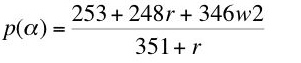
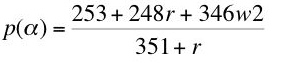
Given the above conditions, Equations 1 and 2 must be satisfied if the Alpha technique is adopted by the firms:

(1)
(2)
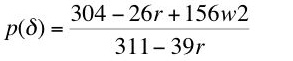
where corn is the numeraire, p is the price of steel, w1 is the wage of category 1 labor, w2 is the wage of category 2 labor, and r is the rate of profits (sometimes called the interest rate). The constants in Equation 1 come from the steel-producing process (Process A) in the alpha technique. The constants in Equation 2 come from the corn-producing process (Process D). Equations 1 and 2 provide a system of two equations in four unknowns. Thus, two degrees of freedom exist in this system. The system can be solved for the wage of category 1 labor and the price of steel in terms of a given rate of profits and a given wage of category 2 labor.

(3)
(4)
Equation 3 is the so-called factor price surface for the Alpha technique. This is a two-dimensional surface in a three-dimensional space.

Corresponding solutions for the systems of equations arising for the Beta, Gamma, and Delta techniques are relegated to Appendix C.

5.0 Choice of Technique
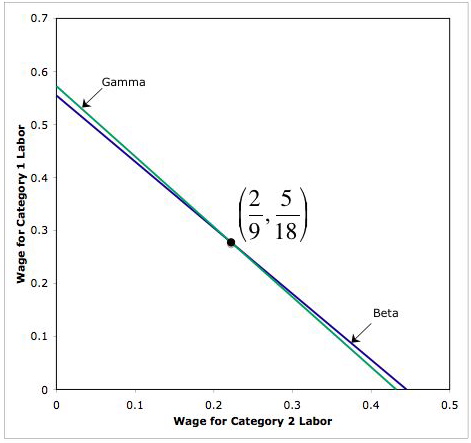
The system of equations described in Section 4 for a given technique guarantee that costs, including interest charges, do not exceed revenues for the processes comprising that technique. They also guarantee that no pure economic profits can be earned by operating either one of those processes. They do not guarantee that no pure economic profits can be earned in the processes outside that technique. That is, it remains to be shown which technique is cost-minimizing. The so-called factor-price frontier can be used to analyze the choice of technique.

For this example, the factor-price frontier is a two-dimensional surface in a three-dimensional space. The dimensions of that space are the rate of profits and the wages for the two categories of labor. I consider a slice through the frontier for two separate values of the rates of profits.

5.1 A Rate of Profits of 0%
Figure 2 shows the factor-price curves for three techniques when the rate of profits is zero. (The curve for the Delta technique is never on the frontier formed from the outer envelope of these curves, and it is not shown.) The cost-minimizing technique at a given rate of profits and a given wage of category 2 labor maximizes the wage of category 1 labor. Thus, for a rate of profits of zero percent, the Alpha technique is cost minimizing at a low wage of category 2 labor, the Beta technique is cost-minimizing at an intermediate wage, and the Gamma technique is cost-minimizing at a high wage. (Notice that the curves for the techniques are straight lines in the figure. This is a general implication of the mathematics. Reswitching of techniques cannot arise at a given level of the rate of profits for varying levels of the wages of the two categories of labor.)
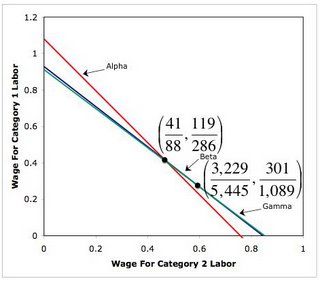
Figure 2: Factor Price Fronter At r = 0%
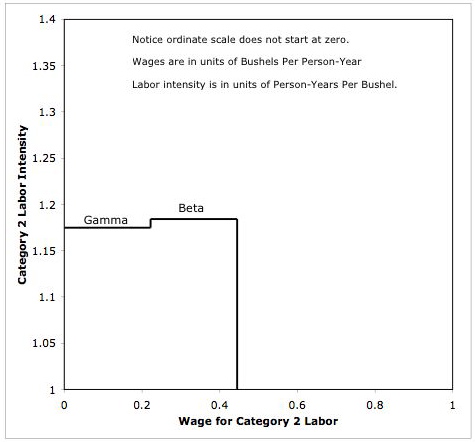
Since the technique and prices have been determined at a zero percent rate of profits, for any given wage of category 2 labor, one can graph the labor intensity for category 2 labor for the cost-minimizing technique against the wage of category 2 labor. Figure 3 shows the result. In this case, a higher wage of category 2 labor is associated with a step-decrease in the labor intensity of category 2 labor. For this specific example, the behavior at an interest rate of zero percent seems to conform to ill-educated and outdated neoclassical intuition about factor substitution.
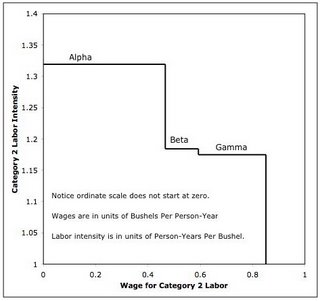
Figure 3: Category 2 Labor Intensity Versus Wage At r = 0%


5.2 A Rate of Profits of 150%
Figure 4 shows the factor-price curves on the frontier when the rate of profits is 150 percent. In this case, the Gamma technique is cost-minimizing at a low wage of category 2 labor, while the Beta technique is cost-minimizing at a high wage.
Figure 4: Factor Price Fronter At r = 150%
Figure 5 shows the labor-intensity of category 2 labor graphed against the wage of category 2 labor. In this case, a higher wage is associated with a choice of technique in which a more labor intensive technique. It is mathematically incorrect to state that, given typical neoclassical assumptions, firms will substitute another category of labor if the wage of one category of labor is increased.
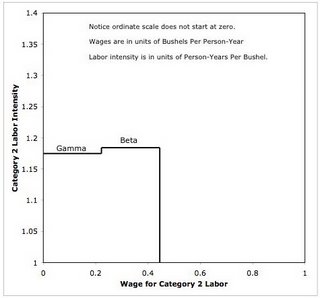
Figure 5: Category 2 Labor Intensity Versus Wage At r = 150%


6.0 Conclusion
So much for explaining wages and employment by the interaction of well-behaved supply and demand functions for labor categories in any practical application, as such functions are understood in neoclassical economics.

(A counterargument would show how to draw empirically-applicable, downward-sloping labor demand functions in this and related examples; point out some typical neoclassical assumption violated in this and related examples; state empirically validated special-case conditions on, say, technology that rule out these sort of Sraffa effects; show how the rejection of the old-fashioned neoclassical story about substitution effects is consistent with typical applications; or, perhaps, reject such applications.)

Appendix C
Appendix C.1 Beta Prices
(C-1)
(C-2)
Appendix C.2 Gamma Prices
(C-3)
(C-4)

Appendix C.3 Delta Prices
(C-5)
(C-6)

References
  • Kurz, Heinz D. and Neri Salvadori (1995). Theory of Production: A Long-Period Analysis, Cambridge University Press
  • Metcalfe, J. S. and Ian Steedman (1972). "Reswitching and Primary Input Use", Economic Journal

Monday, February 05, 2007

Example With Heterogeneous Labor (Part 2 of 3)

3.0 Quantity Flows
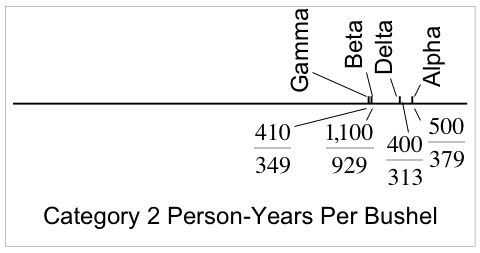
The example is constructed by comparing constant prices associated with stationary states for producing the net output of a bushel corn. Four stationary states are possible, or linear combinations of them. Each of the four pure stationary states corresponds to a choice of one of the techniques. Table 4 shows the quantity flows for a stationary state in which the alpha technique is used. The quantity flows for the stationary states in which the other techniques are used are shown in Appendix B.
Table 4: Quantity Flows For Alpha Technique
InputsSteel IndustryCorn Industry
Category 1 Labor(1/379) Person-Year(350/379) Person-Year
Category 2 Labor(100/379) Person-Years(400/379) Person-Years
Steel0 Ton(100/379) Ton
Corn(71/379) Bushel(50/379) Bushel
Outputs(100/379) Tons Steel(500/379) Bushels Corn
Notice that the steel used up as an input in the stationary state shown in Table 4 is exactly replaced by the output of the steel industry. After replacing the corn used up as inputs in the two industries, the net output of this stationary state is one bushel corn. And (500/379) person-years of category 2 labor are used to produce this net output. Thus, for the alpha technique, the category 2 labor intensity of corn output is (500/379) person-years per bushel, as shown in Figure 1. The category 2 labor intensities for the other techniques can easily be calculated from the Tables in the appendix.
Figure 1: Technique By Category 2 Labor Intensity
Appendix B
Table B-1: Quantity Flows For Beta Technique
InputsSteel IndustryCorn Industry
Category 1 Labor(1/929) Person-Year(1,000/929) Person-Years
Category 2 Labor(100/929) Person-Year(1,000/929) Person-Years
Steel0 Ton(100/929) Ton
Corn(71/929) Bushel0 Bushel
Outputs(100/929) Tons Steel(1,000/929) Bushels Corn

Table B-2: Quantity Flows For Gamma Technique
InputsSteel IndustryCorn Industry
Category 1 Labor(33/349) Person-Year(350/349) Person-Years
Category 2 Labor(60/349) Person-Year(350/349) Person-Years
Steel(15/349) Ton(35/349) Ton
Corn(1/349) Bushel0 Bushel
Outputs(50/349) Tons Steel(350/349) Bushels Corn

Table B-3: Quantity Flows For Delta Technique
InputsSteel IndustryCorn Industry
Category 1 Labor(66/313) Person-Years(245/313) Person-Years
Category 2 Labor(120/313) Person-Years(280/313) Person-Years
Steel(30/313) Ton(70/313) Tons
Corn(2/313) Bushel(35/313) Bushel
Outputs(100/313) Tons Steel(350/313) Bushels Corn

Sunday, February 04, 2007

Example With Heterogeneous Labor (Part 1 of 3)

1.0 Introduction
I thought I would go through another example in which firms want to hire more workers (per unit output) at a higher wage. Since the last time I presented such an example, I've learned more about how to present mathematics in a blog post.

This example was originally developed by Metcalfe and Steedman. I've renamed the inputs so as to present it as a case of non-competing types of heterogeneous labor. I don't think reswitching need occur for the behavior illustrated in Figure 5 in the third part to occur.

2.0 Data On Technology
Consider a very simple economy that produces a single consumption good, corn, from inputs of two categories of labor, steel, and (seed) corn. All production processes in this example require a year to complete. Two production processes are known for producing steel. These processes require the inputs shown in Table 1 to be available at the start of the year for each ton steel produced and available at the end of the year. Two processes, as shown in Table 2, are also known for producing corn.
Table 1: Inputs Required Per Ton Steel Produced
Process AProcess B
Category 1 Labor(1/100) Person-Year(33/50) Person-Year
Category 2 Labor1 Person-Year(6/5) Person-Year
Steel0 Ton(3/10) Ton
Corn(71/100) Bushel(1/50) Bushel

Table 2: Inputs Required Per Corn Bushel Produced
Process CProcess D
Category 1 Labor1 Person-Year(7/10) Person-Year
Category 2 Labor1 Person-Year(4/5) Person-Year
Steel(1/10) Ton(1/5) Ton
Corn0 Bushel(1/10) Bushel
A technique consists of a process for producing the consumption good, corn, and a process for producing each non-consumption reproducible good used as an input in the process for producing the consumption good. In other words, a technique is a combination of one steel-producing process and one corn-producing process. The number of techniques is the product of the number of corn-producing processes and the number of steel-producing process. Thus, four techniques exist in this example. They are defined in Table 3.
Table 3: Techniques and Processes
TechniqueProcesses
AlphaA, D
BetaA, C
GammaB, C
DeltaB, D

Appendix A
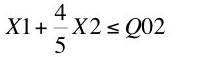
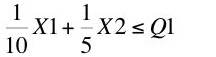
The production functions that describe the technology in this example exhibit common neoclassical features: Constant Returns to Scale and non-increasing marginal returns to each factor. For purposes of constructing the production function for corn, the quantities of both categories of labor, steel, and corn available as input to corn production are taken as given. Let Q01, Q02, Q1, and Q2 be these quantities of category one labor, category two labor, steel, and corn, respectively. All quantities are measured in physical units (person-years, tons, bushels). The following Linear Program expresses the problem of maximizing the output of corn from these inputs: choose X1 and X2, the quantities of corn produced by processes C and D, respectively, to maximize:
(A-1)
such that
(A-2)
(A-3)
(A-4)
(A-5)
(A-6)
The production function for corn, f( Q01, Q02, Q1, Q2 ) is the value of the objective function, X* for the solution of the above Linear Program, expressed as a function of the physical inputs into corn production. These parameters define the right-hand-side of the linear constraints in Displays A-2 through A-5. The left-hand-side of these constraints is defined by the parameters in Table 2.

One standard method of visualizing production functions is with isoquants. An isoquant for this production function is a four dimensional surface, which I find difficult to draw. Accordingly, suppose the inputs of category 1 labor and corn are not binding for the level of output for which isoquants are drawn. Then Figure A-1 shows the isoquants for the corn production function in the remaining two dimensions. The dashed rays from the origin correspond to the two processes available for producing corn. If only one process for producing corn was known (a Leontief production function or "fixed coefficients" of production), an isoquant would consist of two rays, one extending horizontally right from the dashed line and the other extending vertically upward from the dashed line for that process. For the two known processes, an isoquant also contains the line segment shown sloping downward to the right. This line segment corresponds to a linear combination of the processes C and D, in which coefficients of production continuously vary.
Figure A-1: Isoquants For Corn Production Function
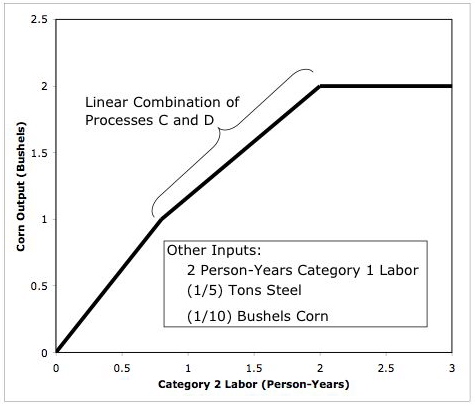
One can also consider the (physical) marginal product of category 2 labor as the slope of the function shown in Figure A-2. In this case, no inputs except category 2 labor are binding for the lowest quantities of category 2 labor input. Since process D produces more corn than process C per person-year of category 2 labor, process D provides the steepest part of this projection of the production function for corn. When the steel input becomes binding, the marginal product of category 2 labor declines to the slope of the line segment corresponding to linear combinations of the two processes. Finally, the other inputs constrain a corn-producing firm to only adopt process C for a fixed level of output, and the marginal product of category 2 labor is zero. For this model of technology the marginal product of each input is a decreasing step function.
Figure A-2: Outputs As Category 2 Labor Varies
A textbook presentation of production functions to students assumed to know the calculus often presents smooth isoquants and production functions that are at least twice continuously differentiable. A discrete model of technology can approximate smooth functions arbitrarily closely, given enough processes. When more processes are available, more line segments representing linear combinations of processes arise. Smooth production functions correspond to the limit, in which there an uncountably infinite number of processes available. As I understand it, no point in the limit case, however, corresponds to a linear combination of processes. "Perverse" Sraffa effects can arise in both a discrete and a smooth technology. But I like Linear Programming, and will stick to a discrete model of technology.

Tuesday, January 30, 2007

Bastard Keynesianism From Krugman

Consider this claim:
"Until John Maynard Keynes published The General Theory of Employment, Interest, and Money in 1936, economics - at least in the English-speaking world - was completely dominated by free-market orthodoxy. Heresies would occasionally pop up, but they were always suppressed. Classical economics, wrote Keynes in 1936, 'conquered England as completely as the Holy Inquisition conquered Spain.' And classical economics said that the answer to almost all problems was to let the forces of supply and demand do their job." -- Paul Krugman
A lot of historians of economics have been discussing this claim, under a thread titled "QUERY - All pre-1936 economists were laissez-faire advocates".

I want to consider why Krugman understates the impact of the General Theory, if you read this as a statement about policy. In Britain, some economists certainly opposed both the building of Keynesian institutions and fiscal countercyclical policy, as later promoted, for example, by Abba Lerner. As such opponents, I cite Hayek and Robbins at the London School of Economics and the "Treasury view". I also think that many economists were arguing for something like Keynesian policy.

But I think these "Keynesian" advocates were not basing themselves on a theory strongly integrated with the central neoclassical (Marshallian?) price theory. For example, American Institutionalists of the time could be accused of advocating "measurement without theory", as Koopmans later put it. And those, such as some Keynes' British colleagues, looking into business cycle theory or monetary theory could be accused of ad-hoc short term theory.

A Post Keynesian perspective is that Keynes was addressing this lack of theoretical support for pragmatic policy more than the lack of reasonable policy itself. He says so himself in the second sentence of the preface:
"But [this book's] main purpose is to deal with difficult questions of theory, and only in the second place with the applications of this theory to practice." - John Maynard Keynes, The General Theory of Employment, Interest, and Money, p. v
I find this perspective lacking in the HES discussion so far. (I do not want to argue, in this place, against any argument that, for example, (early) Joan Robinson is a source of what she later labeled "bastard Keynesianism.")

Monday, January 29, 2007

Mumpsimus

Apparently, Gary Becker and Richard Posner have an editorial in the 26 January 2007 issue of the Wall Street Journal. They oppose an increase in the minimum wage:
"An increase in the minimum wage raises the costs of fast foods and other goods produced with large inputs of unskilled labor. Producers adjust both by substituting capital inputs and/or high-skilled labor for minimum-wage workers and, because the substitutes are more costly (otherwise the substitutions would have been made already), by raising prices. " -- Gary Becker and Richard Posner
I know about this editorial from posts from Frederic Sautet and Don Boudreaux. Both Sautet and Boudreaux endorse Becker and Posner's "reasoning". When will economists accept arithmetic?

Sunday, January 28, 2007

Welcome To The Party

Compare and contrast this:
"When Friedman was beginning his career as a public intellectual, the times were ripe for a counterreformation against Keynesianism and all that went with it. But what the world needs now, I'd argue, is a counter-counterreformation." - Paul Krugman (2007). Who Was Milton Friedman?, New York Review of Books, V. 54, N 2 (February 15)
And this:
"What professional economics now needs is a rebellion against supply and demand. We need a rebellion against the idea that people are actually paid in proportion to the value of what they produce. We need a rebellion against the metaphor of the labor market - an entity that no one has ever seen, where no one has ever been, an entity that lacks the mechanishms of price adjustment that would be required for the marginal productivity theory to work. Economics needs a rebellion that is almost less against the system under which we live, as against the sources of our complacency about that system. We need a rebellion, not so much as against existing market institutions, as against the analytical tyranny of the idea of the market, as it applies to pay.

[Footnote:] Such a rebellion almost got going in the 1960s, when a dispute known as the 'Cambridge controversies' challenged the concept of capital as a factor of production and hence the coherence of the notion of marginal productivity. But the marginal productivity theory of the labor market survived that challenge, and its success in so doing is the root of the difficulty today." - James K. Galbraith (1998). Created Unequal: The Crisis in American Pay, Free Press: 265-266

Thursday, January 25, 2007

Steedman's Full Industry Equilibrium

Ian Steedman, over a couple of decades, has been considering a coherent comparative statics analysis of industries in equilibrium. He points out that all industries typically cannot be in equilibrium if just one input price, say, varies. More than one price must vary for the industries in the economy to remain in long-run equilibrium, that is, in what Steedman calls Full Industry Equilibrium (FIE). And he has produced many examples, often without reswitching or even capital-reversing, in which competitive firms facing Constant-Returns-to-Scale technology desire to employ more of an input per unit output when that input's price is higher.

Although he has occasionally taken excursions into consumer theory or the Heckscher-Ohlin-Samuelson (HOS) theory of international trade, Steedman's analysis is not of General Equilibrium. He does not consider utility maximization. Thus, he does not consider the supply of non-produced inputs or the demand for consumer goods. FIE does not imply that the economy as a whole is in equilibrium or that supply and demand match in every industry. It is an open partial analysis.

I read the earliest couple of these papers a while ago. (I reference them in my 2005 Manchester School paper.) But only in the last few years did I become aware that one of Steedman's research agendas is so focused.
  • Opocher, Arrigo and Ian Steedman (2006). "Long-Run Rising Supply Price and the Numeraire", Discussion Papers in Economics, Manchester Metropolitan University, ISSN 1460-4906
  • Opocher, Arrigo and Ian Steedman (2005). "The Industry Supply Curve: Two Different Traditions", Manchester Metropolitan University, ISSN 1460-4906
  • Steedman, Ian (2006a). "Long Run Demand for Labour in the Consumer Good Industry", Metroeconomica, V. 57, N. 2: 158-164
  • Steedman, Ian (2006b). "Differential Depreciation and the 2x2 Model of Distribution, Pricing and Production", Metroeconomica, V. 57, N. 1: 112-119
  • Steedman, Ian (2005). "Long Run Input Use-Input Price Relations and the Cost Function Hessian" (working paper?)
  • Steedman, Ian (2004). "Consumer Substitution Effects Under Full Industry Equilibrium", Metroeconomica, V. 55, N. 1: 41-48.
  • Steedman, Ian (2003). "The Comparative Statics of Industry-Level Produced-Input-Use in HOS Trade Theory" (working paper?)
  • Steedman, Ian (2002). "Process Recurrence and Input Use at the Industry Level: A Coherent Long-Period Analysis", Economic Issues, V. 17, P. 1 (March): 59-66
  • Steedman, Ian (1998). "Produced Input Use Per Unit of Output", Economic Letters, V. 59: 195-199
  • Steedman, Ian (1988). "Sraffian Interdependence and Partial Equilibrium Analysis", Cambridge Journal of Economics, V. 12: 85-95
  • Steedman, Ian (1985). "On Input 'Demand Curves'", Cambridge Journal of Economics, V. 9, N. 2: 165-172

Tuesday, January 23, 2007

An Institutionalist Before Joan Robinson

"...An eminent professor of law once defined the legal mind in this way. If, he said, there are two things so closely related that one cannot be conceived except in terms of the other, but if you can think of one without thinking of the other, then you have a legal mind. In somewhat similar fashion it might be said that if two things are utterly and completely distinct, but if you nevertheless think of them as being identical, then you have an economic mind...

...This is the idea of capital. Unfortunately for all of us, it is quite false. As everybody knows, the progress of any society depends upon its ability to enlarge the productive apparatus of the community...But since money will buy anything in commercial society, those who control accumulations of money are in a position to buy and control the increasing productive apparatus that spells progress. Therefore, it seems that money is the instrument of progress...

...Some people call it nature, but others call it capital. Even in early modern times industry was growing fast. That growth was a function of the industrial equipment of the community, as anybody could see even in early times. To identify that function with the accumulation of money was to attribute the whole thing to the men who made money. This is what we accomplish by calling both things 'capital.' The argument runs as follows: Economic progress results from the growth of the material equipment of industry, that is to say, capital; capital, that is to say, money, is created by 'saving'; therefore economic progress is made possible by 'saving.' In this fashion the money power became functional.

...The double-talk of capital has become an ingrained habit. It runs through virtually every textbook. Textbook writers solemnly warn their students of confusion which lurk behind this word. Resolutely they insist that it must be used to refer to one thing or the other, and not both. With exemplary clarity they declare, for example, that they propose to use it to refer only to the physical equipment of industry: plant, machines, raw materials, and so forth. And in the very next paragraph we find them saying that capital is brought into existence by saving! But now, obviously, they are talking about money!

That is how it is done." -- C. E. Ayres, The Divine Right of Capital (1946)

Saturday, January 20, 2007

Sicklied O'er With The Pale Cast Of Thought

"'In truth, however, value is here [in capital] the active factor in a process, in which, while constantly assuming the form in turn of money and commodities, it at the same time changes in magnitude, differentiates itself by throwing off surplus-vaule from itself; the original value, in other words, expands spontaneously. For the movement, in the course of which it adds surplus-value, is its own movement, its expansion, therefore, is automatic expansion. Because it is value, it has acquired the occult quality of being able to add value to itself. It brings forth living offspring, or, at the least, lays golden eggs...

In simple circulation, C-M-C, the value of commodities attained at the most a form independent of their use-values, i.e., the form of money; but the same value now in the circulation M-C-M, or the circulation of capital, suddenly presents itself as an independent substance, endowed with a motion of its own, in which money and commodities are mere forms which it assumes and casts off in turn. Nay, more: instead of simply representing the relations of commodities, it enters now, so to say, into private relations with itself. It differentiates itself as original value from itself as surplus value; as the father differentiates himself from himself qua the son, yet both are one and of one age: for only by the surplus-value of 10 pounds does the 100 pounds originally advanced become capital, and so on as this takes place, so soon as the son, and by the son, the father is begotton, so soon does their difference vanish, and they again become one, 110 pounds.' [Marx, Capital, V. 1, 171-173]
...Is capital, then, the true Subject/Substance? Yes and no: for Marx, this self-engendering circular movement is - to put it in Freudian terms - precisely the capitalist 'unconscious fantasy' which parasitizes upon the proletariat as the 'pure substanceless subjectivity'; for this reason, capital's speculative self-generating dance has a limit, and it brings about the conditions of its own collapse. This insight allows us to solve the key interpretative problem of the quote above: how are we to read its first three words, 'In truth, however'? First, of course, they imply that this truth has to be asserted against some false appearance or experience: the everyday experience that the ultimate goal of capital's circulation is still the satisfaction of human needs, that capital is just a means to bring this satisfaction about in a more efficient way. This 'truth', however, is not the reality of capitalism: in reality, capital does not engender itself, but exploits the worker's surplus-value. There is thus a necessary third level to be added to the simple opposition of subjective experience (of capital as a simple means of efficiently satisfying people's needs) and objective social reality (of exploitation): the 'objective deception', the disavowed 'unconscious' fantasy (of the mysterious self-generating circular movement of capital), which is the truth (although not the reality) of the capitalist process. Again - to quote Lacan - truth has the structure of a fiction: the only way to formulate the truth of capital is to present this fiction of its 'immaculate' self-generating movement. And this insight also enables us to locate the weakness of the 'deconstructionist' appropriation of Marx's analysis of capitalism: although it emphasizes the endless process of deferral which characterizes this movement, as well as its fundamental inconclusiveness, its self-blockade, the 'deconstructionist' retelling still describes the 'fantasy' of capital - it describes what individuals believe, although they don't know it." -- Slavoj Zizek (2006). The Parallax View, MIT Press: 59-60.

Friday, January 19, 2007

Reification and the Consciousness of the Proletariat

If you grow up in a capitalist society, like the United States, you will be inclined to all sorts of odd beliefs, about human nature, laws of economics, and earning one's pay, for example. These beliefs will condition how you feel about, for example, labor unions. Academic economics is an expression of this tendency. As such, the best it can be, without a lot of pushback from within and without, is confused. Since it is confused, one can find self-contradictions in its teachings, and one will find which theoretical trends are marginalized and which are valorized have little to do with the worth of their contents. (Note that one can argue about specific self-contradictions and the worth of specific trends independently of one's opinions about the above claims.)

I suggest that one can find some such claims in some of the texts of Karl Marx. And those specific texts are still worth exploring. I refer to, for example:
  • The Poverty of Philosophy (I suppose specifically, Chapter II, The Metaphysics of Political Economy, is a more narrow reference)
  • The distinction between "Classical political economy" and "Vulgar political economy" in the author's preface to the second edition of Capital
  • Capital, Volume 1, Part 1, Chapter I, Section 4: The Fetishism of Commodities and the Secret Thereof
  • Capital, Volume 3, Part Seven: The Revenues and Their Sources
  • Theories of Surplus Value, Part III, Addenda: Revenue and Its Sources. Vulgar Political Economy

Thursday, January 18, 2007

Nothing is New Under the Sun

A lot of neoclassical textbooks echo ideas developed by J. R. Hicks. I believe Shove's criticisms are still applicable to mainstream teaching.
"The central thesis is this: that if wage-rates generally are forced above 'the competitive level' (whatever exactly that may be), unemployment will be caused in two ways: (i) by the 'tendency for capital to shift from the less capitalistic to the more capitalistic trades' (and methods) ..., i.e. to 'those which use a relatively large proportion of capital to labour in making a unit of product' ..., from those which use a relatively small proportion; (ii) because 'the total supply of capital' will be diminished ..., since capital will be 'lost' ..., 'eaten into' ..., 'consumed' ..., 'destroyed' ..., 'cut into' ..., 'dissipated' ... or 'decumulated', and 'savings' therefore checked ... Unfortunately, 'capital' is not defined and we are not told how quantities of it (or indeed of labour) are to be measured, and similarly of 'saving'. Presumably, these are 'matters which properly belong to the theory of capital' ... But until they are cleared up it is impossible to follow Mr. Hicks's reasoning; and surely a theory of wages may not unreasonably be expected to include a precise and intelligible explanation of the processes through which wage-rates influence employment. For instance, it is not immediately apparent why employment should be diminished in the first of the two ways above distinguished...

...Again, Mr. Hicks excludes from consideration the monetary reactions of wage-policy. He recognises that 'the kind of processes we have been examining would itself have reactions on the monetary machine; and these would have further repercussions on the "real" process' ... 'But', he continues, 'perhaps the writer will be excused if he decides that, for the present, these repercussions lie outside the Theory of Wages' on the grounds that there is no general agreement among economists about the character of the reactions. But it is not possible to separate 'the real process' from 'its monetary reactions' in this way when we are dealing with all-round changes in wage-rates - even if it be possible when we are concerned with changes in a single occupation playing a small part in the total activity of the community. For in a monetary economy it is through the monetary mechanism that the effects of such a change are brought about, and their nature cannot be discovered or understood without a clear analysis of that mechanism: the monetary reactions, in fact, are not simply 'repercussions of' the process set up by the change, they are the process and must occupy a central position in the analysis of it. The only way to get rid of them is to postulate a barter-economy; and this Mr. Hicks does not do - his discussion hovers between what would happen in a barter economy and what does happen in a money-economy. He seems, for example, to suppose that monetary disturbances may be neglected if the wages fixed are supposed to be 'real wages' in the sense of 'money wages corrected for movements in the price-level of consumption goods' by means of 'cost of living sliding-scales' ... - which is manifestly untrue.

Thus, the obscurity and lack of precision which mar these chapters spring, I believe, from the attempt to narrow down the theory of wages by excluding from it any discussion, first, of the nature of capital and processes governing its supply, and, secondly, of the monetary reactions set up by changes, or disequilibria, in wage-rates." -- G. F. Shove, (1933). "Review of Hicks's The Theory of Wages, Economic Journal
See also:
  • Molina, Mario Garcia (2005). "Capital Theory and the Origins of the Elasticity of Substitution (1932-35)", Cambridge Journal of Economics, V. 29: 423-437

Tuesday, January 16, 2007

Additions To Blog Roll

You might notice I recently added Chris Hayes and David Warsh to my blogroll. I may soon add Franklin Serrano to my blog roll. He describes his blog:
"The purpose of this blog is to be a forum for discussing political economy issues in the tradition of Piero Sraffa and Mikhail Kalecki."
I assume he'll be more policy-oriented than I am.

I've been thinking about saying something about Michel Kalecki myself, if only to document that it is a strawperson to say leftists imagine democratic governments will be run by altruistic idealist politicians looking out for the nation as a whole.

Monday, January 15, 2007

No One Can Repent And Will At Once; The Law of Contradiction Won't Allow It

Don Boudreaux confuses a shift in production functions - that is an innovation - with a choice among techniques in response to changes in relative factor prices. Not only that, he is simply incorrect about the analysis of the choice of technique.

Gabriel Mihalache also pretends that the logic of perfect competition with ideal rational behavior supports his exploded ideas about the minimum wage.

Sunday, January 14, 2007

The Wretched of My Earth

I was born and raised in the Rochester metropolitian area. Long before I was born, the speech containing the following extract was delivered at Rochester:
"What to the American slave is your Fourth of July? I answer: a day that reveals to him, more than all other days in the year, the gross injustice and cruelty to which he is the constant victim. To him your celebration is a sham; your boasted liberty, an unholy licence; your national greatness, swelling vanity; your sounds of rejoicing are empty and heartless; your denunciation of tyrants, brass-fronted impudence; your shouts of liberty and equality, hollow mockery; your prayers and hymns, your sermons and thanksgivings, with all your religious parade and solemnity, are, to him, more bombast, fraud, deception, impiety and hypocrisy - a thin veil to cover up crimes which would disgrace a nation of savages...

...You boast of your love of liberty, your superior civilization, and your pure Christianity, while the whole political power of the nation (as embodied in the two great political parties) is solemnly pledged to support and perpetuate the enslavement of three millions of your countrymen. You hurl your anathemas at the crown-headed tyrants of Russia and Austri and pride yourselves on your democratic institutions, while you yourselves consent to be mere tools and bodyguards of the tyrants of Virginia and Carolina. You invite to your shores fugitives of oppression from abroad, honor them with banguets, greet them with ovations, cheer them, toast them, salute them, protect them, and pour out your money to them like wate; but the fugitive from your own land you advertise, hunt, arrest, shoot, and kill. You glory in your refinement and your universal education; yet you maintain a system as barbarous and dreadful as ever stained the character of a nation - a system begun in avarice, supported in pride, and perpetuated in cruelty. You shed tears over fallen Hungary, and make the sad story of her wrongs the theme of your poets, statesmen, and orators, till your gallant sons are ready to fly to arms to vindicate her cause against the oppressor; but in regard to the ten thousand wrongs of the American slave, you would enforce the strictest silence, and would hail him as an enemy of the nation who dares to make these wrongs the subject of public discourse!" -- Frederick Douglas, 5 July 1852

Thursday, January 11, 2007

A Daniel Come To Judgement! Yea, A Daniel!

A blog post from a guest blogger at Glenn Greenwald's argues that Catholic teaching does not support some stances in opposition to an increase in the minimum wage in the United States. Catholic teaching on economic matters predates the establishment of capitalism. I happen to have recently read a claim by Alessandro Roncaglia that Pribram (1983) is a good scholarly work on medieval economics.

While I'm bringing attention to Catholic teaching on economics, I might as well mention some other texts. I don't claim to be authoritative on Catholic theology. These are just some texts I am aware of the existence of. Popes Leo XIII and Pius XI both issued encyclicals on the social question. I provide some quotes from a second Vatican Council document:
"...the picture is not without its disturbing elements. Many people, especially in economically advanced areas, seem to be dominated by economics; almost all of their personal and social lives are premeated with a kind of economic mentality, and this is true of nations that favor a collective economy as well as other nations. At the very time when economic progress (provided it is directed and organized in a reasonable and human way) could do so much to reduce social inequalities, it serves all too often to aggravate them; in some places it even leads to a decline in the position of the underprivileged and contempt for the poor. In the midst of vast numbers of people deprived of the absolute necessaries of life there are some who live in luxury and squander their wealth, and this happens in less developed areas as well. Luxury and misery exist side by side. While a few individuals enjoy an almost unlimited opportunity to choose for themselves, the vast majority have no chance whatever of exercising personal initiative and responsibility, and quite often they have to live and work in conditions unworthy of human beings...

...Justice and equity also demand that the livelihood of individuals and their families should not become insecure and precarious through a kind of mobility which is a necessary feature of developing economies. All kinds of discrimination in wages and working conditions should be avoided in regard to workers who come from other countries or areas and contribute by their work to the economic development of a people or a region. Furthermore, no one, especially public authorities, should treat them simply as mere tools of production rather than as persons; they should facilitate matters so that they may have their families with them and be able to acquire decent housing conditions, and they should endeavor to integrate them into the social life of the country or area to which they have come. However, employment should be found for them in their own countries whenever possible...

...we believe by faith that, through the homage of work offered to God, man is associated with the redemptive work of Jesus Christ whose labor with his hands at Nazareth greatly ennobled the dignity of work. This is the source of every man's duty to work faithfully, as well as the basis of his right to work; moreover, it is the duty of society, according to the prevailing circumstances, to see to it that all citizens have the opportunity of finding employment. Finally, renumeration for work should guarantee man the opportunity to provide a dignified livelihood for himself and his family on the material, social, cultural and spiritual level to correspond to the role and the productivity of each, the relevant economic factors in his employment, and the common good.

Since economic activity is, for the most part, the fruit of the collaboration of many men, it is unjust and inhuman to organize and direct it in such a way that some workers are exploited. But it frequently happens, even today, that workers are almost enslaved by the work they do. Under no circumstances can this fact be justified by so-called laws of economics. Therefore, the entire process of productive work must be adapted to the needs of the human person and to his way of life, with special attention to domestic life and mothers of families in particular, always taking sex and age into account. Workers should have the opportunity to develop their talents and their personality through the performance of their work. While devoting their time and energy to the performance of their work with a due sense of responsibility, they should also be allowed sufficient rest and leisure to cultivate their family, cultural, social and religious life. In addition, they should be given the opportunity to develop those energies and talents to which their professional work may perhaps give little scope...

...Among the fundamental rights of the individual must be numbered the right of workers to form themselves into associations which truly represent them and are able to cooperate in organizing economic life properly. Included is the right to freely take part in the activities of such associations without fear of reprisal..." - Paul VI (1965)
More parochially, Catholics in the United States can look to a U. S. Bishops' pastoral letter of two decades ago.
  • Leo XIII (1891). Rerum Novarum
  • Paul VI (1965). De Ecclesia in Mundo Huius Temporis
  • Pius XI (1931). Quadragesimo Anno
  • Pribram, K. (1983). A History of Economic Reasoning, Baltimore: John Hopkins University Press
  • United States Catholic Conference (1986). Economic Justice for All: Pastoral Letter on Catholic Social Teaching and the U.S. Economy

Wednesday, January 10, 2007

A Post Keynesian Model of Growth and Distribution (Part 4 of 4)

3.0 SUMMARY

The previous three parts specify a steady-state growth model applicable to an advanced capitalist economy. Figure 2 summarizes the structure of this model. The arrows indicate how variables are determined, including accounting identities, in the mathematical structure of the model. Notice that the major macroeconomic variables are determined by decisions within the corporations. Household savings decisions can affect only the overall value of stocks and the personal distribution of income. Control over the means of production determines the functional distribution of income.
Figure 2: Dependencies Among Variables and Parameters
The above model is one of a family of models. Table 2 shows two important special cases in the development of this model. A generalization would assume saving propensities vary by source of income, as well as class.
Table 2: Variants
VariantCharacterizationParameters
Kaldor (1966) variantNo class of pure capitalistssr = 0, j = 1
Pasinetti (1962) variantNo corporate sectorsc = 0, f = 1, v = 1
A number of research programs can be organized around these models. The generalization of the production models to more commodities has been long accomplished. Kaldor also included endogenous technical change in his models. One might assume industries exhibit various barriers to entry. This is Paolo Sylos Labini's (old) Industrial Organization. The model shows the rate of industrial profits as depending on corporate decisions about growth and finance. Related issues are explored in managerial theories of the firm, as developed by Edith Penrose, Robin Marris, Adrian Wood, Alfred Eichner, and Edward Nell. I don't think this family of models is particularly strong on environmental issues; nevertheless, the extension of the production model to include joint production provides an essential tool for environmental economics. Some work has been done on including government and international trade in this family of models. Some have examined the relationship of this family of models to other theories of distribution, such as a monetary theory of distribution. One might see this theory as a long period extension of Keynes' General Theory. Kregel, who emphasizes the role of money and uncertainty have questioned whether such elements were adequately incorporated into this family of models. Man-Seop Park, building on and criticizing recent work by Thomas Palley, is investigating incorporating more elements of the financial system into this family of models. I do not claim the above brief survey is comprehensive.

REFERENCES
  • Kahn, R. F. (1959). "Exercises in the Analysis of Growth", Oxford Economic Papers, New Series, V. 11: 143-156
  • Kaldor, Nicholas (1956). "Alternative Theories of Distribution", Review of Economic Studies, V. XXIII: 83-100
  • Kaldor, Nicholas (1966). "Marginal Productivity and the Macroeconomic Theories of Distribution: Comment on Samuelson and Modigliani", Review of Economic Studies, V. XXXIII, N. 4 (Oct.): 309-319
  • Kregel, J. A. (1985). "Hamlet without the Prince: Cambridge Macroeconomics without Money", American Economic Review, V. 75, N. 2 (May): 133-139
  • Moss, S. J. (1978). "The Post-Keynesian Theory of Income Distribution in the Corporate Economy", Australian Economic Papers, V. 17, N. 31 (Dec.):303-322
  • Park, Man-Seop (2006). "The Financial System and the Pasinetti Theorem", Cambridge Journal of Economics, V. 30: 201-217
  • Pasinetti, Luigi L. (1962). "Rate of Profit and Income Distribution in Relation to the Rate of Economic Growth", Review of Economic Studies, V. XXIX, N. 4 (Oct.): 267-279
  • Robinson, Joan (1962). Essays in the Theory of Economic Growth, Macmillan