Monday, July 24, 2023

Prices In An Example Of The Life Of A Machine

Figure 1: Structural Economic Dynamics of the Price of a New Machine

I am not sure that there is any great insight here. But this post depicts the evolution of prices in an example which I have been explaining in two posts. For some parameters, I have found that a shorter economic life of a machine may be associated with a more capital-intensive technique around a switch point. This can occur at both a 'normal' and a 'perverse' switch point. This finding raises difficulties for tradional expositions of Austrian capital theory.

In this post, I repeat the specification of technology. Table 1 presents coefficients of production. Corn is both a consumption good and a capital good, insofar as it is an input into all four processes. Corn is also the numeraire. Machines are only capital goods. Technology is not yet fully specified in this example, with numerical values undefined for two coefficients of production. The machine does not work with a constant efficiency throughout its physical life. The inputs of seed corn needed to work with the machine increase in agriculture as the machine ages. Labor inputs first increase and then decrease. A one-year old machine is more efficient than both a two-year old and a three-year old machine. Whether a two-year old machine is more efficient than a three-year old machine cannot be determined based on physical data alone. I assume constant returns to scale and free disposal of old machines.

Table 1: Technology
InputIndustryAgriculture
IIIIIIIV
Labora0,139/200117/20039/100
Corna1,139/100141/250117/200
New Machines0100
1-Year Old Machines0010
2-Year Old Machines0001
Output
Corn0111
New Machines1000
1-Year Old Machines0100
2-Year Old Machines0010

I defined the techniques in the previous posts. In the Alpha technique, the machine is run for one year. In Beta, it is run for two years. In Gamma, it is run for its full physical life of three years.

The evolution of the coefficients for production for labor and corn inputs in manufacturing the machine is as noted in Figure 1. I showed previously that, with these specific assumptions, time is partitioned by fluke switch points. Aside from extremes at a time t of 0 and 9, I chose three instants of time, each at the midpoint of one of these partitions. Figures 1 and 2 graph the price of a new machine, one-year old machine, and two-year old machine as functions of the rate of profits at these instants of time.

Figure 2: Structural Economic Dynamics of the Prices of Old Machines

As time goes on, the price of production of each vintage machine decreases at any given rate of profits with technical progress in the manufacture of machines. The maximum possible rate of profits, when 'workers live on air', also increases with technical progress.

At the start of time, the Gamma technique is cost-minimizing for any feasible rate of time. This is depicted by the top curve in Figure 1 and both panes of Figure 2. At the end of time, technical progress has made the Alpha technique cost-minimizing for any feasible rate of profits. See the bottom curve in Figure 1. Since the prices of one-year old and two-year old machines are zero for Alpha, no curves for t = 9 appear in Figure 2.

The choice of the economic life of the machine varies with the rate of profits at intermediate times. About when t = 3, the price of a two-year old machine turns negative at a high enough rate of profits at Gamma prices. The machine can still be used in this range if it disposed of after running for two years. At the start of the second year, it is one year old and has a positive price. The Beta technique is cost-minimizing at a high enough rate of profits. At the switch point in which the price of the two-year old machine is zero, the prices of new and one-year old machines are the same for Beta and Gamma techniques. This common price of machines is an illustration of the general result that prices are unique at switch points.

A time around t = 5.214 is an example of reswitching. The price of a one-year old machine is negative, at Gamma and Beta prices, at a rate of profits of zero. Thus, for a low enough rate of profits, the Alpha technique is cost-minimizing. The price of a one-year old machine turns positive at Gamma prices, with an increase in the rate of profits, before it turns positive for Beta prices. A first switch point exists between Alpha and Gamma at a low rate of profits. At a higher rate of profits, the price of a two-year machine becomes zero at Gamma prices. This is the switch point between Beta and Gamma noted in the previous paragraph above. Finally, the price of a one-year old machine becomes negative at Beta prices at a high rate of profits, and Alpha is once again cost-minimizing.

A time around t = 5.96 is a simpler case of reswitching, between Alpha and Gamma. Two switch points exist, and the price of a one-year old machine is zero at Gamma prices at those switch points. The price of a one-year old machine at Beta prices is always negative for all feasible rate of profits.

This analysis demonstrates how examining when prices of production become negative relates to the determination of the cost-minimizing economic life of a machine. At switch points, the price of some old machine is zero.

Depreciation charges fall out of this analysis. Depreciation is the difference in price, at a given rate of profits, of a machine between two years. In the case of a machine of constant efficiency, charges for the cost of machines vary as the value of an annuity lasting for the length of the life of the machine. Modeling the price of a machine as varying as radioactive decay is not a good choice. The example illustrates the more general case of non-constant efficiency. Strangely enough, the machine appreciates from the second year to the third year when the cost-minimizing choice of technique is to run the machine for its full physical life.

Friday, July 21, 2023

Elsewhere

Does Learning How To Think In Coding Transfer More Generally?
  • Another YouTube Video in the above series. I suspect some of us are not fans of some of those interviewed, although you must admit they changed the world.
  • John Michael Colón, Wobbly Economics - Part I. A tribute to Fred Lee and an explanation of why you are right to distrust economists.
  • Shattering 'Market Theory', an old post on Daily Kos, reporting a discussion on a private email list of one of my numeric examples.
  • Draft of Ederer, Goldsmith-Pinkham, and Jensen (2023) on the vicious fools on EJMR. slides. These links are probably temporary, and I am in the data.

Monday, July 17, 2023

A Letter From Marx To Engels In 1868 On The First Volume Of Capital

Over years, I have considered how Marx continues and differs from classical political economy. I have also documented some foreshadowings and outlines of the transformation problem. This is another letter in a series

In this letter, Marx alludes to prices of production and the transformation problem. Apparently, he thinks at this time that volumes 2 and 3 will be a single volume.

Here he sets out three points which he thinks are original to the first volume of Capital. The first is that he abstracts from rent, interest, and profits to the general form of surplus value. Previously, he told Engels this is one of the two best points in his book. His second point in which he thinks he is original, he also thinks is one of his best points: namely, the treatment of concrete and abstract labor activities. His third original point is how he treats both time and piece wages. This is another example of abstraction. I think Marx was, despite his differences, always aware of his debt to the Ricardian socialists. Maybe, he treats them elsewhere with more respect than he ever treats Proudhon after ensuring that they never again would be drinking buddies.

8 January 1868

Dear Fred,

Ad vocem Duühring. It is a great deal from this man that he gives almost positive acceptance to the section on 'primitive accumulation'. He is still young. As a follower of Carey he is in direct opposition to the FREETRADERS. Furthermore, he is a university lecturer, and therefore not displeased that Professor Roscher, who blocks the way for them all, is receiving some kicks. One thing in his description struck me very strongly. That is, as long as the determination of value by labour time is itself left 'undetermined', as it is with Ricardo, it does not make people SHAKY. But as soon as it is brought exactly into connection with the working day and its variations, a very unpleasant new light dawns upon them. I believe one reason that Duühring reviewed the book at all is malice against Roscher. Indeed it is easy to scent his anxiety that he might also be 'Roscher'ed. Curiously, the fellow has not detected the three fundamentally new elements of the book:

1. that in contrast to all previous political economy, which from the outset treated the particular fragments of surplus value with their fixed forms of rent, profit and interest as already given, I begin by dealing with the general form of surplus value, in which all these elements are still undifferentiated, in solution as it were;

2. that the economists, without exception, have missed the simple fact that, if the commodity has the double character of use value and exchange value, then the labour represented in the commodity must also have a double character; thus the bare analysis of labour sans phrase, as in Smith, Ricardo, etc., is bound to come up against the inexplicable everywhere. This is, in fact, the whole secret of the critical conception;

3. that for the first time wages are shown as the irrational outward form of a hidden relationship, and this is demonstrated exactly in both forms of wages: time wages and piece wages. (It was a help to me that similar formulae are often found in higher mathematics.)

As for Mr Dühring's modest objection to the determination of value, he will be astonished when he sees in Volume II how little the determination of value counts for 'directly' in bourgeois society. Actually, no form of society can prevent the labour time at the disposal of society from regulating production in ONE WAY OR ANOTHER. But so long as this regulation is not effected through the direct and conscious control of society over its labour time - which is only possible under common ownership - but through the movement of commodity prices, then things will remain as you so aptly described them already in the Deutsch-Französische Jahrbücher.

Ad vocem Vienna. I am sending you various Vienna papers (of which you must return to me the Neues Wiener Tagblatt which belongs to Borkheim, and keep the rest), from which you will see two things: firstly how important Vienna is at this moment as a market place, since there is new life there; and secondly the way the matter should be handled there. I cannot find the address of Prof. Richter. Perhaps you have Liebknecht's letter which gives it. If not, ask him to send it to you, and then dispatch the article direct to Richter, but not via Liebknecht.

It seems to me that Wilhelmchen is by no means ALTOGETHER bona fide. He (for whom I have had to find so much time to make good his asininity in the Allgemeine Augsburger, etc.,) has so far found no time even to mention publicly the title of my book or my name. He overlooks the affair in the Zukunft so as not to be put in the embarrassing position of sacrificing his own independent greatness. And there was also no time available to say a solitary word in the workers' paper (Deutsche Arbeiterhalle, Mannheim), which appears under the direct control of his friend Bebel. In short, it is certainly no fault of Wilhelmchen that my book has not been totally ignored. First, he has not read it (although to little Jenny he made fun of Richter, who thinks that he needs to understand a book before he can publicise it), and secondly, after he had read it or claimed to have read it, he has had no time, although he has time, since I got him Borkheim's SUBVENTION, to write letters twice weekly to Borkheim; although, instead of sending the shares to Strohn for the money, which was transmitted to him through me and obtained by my good offices, he asks for Strohn's address, in order to play his tricks with him directly, behind my back, and swamp him with epistles as he does Borkheim. In short, Wilhelmchen wants to make himself important, and in particular the public should not be distracted from its interest in Wilhelmchen. We must now act half as if we did not notice this, but still treat him with caution. As for his call to Austria, you cannot believe him until it has happened. And secondly if it should come to this, we shall not dissuade him, but IF NECESSARY, simply explain to him what I explained to him when he joined Brass's Norddeutsche, that, if he should compromise himself again, he will be, if necessary, publicly disavowed. I told him this, in the presence of witnesses, when he moved off to Berlin at that time.

I think you can send articles direct to the enclosed Neue Freie Presse (Vienna). The present joint owner, Dr Max Friedländer (Lassalle's cousin and deadly enemy), was the person for whom I acted as a correspondent for a longish period for the old Vienna Presse and for the Oder-Zeitung.

Finally, with regard to the Internationale Revue, Fox (who was sent to Vienna by an English paper to pay a visit and establish connections) asked me, from Vienna a few days ago, for a letter of introduction to Arnold Hilberg. I sent it to him, and at the same time told the said Hilberg in this letter that circumstances had prevented us writing, that we would do something this year, etc.

Fortnightly Review. Professor Beesly, one of the triumviri who secretly direct this paper, has told his special friend Lafargue (whom he constantly invites to dine at his house) that he is morally certain (it completely depends upon him!) that a review would be accepted. Lafargue would hand it in to him himself.

Ad vocem Pyat. In today's Times you will see the ADDRESS of the FRENCH DEMOCRATS about FENIANISM. (which appeared 4 weeks ago) and was sent in by Pyat. What has happened is this. The French government has launched an investigation (particularly visites domiciliaires at the homes of our correspondents in Paris) against the International Association as a société illicite. Ditto probably sent to the British government letters about FENIANISM written by our Dupont. Mr Pyat, who always ran down our 'Association' as non-revolutionary, Bonapartist, etc., is afraid of this TURN of things, and is swiftly seeking to give the appearance that he has something to do with the matter and is 'MOVING'.

Ad vocem Benedek: can I have the journal for A FEW DAYS? YOU have now proven yourself twice a prophet, firstly a tactical prophet (in the Sevastopol affair), and secondly a strategic prophet (in the Prussian-Austrian affair). But the sense of sensible men cannot predict the stupidities of which man is capable.

Ad vocem carbuncles. Consulted doctors. Nothing new. Everything which the gentlemen have to say indicates that one has to have private means to live in accordance with their prescriptions, instead of being a poor devil like me, poverty-stricken as a church-mouse. When you see Gumpert, you can tell him that I feel (up to THIS MOMENT that I write) a stinging prickle in my body, that is my blood. It seems to me that for this year I shall not be quite over the affair.

My COMPLIMENTS TO Mrs Burns.

Salut

Your

Moor

Tuesday, July 11, 2023

Technological Progress In Industry And The Life Of A Machine In Agriculture

Figure 1: Variation of Switch Points with Technological Progress in Industry

This post is an expansion on this post.

Technological progress in industry, in which the machine is produced, can be illustrated in Figure 1 in the previous post by a movement roughly from off the graph to the upper right to below the lower left. More concretely, suppose each of the two non-zero coefficients of production in the machine industry decrease at a constant rate of σ0 and σ1 respectively. The two coefficients of production thus vary with time as an exponential function.

Variation in the efficiency of the machine with age in agriculture is unaffected by this technological progress in industry. One can calculate prices of production, including switch points, at each instant of time. The machine does not work with a constant efficiency throughout its physical life. The inputs of seed corn needed to work with the machine increase in agriculture as the machine ages. Labor inputs first increase and then decrease. Whether a two-year old machine is more efficient than a three-year old machine cannot be determined based on physical data alone.

Figure 2: Variation of Switch Points and Wages with Technological Progress in Industry

Figure 1 plots the maximum rate of profits and the rate of profits for switch points against time, for specified parameters for technological progress. Figure 2 shows the corresponding plot with the wage as the ordinate. Progress in industry manifests in the variation in the economic life of the machine, as it is used in agriculture. At the start, the machine is used for its full three years, whatever the distribution of income. It is used for only one year, whatever the distribution, at the end of the technological progress depicted here. Switch points, including so-called ‘perverse’ switch points arise during this process, but eventually vanish.

The vertical partitions in the figures occur at times in which at least one switch point is a fluke. The illustrated fluke cases are for a switch point arising at a rate of profits of zero, switch points at the maximum rate of profits, a switch point in which three wage curves intersect, and a switch point in which two wave curves are tangent. The rate of decrease of corn inputs per produced machine has been carefully chosen to ensure the occurrence of the fluke case illustrated in Figure 2 in the previous post. Generally, the fluke case in which the switch point between Alpha and Beta occurs at the maximum rate of profits will occur before or after the fluke case in which a switch point between Alpha and Gamma occurs at the maximum wage. One cannot expect technology to evolve such that two fluke cases occur simultaneously.

A fluke case is such that almost any perturbation of model parameters disturbs its qualitative properties. Between fluke cases, the number and sequence of switch points along the wage frontier, as depicted in Figures 1 and 2, are invariant. This perturbation analysis illustrates that switch points with positive real Wicksell effects are not fluke cases. Likewise, associations of a shorter economic life of a machine with greater capital intensity or with a lower rate of profits are not fluke cases.

Saturday, July 08, 2023

How Would Socialism Work?

On Another Topic, with an Appearance by Rutger Bregman.

This post does not answer the question, but merely provides a bibliography. I have not read everything below. I suppose this is something of a hodge podge. I include a book from Peter Kropotkin, even though it is much older than the remaining non-fiction works, since I am currently one third, maybe, through it.

  • Novels (Ken Macleod, in The Cassini Division has a more complete list as chapter titles.)
    • Edward Bellamy. 1888. Looking Backward.
    • Ursula K. Leguin. 1974 The Dispossessed.
    • William Morris. 1890. News from Nowhere.
    • Charlotte Perkins Gilman. 1915. Herland. Apparently this is one of a genre of feminist utopias.
    • Francis Spufford. 2010. Red Plenty.
  • Analyses and detailed proposals.
    • Michael Albert. 2003. Parecon: Life After Capitalism.
    • Rutger Bregman. 2017. Utopia for Realists: The Case for a Universal Basic Income.
    • Gerald Cohen. 2009. Why Not Socialism?
    • Theodore Burczak. 2006. Socialism after Hayek.
    • Paul Cockshott and Allin Cottrell. 1993. Towards a New Socialism.
    • David Ellerman. 2021. Neo-Abolitionism: Abolishing Human Rentals in Favor of Workplace Democracy.
    • Geoffrey Hodgson. 2019. Is Socialism Feasible? Torwards an Alternative Future.
    • Bruno Jossa. 2020. Managing the Cooperative Enterprise: The Rise of Worker-Controlled Firms.
    • Janos Kornai. 1992. The Socialist System: The Political Economy of Communism.
    • Peter Kropotkin. 1892. The Conquest of Bread.
    • Guinevere Liberty Nell. 2010. Rediscovering Fire: Basic Economic Lessons from the Soviet Experiment to Eliminate the Market.
    • Alex Nove. 1983. The Economics of Feasible Socialism.
    • David Schweickart. 2002. After Capitalism.
    • Joseph Stiglitz. 1996. Whither Socialism.
    • Philippe Van Parijs. 2019. Basic Income: A Radical Proposal for a Free Society and a Sane Economy.

There is no scarcity of informed ideas on how a better society might function.

Thursday, July 06, 2023

A Letter From Marx To Engels In 1867 On The First Volume Of Capital

This is another letter in a series I have been transcribing in which Marx discusses Capital. In this letter, he says one of the two best points in his book is his discussion of labor expressed in use value or in exchange value. Since I have not read (an english edition of) the first edition, I cannot be sure of my ground here. Apparently, Marx revised Chapter 1 quite extensively among editions. Anyways, I think this expression of labor gets at the distinction between concrete and abstract labor activities. I think the distinction between labor power and labor is a different, albeit related, distinction. Marx says that the other best point is his treatment of surplus value as an abstraction of profit, interest, and rent. I think this is an innovation not to be found in Ricardo or any other of his predecessors.

I wonder if Marx would have lived long enough to complete volumes 2 and 3, whether he would have had more concrete material and extracts from blue books in the later volumes, since Volume 3, at least, is at a lower level of abstraction. Given his work habits, he would have had to live a very long time. Every time he said he was going to write a few sentences on political economy, he wrote paragraphs. When he tried to write a paragraph, he wrote chapters. And a chapter would become a book. And all needed to be revised.

24 August 1867

Dear Fred,

I have received no further corrected proofs since the 2 last that I sent you. I am exceedingly vexed with Meissner. He has obviously held back what Wigand has sent him in order to send everything at once - and save 4d. postage!

The same Meissner wrote me last week that he is printing a certain part of my preface specially (and he has indeed made the right choice) to send to the German newspapers. I wrote asking him to send me COPIES of it at once. I reckoned that you would translate the thing into English (I shall then give it to The Bee-Hive, which is taken by Mill, Beesly, Harrison, etc.), and Lafargue with Laura's help into French for the Courrier français, finally I wanted to send ONE COPY to my correspondent in America. To save the 4d., Meissner has sent nothing. He will be sending it all together. But a great deal of time is lost in the process!

The best points in my book are: 1. (this is fundamental to all understanding of the FACTS) the two-fold character of labour according to whether it is expressed in use-value or exchange-value, which is brought out in the very First Chapter; 2. the treatment of surplus-value regardless of its particular forms as profit, interest, ground rent, etc. This will be made clear in the second volume especially. The treatment of the particular forms in classical political economy, where they are for ever being jumbled up together with the general form, is an olla potrida.

Please enter your desiderata, critical remarks, QUERIES, etc., on the corrected proofs. This is very important for me, as I am reckoning on a 2nd edition sooner or later. As regards CHAPTER IV, it was a hard job finding things themselves, i.e., their interconnection But with that once behind me, along came one BLUE BOOK after another just as I was composing the final version, and I was delighted to find my theoretical conclusions fully confirmed by the FACTS. Finally, it was written to the accompaniment of CARBUNCLES and daily dunning by creditors!

For the conclusion to the 2nd book (Process of Circulation), which I am writing now, I am again obliged to seek your advice on o ne point, as I did many years ago.

Fixed capital only has to be replaced in natura after, say, 10 years. In the meantime, its value returns partially and gradatim, as the goods that it has produced are sold. This PROGRESSIVE RETURN of the fixed capital is only required for its replacement (aside from REPAIRS and the like) when it becomes defunct in its material form, e.g., as a machine. Prior to that, however, these SUCCESSIVE RETURNS are in the capitalist's possession.

Many years ago I wrote to you that it seemed to me that in this manner an accumulation fund was being built up, since in the intervening period the capitalist was of course using the returned money, before replacing the capital fixe with it. You disagreed with this SOMEWHAT SUPERFICIALLV in a letter. I later found that MacCulloch describes this SINKING FUND as an accumulation fund. Being convinced that no idea of MacCulloch's could ever be right, I let the matter drop. His apologetic purpose here has already been refuted by the Malthusians, but they, too, admit the FACT.

Now, as a manufacturer, you must know what you do with the RETURNS on capital fixe before the time it has to be replaced in natura. And you must answer this point for me (without theorising, in purely practical terms).

Salut

Your

K. M.

Salut to Mrs Lizzy!

The children are still at Royan, near Bordeaux.

Monday, July 03, 2023

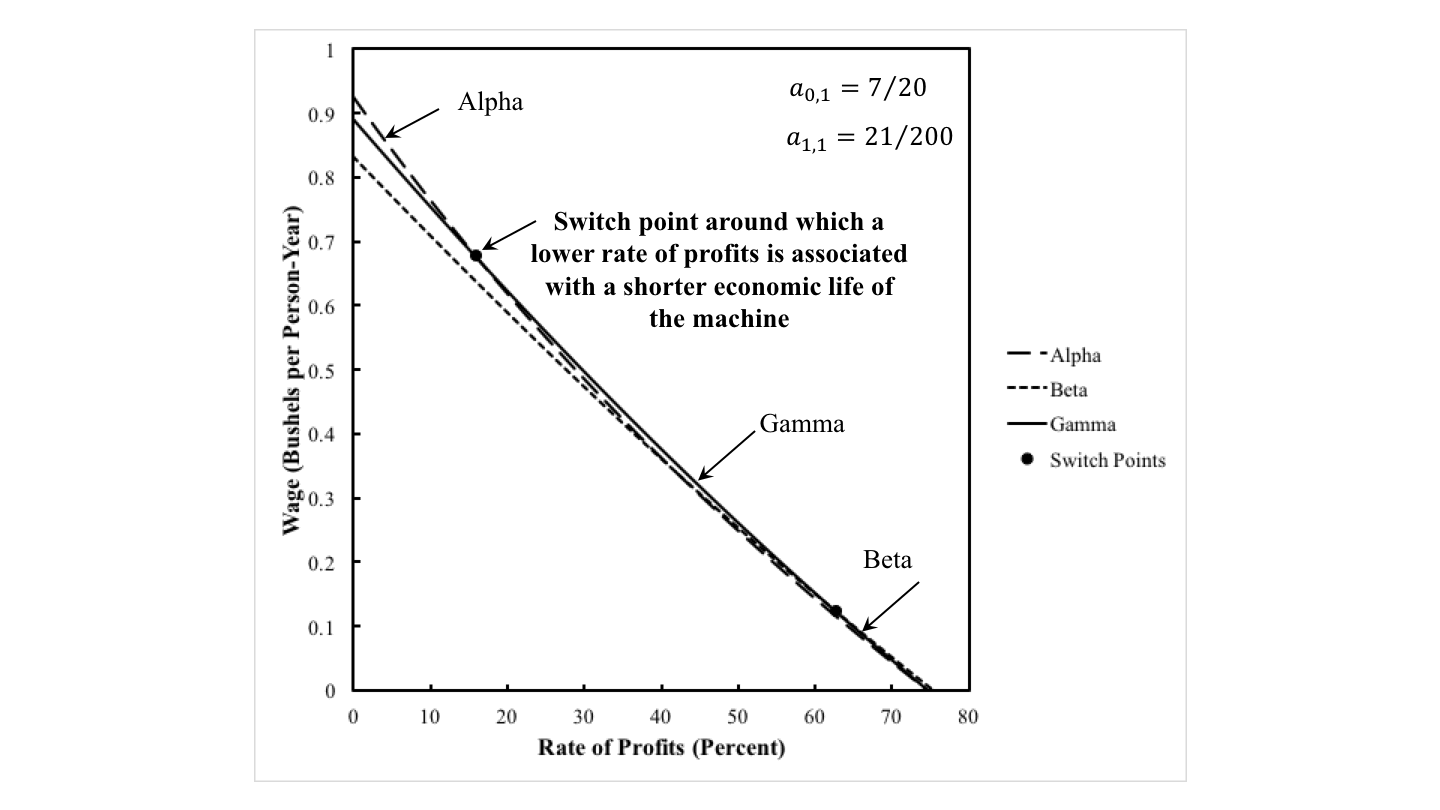
The Emergence Of Non-Monotonic Variations In The Economic Life Of A Machine

Figure 1: A Part of the Parameter Space
1.0 Introduction

This post presents a perturbation of an example from Salvatore Baldone. It follows the style of some posts that almost add up to a draft research paper.

A widespread view among Austrian-school and mainstream economists is mistaken. Given competitive markets, if the supply of capital were increased, in some sense, the rate of profits would supposedly be driven down. At the level of abstraction here, no distinction exists between the interest rate and the rate of profits. A lower rate of profits would incentivize capitalists to adopt more capital-intensive techniques and thereby increase the output produced per worker. A more capital-intensive technique is supposed to be associated with an increased period of production. Some such regularity seems to me to be necessary to make sense out of Austrian Business Cycle Theory.

This post presents a perturbation of an example in which net output conisists of a single commodity. Capital inputs are heterogeneous. One input consists of a machine. Sometimes truncating the economic life of the machine results in a more capital-intensive technique of production. This post emphasizes the disconnection between capital-intensity and physical properties of how long machinery is operated by capitalists maximizing their profits.

2.0 Technology

Table 1 presents coefficients of production in a perturbation of an example from Baldone (1974). With the first process, workers, under the direction of mangers of firms, manufacture new machines. The remaining three processes are used to produce corn. The second process requires an input of a new machine, as well as seed corn. A one-year old machine is jointly produced with the output of corn. The third process jointly produces an output of a two-year old machine with corn. The fourth process exhausts the physical life of the machine. Only corn is produced as a output in this process.

Table 1: Technology
InputIndustryAgriculture
IIIIIIIV
Labora0,139/200117/20039/100
Corna1,139/100141/250117/200
New Machines0100
1-Year Old Machines0010
2-Year Old Machines0001
Output
Corn0111
New Machines1000
1-Year Old Machines0100
2-Year Old Machines0010

Corn is both a consumption good and a capital good, insofar as it is an input into all four processes. Technology is not yet fully specified in this example, with numerical values undefined for two coefficients of production. I assume free disposal of old machines. The choice of technique here is equivalent to the choice of the economic life of the machine. Table 2 lists the processes operated for the available techniques, each of which can produce a net output of one bushel corn. Under Alpha, the machine is junked after operating one year. Under Beta, it is junked after two years. Under Gamma, it is operated for its full physical life.

Table 2: The Technique of Production
TechniqueProcesses
AlphaI, II
BetaI, II, III
GammaI, II, III, IV

3.0 Prices of Production and the Choice of Technique

The economic life of the machine is chosen on the basis of cost-minimization. Accordingly, I consider prices of production for each technique. A bushel corn is numeraire. I assume that wages are paid out of the surplus product at the end of the year. Each operated process yields the same rate of profits.

These assumptions are enough to derive, for each technique, wages and prices as functions of the rate of profits. Three equivalent methods can be used to find the cost-minimizing technique at any given rate of profits:

  • Construct the wage frontier as the outer envelope of the wage curves for the technique. This is a pure fixed capital example.
  • Look for negative prices for old machines. Beta cannot be cost minimizing if a one-year old machine has a negative price at prices of production for the Beta technique. Gamma cannot be cost-minimizing if a two-year old machine has a negative price at Gamma prices.
  • Determine if extra profits can be made by adopting a process not operated in calculating prices of production. Does operating the machine for two years yield extra profits at Alpha prices? For three years at Beta prices?

For the pure fixed capital model, these three methods of analyzing the choice of technique are equivalent. In the general case of joint production, the outer envelope of the wage curves does not always correspond to the cost-minimizing technique.

4.0 Two Fluke Points and the Perturbation of Coefficients of Production

Figure 2 illustrates the analyis of the choice of technique for the specified values of the direct labor input and corn input, per machine produced in the industrial process. A switch point between Beta and Gamma exists at approximately 61 percent. Around this switch point, a lower rate of profits is associated with an extension of the economic lifetime of the machine and an increased output per worker. Score one for Böhm Bawerk. These parameters have been carefully chosen to yield two fluke switch points with Alpha, one at the maximum wage and one at the maximum rate of profits. Aside from these flukes, this example seems straightforward.

Figure 2: An Example Of Two Fluke Switch Points

I now consider local perturbations of these two coefficients of production. Figure 1, at the top of this post, depicts the part of the parameter space under consideration. The machine varies in efficiency as it is used in agriculture, and these perturbations leave unchanged the needed inputs of labor and corn to operate with the machine at each age. The parameters partition the parameter space around the fluke case in Figure 2. The wage frontier does not differ qualitatively in each of these four regions, but it does differ among regions.

The wage frontier to the northeast looks like the frontier in Figure 2, but the switch points on the axis for the wage or the rate of profits no longer appear. As noted, the single switch point between Beta and Gamma conforms to outdated Austrian and marginalist intuition.

5.0 Non-Monotonic Economic Lifetime of a Machine to the Northwest

The region to the northwest, as illustrated in Figure 3, is more interesting. This is not a reswitching example. Nor is it an example of capital-reversing in this region of the parameter space. Prices can be used to evaluate the payments made for advances for capital inputs for each technique. Around the two switch points, a lower rate of profits is associated with a larger value of capital per unit output for the newly cost-minimizing technique. More capital per worker is used, and output per worker is increased. With a lower rate of profits, the machine is operated two years, three years, and then one year. At the first switch point, a shorter economic life of a machine is associated with greater capital-intensity. This result seems to pose some difficulty for traditional formulations of Austrian capital theory.

Figure 3: An Example Of Non-Monotonic Variations in the Economic Life of a Machine

6.0 Capital-Reversing to the Southeast

Figure 4 illustrates the region in the parameter space to the southeast. This is an example of capital-reversing but not of the reswitching of techniques. The wage curves for the Alpha and Beta techniques intersect twice, with the first intersection within the wage frontier. Around the second switch point, a lower rate of profits is associated with a smaller value of capital per unit output. Less capital per worker is used, and output per worker is lower at a lower rate of profits. Long run marginalist theory is falsified. With a lower rate of profits, the machine is operated one year, two years, and then three years. At the second switch point, a longer economic life of a machine is associated with a decrease in capital-intensity. Austrian capital theory is not validated here, either.

Figure 4: An Example Of Capital-Reversing

7.0 Reswitching to the Southwest

In the southwest, both these difficulties for Austrian capital theory arise, as illustrated in Figure 5. This is now a reswitching example. At a low or high rate of profits, the machine is operated for one year. The interval of the rate of profits between these two intervals in which Alpha is cost-minimized are partitioned by another switch point. Gamma is cost-minimizing in one partition, and Beta is cost-minimizing in the other. At the first switch point, a shorter economic life of the machine is associated with a lower rate of profits and the adoption of a more capital-intensive technique. At the third switch point, a longer economic life of a machine is associated with a smaller rate of profits and a decrease in capital-intensity.

Figure 5: A Reswitching Example

8.0 Conclusion

Harwick (2022) has noted that some followers of the Austrian school have recently tried to consider Austrian capital theory separately from business-cycle theory. Lewin and Cachanosky (2019) consider a financial measure of capital-intensity, namely the average duration of an investment project. Around any switch point, an increased Duration is (tautologically?) associated with a lower interest rate. As noted by Fratini (2019), an increased capital intensity, in this sense, is associated with reduced net output per worker around a so-called 'perverse' switch point. Noting that a technique exhibiting joint production cannot always be reduced to an infinite series of dated labor inputs, I do not know how to calculate Duration for the above example. (Those wanting to address this implicit challenge might want to start with this example to warmup.) But even so, an increased Duration can be associated with the reduction in the economic life of a machine.

Anyways, a reduction in the economic life of a machine is consistent with an increase in capital-intensity. Capital-intensity is assessed above by evaluating the price of inputs, either for a given net output or per worker. This association between a shorter economic life and greater capital-intensity can arise around a switch point in which a smaller rate of profits incentives the adoption of a more capital-intensive technique, with a consequent greater net output per worker. It can also arise around a ‘perverse’ switch point in which a less capital-intensive technique is adopted at a lower rate of profits. Neither type of switch point is a fluke case, as can be seen by contrasting such switch points with genuine fluke cases.

Reference
  • Salvatore Baldone. 1974. Il capitale fisso nello schema teorico di Piero Sraffa. Studi Economici XXIV(1): 45-106. Translated in Pasinetti (1980).
  • Saverio M. Fratini. 2019. A note on re-switching, the average period of production and the Austrian business-cycle theory. Review of Austrian Economics 32: 363-374.
  • Cameron Harwick. 2022. Unmixing the metaphors of Austrian capital theory. Review of Austrian Economics 35: 163-176.
  • Peter Lewin and Nicholas Cachanosky. 2019. Austrian Capital Theory: A Modern Survey of the Essentials. Cambridge: Cambridge University Press.

Friday, June 30, 2023

Leontief On Reswitching

An old puzzle is why do those who build on Leontief's empirical work not make more of Sraffa? And why do those who build on Sraffa's theory not interact more with those building on Leontief?

Sraffa implicitly refers to Leontief, von Neumann, and others in the preface to his 1960 book. Those, like Zambelli, that have done empirical work on capital-theoretical 'paradoxes' draw on Leontief matrices constructed from national income and product accounts. So do those who are exploring empirical data to test a simple labor theory of value or Marx's law of the tendency of a declining rate of profits.

But consider ten Raa (2022), which I recently stumbled upon. This is a short reflection on Leontief and an exchange of letters in 1985 and 1986. Apparently, Leontief wrote a paper about then exploring if reswitching was likely to arise empirically in the United States economy. He asserted a simple example could be constructed with three produced commodities. This example would include (an approximation for) fixed capital. The editors of the American Economic Review rejected it as of being of no interest to their readers. Leontief published it as a chapter in the second edition of his book on input-output analysis. (By the way, I attended a guest lecture by Leontief a few years before that.)

Thijs ten Raa says that in his exchange of letters, he developed an explicit two-good example. He notes that a few empirical examples of reswitching have been found, for example, by Han and Schefold. He concludes this paper by quoting Samuelson (1966) and Pasinetti (2003) on how "current neoclassical economists do not seem to like Samuelson's 'facts of life.'"

Those who say, "economics is fake", have a point.

Selected Reference
  • Thijs ten Raa. 2005. The economics of Input-Output Analysis, Cambridge University Press.
  • Thijs ten Raa. 2022. Reswitching and capital models. Journal of Economic Structures 11 (1).

Monday, June 26, 2023

Is Socialism Possible?

The strongest argument against socialism, understood as entailing central planning, comes from Enrico Barone. Von Mises popularized this argument. Maybe he was subjectively original. I think von Mises did not have a good understanding of duality theory and shadow prices. Anyways, his argument is supposed to be an argument in principle, an impossibility argument. Oskar Lange, Abba Lerner, and Fred Taylor, for example, provided answers. Hayek proposed a revision emphasizing practicality and distributed tacit knowledge. The argument still needs to be remade, since marginalist price theory has been shown half a century ago to be, at best, wrong.

But socialists need to have no opinion on the possibility of central economic planning in a democracy. One can advocate a plethora of policies and institutions in the here and now which give the vast majority of the population more control over their lives, more participation in their society, and more opportunities to develop their potentials. Achieving these goals requires a much less extreme inequality in the distribution of income and wealth. Some examples of policies and institutions are:

  • The creation of Sovereign Wealth Funds.
  • Universal Basic Income.
  • Co-determination. Corporate charters are a creature of the state, often Delaware in the United States. Laws can mandate workers have representatives on the board of directors and other goverance practices be put in place.
  • Government ownership, at various levels, of utilities, railrods, port facilities, telecommunications infrastructure and so, keeping in mind the principle of subsidiarity.
  • Extensive re-creation of infrastructure and industry to diminish the threat of global warming.
  • The support for loans or subsidies for the formation of co-operatives.
  • Simplifing the organization of labor unions. Card check is a current possibility in the United States. (Is Labor Notes a worthwhile site?)
  • Legalizing union contracts in which a contract clause mandates that all workers at certain tiers in an unionized firm pay union dues. (The prohibition of such contracts is dishonestly called 'the right to work'.)
  • Legalizing sympathy strikes.
  • More generous funding on education, basic research, and so.
  • A generous social safety net
  • Universal health care, disconnected from employment.
  • Higher taxes on the wealthy, especially on property income.

I have banged on like this before. I think for all of the above to be possible in the United States necessitates a much different political climate than currently prevailing. When such a country is achieved is time enough to argue about (other) varieties of socialism.

References

Friday, June 23, 2023

What Are Prices Of Production?

Suppose one rejects the labor theory of value as a theory of prices. Or, even more, one could reject Marx's theory of value in volume 1 of Capital. Still, one could elaborate the theory of prices of production. In my published works, I have tried to extend the theory a step or two. And the theory of prices of production is opposed to a marginalist theory, a theory of supply and demand, if any such coherent theory exists.

In this post, I offer one explanation of the setting of the theory of prices of production. I am heavily indebted to Alessandro Roncaglia. Heinrich Bortis is another point of reference here. As usual, my favorite textbook expositions of the details of prices of production are by Luigi Pasinetti and Heinz Kurz and Neri Salvadori. I have yet to read Fabio Petri's recent textbook.

Suppose, for purposes of exposition, time is broken up into discrete intervals, namely, years. And the economy to be considered is a capitalist economy. Managers of firms, at the start of the year, hire so many workers and buy so many commodities on the market for fuel, raw material, tools, and so on.

One can imagine taking a snapshot at the end of the year, after the harvest. Produced commodities are in the hands of the (owners of) firms which have produced them. They need to be redistributed, among industries and among consumers, for production to continue.

Workers will purchase some commodities, with their wages and through a retail sector. Capitalists will also purchase some commodities for consumption. Firms that continue in business will buy their needed inputs from firms in other industries to continue production in the next year. Some firms will retain some of their output for use in production. I am thinking, for example, of seed in agriculture. Used machinery or a plant can be thought of as jointly produced with a more obvious commodity. Joint production proper occurs in oil refineries and breweries, I guess.

A realization problem arises here. Some will find that the (market) prices at which they buy and sell deviate from what they expected. Capitalists had certain expectations and plans when they made production decisions at the start of the year, and they may find those plans incapable of being realized at the end of the year.

But one can ask what must be prices be such that capitalists would find no need to modify their plans? These are prices of production. In a competitive capitalist economy, one assumes a common rate of profits rules in all industries. In calculating prices of (re)production, one takes either the real wage or the rate of profits as given. One might think of the wage as embodying all sorts of conventions and norms about what workers in different strata are expected to be able to purchase. At any rate, prices of production allow buying and selling that go on after the harvest to be such that produced commodities are redistributed such that a capitalist economy can be reproduced.

Some points on this abstract description of a capitalist economy:

  • Decisions on what and how much to produce are made upstream from the realization problem, so to speak. At no point in time can one simultaneously validate current decisions.
  • Decisions on production also generate, at the end of the year, the income used to purchase the output. Many of these decisions are for the production of capital goods quite distant from consumption.
  • The workers are are hired with the promise of a payment of a money wage. The possibility arises of a conflict over distribution at the end of year in which total money claims add up to more than the output produced.
  • Say's law is not assumed. Realization problems may lead to some capitalists having more unused capacity than planned or too little capacity. (Typically, firms plan to have some unused capacity so as to meet unanticipated demands.)
  • No need exists to talk about supply and demand functions in explaining prices of production. No assumptions are made about any tendency for the labor market to clear in calculating prices of production.
  • Perhaps capitalists can approximate prices of production, given accounting conventions about markups. Would deviations of market prices from prices of production be taken into account when they revise their plans? Or should such a story only be concerned with market prices?
  • The equations for prices of production provide an open model, in some sense. The level of aggregate demand and the distribution of income are taken from outside the model.

I hope you can see some family resemblances between the approaches of Sraffa and Keynes to economics. A parallelism to the works of Marx also exists here.

Sunday, June 18, 2023

A Letter From Marx To Engels In 1867 On The Order Of Presentation In Capital

This is another letter in a series I have been transcribing in which Marx explains his theory to Engels. In 1867, he was going through the proofs of Capital and so penned several such letters. I think one can ignore Hegel and read Marx as presenting a scientific theory, from abstract principles to more concrete applications. I would not necessarily disagree with those who think such a reading misses much. But I find it interesting how much this reading captures.

I like that in this letter, Marx explicitly says that his dialectic method of presentation provides traps for bad readers. You can easily find many such poor readers today. We see that Marx here distinguishes again scientific from vulgar political economy. I think Marx's letter, on 11 July 1868, to Kugelmann, echoes points here. There he objects to those who want to give the "science before the science".

27 June 1867

Dear Fred,

The 2 half 5 pound-notes received with kindest thanks. With respect to the address, use Borkheim. He knows my situation, though with as much concealment as I consider necessary in his regard. I would even like him to know that you are lending me money. But you must write and tell me when the money is to be sent to him. I do not see why I should involve yet a 3rd philistine.

The Fenians should be delivered to you today.

I was so very pleased by your lines of yesterday, and that requires no further elaboration from me.

Sheet 20 was the latest to reach me. It will probably run to 40 or 42 sheets in all. I've not as yet received any corrected proofs after the ones already sent you. On your departure send me back those which are in your possession.

Regarding the objection that you mentioned the philistines and vulgar economists will infallibly raise (they forget, of course, that, if they reckon paid labour as wages, they are reckoning unpaid labour as profit, etc.), it amounts, in scientific terms, to the following question:

How is the value of the commodity transformed into its price of production, in which

1. the whole of the labour appears paid for in the form of wages;

2. the surplus-labour, however, or the surplus-value, assumes the form of an addition to the price, and goes by the name of interest, profit, etc., over and above the cost-price (=price of the constant part of capital + wages).

Answering this question presupposes:

I. That the transformation of, for example, the value of a day's labour-power into wages or the price of a day's labour has been explained. This is done in Chapter V of this volume.

II. That the transformation of surplus-value into profit, and of profit into average profit, etc., has been explained. This presupposes that the process of the circulation of capital has been previously explained, since the turnover of capital, etc., plays a part here. This matter cannot therefore be treated prior to the 3rd book (Volume II is to contain books 2 and 3). Here it will be shown how the philistines' and vulgar economists' manner of conceiving things arises, namely, because the only thing that is ever reflected in their minds is the immediate form of appearance of relations, and not their inner connection. Incidentally, if the latter were the case, we would surely have no need of science at all.

Now if I wished to refute all such objections in advance, I should spoil the whole dialectical method of exposition. On the contrary, the good thing about this method is that it is constantly setting traps for those fellows which will provoke them into an untimely display of their idiocy.

By the by, Para. 3: 'The Rate of Surplus Value', which was the last one you had in your possession, is immediately followed by the Para.: 'The Working Day' (struggle for the reduction of working time), whose argument demonstrates ad oculos [vividly] to what extent those bourgeois gentlemen comprehend the source and nature of their profit in practice. This is also shown in the Senior CASE, where your bourgeois assures us that his whole profit and interest derive from the last unpaid hour of labour.

Kindest regards to Mrs Lizzy.

Your

K. M.

You must stop over for a few days here on your journey home.

Apropos. I judged it in every way imprudent to take Mr Meissner into my confidence regarding my private circumstances.

Saturday, June 17, 2023

Daniel Ellsberg (1931 - 2023)

I find that I summarized the Ellsberg paradox back in 2009. I have also commented on who in the United States was prosecuted for leaking classified information to the press. Eric Loomis has an obituary. The Pentagon Papers are now unclassified and available from the National Archives. As I understand it, Ellsberg copied each page personally - no downloading to a thumb drive in his day. David Halberstam's book, The Best and the Brighest is a well-known work of journalism (the first draft of history) on Vietnam.

Thursday, June 15, 2023

Elsewhere

Having read his book, I think Zachery Carter is quite aware of the reputation of the University of Massachusetts at Amherst, the New School for Social Reserarch, Utah, and a few other places. In his New Yorker article, he does not say anything about heterodox or non-mainstream economics. He does not say anything about the sociology of the field. He does note Krugman and others calling Weber (or her work) 'stupid'. Carter treats Weber as any other economist that has something interesting to say about current issues in understanding the economy of the United States and other countries.

I think some of my work is not too far away from Weber's work. I wonder if she knows about the work of Adam Rose and others using input-output analysis to understand the economic impact of disastors, such as hurricanes and earthquakes.

Update 16 June 2023: Added link to Meg Jacobs article.

Saturday, June 10, 2023

A Iterative Procedure Converging To Prices Of Production

Figure 1: Prices of Corn and Ale in an Iterative Process
1.0 Introduction

Anwar Shaikh proposed, sometime in the 1970s, I guess, an interpretation of Marx's transformation problem. Marx's solution in volume 3 of Capital is the first step of an iterative process. I thought I might work through this idea with an example from an old exposition of mine. I am not sure how faithful I am to Shaikh's approach. I notice that as I explain it, the equality of total values and of total prices is maintained for gross output. In this conception, Marx's solution to the transformation problem is not incorrect or incoherent, but merely incomplete.

My favorite solution to the transformation problem is based on von Charasoff's original capital, also known as Sraffa's standard commodity. Both Shaikh and Sraffa's solution raise a question about what is special about labor. As I understand it, Shaikh's iterative procedure does not need to start at labor values. One needs to look outside what is formalized in the mathematics.

2.0 Technology and Labor Values

Consider a simple capitalist economy that produces only two goods, corn and ale. Assume the amounts of corn and ale produced each year are given, as well as the production processes used in each industry. Corn and ale are each produced by processes that require a year to complete. These processes require a certain number of workers to be hired at the beginning of the year, as well as the purchase of certain quantities of corn and ale to be used as inputs in production. Operating these processes then produces certain quantities of outputs of corn and ale for use at the end of the year. Table 1 shows the amount of inputs per unit output for both industries. The data allow for surplus production, that is for more corn and ale to be produced than are used as inputs. I might as well assume Constant Returns to Scale (CRS).

Table 1: The Technique of Production
InputCorn IndustryAle Industry
Labor1 Person-Year1 Person-Year
Corn1/8 Bushel3/8 Bushel
Ale1/16 Bottle1/16 Bottle
Output1 Bushel1 Bottle

I now want to consider a couple of levels at which these processes can be operated. Suppose the first process is scale to produce a gross output of 15/16 bushels, and the second process is used to produce 1/16 bottles. Then the quantity flows shown in Table 2 result. With these gross outputs, one person-year is employed throughout the economy. The ale used up in production is exactly replaced by the output of ale industry. 9/64 bushels of the corn produced replace the corn used up in production. So these quantity flows are for a stationary state in which one person-year of labor are used to produce a net output of 51/64 bushels of corn. So a bushel of corn embodies 64/51 ≈ 1.255 person-years per bushel. If the wage consists entirely of corn, the maximum wage is 51/64 bushels per person-years.

Table 2: Processes Scaled to Produce a Net Output of Corn
InputCorn IndustryAle Industry
Labor15/16 Person-Year1/16 Person-Year
Corn15/128 Bushel3/128 Bushel
Ale15/256 Bottle1/256 Bottle
Output15/16 Bushel1/16 Bottle

On the other hand, suppose that 3/10 bushels of corn are produced in the corn industry, and 7/10 bottles are produced in the ale industry. The quantity flows shown in Table 3 result. Here, too, one person-year is employed throughout the economy. The corn produced is wholly used to replace the corn used as inputs throughout the economy. The net output of the ale industry, after replacing the ale used as capital goods, is 51/80 bottles. That is, a bottle of ale embodies 80/51 ≈ 1.569 person-years per bottle. The maximum wage is 51/80 bottles per person-years.

Table 3: Processes Scaled to Produce a Net Output of Corn
InputCorn IndustryAle Industry
Labor3/10 Person-Year7/10 Person-Year
Corn3/80 Bushel21/80 Bushel
Ale3/160 Bottle7/160 Bottle
Output3/10 Bushel7/10 Bottle

Labor values are 64/51 ≈ 1.255 person-years per bushel and 80/51 ≈ 1.569 person-years per bottle.

3.0 An Iterative Procedure

To specify the iterations of prices, a general notation is useful. Accordingly, define the following variables.

  • a0: A two-element row vector of direct labor coefficients.
  • A: A 2x2 Leontief matrix.
  • q: A two-element column vector of gross outputs.
  • y: A two-element column vector of net outputs.
  • w: A two-element column vector of the commodity wage.
  • p: A two-element row vector of prices. Indexed in the iterative process.
  • Cn: Constant capital, evaluated at prices in the iterative process.
  • Vn: Variable capital, evaluated at prices in the iterative process.
  • Sn: Surplus product, evaluated at prices in the iterative process.

The rate of profits is defined in terms of the ratio of surplus value to the value of the capital advanced. Both the numerator and the denominator are aggregated across all industries. Accordingly, I find it convenient to specify the level and composition of the economy as such that employment is one person-year, and the net output of the economy is in the proportions of the wage basket. These assumptions are more restrictive, I think, than is needed. Anyways, for this exposition of the first case, suppose quantity flows are as in Table 2. And let the commodity wage be at a level where half the net output is paid out as the wage. In this case, only corn is a consumption good.

Initially, prices are assumed to be labor values. The price of constant capital, at a given iteration, is:

Cn = pn A q

The value of advanced wage goods, at a given iteration, is:

Vn = pn w a0 q

The value of surplus value is the value of net output not paid out to the workers:

Sn + Vn = pn y

I take wages as advanced, along with constant capital. Accordingly, the overall rate of profits at a given iteration, is:

rn = Sn/(Cn + Vn)

Prices are iterated as follows:

pn + 1 = pn (A + w a0)(1 + rn)

Notice that all the terms on the right-hand side are defined at a given iteration. Table 4 shows the results for the first few iterations in the case of the numeric example, with the assumptions for the first case.

Table 4: One Set of Iterative Prices
Countp1 (approx.)p2 (approx.)S/(C + V) (approx.)
064/5180/510.645570
11.2422441.7585010.634923
21.2427761.7505190.635368
............
1.2427551.7508390.635350

As I understand, this iteration occurs in logical time. It is not a process in historical time. This process converges to prices of production, which satisfy the following equation:

p (A + w a0)(1 + r) = p

Marx sets out the first iteration above. One can modify the assumptions. I do not think much is gained by restricting attention to schemes of simple and expanded production, as at the end of Volume 2 of Capital.

Figure 2: Rate of Profits in an Iterative Process

In Figures 1 and 2, the lines labeled 'Corn Wage' are for the quantity flows in Table 2. The lines labeled 'Ale Wage' are for the quantity flows in Table 3. I suppose a better numeric example would not converge as quickly.

4.0 Conclusion

This post is one more illustration that academics have had ways of making sense of the transformation problem. One could argue about which way is more insightful. Do these discussions help make sense of capitalist economies and of the confusions in mainstream economics?

References
  • Deepankar Basu. 2020. Can commodities be substance of value? UMass Economics Working Papers. 290.
  • Fred Moseley. 2020. A critique of Shaikh's two interpretations of Marx's 'transformation problem'. Cambridge Journal of Economics.
  • Anwar Shaikh. 1977. Marx's theory of value and the 'transformation problem'. The Subtle Anatomy of Capitalism (ed. by Jesse Schwartz).

Thursday, June 08, 2023

Marx To Vera Zasulich In 1881

Is historical materialism a deterministic theory? Must all societies (in particular, Russia) go through the same stages, including feudalism, capitalism, and, eventually, socialism? Perhaps Marx says otherwise in the following letter.

London, 8 March 1881
41 Maitland Park Road, N.W.

Dear Citizen,

A nervous complaint which has assailed me periodically over the last ten years has prevented me from replying any sooner to your letter of 16 February. I am sorry that I cannot provide you with a concise exposé, intended for publication, of the question you have done me the honour of putting to me. Months ago I promised the St Petersburg Committee to let them have a piece on the same subject. I hope, however, that a few lines will suffice to dispel any doubts you may harbour as to the misunderstanding in regard to my so-called theory.

In analysing the genesis of capitalist production I say:

'At the core of the capitalist system, therefore, lies the complete separation of the producer from the means of production ... the basis of this whole development is the expropriation of the agricultural producer. To date this has not been accomplished in a radical fashion anywhere except in England... But all the other countries of Western Europe are undergoing the same process' (Capital, French ed., p. 315).

Hence the 'historical inevitability' of this process is expressly limited to the countries of Western Europe. The cause of that limitation is indicated in the following passage from Chapter XXXII:

'Private property, based on personal labour ... will be supplanted by capitalist private property, based on the exploitation of the labour of others, on wage labour' (l.c., p. 341).

In this Western movement, therefore, what is taking place is the transformation of one form of private property into another form of private property. In the case of the Russian peasants, their communal property would, on the contrary, have to be transformed into private property.

Hence the analysis provided in Capital does not adduce reasons either for or against the viability of the rural commune, but the special study I have made of it, and the material for which I drew from original sources, has convinced me that this commune is the fulcrum of social regeneration in Russia, but in order that it may function as such, it would first be necessary to eliminate the deleterious influences which are assailing it from all sides, and then ensure for it the normal conditions of spontaneous development.

I have the honour to be, dear Citizen,

Yours very faithfully,

Karl Marx

Is the above in agreement with a letter of Engels?

I think of Georgi Plekhanov as having introduced Marxism into Russia. Vera Zasulich, however, was another who had an early interest. Others include Pavel Axelrod, Nikolai Danielson, Ivan Fesenko, Julius Martov, Pyotr Struve, and Nikolai Ziber. The founders in exile in Geneva of the Emancipation of Labour group provide another list. Danielson translated Capital. Struve was part of the school of legal Marxism before becoming a liberal. Axelrod and Martov became prominent Menshevik. Nikolai Chernyshevsky and Pyotr Lavrov are of interest. The former wrote a novel, What is to be done?, from which Lenin took the title. The latter headed a movement opposed to the Narodniks.

Sunday, June 04, 2023

A Letter From Marx To Engels In 1862 On The Transformation Problem

Here Marx sets out the transformation problem in a letter to Engels. The first volume of Capital was published in 1967. So this is another instance of Marx distinguishing labor values and prices of production before publication of Capital. This post is the second in a series I am working on in which he sets out critical parts of the (critique of) political economy in Capital in letters to Engels. As I understand it, the concept of absolute rent was original with Marx.

Marx criticizes Ricardo for not distinguishing the labor embodied in inputs in production from their cost price. Is the distinction between cost price and prices of production clear in this letter? Maybe not. He goes on here about rent. He assumes that the organic composition of capital is lower in agriculture than in industry. Hence, for Marx, more surplus value is generated in agriculture, for a given expenditure of capital, than in industry.

2 August 1862

Dear Frederick,

Best thanks for the 10 pounds.

I very much dislike your being in financial difficulties on my account, but que faire? Who is capable of withstanding such a crisis as the American one? Not to mention my peculiar bad luck in having a rotten rag like the Vienna Presse to deal with. OTHERWISE, the fellows might, at least, have been able to make up for the loss of the Tribune TO SOME EXTENT. Do you suppose, perhaps, that the time has now come for me to approach, say, the Evening Post (THE ABOLITIONIST PAPER in New York) about my contributing to it?

All things considered, it's a real miracle that I have been able to get on with my theoretical writing to such an extent. I now propose after all to include in this volume an extra chapter on the theory of rent, i.e., by way of 'illustration' to an earlier thesis of mine. Let me say a word or two about what will, in the text, be a lengthy and complex affair, so that you may let me have your opinion on it.

As you know, I distinguish 2 parts in capital: constant capital (raw material, matières instrumentales, machinery, etc.), whose value only reappears in the value of the product, and secondly variable capital, i.e., the capital laid out in wages, which contains less materialised labour than is given by the worker in return for it. E.g. if the daily wage = 10 hours and the worker works 12, he replaces the variable capital + 1/5 of the same (2 hours). This latter surplus I call SURPLUS VALUE.

Let us assume that the rate of surplus value (that is the length of the working day and the surplus labour in excess of the necessary labour performed by the worker to reproduce his pay) is given, e.g. = 50 p.c. In this case, in a 12 hour working day the worker would work e.g. 8 hours for himself, and 4 hours (8/2) for the EMPLOYER. And indeed, let us assume this to apply to all TRADES SO that any variations there may be in the AVERAGE WORKING TIME simply allow for the greater or lesser difficulty of the work, etc.

In these circumstances, given equal exploitation of the worker in different TRADES, different capitals in different spheres of production will, given equal size, yield very different AMOUNTS OF SURPLUS VALUE and hence very different rates of profit, SINCE PROFIT IS NOTHING BUT THE PROPORTION OF THE SURPLUS VALUE TO THE TOTAL CAPITAL ADVANCED. This will depend on the organic composition of the capital, i.e., on its division into constant and variable capital.

Let us assume, as above, that the surplus labour = 50 p.c. If, therefore, e.g. 1 pound = 1 working day (no matter whether you think in terms of a day or a week, etc.), the working day = 12 hours, and the necessary labour (i.e. reproductive of the pay) = 8 hours, then the wage of 30 workers (or working days) = 20 pounds and the value of their labour = 30 pounds, the variable capital per worker (daily or weekly) = 2/3 pounds and the value he creates = 1 pound. The AMOUNT of SURPLUS VALUE produced by a capital of 100 pounds in DIFFERENT TRADES will vary greatly according to the proportion in which the capital of 100 pounds is divided into constant and variable capital. Let us call CONSTANT CAPITAL C, and VARIABLE CAPITAL V. If, e.g. in the COTTON industry, the composition was C 80, V 20, the value of the product would = 110 (given 50 p.c. surplus value or SURPLUS LABOUR). The amount of the surplus value = 10 and the profit rate = 10 p.c., since the profit = the proportion of 10 (the SURPLUS VALUE): 100 (the total value OF THE CAPITAL EXPENDED). Let us suppose that, in a large tailoring shop, the composition is C 50, V 50, so that the product = 125, the surplus value (at a rate of 50 p.c. as above) = 25 and the profit rate = 25 p.c. Let us take another industry where the proportion is C 70, V 30, hence the product = 115, the profit rate = 15 p.c. Finally, an industry where the composition = C 90, V 10, hence the product = 105 and the profit rate = 5 p.c.

Here, given equal exploitation of labour, we have IN DIFFÉRENT TRADES very DIFFERENT AMOUNTS OF SURPLUS VALUE AND HENCE VERY DIFFERENT' RATES OF PROFIT for capitals of equal size.

If, however, the above 4 capitals are taken together, we get

1.C 80V 20110profit rate = 10 p.c.Rate of surplpus
value in all
cases = 50 p.c.
2.C 50V 50125profit rate = 25 p.c.
3.C 70V 30115profit rate = 15 p.c.
4.C 90V 10105profit rate = 5 p.c.
Capital400Profit = 55

On 100, this makes a PROFIT RATE of 13 3/4 p.c.

If the total capital (400) of the class be considered, the profit rate would = 13 3/4 p.c. And capitalists are brothers. As a result of competition (TRANSFER OF CAPITAL OR WITHDRAWAL OF CAPITAL FROM ONE TRADE TO THE OTHER), capitals of equal size in DIFFERENT TRADES, DESPITE THEIR DIFFERENT OGRANIC COMPOSITIONS, YIELD THE SAME AVERAGE RATE OF PROFIT. In other words, the AVERAGE profit, which F.I. A CAPITAL OF 100 pounds yields IN A CERTAIN TRADE, it yields, not as a capital specifically applied to the same nor, therefore, in the proportion in which it of itself produces SURPLUS VALUE, but as an aliquot part of the total capital of the capitalist class. It is a SHARE the dividend on which will be paid in proportion to its size out of the total amount of the SURPLUS VALUE (or unpaid labour) produced by the total variable (laid out in wages) capital of the class.

If then 1, 2, 3, 4 in the above illustration are to make the same AVERAGE PROFIT, each category must sell its goods at 113 1/3 pounds. 1 and 4 will sell them at more than their value, 2 and 3 at less.

The price so regulated = THE EXPENSES OF CAPITAL + THE AVERAGE PROFIT (F.I. 10 p.c.), is what Smith called the NATURAL PRICE, COST PRICE, etc. It is the AVERAGE PRICE to which competition between DIFFERENT TRADES (by TRANSFER OF CAPITAL or WITHDRAWAL OF CAPITAL) reduces the prices in DIFFERENT TRADES. Hence, competition reduces commodities not to their value, but to the cost price, which, depending on the organic composition of the respective capitals, is either above, below or = to their values.

Ricardo confuses value and cost price. He therefore believes that, if there were such a thing as absolute rent (i.e., rent independent of variations in the fertility of the soil), AGRICULTURAL PRODUCE, etc., would be constantly sold for more than its value, because at more than cost price (THE ADVANCED CAPITAL + THE AVERAGE PROFIT). That would demolish the fundamental law. Hence he denies absolute rent and assumes only differential rent.

But his identification of VALUES OF COMMODITIES and COST PRICES OF COMMODITIES is totally wrong and has traditionally been taken over from A. Smith.

The facts are as follows:

If we assume that the AVERAGE COMPOSITION of all NOT AGRICULTURAL CAPITAL is C 80, V 20, then the product (assuming that the rate of surplus value is 50 p.c.) = 110 and the profit rate = 10 p.c.

If we further assume that the AVERAGE COMPOSITION of AGRICULTURAL CAPITAL is C 60, V 40 (in England, this figure is statistically fairly correct; rent for pasture, etc., has no bearing on this question, being determined not by itself, but by the CORN RENT), then the product, given equal exploitation of labour as above = 120 and profit rate = 20 p.c. Hence, if the farmer sells his AGRICULTURAL PRODUCE for what it is worth, he is selling it at 120 and not at 110, its cost price. But landed property prevents the farmer, like his BROTHER CAPITALISTS, from equalising the value of the product to the cost price. Competition between capitals cannot enforce this. The landowner intervenes and pockets the difference between value and cost price. A low proportion of constant to variable capital is in general an expression of the poor (or relatively poor) development of the productive power of labour in a particular sphere of production. Hence, if the AVERAGE COMPOSITION of AGRICULTURAL CAPITAL is e.g. C 60, V 40, while that of NOT AGRICULTURAL CAPITAL is C 80, V 20, this proves that agriculture has not yet reached the same stage of development as industry. (Which is easily explicable since, apart from anything else, a prerequisite for industry is the older science of mechanics, while the prerequisites for agriculture are the completely new sciences of chemistry, geology and physiology.) If the proportion in agriculture becomes C 80, V 20 (in the above premise), then absolute rent disappears. All that remains is differential rent, which I shall also expound in such a way as to make Ricardo's assumption of the constant DETERIORATION OF AGRICULTURE appear MOST RIDICULOUS AND ARBITRARY.

Having regard to the foregoing definition of COST PRICE as distinct from VALUE, it should further be noted that, besides the distinction between constant capital and variable capital, which arises out of the immediate production process of capital, there is the further distinction between fixed and circulating capital, which arises out of the circulation process of capital. However, the formula would become too involved if I were to seek to incorporate this in the above as well.

There you have - ROUGHLY, for the thing's fairly complicated - the critique of Ricardo's theory. This much you will admit - that by taking into account the ORGANIC COMPOSITION OF CAPITAL, one disposes of a mass of what have so far seemed to be contradictions and problems.

Apropos. There are certain reasons, of which I shall inform you in my next letter, why I should be very glad if you would write me a detailed military critique (I shall deal with the political aspect) of Lassalle-Rüstow's liberation nonsense.

Your

K. M.

Regards to the ladies.

Imandt has announced himself. Izzy leaves on Monday.

It will be evident to you that, given my view of 'absolute rent', landed property (UNDER CERTAIN HISTORICAL CIRCUMSTANCES) does INDEED put up the prices of raw materials. Very important, communistically speaking.

Assuming the correctness of the above view, it is by no means essential for absolute rent to be paid under all circumstances or in respect of every type of soil (even if the composition of AGRICULTURAL CAPITAL is as assumed above). It is not paid when landed property does not exist, either factually or legally. In such a case, AGRICULTURE offers NO PECULIAR RESISTANCE TO THE APPLICATION OF CAPITAL, which then moves as easily in this element as in the other. The agricultural produce is then sold, as masses of industrial products always are, at cost price for less than its value. In practice, landed property may disappear, even when capitalist and landowner are one and the same person, etc.

But it would be otiose to go into these details here.

Differential rent as such - which does not arise from the circumstance that CAPITAL is employed ON LAND INSTEAD OF ANY OTHER FIELD OF EMPLOYMENT - presents no difficulty in theory. It is nothing other than SURPLUS PROFIT which also exists in every sphere of industrial production wherever capital operates under better than AVERAGE CONDITIONS. It is firmly ensconced in agriculture only because founded on a basis as solid and (relatively) stable as the DIFFERENT DEGREES OF NATURAL FERTILITY of various types of soil.