"Over the last three decades, economists played an important role in creating the conditions of the 2008 crisis (and dozens of smaller financial crises that came before it since the early 1980s, such as the 1982 Third World debt crisis, the 1995 Mexican peso crisis, the 1997 Asian crisis and the 1998 Russian crisis) by providing theoretical justifications for financial deregulation and the unrestrained pursuit of short-term profits. More broadly, they advanced theories that justified the policies that have led to slower growth, higher inequality, heightened job insecurity and more frequently financial crises that have dogged the world in the last three decades... On top of that, they pushed for policies that weakened the prospects for long-term development in developing countries... In the rich countries, these economists encouraged people to overestimate the power of new technologies..., made people's lives more and more unstable..., made them ignore the loss of national control over the economy..., and rendered them complacent about de-industrialization... Moreover, they supplied arguments that insist that all these economic outcomes that many people find objectionable in this world - such as rising inequality..., sky-high executive salaries... or extreme poverty in poor countries... - are really inevitable, given (selfish and rational) human nature and the need to reward people according to their productive contributions.In other words, economics has been worse than irrelevant. Economics, as it has been practised in the last three decades, has been positively harmful for most people." -- Ha-Joon Chang, 23 Things They Don't Tell You About Capitalism. Bloomsbury Press (2011).
Saturday, January 14, 2012
Economists Working To Increase The Pain And Misery Of Billions
Monday, January 09, 2012
On "Lady Rosa De Luxembourg"
![]() |
| Figure 1: Statue on top of Obelisk |
During the last week of 2011, I saw an exhibition of Sanja Ivekovíc's work at the Museum of Modern Art (MOMA). This show, Sweet Violence, continues through March.
The centerpiece of the exhibition is Ivekovíc's Lady Rosa of Luxembourg. This work mocks a statue, Gëlle Fra (Golden Lady), in Luxembourg. As I understand it, the original commemorates partisans active during World War II. The base of Ivekovíc's obelisk combines the phrases "La Résistance", "La Justice", "La Liberté", "L’Indépendence"; "Kitsch", "Kultur", "Kapital", "Kunst"; and "Whore", "Bitch", "Madonna", "Virgin". Three words, one from each of the three groups, is repeated on each of the four sides.
As far as I can see, this work, despite its title, does not have much to do with Rosa Luxemburg. It is more a matter of épater la bourgeoisie. I think Luxemburg's friend and colleague Clara Zetkin was more of a feminist; Luxemburg focused more on class. I don't know how Luxemburg looked while giving speeches. I know she walked with a limp as a result of a childhood disease. One leg was longer than the other. So I doubt she stood like the statue.
And I didn't overhear any museum visitors discussing such questions as:
- Do Marx's models of simple and expanded reproduction require an outside source of demand for capitalists to make the depicted investment decisions?
- Does Marx's depiction in volume 2 of Capital of smoothly reproducing capitalist economies contradict his account in volumes 1 and 3 of the breakdown of capitalism?
Saturday, January 07, 2012
Occupy the American Economic Association@Chicago
- 12:00 - 3:00 - People's Economic Conference Roosevelt University (430 S. Michigan, 3rd Floor)
- 4:30 - Mock Awards Ceremony (Michigan and Wacker)
Monday, December 26, 2011
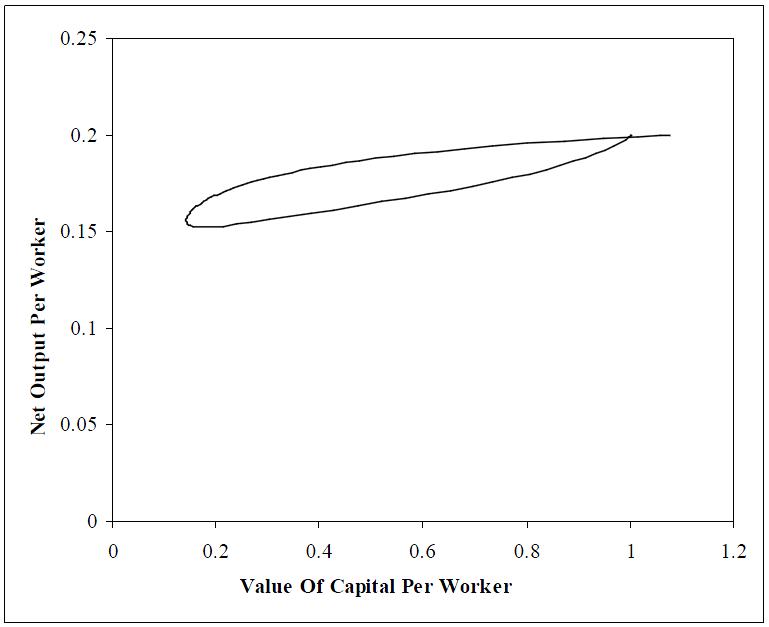
"Perverse" Price Wicksell Effects Swamping "Normal" Real Wicksell Effects
Capital-reversing can arise in a couple of ways without reswitching. This post steps through a case in which positive price Wicksell effects can dominate negative real Wicksell effects. Around each switch point, firms choose to adopt a more capital-intensive technique of production for slightly lower interest rates. So real Wicksell effects agree, in this example, with the incoherent and outdated intuition of applied neoclassical economics. Nevertheless, due to the re-evaluation of a given set of capital goods at different interest rates, one can find a pair of points such that cost-minimizing firms adopt a more capital-intensive technique, from the given technology, at the higher interest rate. And this pair of points can span at least one switch point. Basically, I created a simple example to replicate graphs like those in Appendix D in Lazzarini (2011).
A case of a positive price Wicksell and negative real Wicksell effect is one case in my suggested taxonomy of Wicksell effects. Burmeister provides one possible neoclassical response to this sort of example. Burmeister advocated the use of David Champernownes (unobservable) chain-index measure of capital.
2.0 The Technology
Consider a very simple economy in which a single consumption good, corn, is produced. Entrepreneurs know of the two processes for producing corn shown in the last two columns of Table 1. One corn-producing process produces corn from inputs of labor time and steel. The other corn-producing process uses inputs of labor time and tin. The entrepreneurs know of two other processes, also shown in Table 1. Additional steel can be produced from inputs of labor time and steel. Similarly, labor time and tin can produce more tin.
| Inputs | Steel Industry | Tin Industry | CornIndustry | |
| Labor | 1 Person-Year | 1 Person-Yr | 1 Person-Yr | 2 Person-Yrs |
| Steel | 1/2 Ton | 0 Ton | 1/4 Ton | 0 Ton |
| Tin | 0 Kg. | 9/20 Kg. | 0 Kg. | 1/3 Kg. |
| Output: | 1 Ton Steel | 1 Kg. Tin | 1 Bushel Corn | 1 Bushel Corn |
All processes exhibit Constant Returns to Scale (CRS). Each process requires a year to complete. Their outputs become available at the end of the year, and they totally use up their inputs of capital goods over the course of the year.
3.0 Quantity Flows
Two techniques are available for producing a bushel of corn as net output.
The first technique, to be called the steel technique, operates the first process to produce 1/2 ton steel and the first corn-producing process to produce one bushel corn. 1/4 ton of the output of the steel-producing process replaces the steel-capital used up in producing steel. The other 1/4 ton output from the steel-producing process replaces the 1/4 ton steel used up in producing corn. In effect, 1 1/2 person-years labor are used in the steel technique for each bushel corn producing in a self-sustaining way.
In the tin technique, 20/33 kilograms tin are produced with the tin-producing process, and one bushel corn is produced with the second corn-producing process. 2 20/33 person-years labor are used in the tin technique for each bushel of corn in the economys net output.
Note that the production of corn with the steel system provides more consumption per worker-year than is provided with the tin system. Under the false and exploded neoclassical theory, one would expect the steel system to require more capital per worker. One would also expect it to be adopted at a low interest rate, since the low interest would be signaling a relative lack of scarcity of capital.
4.0 Price Equations
Next, I consider constant prices consistent with the adoption of each technique. Firms will not adopt a technique unless the interest rate (also known as the rate of profits) is earned for each process in use in a technique. For definitiveness, I assume that wages are paid at the end of the year out of output and that a bushel corn is the numeraire.
4.1 Steel Technique
Given these assumptions, the following system of two equations must hold when the steel technique is in use:
(1/2)ps(1 + r) + w = ps
(1/4)ps(1 + r) + w = 1where ps is the price of a ton of steel, w is the wage, and r is the interest rate.
Above is a system of two equations in three variables. This system has one degree of freedom. Two variables can be found as functions of the one remaining variable. For example, the wage and the price of steel can be expressed as (rational) functions of the rate of profits. And that price of steel can be used to find the value of capital. The resulting capital-output ratio is:
vs(r) = 2/(3 - r)where vs is the ratio of the value of capital to the value of output in the steel technique.
4.2 Tin Technique
The following system of two equations must hold when the tin technique is in use:
(9/20)pt(1 + r) + w = pt
(1/3)pt(1 + r) + 2 w = 1where pt is the price of a kilogram of tin.
The ratio of the value of capital to the value of output in the tin technique, vt, expressed as a function of the interest rate, is:
vt(r) = 200/(473 - 187 r)
5.0 Choice of Technique
The trade off between the wage and the rate of profits, for a given technique, is the wage curve for that technique. Figure 1 shows the wage curves for the two techniques, as well as the wage frontier formed as an outer envelope of the wage curves for all the techniques that comprise the technology. Given the interest rate, the cost-minimizing firm adopts the technique whose wage curve is on the frontier at that point. At the switch point, two techniques are simultaneously cost minimizing.
![]() |
| Figure 1: The Wage-Rate of Profits Frontier |
The wage curve for a given technique expresses the wage as a function of the rate of profits. The rate of profits at which the switch point occurs is found by equating the wage for two techniques. In the numerical example analyzed in this post, the following quadratic equation arises:
(41/240)(1 + r)2 - (13/15)(1 + r) + 1 = 0The switch point occurs at a rate of profits of approximately 77.46%.
6.0 Conclusion
The above analysis has shown for the example:
- Which technique is cost-minimizing at any given interest rate up to a maximum.
- The ratio of the value of capital to output for each technique for each interest rate.
![]() |
| Figure 2: The Rate of Profits Versus Capital-Intensity |
This example has shown that capital-reversing can exist around a switch point even in the absence of reswitching.
References
- Edwin Burmeiser (1980). Capital Theory and Dynamics, Cambridge University Press.
- Andrés Lazzarini (2011). Revisiting the Cambridge Capital Theory Controversies: A Historical and Analytical Study, Pavia University Press.
Friday, December 23, 2011
Pecan Pie
![]() |
| 9 inch pie | 8 inch pie |
| 3 large eggs | 2 |
| 2/3 cup sugar | 1/2 cup |
| 1/3 teaspoon salt | 1/4 teaspoon |
| 1/3 cup butter, melted | 1/4 cup |
| 1 cup maple syrup | 3/4 cup |
| 1 cup chopped pecans | 3/4 cup |
Add ingredients in order, stirring thoroughly after each ingredient. Pour into pastry-lined pie pan. Bake at 375 degrees for 40-50 minutes, until set and pastry is nicely browned. Cool. Serve cold or slightly warm.
Friday, December 16, 2011
Elsewhere
- Dan Berrett, in The Chronicle of Higher Education, reports that "Economists push for a broader range of viewpoints". The Institute for New Economic Thinking, Econ4, a couple of professors at the University of Massachusetts at Amherst, and Stephen Marglin are all mentioned.
- Daron Acemoglu recommends five books1 on inequality in the distribution of income or wealth. Is he basically confused about the logic of the theory of marginal productivity?
- Bryan Caplan parades his ignorance of Keynes on wages. According to Caplan, "nominal wage rigidity is the driving force of the Keynesian model" and if employment increases, wages must fall. But:
- Keynes explicitly argues, in chapter 19 of the General Theory that his analysis applies if money wages are flexible.
- At the time of the publication of the General Theory, Keynes had "always regarded decreasing physical returns in the short period as one of the very few incontrovertible propositions in our miserable subject". So he believed then that less unemployment would be associated with lessened real wages. He changed his mind2 in responding to empirical evidence from John T. Dunlop and Laurie Tarshis. Empirical evidence for reverse L-shaped cost curves in industry has held up since then.
1. My list includes, at least:
- James K. Galbraith (1998). Created Unequal: The Crisis in American Pay. Free Press.
- Stephen A. Marglin (1984). Growth, Distribution, and Prices. Harvard University Press
- John T. Dunlop (1938). "The Movement of Real and Money Wage Rates", Economic Journal. v. 48 (Sept.): 413-434.
- J. M. Keynes (1939). "Relative Movements of Real Wages and Output", Economic Journal, v. 49 (March): 34-51.
- Lorie Tarshis (1939). "Changes in Real and Money Wages", Economic Journal, v. 49 (March): 150-154.
Wednesday, December 14, 2011
A Serendipitous Juxtaposition
"The cartoon version of Strauss, which is broadly correct, goes like this: The great philosophers of the past, each in their way, were led by the force of logic and experience to a dangerous insight, that no social or cultural arrangement can substitute for the necessity of virtue, and that only a small minority of individuals are truly virtuous... Those who perceive this truth must write deceptively, since the unworthy masses, if they sense that they are being judged unworthy, will persecute the truth-teller. Strauss provided readings of the canonical texts that claimed to show they functioned on two levels, as decoys for the average reader and secret wisdom for the initiate." -- Peter Dorman
And on Monday, Dani Rodrik, at Project Syndicate notes the difference between discourse among elite economists and what they tell introductory students and the general public:
"As the late great international economist Carlos Diaz-Alejandro once put it, 'by now any bright graduate student, by choosing his assumption...carefully, can produce a consistent model yielding just about any policy recommendation he favored at the start.' And that was in the 1970's! An apprentice economist no longer needs to be particularly bright to produce unorthodox policy conclusions.Nevertheless, economists get stuck with the charge of being narrowly ideological, because they are their own worst enemy when it comes to applying their theories to the real world. Instead of communicating the full panoply of perspectives that their discipline offers, they display excessive confidence in particular remedies - often those that best accord with their own personal ideologies...
...In my book The Globalization Paradox, I contemplate the following thought experiment. Let a journalist call an economics professor for his view on whether free trade with country X or Y is a good idea. We can be fairly certain that the economist, like the vast majority of the profession, will be enthusiastic in his support of free trade.
Now let the reporter go undercover as a student in the professor’s advanced graduate seminar on international trade theory. Let him pose the same question: Is free trade good? I doubt that the answer will come as quickly and be as succinct this time around. In fact, the professor is likely to be stymied by the question. 'What do you mean by "good?"' he will ask. 'And good for whom?'
The professor would then launch into a long and tortured exegesis that will ultimately culminate in a heavily hedged statement: 'So if the long list of conditions I have just described are satisfied, and assuming we can tax the beneficiaries to compensate the losers, freer trade has the potential to increase everyone's well-being.' If he were in an expansive mood, the professor might add that the effect of free trade on an economy’s growth rate is not clear, either, and depends on an altogether different set of requirements.
A direct, unqualified assertion about the benefits of free trade has now been transformed into a statement adorned by all kinds of ifs and buts. Oddly, the knowledge that the professor willingly imparts with great pride to his advanced students is deemed to be inappropriate (or dangerous) for the general public." -- Dani Rodrik
This bifurcated discourse in economics creates a problem for critics. They can point out that most introductory mainstream teaching and applied policy advice of mainstream economists is self-contradictory and theoretically and empirically unfounded. Defenders of orthodox economists can then accuse the critics of attacking a strawperson. The failure to take their own advanced teaching seriously leads orthodox economists to disappear as a target, in some sense. Maybe the question is one of professional ethics.
Friday, December 09, 2011
On Hayek's Lack Of Impact On Macroeconomics
Keynes argued with many while writing the General Theory. Why not say Keynes versus Dennis Robertson is "the clash that defined modern economics"? I think one could argue that Hayek influenced mainstream macroeconomics through J. R. Hick's exposition of temporary equilibrium in Value and Capital, but this seems a quite attenuated influence.
Keynesians can accept that Hayek had the better of the early 1930s debate with Keynes over Keynes's Treatise on Money. The Treatise is not the General Theory. But Sraffa and Kaldor embarrassed Hayek in his attempt to develop the ABCT. I think the two most important errors in the ABCT are:
- The natural rate of interest is undefined in intertemporal General Equilibria (also known as, more or less, "plan coordination").
- No simple relation exists between the optimal allocation of resources among orders of goods and interest rates.
Qualitative stories about the embodiment in capital goods of misaligned plans are, perhaps, the best one can get from Hayek's capital theory. Ludwig Lachmann and Peter Lewin are my favorite Austrian-school economists to read on this point. (Did Lachmann have any enduring effect on mainstream economics?) But it is hard to quantitatively estimate the effects of such misalignments, and I don't find convincing that recovering from these misalignments are the source of the largest worldwide business cycles that we have seen. Anyways, I prefer Joan Robinson on capital theory in disequilibrium.
The importance one should assign the clash between Hayek and Keynes in the history of macroeconomics seems to me to depend crucially on the impact of Hayek on mainstream views of Keynes' General Theory. But Hayek had no such impact. Hayek tried to address the General Theory in his Pure Theory of Capital. But Hayek's book was ignored at the time and is generally considered a failure. About the only thing else Hayek had to say about Keynes's General Theory occurred in interviews and other transient popular pieces. So, whatever you may think about the worth of Hayek's writings, where can you locate their impact?
Monday, December 05, 2011
Walras's Law Is False
I have asserted that the distribution of income is determined by political power, not by intertemporal utility-maximization. Interest rates are not the result of individual decisions trading off consumption at future dates against consumption now.
Is it not a consequence of this view that Walras's law does not apply to capitalist economies?
2.0 On the Derivation of Walras's Law
Walras's law states that the sum of excess demand across all goods is zero:
p z(p) = p1z1(p) + p2z2(p) + ... + pnzn(p) = 0The excess demand for the jth good is the difference between the demand and supply of that good at the set of prices at which these functions are being evaluated:
zj(p) = dj(p1, p2, ..., pn) - sj(p1, p2, ..., pn)And supply and demand functions for each market are found by summing over the supplies and demands for all individuals. But individual supply and demand functions are derived from the theory of utility-maximization, given the initial distribution of the endowments of all goods.
3.0 Macroeconomic Reasoning With Walras's Law
Don Patinkin considered an economy in which n - 1 commodities and "money" are traded.
"For the amount of excess demand for money equals the aggregate value of the amounts of excess supplies of commodities." -- Don Patinkin, Money, Interest, and Prices (2nd edition, Harper and Row, 1965)I believe Patinkin's approach can be seen as building on J. R. Hicks's Value and Capital (2nd edition, Oxford University Press, 1946). Hicks included demands for both money and other securities in his General Equilibrium approach.
One can argue that the world economy is currently in a disequilibrium; both labor and produced commodities are in excess supply. Thus, by Walras's law, there must be an excess demand for money. And it is the job of monetary authorities, such as the United States's Federal Reserve, to meet that demand, by flooding the market with money while this disequilibrium exists. At least, this is the argument of prominent mainstream "Keynesians", such as Brad DeLong and Paul Krugman (suggestions for links to their blogs here are welcome).
4.0 Conclusion
Keynes's emphasis on fundamental uncertainty is arguably incompatible with the explanation of the demand for money by intertemporal utility-maximizing in a model of General Equilibrium. Thus, the above justification of "Keynesian" monetary policy, based on Walras's law, does not harmonize with Keynes's theory.
Tuesday, November 29, 2011
Krugman Wrong, Robinson Correct
"After all, in an idealized market economy each worker would be paid exactly what he or she contributes to the economy by choosing to work, no more and no less. And this would be equally true for workers making $30,000 a year and executives making $30 million a year." -- Paul KrugmanElsewhere, Rod Hill and Tony Myatt quote Joan Robinson:
"There is the problem of the relative levels of different types of earned income. Here we have the famous marginal productivity theory... The real wage of each type of labour is supposed to measure its marginal product to society. The salary of a professor of economics measures his contribution to society and the wage of a garbage collector measures his contribution. Of course this is a very comforting doctrine for professors of economics but I fear that once more the argument is circular. There is not any measure of marginal products except the wages themselves. In short, we have not got a theory of distribution. We have nothing to say on the subject which above all others occupies the minds of the people whom economics is supposed to enlighten." -- Joan RobinsonI like to refute the existence of the so-called marginal productivity theory of distribution with reswitching examples. In such examples, at least two vastly different distributions of income between wages and profits are associated with a single technique. Presumably in Krugman's morality play, the owner of each factor of production would be making the same "contribution" to the economy, whichever income distribution happened to prevail. Furthermore, it can be the case that a higher wage results in more labor being hired by cost-minimizing competitive firms. A similar point can be made with models with heterogeous labor.
I welcome Krugman's support for (some) good policies - including in the referenced newspaper column, despite his archaic knowledge of economics.
Saturday, November 26, 2011
Mark Blaug (1927 - 2011)
The first edition of Blaug's Economic Theory in Retrospect was published in 1962, and later editions came out in 1968, 1978, 1985, and 1997. I can comment on the fourth edition. I particularly like the suggested readings at the end of each chapter, which, as far I can see, provide tasteful selections of competing interpretations. And I appreciate the reading guides to various classic books. The fourth edition guides are to Smith's The Wealth of Nations, Ricardo's Principles, J. S. Mill's Principles, Marx's Capital, Marshall's Principles, Wicksteed's Common Sense of Political Economy, Wicksell's Lectures. I find the book too Whiggish for my tastes, and I have differences with Blaug throughout. Nevertheless, I can say Blaug seems equally at home in writing about any economist in the period from before Smith to after Keynes.
Blaug has been quarreling with Sraffians for decades. Consequently, I have previously had something to say about his work. The current issue of the History of Political Economy contains a posthumous article by Garegnani and an article by Kurz and Salvadori, both counter-attacking Blaug's most recent attack on Sraffians. A demand for empirical demonstrations of Sraffa effects is a defense of neoclassical economics I have never found plausible. The Cambridge critique is a logical demonstration of the incoherence of neoclassical theory. I think this defense on the basis of supposed empiricism was introduced by C. E. Ferguson, but Blaug may have been the most consistent advocate of this point of view.
Blaug has also been a critic of trends in mainstream economics, especially the effects of the formalist revolution, which he dates to the 1950s. I found particularly surprising a recent article praising Henry George.
I have nothing to say about the economics of art and the economics of education, apparently two fields in which Blaug had a lot to say.
References
- Mark Blaug (1958). Ricardian Economics: A Historical Study, Yale University Press.
- Mark Blaug (1975). The Cambridge Revolution: Success or Failure? A Critical Analysis of Cambridge Theories of Value and Distribution, Institute of Economic Affairs.
- Mark Blaug (1985). Economic Theory in Retrospect, Fourth edition, Cambridge University Press. [This is the version I have most convenient. I believe there is a fifth edition.]
- Mark Blaug (1987). "Classical Economics", in The New Palgrave (ed. by J. Eatwell, M. Milgate, and P. Newman), Macmillan.
- Mark Blaug (1998). Economics Through the Looking Glass: The Distorted Perspective of the New Palgrave Dictionary of Economics, Institute of Economic Affairs.
- Mark Blaug (1997). "Ugly Currents in Modern Economics", Policy Options (September): pp. 3-8.
- Mark Blaug (1998). "The State of Modern Economics: Disturbing Currents in Modern Economics", Challenge (May-June).
- Mark Blaug (1999). "Misunderstanding Classical Economics: The Sraffian Interpretation of the Surplus Approach", History of Political Economy, V. 31, n. 2: pp. 213-236.
- Mark Blaug (2000). "Henry George: Rebel with a Cause", European Journal History of Economic Thought, V. 7, n. 2 (Summer): pp. 270-288.
- Mark Blaug (2001). "No History of Ideas, Please, We're Economists", Journal of Economic Perspectives, V. 15, n. 1 (Winter): pp. 145-164.
- Mark Blaug (2002). "Kurz and Salvadori on the Sraffian Interpretation of the Surplus Approach", History of Political Economy, V. 34, n. 1: pp. 237-247.
- Mark Blaug (2003). "Rational vs. Historical Reconstruction - A Counter-note on Signorino's Note on Blaug", European Journal of History of Political Economy, V. 10, n. 4 (Winter): pp. 607-608.
- Mark Blaug (2003). "The Formalist Revolution of The 1950s", Journal of History of Economic Thought, V. 25, n. 2: pp. 145-156.
- Mark Blaug (2009). "The Trade-Off between Rigor and Relevance: Sraffian Economics as a Case in Point", History of Political Economy, V. 41, n. 2: pp. 219-247.
- Pierangelo Garegnani (2002). "Misunderstanding Classical Economics? A Reply to Blaug", History of Political Economy, V. 34, n. 1 (Spring): pp. 241-254.
- Pierangelo Garegnani (2011). "On Blaug Ten Years Later", History of Political Economy, V. 43, n. 3: pp. 591-605.
- Heinz D. Kurz and Neri Salvadori (2002). "Mark Blaug on the 'Sraffian Interpretation of the Surplus Approach'", History of Political Economy, V. 34, n. 1 (Spring): pp. 225-236.
- Heinz D. Kurz and Neri Salvadori (2011). "In Favor of Rigor and Relevance: A Reply to Mark Blaug", History of Political Economy, V. 43, n. 3: pp. 607-616.
- Carlo Panico (2002). "Misunderstanding the Sraffian Reading of the Classical Theory of Value and Distribution: A Note", in Competing Economic Theories: Essays on Memory of Giovanni Caravale (ed. by Nisticò and D. Tosato), Routledge.
Tuesday, November 22, 2011
Two Updates
Last October, I briefly surveyed some experimental evidence, including a paper by Romer and Romer, demonstrating the existence of the Keynesian multiplier. Christina Romer has a more comprehensive presentation of the evidence. (Hat tip: Paul Krugman.)
Thursday, November 17, 2011
Keynes Versus Hayek On The Radio
Saturday, November 12, 2011
"He's Mixin' Up The Truth With Something Funny, I Start To See"
- Adam Smith did not use the phrase "The invisible hand" to refer to the optimality properties of a static general equilibrium supposedly brought about by the workings of competitive markets.
- Thomas Carlyle did not coin the phrase "The dismal science" to refer to Thomas Malthus's anti-utopian theory of population. According to that theory, human population responds endogenously to increased prosperity, thereby making impossible any rapidly established, long-lasting general rise in per capita income beyond the custom and habits of mankind.
- John Maynard Keynes, in The General Theory of Employment, Interest, and Money, did not explain widespread and persistent unemployment by sticky, rigid, or slowly adjusting money wages and prices - a pre-Keynesian theory that, in fact, he opposed.
"You can even give this all a Keynesian take... Since 1997-2000, there is downward pressure on lots of wages, but morale matters and labor market incumbents retain a favored position. Though some wages fall, employers resist that downward pressure, and pass along a lot of the burden of adjustment to new job seekers. Even if that original downward pressure on wages is smallish, new job seekers have to make big adjustments in their career plans, majors, ambitions, etc. to get through the door at all. They didn't." -- Tyler CowenIt seems to be a quixotic and never-ending task to oppose demonstrably false statements about economics, often made by economists. Gavin Kennedy illustrates such a quest in defense of my first proposition.
Thursday, November 10, 2011
Sausage With Pepper And Onions
(The sides in this case are mashed sweet potatoes and a cut-up Granny Smith apple with a little bit of sugar sprinkled and mixed in. I like a mixture of cut-up apples and pears, too.)
Sunday, November 06, 2011
Elsewhere
- Arjo Klamer has a blog, mainly in dutch. In one post in English, he argues that the award of the Nobel to Sargent and Sims symbolizes the failure of economics.
- The U.S. Solidarity Economy Network (SEN) looks like an interesting site to explore. They attempt "to connect a diverse array of individuals, organizations, businesses and projects in the shared work of building and strengthening regional, national and international movements for a solidarity economy."
- A group anti-Mankiw blog has been created to respond to the bushwa Mankiw posts on his blog. (Hat tip to Daniel MacDonald, who has quite a bit to say about walking out on Mankiw's class and the incoherence of his textbook.)
- Corey Robin has a blog. His book, The Reactionary Mind: Conservatism from Edmund Burke to Sarah Palin, argues that what unites conservatives is reacting against attempts of oppressed groups (slaves vs. masters, workers vs. capitalists, women vs. men) to assert agency. The reaction is important - conservatives are often modernizers and derisive of the abilities of the ruling classes that they are attempting to defend. His book is analytical, not mocking, and not arguing for what is to be done.
Wednesday, November 02, 2011
Walkout On Mankiw's Blather
Stephen Marglin is one Harvard economist I respect. I find the Harvard Crimson has been, with difficulty*, scanning back issues. Apparently, they rewrote the same article about Marglin every few years for a while there: 1975, 1980, 1982, 2009. Here's a 2009 article about his controversial introductory economics class.
Update: CNN and the Crimson report on the results. An open letter to Greg Mankiw, from one of the organizers, explains the action. Some Harvard student has a response at the same site.
* Substituting "Mary" for "Marx" is probably a scanning error.
Sunday, October 30, 2011
Corporate Governance
But I want to consider a reverse interaction between state and market, so to speak. I focus here on how many private actions are not only of public concern, but even are made as part of a political process. Market actors often take actions that in other systems would be delegated to the state. Consider proposals for voting on at the annual meeting of a corporation, which can be of two types:
- Company-sponsored resolutions,
- Shareholder resolutions brought forth under the Securities and Exchange Commission (SEC) Rule 14a-8.
I think it would be interesting to find a database of proxy resolutions. One could then confirm my claim above about many being political. Could one classify proxies, especially shareholder-sponsored ones, into various categories? Could the number in such categories be used in some sort of Instrumental Variable (IV) analysis or correlated over time with anything of interest? Broadbridge Financial Solutions provides support to many companies in electronic voting of shareholder proxies at corporate annual meetings. As far as I could see, they only provide access to the statement of proxy resolutions to shareholders of the company to which the resolution applies. Other possible sources of proxy resolutions are the SEC and organizations that track socially responsible investing.
Thursday, October 27, 2011
Vatican: Abolish IMF
"The Pontifical Council for Justice and Peace released a document Oct. 24 calling for a radical reform of the world's financial and monetary systems. It also proposed the creation of a global political authority to manage the economy and a new world economic order based on ethics.The note entitled 'Towards reforming the international financial and monetary systems in the context of the global public authority' was presented to journalists..."-- staff for the National Catholic Reporter
Wednesday, October 26, 2011
Two Sraffian Propositions
| A Wage-Rate Of Profits Fontier |
One might infer the following from Sraffa's book, The Production of Commodities by Means of Commodities: A Prelude to a Critique of Economic Theory:
- The distribution of income is not determined by the supply and demand for factors of production. Instead, it is determined by power, politics, and the evolution of social norms.
- The returns to capital are not determined by consumers rationally choosing to trade-off consumption today for consumption sometime in the future.
Footnotes:
1One might even argue that certain empirical trends (and an emerging worldwide political movement) should be giving Sraffian research more salience.
2Over a decade ago, James Galbraith provided empirically-supported arguments about the importance of politics in determining income distribution.
3Over a decade and a half ago, Paul Davidson was citing a 1982 study by Danziger, Van der Haag, Smolensky, and Taussig on savings during retirement. Their empirical results were not consistent with a model of lifecycle saving built on a foundation of intertemporal utility-maximizing.
Bibliography
- George A. Akerlof and Robert J. Shiller (2009). Animal Spirits: How Human Psychology Drives the Economy and Why It Matters for Global Capitalism, Princeton University Press.
- Paul Davidson (1994). Post Keynesian Macroeconomic Theory: A Foundation for Successful Economic Policies for the Twenty-first Century, Edward Elgar.
- James K. Galbraith (1998). Created Unequal: The Crisis in American Pay, Free Press.
- Jacob S. Hacker & Paul Pierson (2010). Winner-Take-All Politics: How Washington Made the Rich Richer - And Turned Its Back on the Middle Class, Simon & Schuster.
Tuesday, October 18, 2011
Pierangelo Garegnani (1930 – 14 October 2011)
| Figure 1: A Production Function In Garegnani (1970) |
I think the following are some of Garegnani's major claims about economics:
- Classical economics provides an alternative theory to marginalist economics (misleadingly called "Neoclassical economics")
- The givens of the classical theory of value and distribution are:
- The gross quantities of output,
- The production technique, and
- The rate of profits or the wage.
- These givens are to be explained within the discipline of political economy.
- The classical theory of value and distribution can be combined with a Keynesian theory of effective demand.
- The marginalists, from about 1870 to about 1930, shared with the classical economists a common method of trying to explain long-period prices and distribution.
- Yet, the marginalist theory was incoherent because of their reliance on a given quantity of capital.
- Hayek and Hicks, among others, initiated a major change in method with their creation of (very short period) theories of intertemporal and temporary equilibrium.
- These new-fangled theories remain vulnerable to capital-theoretic critiques.
I include in the bibliography a festschrift published in his honor.
Selected Bibliography
- Pierangelo Garegnani (1970). "Heterogeneous Capital, the Production Function and the Theory of Distribution", Review of Economic Studies V. 37, N. 3 (July): 407-436.
- -- (1976) "On a Change in the Notion of Equilibrium in Recent Work on Value", in Essays in Modern Capital Theory (ed. by M. Brown, K. Sato, and P. Zarembka), North Holland. (Reprinted in J. Eatwell and M. Milgate (editors) (1983) Keynes's Economics and the Theory of Value and Distribution, Oxford.)
- -- (1978) "Notes on Consumption, Investment, and Effective Demand, Part I", Cambridge Journal of Economics, V. 2: 335-353.
- -- (1979) "Notes on Consumption, Investment, and Effective Demand, Part II", Cambridge Journal of Economics, V. 2:3: 63-82.
- -- (1984). "Value and Distribution in the Classical Economists and Marx", Oxford Economic Papers, V. 36, N. 2 (June): 291-325.
- -- (1990). "Quantity of Capital", in The New Palgrave: Capital Theory (Ed. by J. Eatwell, M. Milgate, and P. Newman), Macmillan Press.
- -- (1990b). "Sraffa: Classical versus Marginalist Analysis", in Essays on Piero Sraffa: Critical Perspectives on the Revival of Classical Theory (Ed. by K. Bharadwaj and B. Schefold), Unwin-Hyman.
- -- (2010). "On the Present State of the Capital Controversy", Sraffa's Production of Commodities by Means of Commodities,1960-2010: Critique and Reconstruction of Economic Theory, Roma (2-4 December).
- Gary Mongiovi and Fabio Petri (editors) (1999). Value, Distribution and Capital: Essays in honour of Pierangelo Garegnani, Routledge.
Update (21 October): Some other obituaries: Tyler Cowen, at Daily Kos, Barkley Rosser, David Ruccio, Matias Vernengo. In other languages than mine: Sergio Cesaratto, Revista Circus, Giorgio Napolitano, Antonella Stirati
Sunday, October 16, 2011
A Modest Proposal To A Random Cop
![]() |
If some policeman were to consider this, I suspect that they know it would not be good for their career. And they know that there are some (presumably ineffective) Internal Review Board processes. But if you did arrest another officer for committing a crime right in front of you when the whole world is watching, you would have another career. For example, you could be invited to lectures at many colleges for some years.
I think that any cop that does this would want to be smiling, quiet, and polite through the whole process. I recently asked a Military Policeman at some bar if he had ever prohibited a general from entrance onto his facility. (I know there are processes and paperwork to get a visit approved.) He told me, "No, but I did forbid a major the other month." And he told me that his amusement with the major's assertions was increased by smiling the whole while.
Wednesday, October 12, 2011
Current Mentions Of Keynes In The Press
- John Cassidy's article, "The Demand Doctor: How right was John Maynard Keynes" is in The New Yorker, 10 October 2011 (pp. 46-57).
- Thomas Geoghegan's article "What would Keynes do?" is in The Nation, 17 October 2011 (pp. 11-17).
- Robert Solow's article, "Working in the Dark", is a review of Sylvia Nasar's book, Grand Pursuit: The Story of Economic Genius. It is in the 28 September 2011 issue of The New Republic.
- Consider re-reading Ester-Mirjam Sent's The Evolving Rationality of Rational Expectations: An Assessment of Thomas Sargent's Achievements (Cambridge University Press, 1998).
- Consider buying:
- Robert Leonard, Von Neumann, Morgenstern, and the Creation of Game Theory: From Chess to Social Science, 1900-1960 (Cambridge University Press, 2010)
- Malcolm Rutherford, The Institutionalist Movement in American Economics, 1918-1947: Science and Social Control (Cambridge University Press, 2011)
- Steve Keen, Debunking Economics - Revised and Expanded Edition: The Naked Emperor Dethroned? (Zed Books, 2011) (I own the first edition.)
Saturday, October 08, 2011
Family Resemblances
Works by David Ricardo (1821), Karl Marx, Wassily Leontief (1941), John Von Neumann (1945-1946), and Piero Sraffa (1960) are important components in a long-established, anti-marginalist, analytical tradition.
References
- D. G. Champernowne (1945-1946). "A Note on J. v. Neumann's article on 'A Model of Economic Equilibrium'", Review of Economic Studies, V. 13, N. 1: pp. 10-18.
- Heinz D. Kurz and Neri Salvadori (1995). Theory of Production: A Long-Period Analysis, Cambridge University Press.
- Wassily Leontief (1941). The Structure of the American Economy, Harvard University Press. [I haven’t read this particular reference.]
- Karl Marx (). Capital: A Critique of Political Economy
- David Ricardo (1821). On the Principles of Political Economy and Taxation, Third edition. (Republished as the first volume of The Works and Correspondence of David Ricardo (ed. by P. Sraffa), Cambridge University Press.)
- Piero Sraffa (1960). Production of Commodities by Means of Commodities: Prelude to a Critique of Political Economy, Cambridge University Press.
- John Von Neumann (1945-1946). "A Model of Economic Equilibrium", Review of Economic Studies, V. 13, N. 1: pp. 1-9.
Wednesday, October 05, 2011
Mainstream Multipliers
"Theorizing aside, Keynesian policy conclusions, such as the wisdom of additional stimulus geared to money transfers, should come down to empirical evidence. And there is zero evidence that deficit-financed transfers raise GDP and employment—not to mention evidence for a multiplier of two." -- Robert Barro, Wall Street JournalI find the above disingenuous, although cleverly worded to narrowly focus on transfer payments. Empirical evidence exists on Keynesian multipliers, thereby supporting the theory from which the policy recommendations are drawn.
In this post, I draw attention to four studies using Instrumental Variables (IVs) to estimate Keynesian multipliers. Currently, many economists find quite promising the use of IVs to emulate controlled experiments. For some more on the stimulus, that is, the 2009 American Recovery and Reinvestment Act, see Dylan Matthews' summaries of nine studies. I also have yet to make anything of Auerbach and Gorodnichenko (2011).
2.0 Methodology
The change in the ratio of public debt to GDP is increased by a rise in nominal interest rates, a fall in the rate of growth of real GDP, and a fall in the rate of inflation. The question addressed by this post is how to distinguish the effects of government policy on GDP from the effects of changes in GDP on government policy.
Some tax and government spending is endogenous to the economy. For example, a reduction in Gross Domestic Product (GDP) can result in:
- Lower taxes, since the income on which taxes are based has declined, and more government spending on predefined social programs
- Deliberate attempts at short-run government counter-cyclical increases in government spending and lower taxes.
- Taxes to supposedly lower or raise long run rate of growth of GDP
- Taxes to bring thedeficit closer to balance.
David Cloyne (2011) applies this narrative approach for constructing a time series of exogenous tax changes to the United Kingdom. Jaime Guajardo, Daniel Leigh, and Andrea Pescatori (2011) extend this narrative approach across countries in the Organisation for Economic Co-Operation and Development (OECD).
Daniel Shoag adopts a different approach, applicable at the state level in the United States. He considers changes in state-level spending associated with windfall gains and losses in state pensions. A state pension is typically not invested in that individual state, and the dispersion of pension performance across states is exogenous, he argues, to the variation in the economic performance across states. So pension performance gives Shoag his IV. (His references include additional multiplier estimates, if I understand correctly.)
3.0 Results
- Romer and Romer find lowering taxes by 1% of GDP raises GDP by 3% in 2 1/2 years.
- Cloyne finds that lowering taxes by 1% of GDP raised GDP by 2.5% in three years.
- Guajardo et al find that fiscal consolidation (that is, raising taxes or lowering government spending) of one percent of GDP reduces real GDP by 0.62 percent.
- Shoag finds that a dollar of government spending generates $2.12 of personal income. Raising government spending by $35,000 generates another job in-state.
Bibliography
- Alan J. Auerbach and Yuriy Gorodnichenko (Aug. 2011) "Fiscal Multipliers in Recession and Expansion"
- James Cloyne (2011) "What are the Effects of Tax Changes in the United Kingdom? New Evidence from a Narrative Evaluation"
- Jaime Guajardo, Daniel Leigh, and Andrea Pescatori () "Expansionary Austerity: New International Evidence", IMF Working Paper WP/11/158.
- Roberto Perotti (16 June 2011) ""The 'Austerity Myth': Gain Without Pain?"
- Christina D. Romer and David H. Romer (June 2010) "The Macroeconomic Effects of Tax Changes: Estimates Based on a New Measure of Fiscal Shocks", American Economic Review: 763-801.
- Daniel Shoag () "The Impact of Government Spending Shocks: Evidence on the Multiplier from State Pension Plan Returns".
Friday, September 30, 2011
Vernengo On Recent History Of Macroeconomics
Vernengo is riffing off a Krugman post on his New York Times blog. A commentator on that brings up John Eatwell's 1980s work on capital theory and Keynes. See also this Krugman post on Keynes' debunking of the idea that unemployment is caused by excessively high wages.
Update (12 October 2011): Peter Cooper has two posts discussing Vernengo's views.
Wednesday, September 28, 2011
The European Union: A Prescient Sraffian Economist
"It is my view that the European project for arriving at economic and monetary union (EMU) should be regarded as the combined result of a radical change, since the late 1970s, in the principal economic policy objective of the major industrial countries - an epoch-making shift in emphasis away from unemployment and poverty to the objective of reducing inflation; and of the theoretical restoration that has occurred over the last twenty years, with the revival of pre-Keynesin conceptions in macroeconomic thinking. This view, which I have discussed elsewhere ..., makes it reasonable to believe also that the project's fortunes will reflect developments in these two ambits. Specifically, one can sensibly expect the EMU project to be definitively abandoned as soon as the social impact of actual unemployment will again make the pursuit of its reduction each government's main focus of concern, at the same time leading to a rejection of the 'natural' rate concept of the economy.I think federal systems are a good idea. I'm hoping a European government capable of conducting fiscal policy and issuing "euro-bonds" will emerge under the pressure of events.This process of gradual abandonment of the project, however, is likely to be delayed as regards countries in which the EMU is seen as a means of solving a 'commitment problem' in their national economic policies - an irreplaceable source of discipline, that is to say, with respect to inflation, government budget deficits and government debt." -- Massimo Pivetti (1999). "High Public Debt and Inflation: On the 'Disciplinary' View of European Monetary Union". In Value, Distribution and Capital: Essays in Honour of Pierangelo Garegnani (edited by Gary Mongiovi and Fabio Petri), Routledge.
Thursday, September 22, 2011
International Journal of Pluralism and Economics Education
"Another example is that in a system of production with produced inputs with circular production, a change in a factor input price generates collateral effects that invalidates the ceteris paribus, partial equilibrium methodology underpinning the derivation of the slope of the constant output factor input demand function. This not only makes the function meaningless, it also undermines partial equilibrium analysis. However, this well-known point is simply ignored." -- Frederick S. Lee
Saturday, September 17, 2011
Fathers And Children and Rediscovering Fire
I recently stumbled across an English-language copy of the Turgenev novel where the title was translated as in this blog post. This reminds me that I once listed the following pairs of economists:
- John Bates Clark, John Maurice Clark
- Milton Friedman, David Friedman
- John Kenneth Galbraith, James Galbraith
- John Neville Keynes, John Maynard Keynes
- James Mill, John Stuart Mill
- Auguste Walras, Marie Esprit Leon Walras
- Sidney Weintraub, Eliot Roy Weintraub
One way of reading the series of models in Sraffa's Production of Commodities by Means of Commodities is as an historical series. Later models in the series apply to an institutional setup that followed earlier models. Some, including maybe Engels, have read Marx in this way. The labor theory of value is alleged to apply to a pre-capitalist, late medieval artisan economy. The transformation of values into prices of production is then a historical process occurring with the emergence of capitalism. Be that as it may, Edward Nell's work on the theory of Transformational Growth, fits well with this literature.
2.0 Rediscovering Fire
Guinever Liberty Nell has written a book, Rediscovering Fire: Basic Economic Lessons From the Soviet Experiment (Algora Publishing, 2010), in some ways in a very different tradition. She also considers institutions in different historical settings. But consider that Peter Boettke and Peter Leeson, in the George Mason tradition, appear in the acknowledgments. I gather she currently works for the Center for Data Analysis of the Heritage Foundation. She notes her differences with her family:
"I also thank my brother Jacob for introducing me to Alec Nove's work, which was the inspiration for writing this book. I must also thank Thomas W. Moore IV for endless intellectual battles that helped me challenge the beliefs I was raised with, and my sister Miranda for then debating with me endlessly from the other side."Her book is dedicated as so:
"To my mother for raising me in confidence in my own creativity and ability, and my father for infusing me with the economics 'bug'."
The book is organized in somewhat repetitive themes. Aside from the introduction and conclusions, chapters treat competition, (un)employment, profit (impact on the firm), profit (impact on the economy), middlemen and trade, prices, money, regulation, democracy, corporations. Each of these substantive chapters consists of an introduction, a summary of the socialist argument, a description of the soviet experience, lessons to be drawn, and a conclusion. I'm not finished; I'm in the chapter on prices.
In many cases, I disagree with her account of the socialist argument. For example, she writes:
"Under socialism, workers were to be paid according to work, while under communism they would be paid according to need. According to theory, workers were to receive the full value of their product." -- Guinevere Libery Nell, Rediscovering Fire, p. 61.As far as I am concerned, this claim is explicitly contradicted in Marx's Critique of the Gotha Program. Lenin knew this work quite well, he writes about it in State and Revolution. As another example, Nell writes:
"Marx did not believe in gains from trade... However, there are several reasons why both parties can gain from an exchange. One is that division of labor enables one person to make a product at lower cost than another person can make it." -- Guinevere Libery Nell, Rediscovering Fire, p. 92.But Marx, in Capital explicity states that such gains from trade exist. On the other hand, she extensively references Nikolai Bukharin and Evgenii Preobrazhensky's The ABCs of Communism, which I have often seen referenced as a primer to Bolshevikism. I think Nell would agree with me that the book concentrates more on economic history than the history of economic thought.
I'm no expert on Soviet history (I'm best on the 1920s, I think). Nevertheless, I'll record my impression that I find the thematic organization confusing. In some chapters, she writes about either war communism, the New Economic Program, the collectivization of agriculture, or the 1965 reform, for example. But these analyzes are not arranged chronologically. If she ever produces a new edition (paperback?), perhaps she can include a short chronology or timeline.
I'm willing to accept, say, war communism as an attempt to construct a close to pure socialist economy. But I found Nell's attempts to apply lessons directly to current institutions in the United States economy unconvincing. Maybe pure planning of an entire economy cannot be done. I don't see why a large amount of planning and regulation is therefore inappropriate for specific sectors (for example, utilities or health) in certain settings. On the other hand, she is often careful to be tentative in her suggestions. Maybe Obama "may" want to consider some unintended consequence in restructuring health insurance. A somewhat facile objection to her lessons can easily be constructed. Of course, the Soviet experience with planning did not work very well. They did not have powerful networked computers.Maybe this objection would be less likely to arise if she had taken more of a historical and less of a thematic approach.
3.0 An Open Request
But that's not what I want to talk about. I wonder whether Nell would be willing to share any anecdotes about growing up. Is she able to discuss political disagreements with family members without rancor? I guess of more interest to me would be whether she has formed personal impressions of Joan Robinson, Pierangelo Garegnani, or Anwar Shaikh. On the other hand, if her stories would be like those in Jan Myrdal's memoir Childhood, who seems not to have got on with much of his family, I don't know that I want to hear about it.
Sunday, September 11, 2011
Davidson On Obama's Job Plan
Wednesday, September 07, 2011
Nick Rowe, Confused
"Don't take my answer as authoritative.I doubt Rowe is aware of the existence of Colin Rogers. I don't know what it means to talk of a natural rate of interest in the Arrow-Debreu model of intertemporal equilibrium. (This is certainly not Wicksell's long period approach.) Money does not exist in the model. For every numeraire, one will get another interest rate (for a loan for one one period of the numeraire good, starting at a designated time period). Which of these many interest rates is the "natural rate"? (It would help if when Rowe asks his question about Sraffa on own rates of interest of barley and wheat, he would bring up that he referencing Sraffa's critique of Hayek, not the more mature Production of Commodities by Means of Commodities.) Rowe has not grasped that classical economics and extensions of the economics of Keynes provide different theories of distribution. One need not close Sraffa's model by assuming intertemporal utility-maximization. I don't see why I need I care about Rowe's hunches on "importance", although, I suppose, he gets points for recognizing the arbitrariness of a downward-sloping investment demand function.
As far as I can see, the Cambridge-Cambridge Capital Controversy has had almost zero impact on modern macroeconomics. My guess is that not many have much knowledge of that debate. (I have *some* knowledge, through my own curiosity 30 years ago, but not much). The existence of a natural rate is treated as unproblematic. There is some possibility allowed that monetary policy might have some long-run non-neutralities, (multiple equilibria), but even here the focus is more on natural rates of output and unemployment, rather than on the natural rate of interest itself (though one would almost always imply the other).
The concept and existence of the natural rate of interest plays a central role in modern Neo-Wicksellian/New Keynesian macroeconomics...
In my own case, recently I made the more modest critique that the natural rate may exist, and be unique, but we cannot come anywhere close to observing it in real time...
And that's leaving aside the problem that different financial assets will have different natural rates, and the spreads between them may vary over time, especially in a financial crisis.
Now, funnily enough, there is one small exception *I know about* (others may know of others) to my statement that macroeconomists ignore CCCC. David Laidler recently wrote a paper for the CD Howe that explicitly used CCCC to critique the Neo-Wicksellian monetary policy of the Bank of Canada. And David is a monetarist!
...I, personally, remain unconvinced by the Cambridge critique. *As far as I can see*, if a Walrasian/Arrow-Debreu equilibrium exists, and is unique, it defines within it a natural rate of interest (subject to qualifications in my question below). *As far as I can see* a lot of the CCCC debate was really about whether the natural rate could be determined *independently of preferences*. And (outside of very special one-good Y=F(K,L) models) it cannot. So what? I say. Preferences matter too, in determining relative prices including intertemporal prices like interest rates.
BUT, the chances of getting a nicely-well-behaved downward-sloping Investment demand function (and hence IS curve) out of anything other than a one-good model? I wouldn't bet on it. But my hunch is that the complications that arise from firms being sales-constrained (ignored in the Walrasian model) are more important than anything coming out of CCCC. Hence this post.
Now, my question: I never found Sraffa easy to understand. Sraffa said (I think) that the natural rate on wheat would, in general, be different from the natural rate on barley. Right? If so, is this what he meant:
Suppose the relative price of barley against wheat is rising at (say) 1% per year. Then, under perfect competition, and free flow of capital across sectors, the barley natural rate of interest must be one percentage point lower than the wheat natural rate of interest.
Is that what Sraffa was saying? (With all due allowance for over-simplification?)" -- Nick Rowe
"Those re-switching examples never seemed to me to pay enough attention to the term structure of interest rates. There was always a flat term structure assumed. Not to mention how the term structure of investment would interact with the desired term structure of saving and consumption at the aggregate level, to create a term structure of interest rates." -- Nick RoweI find this incomprehensible. Let the interest rate on a loan for n years be 100 rn percent. Typically, in a reswitching example, the following relationship holds:
1 + rn = (1 + r1)nThis is a term structure of interest rates. Suppose one wanted to allow expectations of future yearly interest rates to differ from the current yearly interest rate. That is easy to introduce, but those extra degrees of freedom make it even easier to show violations of traditional neoclassical parables. Although it's easy to construct closed reswitching examples, I don't see why mainstream economists cannot consider open models.
Bill Woolsey's comment in the same thread is too stupid to bother with. I would think it possible to discuss analytical points somewhat separately from ideology.
Friday, September 02, 2011
Elsewhere
- Arindrajit Dube takes the opportunity of Alan Krueger's nomination, as chair of the Council of Economic Advisors, to note that Card and Krueger's work has stood the test of time. He also notes the bias in Neumark and Wascher's work.
- Dean Baker's new book, The End of Loser Liberalism: Making Markets Progressive is now available. What is the point of the cover photo of Biscuit? Is it that poodles are losers; progressives should try to emulate a bigger, more assertive breed? (Anyway, I am currently reading Jacob Hacker and Paul Pierson's Winner-Take-All Politics: How Washington Made the Rich Richer - And Turned Its Back on the Middle Class; so I'm not enthusiastic about reading a similarly themed book right away.
Thursday, August 18, 2011
David Henderson, Idiot
"Then, in my late teens, I started to learn economics. I started to understand that the vast majority of income in a relatively free society is earned. It's true that a small number of wealthy people did get their money by fraud or dishonesty. More common, especially in societies with lots of government controls, were people who got wealthy by using political pull. But I started to see that the typical high-income person in a relatively free society gets his or her income the old-fashioned way--by earning it." -- David HendersonI suppose it is good that some economists are willing to expose themselves, or their teachers, as incompetent. Economists refusing to teach theories that collapsed half a century ago, except as history, would be better. Even if markets were perfectly competitive, marginal productivity would not be a theory of income distribution. In neoclassical economics, properly understood, no sense can be attached to the claim that the rich earn their income. But, of course, markets are not perfectly competitive in the United States. The ever increasing income and wealth being seized by the top quintile, or 10%, or 1%, or 0.1%, etc. is the result of the exercise of political power.
Noah Smith, who probably thinks of himself as a liberal opposing "libertarians" (that is, propertarians), is not much better. In his discussion, he fails to mention any empirical facts about the increasing and astonishing unequal distribution of income in the United States. He fails to discuss whether or not gross inequalities in the distribution of income and wealth is consistent with the smooth expanded reproduction of a capitalist economy. And he fails to discuss whether having an income distribution in the United States that has not been matched since the 1920s might have something to do with current recessionary conditions. Instead, he writes about feelings. As far as feelings go, the vast majority of Americans should be angrier. "Let fury have the hour, anger can be power/D'you know that you can use it?"
Wednesday, August 17, 2011
Scholarly Fantasies
- The Gospel According to Thomas and other gnostic manuscripts: Two Egyptian farmers discovered the Nag Hammadi library in 1945. This story is fairly incredible. While these Egyptian brothers pursued a feud with one of their neighbors, they left them in the keeping of their mother. She, in turn, I guess, started a fire with them every morning, until a coptic priest recognized their importance. And then they were smuggled out of Egypt.
- Thomas Malory's Le Morte d'Arthur: While cataloging the Winchester College library, in 1934, Sir Walter Fraser Oakshott discovered a manuscript of this book. This manuscript suggests that Malory conceived his work as a collection of tales. Caxton, the printer, edited it into an unified tragedy.
- Third edition of François Quesnay's Tableau Économique: Marguerite Kuczynski, in the late 1960s, asked the heirs of Pierre Samuel Du Pont de Nemours if they had any printed works by Quesnay in their possession. And the Eleutherian Mills Historical Library told her "Yes".
- David Ricardo's unknown correspondence and manuscripts: Piero Sraffa's discovered, in 1934, a bundle in F. E. Cairnes castle at Raheny. Raheny is near Dublin, and F. E. Cairnes, son of a 19th-century economist, had recently died. The bundle contained 57 letters from Ricardo to James Mill and various manuscripts written by Ricardo
- Ludwig Von Mises' papers from his apartment in Vienna: Unbeknownst to Mises, the Nazis preserved these after Mises fled. The Soviets captured them from Germany at the end of WW II, catalogued them, and preserved them in the KGB archives. Richard Ebeling brought them back from Russia in 1996 after their discovery by western scholars after the collapse of the Soviet Union.
Tuesday, August 09, 2011
Video Strategy Games As A Testbed For Decision Theory
Daniel MacDonald occasionally mentions video games. It turns out some researchers use strategy video games for exploring decision theory models. (Partially observable Markov decision processes and partially observable stochastic games are examples of such models for decision theory.) Frans A. Oliehoek and others at the Intelligent Systems Lab, at the University of Amsterdam, have developed the Multi-Agent Decision Process (MADP) Toolbox, "an open source C++ library for decision-theoretic planning under uncertainty in multiagent systems."
Some researchers, I guess in this lab, have integrated MADP into StarCraft, a real-time strategy game. StarCraft has a science fiction setting, and MADP routines are used to calculate policies for one of the three races in the game.
I consider Edward Castronova one the most interesting researchers exploring the intersection of computer games and economics.
Don't tell Brad DeLong (who at one time found he had to choose between playing Civilization or doing economics) about this post.
Sunday, August 07, 2011
Quiggin Fortunate In His Enemies; Williamson Still A Fool
- An attack by Michael Stutchbury in The Australian. (Even the title is a lie - social democrats are not on the "far left".)
- John Quiggin responds.
- Stephen Williamson reviews Zombie Economics. We learn "DSGE has no implications, and therefore can't be wrong. Indeed DSGE encompasses essentially all of modern macroeconomics."
- John Quiggin tries to correct Williamson.
- Noah Smith also tries.
- Paul Krugman links to Smith and gently chides Williamson.
- Stephen Williamson comically explains this is not pulling rank: "Zombie Economics reads like fringe economics (Austrians, Post-Keynesians, etc.). In fringe economics, the game is dismissing things you know little about, and offering little that is actually constructive."
- Stephen Williamson provides an even worse elaboration, as if Krugman's point were that his synthetic Nobel makes him right.
Wednesday, August 03, 2011
Hahn On Regression In Macroeconomics
"One should now ask how the present mess came into being. For macroeconomics today is in a state which astronomy would be if Ptolemaic theory once again came to dominate the field. There can be few instances in other disciplines of such a determined turning back of the clock. A great deal of what is written today as well as the policy recommendations which have been made would be thoroughly at home in the twenties. So something needs explaining and I hope that some good intellectual historian will attempt to do so soon." -- Frank Hahn (1985) (as quoted in Philip Mirowski's More Heat Than Light, p. 411).Do I need to note some economists today would still find Hahn's opinion apposite?