Sunday, October 30, 2011

Corporate Governance

Most arguments about the state versus the market seem fundamentally misguided to me, begging, as they do, false premises. Many have noted that the state underlies the ability to trade goods on the market. What attributes of a bundle of property rights are alienable, what contracts can be enforced, default conditions, etc. are all defined by laws enforced by the state.

But I want to consider a reverse interaction between state and market, so to speak. I focus here on how many private actions are not only of public concern, but even are made as part of a political process. Market actors often take actions that in other systems would be delegated to the state. Consider proposals for voting on at the annual meeting of a corporation, which can be of two types:

Many resolutions are about pay, or the process for setting pay, appointing independent directors to the committees that set executive compensation, etc. Both Lenin and Hayek consider the question of "who-whom?" as political, even if we leave much of the answer to the result of the interactions of private actors. But many laws you might see debated in Washington, I think, resemble certain shareholder resolutions. My impression is that such resolutions might treat working conditions in China that must be satisfied for parts built into products distributed in the United States, environmentally responsible methods of production, etc. Many of these political resolutions for controlling corporate behavior may have low likelihood of enactment. They are, I think, more about raising consciousness.

I think it would be interesting to find a database of proxy resolutions. One could then confirm my claim above about many being political. Could one classify proxies, especially shareholder-sponsored ones, into various categories? Could the number in such categories be used in some sort of Instrumental Variable (IV) analysis or correlated over time with anything of interest? Broadbridge Financial Solutions provides support to many companies in electronic voting of shareholder proxies at corporate annual meetings. As far as I could see, they only provide access to the statement of proxy resolutions to shareholders of the company to which the resolution applies. Other possible sources of proxy resolutions are the SEC and organizations that track socially responsible investing.

Thursday, October 27, 2011

Vatican: Abolish IMF

"The Pontifical Council for Justice and Peace released a document Oct. 24 calling for a radical reform of the world's financial and monetary systems. It also proposed the creation of a global political authority to manage the economy and a new world economic order based on ethics.

The note entitled 'Towards reforming the international financial and monetary systems in the context of the global public authority' was presented to journalists..."-- staff for the National Catholic Reporter

Wednesday, October 26, 2011

Two Sraffian Propositions

A Wage-Rate Of Profits Fontier

One might infer the following from Sraffa's book, The Production of Commodities by Means of Commodities: A Prelude to a Critique of Economic Theory:

  • The distribution of income is not determined by the supply and demand for factors of production. Instead, it is determined by power, politics, and the evolution of social norms.
  • The returns to capital are not determined by consumers rationally choosing to trade-off consumption today for consumption sometime in the future.
Sraffa's models, I think, are consistent with these ideas, even if they cannot be formally derived from his propositions as a matter of mathematical proof. Various empirical findings published lately support these ideas1. I refer, specifically, to the arguments in Hacker & Pierson (2010)2 and to the research3 summarized in Chapter 10, "Why is saving for the future so arbitrary?" of Akerlof and Shiller (2009).

Footnotes:

1One might even argue that certain empirical trends (and an emerging worldwide political movement) should be giving Sraffian research more salience.
2Over a decade ago, James Galbraith provided empirically-supported arguments about the importance of politics in determining income distribution.
3Over a decade and a half ago, Paul Davidson was citing a 1982 study by Danziger, Van der Haag, Smolensky, and Taussig on savings during retirement. Their empirical results were not consistent with a model of lifecycle saving built on a foundation of intertemporal utility-maximizing.

Bibliography

  • George A. Akerlof and Robert J. Shiller (2009). Animal Spirits: How Human Psychology Drives the Economy and Why It Matters for Global Capitalism, Princeton University Press.
  • Paul Davidson (1994). Post Keynesian Macroeconomic Theory: A Foundation for Successful Economic Policies for the Twenty-first Century, Edward Elgar.
  • James K. Galbraith (1998). Created Unequal: The Crisis in American Pay, Free Press.
  • Jacob S. Hacker & Paul Pierson (2010). Winner-Take-All Politics: How Washington Made the Rich Richer - And Turned Its Back on the Middle Class, Simon & Schuster.

Tuesday, October 18, 2011

Pierangelo Garegnani (1930 – 14 October 2011)

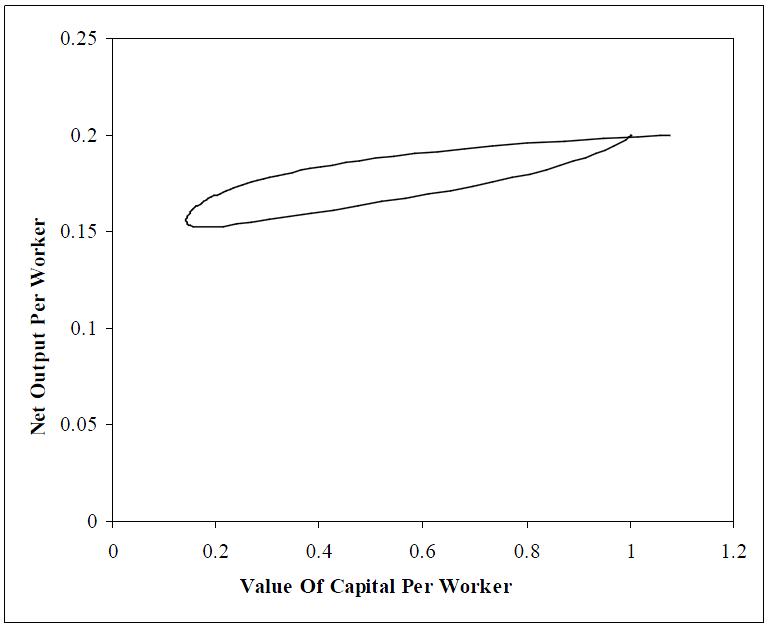
Figure 1: A Production Function In Garegnani (1970)

I think the following are some of Garegnani's major claims about economics:

  • Classical economics provides an alternative theory to marginalist economics (misleadingly called "Neoclassical economics")
  • The givens of the classical theory of value and distribution are:
    • The gross quantities of output,
    • The production technique, and
    • The rate of profits or the wage.
  • These givens are to be explained within the discipline of political economy.
  • The classical theory of value and distribution can be combined with a Keynesian theory of effective demand.
  • The marginalists, from about 1870 to about 1930, shared with the classical economists a common method of trying to explain long-period prices and distribution.
  • Yet, the marginalist theory was incoherent because of their reliance on a given quantity of capital.
  • Hayek and Hicks, among others, initiated a major change in method with their creation of (very short period) theories of intertemporal and temporary equilibrium.
  • These new-fangled theories remain vulnerable to capital-theoretic critiques.
I give a very limited biography of articles in which Garegnani puts forth these theses, in English. As I understand it, his 1960 doctoral thesis was only published in Italian. His 1970 Review of Economic Studies article refutes the neoclassical long period theory of value and distribution, in general, and Samuelson's attempted defense with the pseudo-production function, more specifically. Joan Robinson took the opportunity of his 1978 and 1979 articles to break with Sraffianism on the ground that Garegnani's models were not located in historical time.

I include in the bibliography a festschrift published in his honor.

Selected Bibliography

  • Pierangelo Garegnani (1970). "Heterogeneous Capital, the Production Function and the Theory of Distribution", Review of Economic Studies V. 37, N. 3 (July): 407-436.
  • -- (1976) "On a Change in the Notion of Equilibrium in Recent Work on Value", in Essays in Modern Capital Theory (ed. by M. Brown, K. Sato, and P. Zarembka), North Holland. (Reprinted in J. Eatwell and M. Milgate (editors) (1983) Keynes's Economics and the Theory of Value and Distribution, Oxford.)
  • -- (1978) "Notes on Consumption, Investment, and Effective Demand, Part I", Cambridge Journal of Economics, V. 2: 335-353.
  • -- (1979) "Notes on Consumption, Investment, and Effective Demand, Part II", Cambridge Journal of Economics, V. 2:3: 63-82.
  • -- (1984). "Value and Distribution in the Classical Economists and Marx", Oxford Economic Papers, V. 36, N. 2 (June): 291-325.
  • -- (1990). "Quantity of Capital", in The New Palgrave: Capital Theory (Ed. by J. Eatwell, M. Milgate, and P. Newman), Macmillan Press.
  • -- (1990b). "Sraffa: Classical versus Marginalist Analysis", in Essays on Piero Sraffa: Critical Perspectives on the Revival of Classical Theory (Ed. by K. Bharadwaj and B. Schefold), Unwin-Hyman.
  • -- (2010). "On the Present State of the Capital Controversy", Sraffa's Production of Commodities by Means of Commodities,1960-2010: Critique and Reconstruction of Economic Theory, Roma (2-4 December).
  • Gary Mongiovi and Fabio Petri (editors) (1999). Value, Distribution and Capital: Essays in honour of Pierangelo Garegnani, Routledge.

Update (21 October): Some other obituaries: Tyler Cowen, at Daily Kos, Barkley Rosser, David Ruccio, Matias Vernengo. In other languages than mine: Sergio Cesaratto, Revista Circus, Giorgio Napolitano, Antonella Stirati

Sunday, October 16, 2011

A Modest Proposal To A Random Cop

Suppose I walked up to some random strangers on the street and sprayed them with pepper spray. I'm fairly sure that I would be breaking some serious laws. And if I did that in front of a crowd of police officers, I would be quickly arrested. So why don't you arrest an officer if he does that in a totally unprovoked situation?

If some policeman were to consider this, I suspect that they know it would not be good for their career. And they know that there are some (presumably ineffective) Internal Review Board processes. But if you did arrest another officer for committing a crime right in front of you when the whole world is watching, you would have another career. For example, you could be invited to lectures at many colleges for some years.

I think that any cop that does this would want to be smiling, quiet, and polite through the whole process. I recently asked a Military Policeman at some bar if he had ever prohibited a general from entrance onto his facility. (I know there are processes and paperwork to get a visit approved.) He told me, "No, but I did forbid a major the other month." And he told me that his amusement with the major's assertions was increased by smiling the whole while.

Wednesday, October 12, 2011

Current Mentions Of Keynes In The Press

  • John Cassidy's article, "The Demand Doctor: How right was John Maynard Keynes" is in The New Yorker, 10 October 2011 (pp. 46-57).
  • Thomas Geoghegan's article "What would Keynes do?" is in The Nation, 17 October 2011 (pp. 11-17).
  • Robert Solow's article, "Working in the Dark", is a review of Sylvia Nasar's book, Grand Pursuit: The Story of Economic Genius. It is in the 28 September 2011 issue of The New Republic.
Off topic reminders to myself:

Saturday, October 08, 2011

Family Resemblances

I expect many mainstream economists to blithely make many untrue statements. It is not, necessarily, because they disagree with prosaic ideas I think well-established in the literature. I suspect it is because they are just ignorant of the literature. This post offers an example of such a prosaic idea.

Works by David Ricardo (1821), Karl Marx, Wassily Leontief (1941), John Von Neumann (1945-1946), and Piero Sraffa (1960) are important components in a long-established, anti-marginalist, analytical tradition.

References

  • D. G. Champernowne (1945-1946). "A Note on J. v. Neumann's article on 'A Model of Economic Equilibrium'", Review of Economic Studies, V. 13, N. 1: pp. 10-18.
  • Heinz D. Kurz and Neri Salvadori (1995). Theory of Production: A Long-Period Analysis, Cambridge University Press.
  • Wassily Leontief (1941). The Structure of the American Economy, Harvard University Press. [I haven’t read this particular reference.]
  • Karl Marx (). Capital: A Critique of Political Economy
  • David Ricardo (1821). On the Principles of Political Economy and Taxation, Third edition. (Republished as the first volume of The Works and Correspondence of David Ricardo (ed. by P. Sraffa), Cambridge University Press.)
  • Piero Sraffa (1960). Production of Commodities by Means of Commodities: Prelude to a Critique of Political Economy, Cambridge University Press.
  • John Von Neumann (1945-1946). "A Model of Economic Equilibrium", Review of Economic Studies, V. 13, N. 1: pp. 1-9.

Wednesday, October 05, 2011

Mainstream Multipliers

1.0 Introduction
"Theorizing aside, Keynesian policy conclusions, such as the wisdom of additional stimulus geared to money transfers, should come down to empirical evidence. And there is zero evidence that deficit-financed transfers raise GDP and employment—not to mention evidence for a multiplier of two." -- Robert Barro, Wall Street Journal
I find the above disingenuous, although cleverly worded to narrowly focus on transfer payments. Empirical evidence exists on Keynesian multipliers, thereby supporting the theory from which the policy recommendations are drawn.

In this post, I draw attention to four studies using Instrumental Variables (IVs) to estimate Keynesian multipliers. Currently, many economists find quite promising the use of IVs to emulate controlled experiments. For some more on the stimulus, that is, the 2009 American Recovery and Reinvestment Act, see Dylan Matthews' summaries of nine studies. I also have yet to make anything of Auerbach and Gorodnichenko (2011).

2.0 Methodology
The change in the ratio of public debt to GDP is increased by a rise in nominal interest rates, a fall in the rate of growth of real GDP, and a fall in the rate of inflation. The question addressed by this post is how to distinguish the effects of government policy on GDP from the effects of changes in GDP on government policy.

Some tax and government spending is endogenous to the economy. For example, a reduction in Gross Domestic Product (GDP) can result in:

  • Lower taxes, since the income on which taxes are based has declined, and more government spending on predefined social programs
  • Deliberate attempts at short-run government counter-cyclical increases in government spending and lower taxes.
One cannot easily use such endogenous changes to spending or taxes to identify subsequent causal effects from government spending and taxes on the overall level of economic activity. Accordingly, Christina D. Romer and David H. Romer (2010) consider exogenous changes to taxes, which generally fall into two categories:
  • Taxes to supposedly lower or raise long run rate of growth of GDP
  • Taxes to bring thedeficit closer to balance.
Romer and Romer consider quarterly USA data from 1945 to 2007. They look at narrative data, such as official reports, to classify changes in tax rates as endogenous or exogenous. The exogenous changes provide their IV which they can then use to identify subsequent causal changes in GDP.

David Cloyne (2011) applies this narrative approach for constructing a time series of exogenous tax changes to the United Kingdom. Jaime Guajardo, Daniel Leigh, and Andrea Pescatori (2011) extend this narrative approach across countries in the Organisation for Economic Co-Operation and Development (OECD).

Daniel Shoag adopts a different approach, applicable at the state level in the United States. He considers changes in state-level spending associated with windfall gains and losses in state pensions. A state pension is typically not invested in that individual state, and the dispersion of pension performance across states is exogenous, he argues, to the variation in the economic performance across states. So pension performance gives Shoag his IV. (His references include additional multiplier estimates, if I understand correctly.)

3.0 Results

  • Romer and Romer find lowering taxes by 1% of GDP raises GDP by 3% in 2 1/2 years.
  • Cloyne finds that lowering taxes by 1% of GDP raised GDP by 2.5% in three years.
  • Guajardo et al find that fiscal consolidation (that is, raising taxes or lowering government spending) of one percent of GDP reduces real GDP by 0.62 percent.
  • Shoag finds that a dollar of government spending generates $2.12 of personal income. Raising government spending by $35,000 generates another job in-state.
Update (12 October 2011): The September issue of the Journal of Economic Literature contains three articles debating the size of the multiplier.

Bibliography

Friday, September 30, 2011

Vernengo On Recent History Of Macroeconomics

Matias Vernengo argues that, "The fundamental problem of the neoclassical/marginal approach, and the importance of Keynesian analysis, can ONLY be properly understood in light of the 1960s capital debates."

Vernengo is riffing off a Krugman post on his New York Times blog. A commentator on that brings up John Eatwell's 1980s work on capital theory and Keynes. See also this Krugman post on Keynes' debunking of the idea that unemployment is caused by excessively high wages.

Update (12 October 2011): Peter Cooper has two posts discussing Vernengo's views.

Wednesday, September 28, 2011

The European Union: A Prescient Sraffian Economist

"It is my view that the European project for arriving at economic and monetary union (EMU) should be regarded as the combined result of a radical change, since the late 1970s, in the principal economic policy objective of the major industrial countries - an epoch-making shift in emphasis away from unemployment and poverty to the objective of reducing inflation; and of the theoretical restoration that has occurred over the last twenty years, with the revival of pre-Keynesin conceptions in macroeconomic thinking. This view, which I have discussed elsewhere ..., makes it reasonable to believe also that the project's fortunes will reflect developments in these two ambits. Specifically, one can sensibly expect the EMU project to be definitively abandoned as soon as the social impact of actual unemployment will again make the pursuit of its reduction each government's main focus of concern, at the same time leading to a rejection of the 'natural' rate concept of the economy.

This process of gradual abandonment of the project, however, is likely to be delayed as regards countries in which the EMU is seen as a means of solving a 'commitment problem' in their national economic policies - an irreplaceable source of discipline, that is to say, with respect to inflation, government budget deficits and government debt." -- Massimo Pivetti (1999). "High Public Debt and Inflation: On the 'Disciplinary' View of European Monetary Union". In Value, Distribution and Capital: Essays in Honour of Pierangelo Garegnani (edited by Gary Mongiovi and Fabio Petri), Routledge.

I think federal systems are a good idea. I'm hoping a European government capable of conducting fiscal policy and issuing "euro-bonds" will emerge under the pressure of events.

Thursday, September 22, 2011

International Journal of Pluralism and Economics Education

I recently stumbled upon this journal. Its first issue was in 2009, and the articles in the third issue of the first volume are available for download by non-subscribers.I like Fred Lee's article, "A Heterodox Teaching of Neoclassical Microeconomic Theory". He mentions my favorite criticism:
"Another example is that in a system of production with produced inputs with circular production, a change in a factor input price generates collateral effects that invalidates the ceteris paribus, partial equilibrium methodology underpinning the derivation of the slope of the constant output factor input demand function. This not only makes the function meaningless, it also undermines partial equilibrium analysis. However, this well-known point is simply ignored." -- Frederick S. Lee

Saturday, September 17, 2011

Fathers And Children and Rediscovering Fire

1.0 Turgenev's Novel
I recently stumbled across an English-language copy of the Turgenev novel where the title was translated as in this blog post. This reminds me that I once listed the following pairs of economists:
  • John Bates Clark, John Maurice Clark
  • Milton Friedman, David Friedman
  • John Kenneth Galbraith, James Galbraith
  • John Neville Keynes, John Maynard Keynes
  • James Mill, John Stuart Mill
  • Auguste Walras, Marie Esprit Leon Walras
  • Sidney Weintraub, Eliot Roy Weintraub
I now find I can add another pair of names, Edward J. Nell and Guinevere Liberty Nell.

One way of reading the series of models in Sraffa's Production of Commodities by Means of Commodities is as an historical series. Later models in the series apply to an institutional setup that followed earlier models. Some, including maybe Engels, have read Marx in this way. The labor theory of value is alleged to apply to a pre-capitalist, late medieval artisan economy. The transformation of values into prices of production is then a historical process occurring with the emergence of capitalism. Be that as it may, Edward Nell's work on the theory of Transformational Growth, fits well with this literature.

2.0 Rediscovering Fire
Guinever Liberty Nell has written a book, Rediscovering Fire: Basic Economic Lessons From the Soviet Experiment (Algora Publishing, 2010), in some ways in a very different tradition. She also considers institutions in different historical settings. But consider that Peter Boettke and Peter Leeson, in the George Mason tradition, appear in the acknowledgments. I gather she currently works for the Center for Data Analysis of the Heritage Foundation. She notes her differences with her family:
"I also thank my brother Jacob for introducing me to Alec Nove's work, which was the inspiration for writing this book. I must also thank Thomas W. Moore IV for endless intellectual battles that helped me challenge the beliefs I was raised with, and my sister Miranda for then debating with me endlessly from the other side."
Her book is dedicated as so:
"To my mother for raising me in confidence in my own creativity and ability, and my father for infusing me with the economics 'bug'."

The book is organized in somewhat repetitive themes. Aside from the introduction and conclusions, chapters treat competition, (un)employment, profit (impact on the firm), profit (impact on the economy), middlemen and trade, prices, money, regulation, democracy, corporations. Each of these substantive chapters consists of an introduction, a summary of the socialist argument, a description of the soviet experience, lessons to be drawn, and a conclusion. I'm not finished; I'm in the chapter on prices.

In many cases, I disagree with her account of the socialist argument. For example, she writes:
"Under socialism, workers were to be paid according to work, while under communism they would be paid according to need. According to theory, workers were to receive the full value of their product." -- Guinevere Libery Nell, Rediscovering Fire, p. 61.
As far as I am concerned, this claim is explicitly contradicted in Marx's Critique of the Gotha Program. Lenin knew this work quite well, he writes about it in State and Revolution. As another example, Nell writes:
"Marx did not believe in gains from trade... However, there are several reasons why both parties can gain from an exchange. One is that division of labor enables one person to make a product at lower cost than another person can make it." -- Guinevere Libery Nell, Rediscovering Fire, p. 92.
But Marx, in Capital explicity states that such gains from trade exist. On the other hand, she extensively references Nikolai Bukharin and Evgenii Preobrazhensky's The ABCs of Communism, which I have often seen referenced as a primer to Bolshevikism. I think Nell would agree with me that the book concentrates more on economic history than the history of economic thought.

I'm no expert on Soviet history (I'm best on the 1920s, I think). Nevertheless, I'll record my impression that I find the thematic organization confusing. In some chapters, she writes about either war communism, the New Economic Program, the collectivization of agriculture, or the 1965 reform, for example. But these analyzes are not arranged chronologically. If she ever produces a new edition (paperback?), perhaps she can include a short chronology or timeline.

I'm willing to accept, say, war communism as an attempt to construct a close to pure socialist economy. But I found Nell's attempts to apply lessons directly to current institutions in the United States economy unconvincing. Maybe pure planning of an entire economy cannot be done. I don't see why a large amount of planning and regulation is therefore inappropriate for specific sectors (for example, utilities or health) in certain settings. On the other hand, she is often careful to be tentative in her suggestions. Maybe Obama "may" want to consider some unintended consequence in restructuring health insurance. A somewhat facile objection to her lessons can easily be constructed. Of course, the Soviet experience with planning did not work very well. They did not have powerful networked computers.Maybe this objection would be less likely to arise if she had taken more of a historical and less of a thematic approach.

3.0 An Open Request
But that's not what I want to talk about. I wonder whether Nell would be willing to share any anecdotes about growing up. Is she able to discuss political disagreements with family members without rancor? I guess of more interest to me would be whether she has formed personal impressions of Joan Robinson, Pierangelo Garegnani, or Anwar Shaikh. On the other hand, if her stories would be like those in Jan Myrdal's memoir Childhood, who seems not to have got on with much of his family, I don't know that I want to hear about it.

Sunday, September 11, 2011

Davidson On Obama's Job Plan

Paul Davidson discusses Obama's job plan. The blogger "Lord Keynes" presents links to other reactions to Obama's speech. (I dislike the use as pseudonyms of historical names of still current interest.)

Wednesday, September 07, 2011

Nick Rowe, Confused

Nick Rowe comments on the Cambridge Capital Controversy in comments to this post:
"Don't take my answer as authoritative.

As far as I can see, the Cambridge-Cambridge Capital Controversy has had almost zero impact on modern macroeconomics. My guess is that not many have much knowledge of that debate. (I have *some* knowledge, through my own curiosity 30 years ago, but not much). The existence of a natural rate is treated as unproblematic. There is some possibility allowed that monetary policy might have some long-run non-neutralities, (multiple equilibria), but even here the focus is more on natural rates of output and unemployment, rather than on the natural rate of interest itself (though one would almost always imply the other).

The concept and existence of the natural rate of interest plays a central role in modern Neo-Wicksellian/New Keynesian macroeconomics...

In my own case, recently I made the more modest critique that the natural rate may exist, and be unique, but we cannot come anywhere close to observing it in real time...

And that's leaving aside the problem that different financial assets will have different natural rates, and the spreads between them may vary over time, especially in a financial crisis.

Now, funnily enough, there is one small exception *I know about* (others may know of others) to my statement that macroeconomists ignore CCCC. David Laidler recently wrote a paper for the CD Howe that explicitly used CCCC to critique the Neo-Wicksellian monetary policy of the Bank of Canada. And David is a monetarist!

...I, personally, remain unconvinced by the Cambridge critique. *As far as I can see*, if a Walrasian/Arrow-Debreu equilibrium exists, and is unique, it defines within it a natural rate of interest (subject to qualifications in my question below). *As far as I can see* a lot of the CCCC debate was really about whether the natural rate could be determined *independently of preferences*. And (outside of very special one-good Y=F(K,L) models) it cannot. So what? I say. Preferences matter too, in determining relative prices including intertemporal prices like interest rates.

BUT, the chances of getting a nicely-well-behaved downward-sloping Investment demand function (and hence IS curve) out of anything other than a one-good model? I wouldn't bet on it. But my hunch is that the complications that arise from firms being sales-constrained (ignored in the Walrasian model) are more important than anything coming out of CCCC. Hence this post.

Now, my question: I never found Sraffa easy to understand. Sraffa said (I think) that the natural rate on wheat would, in general, be different from the natural rate on barley. Right? If so, is this what he meant:

Suppose the relative price of barley against wheat is rising at (say) 1% per year. Then, under perfect competition, and free flow of capital across sectors, the barley natural rate of interest must be one percentage point lower than the wheat natural rate of interest.

Is that what Sraffa was saying? (With all due allowance for over-simplification?)" -- Nick Rowe
I doubt Rowe is aware of the existence of Colin Rogers. I don't know what it means to talk of a natural rate of interest in the Arrow-Debreu model of intertemporal equilibrium. (This is certainly not Wicksell's long period approach.) Money does not exist in the model. For every numeraire, one will get another interest rate (for a loan for one one period of the numeraire good, starting at a designated time period). Which of these many interest rates is the "natural rate"? (It would help if when Rowe asks his question about Sraffa on own rates of interest of barley and wheat, he would bring up that he referencing Sraffa's critique of Hayek, not the more mature Production of Commodities by Means of Commodities.) Rowe has not grasped that classical economics and extensions of the economics of Keynes provide different theories of distribution. One need not close Sraffa's model by assuming intertemporal utility-maximization. I don't see why I need I care about Rowe's hunches on "importance", although, I suppose, he gets points for recognizing the arbitrariness of a downward-sloping investment demand function.

"Those re-switching examples never seemed to me to pay enough attention to the term structure of interest rates. There was always a flat term structure assumed. Not to mention how the term structure of investment would interact with the desired term structure of saving and consumption at the aggregate level, to create a term structure of interest rates." -- Nick Rowe
I find this incomprehensible. Let the interest rate on a loan for n years be 100 rn percent. Typically, in a reswitching example, the following relationship holds:
1 + rn = (1 + r1)n
This is a term structure of interest rates. Suppose one wanted to allow expectations of future yearly interest rates to differ from the current yearly interest rate. That is easy to introduce, but those extra degrees of freedom make it even easier to show violations of traditional neoclassical parables. Although it's easy to construct closed reswitching examples, I don't see why mainstream economists cannot consider open models.

Bill Woolsey's comment in the same thread is too stupid to bother with. I would think it possible to discuss analytical points somewhat separately from ideology.

Friday, September 02, 2011

Elsewhere

  • Arindrajit Dube takes the opportunity of Alan Krueger's nomination, as chair of the Council of Economic Advisors, to note that Card and Krueger's work has stood the test of time. He also notes the bias in Neumark and Wascher's work.
  • Dean Baker's new book, The End of Loser Liberalism: Making Markets Progressive is now available. What is the point of the cover photo of Biscuit? Is it that poodles are losers; progressives should try to emulate a bigger, more assertive breed? (Anyway, I am currently reading Jacob Hacker and Paul Pierson's Winner-Take-All Politics: How Washington Made the Rich Richer - And Turned Its Back on the Middle Class; so I'm not enthusiastic about reading a similarly themed book right away.

Thursday, August 18, 2011

David Henderson, Idiot

David Henderson tells us:
"Then, in my late teens, I started to learn economics. I started to understand that the vast majority of income in a relatively free society is earned. It's true that a small number of wealthy people did get their money by fraud or dishonesty. More common, especially in societies with lots of government controls, were people who got wealthy by using political pull. But I started to see that the typical high-income person in a relatively free society gets his or her income the old-fashioned way--by earning it." -- David Henderson
I suppose it is good that some economists are willing to expose themselves, or their teachers, as incompetent. Economists refusing to teach theories that collapsed half a century ago, except as history, would be better. Even if markets were perfectly competitive, marginal productivity would not be a theory of income distribution. In neoclassical economics, properly understood, no sense can be attached to the claim that the rich earn their income. But, of course, markets are not perfectly competitive in the United States. The ever increasing income and wealth being seized by the top quintile, or 10%, or 1%, or 0.1%, etc. is the result of the exercise of political power.

Noah Smith, who probably thinks of himself as a liberal opposing "libertarians" (that is, propertarians), is not much better. In his discussion, he fails to mention any empirical facts about the increasing and astonishing unequal distribution of income in the United States. He fails to discuss whether or not gross inequalities in the distribution of income and wealth is consistent with the smooth expanded reproduction of a capitalist economy. And he fails to discuss whether having an income distribution in the United States that has not been matched since the 1920s might have something to do with current recessionary conditions. Instead, he writes about feelings. As far as feelings go, the vast majority of Americans should be angrier. "Let fury have the hour, anger can be power/D'you know that you can use it?"

Wednesday, August 17, 2011

Scholarly Fantasies

Maybe many that read old books might find interest the rediscovery of works whose existence was previously unknown or thought to be gone forever. Some examples:
  • The Gospel According to Thomas and other gnostic manuscripts: Two Egyptian farmers discovered the Nag Hammadi library in 1945. This story is fairly incredible. While these Egyptian brothers pursued a feud with one of their neighbors, they left them in the keeping of their mother. She, in turn, I guess, started a fire with them every morning, until a coptic priest recognized their importance. And then they were smuggled out of Egypt.
  • Thomas Malory's Le Morte d'Arthur: While cataloging the Winchester College library, in 1934, Sir Walter Fraser Oakshott discovered a manuscript of this book. This manuscript suggests that Malory conceived his work as a collection of tales. Caxton, the printer, edited it into an unified tragedy.
  • Third edition of François Quesnay's Tableau Économique: Marguerite Kuczynski, in the late 1960s, asked the heirs of Pierre Samuel Du Pont de Nemours if they had any printed works by Quesnay in their possession. And the Eleutherian Mills Historical Library told her "Yes".
  • David Ricardo's unknown correspondence and manuscripts: Piero Sraffa's discovered, in 1934, a bundle in F. E. Cairnes castle at Raheny. Raheny is near Dublin, and F. E. Cairnes, son of a 19th-century economist, had recently died. The bundle contained 57 letters from Ricardo to James Mill and various manuscripts written by Ricardo
  • Ludwig Von Mises' papers from his apartment in Vienna: Unbeknownst to Mises, the Nazis preserved these after Mises fled. The Soviets captured them from Germany at the end of WW II, catalogued them, and preserved them in the KGB archives. Richard Ebeling brought them back from Russia in 1996 after their discovery by western scholars after the collapse of the Soviet Union.

Tuesday, August 09, 2011

Video Strategy Games As A Testbed For Decision Theory


Daniel MacDonald occasionally mentions video games. It turns out some researchers use strategy video games for exploring decision theory models. (Partially observable Markov decision processes and partially observable stochastic games are examples of such models for decision theory.) Frans A. Oliehoek and others at the Intelligent Systems Lab, at the University of Amsterdam, have developed the Multi-Agent Decision Process (MADP) Toolbox, "an open source C++ library for decision-theoretic planning under uncertainty in multiagent systems."

Some researchers, I guess in this lab, have integrated MADP into StarCraft, a real-time strategy game. StarCraft has a science fiction setting, and MADP routines are used to calculate policies for one of the three races in the game.

I consider Edward Castronova one the most interesting researchers exploring the intersection of computer games and economics.

Don't tell Brad DeLong (who at one time found he had to choose between playing Civilization or doing economics) about this post.

Sunday, August 07, 2011

Quiggin Fortunate In His Enemies; Williamson Still A Fool

  • An attack by Michael Stutchbury in The Australian. (Even the title is a lie - social democrats are not on the "far left".)
  • John Quiggin responds.
  • Stephen Williamson reviews Zombie Economics. We learn "DSGE has no implications, and therefore can't be wrong. Indeed DSGE encompasses essentially all of modern macroeconomics."
  • John Quiggin tries to correct Williamson.
  • Noah Smith also tries.
  • Paul Krugman links to Smith and gently chides Williamson.
  • Stephen Williamson comically explains this is not pulling rank: "Zombie Economics reads like fringe economics (Austrians, Post-Keynesians, etc.). In fringe economics, the game is dismissing things you know little about, and offering little that is actually constructive."
  • Stephen Williamson provides an even worse elaboration, as if Krugman's point were that his synthetic Nobel makes him right.

Wednesday, August 03, 2011

Hahn On Regression In Macroeconomics

One can find many amusing quotes from such as Frank Hahn and Robert Solow on trends in macroeconomics after Robert Lucas. I get this one second-hand:
"One should now ask how the present mess came into being. For macroeconomics today is in a state which astronomy would be if Ptolemaic theory once again came to dominate the field. There can be few instances in other disciplines of such a determined turning back of the clock. A great deal of what is written today as well as the policy recommendations which have been made would be thoroughly at home in the twenties. So something needs explaining and I hope that some good intellectual historian will attempt to do so soon." -- Frank Hahn (1985) (as quoted in Philip Mirowski's More Heat Than Light, p. 411).
Do I need to note some economists today would still find Hahn's opinion apposite?