Saturday, September 28, 2013

What's Bayesianism Got To Do With It? A Software Reliability Example

Figure 1: The Musa-Okumoto Model Fit To Failure Data
1.0 Introduction

I was partly inspired for this post by a dispute between Matheus Grasselli and Philip Pilkington over the applicability of Bayesian statistics to non-ergodic processes. I happen to know of certain parametric software reliability models that describe software failures as non-stationary stochastic processes. Bev Littlewood is a prominent proponent of Bayesian models in software reliability engineering. And he has also recommended a certain approach to accessing the goodness of fit for software reliability models, including ones not originally put forth as Bayesian models.

Here I provide an example of an application of this approach for assessing goodness of fit. I do not see what Bayesianism has to do with this approach. It is not expounded in terms of prior and posterior distributions. I do see that this approach considers the model(s) being assessed as part of a larger system for making predictions, with the parameter estimates on which those predictions are based being updated with each new observation. Is this approach, therefore, Bayesian?

2.0 Failure Data

The data used for illustration here consists of 367 failures observed over 73 weeks, and they were provided by the Jet Propulsion Laboratory (JPL). The system under test was:

"A facility for tracking and acquiring data from earth resource satellites in high-inclination orbits... About 103,000 uncommented Source Lines Of Code in a mixture of C, Fortran, EQUEL, and OSL... Failure data were obtained from the development organization's anomaly reporting system during software integration and test." -- Nikora and Lyu (1996).

The blue line in Figure 1 above represents the data. This is a step function, where each step occurs after an interval of one week. The height of each step represents the number of failures observed in the week ending at the start of the step. Figure 1 also shows a point estimate of the mean value function, and 90% confidence intervals, based on fitting the Musa-Okumoto software reliability model to the data.

3.0 The Musa-Okumoto Model

As in other software reliability models, the Musa-Okumoto model relies on a distinction between failures and faults. A failure is behavior, including unexpected termination, observed while the software system under test is running. A failure occurs when the system is observed to behave other than specified. A fault, also known as a bug, is a static property of the system. A failure occurs when the inputs to the system cause altered behavior from the software entering a state in which a bug is tripped.

The Musa-Okuomoto model is an example of a software reliability model based on the assumption that the system under test contains an infinite number of faults. No matter how many faults have been found and removed, more faults always exist. Faults found later, however, tend to have an exponentially decreasing impact on the failure rate. More formally, the assumptions of the model are:

  1. The numbers of failures observed in non-overlapping time intervals are stochastically independent.
  2. The probability of one failure occurring in a small enough time interval is roughly proportional to the length of the time interval.
  3. The probability of more than one failure occurring in a small enough time interval is negligible.
  4. Detected faults are immediately corrected.
  5. No new faults are introduced during the fault-removal process.
  6. Aside from such repair of faults, the software is unchanged during test. No new functionality is introduced.
  7. Testing is representative of operational usage.
  8. The failure rate decreases exponentially with the number of removed faults.

The first three assumptions imply that failures occur as a Poisson Process, where a Poisson Process describes events happening randomly in time, in some sense. The sixth and seventh assumptions are unlikely to be met for the data being analyzed here. For best use of these kinds of software reliability models, system test should be designed to randomly select inputs from a specified operational profile. Nevertheless, these sorts of models have often been applied to test data observed naturally. The remaining assumptions imply that failures occur as a Non-Homogeneous Poisson Process (NHPP), where the failure rate is the following function of the mean value function:

λ(t) = λ0 em(t)

where:

  • λ(t) is the failure rate, in units of failures per week. (The distinction between the failure rate and the failure intensity is moot for Poisson Processes.)
  • m(t) is the mean value function, that is, the number of failures expected by week t.
  • λ0 is the initial failure rate.
  • θ is the failure rate decay parameter.

Figure 2 plots the above function for the data for the system under test, with parameter estimates being based on all of the data. The mean value function is plotted with the data along the abscissa for each week by taking the cumulative number of failures observed by the end of that week. The corresponding ordinate value for the data is the quotient of the number of failures observed in each time interval (namely, a week) and the length of the time interval. The graph shows quite a bit of variation on this scale, clustered around the model estimate. A slight improvement in software reliability is noticeable, but the convexity in the estimate from the model is hard to see.

Figure 2: The Failure Rate As A Function Of The Mean Value Functon

4.0 The U-Test: How Am I Doing

An attempt was made to estimate the model parameters after each week. For this model, maximum likelihood estimates are found by an iterative algorithm. The iterative algorithm did not converge at the end of week 49, leaving the twenty four parameter estimates shown in the table in Figure 3. Figure 3 also shows percent variability of the parameter estimates. (Percent variability is the ratio of the absolute difference of the estimates for two successive weeks to the estimate for the earlier of the two weeks.) The model estimates seem to have settled down towards the end of test period. They are unlikely to vary much over succeeding weeks if testing is to continue.

Figure 3: Percent Variability In Parameter Estimates

In the Musa-Okumoto model, the number of failures observed in a given week is a realization of a random variable from a Poisson distribution. The mean of this distribution, for given model parameters, varies with the week. The expected number of failures declines in later weeks. In the approach illustrated here, the model parameters are re-estimated in each successive week. Specifically, define ui; i = 1, 2, ..., 23; as the value of the CDF for the number of failures in week 50 + i, where:

  • The CDF is evaluated for the number of failures actually observed in the given week.
  • The CDF is calculated with estimates of the model parameters based on the number of failures observed in all weeks up to, but not including the given week.

For example, u1 is an estimate of the CDF for the number of failures found in week 51, based on parameter estimates found with the number of failures observed in weeks 1 through 50. This procedure yields a sequence of (temporally ordered) numbers:

u1, u2, ..., u23

Each ui, being a probability, is between zero and one. These numbers, in effect, provide a measure of how well the model, with its estimation procedure, is predicting failures of the system under test. Under the null hypothesis that the model describes the test process generating the failure data, the sequence of uis is the realization of a random sample from a probability distribution uniformly distributed on the interval [0, 1].

The Kolmogorov-Smirnov statistic provides a formal test that the uis are realizations of identical and independently distributed random variables from a uniform distribution. Figure 4 compares and contrasts the CDF from a uniform distribution with the empirical probability distribution found from the data. The theoretical distribution for the uniform distribution is merely a 45 degree line segment sloping upward from the origin to the point (1, 1). That is, the probability that a realization of a random variable uniformly distributed on [0, 1] will be less than some given value u is merely that given value.

Figure 4: The U-Test For The Example

The empirical CDF found from the Musa-Okumoto model applied to the data is a step function. The probability that a random variable from this distribution will be less than a given value u is the proportion of uis in the data less than that given value. The exact location of the step function is found as follows. First, sort the sample values in increasing order:

u(1)u(2) ≤ ... ≤ u(23)

The sorted values are known as order statistics. (Note the temporal order is lost by this sorting; this test does not reject the model if, for example, overestimations of failures in earlier weeks average out underestimations of failures in later weeks.) For this data, u(1) is approximately 0.007271, and u(23) is approximately 0.939. Plot these order statistics along the abscissa. A step occurs at each plotted order statistic, and each step is, in this case, of size 1/(23 + 1) (approximately 0.042) up.

The Kolmogorov-Smirnov statistic is the maximum vertical distance between the theoretical CDF, specified by the null hypothesis, and the empirical CDF, as calculated from the data. In the figure, this maximum vertical distance is 0.18869, found for the second step up, at u(2) (which is approximately 0.23). The p-value of 34.2% is the probability that the empirical CDF, for a random sample of 23 points drawn from a uniform sample, will be at least this far above or below the empirical CDF. Since the p-value exceeds the pre-selected conventional level of statistical significance of 10%, the data does not allow one to conclude that the model does not fit the data. (One should set a fairly low level of statistical significance so as to increase the power of the test.) Thus, one accepts that the Musa-Okumoto model is successful in predicting failures in weeks one step ahead.

5.0 Conclusions

The above analysis suggests that, despite the violation of model assumptions in the test process, JPL could have used the Musa-Okumoto model as an aid in managing this test phase of the tracking and data acquisition system considered here.

In what sense, if any, is the method illustrated here for analyzing the model's goodness-of-fit Bayesian?

References
  • Sarah Brocklehurst and Bev Littlewood (1996). Techniques for Prediction Analysis and Recalibration, in Handbook of Software Reliability (edited by M. R. Lyu), McGraw-Hill.
  • Grasselli, Matheus (2013). Keynes, Bayes, and the law.
  • Nikora, Allen P. and Michael R. Lyu (1996). Software Reliability Measurement Experience, in Handbook of Software Reliability (edited by M. R. Lyu), McGraw-Hill.
  • Pilkington, Philip (2013). Holey Models: A Final Response to Matheus Grasselli.

Wednesday, September 25, 2013

S. Abu Turab Rizvi, Not Steve Keen

Notice the point about the need in neoclassical theory to assume that preferences satisfy Gorman's assumptions of identical and homothetic (non-varying with income) preferences:

"Extensions of the basic arbitrariness results to configurations of preferences and endowments which are in no way 'pathological', and are in fact more and more restrictive, indicate the robustness of S[onnenschein-]M[antel-]D[ebreu] theory.

For instance, an assumption which is often made to improve the chances of meaningful aggregation is that of homothetic preferences, which yields linear Engel curves and so no complicated income effects at the level of the individual. However, with only a slight strengthening of the requirements of Debreu's theorem, Mantel (1976) showed that the assumption of homotheticity does not remove the arbitrariness of A[ggregate] E[xcess] D[emand functions].

Moreover, the possibility that consumers have to be very different, or that unusual endowment effects need to take place, in order for SMD-type results to hold was refuted by Kirman and Koch (1986): even supposing consumers to have identical preferences and collinear endowments does not remove the arbitrariness of the AEDs. Of course, if preferences are simultaneously identical and homothetic, AED is a proportional magnification of individual excess demand (Gorman, 1953; Nataf, 1953) and the whole economy behaves as if it were an individual (obeying the Weak Axiom of Revealed Preference in the aggregate), but this is an extremely special situation. The Mantel and Kirman-Koch theorems effectively countered the criticism of SMD theory raised by Deaton by showing that the primitives can be arrayed in ways which on the face of it are very congenial towards generating well-behaved results, yet the arbitrariness property of AEDs remains." -- S. Abu Turab Rizvi, "The Microfoundations Project in General Equilibrium Theory", Cambridge Journal of Economics, V. 18 (1994): p. 362.

In short, neoclassical economists have proved (by contradiction, in some sense) that neoclassical microeconomics is not even wrong and that methodological individualism has failed.

Monday, September 23, 2013

On The Ideological Function Of Certain Ideas Of Friedman And Barro

A Simple Keynes-Like Model
1.0 Introduction

I want to comment on an ideology that would lead to an acceptance of:

  • Milton Friedman's Permanent Income Hypothesis (PIH)
  • Robert Barro's so-called theory of Ricardian Equivalence

My claim is that Friedman and Barro were each responding, in their own way, to the (policy implications suggested by) Keynes' General Theory. So first, I outline, very superficially, some ideas related to the General Theory. I then briefly describe how Friedman and Barro each tried to downplay these ideas, before finally concluding.

I have a number of inspirations for this post, including Robert Waldmann's assertion that the denial of the PIH is consistent with the data; Brad DeLong noting Simon Wren-Lewis and Chris Dillow commenting on the incompetence of, say, Robert Lucas; and Josh Mason pointing out the nonsense that is taught in graduate macroenonomics about the government budget constraint and interest rates.

2.0 Governments Can End Depressions

The figure above illustrates some basic elements of Keynes' theory. This specification of a discrete-time, dynamic system includes an accounting identity for a closed economy, namely, that national income in any time period is the sum of consumption spending, investment, and government spending. And it includes a behavioral relation, namely, a dynamic formulation of a consumption function. In this system, consumption is the sum of autonomous consumption and a term proportional to national income in the previous period. One should assume that the parameter b lies between zero and one.

A policy consequence follows: government can lift the economy out of a depression by spending more. Government spending increases national income immediately. Through the consumption function, it has a positive feedback on next period's income, as well.

3.0 The Permanent Income Hypothesis

Suppose you are hostile to this policy conclusion and, like the current Republican party in the USA, dislike your fellow countrymen. How might you suggest a theoretical revision to the system structure to mitigate the influence of current government spending? One possibility is to suggest more terms enter the consumption function. With the proper manipulation, current government spending will have a smaller impact, since current income will have a smaller impact on consumption.

So, suppose the consumption function does not contain a term multiplying b by income lagged one period. Instead, assume b multiplies an unobserved and (directly) unobservable state variable which, in turn, is an aggregate of current income lagged multiple periods (Yt - 1, Yt - 2, ..., Yt - n). Call this state variable "permanent income", and assume the aggregation is a matter of forming expectations about this variable based on a number of past values of income.

This accomplishes the goal. Current government spending can directly affect current income. But to have the same size impact as before on future income, it would have to be maintained through many lags. The policy impact of increased government spending is attenuated in this model, as compared to the dynamic system illustrated in the figure.

4.0 "Ricardian" Equivalence

One can go further with unobserved state variables. Suppose that households consume based less on recent income, but, once again, on expected values of future income. And suppose that consumers operate under the mainstream economist's mistaken theory of a government budget constraint. So consumers expect increased income today, if it results from increased government spending, to be accompanied by some combination of future decreased government spending and increased taxes. So the same current upward shock to the system causes an expectation of a future downward shock.

This is the theory of Ricardian equivalence. And, like the PIH, it suggests that Keynesian effects are not as dependable as otherwise would be the case.

5.0 Conclusion

The above story portrays economics as driven by results favorable to the biases and perceived self-interests of the extremely affluent. One would hope that academic economics is not entirely like this.

Tuesday, September 17, 2013

Seth Ackerman And Mike Beggs On The Intellectual And Moral Bankruptcy Of Mainstream Economics

Seth Ackerman and Mike Beggs have an interesting article in Jacobin. They note:

  • Marginalist economics arose as a reaction against the analysis of class conflict in classical economics.
  • Greg Mankiw's defense of the 1% is deeply muddled.
  • The Arrow-Debreu model's use as a benchmark reflects a "broken" "belief system".
  • Marx and Keynes developed different, but perhaps compatible views of political economy.
  • Post Keynesians developed anti-neoclassical elements in Keynes' theory and revived the surplus-based approach to political economy.

I'll quote the last two paragraphs here:

"But in the long run, radicals need something more from their economics. Class conflict is at the heart of the capitalist economy and the capitalist state, yet neoclassical economics will not acknowledge the fact. How, then, should we think about economics as a discipline and the question of inequality as its subject? At an individual level, there are truly great economists working in the mainstream — some harboring deeply humane instincts, and some even with good politics. As a body of knowledge, economics yields a flood of invaluable empirical data and a trove of sophisticated tools for thinking through discrete analytical questions.

But as a vision of capitalist society, mainstream economics is simply hollow at its core — and the hollow place has been filled up with a distorted bourgeois ideology that does nothing but impede our understanding of the social world." -- Seth Ackerman & Mike Beggs

Monday, September 16, 2013

International Trade References

If I amend my paper, I might want to say something about:

  • Bajona, Claustre and Timothy J. Kehoe (2006). Demographics in Dynamic Heckscher-Olin Models: Overlapping Generations Versus Infinitely Lived Consumers, Staff Report 377, Federal Reserve Bank of Minneapolis.
    • My model does not consider transition from autarky to a stationary with-trade equilibrium; this paper does in a model with a somewhat different structure.
    • This paper models dynamics by analyzing intertemporal equilibrium paths. The worth of such analysis is questionable since in any disequilibrium approach to such paths, the initial quantities of capital goods, taken as data in the model, vary. Any time to approach equilibrium is too long.
    • It is clear on the distinction between international trade in financial capital ("bonds" in the model) and international trade in capital goods (intermediate goods in the model).
    • The model could be improved by considering the ambiguity of a given endowment of capital in models with multiple capital goods. Does the given quantity of capital consist of a vector of intermediate goods, as in intertemporal equilibrium, or a numeraire quantity, as in the traditional and textbook HOS model?
    • The model could also be improved by recognizing the impossibility, in general, of classifying commodities as "labor-intensive" and "capital-intensive". Is this issue orthogonal to the issue of factor-intensity reversals in models of international trade?
  • Bhagawti, J. (1971). The Generalized Theory of Distortions and Welfare, in The Generalized Theory of Distortions and Welfare. Considers how the theory of comparative advantage does not justify laissez faire in international trade, given price distortions. Bhagwati was clearly ignorant of the fact that a positive interest rate and the existence of capital goods destroys the case for laissez faire. So he makes arguably incorrect statements: "...for a perfectly competitive system with no monopoly power in trade, ...the economic system will operate with technical efficieny (i..e., on the 'best' production possibility curve...">
  • Brewer, Anthony (1985). Trade with Fixed Real Wages and Mobile Capital, Journal of International Economics, V. 18, Iss. 1-2: pp. 177-186. Contains some neat (counter) examples, either with labor being used to directly produce consumer goods or with a circular structure of production. In other words, the structure of my example is distinct.
  • Dixit, A. and V. Norman (1980). Theory of International Trade, Cambridge Economic Handbooks. This supposedly demonstrates that, without a fixed interest rate distortion, free trade dominates autarky. Do I care about theorems that have no practical application in economics? On the other hand, if they explicitly mention capital and interest rates, I suppose I should reference this.
  • Lipsey, R. G. and Kelvin Lancaster (1956-1957). The General Theory of Second Best, Review of Economic Studies, V. 24, No. 1: pp. 11-32. They use international trade and tariffs as one of their examples. I do not know that they use the phrase "price distortion", or point out that the mere existence of capital goods with a positive interest rate constitutes a price distortion.
  • Parrinello, Sergio (2000). The "Institutional Factor" in the Theory of International Trade: New vs. Old Trade Theories. Comments on Krugman's new trade theory.
  • Prasch, Robert E. (1996) Reassessing the Theory of Comparative Advantage, Review of Political Economy, V. 8, Iss. 1. Is this article fairly summarized as being a criticism of the realism of assumptions?

Do I want to say something about surveys of economists showing their overwhelming support for "free trade"? Do I want to say something about how comparative advantage is an empirical failure in providing a straight-forward explanation of patterns of trade? That is, do I want to say something about the Leontief paradox? Do I need to reference additional textbooks on trade, e.g., Krugman, Obstfeld, and Melitz?

Do I need to even close my numeric example with utility maximization? I have found some economists struggle with the very concept of an open model. Certainly closing the model in a neoclassical manner makes my case quite strongly. I want to ensure that I am claiming merely to produce a simple numeric example, to simplify accepted ideas in the research literature that contradict textbook teaching.

Wednesday, September 11, 2013

Wynne Godley On Front Business Page Of New York Times

The New York Times, even outside of their editorial pages, seems to think their readership should know about the non-mainstream economists I generally like:

I predict that this profile of Godley will get a more positive response from Post Keynesians and advocates of endogenous money than their profile of Warren Mosler did. One caveat: I think Godley was more about using his stock-flow consistent modeling to identify unsustainable trends, than to quantitatively predict the course of, say, Gross Domestic Product (GDP) over the next n quarters. (He also accepted the conclusions of the Cambridge Capital Controversy.)

Update: I should have noticed that the Jonathan Schlefer is the author of the article on Godley. L. Randall Wray comments.

Tuesday, September 10, 2013

Utility Maximization For A Numeric Example Of International Trade

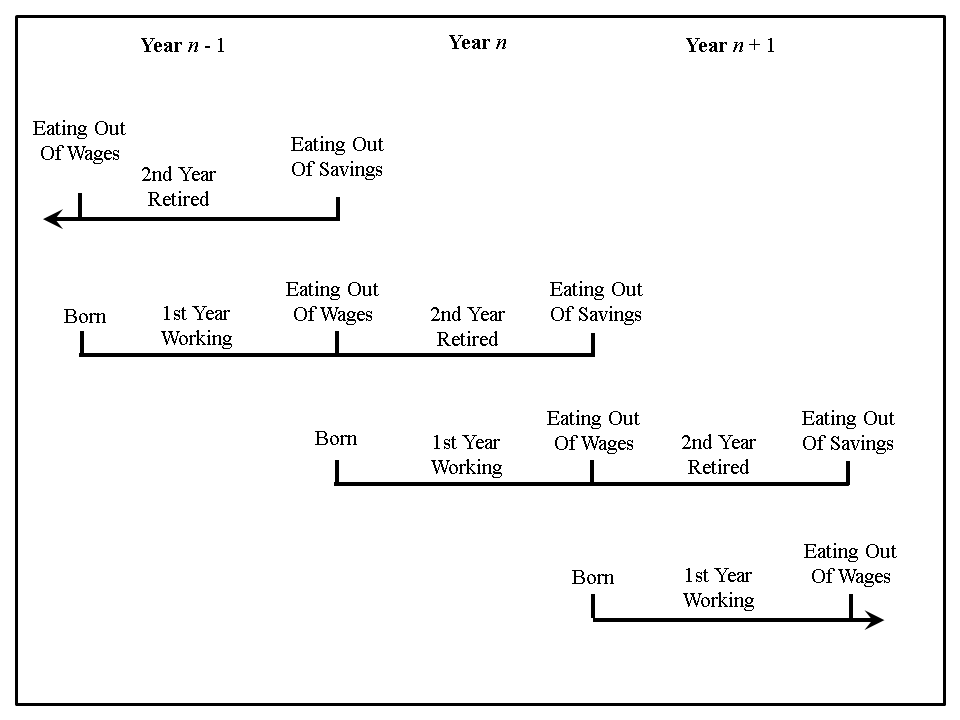
Overlapping Generations
1.0 Introduction

The theory of comparative advantage does not justify free trade in consumer goods. The mainstream textbook presentation is just logically mistaken. I have proven these claims in a paper building on work staring from a third of a century ago. My paper provides a numeric example. I have previously presented the production side of another numeric example here. My paper concludes with an utility-maximizing closure, but I have decided that this part of my paper could be improved. Accordingly, this post provides a simple overlapping generations example to combine with my previous numeric example in the blog post.

2.0 Overlapping Generations

Accordingly, consider an Overlapping Generations (OLG) model in which each agent lives for two years. Each agent works in the first year of their life and is retired in the second year. They are paid their wages at the end of the year in which they work. They can choose to save some of their wages for consumption at the end of the second year of their life.

Suppose each agent has the following utility function:

U(x20, x21, x40, x41) = (x20 x40)γ(x21 x41)1/2 - γ, 0 < γ < 1/2

where:

  • x20 is the quantity of wine consumed at the end of the first year of the agent's life.
  • x21 is the quantity of wine consumed at the end of the second year of the agent's life.
  • x40 is the quantity of silk consumed at the end of the first year of the agent's life.
  • x41 is the quantity of silk consumed at the end of the second year of the agent's life.

In the numeric example, 4,158 agents are born each year in country A, and 3,969 agents are born each year in country B. Since wine and silk enter the utility function symmetrically, equal amounts of wine and silk are consumed each year in each country in a stationary state, given an (international) price of silk of unity. Although all agents are assumed identical in a given country, agents may vary across countries. In particular, difference in the parameter γ in the utility function between countries can rationalize the difference in income distribution between the two countries in the example.

It remains to outline in more detail a demonstration of these claims. The agent is faced with the following mathematical programming problem:

Given p, w, and r
Choose x20, x21, x40, x41
To maximize U(x20, x21, x40, x41)
Subject to:
(x20 + px40)(1 + r) + (x21 + px41) = w(1 + r)
x20 ≥ 0, x21 ≥ 0, x40 ≥ 0, x41 ≥ 0

Three independent marginal conditions arise in solving this optimization problem:

(∂U/∂x20)/(∂U/∂x21) = 1 + r
(∂U/∂x20)/(∂U/∂x40) = 1/p
(∂U/∂x21)/(∂U/∂x41) = 1/p

These three marginal conditions, along with the budget constraint, constitute a system of four equations in four variables. Its solution is:

x20 = γ w
x21 = (1 - 2 γ) w (1 + r)/2
x40 = γ w/p
x41 = (1 - 2 γ) (w/p) (1 + r)/2

The total demand for, say, wine to consume at the end of each year is summed over workers and retirees in that year:

X2 = lTotal(x20 + x21)
where:
  • X2 is the quantity of wine demanded in a given country each year.
  • lTotal is the annual endowment of labor in the given country.

A similar equation arises for the demand, X4, for silk:

X4 = lTotal(x40 + x41)

One can use the above equations to close the with-trade case in my numeric example, at least in cases where the interest rate is not too big. In the latter sort of cases, I might want to consider models in which agents either work or retire for more than one year. At any rate, agents, in this extension, will live for more than two years, and more than two generations will be alive in any given year.

3.0 Autarky

An autarky for my model of production is closed with this model of utility-maximization. A degree of freedom does not exist. The condition that both wine and silk both be produced leads to the determination of the wage and the price of silk as a function of the interest rate.

The equality of savings and investment is an equilibrium condition. In the above model, savings, S, is:

S = lTotal(w - x20 - p x40)

Using the aforementioned price equations, one can express savings as:

S = lTotal(1 - 2 γ)/(l1R + l2),

where:

R = 1 + r

Investment, I, is a numeraire quantity of capital, found from an indirect demand from consumer goods:

I = (l1 X2 + l3 X4)w

Once again, using the price equations, one can express investment as a function of model parameters and the interest rate:

I = lTotal[2 γ + (1 - 2 γ)R](2l1l3R + d)/[2 (l1R + l2)2 (l3R + l4)]

where:

d = l1 l4 + l2 l3

The equilibrium interest rate and, hence, the (domestic) price of silk and wage are found by equating savings and investment. I am hoping that this solution is sufficient to guarantee the quantities demanded of wine and silk lie on the Production Possibilities Frontier (PPF).

4.0 Numeric Values

In the numeric example, prices are specified. Wine is taken as the numeraire. The price of silk on the international market is unity. The wage is (1/200) units wine per person-year in country A and (1/194) units wine per person-year in country B. The interest rate is 20% in country A and 5% in country B. Let the parameter of the utility function be as follows in the two countries:

γA = 47/99
γB = 89/378

Then the quantities of wine and silk demanded for consumption are as in Table 1. But the entries in Table 1 are taken from my numeric example. So this utility-maximization model does, in fact, close the model of production and international trade used in the numeric example, at least in the with-trade case. When I worked out the autarky case, though, I ended up with a negative interest rate in the two countries.

Table 1: Selected Results for the Numeric Example
With-Trade Specialization
EndowmentsCountry AlTotal,A = 4,158 person-years
Country BlTotal,B = 3,969 person-years
International Price of Silkp = 1 Unit wine per Unit silk
Wine ConsumptionCountry A10 1/2 Units wine
Country B10 1/2 Units wine
Total22 Units wine
Silk ConsumptionCountry A10 1/2 Units silk
Country B10 1/2 Units silk
Total22 Units silk
5.0 Conclusion

I have constructed a numeric example in which trade in consumer goods unambiguously leaves the Production Possibilities Frontier (PPF) rotated inward, as compared with autarky, for country A. And I have rationalized, in a way consistent with neoclassical theory, why a positive interest rate exists and varies between countries in the with-trade equilibrium. But I have not found an example in which the corresponding autarkic equilibrium is consistent with positive interest rates in the two countries in the example.

Appendix: Definition of Parameters and Variables
  • γ: A parameter of the agent's utility function.
  • γA: A parameter of the agent's utility function for country A.
  • γB: A parameter of the agent's utility function for country B.
  • I: National investment.
  • R: 1 + r.
  • S: National savings.
  • U(x20, x21, x40, x41): The agent's utility function.
  • X2: The quantity of wine demanded yearly in a given country, summed across all agents.
  • X4: The quantity of silk demanded yearly in a given country, summed across all agents.
  • d: A parameter relating to the relative labor intensity of wine and silk production.
  • lTotal: The total endowment of labor in a given country; that is, the number of agents born each year.
  • x20: The quantity of wine the agent consumes at the end of the first year of his life.
  • x21: The quantity of wine the agent consumes at the end of the second year of his life.
  • x40: The quantity of silk the agent consumes at the end of the first year of his life.
  • x41: The quantity of silk the agent consumes at the end of the second year of his life.
  • p: The price of silk (in unit's wine per unit silk).
  • r: The interest rate.
  • w: The wage (in unit's wine per person-year).

Friday, September 06, 2013

What To Think Of This Alex Rosenberg Piece?

Alex Rosenberg writes on Free Markets and the Myth of Earned Inequalities.

What should we think of this essay? Philosophers of science, as I understand it, tend, these days, to take the consensus viewpoint in the sciences they examine as a given. They do not, in their professional role, advocate some overarching, context-free, scientific rationality and attempt to dictate to each specific science. Rather, they are engaged in trying to understand how scholars reason in specific disciplines. Furthermore, if one wants to be effective in practical policy advice, one might want, as a rhetorical strategy, to show how your policy conclusions follow from consensus views, no matter how mucked up that consensus may be. So I can understand how, sometimes, Rosenberg might be inclined to take neoclassical economics as given.

Furthermore, I accept some of the points of this essay. I can see how one might describe increased inequality in income distribution as part of a process of cumulative causation. Winners in competitive markets will tend to use their gains as a source of political power. And with that power, they will try to rewrite the rules of the game to gain even more. So competitive markets will lead, endogenously, to non-competitive markets. Is Rosenberg influenced by Dean Baker or Chris Hayes here?

In what sense do people born with better endowments deserve more because they earn more with those endowments? I think Rosenberg is correct to raise this question. (In agreement with Adam Smith, I question whether inborn talents have much to do with the distribution of income.)

I also agree with the general conclusion that government is violating no ethical norm when it institutes redistributive taxation. I would argue for the current need for such policy in the United States on the basis of the lack of sustainability of trends for the last third of a century.

But I think the following observations undermine much of the economics that Rosenberg draws on in his essay: Arrow and Debreu's proof of the Pareto efficiency of a static "competitive" General Equilibrium does not have much to do with the magnificent dynamics that Adam Smith and the classical economists were arguing about. Furthermore, price-taking in General Equilibrium Theory is a model of central planning (by the so-called auctioneer), not of competition. In actually existing capitalist economies, prices are formed in a range of institutions. Even when price-taking occurs, that occurrence depends on existence of certain algorithms for matching bids and offers, say, on the Chicago Mercantile Exchange. Marginal productivity, correctly understood, is not a theory of distribution; it is a theory of the choice of technique. Thus, marginal productivity cannot be correctly cited in an argument that, under competitive capitalism, agents earn what they get. Does Rosenberg know about reswitching examples, in which the same relative quantity flows in production are compatible with vastly different (functional) distributions of income? Besides, as Joan Robinson asked, in what sense is the ownership of capital productive?

Wednesday, September 04, 2013

Ronald Coase, 1910 - 2013

Elsewhere, on Ronald Coase:

  • An obituary in the New York Times.
  • John Cassidy offers an appreciation.
  • Mike Konczal explains that Coase's unintentionally undermines propertarianism (sometimes called "libertarianism").
  • Discussion of Coase at Crooked Timber.
  • An older piece, from Deidre McCloskey, arguing that the "Coase theorem" is misleadingly named.

Past posts from me:

  • The Coase Theorem does not describe market transactions.
  • Elodie Bertrand shows shows Coase was mistaken about lighthouses.
  • Michael Albert argues that building a law and economics approach on the Coase theorem encourages bullying and nasty behavior.

Related past posts from me:

  • Transactions costs make a nonsense out of the textbook theory of the firm under perfect competition.
  • America institutionalists had combined law and economics before Coase's work was picked up.

Thursday, August 29, 2013

Capital As A Social Relationship

Home Depot Sells Consumer Goods
1.0 Introduction

The lumber in the above picture may look like an immense accumulation of capital goods, where capital goods are a type of commodity. But, I argue, these commodities should properly be thought of as consumer goods.

2.0 A Keynesian Perspective

John Maynard Keynes, in The General Theory of Employment, Interest and Money, was interested in the sources of aggregate demand. Aggregate demand is demand for commodities, and an increase in this demand leads to an increase in waged labor. So, for Keynes, capital goods are goods whose use would be accompanied by labor being paid wages.

Home Depot and Loewes market to the Do-It-Yourselfer. (I assume building contractors buy in bulk, and purchase most of their stuff elsewhere.) The purchaser of products from these commercial enterprises may intend to construct a deck, erect a shed in their backyard, or remodel a kitchen or bathroom. But the work in completing this products will not be paid a wage. That is, as far as aggregate demand in a capitalist economy goes, the lumber pictured acts like a consumer good, not a capital good.

3.0 A Classical Perspective

Classical economists, such as Adam Smith, distinguished between "productive" and "unproductive" labor. Unproductive labor is that labor which is paid for out of revenue, not out of a capital fund. Unproductive labor does not earn a profit, even tendentially:

"There is one sort of labour which adds to the value of the subject upon which it is bestowed: there is another which has no such effect. The former, as it produces a value, may be called productive; the latter, unproductive labour. Thus the labour of a manufacturer adds, generally, to the value of the materials which he works upon, that of his own maintenance, and of his master's profit. The labour of a menial servant, on the contrary, adds to the value of nothing. Though the manufacturer has his wages advanced to him by his master, he, in reality, costs him no expence, the value of those wages being generally restored, together with a profit, in the improved value of the subject upon which his labour is bestowed. But the maintenance of a menial servant never is restored. A man grows rich by employing a multitude of manufacturers: he grows poor by maintaining a multitude of menial servants." -- Adam Smith, Wealth of Nations, Book II, Chapter 2.

I think of a typical example of unproductive labor as the work of a carpenter hired by a 18th or 19th century British aristocrat to build him a chest with wood that the aristocrat's estate provides. I guess such an estate would support all sorts of servants in the surrounding community. But profits would not be earned on their wages, either by these servants or by their employers.

So, even if the purchaser of the lumber products under consideration here hired some helpers or, perhaps, compensated some assistants with food or drink, these products would still not be capital goods.

4.0 A Neoclassical Perspective

A neoclassical might abstract from all these considerations of institutions, particularly for those that constitute capitalism. And the neoclassical economist might classify as capital those goods that last for many periods, providing a flow of services. (I think you can find this perspective in Leon Walras; he certainly distinguishes between a flow of services and the stock of goods.) At the highest level of abstraction, whether the owner of a capital good is a firm or a household is irrelevant. Furthermore, home improvements will increase the price that a house can fetch if you decide to sell it. If you rent it out, you will acquire what Alfred Marshall described as a quasi-rent from these home improvements.

Note, though, that this perspective abstracts from the distinction between goods, that once produced, are given in quantity at a point in time and, say, an annual cycle of (re)production of commodities needed to sustain a capitalist economy. As can be seen on the first page of the first chapter of David Ricardo's Principles of Political Economy and Taxation, classical economic theory focuses on the latter aspect.

Thursday, August 22, 2013

Preliminary Thoughts on Volume Two of the Collected Papers of Robert Paul Wolff

1.0 Introduction

I have been reading From Each According to His Ability: Essays on Karl Marx and Classical Political Economy, by Robert Paul Wolff. This is a collection of essays, including critiques of Wolff's views by John Roemer and David Schweickart with Wolff's responses. I have read at least two1 of these essays before2. Many of these essays build on two books Wolff has written3. This book is available only as an E-book4. Some typographic errors exist here and there. It is basically self-published, with Wolff getting permission from various journals to republish the essays not originally presented on his blog.

These essays concentrate on two main themes. One is a formal presentation of Marxist political economy, developed by Piero Sraffa and others. The other is an interpretation of the curious literary style of Marx's Capital, in which commodities are treated as persons, persons are personifications of abstract classes, and the argument in the first chapter for the labor theory of value5 is difficult to take seriously.

2.0 A Formal Interpretation of Marx

Wolff is impressed with how Sraffians and analytical Marxists have (or should have) transformed our understanding of economics. Before this recent development, Marxists tended to concentrate on philosophical themes of alienation in Marx's early works, historical materialism, and cultural criticism. Marx's economics seemed to be in the trash bin of history:

"There has, in the past two decades, been an enormous world-wide upsurge of serious interest in, and rigorous investigation of, the central theses of the political economy of Karl Marx. Such doctrines as the labour theory of value, which for almost a century were ridiculed as outmoded ideology, as superstition, as metaphysics, are now taken seriously and debated with the aid of the most sophisticated tools of modern formal analysis. What began primarily as an activity of mathematical economists has now become a philosophical endeavor as well, with the result that the rediscovery of Marx is taking on a broader and deeper dimension." -- Robert Paul Wolff, "A Reply to Professor Schweickart"

I think Wolff is too optimistic here. I, of course, agree that a rigorous, formal, reconstruction of classical and Marxian economics is now available to economists. It is my impression, however, that, due to the sociology of the profession, most economists are unaware of the existence of this approach. I expect them to be still echoing seriously outdated mistakes about Marx's economics being ideology, superstition, and metaphysics. At least, I do not expect this formal reconstruction to be available in textbooks widely used by economists up through graduate school.

For his formal analysis, Wolff draws on definitions of labor values in terms of quantity flows between industries, as expressed in Leontief input-output matrices for self-reproducing capitalist economies. Prices of production are similarly calculated from such inter-industry quantity flows and an external specification of the distribution of the surplus. Wolff quotes Adam Smith on how a process akin to gravitation will lead market prices to approach prices of production, but does not otherwise analyze this claim extensively.

Wolff notes that both Ricardo and Marx were aware that prices of production generally deviate from labor values. Wolff discusses Marx's solution to the transformation problem, and what Wolff calls "conservation laws"6. The equality of surplus value with, to a first approximation, profits, seems to be primary with Wolff. He points out that this equality can be obtained by a specification of the appropriate numeraire. So he brings in a second equality between total value produced in a given time and the total output, evaluated at prices of production. Because of a dimensional analysis, Wolff's ends up interpreting Marx as claiming a general equality between the ratio of surplus value to total value and the ratio of profits to the prices of output. And, in consistency with the traditions upon which Wolff draws, he argues that Marx's claim is mistaken, except in special cases7.

Marx, however, assumes the labor theory of value in Volume 1, to explain the origin of profits. As I read Wolff, he does not think Marx's difficulties with solving the transformation problem invalidates the Volume 1 analysis. Marx's innovation in Volume 1 is to introduce the distinction between labor and labor power, where the latter is the labor value embodied in the commodities purchased by (non-saving) workers for consumption. For Wolff, what Morishima has dubbed the Fundamental Theorem of Marxism seems, at first glance, to justify Marx. A surplus is available to be distributed to capitalists as profit and to landlords as rent if and only if labor is exploited. That is, the labor value of output net of the labor value of capital goods consumed in producing that output must exceed the labor-value of labor power for a profit to exist.

For Wolff, the most serious objection to Marx's economics seems to be that this Fundamental Theorem is true for all commodities, not just labor-power. Surplus value exists, for example, if and only if corn is exploited. Wolff thinks he has an answer to this objection. Labor power is different than other commodities in that it is produced outside of capitalist relations, in some sense. Household production, outside of slavery, need not obtain the general rate of profits used in calculating prices of production. Furthermore, workers in selling their labor power must put their wills under the direction of the capitalists8.

3.0 Literary Matters

Wolff's literary analysis of Capital concentrates on the opening chapters. He thinks Marx adopted a style appropriate for his material. When observing a capitalist economy, all trades in the market look like they are made between equals, at least under competitive conditions. For Marx, this is a mystifying illusion resulting from commodity fetishism. Furthermore, Marx treats the labor theory of value with a certain amount of irony. For Marx, according to Wolf, labor values are not a physical embodiment of past labor, but the result of social relationships.

Why does Marx write in a ironic, mystifying style? To see that there is a problem in treating commodities as naturally commensurable and in accounting for the source of profits. If all commodities trade at labor values, how can profits arise? How can workers be said to be exploited, in a descriptive sense? Marx wants the reader to see that the reality thrown up by capitalist economies is topsy-turvy, and that these are questions that need to be asked and answered.

4.0 Conclusion

These essays reflect a perspective developed in the late 1970s and in the 1980s. You can find, on Wolff's blog, some commentators pointing out, for example, the Temporal Single System Interpretation (TSSI) of Andrew Kliman and others. I happen to agree with Wolff's perspective. But the reader should be aware that Wolff has not addressed more recent developments, either in Marxist and Sraffian economic theory, or in literary criticism9.

Wolff, being disappointed in the reception of the second of his books on Marx, never wrote a planned third book to integrate his mathematical formalist perspective on Marx and his ironic reading of Marx. The essays in the fourth section of this volume of his collected papers provide a start to such integration. But I have yet to read this section.

Footnotes
  1. I think some other chapters might have been blog posts. At least, there is some redundancy, either among chapters or between chapters and other things Wolff has written.
  2. "Ricardo's Principles", originally a series of blog posts (for example) in 2011, and Wolff (1982).
  3. Understanding Marx and Moneybags Must Be So Lucky.
  4. Is it available only in a Kindle format?
  5. I refer to Marx's supposed search for a "common element" in commodities, an argument that Wolff says is entirely meretricious.
  6. Elsewhere, I have written about these conditions as "invariants".
  7. When all commodities are produced with the same organic composition of capital or when the output of the economy is in standard proportions.
  8. Wolff's disputes with Roemer and Schweickart are over the precise statement of this claim and its validity.
  9. See Kornbluh (2010) for a recent literary reading of Marx's Capital drawing on postmodern theory. Kornbluh also sees Marx style as attempting to defamiliarize capitalism so as to explain the mystifications produced in a capitalist economy.
References

Wednesday, August 14, 2013

Economists For The General Reader

What economists would you expect somebody with a general university education to have heard of? My list is quite short:

  • Adam Smith
  • Karl Marx
  • John Maynard Keynes

I expect these authors to function mostly as symbols in the popular consciousness. I might expect Americans above a certain age to have heard of John Kenneth Galbraith and Milton Friedman. Would they have heard of Paul Samuelson? He did have a column in Newsweek for a while. I first became aware of the existence of Joan Robinson by seeing a reference to her as the "British Galbraith". From what I've read, Nicholas Kaldor also had a certain public presence in Britain for a certain generation.

Given the highly technical nature of academic economists these days, it is hard for economists to invite the public into their discussions. I guess a theme of this blog is that most academic economists are not to be trusted. Others, such as Steve Keen, Fred Lee, and Bill Mitchell say fairly much the same. But I am not opposed to thinking of economics as a technical subject. I do not think I have resolved a tension here in my own mind.

Sunday, August 04, 2013

Knowledge/Power

Figure 1: Paul Krugman And Bill O'Reilly Talk To Tim Russert

"My problem was ... to pose the question, 'How is it that at certain moments and in certain orders of knowledge, there are these sudden take-offs, these hastenings of evolution, these transformations which fail to correspond to the calm, continuist image that is normally accredited?' But the important thing here is not that such changes can be rapid and extensive or, rather, it is that this extent and rapidity are only the sign of something else - a modification in the rules of formation of statements which are accepted as scientifically true. Thus, it is not a change of content (refutation of old errors, recovery of old truths), nor is it a change of theoretical form (renewal of a paradigm, modification of systematic ensembles). It is a question of what governs statements, and the way in which they govern each other so as to constitute a set of propositions that are scientifically acceptable and, hence, capable of being verified or falsified by scientific procedures. In short, there is a problem of the regime, the politics of the scientific statement. At this level, it's not so much a matter of knowing what external power imposes itself on science as of what effects of power circulate among scientific statements, what constitutes, as it were, their internal regime of power, and how and why at certain moments that regime undergoes a global modification.

It was these different regimes that I tried to identify in The Order of Things, all the while making it clear that I wasn't trying for the moment to explain them, and that it would be necessary to try to do this in a subsequent work. But what was lacking here was the problem of the 'discursive regime', of the effects of power peculiar to the play of statements. I confused this too much with systematicity, theoretical form, or something like a paradigm. This same central problem of power, which at that time I had not yet properly isolated, emerges in two very different aspects at the point of junction of Madness and Civilization and The Order of Things." -- Michel Foucault, "Truth and Power", reprinted in The Chomsky-Foucault Debate: On Human Nature, The New Press (2006), pp. 144-145.

I do not know that I understand Michel Foucault, and I have not read much that he wrote towards the end of his life. I had thought Foucault's discursive formations were to be grouped with Thomas Kuhn's paradigms and Imre Lakatos's scientific research program. To me, economics is like medicine, psychiatry, and penology. It fits in well with the disciplines that Foucault analyses. Superficially, the epistemic status of these disciplines is more questionable than a hard science. And they have been used to help nation states categorize, partition, and rule their subjects since, say, the eighteenth century. But I want to drop talk of science for now. I look at a concrete example to help me understand what Foucault might mean when he talks about government, power, the political economy of the sign, a discursive regime, and politics. Doubtless, I will miss many, many nuances here.

You can see many commentators and supposed experts in the media, although, for many, I am none too clear in what area they are expert. (I have in mind such people as Rush Limbaugh, Bill O'Reilly, and even Wolf Blitzer and Thomas Friedman.) Many write best-selling books. A book store will classify them, when they come out, in a section labeled "current events". I suppose libraries will put them somewhere in social sciences. People with the sort of media presence I have in mind can be said to benefit from a sort of power for their statements. From an analytical point of view, you might know a drunk at the end of your local bar who is more worth listening to. Yet these commentators react to one another, take each other seriously, and end up having effects on laws that are passed. At least one kind of power circulates among their statements, a power that is not easily available to those taking their own way at your local.

Foucault also writes about power being productive, not solely a matter of prohibitions. How does the above clip illustrate this theme? Those who have power circulating their statements can sometimes dismiss others as living in a "fantasy world". But I think the power we see in right wing commentators in America extends to individuals in communities across the country. You can find many who think they keep informed by watching TV news. And they will have conversations with one another, maybe conversations that you could not participate in without being seen as rude, dismissive, and condescending. Some of these people might even participate in governing your community by participating in, say, the school board, the city council, or state government. Within such groups, you might find an intellectual who has read, for example, Hayek's Road to Serfdom on Glenn Beck's recommendation. So this power I am vaguely pointing at helps form local communities, as well as national discourse.

I consider Krugman to be at a different level of seriousness than the other two people in the above clip. Still these questions arise for him. What power gets his statements listened to and to circulate widely? It would be a mistake to classify his statements solely as part of the academic discipline of economics. For example, his newspaper columns about the Iraq war do not have much to do with economics. And a regime in which he occupies the acceptable left wing of the public face of economics seems quite limiting to me. When Krugman debates Keen through their blogs, it seems clear who is doing the other more of a favor to acknowledge the existence of the other's work, whatever you make think of the outcome of that debate.

I trust that one can see that in merely acknowledging the existence of political power that allows Krugman's statements to circulate, I am not thereby criticizing their content or what Krugman does with this non-personal power. In fact, I think Krugman has quite often acknowledged the power of his platforms and talked about how that influences his topics. As far as I know, he does not read Foucault. (Has not Brad DeLong written a bit on Foucault?) I am not sure what Krugman has said about his willingness to participate in the sort of hurlyburly babble seen in the above clip, other than that he sometimes has a book to promote. I suppose the bit where he leans back and rolls his eyes at the ceiling is comment enough on his particular antagonist there. I think Krugman would even be receptive to claims about the lack of agency of the author. He is rarely as forthright as in the above clip about calling a lie, "a lie". And he knows that his conventions do not allow him to comment on nonsense spouted by his fellow columnists, except very elliptically.

By the way, the video clip above is not directly from a major network. Apparently, it was put on YouTube with annotations added by Jim Gilliam. And, of course, I do not claim the power of those you might see babbling on your television.

Sunday, July 28, 2013

Trends in Hardware and Software Costs as an Example of Structural Economics Dynamics

Empirical Trends in Costs for Computer Systems
1.0 Introduction1

Over time, the proportion of the cost of computer systems consumed by software has tended to rise. Figure 1, originally in Boehm (1973) illustrates. In this post, I offer a theoretical explanation of this empirical observation. One might take this post as an illustration of an empirical use of the Labor Theory of Value.

2.0 The Model

Assume a computer system consists of equal amounts of hardware and software, both measured in some standard units1, 2. Earlier computer systems delivered less units, while current computer systems deliver more. Next, assume that both hardware and software are produced directly from labor3.

2.1 Definitions and Assumptions

Let lh be the staff-hours needed to produce a unit of hardware. Define ρh to be the rate of growth of labor productivity in the hardware industry:

ρh = - (1/lh)(dlh/dt)

Similarly, let ls be the staff-hours needed to produce a unit of software, and define ρs to be the rate of growth of labor productivity in the software industry:

ρs = - (1/ls)(dls/dt)

The last assumption is that the rate of growth of productivity is higher in producing hardware:

0 < ρs < ρh

One last variable must be defined. Let p be the ratio of labor costs to total system costs for a software system:

p = ls/(lh + ls)

This completes the exposition of the model assumptions and variable definitions.

2.2 The Solution of the Model

Some algebraic manipulations with the above definitions yields the following differential equation:

(1/p) (dp/dt) = Δ(1 - p),

where Δ is the difference in the growth rates of labor productivities in hardware and software productivity:

Δ = ρh - ρs

This differential equation expresses the rate of growth of software cost, as a proportion of total system cost. The solution to this differential equation is:

p(t) = 1/[1 + c exp(-Δ t)]

where c is a constant determined by an initial value:

c = [1/p(0)] - 1

2.3 Numerical Values

Calibrating the model is the last step in the analysis presented here. Suppose 20% of the cost of a system is software in 1960, and that 80% of the cost of a system is software in 1995. The rate of growth of labor productivity is then 8% more in hardware than in software.

Δ = (1/35)[ln(4) - ln(1/4)] ≈ 7.9 %

The integrating constant for the initial value is:

c = 4/exp(-1960 Δ) ≈ 1.1 x 1068

Figure 2 shows the relative proportion of system costs, as generated by the model with these parameters. Notice how closely Figure 2 resembles Figure 1. The model provides an explanation of the empirical observations.

Modeled Trends in Costs for Computer Systems

3.0 Conclusion

This post has presented a model, with its attendant idealizations. And that model shows how the empirical observation that productivity increases faster in hardware than software can account for the empirical observation that the cost of computer systems have become mostly software costs. Hardware costs, as a proportion of total system costs have been declining for decades.

Footnotes
  1. This post draws on work I did elsewhere decades ago.
  2. Floating Point Operations per Second (FLOPs) is a common measure of output in hardware. I suppose one should also specify the power at which these FLOPs are generated.
  3. Source Lines Of Code (SLOC) is a common measure of software size. I have heard the analogy that measuring software in SLOC is like measuring the size of a house by the number of nails used in its construction. I guess one could always use Function Points (FPs) as a measure of software.
  4. A natural extension would be to assume both hardware and software are produced solely from inputs of labor, hardware, and software. I am not sure if I ever stepped through such a model in this context.
References
  • Barry W. Boehm (May 1973). "Software and Its Impact: A Quantitative Assessment", Datamation.
  • Luigi L. Pasinetti (1993). Structural Economic Dynamics: A Theory of the Economic Consequences of Human Learning, Cambridge University Press.

Sunday, July 21, 2013

Elsewhere

  • Steve Denning, a writer for Forbes, describes Milton Friedman as being the source of "The world's dumbest idea". (I have written on Milton Friedman's confusion. incoherence, and lack of integrity, as well as Michael Jensen's (ir)responibility. See also Unlearning Economics.)
  • Mike Konczal on Philip Mirowski's new book.
  • Henry Scowcroft on the need for communicating economics to the public.
  • Michael Lind on supposedly "Econ 101". Noah Smith complains about the public impression of what economists teach.
  • Robert Neild on a 1981 anti-monetarism petition. I am especially amused about him losing his cool in a debate with Milton Friedman.
  • Mark van Vugt and Michael Price, two psychologists, I gess, comment on Homo Economics. They link to a website which has David Sloan Wilson as editor in chief.
  • Floyd Norris, in the New York Times, explains that Steve Keen foresaw the global financial crisis better than Ben Bernanke did.

Thursday, July 18, 2013

Who Are The Nine People Prosecuted By The USA For Espionage For Leaking Secrets To The Press?

1.0 Introduction

This is a current affairs post, usually outside what I blog about.

I have found the count in the post title echoed in several publications, for example:

"...Historically, the vast majority of leak-related investigations have turned up nothing conclusive, and several of the nine that have been prosecuted — six already under the Obama administration, and just three more under all previous presidents — collapsed...

...Many people are surprised to learn that there is no law against disclosing classified information, in and of itself. The classification system was established for the executive branch by presidential order, not by statute, to control access to information and how it must be handled. While officials who break those rules may be admonished or fired, the system covers far more information than it is a crime to leak.

Instead, leak prosecutions rely on a 1917 espionage statute whose principal provision makes it a crime to disclose, to persons not authorized to receive it, national defense information with knowledge that its dissemination could harm the United States or help a foreign power." -- Charlie Savage, New York Times, 9 June 2012.


"Only three times in its first 92 years was the Espionage Act of 1917 used to prosecute government officials for leaking secret information to the press. However, the current administration has already brought six charges under this Act. The accused in all of these cases appear to represent whistleblowers, not those engaged in attempted espionage for foreign governments that 'aid the enemy.'" -- Association for Education in Journalism and Mass Communication

2.0 Possible List

Maybe these are those being discussed:

  1. Daniel Ellsberg: Famous for the Pentagon Papers.
  2. Anthony Russo: Also involved in disseminating the Pentagon Papers.
  3. Samuel Loring Morison: Only person ever convicted, in a trial, for espionage for leaking classified information to the press.
  4. John Kiriakou
  5. William Binney.
  6. J. Kirk Wiebe.
  7. Ed Loomis.
  8. Thomas Drake.
  9. Bradley Manning: Involved with Wikileaks.

Apparently, Scooter Libby was not indicted and tried for espionage. The Espionage Act of 1917 was modified by the McCarran Internal Security Act of 1950, I guess.

3.0 Possible Future Additions

Possibly, Edward Snowden and Retired General James Cartwright (for leaking, maybe, about Stuxnet) will be added sometime to the above list.

(Somewhere in Democracy in America, as I remember it, Alexis de Tocqueville observes that political disputes in the United States almost always become legal disputes.)

Sunday, July 14, 2013

Rate of Profits And Value Of Stock Independent Of Workers Saving

.

1.0 Introduction

This post presents elements of a model of a smoothly reproducing economy, that is, of an economy growing along at the warranted growth rate. I have previously presented a more detailed exposition of a variant of this model. One could add, say, Harrod-neutral technical change to that exposition. I would find it easier to add biased technical change by assuming fixed, not variable, coefficients of production. Perhaps this model reflects conventions and the balance of class forces prevalent in Anglo-American economies after World War II and before the collapse of the Bretton Woods system.

Anyways, I am revisiting this model because, recently, I have noticed another mathematical property of this model. Not only are the determinants of the rate of profits along a warranted growth path independent of the decisions of the workers to save. So is the average stock price of corporations.

2.0 The Model

This model abstracts from the existence of government spending and taxation. It also treats foreign trade as negligible. National income is comprised of wages, W, and profits, P. The rate of profits, r, is the ratio of profits to the value of capital goods, K, used in producing national income.

2.1 The Corporate Sector

I begin with corporations. The corporations own the capital goods and hire the workers to produce output with these capital goods. Corporate managers decided on the level of investment, I, to achieve a target growth rate, g.

Investment, in this model, is financed by some mixture of retained profits and the issuance of new stock (also known as shares) on the stock market. Corporate managers decide on this mix. Let sc be the proportion of profits that are retained to finance new investment. And let f be the proportion of investment financed by issuing new shares:

I = sc P + f I

Some algebra yields:

P/K = [(1 - f)/sc] (I/K)

Or:

r = [(1 - f)/sc] g

Thus, the rate of profits consistent with a warranted rate of growth is determined by parameters characterizing decisions made by corporate managers.

2.2 Finances and Households

In this model, households do not own capital goods. Rather, corporations own capital goods, and households own stock in these corporations. The ratio of the market value of stock to the value of the capital goods owned by the corporations is called the valuation ratio, v. The valuation ratio is assumed constant along a warranted growth path. Variations in the valuation ratio reflect short-term speculation. Generally, the valuation ratio is above unity.

Households are divided into two classes in this model, workers and capitalists. Workers receive part of their income in the form of wages. Given a positive savings rate on the part of workers, they also receive dividends and capital gains from their stock. Capitalists do not labor; their households receive all their income from dividends and capital gains. The variable j is used to denote the proportion of stocks owned by the workers.

Dividends consist of profits received and not retained by the corporations. By assumption, the value of dividends is then (1 - sc)P. Net investment, I, is the increase in the value over a year of the capital goods owned by corporations, while the increase in the value of stocks is vI. But the value of new shares is only fI. The difference, (v - f)I, is the value of capital gains.

The interest rate is the ratio of the returns to financial capital (that is, dividends and capital gains) to the value of stock. With a valuation ratio above unity the interest rate, i, falls below the rate of profits. The valuation ratio then becomes:

v = (r - g)/(i - g)

I assume workers typically save at the rate sw, and capitalists typically save at the greater rate sr. Table 1 shows sources of savings, based on these definitions and behavioral assumptions.

Table 1: Sources of Economy-Wide Savings
SourceAmount
Retained Earnings:sc P
Capitalist Savings Out of Dividends:(1 - j)sr(1 - sc)P
Minus Capitalist Consumption Out of Capital Gains:- (1 - j)(1 - sr)(v - f)I
Worker Savings Out of Wages:swW
Worker Savings Out of Dividendsj sw(1 - sc)P
Minus Worker Consumption Out of Capital Gains:- j(1 - sw)(v - f)I

In adding up savings, one must be sure not to double-count retained earnings. Corporations decide to save retained earnings, but households can undo this decision by consuming capital gains. Total savings for capitalists, Sr, are:

Sr = (1 - j) sr[(1 - sc)P + (v - f)I]

Total savings for workers, Sw, are:

Sw = swW + j sw[(1 - sc)P + (v - f)I]

Along a warranted growth path, investment is always equal to savings. The following equation is based on the components in Table 1:

I = sc P + (1 - j)[sr(1 - sc)P - (1 - sr)(v - f)I]
+ swW + j [sw(1 - sc)P - (1 - sw)(v - f)I]

A bit of algebra allows the investment-savings equality to be restated:

I = sc P + Sr + Sw - (v - f)I

The last term (that is, capital gains) is subtracted to avoid double-counting.

Another condition of a warranted growth path in this model is that the corporate sector, capitalist households, and workers continue to endure. This condition requires that the rate of growth of the book-value of the capital goods held by the corporations, the rate of growth of the value of the stock held by capitalists, and the rate of growth of the value of the stock held by the workers all be equal. Thus, the rate of growth of the value of the stock held by capitalists is:

g = Sr/[(1 - j)v K]

The rate of growth of the value of the stock held by workers is:

g = Sw/(j v K)

This completes the exposition of the equations I need for my point here.

2.3 Some Algebra

I now report on some algebraic manipulations of these equations. The condition that the value of the stock held by capitalists and workers grows at the same rate yields the following condition:

Sw = Sr [j/(1 - j)]

Substituting in the investment-savings equality, one can obtain:

I = sc P + [Sr/(1 - j)] - (v - f)I

Or, by expanding the definition of capitalist savings:

I = sc P + sr[(1 - sc)P + (v - f)I] - (v - f)I

Regrouping yields:

[1 + (1 - sr)(v - f)]I = [sc + sr(1 - sc)]P

Dividing through by the book value of the capital goods owned by the corporations, one obtains:

r = {[1 + (1 - sr)(v - f)]/[sc + sr(1 - sc)]} g

Equating for the value of the rate of profits previously found, one obtains an expression for the valuation ratio in terms of model parameters:

v = {[sr(1 - sc)]/[sc(1 - sr)]} - {sr/[sc(1 - sr)]} f

Notice the parameters on the right-hand-side characterize either corporate decisions or the decisions of capitalist households. The saving propensities of the workers do not enter into it. The more that corporations finance investment by issuing shares, instead of using retained earnings, the lower the valuation ratio is along a warranted growth path. If the proportion of profits distributed in dividends lies below the proportion of investment financed by issuing new stock, a smaller capitalist savings propensity is associated with a higher valuation ratio. In some sense, capitalists get what they spend.

3.0 Conclusions

This post has outlined some necessary properties of a warranted growth path in a model containing:

  • Corporations, a capitalist class, and a class of workers.
  • A stock market, in which ownership shares in the corporations are bought and sold.
  • A growth rate determined by decisions of the corporate managers.

In this model, the decisions of the corporate manager as to the growth rate, retained earnings, and finance obtained by issues of new stock determine the rate of profits consistent with a warranted growth path. These decisions of the corporate managers, along with the savings propensities of the capitalists, determine the ratio of the price of stock to the book value of the capital goods owned by the corporations. A fortiori, these decisions also determine the interest rate. Within the limits where a warranted growth path exists, the savings propensities of the workers have no effect on the growth rate, the rate of profits, the price of stock, the interest rate, or the functional distribution of income. The savings decisions of the workers do affect, however, the personal distribution of income and the proportion of stock owned by the workers.

Appendix: Variable Definitions
  • K is the book value of the capital goods, in numeraire units, owned by the corporations.
  • I is investment, in numeraire units.
  • P is corporate profits, in numeraire units.
  • Sr is capitalist savings, in numeraire units.
  • Sw is worker savings, in numeraire units.
  • f is the proportion of investment financed by issuing new stock (also known as shares).
  • g is the warranted rate of growth.
  • i is the interest rate.
  • j is the proportion of stock owned by workers.
  • r is the rate of profits earned by the corporations on the book value of their capital stock.
  • sc is the proportion of profits retained by corporations.
  • sr is the (average and marginal) to save of the capitalists.
  • sw is the (average and marginal) to save of the workers.
  • v is the valuation ratio, that is, the ratio of the value of the stocks of the corporations to their book value.
Reference
  • Scott J. Moss (Dec. 1978). The Post-Keynesian Theory of Income Distribution in the Corporate Economy, Australian Economic Papers, V. 17, N. 31: pp. 302-322.