Saturday, November 28, 2020

A Three-Technique Pattern Over The Wage Axis

Figure 1: Wage Frontier for a Fixed Capital Example

This post presents a perturbation of parameters in a 'one good' model of fixed capital. The coefficients of production differ from those in this reswitching example. But the model has the same structure.

Consider a one-commodity economy in which labor and widgets are used to produce new widgets, the only consumption good. (The use of the term 'widget' to designate the single produced commodity emphasizes how unrealistic this model is.) New widgets last several years when used in producing widgets. In this particular answer to Steedman's homework assignment, they last three years. And their efficiency can vary throughout their technical lifetime. Accordingly, Tables 1 and 2 specify the coefficients of production for three processes.

Table 1: Inputs for The Technology
InputProcess
(I)(II)(III)
Labora0,1a0,2a0,3
New Widgets100
One-Year Old Widgets010
Two-Year Old Widgets001

Table 2: Outputs for The Technology
OutputProcess
(I)(II)(III)
New Widgetsb1,1b1,2b1,3
One-Year Old Widgets100
Two-Year Old Widgets010

Firms are not required to operate all three processes. They can truncate the use of widgets after one or two years. The choice of technique in this model is equivalent to the choice of the economic life of a widget. In the Alpha technique, the widget is operated for one year; in the Beta technique, it is operated for two years; and in the Gamma technique, it is operated for the full three years.

The wage frontier is the outer envelope of all wage curves. In models of circulating and fixed capital without superimposed joint production, the cost-minimizing technique, at a given rate of profits, is the technique which contributes its wage curve to the frontier at that rate. The Gamma technique is cost-minimizing in Figure 1 for all feasible rates of profits. Wage curves, when on the frontier, are declining functions of the rate of profits. At a switch point, more than one technique is cost-minimizing. At a rate of profits of zero in Figure 1, the Alpha, Beta, and Gamma techniques are all cost-minimizing.

The single switch point in Figure 1 is a fluke case several times over. It is the intersection of three wage curves, not two. And the switch point is on the wage axis, occurring for a rate of profits of zero. These properties are destroyed by any variation in certain coefficients of production. Figure 2 illustrates variations in b1,2 and b1,3. (The numbering of regions are consistent with this post.) The location in parameter space for fluke switch points, which I call patterns of switch points, is shown. Consider parameters in Region 4, and suppose b1,2 is increased. Eventually, a fluke case will arise in which the switch point between the Alpha and Beta technique is on the wage axis. When b1,2 > 10, this switch point will no longer occur for a non-negative rate of profits. It will only be cost-minimizing to run widgets for two or three years, depending on distribution. On the other hand, consider an increase in b1,3. The switch points between Alpha and Beta and between Beta and Gamma will eventually coincide, in a single switch point at a positive rate of profits. With any further increase in this parameter, it is no longer cost minimizing to run widgets for two years, whatever the distribution of income.

Figure 2: Selected Regions in Parameter Space

Tables 3 and 4 summarize the choice of technique in each region in Figure 2. Negative real Wicksell effects occur at all switch points in the four regions in Figure 2. According to traditional Austrian and marginalist dogma, one might expect an increase in capital intensity to go along with a longer economic life of a widget. This idea is proven to be untrue in Regions 1, 4, and 5. Is the jump over an economic life of two years in Region 1 surprising? Adjacent techniques on the wage frontier need not be near in a parameter space formed by coefficients of production. Continuity in the wage frontier does not imply continuous variation in coefficients of production. In this case, the three-technique pattern of switch points illustrates how managers of firms come to eliminate the choice of the Beta technique.

Table 3: Variation in the Choice of Technique
10 ≤ rr1Widgets operated for one year
r1rrγWidgets operated for three years
30 ≤ rrγWidgets operated for three years
40 ≤ rr1Widgets operated for one year
r1rr2Widgets operated for two years
r2rrγWidgets operated for three years
50 ≤ rr1Widgets operated for two years
r1rrγWidgets operated for three years

Table 4: Summary of Local Structural Changes
1A larger rate of profits is associated with a longer economic life of a widget.
3No switch points.
4A larger rate of profits is associated with a longer economic life of a widget.
5A larger rate of profits is associated with a longer economic life of a widget.

This structure in a two-dimensional parameter space is generic, in some sense. Three partitions of patterns over the wage axis intersect in the start of a ray that is a partition for a three-technique pattern. A corresponding structure exists for patterns over the axis for the rate of profits.

Thursday, November 26, 2020

The LTV And Commodity Fetishism

You will occasionally come upon supposed refutations of Marx's theory of value that I find just ignorant. One might talk about two divers. One comes up with a handful of sand, and the other comes up with a pearl. They have put in the same labor, but their products are of quite different exchange values. Or consider the labor that goes into making a useless product, something that cannot be sold as a commodity on a market. Obviously, labor does not create value.

A refutation can only be effective, at least among serious people, if it attempts to start with an understanding of the idea being attacked. A critique could be immanent and transcend the position it starts with. Or it can end up just rejecting that position.

I am not sure why I included a bit about commodity fetishism in my Frequently Asked Questions about the Labor Theory of Value. Apparently, one of my most popular posts is this one, in which I collect passages in Marx on vulgar political economy, commodity fetishism, and the illusions created by competition.

Marx, in Capital, for example, is analyzing the conditions that allow for a capitalist society to continue, to be self reproducing, albeit with fits and starts. One condition is that labor be distributed among many different concrete activities. For car and trucks to be produced, workers, besides making cars, maybe must be making tires out of rubber and steel out of iron, for example. And trucks or locomotives might be being driven to deliver steel or tires to outside of Detroit. The workers performing these activities are in a social relationship, but they do not see this. Even the managers of firms do not see this. Rather, this social relationship between workers is brought about by selling and buying commodities, such as tires, steel, and cars. Prices bopping about on markets bring about and maintain the relationships between workers. One can see why an analysis of capitalism might begin with an analysis of a commodity.

Individuals living in a self-reproducing society take on various roles, roles that cannot be defined in terms of a single individual or single transaction. Teachers cannot exist without students sometimes listening. And for a teacher to be a teacher, there cannot be just one teacher who once taught one student for one session. Instead, to be a teacher requires that one sometime has taught a student week after week. Nor can a king exist, Antoine de Saint-Exupery to the contrary, alone on an isolated asteroid. Subjects also must exist who acknowledge at least the possibility of sovereignty.

Marx treats the capitalist as 'capital personified'. The capitalist repeatedly uses money to buy raw materials and machinery (means of production) and hire workers (labor power). The workers make a commodity under the direction of the capitalist, and the capitalist owns what the worker makes. The capitalist must then sell the produced commodities on the market. The repeating of this process, time after time, is what makes a capitalist a capitalist according to Marx.

Neither capitalists nor workers calculate labor values. When the capitalist sells commodities on the market, he does not view the commodity as a 'material receptacle of homogeneous human labour'. And capitalists are not required to recognize that the relative prices of commodities express a social relationship characterizing how the total workforce is distributed among their establishments in the various industries in which production goes on in parallel.

Workers pressing for higher wages, less hours, and better working conditions also need no awareness of the labor time embodied in the commodities that they produce and in the commodities embodied in their wage. I take no issue, though, that it is helpful for workers and their advocates to have some awareness of the 'laws of motion' of the mode of production for the society in which they live.

It is a necessary consequence of this analysis that sometimes capitalists will direct workers to make something that cannot be sold as a commodity on the market. In some industries and processes, one expects a certain average failure rate. In oil drilling, for instance, one would expect a certain number of wells to fail. This rate may be lowered by technological advances, such as in controlled denotations and in signal processing applied to returns from various kinds of sensors. Likewise, if all of a company's research and development efforts pay off, it is not doing R and D right.

The deviation of market prices from prices of production is another reason sometimes some commodities cannot be sold on the market for prices that cover the average rate of profits. It is precisely the capitalists reactions to these deviations that bring about the social relationship between workers.

In this post, I have not even defined labor values, much less made any claims about quantitative relations between prices and labor values. I have also deliberately not used the phrase 'socially necessary abstract labor time' (SNALT). I think it clear that Marx thought that none of his claims depended on prices of production being proportional to labor values. I end where one could start with a mathematical treatment of Marx's theory of value. Only then could one argue about whether Sraffa's standard commodity does or does not provide a solution to the transformation problem.

References
  • Arato, Andrew and Paul Breines. 1979. The Young Lukács and the Origins of Western Marxism. The Seabury Press.
  • López, Daniel Andrés. 2019. Lukács: Praxis and the Absolute. Brill Books.
  • Lukács, Georg. 1967. History and Class Consciousness. Trans. by Rodney Livingston.. Merlin.
  • Rubin, Isaak I. Essays on Marx's Theory of Value.

Saturday, November 21, 2020

Visualizing The Effects Of Parameter Perturbations In Models Of Joint Production

A Temporal Path

I have a new working paper.

Abstract: This article illustrates the analysis of prices of production with joint production by a numerical example. The example is used to illustrate the applicability of techniques to identify and visualize qualitative changes in the choice of technique with parameter perturbations. Patterns of switch points are knife-edge or fluke cases in which any perturbation of parameters results in such a qualitative change. This article identifies a new case, called a pattern for requirements for use, in which prices are indeterminate. If the proportions specified by requirements for use are varied at all, this indeterminancy vanishes.

I need more examples of flukes in models of pure joint production.

Wednesday, November 18, 2020

Elsewhere On 2020 'Nobel Prize'

I should have a link to somethingn written by Glen Weyl, not just hom being interviewed.

Thursday, November 12, 2020

Fluke Switch Points At Both The Maximum Wage And The Maximum Rate Of Profits

Figure 1: Wage Frontier for a Fixed Capital Example
1.0 Introduction

I continue to explore the simplest multisector model of the production of commodities by means of commodities in which circulating and fixed capital is used in both sectors. In previous explorations, I locate a four-technique pattern, observe recurrence of truncation, and provide an example in which truncating all machines is infeasible.

I think my taxonomy of fluke switch points and methods of visualizing the effects of perturbing parameters, such as coefficients of production, applies unchanged to models of the production of commodities with fixed capital, maybe with certain simplifying assumptions. So I want to, at least, show fluke swith points of co-dimension one in models of fixed capital.

Every switch point is specified by the condition that two techniques be cost-minimizing at that switch point. The co-dimension is the number of additional conditions that must be met by that switch point:

  • A pattern over the wage axis: The rate of profits is zero at the switch point.
  • A pattern over the axis for the rate of profits: The wage is zero at the switch point.
  • A three-technique pattern: A third technique is cost-minimizing at the switch point.
  • A reswitching pattern: The two wage curves at the switch point.

So I am thinking of how to bring my examples of fixed capital together to show that all of these flukes are available with fixed capital. This post presents a global pattern which combines a pattern over the wage axis and a pattern over the axis for the rate of profits.

2.0 Technology

Table 1 specifies the coefficients of production for the example. In both the machine sector and the corn sector, an old machine cannot be transferred to the other sector. Corn is the consumption good and also acts as circulating capital. This is the simplest mutli-sectoral structure with both circulating and fixed capital in all sectors. The available techniques are defined in Table 2, unchanged from previous posts.

Table 1: Coefficients of Production for The Technology
InputProcess
(I)(II)(III)(IV)
Labor1/10843/401
Corn0.5488007121.74435840.1250.282386
New Machines1010
Old Machines A0100
Old Machines B0001
Outputs
Corn0010.56
New Machines25/200
Old Machines A1000
Old Machines B0010

Table 2: Techniques
TechniqueProcesses
AlphaI, III
BetaI, II, III
GammaI, III, IV
DeltaI, II, III, IV

3.0 Some Observations on Prices

The choice of technique can be analyzed by the construction of the wage frontier. Corn is the numeraire, and wages are assumed to be paid out of the surplus at the end of the year. As shown in Figure 1 above, the Gamma technique is cost-minimizing at any possible distribution of income. The economic life of a machine is truncated in the machine sector and operated for the full two years in the corn sector. At a rate of profits of zero, it is also cost-minimizing to truncate the machine in the corn sector. At a maximum rate of profits, it is also cost-minimizing to operate the machine for the full two years in the machine sector.

The analysis of the choice of technique is re-inforced by looking at prices. Figure 2 plots the price of a new machine as a function of the rate of profits, for all four techniques. At a switch point, the price of a new machine is the same for both techniques cost-minimizing at that rate of profits.

Figure 2: Price of New Machine

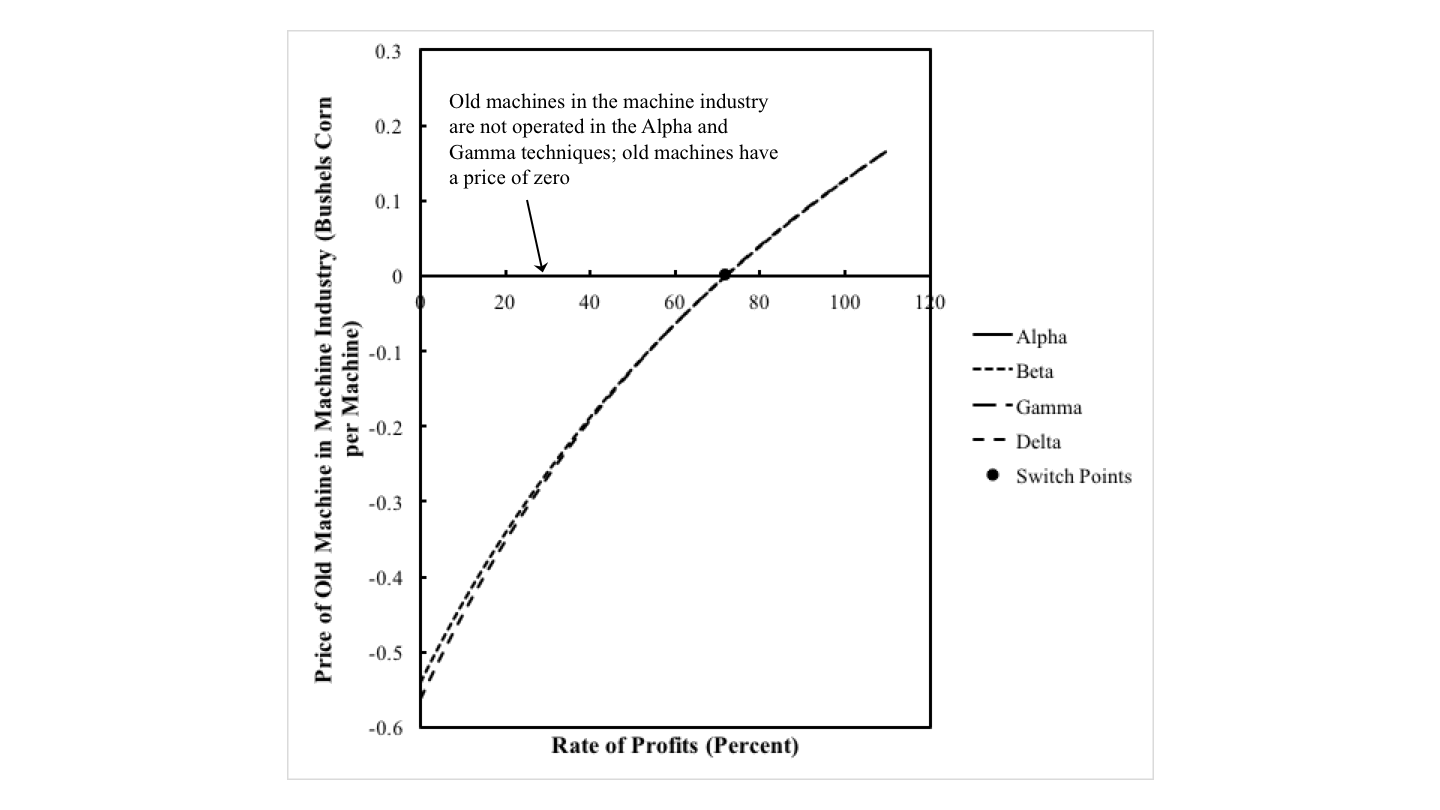
Figure 3 plots the price of an old machine in the machine sector. This price is zero for the Alpha and Gamma techniques, in which the economic life of the machine in the machine sector is truncated to one year. Up to the maximum rate of profits, the price of this type of old machine is negative for the Beta and Delta techniques. Thus, these techniques are not cost-minimizing. If either one of these techniques was in operation, managers of firms would be incentivized to truncate the operation of the machine after one year in the machine sector. At the switch point at the maximum rate of profits, the price of the old machine is zero. Thus, the machine could be operated for two years in the machine sector when the workers live on air.

Figure 3: Price of Old Machines in Machine Sector

Figure 4 shows the price of an old machine in the corn sector. Here the price of an old machine is zero for the Alpha and Beta techniques. The switch points are shown.

Figure 4: Price of Old Machines in Corn Sector

4.0 Perturbing Coeffients of Production for Circulating Capital Needed in Machine Sector

I now look at a slice of parameter space around the fluke case above. Consider small variations in a1,1 and a1,2, the bushels of corn need for input for a unit level of operation of the processes in the machine sector. At a unit level, these processes operate with a new machine and a one-year old machine, respectively, to produce new machines for use in either sector.

Figure 5 shows this slice of the parameter space around the fluke switch points in Figure 1. Variation in a1,2 has no effect on the wage curves for the Alpha and Gamma techniques. Hence, the pattern over the wage axis is a vertical line in the figure. The pattern over the axis for the rate of profits is a diagonal line. The figure shows which techniques are cost-minimizing in which of the four 'quadrants' in which I have partitioned the parameter space.

Figure 5: Selected Regions in Parameter Space

Tables 3 and 4 summarize this local analysis. Around all switch points in illustrated regions of the parameter space, a lower rate of profits is associated with greater net output per person-year. In some sense, a lower rate of profits is associated, in this example, with the adoption of a more capital-intensive technique. But, for all switch points, examined here this increase in the amount of 'capital' used per worker is associated with a decrease in the economic life of a machine, in one sector or the other.

Table 3: Variation in the Choice of Technique
10 ≤ rr1Operation of machine truncated in both sectors.
r1rr2Operation of machine truncated after 1 year in machine sector. Operated for 2 years in corn sector.
r1rrδMachine operated for 2 years in both sectors.
20 ≤ rr1Operation of machine truncated after 1 year in machine sector. Operated for 2 years in corn sector.
r1rrδMachine operated for 2 years in both sectors.
30 ≤ rr1Operation of machine truncated in both sectors.
r1rrγOperation of machine truncated after 1 year in machine sector. Machine operated for 2 years in corn sector.
40 ≤ rrγOperation of machine truncated after 1 year in machine sector. Machine operated for 2 years in corn sector.

Table 4: Summary of Local Structural Changes
1Larger rate of profits associated with longer economic life of machine in both sectors.
2Larger rate of profits associated with longer economic life of machine in machine sector.
3Larger rate of profits associated with longer economic life of machine in corn sector.
4No switch points.

5.0 Conclusion

So that is another example of patterns around the wage axis and the axis for the rate of profits. I still have not found in this particular model examples of reswitching or capital-reversing. But I have such examples in other models of fixed capital. The above example, however, re-iterates that no connection exists between lengthening the economic life of a machine and an increase in the supply of 'capital'. Bohm-Bawerk was not incorrect merely because of the difficulty of defining a measure of the average period of production. His intuition, and not just his, on how prices work was itself incorrect.

Monday, November 09, 2020

Fields Impacted By The Cambridge Capital Controversy (CCC)

Some of these should have been more impacted:

  • Macroeconomics: Measures of Total Factor Productivity, every model with an aggregate production function, and a belief that business cycles are to be explained by sticky or rigid prices or other imperfections are all shown to be questionable.
  • Marxist economics: Steedman's Marx after Sraffa made a splash, with many writing afterwards. Lately, I've read a bit of Riccardo Bellofiore, but a bibliography here could go on and on.
  • Monetary economics: Sraffa's work undermines the concept of the natural rate of interest and the concept of a neutral monetary policy. Colin Rogers' Money, interest and capital: A Study in the foundations of monetary theory goes into this.
  • Labor economics: Here I point to my own stuff.
  • Theory of the firm: Opocher and Steedman's Full Industry Equilibrium: A Theory of the Industrial Long Run is an adequate illustration.
  • Industrial Organization: I have been working on a contribution here.
  • The theory of international trade: Mainwaring, Metcalfe, Parrinello, and Steedman have early contributions in this area.
  • Spatial or regional economics: I'll mention Sheppard and Barnes's textbook The Capitalist Space Economy: Geographical Analysis After Ricardo, Marx, and Sraffa and the work of Walter Isard with different regions being modeled by interacting Leontief matrices.
  • Environmental or ecological economics: I think of Robin Hahnel's recent work on throughput or Richard England (1986) drawing connections between ecological costs and the functional distribution of income.

I do not claim that the above list is complete.

Thursday, November 05, 2020

Infeasibility Of All Machines Truncated

Figure 1: Factor Wage Curves For Feasible Techniques

There are 12 coefficients that can be varied in my minimum multisector model in which production in all sectors can require both fixed and circulating capital. I do not think I am being very orderly in exploring this twelve-dimensional space.

This is a fluke case in which the maximum rate of profits is zero for both the Alpha and the Beta techniques. If only new machines are used as means of production in producing new machines and in producing corn, no surplus product is available to pay out as wages and profits. Likewise, if a machine is run for its full physical lifetime of two years in the machine sector, but truncated in the corn sector, no surplus product is, once again, available. But this is a feasible technology in that a surplus product is available when machines are operated for a full two years in the corn sector. (If a1, 1 and a1, 2 are slightly increased, the maximum rate of profits is negative for both the Alpha and Gamma techniques. Then this would be a non-fluke case.)

Managers of firms choose among feasible techniques by deciding whether or not to operate machines for two years, or to truncate their use, in the machine sector. As shown by the wage frontier above, their decision varies with the distribution of income. Baldone (1980) notes the possibility that for a viable technology with fixed capital, the truncation of the economic life of a machine may result in a non-viable technology. In an already long paper, he does not have a numerical example, however. By the way, Baldone has an appendix with a numerical example of the recurrence of truncation.

For completeness, Table 1 specifies the coefficients of production. I also define the techniques, which are unchanged from previous posts exploring this model. I would be impressed if somewhere in this twelve-dimensional space, almost all phenomena noted in the literature for models of fixed capital and new cases could be found. I have yet to locate cases of reswitching in this model. By definition, I will not be able to find a 'one-good' model with reswitching in this model (albeit what happens if the coefficients of production are the same in the two sectors, perhaps extended to have the machine last three years?).

Table 1: Coefficients of Production for The Technology
InputProcess
(I)(II)(III)(IV)
Labor1/10843/401
Corn0.8752.18750.1250.282386
New Machines1010
Old Machines A0100
Old Machines B0001
Outputs
Corn0010.56
New Machines25/200
Old Machines A1000
Old Machines B0010

Table 2: Techniques
TechniqueProcesses
AlphaI, III
BetaI, II, III
GammaI, III, IV
DeltaI, II, III, IV

References
  • Salvatore Baldone (1980) Fixed capital in Sraffa's theoretical scheme. Trans. in Pasinetti (1980).
  • Christian Bidard (2020) The wage-minimisation property. Working paper 2020-17.
  • Luigi L. Pasinetti, ed. (1980) Essays on the Theory of Joint Production. New York: Columbia University Press.
  • Bertram Schefold (1980) Fixed capital as a joint proudct and the analysis of accumulation with different forms of technical progress. Trans. in Pasinetti (1980).
  • Paolo Varri (1980) Prices, rate of profit and life of machines in Sraffa's fixed capital model. Trans. in Pasinetti (1980).

Tuesday, November 03, 2020

Recurrence Of Truncation In A Perturbation Analysis

Figure 1: Variation of Choice Of Technique with a Coefficient of Production

This post continues the analysis of this example. The coefficients of production and the techniques are the same as in the linked post, except here I consider the results of varying a1, 2, the amount of corn needed as circulating capital in operating Process II at unit level. Figure 1 above shows how the choice of technique varies with this parameter. This is a two-sector model, in which new machines and corn are produced in both sectors. Corn acts as circulating capital, as the sole consumption good, and as the numeraire. Machines act as fixed capital. Managers of firms have the ability to run machines for two years in both sectors, but old machines cannot be transferred between sectors.

Table 1: Variation in the Choice of Technique
10 ≤ rr1Operation of machine truncated in both sectors.
r1rrβMachine operated for 2 years in machine sector. Truncated after 1 year in corn sector.
20 ≤ rr1Operation of machine truncated in both sectors.
r1rr2Operation of machine truncated after 1 year in machine sector. Machine operated for 2 years in corn sector.
r2rr3Machine operated for two years in both sectors.
r3rrβMachine operated for 2 years in machine sector. Truncated after 1 year in corn sector.
30 ≤ rr1Operation of machine truncated in both sectors.
r1rr2Operation of machine truncated after 1 year in machine sector. Machine operated for 2 years in corn sector.
r2rrδMachine operated for two years in both sectors.
40 ≤ rr1Operation of machine truncated in both sectors.
r1rrγOperation of machine truncated after 1 year in machine sector. Machine operated for 2 years in corn sector.

One can tell a tale with this example by reading Figure 1 from right to left. Initially, managers of firms do not find it profitable to run a machine for more than one year in the machine sector. At a high rate of profits (or a low wage), they want to run the machine for two years in the corn sector. Meanwhile, the engineers are figuring out how to use less circulating capital with old machines in the sector manufacturing new machines. Eventually, as at the start, firms run machines in both sectors for one year for low rates of profits. But which sector they want to run machines for two years in at high rates of profits is reversed; at the end they run machines for two years only in the machine sector at high rates of profits. The above figure and table show this change coming about.

Table 2: Summary of Results
1Larger rate of profits associated with longer economic life of machine in machine sector
2Larger rate of profits associated with longer economic life of machine in machine sector; Recurrence of truncation in corn sector
3Larger rate of profits associated with longer economic life of machine in both sectors
4Larger rate of profits associated with longer economic life of machine in corn sector

The example can be used to highlight the falsity of outdated, archaic intuition associated with neoclassical and Austrian-school price theory. One might think that a desire of individuals to save more would be associated with an increased supply of capital. And this would drive the interest rate down. A lower interest rate would supposedly induce firms to adopt more capital-intensive techniques and to run machinery longer. The adoption of more capital-intensive techniques would, in turn, lead to greater output per worker. Around each switch point in the example, a lower interest rate is indeed associated with the adoption of a technique which provides greater output per head. (This property does not generalize, as shown by examples of capital-reversing, also known as positive real Wicksell effects.) But, in the example, a lower interest rate is associated with the truncation of the economic life of machines, except in the corn sector in Region 2. In that region, a lower interest rate is first associated with an increase of the economic life of the machine and then, for an even lower interest rate, a truncation of its life in the corn sector. The economic life of the machine does not even bear a monotonic relationship with the interest rate.

Notice that I am not arguing about aggregate measures of capital or the so-called average period of production. An analysis of prices of production shows that out-dated neoclassical and Austrian-school economists just have a faulty understanding of microeconomics, of how prices work.

I guess this example is something different than the recurrence of a process, given the specific manner in which fixed capital is involved. If you have thoroughly absorbed post Sraffian price theory, the recurrence of truncation is, I guess, no surprise. My contribution is in visualizing this possibility.

Saturday, October 31, 2020

Noah Smith Claims To Have A View On The Cambridge Capital Controversy

I have been reading Noah Smith, off and on, for years. He has expressed scepticism about the obvious unrealism of macroeconomics, but I have not found him knowledgaable about heterodox economics.

Noah Smith claims to have a view on the Cambridge Capital Controversy. He is asked, "Is there someplace that could help me learn Sraffa? The stuff I've read from him is interesting, but is often difficult conceptually." His response is, "Just read Sraffa."

And he is asked, "Which side are you on re the Cambridge Capital Controversy?" Smith says, "Samuelson."

Smith has the honor of being mentioned in Edward Nik-Khah and Philip Mirowski's "The ghosts of Hayek in orthodox microeconomics: markets as information processors". If Smith tries to say something about the CCC in a Bloomberg column, I'd like to hear about it.

For some modern art, I find it useful to listen to what others have to say about it. When one is asked for bread, it would be ungenerous to give stones. Therefore, in addition to Sraffa, one might consult one of the following for a textbook overview of the CCC:

  • H. D. Kurz and N. Salvadori (1995). Theory of Production: A Long-Period Analysis, Cambridge University Press
  • L. L. Pasinetti (1977). Lectures on the Theory of Production, Columbia University Press
  • V. Walsh and H. Gram (1980). Classical and Neoclassical Theory of General Equilibrium: Historical Origins and Mathematical Structure, Oxford University Press.

The above happen to be in order of declining mathematical difficulty. If you want a neoclassical textbook, you could do worse than one of these:

  • Christopher J. Bliss (1975). Capital Theory and the Distribution of Income, Amsterdam: North Holland Press.
  • E. Burmeister (1980). Capital Theory and Dynamics, Cambridge University Press

For more blow-by-blow accounts of the controversy, you could try one of:

  • Cohen, A. J. and Harcourt, G. C. (2003). Whatever Happened to the Cambridge Capital Theory Controversies? Journal of Economic Perspectives, V. 17, N. 1 (Winter): 199-214.
  • Harcourt, G. C. (1969). Some Cambridge Controversies in the Theory of Capital, Journal of Economic Literature, June.
  • Andrés Lazzarini (2011). Revisiting the Cambridge Capital Theory Controversies: A Historical and Analytical Study, Pavia University Press.
  • I've provided these sorts of lists before. I approve of many more works than are listed above.
  • Thursday, October 29, 2020

    A Four-Technique Pattern In A Model With Fixed Capital

    Figure 1: A Wage Frontier
    1.0 Introduction

    This post presents a numberic example of a non-interlocked system with fixed capital and no superimposed joint production. This seems to be the minimum multiple-sector model:

    • Of the production of commodities by means of comodities
    • With both circulating and fixed capital,
    • In which the fixed capital consists of machines of non-constant efficiency with a physical lifetime of more than one period.

    This is a step in my research agenda of exploring perturbations in the analysis of the choice of technique, including perturbations of fluke switch points. This post presents a fluke switch point in which four techniques are simultaneously cost-minimizing at a switch point.

    2.0 Technology

    In this economy, firms produce machines and corn. Corn is the only consumption good, and a bushel corn is the numeraire. Corn acts also as circulating capital. New machines and corn are final goods.

    As shown in Table 1, two processes are available in the machine sector to produce two machines. One uses a new machine as fixed capital and jointly produces an old machine (with a history of having been run in the machine sector) with the new machine. The other process uses the old machine as fixed capital to produce a new machine. Both processes also require inputs of labor and corn. The corn acts as circulating capital. All processes are assumed to exhibit constant returns to scale (CRS) and to take a year to complete.

    Table 1: Coefficients of Production for The Technology
    InputsProcess
    (I)(II)(III)(IV)
    Labor1/10843/401
    Corn1/161/41/80.2823836
    New Machines1010
    Old Machines - Type A0100
    Old Machines - Type B0001
    Outputs
    Corn00114/25
    New Machines25/200
    Old Machines - Type A1000
    Old Machines - Type B0010

    Managers of firms also know of two processes in the corn sector that can be operated to produce corn. These processes have a similiar structure as the processes in the machine sector.

    Although the physical life of a machine is two years, firms are not required to operate a machine for two two years. They face a choice of technique. They can truncate the machine after one year in either sector. Consequently, they must choose among the four techniques listed in Table 2.

    Table 2: Techniques
    TechniqueProcesses
    AlphaI, III
    BetaI, II, III
    GammaI, III, IV
    DeltaI, II, III, IV

    3.0 Price Systems

    One can set up a system of equations for prices of production, as in single production technology, from the processes that are operated in a given technique. Each process contributes an equation. I assume wages are paid out of the surplus at the end of the year, not advanced. In a non-interlocking system with no superimposed joint production, the prices of old machines can be eliminated, following the approach in Sraffa's chapter on fixed capital.

    In this example, this elimination will yield two equations for each technique. The variables in these two equations are the wage, the rate of profits, the price of corn, and the price of a new machine. Since corn is the numeraire, its price is unity. Given the rate of profits, one can solve for the remaining variables. Figure 1, at the top of this post, plots the wage versus the rate of profits for each technique. Figure 2 plots the price of a new machine against the rate of profits.

    Figure 2: The Price of a New Machine

    A single switch point arises in this example. The wage and the price of a new machine at the switch point are the same for all for techniques. This is a fluke.

    4.0 The Choice of Technique

    In general models of joint production, one cannot use the wage frontier to analyze the choice of technique and other properties of single production systems do not carry over. As I understand it, in models of fixed capital with certain properties and without superimposed joint production, properties of single production systems still obtain. Accordingly, Figure 1 does illustrate the variation of the choice of technique with distribution for this example.

    But I want to consider an analysis that does not rely on the construction of the wage frontier. In the analysis presented here, the price of old machines enters in.

    I begin by considering prices of production when the Alpha technique is in operation. No joint production occurs in the Alpha technique. Figure 3 shows extra profits obtained by each process with Alpha prices. It is not evident on the graph, but extra profits in the first and third process are zero, whatever the distribution of income. This is just a check that these prices do indeed solve the price system for the Alpha technique. For any rate of profits less than at the switch point, the second and fourth process incur extra costs. It does not pay to operate a machine for a second year in either sector. The Alpha technique is indeed cost-minimizing for this range of the rate of profits. But the Alpha technique is not cost-minimizing for larger feasible rate of profits. Operating the machine for a second year makes extra profits in both sectors.

    Figure 3: Extra Profits with the Alpha Technique

    Next, I want to consider the price of an old machine in the machine sector. Figure 4 shows how the price of such a machine varies with the rate of profits for the price systems for each technique. An old machine is operated in the machine sector under the Beta and Delta techniques. For a rate of profits below the rate of profits at the switch point, the price of this old machine is negative. The implication is that the Beta and Delta techniques cannot be cost-minimizing in this range of the rate of profits. The old machine should not be operated for the second year; its economic life should be truncated. On the other hand, the price of an old machine is the machine industry is non-negative for a rate of profits larger than the rate of profits at the switch point, whatever the technique.

    Figure 4: The Price of an Old Machine in the Machine Sector

    Figure 5 graphs the price of an old machine in the corn sector. Such a machine is operated in this sector under the Gamma and Delta techniques. We have already seen that the Beta and Delta techniques cannot be cost-minimizing for a low rate of profits. The operation of an old machine in the corn sector should be truncated at a low rate of profits under the Gamma technique. So the condition that prices of old machines cannot be negative for the cost-minimizing technique implies that the Alpha technique is uniquely cost-minimizing at rates of profits smaller than the rate at the switch point.

    Figure 5: The Price of an Old Machine in the Corn Sector

    For high rates of profits, the use of an old machine in the corn sector must be truncated under the Delta technique. In fact, at Beta prices, the operation of an old machine in the corn sector incurs extra costs at high rates of profits. At Gamma prices, the operation of an old machine in the machine sector makes extra profits at high rates of profits. So from Figure 3, one knows that the Alpha technique is not cost-minimizing at high rates of profits. The Gamma technique cannot be cost-minimizing at high rates of profits, since a process (Process II) not in the technique makes extra profits. But by Figure 5, the Delta technique cannot be cost-minimizing at high rates of profits. Only the Beta technique is consistent with cost-minimization at high rates of profits.

    So this analysis of the choice of technique based on which processes make extra profits, for each price system, and which prices of old machines are negative justifies, for this example, the results of an analysis based on the outer envelope for the wage curves for the various techniques.

    5.0 Conclusion

    I have briefly considered the effects of perturbations of a1, 4. For a slightly higher value, the Alpha and Beta techniques, in order of an increasing rate of profits, are cost-minimizing. For a slightly lower value, the Alpha, Gamma, and Delta techniques are cost-minimizing. This fluke switch point arises as technical progresses leads it to be worthwhile to operate the machine for two years in the corn sector.

    Nevertheless, am not sure if I fully understand how this fluke case fits into my taxonomy. Furthermore, I am seeking a numerical example with this fluke case in which a fuller perturbation analysis will find a case of capital-reversing, if not reswitching.

    Wednesday, October 21, 2020

    Sraffa's PoCbMoC At 60

    Seminar

    I finally watched Production of Commodities at 60. Our host and moderator is Matias Vernengo. Seminar participants are Franklin Serrano, Antonella Palumbo, and Ed Nell, who present in that order. They take questions at the end.

    I cannot recall who made these points; they generally agreed. But here are some I noted. Sraffa is not only about an internal critique of marginalist theory, but a setting out of an alternative theory. This is a rediscovery of the classical theory of value.

    Sraffa's theory is not restricted to perfect competition. Paul Sweezy was wrong to think that the advent of monopoly capitalism meant that only qualitative assertions could be made about value.

    Ed Nell talks about linear programming, as contrasted to prices that support the reproduction of the economy. He is probably thinking of an appendix in Pasinetti (1977). I take his point, but I and others have shown that a LP can be used to formalize prices of reproduction.

    In the Q and A at the end, Vernengo reads a question about whether Sraffa was inspired by Marx's schemes of simple and expanded reproduction in his development of his first and second system of equations equations. Like the seminar participants, I do not have a strong opinion on this question. I wish the scholars debating this would look into Sraffa's reading of the french translation of Kautsky's edition of Theories of Surplus Value. What is different about the later more complete edition? Does Sraffa's copy have marginal notes?

    Another question concerns the relevance of steady state growth paths. Come to think of it, Serrano's remarks about a more general, looser concept might draw on his work on the supermultiplier, which he otherwise does not talk about. I think it was Nell who raises the point that Robinson did not think much of the analysis of the choice of technique. When one technique replaces another over historical time, this is not a choice with given knowledge of alternative techniques. What would Robinson think of my merging the two by considering, say, perturbations of coefficients of production in logical time? Probably not much.

    Anyways, this is just a selection of topics from a far-ranging discussion.

    Thursday, October 15, 2020

    Non-Uniform Rates Of Profits

    This post presents a limited account of the history of analyzing prices of production with non-uniform rates of profits. I start from developments in post Sraffian price theory. D’Agata (2018) and Zambelli (2018b) have argued that Sraffian prices of production can still be defined when rates of profits have regular and persistent variations among industries. Barriers to entry or idiosyncratic properties of investment can result in such variations. Steedman (1981) presents the first formulation in post Sraffian price theory that I know of in English with systematic variations of the rate of profits among industries. Roemer (1981: 23-29) provides microfoundations for modeling imperfect competition in linear production models. He assumes different capitalists have different information sets; they only know of some of the production processes that are available. He argues that this can lead to specified ratios of rates of profits among industries. Cogliano et al. (2018) and Screpanti (2019) are some more Marxist contributions along the same lines.

    Adam Smith (1776) called 'natural prices' what I, following Marx, am calling prices of production. He explained differences in rates of profits among industries as arising both in competitive conditions and as a result of barriers to entry. Book 1, Chapter X of The Wealth of Nations is titled 'Of wages and profits in the different employments of labour and stock'. According to Smith, the rate of profits is systematically higher in industries thought disagreeable or disgraceful. It is also higher in less risky investments, because capitalists overvalue their chance of gain and undervalue the chance of loss. (Smith also explained systematic differences in wages from these same causes. Typically, in my approach:

    "We suppose labour to be uniform in quality or, what amounts to the same thing, we assume any differences in quality to have been previously reduced to equivalent differences in quantity so that each unit of labour receives the same wage" (Sraffa 1960: 11).))
    Smith argues that for natural prices to obtain, employments must be well-known and long established in each neighborhood. Policy in European countries, according to Smith, restricted competition in some employments and encouraged excessive employments in others. Furthermore:

    "It is to prevent this reduction of price, and consequently of wages and profit, by restraining that free competition..., that all corporations, and the greater part of corporation laws, have been established" (Smith 1776).

    (This chapter contains another well-known quotation:

    "People of the same trade seldom meet together, even for merriment and diversion, but the conversation ends in a conspiracy against the public, or in some contrivance to raise prices" (Smith 1776).)

    David Ricardo and other classical economists accepted Smith’s account of the causes of non-uniform profits and wages.

    Many groups of economists during the twentieth century developed theories of oligopoly and analyzed the effects on prices and the rate of profits of barriers to entry. Edward Chamberlin (1958) and Joan Robinson (1933) put forth almost simultaneously their theories of monopolistic and imperfect competition. Robinson drew on the earlier work of Sraffa (1926). These works clarified, to some extent, the assumptions needed for the neoclassical theory of perfect competition.

    Some were inspired by empirical research. The Oxford Economists’ Research Group was set up in the 1930s. As part of the group’s research, Hall and Hitch (1939) found, in interviews with businessmen, that firms do not set prices based on marginal cost and marginal revenue. Michal Kalecki (1965) took these findings in stride and developed a theory of markup pricing as a microfoundation for his independently developed Keynesian macroeconomics. Perhaps some of my work can be seen as a partial answer to Steedman's questions for Kaleckians (Steedman 1992).

    Old industrial organization, as developed by Joe Bain (1956) and Paolo Sylos Labini (1969), (Modigliani (1958) is a prescient survey.) rediscovered a classical notion of competition and a corresponding theory of oligopoly. Free competition is about the absence of barriers to entry, in contrast to the marginalist notion of perfect competition, in which managers of firms take prices as given.

    Since I am interested in the labor theory of value, I want to mention the treatment of oligopoly and monopoly by economists associated with the Monthly Review. (For example, Sweezy (1942), Baran (1957), and Baran and Sweezy (1966).) As I read them, oligopolies and monopolies present a challenge to maintaining a quantitative theory of prices:

    "Under conditions of monopoly, exchange ratios do not conform to labour-time ratios, nor do they stand in a theoretically demonstratable relation to labor-time ratios as is the case with prices of production." (Sweezy 1942: 270)

    Baran (1957) is a Marxist who, as a consequence of his understanding of the importance of the role of monopoly, drops talk of 'surplus value' for the more qualitative concept of the 'surplus'. At the high level of abstraction of my work, however, this attitude seems unjustified.

    Managerial theories of the firm (Marris (1964), Eichner (1973 and 1976), Harcourt and Kenyon (1976), and Wood (1975), for example. See also Penrose (1980).) were developed during the 1960s and 1970s. In these theories, firms set their markup over cost to generate internal funds to, in combination with external finance, fund investment plans to achieve a target rate of growth. They strive to achieve a normal rate of profits at a planned rate of capacity usage.

    The research briefly summarized above has been quite influential, particularly among non-mainstream economists, to this day. For my purposes, I ignore distinctions among behavioral and managerial theories of the firm, administrated prices, full cost prices, normal cost prices, theories of the degree of monopoly, and markup pricing. (Lee (1999) emphasizes the distinctiveness of the theories of administered, normal cost, and markup price theories.) Rather, ratios of rates of profits among industries are taken as given parameters in defining prices of production.

    This post is basically an abstract from something I may never publish.

    Monday, October 12, 2020

    Can We Hear Phil Mirowski In The Media Talk About Paul Milgrom And Robert Wilson?

    The 2020 "Nobel Prize" in economics goes to Paul Milgrom and Robert Wilson. I suppose it is nice that economists acknowledge that markets are not natural entities but need to be constructed. For example, consider the Federal Communications Commission auction of the microwave spectrum.

    The 2012 "Nobel Prize" went to Alvin Roth and Lloyd Shapley. The 1996 "Nobel Prize", to William Vickrey (a Post Keynesian, by the way) was also for acution theory. The 2002 prize went to Daniel Kahneman and Vernon Smith. Smith's work included experiments with markets constructed in the laboratory.

    I do not know much about this field. But I am hoping some journalists know of Philip Mirowski, an expert on the history of information in economics, and get him to comment on the award this year.

    Saturday, October 10, 2020

    A Fluke Case For Requirements For Use

    Figure 1: Prices of Production
    1.0 Introduction

    This post presents a new kind of fluke case in the analysis of the choice of technique, at least new to me. I call this a pattern for requirements for use, and it can arise only in a case of joint production. My graphs in this post have some incomprehensible notation, since I am currently exploring perturbing parameters, in line with my research agenda. I know that perturbing the requirements for use removes the indeterminancy in this example.

    2.0 The Givens

    For this example, the data consist of the available technology and the proportions in which the two produced commodities, corn and silk, enter into the commodity basket specified by the requirements for use. I also choose a numeraire. The example is a perturbation of problem 8.2 in Kurz and Salvadori (1995).

    Table 1 specifies a constant returns-to-scale technology. In each of three processes known to managers of firms at a given time, laborers work with inputs of corn and silk to produce outputs of corn, silk, or both. The inputs are completely used up in producing the output, and all three processes are assumed to take a year to complete. Since two commodities are produced in this numerical example, a technique consists of at most two processes. Table 2 lists the techniques and the processes corresponding to each technique.

    Table 1: Coefficients of Production for The Technology
    InputProcess
    IIIIII
    Labor1 Person-Yr.1 Person-Yrs(e/16) Person-Yr.
    Corn1 Bushel1 Bushel1 Bushel
    Silk1 Sq. Meter1 Sq. Meter1 Sq. Meter
    Output
    Corn3 Bushels5 Bushels0 Bushel
    Silk3 Sq. Meters0 Sq. Meter5 Sq. Meters

    Table 2: Techniques of Production
    TechniqueProceses
    Alpha(I), (II)
    Beta(I), (III)
    Gamma(II), (III)
    Delta(I)
    Epsilon(II)
    Zeta(III)

    The requirements for use are such that equal quantities of corn and silk are required. The numeraire consists of a commodity basket of one bushel corn and one square meter of silk.

    3.0 Quantity Flows

    Which techniques can satisfy the requirements for use? Suppose, contrary to the specification, that requirements for use specified that more bushels of corn be supplied than square meters of silk. The Alpha technique technique could satisfy these requirements for use, with Process I and Process II both being operated at a positive level of operations. As the requirements for corn declined, the relative level of operation of Process II would decline. The Alpha technique satisfies the given requirements for use with Process II operated at a level of zero. This is a corner case in which Process II still contributes an equation to the price system.

    By a symmetric argument, the Beta technique can also satisfy the requirements for use. Process III is operated at a level of zero in the Beta techniquye.

    The Gamma technique can satisfy any composition of the requirements of use, as in the theory of single production. So it can satisfy the requirements for use in this case, too.

    The Delta technique can satisfy any requirements for use, as well. However, when the requirements for use specify an unequal number of bushels corn and square meters of silk, one commodity is in excess supply and its price of production is zero.

    Neither the Epsilon nor the Zeta technique can satisfy the requirements for use when the net output must contain a positive quantity of both commodities.

    4.0 Prices of Production

    But being feasible, in the sense that a technique can satisfy the requirements for use, is not sufficient for a technique to be cost-minimizing. Prices of production must be considered, as in models of the production of commodities with single production. Prices of production vary with distribution and the technique. Figure 1, at the top of this post, graphs the price of corn for the three techniques which contribute two equations, in addition to the equation specifying the numeraire, to determine the four price variables (price of corn, price of silk, the wage, and the rate of profits).

    4.1 The Alpha Technique

    Suppose the Alpha technique is in operation. The wage can range from zero to two numeraire units per person-year. Figure 2 shows that the Alpha technique is not cost-minimizing at low rates of profits, but is cost-minimizing at high rates of profits. If, at low rates of profits, Process III replaces I, the Gamma technique will be adopted. If it replaces Process II, the Beta technique is adopted. But the Beta technique is not cost-minimizing at low rates of profits. (In a model of single production, it is unambiguous which process is replaced when a new process is introduced into a technique.)

    Figure 2: Extra Profits with Prices for the Alpha Technique

    4.2 The Beta Technique

    On the contrary, suppose the Beta technique is in operation. Figure 3 shows that this technique is cost-minimizing only at high rates of profits. At low rates of profits, firms will have an incentive to operate Process II. If they replace Process III by Process II, firms will be operating the Alpha technique. The above analysis has shown that the Alpha technique would not be cost-minimizing in this range of the rate of profits. If Process I is replaced by Process II, firms would be operating the Gamma technique.

    Figure 3: Extra Profits with Prices for the Beta Technique

    4.3 The Gamma Technique

    The Gamma technique is cost-minimizing at low rates of profits. Figure 4 shows extra profits for prices for the Gamma technique. Both the Alpha and the Beta technique are cost-minimizing at high rates of profits. Extra profits can be made in operating Process I at Gamma prices for high rates of profits. Firms would find it profitable to replace either Process III or Process II, resulting in either the Alpha or the Beta technique, respectively.

    Figure 4: Extra Profits with Prices for the Gamma Technique

    4.4 The Delta Technique

    I am going to present the Delta technique in more detail. For Process I to neither make extra profits nor to incur extra costs, the following equality must obtain.

    (p1 + p2)(1 + r) + w = 3 p1 + 3 p2

    The specification of the numeraire yields the following equation:

    p1 + p2 = 1

    For the Delta technique to be cost-minimizing, the two equations above must hold, extra profits must not be obtainable in operating Process II, and extra profits must not be obtainable in operating Process III.

    Prices drop out of the equation arising out of the requirement that Process I neither obtains extra profits nor incurrs extra costs. The wage is an affine function of the rate of profits:

    w = 2 - r

    The above wage curve is identical with the wage curves for the Alpha and the Beta techniques.

    For the Delta technique to be cost-minimizing, firms must not be able to obtain extra profits in operating Process II. This condition yields an inequality:

    p1 ≤ 1 + r + w

    Substituting the wage curve and re-arranging terms yields an upper bound on the price of corn:

    p1 ≤ 3/5

    That is, the price of corn cannot exceed the price of corn falling out of the Alpha technique. This inequality is shown by the upper bound of the shaded region in Figure 1 at the top of this post.

    The condition that firms cannot obtain extra profits in operating Process III also yields an inequality:

    p2 ≤ 1 + r + (e/16) w

    Or the price of corn cannot fall below a lower bound:

    (1/80)[64 - 2 e - (16 - e)rp1

    This inequality is shown by the lower bound of the shaded region in Figure 1.

    The Delta technique can be consistent with cost-minimizing for any price of corn in the shaded region, including the boundaries. The two constraints combined impose a lower bound of the rate of profits:

    [2 (8 - e)]/(16 - e) ≤ r

    The lower bound on the rate of profits is the rate of profits at the switch point.

    As with the Alpha, Beta, and Gamma techniques, one can plot extra profits versus the rate of profits for all processes, given the price system for the Delta technique. Since the Delta technique has an extra degree of freedom, one must choose a price, as well as, say, the rate of profits for such an analysis. Figure 5 shows such a graph for a price of corn of 3/5 numeraire units per bushel. The switch point here is at the same rate of profits as for the switch point shown in Figures 2 and 3. For rates of profits below the switch point, firms will want to adopt the Gamma technique. For rates of profits above the switch point, the Delta technique is cost-minimizing, but not uniquely so. Firms would also be willing to adopt the Alpha technique.

    Figure 5: Extra Profits with One Set of Prices for Delta

    But suppose the price of corn happens to be 1/2 numeraire units per bushel. Figure 6 plots extra profits in the three processes against the rate of profits. Firms will no longer be willing to choose to operate Process II along side Process I for some distribution of income. Costs exceed revenues for Process II, whatever the rate of profits.

    Figure 6: Extra Profits with Another Set of Prices for Delta

    For low rates of profits, the Delta technique is not cost-minimizing; firms will want to adopt the Beta technique. The "switch point" in Figure 6 is to the right of the switch point shown in all the other graphs in this post. From Figure 3, we know the adoption of the Beta technique is not the end of the story if the rate of profits lies below the rate of profits in the original switch point. For rates of profits between the two "switch points", prices must adjust until no extra profits can be obtained by operating the Beta technique. For rates of profits above the new "switch point", the Delta technique is uniquely cost minimizing at these prices and distribution of income. The Beta and Delta techniques are both cost-minimizing only at the new "switch point".

    4.5 Summary

    I find the possibilities in joint production confusing. I am fairly convinced of the above analysis, but I would not be surprised if my exposition could be improved. Anyway, here is a summary of the analysis of the choice of technique for this numerical example:

    • When the rate of profits is smaller than the rate of profits at the switch point (or, equivalently, the wage is greater than the wage at the switch point), the Gamma technique is uniquely cost-minimizing. Prices are determined, given, say, the wage.
    • When the rate of profits is larger than the rate of profits at the switch point (or the wage is lower than the wage at the switch point), the Alpha, Beta, and Delta techniques can all be cost-minimizing. Prices are indeterminate, with the price of corn confined to lie in the limits shown in Figure 1 by the curves for the Alpha and Beta techniques. Processes II and III in the technology are each operated at a level of zero, whatever the technique.
    • When the rate of profits and the wage are as at the switch point, the Alpha, Beta, Gamma, or Delta technique are all cost-minimizing. Prices are determined, with a bushel corn priced at 3/5 numeraire units and a square meter of silk at 2/5 numeraire units.

    5.0 Conclusion

    This is a fluke case. If the proportions in which corn and silk enter into the commodity basket specified by requirements for use are varied at all, the indeterminancy of prices associated with a low wage vanishes. If bushels of corn exceeds square meters of silk in requirements for use, the Alpha and Gamma techniques are feasible. The Beta technique cannot satisfy the requirements for use. The Delta technique can satisfy the requirements for use, with an excess supply of silk at a price of zero. But then extra profits would be available by operating the second process. So only the Alpha or Gamma technique would be cost-minimizing, depending on income distribution.

    Wednesday, October 07, 2020

    Origins of Selection from the Prision Notebooks?

    This is C27 in Sraffas archives.

    97 Fortis Green
    London N2
    Tudor 0214

    6th August 1966

    Dear Piero,

    I do not know whether you know Roger Simon, who is Secretary of the Labour Research Department. At all events he is a great admirer and enthusiast of Gramsci. Thanks to his initiative, plans are afoot (in which I too am collaborating) to publish a new volume of Gramsci's works translated into English and Lawrence & Wishart have agreed, in principle, to undertake publication.

    We would very much welcome views and suggestions from you on how this should be done. The general idea at present is a bigger book than the L & W. 1957 translation (which is now out of print), including, if appropriate, passages already translated on that occasion. One line of thought that we are pursuing is that the volume should comprise mainly longer writings from the Notebooks and should be so presented that, if successful, it could be followed by further volumes, with the possible aim of ultimately translating all Gramsci's works. It would be good if the publication of this volume could sow the seeds of a growing interest in and knowledge of this outstanding political thinker, and so it is probably worth giving quite a bit of thought as to how this first step in that direction should be taken.

    One problem is the choice of a translator; the ideal might be a young don specialising in twentieth century Italy and an admirer of Gramsci who would be keen to make a scholarly study of him, his times and his work. Do you know any such person?

    Also do you by any chance know, or know anything of, Gwyn A. Williams who wrote a very interesting and scholarly article on Gramsci in the Journal of the History of Ideas, 1960, and who was at that time at the University College of Wales, Aberystwyth?

    Are there other Gramsci scholars known to you?

    I hope that we may have a chance of meeting some time in the Autumn.

    With best wishes

    Yours,

    Stephen Bodington

    Piero Sraffa Esq., M. A.,
    Trinity College,
    CAMBRIDGE.

    Reference
    • Antonio Gramsci (1971) Selections from the Prison Notebooks (Quintin Hoare and Geoffrey Nowell Smith ed. and trans.), London: Lawrence & Wishart