Showing posts with label Austrian School Of Economics. Show all posts

Thursday, April 23, 2026

How To Draw Hayekian Triangles In A Model Of The Production Of Commodities

1.0 Introduction

This post revisits an analysis of Hayekian triangles in the context of a circular flow of production. Here I go through the mathematics to show how to construct the "triangle".

2.0 The Technique and Net Output

A technique is specified by a row vector a0 of direct labor coefficents of a square Leontief input matrix A. Each labor coefficient and corresponding column of the Leontief matrix specify a process to produce one unit of the good produced by that industry. All coefficients are specified in physical units, such as barrel oils per kilowatt. I assume:

  • The economy is in a stationary state.
  • Constant returns to scale (CRS) prevail.
  • All direct labor coefficients are positive.
  • Every good enters, either directly or indirectly, into the production of every good.
  • The Leontief matrix specifies a productive technique in that a suplus product can be produced.
  • Full employment is assumed. More generally, the units in which labor is measured is scaled such that employment is unity.
  • Wages are paid at the end of the year, not advanced with the payments for capital goods at the beginning of the year.

These assumptions are stronger than needed.

The proportions of net output are assumed to be specified by a column vector d. This vector is also a numeraire. The level of net output y is specified by the scalar c:

y = c d

This formulation allows for specifying any number of techniques, all with the same numeraire and composition of net output, but at different levels.

3.0 Quantity Flows

The net output vecotr y and the gross output vector q are related as:

y = q - A q = (I - A) q

Total employment is unity:

a0 q = 1

These equations have a solution. Consumption per worker is:

c = 1/[a0 (I - A)-1 d

Gross quantities are:

q = c (I - A)-1 d = c d + c A d + c A2 d + ...

The first term in the infinite expansion on the right-hand side is the net product available at the end of the given year. The second term is the quantities of capital goods being produced in the current year to support the production of the net output in the next year. The third term is the capital goods being produced in the current year to eventually produce the net output two years hence. Note that all of these vectors, of consumption goods, specific capital goods, and so on are heterogeneous.

4.0 Labor and Capital Flows in the Hayekian Triangle

The labor li expended in the current year, with previously produced capital goods, to produce the net output, that is, goods of the first order, is defined as:

l1 = c a0 d

The labor li expended in the current year to produce goods of each of the higher orders is:

li = c a0 Ai - 1 d, i = 2, 3, ...

The sum of these quantities of labor is unity, that is, the labor force employed in the current year.

The capital goods expended in the current year to produce goods of each order is:

ki = c Ai d, i = 1, 2, ...

The sum of these quantities of capital goods used in the current year is A q.

5.0 Value Flows in the Hayekian Triangle

Let zi be the addition in value for each stage in the Hayekian triangle. This is merely the value added by original factors of production, properly time discounted for each stage:

zi = w(r) li (1 + r)i - 1, i = 1, 2, ...

The notation reflects the interdependence of the wage 𝑀(π‘Ÿ) and the interest rate π‘Ÿ in a stationary state.

For goods of first order, the length of this step in the Hayekian triangle is:

z1 + z2 + ... = c p(r) d

where p(r) is a row vector of prices. For goods of the second order, the length of the step in the Hayekian triangle is:

z2 + z3 + ... = c p(r) d - z1

For goods of the third order, the length of the step in the Hayekian triangle is:

z3 + z4 + ... = c p(r) d - (z1 + z2)

These steps can be continued. This completes one derivation of the lengths of the steps in a Hayekian triangle.

The length of the ith step can also be expressed as:

zi + zi + 1 + ... = p(r) ki (1 + r)i + w(r) li (1 + r)i - 1, i = 1, 2, ...

With a couple of substitutions and factoring, the above becomes:

zi + zi + 1 + ... = c [p(r) A (1 + r) + w(r) a0] Ai - 1 d (1 + r)i - 1

Or:

zi + zi + 1 + ... = c p(r) Ai - 1 d (1 + r)i - 1, i = 1, 2, ...

The Hayekian triangle, with an infinite number of steps, has now been derived, in two ways, from the circulating capital case of a model of the production of commodities by means of commodities.

6.0 Conclusion

The above derivations assume knowledge of the solutions of the price system for the technique. A more complete exposition would present that solution. It would also show that the Hayekian triangle approaches one constructed with a geometric series, as the order of goods increases. The composition of capital goods approaches that of Sraffa's standard system.

Thursday, April 16, 2026

On The Incoherence Of Austrian Business Cycle Theory

I thought I would try to summarize again some objections to the Austrian school.

Austrian Business Cycle Theory (ABCT) focuses on the consequences of the monetary authority setting the monetary interest rate below the natural rate of interest. Following Knut Wicksell somewhat, the theory argues that capitalist entrepreneurs will lengthen production processes. Since these decisions do not synchronize with household consumption and savings decisions, the artificial boom is unsustainable. A bust is the result.

This theory is built on mistaken capital theory. When Sraffa spanked Hayek, he deliberately put capital theory aside.

What would it mean for a production technique to be more capital-intensive? To examine the (il)logic of this approach, I make various simplifying assumptions.

Accordingly, consider vertically-integrated firms. They produce a given commodity or, rather, a basket of commodities, in fixed proportions. The only input is homogenous labor. All means of production, tools, intermediate goods are produced and used internally.

Under these assumptions, one can talk about (net) output per person-year. Productivity is well-defined. I start by postulating that with a more capital-intensive technique, workers are more productive.

It turns out that a lower interest rate does not induce managers of firms to adopt more capital-intensive techniques. Numerical examples illustrating this point have been available in the literature since the 1960s. And they are accepted by all sides. "The interesting point, however, is the perversity, not the duplicity." -- Robinson and Naqvi (1967).

I have now demonstrated that marginalist capital theory, including the Austrian variant, is invalid. Given typical assumptions, the traditional stories about 'capital' markets do not follow. But what about all that stuff Austrian school economists say about the structure of production?

They are wrong there, too. First, I consider aggregate measures of the period of production. Bohm-Bawerk's measure assumes simple interest, not compound interest. The counterexamples mentioned above demonstrate it is invalid to conclude cost-minimizing entrepreneurs will lengthen the period of production when they anticipate lower interest rates.

Nicolas Cachanosky and Peter Lewin have recently proposed a financial measure of Duration. By this measure, the technique chosen at a lower interest rate, around a switch point, has a larger Duration. But a larger Duration is associated with lower productivity in the counter-examples.

You could also consider how long capitalists will choose to run given machinery. Machines last for more than one production cycle, and capitalists must choose to set their economic life. Surely, a lower interest rate will provide incentives to capitalists to increase their economic life. Well, no. A longer economic life of a machine can be associated with a less capital-intensive technique in the sense that the productivity of labor is decreased. I happen to know that the recurrence of the period of truncation is possible without the reswitching of techniques.

And then there are Hayekian triangles. They do not work either. Hayekian triangles, as Roger Garrison notes, are heuristic pictures, useful for pedagogic purposes. Hayek unsuccessfully tried to put them on rigorous foundations in Prices and Production. But it all fell apart. He even discovered capital-reversing, in some sense. You can find more recent statements with these triangles, but nothing that addresses the difficulties that Hayek found, much less anything that surmounts them.

Saturday, March 21, 2026

Murray Rothbard Muddled And Confused

1.0 Introduction

I try to read Rothbard's 'Toward a reconstruction of utility and welfare economics' (in On Freedom and Free Enterprise: The Economics of Free Enterprise (ed. Mary Sennholz), 1956). It does not go far toward its declared goal.

Some Austrian fanboys point to this paper to show Rothbard with a good understanding of the technical details of economics. And it fails.

2.0 Demonstrated Preference and Indifference

Rothbard proposes a concept, 'demonstrated preference', but never explains it clearly. He cites Ludwig Von Mises, among others, as a forerunner. He says that "Actual choice reveals, or demonstrates, a man’s preferences."

Rothbard asserts, like Von Mises, that marginal utilities can be ranked. You will find it difficult to identify anybody outside the Austrian school who agree today. I do not see that confining oneself to discrete increments of a single good helps Rothbard make his case.

I find strange Rothbard's rejection of an indifference relation. He writes:

"Indifference can never be demonstrated by action. Quite the contrary. Every action necessarily signifies a choice, and every choice signifies a definite preference. Action specifically implies the contrary of indifference."

And his arguments are quite curious. I do not find this persuasive:

"It is immaterial to economics whether a man chooses alternative A to alternative B because he strongly prefers A or because he tossed a coin. The fact of ranking is what matters for economics, not the reasons for the individuals arriving at that rank."

I would think that if I use a coin flip to decide, I am demonstrating that I do not care which way the decision comes out.

"The other attempt to demonstrate indifference classes rests on the consistency - constancy fallacy, which we have analyzed above. Thus, Kennedy and Walsh claim that a man can reveal indifference if when asked to repeat his choices between A and B over time, he chooses each alternative 50 percent of the time.

The above is silly. Would you say that the agent is indifferent if his preferences were constant over the observed time? Refusing to accept the hypothesis does not answer the question.

Does getting rid of the indifference relation hinder the use of 'demonstrated preference' to derive individual demand functions, whether defined on a discrete space or not? Maybe a primitive relation of 'not preferred to' is all that is needed. But Rothbard does not say.

3.0 Praxeology and Logic

I understand logic to be about the form of an argument or deduction. The content or meaning of propositions that appear in an argument are not supposed to matter for its validity.

Rothbard attempts to clarify a different conception:

"...a fundamental epistemological error ... pervades modern thought: the inability of modern methodologists to understand how economic science can yield substantive truths by means of logical deduction (that is, the method of 'praxeology')."

Rothbard asserts that his starting axioms must be true:

"...economics, or praxeology, has full and complete knowledge of its original and basic axioms. These are the axioms implicit in the very existence of human action, and they are absolutely valid so long as human beings exist. But if the axioms of praxeology are absolutely valid for human exisence, then so are the consequents which can logically be deduced from them. Hence, economics, in contrast to physics, can derive absolutely valid substantive truths about the real world by deductive logic."

We now know that Rothbard is incorrect on the his axioms. But never mind that.

"...mathematical logic is uniquely appropriate to physics, where the various logical steps along the way are not in themselves meaningful; for the axioms and therefore the deductions of physics are in themselves meaningless, and only take on meaning 'operationally,' insofar as they can explain and predict given facts. In praxeology, on the contrary, the axioms themselves are known as true and are therefore meaningful. As a result, each step-by-step deduction is meaningful and true. Meanings are far better expressed verbally than in meaningless formal symbols."

I have no idea what formal logic has to do with physics. As far as I know, the conception that logic is about the form of an argument goes back to Plato and Aristotle. Hegel may have had a different idea. Frege was writing about the foundations of arithmetic, not about physics.

4.0 Von Neumann-Morgenstern Cardinal Utility

Rothbard has a few remarks on the Von Neumann-Morgenstern definition of utility. Their exposition goes along with the development of a theory of measurement. A measurement scale is such that statements about things measured along that scale are only meaningful up to a set of transformations.

But according to Rothbard, "Measurement, on any sensible definition, implies the possibility of a unique assignment of numbers which can be meaningfully subjected to all the operations of arithmetic." "No arithmetical operations whatever can be performed on ordinal numbers." But non-parametric statistics was already being developed then. I think of the Mann-Whitney-Wilcoxon statistic, for example. In fact, the first edition of Sidney Siegel's textbook, Non-Parametric Statistics for the Behavioral Sciences, dates from 1956.

Rothbard tells us that those who follow Von Neumann and Morgenstern only apply probability to repeatable events: "... unique events are not repeatable. Therefore, there is no sense in applying numerical probability theory to such events. It is no coincidence that, invariably, the application of the neo-cardinalists has always been to lotteries and gambling. It is precisely and only in lotteries that probability theory can be applied." And Rothbard also asserts that "The leading adherents of the Neumann-Morgenstern approach are Marschak, Friedman, Savage, and Samuelson". But Leonard Savage, in his 1954 book, starts the development of his personalistic approach to probability with unique events. His application of personalistic probability to small worlds is supposed to apply numeric probabilities to unique events there. So, again, Rothbard is mistaken. (I take no position on whether unique events can meaningfully be assigned probabilities, either in a small world or not.)

5.0 Conclusion

Rothbard makes a lot of other dubious or incorrect statements. I concede that his references are wide ranging.

Rothbard's undergraduate degree was in mathematics. I pity the fool.

Wednesday, October 08, 2025

Ludwig Von Mises, Crackpot Conspiracy Theorist?

I get this from Sam Tanenhaus' new biography of William F. Buckley, Jr. The index entry for Von Mises is in error.

The John Birch Society was an extreme reactionary organization in the USA. Bob Welch was its leader and founded it near the start of 1959. Welch had a book, The Politician, later known as the Blue Book, that explained what he was about. According to Welch, George Marshall, Dwight Eisenhower, Earl Warren, the Dulles brother, and on and on were all conscious, dedicated Soviet agents.

Buckley had a magazine, National Review. And he was known for trying to show that American conservatives had views worth taking seriously. They are not all crackpots. So he tried to convey an impression that Bob Welch was not welcome in his movement.

The John Birch Society had a monthly magazine, American Opinion. Von Mises was on its board and had articles published in it. I have read quite a bit of Von Mises and about him too, mostly hagiographies. I never met this historical bit before.

Tuesday, July 01, 2025

On Confusion About Gödel's Theorem, Including In Austrian Economics

1.0 Introduction

Gödel's theorems are often invoked in non-mathematical contexts, sometimes in a very imprecise fashion (Franzen 2005, Raatikaine 2007, Jaimungal). You should be skeptical of what many say about Gödel, including of what I say.

In this post, I look at two examples. One is of a confused economist of the Austrian school. The other is of Wittgenstein, who has been ably defended on this point.

2.0 A Claim About the Economic Calculation Problem

Nguyen (2024) says that somehow Gödel's theorem supports the claim that centralized economic planning is, in principle, impossible. Nguyen is sympathetic to the claim that our minds (brains?) transcend the capabilities of all formal systems. I find this claim dubious, but I have not read Penrose. For purposes of argument, Nguyen assumes, through most of this paper, that the central planner has the information von Mises grants them. Nguyen deliberately puts aside Hayek's concerns about non-articulated, distributed, tacit knowledge.

I have demonstrated that von Mises' argument is invalid. I find I am not original. Cockshott (2010) has done the same. Both of us put forth a linear programming formulation that does not require prices of intermediate goods as part of the data. We differ in our specifications of the planner's objective function. Neither of us are echoing Lange and Lerner's formulations of general equilibrium. As such, I do not see any issues are raised for us by the non-computability of utility functions, preference relations, or general equilibria in which ratios of marginal utilities enter the system of equations.

A polynomial-time algorithm exists for solving linear programs. Linear programs are not undecidable. So Gödel's theorem and issues arising from Turing's work do not seem to have any purchase here.

Furthermore, in practice, only a finite number of numbers would be used in drawing up plans. Real numbers would be approximated, if you can call it that, by IEEE Std. 754. This standard defines floating-point numbers, in single and double precision formats. Your computer does not only fail to represent the full range of real numbers. It also only represents a finite number of integers in words, typically of 32 or 64 bits.

I do not mean to suggest that many practical issues do not arise with central planning Nor am I advocating such. I continue to maintain that von Mises' argument is invalid. And I find Nguyen's paper to be one of those mystical, imprecise invocations of Gödel.

3.0 A Notorious Paragraph from Wittgenstein

Here is Wittgenstein from notes not published until after his death:

"8. I imagine someone asking my advice; he says: 'I have constructed a proposition (I will use "P" to designate it) in Russell's symbolism, and by means of certain definitions and transformations it can be so interpreted that it says: "P is not provable in Russell's system". Must I not say tha this proposition on the one hand is true, and on the other hand unprovable? For suppose it were false; then it is true that it is provable. that surely cannot be! And if it is proved, then it is proved that it is not provable. Thus it can only be true, but unprovable.'

Just as we ask, '"Provable" in what system?,' so we must also ask, '"True" in what system?' 'True in Russell's system' means, as was said, proved in Russell's system, and 'false in Russell's system' means the opposite has been proved in Russell's system. - Now what does your 'suppose it is false' mean? In the Russell sense it means, 'suppose the opposite is proved in Russell's system'; if that is your assumption you will now presumably give up the interpretation that it is unprovable. And by 'this interpretation' I understand the translation into this English sentence. — If you assume that the proposition is provable in Russell's system, that means it is true in the Russell sense, and the interpretation 'P is not provable' again has to be given up. If you assume that the proposition is true in the Russell sense, the same thing follows. Further: if the proposition is supposed to be false in some other than the Russell sense, then it does not contradict this for it to be proved in Russell's system. (What is called 'losing' in chess may constitute winning in another game.)" -- Wittgenstein (1978: Part I, Appendix III)

Wittgenstein seems to equate provability in PM with being true in PM. Is not part of Gödel's point to separate these concepts? Furthermore, Wittgenstein seems to be writing only about the heuristic argument given at the start of Gödel's paper. Do his remarks make sense of Gödel numbering, (primitive) recursive functions, and so on?

As I understand it, Gödel's proof of his incompleteness theorem is a conventional proof. The proof is an argument to convince you that a sequence of statements exists that follow one another, by conventional deduction rules. And the conclusion is a theorem about natural numbers.

Gödel's proof is about the syntactic manipulation of strings of symbols by formal rules. Wittgenstein questions interpretations, I guess, of Godel numbers as the statements or sequence of statements that map into them. Floyd and Putnam (2000) justify Wittgenstein in a way that draws on the distinction between consistency and ω-consistency.

J. B. Rosser replaced ω-consistency with consistency in Gödel's proof. A theory is ω-inconsistent if one can show, for some proposition p:

  • not p(0), not p(1), not p(2), ..., and
  • There exists x such that p(x).

I guess that a non-standard model can be ω-inconsistent, where x is not a natural number, somehow. Suppose PM is ω-inconsistent. And suppose the negation of the Gödel sentence 'P' is true. Then the Godel number for the proof of this proposition could be a non-standard natural number. Wittgenstein writes about interpretations, but does not mention ω-consistency. I suppose he could have known about the Löwenheim-Skolem theorem.

I am sympathetic to being suspicious of English-language interpretations of syntactical manipulations. I am not so sympathetic to how lightly Wittgenstein treats possible contradictions in mathematics. I am sympathetic to the idea that mathematical logic, set theory, and model theory, for example, just provides more maths. One does not need this math to justify what humans have been doing for millennia. Do mathematical propositions have meaning before proofs are found? As I understand Wittgenstein, he says not. Proofs draw connections and give the proved proposition a meaning.

But I am also aware that even if I can echo out some propositions from these fields, I am no expert in them.

References

Thursday, June 26, 2025

Technical Change and Triple-Switching in the Corn-Tractor Model

I have another working paper, Technical change and triple-switching in the corn-tractor model, at the Centro Sraffa. The abstract follows.

Abstract: With triple-switching, each of two techniques are cost-minimizing in two disjoint intervals of the wage or rate of profits. Technology that supports multiple switch points between two techniques can only be a temporary phenomenon, as one technique supplants another with technical progress. A perturbation analysis of a triple-switching example in the corn-tractor model illustrates this claim. A parameter space, defined by two selected coefficients of production, is partitioned by loci corresponding to fluke switch points. The analysis of the choice of technique does not qualitatively vary within each of the resulting regions. Technical progress corresponds to specific trajectories through this parameter space.

Keywords: Cambridge Capital Controversy; Fixed Capital; Reswitching of techniques

JEL Codes: B51: Sraffian; C67: Input-Output Models; D24: Production, Cost, Capital

Monday, June 16, 2025

Capital-Reversing In A Pertubation Of An Example Of The Recurrence Of Truncation

Figure 1: The Wage Frontier for an Example of Capital-Reversing

I am continuing to explore perturbations of coefficients of production for inputs of circulating capital in this example. The example is of the recurrence of truncation without either the reswitching of techniques or capital reversing. This post presents a perturbation in which the recurrence of truncation no longer occurs, but capital-reversing now arises.

Tables 1 and 2 present the coefficients of production for the example. The technology has the minimum structure, in a model in which multiple commodities are produced, and inputs of labor, circulating capital, and fixed capital are needed in each industry. Also, managers of firms in both industries have a choice of the economic life of a machine. In this perturbation, a1, 1 is higher than in the example I started with. a1, 3 is the same. I varied a1, 2 and a1, 4 to find this example of capital-reversing.

Table 1: Inputs for The Technology
InputIndustry
MachineCorn
IIIIIIIV
Labor1/10843/401
Corn32/502/51/80.38944767
New Machines1010
One-Year Old Machines (1st type)0100
One-Year Old Machines (2nd type)0001

Table 2: Outputs for The Technology
OutputIndustry
MachineCorn
IIIIIIIV
Corn00114/25
New Machines25/200
One-Year Old Machines (1st type)1000
One-Year Old Machines (2nd type)0010

Table 3 repeats the definition of the available techniques. I will observe that a switch point between Beta and Gamma cannot exist without that switch point being simultaneously a point at which all wage curves intersect.

Table 3: Specification of Techniques
TechniqueProcesses
AlphaI, III
BetaI, II, III
GammaI, III, IV
DeltaI, II, III, IV

Figure 1, at the top of this post, depicts the wage curves for the four techniques. It is not visually striking. In particular, the wage curves for Beta and Delta are hard to distinguish by eye. Figure 2, below, is an enlargement of part of the wage curves so that you can see that Beta and Delta have different wage curves. The sequence of wage curves on the frontier, in order of an increasing rate of profits, is Alpha, Beta, Delta. Gamma is never on the frontier.

Figure 2: The Wage Frontier for an Example of Capital-Reversing (Enlargement)

This example is one of my usual illustrations that the Austrian and marginalist theories of capital are muddled and confused. Around the switch point between Beta and Delta, a lower interest rate is associated with the truncation of the machine in the corn industry and a less-capital intensive technique. Net output per worker has decreased for the economy as a whole. Around the switch point between Alpha and Beta, a lower interest rate is associated with the truncation of the machine in the machine industry and a more capital-intensive technique. Net output per worker is increased for the economy as a whole.

A lower interest rate need not encourage capitalists to adopt more capital-intensive techniques. No necessary association exists with extending the economic life of a machine and adopting a more capital-intensive technique.

Monday, June 02, 2025

Review of Boettke, Candela, and Truitt: The Socialist Calculation Debate

Boettke, Candela, and Truitt (2024) is in the 'Cambridge elements: Austrian economics' series. It is 85 pages

The first chapter is an overview. Von Neumann, Kantorvich, and Leontief are mentioned. The authors acknowledge that current scholarship rejects the revisionism of Don Lavoie, which seemed to have won around the time of the fall of the Soviet Union. Chapter 2 is a recap of the original debate. Chapter 3 presents the views of Hayek, including in rebuttal of Lange and Lerner. Hayek's The Road to Serfdom is emphasized, including some negative reviews. Chapter 4 goes into Lavoie's revisionism and some socialist responses. Chapter 5 is mostly the authors' response to cybersocialist proposals. They say contemporary scholars miss the point. Tacit knowledge of time and space does not even exist without a price system. Chapter 6 is about economists you might not realize were inspired by the calculation argument. This includes Buchanan and public choice, Coase and transaction costs, and Alchian and evolutionary arguments. Kirzner is also mentioned, but you would expect him. Chapter 7 is a two-page conclusion.

I do not understand this book series. Entries in it are short and cannot be comprehensive. This book does not mention Barone's paper, before Von Mises. It does not mention any literature or arguments distinguishing Hayek's and Von Mises' arguments. Instead, Hayek is treated as if his argument is continuous with Von Mises. It is, I think, unclear on welfare comparisons. I know that Von Mises or Hayek were supposedly clear that they were not making claims about maximizing a social welfare function or about Pareto optimality. I do not know why David Ramsay Steele is not referenced.

I appreciate the references, but I do not think one can get a clear understanding of the arguments against Von Mises or Hayek. Some of the references were new to me. Trying to explain general equilibrium theory (GET) shortly is a challenge. The importance of the socialist calculation argument can be seen in motivating developments in GET. I also do not see how you can understand more current arguments about computational complexity from this book

I am not sure one can fully understand Von Mises or Hayek's arguments, either. The authors accurately notes that Von Mises grants the planners knowledge of the prices of consumer goods, as coming from a market just for them (pp. 17-18). And, on p. 24, Von Mises grants the planner 'complete information about the technological possibilities of their era'. As far as I am concerned, Von Mises' argument is invalid.

But, on p. 24-25, the authors take it back. They say, Mises had his argument 'under constant refinement in articulation of the details.' Supposedly, Hayek's emphasis on disequilibrium is also in Von Mises, specifically, in his argument about socialist calculation.

Strangely enough, this book has Hitler as a socialist, along with Stalin and Mao. The book echoes Hayek's assertion that socialists created the intellectual climate for Nazis. The historical dubiousness of this claim is not noted. Following Hirschman, I think The Road to Serfdom is a jeopardy argument. I agree with the authors that it is not an argument about a slippery slope, a kind of perversity argument.

I think this book must be directed to those who already have quite a background. It does not have the space to back up its assertions with a scholarly apparatus. Maybe it is for those who already have quite a background, but want to find out more about 21st-century arguments, particularly the reactions of some economists of the Austrian school to them. The book has no index.

References
  • Barone, Enrico. 1908, 1935. The ministry of production in the collectivist state. (Tr. in Collectivist Economic Planning (ed. by F. A. Hayek).
  • Bockman, Johanna. 2011. Markets in the Name of Socialism: The Left-Wing Origins of Neoliberalism. Stanford University Press.
  • Boettke, Peter, Rosolino A. Candela, and Tegan L. Truitt. 2024. The Socialist Calculation Debate. Cambridge University Press.
  • Steele, David Ramsay. 1999. From Marx to Mises: Post Capitalist Society and the Challenge of Economic Calculation. Open Court.

Wednesday, May 07, 2025

Recurrence Of Truncation Without Reswitching

Figure 1: Wage Curves In The Example
1.0 Introduction

I have presented this example before. This example is another case of exploring or demonstrating code written for Matlab or Octave.

The structure of the example is the minimum multi-industry example with circulating and fixed capital in all industries and in which the choice of technique is to select the economic life of a machine.

The recurrence of truncation is like the recurrence of a process in single production. As far as I know, no numeric example exists in the literature of the recurrence of truncation without reswitching. This example might have been surprising if I were writing half a century ago. Its possibility is obvious in the work of Bertram Shefold, Heinz Kurz & Neri Salvadori, Ian Steedman, and others. Although reswitching and capital-reversing do not arise in the example, the reverse substitution of labor does.

2.0 Technology and Techniques

Two industries exist in the example. One industry produces machines, and the other industry produces corn. Corn is a consumption good, the good for circulating capital, and the numeraire. Machines are fixed capital. Each machine has a physical life of two years. Old machines cannot be transferred between industries. I assume constant returns to scale (CRS) and the free disposal of old machines. Labor is advanced and paid out of the surplus of corn.

Tables 1 and 2 show the inputs and outputs for each process known to the managers of firms. For example, the inputs, at a unit level of operation, consist of 1/10 person-years, 1/16 bushels corn, and one new machine. The outputs, available after a year, are two new machines and one machine a year older.

Table 1: Inputs for The Technology
InputIndustry
MachineCorn
IIIIIIIV
Labor1/10843/401
Corn1/163/201/853/200
New Machines1010
One-Year Old Machines (1st type)0100
One-Year Old Machines (2nd type)0001

Table 2: Outputs for The Technology
OutputIndustry
MachineCorn
IIIIIIIV
Corn00114/25
New Machines25/200
One-Year Old Machines (1st type)1000
One-Year Old Machines (2nd type)0010

The machines operate an non-constant efficiency in both industries. An old machine, in the machine industry, is used to produce more new machines than a new machine. The inputs of labor services and corn increase with the age of the machine. In the corn industry, an ole machine is used to produce less corn than a new machine. The input of labor services decrease and the corn input increases with the age of the machine.

With this specification of the technology, the economic life of the machine must be chosen in each industry. Table 3 lists the available techniques. The machine is truncated in both industries in the Alpha technique. The machine is operated for its full physical life in both industries in the Delta technique. In Beta and Gamma, the machine is truncated in one industry and operated for its full physical life in the other.

Table 3: Specification of Techniques
TechniqueProcesses
AlphaI, III
BetaI, II, III
GammaI, III, IV
DeltaI, II, III, IV
3.0 Price Systems and the Cost-Minizing Technique

The economic life of a machine is chosen to minimize cost. A system of equations for prices is associated with each technique. This system can be solved. In the solution, the wage is a function of the rate of profit. Each price of a produced commodity is also a function of the rate of profits.

Figure 1 shows the wage curves, for the four techniques in the example. The cost-minimizing technique at each wage or rate of profits is the technique with its wage curve on the outer frontier. The cost-minimizing techniques are indicated on the figure. Maybe I should experiment with perturbing parameters to see if I can get a more visually obvious graph. Figure 2 shows an enlargement, emphasizing rates of profits around the switch point between Gamma and Delta.

Figure 2: Wage Curves In The Example (Enlarged)

At any rate, the cost-minimizing techniques, in order of an increasing rate of profits, are Alpha, Gamma, Delta, and Beta. Each pair of techniques at a switch point on the frontier differs in one process. A switch point in which the economic life of a machine differs in both industries would be a fluke case. No fluke switch points exist in this example, without perturbing some coefficients of production.

4.0 Prices of Old Machines

Identifying when prices of old machines are negative provides another method of analyzing the choice of technique in models of pure fixed capital. A negative price indicates that the economic life of a machine should be shortened. The machine should be truncated and discarded.

Figure 3 plots the price of old machines in the machine industry, for the two techniques in which old machines are operated in this industry. The switch points, at which the price of an old machine is zero, are indicated. As can be seen in Figure 2, the switch point between Alpha and Beta is not on the outer frontier.

For rates of profits less than that at the switch point between Gamma and Delta, the price of an old machine in the machine industry is negative for the Delta price system. If the Delta technique were in operation, prices would signal that machines in the Delta industry should be truncated. This trunction results in the Gamma tecnique being adopted.

Figure 3: The Price of an Old Machine in Machine Production

Figure 4 plots the price of old machines in the corn industry. Old machines are operated in this industry only for Beta and Delta. Since the price of these old machines are negative, in the Gamma price system, for rates of profits less than the rate at which the price is zero, the machine is truncated at these rates and the Alpha technique is adopted. Likewise, at rates of profits greater than the rate at which the price of this machine is zero, in the Delta system, the machine is truncated and the Beta technique is cost-minimizing at these rates.

Figure 4: The Price of an Old Machine in Corn Production

This analysis of prices of old machines has re-justified the analysis of the choice of technique in Section 4.

5.0 Extra Profits in Extending the Economic Life of Machines

A third method of examining the choice of technique is available.

Under Alpha and Gamma, the machine is truncated in the machine industry. The price of an old machine in the machine industry is zero under those price systems. Figure 5 shows extra profits, for each technique, available in operating the machine for a second year. if the life of this type of machine is extended under Gamma, the Delta technique is adopted. Extra profits are available in so extending the life of the machine at any rate of profits greater than at the switch point between Gamma and Delta. Gamma cannot be cost-minimizing in this range.

Figure 5: Extra Profits in the Machine Industry

The machine is truncated in the corn industry for Alpha and Beta. Figure 6 shows extra profits in the corn-industry, for all techniques, in operating the machine for a second year. Extra profits cannot be obtained for Alpha up to the switch point between Alpha and Gamma. Likewise, extra profits are not available for Beta, in extending the life of the machine in corn-production, for rates of profits greater than at the switch point between Beta and Delta. This method of analyzing the choice of technique, not surprisingly, yields the same result as the other two.

Figure 6: Extra Profits in the Machine Industry

6.0 Recap

The above has illustrated three equivalent methods of analyzing the choice of technique for a pure fixed capital model. Table 4 summarizes the results for this numerical example. The bounds on the ranges of the rates of profits are approximate. Matlab has a funtion, roots(), that returns the (possibly complex) zeros for a polynomial of any degree. I use this function in finding the intersections of wage curves in this example.

Table 4: Cost-Minimizing Techniques
RangeTechniqueTruncation
0 ≤ r ≤ 70.21%AlphaMachines truncated in both industries.
70.21% ≤ r ≤ 71.19%GammaMachines truncated in machine-production.
71.19% ≤ r ≤ 87.5%DeltaMachines operated at full physical life in both industries.
87.5% ≤ r ≤ 122.8%BetaMachines truncated in corn-production.

At any rate, the machine is truncated in corn-production when both the Alpha and the Beta technique are cost-minimizing. The truncation of the machine in corn-production recurs, being part of the cost-minimizing technique at extremes of low and high rates of profits. This is not, however, an example of the reswitching of techniques.

Negative real Wicksell effects occur at all four switch points. Around each switch point, a lower rate of profits and higher wage is associated with a greater net output of corn per person-year. At the switch point between Alpha and Gamma, truncation in the corn industry is a switch to a more capital-intensive technique. Likewise, at the switch point Gamma and Delta, truncation in the machine industry is a switch to a more capital-intensive technique. As usual, these results disagree with Austrian capital theory and the ideas of economists of this school about roundaboutness.

Around the switch point between Alpha and Gamma, a lower rate of profits or higher wage is associated with truncation in the corn industry and a greater gross output of corn per person-year hired in the corn industry. Around the switch point between Delta and Beta, contrawise, a lower rate of profits or higher wage is associated with the extension of the economic life of the machine in the corn industry and a decrease in the gross output of corn per person-year hired in the corn industry. This second switch point is a manifestation of the reverse substitution of labor, one of those 'perverse' phenomena found in the Cambridge capital controversy.

Monday, May 05, 2025

Menger's Principles Is Obsolete

Carl Menger has a theory of consumer demand, in his Principles of Economics. This theory, one expression of utility theory, is ejected or ignored by other marginalist economists. Bohm-Bawerk is an exception. He also puts forth this theory. For those who want to read something shorter, I recommend William Smart's 1891 An Introduction to the Theory of Value. Heinz Kurz has recently written about Menger.

I take current theory to be revealed preference theory, which was developed by Paul A. Samuelson. Gerard Debreu's 1959 Theory of Value: An Axiomatic Analysis of Economic Equilibrium is canonical. in the theory, each consumer has a preference relation over a space of goods. Suppose all goods can be enumerated. Debreu has No. 2 Red Winter Wheat as an example of one good. Suppose a consumer is presented with vectors of n goods, where n is the number of goods available. Each vector specifies the quantity of each good available. The consumer is assumed to be able to tell, for each pair of vectors, whether they prefer the first to the second, they prefer the second to the first, or they are indifferent between them. Given certain assumptions on preferences, a utility can be assigned to each vector. This utility has some of the properties of numbers. You may not have the mathematics to understand some expositions of this theory, and other expositions exist, for example, in terms of choice functions.

Menger, by contrast, looks at one good at a time. He has a couple of chapters on the theory of the good. In his chapter on value, he classifies wants or needs into different classes. For example, food might be a class. A good, say, water, might go into several classes. You can drink water, use it to water your lawn, or use it to fill a swimming pool. These might be three different classes. The consumer has ranks, in each class, of satisfactions or utilities. The first gallon of water, in the drinking class, might have a rank of 10, while each successive gallon has a lower rank. When the consumer obtains a new gallon of water, they must look at the next satisfaction to be obtained, with the given distribution of existing goods among the classes. The consumer will then allocate this next gallon among these uses accordingly.

None of the structure in Menger's theory survives in modern economics. I think even Kelvin Lancaster's1966 New approach to consumer theory is something different.

Other aspects of Menger’s book are also obsolete. But I want to only focus on one aspect at a time.

Tuesday, April 29, 2025

An Example Of Fixed Capital From Salvatore Baldone

Figure 1: Wage Curves For A Technique In The Example
1.0 Introduction

I have explored this example from Baldone before, including perturbations of coefficients of production. My purpose here is to demonstrate that my Matlab code for Sraffian analysis can yield the correct results. (I have an off-by-one error that I hard-coded around in obtaining these graphs.)

My favorite method of analyzing the choice of technique applies to models of pure fixed capital. In such models, machines that last over multiple production periods are the only element of joint production. If a machine does not have constant efficiency over its physical life, the analysis of the choice of technique includes a decision on the economic life of the machine. The choice of technique can still be analyzed by the construction of the wage frontier as the outer envelope of wage curves. Unlike in single production, a wage curve can slope up off the frontier.

Baldone's numerical example illustrates an equivalent method for analyzing the economic life of a machine. It focuses attention on negative prices of old machines. The cost-minimizing technique is such that old machines are discarded, not operated. And it is an example of the reswitching of techniques.

2.0 Technology, Techniques, and Quantity Flows

Each column in Tables 1 and 2 defines a production process. Managers of firms know about each process. The first produces new machines, and the remaining three produce corn with machines of various vintages. For instance, a bushel corn and a one-year old machine are produced, in the second process, from inputs of 1/5 person-years of labor, 2/5 bushels corn, and one new machine.

Table 1: Inputs for The Technology
InputProcess
(I)(II)(III)(IV)
Labor2/51/53/52/5
Corn1/102/5289/5003/5
New Machines0100
One-Year Old Machines0010
Two-Year Old Machines0001

Table 2: Outputs for The Technology
OutputProcess
(I)(II)(III)(IV)
Corn0111
New Machines1000
One-Year Old Machines0100
Two-Year Old Machines0010

I call Alpha the technique in which the machine is disposed of after one year and Beta the technique in which the machine is discarded after two years. In Gamma, the machine is run for its full three physical years

Suppose Alpha is adopted, and the first two processes are operated at a unit level. A new machine is simultaneously produced by the first process and operated to its economic life in the second. One bushel corn is produced. One half bushel is used to replace the corn input, leaving a net output of 1/2 bushel corn. This net output is produced by 3/5 person-years labor. Thus, Alpha requires 1.2 person-years per net bushel output ( = (3/5)/(1/2) = 6/5). I leave it for the reader that Gamma requires approximately 1.2103 person-years per net bushel corn, and that Beta requires approximately 1.3015 person-years per net-bushel produced.

3.0 Prices

In a vertically integrated firm, new and old machines are not sold on markets. Nevertheless, the accountants must enter prices on the books. The accounting I outline here can be used to derive the formula for an annuity if the efficiency of the machine were constant. However, since that is not the case, a general approach to depreciation is illustrated.

Let r be the interest rate, as given from the market, w the wage, p0 the price of a new machine, p1 the price of a one-year old machine, and p2 the price of a two-year old machine. The interest rate is also known as the rate of profits. When the Gamma technique is operated, prices must satisfy the following system of four equations:

(1/10)(1 + r) + (2/5) w = p0
((2/5) + p0)(1 + r) + (1/5) w = 1 + p1
((289/500) + p1)(1 + r) + (3/5) w = 1 + p2
((3/5) + p2)(1 + r) + (2/5) w = 1

I take the wage as paid at the end of the year, and all prices are expressed in terms of the net product.

If the interest rate is given, the above system consists of four linear equations in four variables. It can be solved.

The price systems for the other two techniques are a subset of those. The price system for Beta, for instance, consists of the first three equations, with the price of a two-year old machine set to zero.

4.0 Non-Negative Prices and the Choice of Technique
"With decreasing or changing efficiency ... a problem of the choice of technique, that is, of the optimal truncation date, arises. Premature truncation is advantageous as soon as the price (book value) of a partly worn out instrument of production becomes negative. Since the price of a machine (either new or 'aged') is equal to the capital value one gets by discounting all future net recipts that may be obtained by further use of it, where the going rate of profit is taken as the discount rate, negative prices would indicte 'losses' and would thus contradict the assumption of a fully settled competitive position of the economy." -- Kurz and Salvadori (1995: 212).

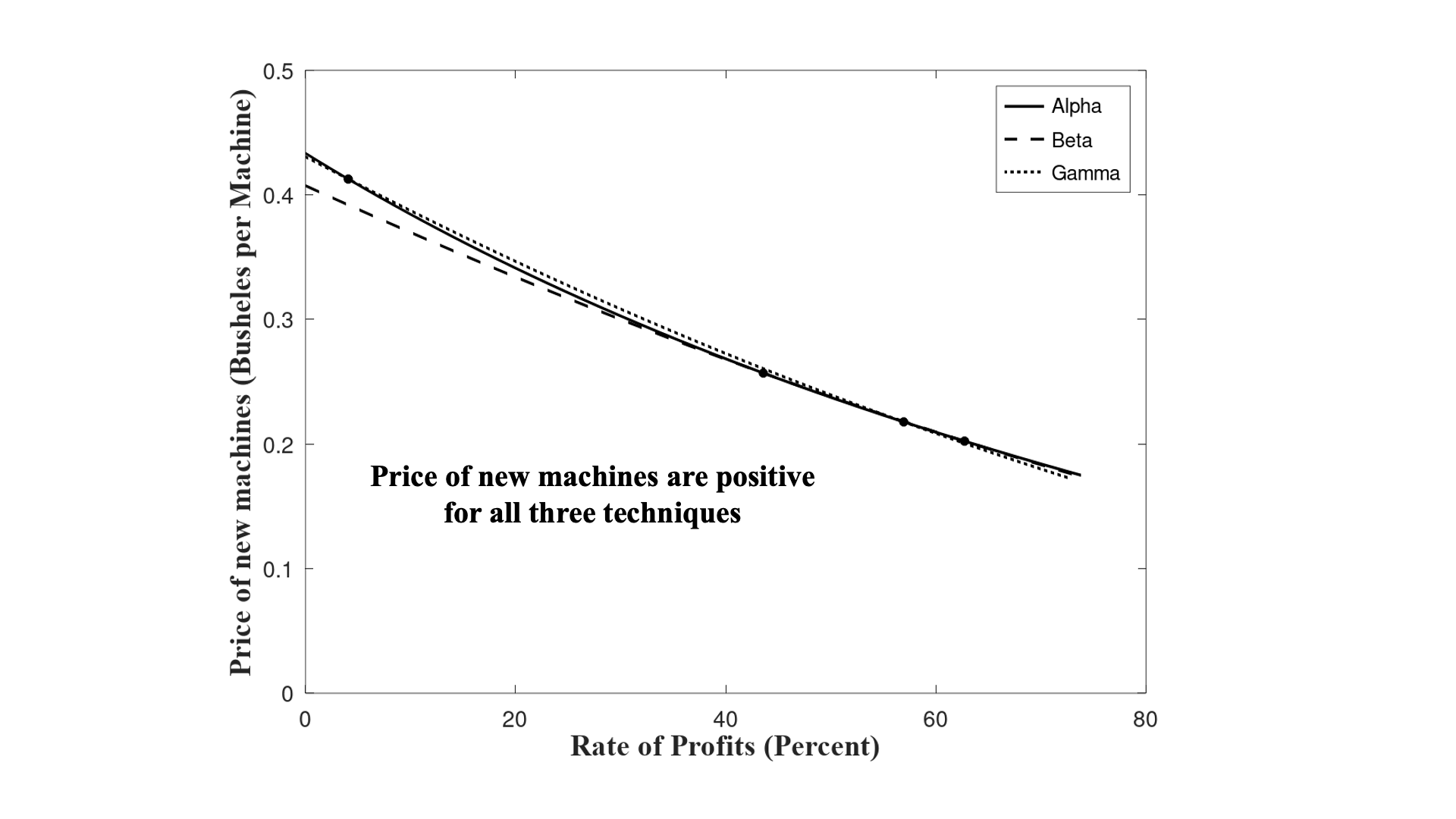
I can find when the price of each machine is positive. For new machines (Figure 2), their prices are positive:

  • For Alpha, when 0 < r < 74.2 percent
  • For Beta, when 0 < r < 73.8 percent
  • For Gamma, when 0 < r < 72.7 percent.

The upper limits are approximate. The wage curves in Figure 1, at the top of this post, intersect the axis for the rate of profits at these upper limits.

Figure 2: Prices of New Machines

One-year old machines have positive prices (Figure 3):

  • For Beta, when 43.6 percent < r < 62.7 percent
  • For Gamma, when 4.1 percent < r < 56.9 percent

Under Alpha, the machine is discarded after one year, and the prices of old machines are identically zero. Beta is not operated outside the limits in which the price curve for Beta intersects the abscissa in Figure 3. If the machine were being truncated after two years, it would pay to discard it after one year. The same applies to Gamma. The analysis, so far, shows that Alpha would be adopted at the extremes of low and high rates of profits,

Figure 3: Prices of One-Year Old Machines

Two-year old machines have positive prices (Figure 4):

  • For Gamma, when 0 < r < 55.7 percent

Since the price of a two year old machine is negative for rates of profits greater than at the switch point, Gamma will not be operated at those rates of profits.

Figure 4: Prices of Two-Year Old Machines

I can now summarize the analysis of the choice of technique for this example. Managers of firms will not adopt a technique when the outputs of a process in the technique has a negative price. Thus, each technique will be adopted in the following intervals:

  • Alpha, for 0 < r < 4.1 percent and 62.7 percent < r < 74.2 percent
  • Beta, for 55.7 percent < r < 62.7 percent
  • Gamma, for 4.1 percent < r < 55.7 percent

Now, I can look at what happens around the three switch points:

  • Around r = 62.7 percent, a lower interest rate is associated with a switch from Alpha to Beta, a more roundabout technique. But net output per worker falls. A more roundabout technique is less capital-intensive.
  • Around r = 55.7 percent, a lower interest rate is associated with a switch from Beta to Gamma, a more roundabout technique. And net output per worker rises.
  • Around r = 4.1 percent, a lower interest rate is associated with a switch from Gamma to Alpha, a less roundabout technique. And net output per worker rises. A less roundabout technique is more capital-intensive.

Only the middle switch point validates Austrian capital theory. Clearly, economists of the Austrian school have made mistakes in logic.

I like to note that the above argument is not about aggregation.

5.0 Conclusion

The above constitutes a proof that Austrian capital theory is mistaken. It relies on an identification, in the example, of more roundaboutness with a longer economic life of a machine. Austrian economists have tried to express their central insight that a greater use of capital is equivalent to a greater use of time in several disparate ways.

Perhaps greater roundaboutness should be identified with the use of different, better machines. By putting aside some time each day, Crusoe can make a net, instead of relying on whatever lies about at hand when catching fish. Or perhaps roundaboutness should be measured by a average period of production. Or by a financial measure of duration. What about those Hayekian triangles?

Since the central insight happens to be wrong, each of these formulations can be demonstrated to be, at best, ad hoc. But for each formulation, to be shown wrong in detail, requires a separate argument. Such can be provided and has been provided for most. Both Austrians and more mainstream marginalists have been in the position, for decades, that every economist is their own capital-theorist.

References
  • Baldone, Salvatore (1974), Il capitale fisso nello schema teorico di Piero Sraffa, Studi Economici, XXIV(1): 45-106. Trans. in Pasinetti (1980).
  • Kurz, Heinz D. and Neri Salvadori. 1995. Theory of Production: A Long-Period Analysis. Cambridge: Cambridge University Press.
  • Pasinetti, Luigi L., (1980) (ed.), Essays on the Theory of Joint Production, New York: Columbia University Press

Friday, April 11, 2025

Austrian Capital Theory And Triple-Switching In The Corn-Tractor Model

Table 1: Lower Rate of Profits around a Switch Point
Tradional Marginalist Story'Perverse' Marginalist Story
Traditional Austrian StoryGreater net output per workerSmaller net output per worker
More roundabout techniqueMore roundabout technique
Switch pt. in region 2, 1st in region 52nd switch point in region 3, 2nd in region 6
'Perverse' Austrian StoryGreater net output per workerSmaller net output per worker
Less roundabout techniqueLess roundabout technique
1st in region 3, 1st and 3rd in region 6, switch point in region 72nd switch point in region 5

My examination of triple-switching in the corn-tractor model allows for drawing some conclusions about Austrian capital theory.

The corn-tractor model, like the Samuelson-Garegnani model, is useful for investigating certain aspects of capital-theory. In obsolete theory from economists of the Austrian school, capital-intensity is associated with roundaboutness (Hennings 1987). A more roundabout technique is identified here with the use of a tractor with a longer lifetime. Only cases in which each type of tractor lasts for the same time in both industries are considered in this article. Thus, the degree of roundaboutness is unambiguous here. In the Austrian theory, a more roundabout technique, in a comparison of stationary states, is supposed to result in a greater net output per worker.

In a stationary state, tractors of each age are operated in parallel, both in the tractor industry and in the corn industry. At the end of each year, the oldest tractors are discarded and the appropriate number of new tractors are added to the stock. The sum of the prices of production of the stock of tractors is the value of capital. Following Steedman, I take a non-physical measure of capital-intensity to be the ratio of the value of capital to the value of net output. The capital-output ratio is a dimensionless number, while the units for the ratio of the value of capital to employment depends on the choice of the numeraire. In a stationary state, net output consists solely of corn, which is consumed. Net output per worker is an unambiguous physical quantity here.

For completeness, I repeat my summary (Table 2) of the analysis of the choice of technique in various regions.

Table 2: Cost-Minimizing Techniques by Region
RegionCost-Minimizing TechniqueNotes
1Type IINo switch point. Type II tractors are dominant with sufficiently low coefficients of production in producing Type II tractors.
2Type II, Type IAround the switch point, a lower rate of profits is associated with a more roundabout technique, a greater capital-output ratio, and more consumption per person-year.
3Type I, Type II, Type IAround the first switch point, a lower rate of profits is associated with a less roundabout technique, a higher capital-output ratio, and more consumption per person-year. Around the second switch point, a lower rate of profits is associated with a more roundabout technique, a lower capital-output ratio, and less consumption per person-year.
4Type INo switch point. Type I tractors are dominant with sufficiently high coefficients of production in producing Type II tractors.
5Type II, Type I, Type IIAround the first switch point, a lower rate of profits is associated with a more roundabout technique, a greater capital-output ratio, and more consumption per person-year. Around the second switch point, a lower rate of profits is associated with a less roundabout technique, a lower capital-output ratio, and less consumption per person-year.
6Type I, Type II, Type I, Type IIAround the first and third switch point, a lower rate of profits is associated with a less roundabout technique, a greater capital-output ratio, and more consumption per person-year. Around the second switch point, a lower rate of profits is associated with a more roundabout technique, a smaller capital-output ratio, and less consumption per person-year.
7Type I, Type IIAround the switch point, a lower rate of profits is associated with a less roundabout technique, a greater capital-output ratio, and less consumption per person-year.

Marginalist economists typically thought of prices as scarcity indices. A higher price of an input into production supposedly signals to mangers of firms to adopt processes in which now cheaper resources are substituted for that input.

"Assume that somewhere ... a new opportunity for the use of some raw material, say, tin, has arisen, or that one of the sources of supply of tin has been eliminated. It does not matter for our purpose ... which of these two causes has made, tin more scarce. ... If only some of [the users of tin] know directly of the new demand, and switch resources over to it, and if the people who are aware of the new gap thus created in turn fill it from still other sources, the effect will rapidly spread throughout the whole economic system and influence not only all the uses of tin but also those of its substitutes and the substitutes of these substitutes, ... without the great majority of those instrumental in bringing about these substitutions knowing anything at all about the original cause of these changes... The mere fact that there is one price for any commodity ... brings about the solution which (it is just conceptually possible) might have been arrived at by one single mind possessing all the information which is in fact dispersed among all the people involved in the process.” (Hayek 1948: 85-86)

This concept of the role of prices is undermined by the Cambridge capital controversy

Bliss (1975), in arguing for general equilibrium theory as an apposite response rejects this role of prices, at least when comparing equilibria:

"Even people who have made no study of economic theory are familiar with the idea that when something is more plentiful its price will be lower, and introductory courses on economic theory reinforce this common presumption with various examples. However, there is no support from the theory of general equilibrium for the proposition that an input to production will be cheaper in an economy where more of it is available. All that the theory declares is that the price of the use of an input which is more plentiful cannot be higher if all other inputs, all other outputs and all other input prices are in constant proportions to each other."

Suppose the rate of profits were an index for the scarcity of capital. A lower rate of profits would indicate that capital was more plentiful, in some sense, as compared to labor. Following the ideas of economists of the Austrian school, managers of firms would be encouraged to adopt more roundabout processes at a lower rate of profits around a switch point (Table 1). According to traditional marginalist reasoning, they would adopt a technique, at a lower rate of profits, with a higher capital-output ratio and more consumption per worker. The switch point in region 2 and the first switch point in region 5 are the only switch points that conform to these outdated ideas.

Other switch points illustrate that these ideas cannot be sustained in general. Consider the first switch point in region 3, the first and third switch points in region 6, and the switch point in region 7. Around these switch points, a lower rate of profits is associated with a higher capital-output ratio and more consumption per worker. Traditional marginalist reasoning is still validated. But, contrary to the expectations of economists of the Austrian school, a less roundabout technique is adopted. As shown in region 7, the disconnection between roundaboutness and capital-intensity does not even require reswitching for its demonstration.

The second switch points in regions 3 and 6, on the other hand, conform to Austrian but not to marginalist reasoning. Around these switch points a lower rate of profits is associated with a more roundabout technique, a lower capital-output ratio, and less consumption per person-year. More roundabout techniques need not be associated with greater capital-intensity or greater net output per worker.

Yeager (1979), in trying to justify Austrian theory with a concept of waiting, expresses puzzlement:

"One paradox not cleared up to my full satisfaction concerns consumption… Since this consumption paradox is a direct arithmetical implication of paradoxes already cleared up, and in particular of capital reversal or perversity, one might contend that no paradox remains. Yet this remark is not wholly satisfying."

The second switch point in region 5 contradicts both Austrian and marginalist reasoning. Around this switch point, a lower rate of profits is associated with a less roundabout technique. And it is associated with a lower capital-output ratio and less consumption per person-year. Perturbing parameters for a single example of triple-switching illustrates a variety of the so-called paradoxes discovered during the Cambridge capital controversy.

Friday, February 07, 2025

A Robinsade For Austrian Capital Theory

I take the following long quote from Bohm-Bawerk.

"The entire sum of originary productive forces at Crusoe’s disposal … is a day’s labor which we shall assume to be a 10-hour workday… Let us assume that the fruit harvest [is] enough to enable our castaway to gather the subsistence minimum in nine hours a day, and enough in 10 hours to furnish him with adequate sustenance for complete health and vigor... Crusoe now has a choice between two lines of conduct. One alternative is ... to consume each day the fruits gathered by a full 10 hours’ work... The other alternative is to restrict himself to the subsistence minimum… In that event – but only in that event – he has a tenth hour open in which he makes hunting equipment for future use... Before there can be any real formation of capital, the productive forces necessary to its production must be saved up at the expense of the enjoyment of the moment.

...The ‘expense of the enjoyment of the moment’ need not always entail downright privation. ...If Crusoe’s labor were somewhat more productive, ...the choice offered might be between ‘adequate supply’ and ‘bounteous fare’. It is not a matter of the absolute magnitude of the minimal claims to enjoyment of the moment, but of their relative magnitude in comparison with ‘income’... The essential point is, that the current endowment of productive forces be not devoted entirely to the enjoyment of the ‘moment’ – the present period – so that a portion of them may be reserved for the service of a future period. Behavior of that kind must unquestionably be called a genuine saving of productive forces.

...It is [productive forces] and not the capital goods themselves which are saved up. We are saving of consumption goods, thereby saving up productive forces and thus can in the end use the latter in order to produce capital goods... To complete the act of forming capital it is of course necessary to complement the negative factor of saving with the positive factor of devoting the thing saved to a productive purpose or, in other words, to endow it with the status of an intermediate product... [O]ur Crusoe has continued throughout one month to consume each day only as much fruit as he could gather in nine hours and has devoted the tenth hour of each day to making hunting equipment. As a result ... he has a bow and some arrows and the possibility of obtaining his subsistence with far greater ease and in much greater abundance than before...

...He must choose another possibility if he is to preserve his capital at its previous level. He must devote at least one hour of his daily allotment of 10 working hours to the rehabilitation of his working equipment and may not spend more than a daily maximum of nine hours on hunting and fruit gathering... In order to preserve capital in status quo ante a certain quantity of the productive forces of the current period must be assigned to the service of the future. And that quantity must be at least equal to the total product of the productive forces of prior periods which is consumed during the current period... Consumption during the current period of the yield of all current and prior productive forces combined, must not exceed the total products that can be derived from the productive forces which accrue afresh in the current period." Bohm-Bawerk (1959: 103-104, emphases in original)

Difficulties arise in this story from applying it to a modern economy and addressing questions of how much. Crusoe’s labor is supposed to represent heterogeneous productive forces. The consumption goods saved and the intermediate capital goods produced stand in a certain ratio, as given by prices. Likewise, the ratio of the consumption goods given up in the current period and those thereby obtained in the future is a kind of price, that is, an interest rate. In a more fully elaborated story, more future-oriented consumers save more, drive the interest rate down, and incentivize managers of firms to adopt more capital-intensive, more roundabout techniques of production. This story cannot be sustained, as is demonstrated, for example, by the triple-switching example in Schefold (1980: p. 170).

References
  • Bohm-Bawerk, Eugen von. 1959. Capital and Interest: Volume II: Positive Theory of Capital (Trans. By George D. Huncke). South Holland: Libertarian Press.
  • Schefold, Bertram. 1980. Fixed capital as a joint product and the analysis of accumulation with different forms of technical progress. In L. L. Pasinetti, ed., Essays on the Theory of Joint Production, New York, Columbia University Press.

Saturday, November 16, 2024

Another Hayekian Triangle Not Supporting The Austrian School

Figure 1: Hayekian Triangles for The Two Techniques
1.0 Introduction

This post is a variation on this one.

2.0 Technology and Net Output

Suppose technology is as characterized by the coefficients of production in Table 1. All techniques are characterized by single production, no fixed capital, and no joint production. In the Alpha technique, the first corn-producing process is operated. The second corn-producing process is operated in the Beta technique. The ale-producing process is operated in both techniques.

Table 1: Regions
InputCorn IndustryAle Industry
Process IProcess IIProcess III
Labor1 person-yr.275/464 person-yrs.1 person-yr.
Corn1/10 kilo-bushels113/232 kilo-bushels2 kilo-bushels
Ale1/40 kilo-liters1/200 kilo-liters2/5 kilo-liters
OUTPUTS1 kilo-bushel1 kilo-bushel1 kilo-liter

Each column in the Leontief matrix and corresponding direct labor coefficient defines a production process. Each process exhibits constant returns to scale and requires a year to complete. Each of the produced commodities are available at the end of the year. All commodities enter, either directly or indirectly, into the production of all commodities and the economy is productive. Labor is directly required to operate each process.

This analysis takes the proportions in the net product as given. These proportions are specified by a column vector, as in Table 2. This numeraire is the net product or net output of Sraffa's standard system for the Alpha technique. This special case has implications for the shape of Hayekian triangles, as seen below.

Table 2: The Numeraire
CommodityAmount
Cornd1 = (337 - 29 (29)1/2)/455 kilo-bushels
Aled2 = (17 + 25 (29)1/2)/1,820 kilo-kiters

3.0 The Choice Of Technique And Hayekian Triangles

The usual analysis of prices and production and the choice of technique yields the wage curves in Figure 2 below. The Beta technique is cost-minimizing for a low interest rate. The Alpha technique is cost-minimizing for a higher interest rate.

Figure 2: Wage Curves for the Two Techniques

Figure 1, at the top of this post, shows the Hayekian triangles at the single switch point. Around this switch point, a lower interest rate does extend the structure of production. But it does not require more savings to achieve that extension.

4.0 Conclusion

The above has constructed Hayekian triangles not consistent with Austrian business cycle theory. A coordinated state does not necessarily rotate the Hayekian triangle to have a longer structure of production with less consumption (more savings).