Saturday, November 13, 2021

A Disconcerting Example of Intensive Rent From D'Agata

Figure 1: The Wage Frontier And Rent
1.0 Introduction

This post is another worked homework example, problem 7.8 in Chapter 10 of Kurz and Salvadori (1995). The example illustrates the possible non-existence of a cost-minimizing technique with intensive rent. I once looked at an example from J. E. Woods of joint production. I claim that that example does not make the desired point, given the possibility of a price of zero for some produced good. I do not think this example of rent can be resolved like that.

Kurz and Salvadori suggest to me how I might apply my perturbation techniques: "...calculate what will happen if either only process (4) or only process (5) were missing."

2.0 Technology, Techniques, and Requirements for Use

Anyways, Table 1 presents the available technology. Corn is grown on homogeneous land, and three processes are available for producing corn. One hundred acres of land are available, leading to the possibility of two processes being operated side-by-side with positive rent.

Table 1: The Coefficients of Production
InputIndustries and Processes
IronSteelCorn
IIIIIIIVV
Labor11111/51
Land00111
Iron001/101/101/10
Steel002/51/101/10
Corn1/103/51/103/102/5

Table 2 shows the processes operated in each of the six techniques available. (All three corn-producing processes are operated only at a switch point where the Delta, Epsilon, and Zeta techniques are simultaneously cost-minimizing. Iron, steel, and corn are basic commodities in all techniques. Land is never a basic commodity.

Table 2: Techniques
TechniqueProcess
AlphaI, II, III
BetaI, II, IV
GammaI, II, V
DeltaI, II, III, IV
EpsilonI, II, III, V
ZeaI, II, IV, V

Requirements for use are 90 tons iron, 60 tons steel, and 19 bushels corn. Alpha, Delta, and Epsilon can meet requirements for use. That is, one can find levels of operation of the processes comprising these techniques such that the net output of the economy is the previously specified vector and no more than 100 acres of land are farmed. Beta, Gamma, and Zeta are infeasible.

3.0 Cost-Minimizing Techniques and the Wage Frontier

When Alpha is used, not all land is farmed. Rent would be zero. But Alpha is never cost-minimizing.

Figure 2: Extra Profits At Delta and Epsilon Prices

To see if a technique is cost-minimizing at a given rate of profits, find prices of production, the wage, and rent for the technique. Then one can calculate extra profits for every process. Costs include the going rate of profits on advances for purchasing capital goods, wages, and rents. Figure 2 plots extra profits for processes for Delta and Epsilon prices.

The left panel illustrates Delta. No extra profits are made or extra costs are incurred in processes I, II, III, and IV. Delta only has a non-negative wage and a non-negative rent between a rate of profits of 1/9 (that is, approximately 11.1 percent) and approximately 52.3 percent. From a rate of profits of approximate 11 percent to 46 percent, extra profits cannot be made in operating process V. Delta is cost-minimizing.

For a higher rate of profits, in a range in which rent is non-negative under Delta prices, process V makes extra profits. Delta is not cost-minimizing. Which technique would be adopted under these conditions? Process V could be be the only corn-producing process, in the Gamma technique. But that technique is not feasible. Suppose process V replaces process III, in the Zeta process. That technique results in more being produced than are needed for requirements for use. Epsilon is the only feasible technique in which land is fully farmed and two corn-producing processes are operated, with a positive rent.

The right panel in Figure 2 illustrates extra profits for all processes under Epsilon prices. Epsilon has a non-negative wage and a positive rent up to a rate of profits of 2/3 (that is, approximately 66.7 percent) In the range of the rate profits from zero to approximately 46 percent, Epsilon is cost-minimizing. For a higher rate of profit, where the wage is still non-negative under Epsilon, process IV makes extra profits. I highlight in this range when Delta is feasible and consistent with a positive wage and positive rent.

The above analysis shows how the wage frontier is constructed in this example. The wage frontier is illustrated in the left panel in Figure 1 at the top of this post. The corresponding rent is shown in the right panel. A range of rate of profits exists in which Delta and Epsilon are both cost-minimizing. The switch point between Delta and Epsilon is at 19/41, (that is, approximately 46.3 percent). Above this rate of profits, no technique is cost-minimizing.

4.0 Conclusion

Between rates of profits of 19/41 and approximately 52.3 percent, Epsilon makes extra profits at Delta prices, and Delta makes extra profits at Epsilon prices. Even though feasible techniques exist that are consistent with positive wages, rates of profits, rent, and prices of production, no cost-minimizing technique need exist.

References
  • D'Agata, Antonio. 1983a. The existence and unicity of cost-minimizing systems in intensive rent theory. Metroeconomica 35: 147-158.
  • Kurz, Heinz D. and Neri Salvadori. 1995. Theory of Production: A Long-Period Analysis. Cambridge: Cambridge University Press.

Wednesday, November 03, 2021

An Example Of External Intensive Rent From D'Agata

Figure 1: The Wage Frontier And Rent

This post is merely a worked homework example, problem 7.10 in Kurz and Salvadori (1995). I have not considered yet which parameters I want to explore perturbing.

As a matter of history, Anderson, West, Malthus, and Ricardo took extensive rent as the paradigm case, and confined it to land. They imposed no limit on the production of industrial commodities. Ricardo, at least, also discussed the case of intensive rent. The marginalists, on the other hand, took the case of intensive rent as the paradigm case and extended it to all commodities and, sloppily, extended the explanation of rent to payments to capital and labor. I still do not get well-behaved supply and demand relationships in models of intensive rent. Marginalism remains mistaken and lacks a coherent price theory.

Table 1 presents coefficients of production for the technology. One process is known for producing iron, three processes are known for producing steel, and one process is known for producing corn. Iron and steel are industrial commodities, while corn is the single agricultural commodity. One hundred acres of land are available. All processes exhibit constant returns to scale, in corn production up to the limit imposed by the scarcity of land. The scarity of land can result in a combination of two processes being used to produce steel, with land receiving a positive rent. Requirements for use are 10 tons iron, 10 tons steel, and 78 bushels corn. I take requirements for use, that is, net output, as the numeraire.

Table 1: The Coefficients of Production
InputIndustries and Processes
IronSteelCorn
IIIIII
Labor111/1011/21
Land00001
Iron03/102/51/101/10
Steel1/103/102/51/101/10
Corn02/53/101/51/10

Six techniques are available for a sustainable economy. In each technique, the iron-producing and corn-producing processes are operated. The techniques are distinguishable by the steel-producing or combination of steel-producing processes that are operated (Table 2).

Table 2: Techniques
TechniqueSteel Process(es)
AlphaI
BetaII
GammaIII
DeltaI, II
EpsilonI, III
ZeaII, III

The Alpha technique is not feasible; requirements for use cannot be satisified by operating the specified combination of processes while respecting the constraint imposed by land. The Beta, Gamma, Delta, and Epsilon techniques are feasible. When the Beta or Gamma techniques are operated to produce the requirements for use, some land is left farrow and rent is zero. The Delta and Epsilon techniques each require all land to be farmed. Zeta produces more commodities than are required for use. It would only be adopted at a switch point between Beta and Gamma, with a rent of zero.

Prices of production for the Beta and Gamma techniques can be analyzed as in models of circulating capital. For the Beta technique, for example, each of the iron-producing, steel-producing, and corn-producing processes provides a price equation. With the specification of the numeraire, one has four equations in five unknowns: the price of iron, the price of steel, the price of corn, the wage, and the rate of profits. Rent is zero, since land is in excess supply. One can solve for each variable as a function of the rate of profits. As shown in Figure 1 at the top of this post, the wage curves for the Beta and Gamma techniques slope down.

When are the Beta and Gamma techniques cost-minimizing? For a given rate of profits, one can calculate, for each process, the difference between revenues and costs, where costs include a charge for profits on the iron, steel, and corn advanced. The Beta technique, for example, is cost-minimizing only when extra profits cannot be made in operating any process. Figure 2 shows the ranges of the rates of profits at which the Beta and Gamma techniques are cost-minimizing.

Figure 2: Extra Profits At Beta Or Gamma Prices

Prices of production can also be found for the Delta and Epsilon techniques. For the Delta technique, for example, the iron-producing, the first and second steel-producing, and the corn-producing processes provide a price equation. Given the rate of profits and the specification of the numeraire, the wage and the prices of iron, steel, and corn, can be solved for from the iron-producing and steel-producing processes. The corn-producing process then yields the rent per acre of land. I confine my attention to non-negative rents and prices. For the Delta technique, rent is negative at a rate of profits of zero, but not for a certain range of postive rates of profits.

Figure 3: Extra Profits At Delta Or Epsilon Prices

To find when the Delta technique is cost-minimizing, one performs the usual analysis. When can extra profits, at Delta prices, be made by operating a process not in the technique? The left-hand panel in Figure 3 shows that extra profits are available from the third steel-producing processes for start of the range of the rate of profits at which the Delta technique yields positive rents. At the end of this range, the Delta technique is cost-minimizing. One can repeat this analysis for the Epsilon technique. The Epsilon technique is cost-minimizing at towards the end of the range for the rate of profits at which it yields a positive rent, as shown in the right-hand panel in Figure 3.

Even though the choice of technique is not analyzed above by construction of an envelope of wage curves, one can still highlight wage curves for each technique when they are cost-minimizing. The left-hand panel in Figure 1, at the top of this post, shows the resulting wage frontier. The right-hand panel shows rent as a function of the rate of profits.

The wage curve for the Delta technique slopes up, even when it is on the frontier. You can see that there is a certain range of the rate of profits where the Beta, Delta, and Epsilon techniques are each cost-minimizing. The wage could just as well be taken as the independent variable. And there is a range of the wage where the Delta, Epsilon, and Gamma techniques are cost-minimizing. Sraffa was wrong or, at least, misleading in certain comments on intensive rent in his book on intensive rent. Some, but not all, of the analytical tools he built can be used to demonstrate these mistakes.

This post illustrates that in a model of external intensive rent, prices of production, rent, and the wage are not necessarily uniquely determined by the rate of profits. Nor are prices of production, rent, and the rate of profits necessarily uniquely determined by the wage. This non-uniqueness cannot arise in circulating capital models or pure fixed capital systems. It can only arise in a model of extensive rent in a fluke case that I have been calling a pattern for the requirements for use.

Friday, October 29, 2021

Post-Sraffian Terminology

Terms that include the word 'pattern' are my own creation, as inspired by my research program. The remainder are, as far as I am concerned, standard terminology, some of which you would be introduced to if you were taught price theory properly. (Most of what is in mainstream microeconomic textbooks is, at best, wrong.) The definitions are my own, although obviously inspired by my reading.

  • Absolute rent: A price paid for a year's services for land under cultivation due to barriers to entry to agriculture that would be otherwise manifested in persistent higher rates of profits in farming.
  • Basic commodity: A commodity that is productively consumed, either directly or indirectly, in the production of each commodity produced in an economy.
  • Capital reversing: The association of a higher rate of profits around a switch point with a cost-minimizing technique with a more capital-intensive technique. Also known as a positive real Wicksell effect.
  • Circulating capital: Produced commodities that are completely consumed in producing other commodities. Contrast fixed capital.
  • Coefficient of production: The amount of a specified commodity that is required as an input to operate a given process at a unit level or the amount of a specified commodity that is produced in operating the given process at a unit level.
  • Differential rent of the first kind: See extensive rent.
  • Differential rent of the second kind: See intensive rent.
  • Extensive rent: A price paid for a year's services for land under cultivation due to the need to cultivate more than one type of land to satisfy requirements for use while prices of production prevail.
  • External intensive rent: A price paid for a year's services for land under cultivation due to the need to more than one process, in an industry that uses negligible inputs land, so as to satisfy requirements for use while prices of production prevail. See intensive rent.
  • Factor price frontier: See wage frontier.
  • Finished good: A produced commodity that is either a consumption good, circulating capital, or a newly produced machine.
  • Fixed capital: Produced commodities that are used in producing other commodities and last over more than one production period. A good used as fixed capital is often referred to simply as a 'machine'. Contrast circulating capital.
  • Forward substitution of labor: The association of a higher rate of profits, or lower wage, around a switch point with a cost-minimizing technique in which, in one industry, the labor per unit of gross output produced is larger. Contrast with reverse substitution of labor.
  • Four-technique pattern of switch points: Occurs when there is a switch point at which four wage curves intersect.
  • Intensive rent: A price paid for a year's services for land under cultivation due to the need to operate more than one process on that land to satisfy requirements for use while prices of production prevail.
  • Intermediate good: An old machine.
  • Joint production: The phenomenon in which some production process produces more than one commodity, such as wool and mutton. Fixed capital, in which a production process produces a finished good and a machine one year older than it was when used as an input is an example. Land, which is both an input to a production process and is an unchanged output, along with a finished good, provides another example.
  • Leontief input-output matrix: A matrix of coefficients of production in models of circulating capital, where each coefficient is the amount of a specified commodity needed in the production of a unit amount of another specified commodity. Leontief matrices are often supplemented by vectors of labor coefficients, matrices for land inputs, and so on.
  • Market prices: Prices existing in markets at a particular moment in time. Market prices are consistent with inequalities in the quantities supplied and demanded and with momentary variations in the rates of profits among industries. Contrast with prices of production.
  • Natural prices: See prices of production.
  • Normal prices: See prices of production.
  • Order of efficiency: See order of fertility.
  • Order of fertility: In models with extensive rent, the order in which lands of different types are taken into cultivation, at a given rate of profits or a given wage, as the quantities in requirements for use expand. Also known as the order of efficiency.
  • Order of rentability: In models with extensive rent, the order of lands of different types from high rent per acre to zero rent, at a given rate of profits or a given wage.
  • Pattern (of switch points) for the requirements for use: Occurs with an indeterminancy in prices and levels at which processes are operated in the cost-minimizing techniques at a given rate of profits. This indeterminancy arises in models of joint reproduction due to the need to satisfy requirements for use.
  • Pattern (of switch points) in the r-order of fertility: Occurs when a switch point associated with a change in the order of fertility of land not on the margin is at the same rate of profits as a switch point on the axis for the rate of profits.
  • Pattern (of switch points) in the w-order of rentability: Occurs when a switch point associated with a change in the order of fertility of land not on the margin is at the same wage as a switch point on the axis for the wage.
  • Pattern (of switch points) over the axis for the rate of profits: Occurs when there is a switch point at a wage of zero.
  • Pattern (of switch points) over the wage axis: Occurs when there is a switch point at a rate of profits of zero.
  • Prices of production: Given technology, the rate of profits or the wage, and requirements for use, prices of commodities consistent with the smooth reproduction of a capitalist economy. Contrast with market prices.
  • Process: A process of production is specified by the quantities of labor, of a specified type of land, and of specified commodities needed to produce a specified output. Under joint production, the output can consist of more than one commodity. A technique consists of a set of processes.
  • Rate of profits: The quotient of the difference between revenue and costs in a process and the costs paid in advances at the start of the production period. The rate of profits is the same for all operated processes when prices of production prevail if there are no barriers to entry or other causes of persistent differences among industries.
  • Recurrence of processes: Occurs when a process is in the cost-minimizing techniques, at two disjoint ranges of the rate of profits, while that process is not in the techniques cost-minimizing at the rates of profits between these two ranges. The recurrence of processes always arises when techniques recur, but the recurrence of processes can occur without the recurrence of techniques.
  • Recurrence of techniques: Occurs when one technique is cost-minimizing at two disjoint ranges of the rate of profits, while one or more other techniques are cost-minimizing at the rates of profits between these two ranges. The recurrence of techniques always arises when techniques reswitch, but the recurrence of techniques can occur without the reswitching of techniques.
  • Requirements for use: The level and composition of net output or of a consumption basket, specified as given in models of production.
  • Reswitching of techniques: Occurs when one technique is cost-minimizing at two disjoint ranges of the rate of profits, while another technique is cost-minimizing at the rates of profits between these two ranges.
  • Reswitching pattern (of switch points): Occurs when two wage curves are tangent at a switch point.
  • Reverse substitution of labor: The association of a higher rate of profits, or lower wage, around a switch point with a cost-minimizing technique in which, in one industry, the labor per unit of gross output produced is smaller. Contrast with forward substitution of labor.
  • Scale factor for the rates of profits: When markups among industries hold persistent and stable ratios among themselves, a scale factor that determines the rate of profits from relative markups. See the rate of profits.
  • Single production: See circulating capital and contrast with joint production.
  • Sraffa effect: The reswitching of techniques, capital reversing, the reverse substitution of labor, the recurrence of techniques, the recurrence of processes, and other effects discovered through the analysis of prices of production that are inconsistent with obsolete marginalist dogmas.
  • Sraffa matrix: A Leontief matrix for a viable technique when at least one commodity is basic and the maximum rate of profits for the submatrix of non-basic commodities exceeds the maximum rate of profits for the submatrix for basic commodities. See pp. 123-124 in Kurz and Salvadori (1995).
  • Structural economic dynamics: The variation in the relative sizes of industries and in prices of production as the result of technical progress, variation in market structure, variations in the rate of growth, and variation in the relative quantities of commodities in consumption baskets.
  • Switch point: A point at which two wage curves intersect. Often defined to apply only to switch points on the wage frontier.
  • Technique: A set of processes. In models of circulating capital, a technique contains one process for producing each commodity in the gross output of an economy.
  • Three-technique pattern of switch points: Occurs when there is a switch point at which three wage curves intersect.
  • Wage curve: For a given technique, the wage as a function of the rate of profits in a system of prices of production. Also known as a wage-rate of profits curve.
  • Wage frontier: In models of circulating capital, the outer envelope of wage curves. Also known as the wage-rate of profits frontier or, misleadingly, the factor-price frontier.
  • Wicksell effect, price: The variation in the numeraire value of capital goods with the rate of profits for a given technique.
  • Wicksell effect, real: The variation in the numeraire value of capital goods with the technique at a given rate of profits. Around a switch point with a negative real Wicksell effect, a higher wage or lower rate of profits is associated with a larger value of capital per person-year employed in a stationary state.

Friday, October 22, 2021

Elsewhere

Why Rationality is Wrong

  • Above is a video by "Dr. Skeleman", first in a series.
  • Nick Romeo, in The New Yorker, on The CORE textbook.
  • Steve Keen's obituary of Janos Kornai.
  • J. Barkley Rosser's comments on Kornai's passing. I feel I should have more to say. I recommend autobiography, By Force of Thought: Irregular Memoirs of an Intellectual Journey, although it is somewhat dry.
  • J. Barkley Rosser's obituary of Peter Flaschel

Thursday, October 21, 2021

Some Kinds Of Rent

Special Cases in the Analysis of Rent
TypeLandAgricultural ProcessesIndustrial Processes
Extensive rentMultiple types of land, each of a given qualityFor a given type of land, one process producing corn is availableFor a given commodity other than corn, one process for producing it is available
Intensive rent properOne type of homogeneous landFor the given type of land, multiple processes are available for producing cornFor a given commodity other than corn, one process for producing it is available
External intensive rentOne type of homogeneous landFor the given type of land, one process for producing corn is availableFor a given commodity other than corn, multiple processes for producing it are available

Economists have explored several kinds of rent in post-Sraffian price theory (Kurz and Salvadori 1995: 279). Suppose, as a simplifying assumption, that one commodity, 'corn', can be produced on land. Land is a non-produced commodity that emerges from a production process unchanged. Furthermore, assume that no pure joint production occurs otherwise. Let requirements for use be specified as a vector of net outputs.

The table at the head of this post lists three kinds of rent. They are characterized by the appending of three additional assumptions. One assumption deals with whether all land is homogeneous, or whether multiple types of land exist. Another assumption states whether one or more than one process is known for operating on any of the given types of land. A final assumption concerns whether different processes are available to produce commodities that do not require direct inputs of land in their production.

As far as I know, a general model of rent, short of the general theory of joint production, has yet to be developed that considers the relaxation and mixing of these assumptions. Those building on the work of Alberto Quadrio Curzio, I guess, have a ways to go. (I have just started reading the reference below.) Absolute rent may be introduced by postulating persisting, non-uniform ratios of rates of profits across sectors. An obvious generalization would consider the possibility of producing more than one agricultural commodity. In a mixed model of extensive and intensive rent, more than one type of land would exist, and more than one production process would be available for at least some types of land. Furthermore, one might introduce fixed capital, thereby raising the question of the cost-minimizing choice of the economic life of machines.

My impression is that results of the circulating capital model generalize to simple models of extensive rent. The dependence of the price system on requirements for use in models of extensive rent, however, is an important difference in the models. Once one considers other types of rent or any of the above complications, issues that arise in general models of joint production also arise in models of rent. These issues include upward-sloping wage curves on the frontier and the non-uniqueness or the non-existence of a cost-minimizing technique at a given rate of profits.

Reference
  • Baranzini, Mauro L., Claudia Rotondo, and Roberto Scazzieri. 2015. Resources, Production and Structural Dynamics. Cambridge: Cambridge University Press.

Saturday, October 16, 2021

On David Card's Nobel

The Sveriges Riksbank prize in economic sciences in memory of Alfred Nobel this year goes to David Card, Joshua Angrist, and Guido Imbens. I cannot say much about instrumental variables, Angrist, or Imbens. Since I have been pointing to Card's work with Alan Krueger on minimum wages for decades, I thought I might say somthing about his half of the prize.

I do not have much new to say. I find both natural experiments and meta-analysis intriguing.

Both Card and Krueger's natural experiments with minimum wages and their meta-analysis have been superceded. Maybe 'transcended' or 'replicated' would be better terminology. That is why, in my 2019 paper in Strucutral Change and Economic Dynamics, I reference Andrajit Dube and his colleagues, not Card and Krueger. Also, David Neumark's quibbles with Card are currently uninteresting. (Any reporter talking to Neumark should note he started out with funding from a consortium of fast food joints.)

I object to attempts to explain the lack of impact of minimum wages on employment by the theory of monopsony. Economists have known, for over half a century, that wages and employment cannot, even under ideal conditions, be explained by the interaction of well-behaved supply and demand curves in the labor market. In marginalist theory, the supply of labor is derived from utility-maximizing households trading off leisure and commodities to consume. The demand for labor is supposed to be derived from profit-maximizing firms. But no such valid derivation goes through if firms produce some commodities with the use of previously produced commodities, that is, capital goods. This well-established result is widely ignored, with no pretence at justification.

Saturday, October 09, 2021

A Structure in Parameter Space with Three Patterns Across The Wage Axis

Figure 1: Three Patterns Across The Wage Axis And One Three-Technique Pattern

This post continues the approach in this post and in this post. As previously stated, I consider the same two examples. In both examples, three processes are known for producing the numeraire, called "corn". In the example for the left panel, corn is a non-basic commodity, and a different basic commodity is used in each of the three techniques. In the example for the right panel, all three corn-producing processes require inputs of labor power, corn, and iron (in different proportions), and managers firms know of a single process for producing iron. Both commodities are basic in this second example. The examples are also parametrized differently.

In both panels, loci for three patterns of switch points on the frontier and over the wage axis terminate at a point that is also the terminus for a locus for a three-technique pattern of switch points. For the example illustrated by the right panel, a second switch point exists on the wage frontier for a larger rate of profits than the one concerned in the patterns of switch points. This structure in parameter space is also depicted as Figure 2 in my paper, 'Fluke switch points in pure fixed capital systems', for a quite different example.

This generic structure in these parameter spaces is obscured by the dotted line in the panel on the right. Along it, the wage curves for the switch point between the Beta and Gamma techniques intersect at a rate of profits of zero. But this switch point is not on the wage frontier. Below and to the right of the dotted line, the switch point between Beta and Gamma on the frontier exhibits capital-reversing, while above it that switch point has a negative real Wicksell effect. Thus, the dotted line is not associated with a change in the number of sequence of switch points along the wage frontier. But it is associated with the change of the direction of real Wicksell effects around one of these switch points.

So here is another perhaps universal structure, in some sense, in parameter spaces associated with the analysis of the choice of technique in models of prices of production.

Saturday, October 02, 2021

A Structure in Parameter Space With Three Patterns Across The Axis For The Rate Of Profits

Figure 1: Three Patterns Across The r Axis And One Three-Technique Pattern

This post continues the approach in this post. I consider the same two examples. In both examples, three processes are known for producing the numeraire, called "corn". In the example for the left panel, corn is a non-basic commodity, and a different basic commodity is used in all three techniques. In the example for the right panel, all three corn-producing processes require inputs of labor power, corn, and labor (in different proportions), and managers firms know of a single process for producing iron. Both commodities are basic in this second example. The examples are also parametrized differently.

These examples are all part of my investigation of how reswitching, capital-reversing, a reverse substitution of labor, process recurrence, and so on can emerge and disappear with perturbations of parameters in post Sraffian models of prices of production.

I call a case when a switch point exists on the wage frontier at a wage of zero a "pattern of switch points over the axis for the rate of profits". When three wage curves intersect on the frontier at a single switch point, I say this is a "three-technique pattern" of switch points.

I claim that the two panels in the figure at the top of this post are the same, at some level of abstaction. Suppose that in the left panel, replace every instance of "Alpha, Gamma" is replaced by S1. Suppose every instance of "Beta" is replaced with "Gamma" and every remaining instance of "Alpha" with "Beta". Let every instance of S1 be replaced with "Alpha". Rotate clockwise somewhat and stretch and otherwise distort the regions.

In both panels, one will then have a region labeled with "Alpha", alone. And it will be bounded by two loci, each designating parameters for a pattern of switch points over the axis for the rate of profits. The region diagonally opposite is then bounded by a locus for a third pattern of switch points over the axis for the rate of profits and a locus for a three-technique pattern.

In other words, loci for three patterns of switch points terminate at a point that is also the terminus for a locus for a three-technique pattern of switch points. For the example illustrated by the left panel, a second switch point exists on the wage frontier for a smaller rate of profits than the one concerned in the patterns of switch points.

So here is another generic structure in the parameter spaces relating to the analysis of the choice of technique.

Friday, October 01, 2021

Elsewhere

  • Alex Thomas on Krishna Bharadwaj as an ideal economist.
  • Her daughter, Sudha Bharadwaj is a political prisoner.
  • The first page of this Jeremy Rudd paper is getting noticed. A lot of mainstream economics is "arrant nonsense."
  • National Public Radio has a rememberance of Charles Mills.
  • Liam Bright has a tribute, too.

Sunday, September 26, 2021

A Structure In Parameter Space

Table 1: A Common Structure Example
1.0 Introduction

This post presents partitions of (a part of) parameter space for two examples of models of prices of production with a choice of technique. The examples have a different structure and are parametrized differently. Yet, I want to argue, the partitions are the same, at some level of abstraction.

2.0 Thing 1

The first example is an instance of the Samuelson-Garegnani model. Table 1 presents the coefficients of production for this example. Each coefficient specifies the units of input needed to produce a unit output of the commodity for the given industry. Corn is the numeraire, and is not an input into any industry. It is non-basic in Sraffa's terminology. Three processes are available for producing corn, each distinguished by the capital good used in that process. In a technique, the process that produces that capital good and the given corn-producing process are operated. The techniques are labeled Alpha, Beta, and Gamma, depending on the corn-producing process. The example is fully specified by assigning values to a2,2 and a3,3.

Table 1: The Coefficients of Production for First Example
InputIndustry
IronCopperUraniumCorn
AlphaBetaGamma
Labor117328/828111361/913.63505
Iron1/200300
Copper0a2,20010
Uranium00a3,3001.95561
Corn000000

Given the technique (with the parameters assigned numberical values) and, say, a feasible rate of profits, one can solve for the real wage and prices of production. At each feasible rate of profits, the choice of technique is determined by cost. It is the cost-minimizing one. In general, the choice of technique varies with the rate of profits. One could also take the wage as given, and find the rate of profits as a function of the wage.

To go on, I draw upon my publications. I call a switch point in which two wage curves are tangent at that point a reswitching pattern (of switch points). A three-technique pattern (of switch points) is a switch point in which three wage curves intersect. Both of these patterns exist in this example.

The left panel in Figure 1 above partitions a portion of the parameter space for this model. I label each region by the cost-minimizing techniques along the wage frontier, in the order of an increasing rate of profits. The partitions are labeled by the corresponding pattern of switch points. This case illustrates how a perturbation of coefficients of production can lead to the emergence of the reswitching of techniques.

3.0 Thing 2

In the second example, two commodities are produced, and they both are basic commodities in all three techniques. Table 2 presents the coefficients of production for this example. I have introduced technological change in this model The coefficients of production for producing corn with the Beta and Gamma processes decrease exponentially. They decrease at different rates for the two processes, but all coeficients for a process descrease at the same rate.

Table 2: The Coefficients of Production for Second Example
InputIndustry
IronCorn
AlphaBetaGamma
Labor15191/5770(305/494) e(3/20) - σt(19/20) e(3/10) - φt
Iron9/201/40(3/1976) e(3/20) - σt(1/40) e(3/10) - φt
Corn21/10(229/494) e(3/20) - σt(1/10) e(3/10) - φt

Given the coefficients at a particular time, one can find prices of production and the cost-minimizing technique. Here, too, the analysis of the choice of technique can be performed by constructing the wage frontier. The model is parametrized by (σ t) and (φ t). The right panel in Figure 1 shows a portion of this parameter space for this model.

4.0 Conclusion

I want to say that the two panels in Figure 1 depict the same structure. The labeling of techniques is different, and one panel requires the other be rotated and stretched, as is typical of topological structures. In both cases, the loci for two reswitching patterns intersects. At that intersection, one wage curve on the wage frontier is tangent to two other wage curves, each at a separate switch point. Each locus for the reswitching patterns terminates at a point of tangency for a locus of three-technique patterns. And a three-technique pattern forms an arc connecting those two points of tangency.

Other common structures can be found in the parameter spaces of models of prices of production with the choice of technique.l

Tuesday, September 21, 2021

John Stuart Mill Illustrates Charles Mills' Racial Contract

Here is John Stuart Mill stating a principle that sounds noble, and then immediately making a strange caveat.

"The object of this Essay is to assert one very simple principle, as entitled to govern absolutely the dealings of society with the individual in the way of compulsion and control, whether the means used be physical force in the form of legal penalties, or the moral coercion of public opinion. That principle is, that the sole end for which mankind are warranted, individually or collectively, in interfering with the liberty of action of any of their number, is self-protection. That the only purpose for which power can be rightfully exercised over any member of a civilized community, against his will, is to prevent harm to others. His own good, either physical or moral, is not a sufficient warrant. He cannot rightfully be compelled to do or forbear because it will be better for him to do so, because it will make him happier, because, in the opinions of others, to do so would be wise, or even right. These are good reasons for remonstrating with him, or reasoning with him, or persuading him or entreating him, but not for compelling him, or visiting him with any evil, in case he do other wise. To justify that, the conduct from which it is desired to deter him must be calculated to produce evil to some one else. The only part of the conduct of any one, for which he is amenable to society, is that which concerns others. In the part which merely concerns himself, his independence is, of right, absolute. Over himself, over his own body and mind, the individual is sovereign.

It is, perhaps, hardly necessary to say that this doctrine is meant to apply only to human beings in the maturity of their faculties. We are not speaking of children, or of young persons below the age which the law may fix as that of manhood or womanhood. Those who are still in a state to require being taken care of by others, must be protected against their own actions as well as against external injury. For the same reason, we may leave out of consideration those backward states of society in which the race itself may be considered as in its nonage. The early difficulties in the way of spontaneous progress are so great, that there is seldom any choice of means for overcoming them; and a ruler full of the spirit of improvement is warranted in the use of any expedients that will attain an end, perhaps otherwise unattainable. Despotism is a legitimate mode of government in dealing with barbarians, provided the end be their improvement, and the means justified by actually effecting that end. Liberty, as a principle, has no application to any state of things anterior to the time when mankind have become capable of being improved by free and equal discussion. Until then, there is nothing for them but implicit obedience to an Akbar or a Charlemagne, if they are so fortunate as to find one. But as soon as mankind have attained the capacity of being guided to their own improvement by conviction or persuasion (a period long since reached in all nations with whom we need here concern ourselves), compulsion, either in the direct form or in that of pains and penalties for non-compliance, is no longer admissible as a means to their own good, and justifiable only for the security of others."

-- J. S. Mill, On Liberty

The second paragraph in that quotation above is no abstract theoretical observation. As I understand it, Mill, following his father, had a day job in the East India Company, eventually becoming Chief Examiner of Correspondence. I gather that that was a fairly prominent position.

Mill, in On Liberty is not writing about a social contract, unlike Hobbes, Locke, and Rousseau, for example. But this book is a classic of liberal political philosophy that, when looked at from a subaltern position, has a dark racial underside. A reader of Charles Mills might be sensitized to see this.

Reference
  • John Stuart Mill. 1859. On Liberty
  • Charles Mills. 1997. The Racial Contract. Cornell University Press

Saturday, September 11, 2021

Summary of Some Conclusions From My Research Program

This blog, over years, presents a welter of fluke cases. I created many of the numerical examples to illustrate the reswitching of techniques, capital reversing, or some such so-called 'perversity'. Fluke cases can be combined. For example, a fluke switch point at a rate of profits of zero can also be a fluke switch point at which three wage curves intersect. Or two switch points on the wage frontier can both be fluke switch points at which four wage curves, not necessarily the same, intersect. Numerical examples remain to be developed for some possibilities.

Selected Fluke Cases
Pattern of switch points over the wage axis
Pattern of switch points for the reverse substitution of labor
Pattern of switch points over the axis for the rate of profits
Reswitching pattern of switch points
Three-techniques pattern of switch points
Four-technique pattern of switch points
Pattern of switch points for the w-order of fertility
Pattern of switch points for the r-order of fertility
Pattern over the wage axis for the order of rentability
Pattern over the axis for the rate of profits for the order of rentability
Pattern for the requirements for use

The analysis and construction of fluke cases yields insights into the analysis of the choice of technique in the system of prices of production. The reswitching of techniques, capital-reversing, process recurrence, the reverse substitution of labor, the extension of the lifetime of a machine at a lower wage, and the divergence between the order of fertility and the order of rentability are not fluke cases. These possibilities can be contrasted with genuine fluke cases, in which the perturbation of parameters destroys characteristics specifying such cases. These fluke cases partition parameter spaces into regions where these so-called 'perverse' phenomena arise.

These phenomena are also more or less independent of one another. Reswitching does not occur without process recurrence, but process recurrence can arise without reswitching. The association of a smaller rate of profits around a switch point with the truncation of the lifetime of a machine may or may not be accompanied by capital-reversing. Capital reversing can arise with or without a reverse substitution of labor and vice versa. Variations in the order of fertility need not accompany variations in the order of rentability. Nor need variations in the order of rentability be accompanied by variations in the order of fertility. The divergence between the order of fertility and the order of rentability can arise in an example of the reswitching of techniques, but reswitching is not necessary for such divergences. These specific examples do not exhaust the possible combinations of Sraffa effects.

The demonstration and visualization of these results is presented in an open and disaggregated model of prices of production. The functional distribution of income between wages, rents, and profits is not specified. The approach illustrated in these blog posts, in some sense, provides an even more open model. Prices of production are consistent with the smooth reproduction of a capitalist economy. In specifying prices of production, technology, relative rates of profits among industries, and requirements for use are frozen. Fluke cases are found, on the other hand, by perturbing parameters that specify these givens for prices of production.

Whatever practical conclusions can be drawn from this widening of the horizon remain on a high level of abstraction. Characteristics of the conflict over the functional distribution of income between wages and profits can depend on struggle within the class of capitalists. Landlords, in as much as they their interests are reflected in the existence and size of the rent of specific types of land, are also affected by the conflicts between workers and capitalists and within the class of capitalists. Variations in technology, in causes of persistent differences in the rate of profits among industries, and in the requirements for can change these characteristics of these conflicts.

Thursday, September 09, 2021

Mark Twain On The Wages Of Whiteness

In Mark Twain's novels, Huckleberry Finn is just a kid in what you might think is the most despised group in society. His mother ran away, and his father, who rarely is home to look after him, is the town drunk. Huck does not go to school, dresses in rags, and often sleeps outside in some barrel down by the waterfront. But Huck is quite conscious that some hard-working adults are looked down on worse than him by respectable people.

'That's all right. Now, where you going to sleep?'

'In Ben Roger's hayloft. He lets me, and so does his pap's nigger man, Uncle Jake. I tote water for Uncle Jake whenever he wants me to, and any time I ask him he gives me a little to eat if he can spare it. That's a mightly good nigger, Tom. He likes me, becuz I don't ever act if I was above him. Sometime I've set right down and eat with him. But you needn't tell that. A body's got to do things when he's awful hungry he wouldn't want to do as a steady thing.'

The Adventures of Tom Sawyer

Remember that Jim is a grown man. Huck in a canoe gets separated from Jim on the raft, which has a wigwam in the center, in a fog in the night. When Huck gets back, Jim is asleep. Huck tells Jim that he was never seperated; Jim was dreaming.

'En when I wake up en fine you back agin, all safe en soun', de tears come, en I could a got down on my knees en kiss yo' foot, I's so thankful. En all you wuz thinking 'bout wuz how you could make a fool uv old Jim wid a lie. Dat truck dah is trash; en trash is what people is dat puts dirt on de head er dey fren's en makes em ashamed.'

Then he got up slow and walked to the wigwam, and went in there without saying anything but that. But that was enough. It made me feel so mean I could almost kissed his foot to get him to take it back.

It was fifteen minutes before I could work myself up to go and humble myself to a nigger; but I done it, and I warn't even sorry for it afterwards, neither. I didn't do him no more mean tricks, and I wouldn't done that one if I'd a knowed it would make him feel that way.

The Adventures of Huckleberry Finn

In quickly googling to check that my title was apropos, I stumbled upon this Adolph Reed essay about W. E. B. Du Bois.

Saturday, September 04, 2021

The Four Circuits Of Capital

The Four Circuits of Capital

Marx describes three circuits of capital in the opening chapters of Volume 2 of Capital. But when I draw a diagram, as above, a fourth circuit seems to be missing. So I have added the circuit of advanced capital.

The circuit of advanced capital begins with commodities, consisting of means of production and labor power, in the hands of or under the direction of capitalists. They have purchased these commodities with monetary advances. The capitalists, at this point, care about the use values of these commodities, and they have purchased them to be in specific proportions.

The sphere of circulation is left behind in the next step in the circuit. Workers apply labor to the means of production, under the formal and real subsumption of capital, to produce another set of commodities. These commodities consist of both means of production and means of consumption, depending on the department in which a capitalist operates. But the capitalists do not care about use values at this point. The commodities are, for him, values.

In the next step, the capitalists sell produced commodities for money. That is, values are realized. Money need not be cash or coins. Some capitalists might sell commodities to other capitalists for bills of exchange. Realized value includes surplus value, added by workers but not paid out in wages.

Although not shown in my diagram above, capitalists may use some of the money they have obtained to purchase necessaries and luxuries. But some money is used to complete the circuit, by purchasing means of production and labor power. Usually, one would expect this completion to allow the circuit to continue on an expanded scale.

The time of turnover of capital is the sum of the time of production (including, for example, time for aging processes in which labor is barely expended) and the time of circulation. In some sense, the time of circulation does not enter the circuit of commodity capital. The industrial capitalist can realize the value of produced commodities by selling to merchants, not directly to consumers, and thereby continue the circuit. But the time of the circulation does enter into the three remaining circuits, that of the circuit of money capital, the circuit of advanced capital, and the circuit of productive capital.

The circuits of capital emphasize that, for Marx, capital is a process for extracting surplus value. Capital is neither money; physical commodities, whether means of production or labor power; nor produced commodities. It is all of these in a social process, where one embodiment of capital follows another.

(I have been reading Resnick and Wolff. They draw on Louis Althusser and emphasize a over-determined, process-oriented reading of Marx. I do not see how one gets much in the way of quantative results from this reading, but their qualitative results can be of interest.)

  • Resnick, Stephen A. and Richard D. Wolff. 2006. New Departures in Marxian Theory. Routledge.

Saturday, August 28, 2021

How To Find Fluke Switch Points

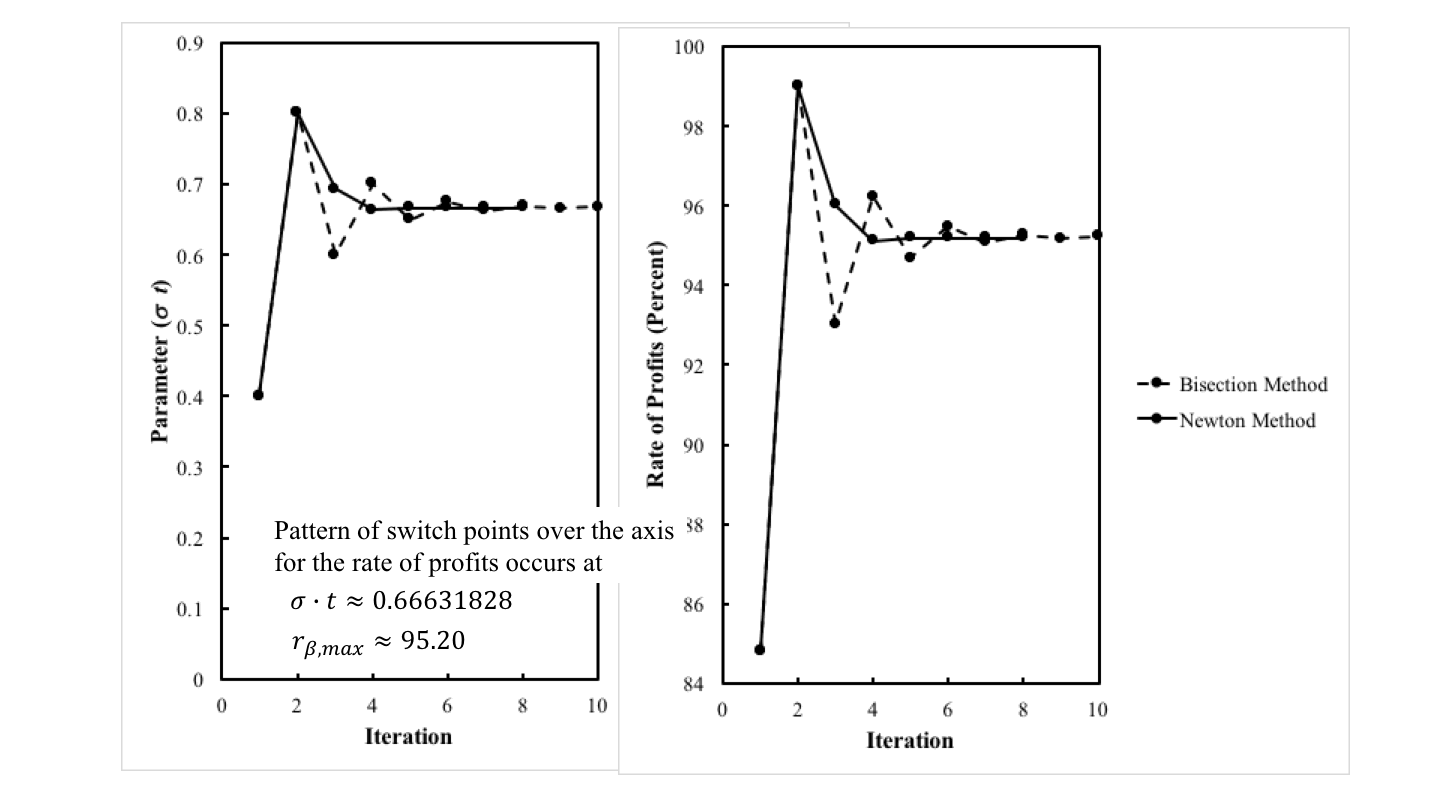
Figure 1: Convergence to a Pattern of Switch Points over the Axis for the Rate of Profits
1.0 Introduction

This post illustrates how to find fluke switch points. As usual, I proceed by example, in this case, as taken from my paper in Structural Change and Economic Dynamics.

2.0 Technoplogy

In this example of a capitalist economy, two commodities, iron and corn, are produced. One process is known for producing iron. In the iron industry, workers use inputs of iron and corn to produce an output of iron. The output of the iron industry is one ton with the inputs shown in Table 1. Two processes are known for producing corn. Each corn-producing process shown in Table 1 produces an output of one bushel corn from inputs of labor power, iron, and corn. Assume constant returns to scale.

Table 1: The Coefficients of Production
InputIndustry
IronCorn
III AlphaII Beta
Labora0,1 = 1a0,2α = (5191/5770) e1/10 - σta0,2β = 305/494
Irona1,1 = 9/20a1,2α = (1/40) e1/10 - σta1,2β = 3/1976
Corna2,1 = 2a2,2α = (1/10) e1/10 - σta2,2β = 229/494

3.0 Switch Points

I take corn as the numeraire. Wages are paid out of the surplus at the end of the harvest. I take the rate of profits as given. In this post, I do not explain how to find the price of iron and the wage for, say, the Alpha technique, given the technology at a given value of (σ t).

At a switch point, no excess profits or costs arise in evaluating the Beta process in the corn industry at Alpha prices. That is, switch points are the roots of the following equation.

1 - {[p1αt) a1,2β + a2,2β](1 + r) + wαt) a0,2β} = 0

The above is a quadratic equation for this example. Let fkt) denote the kth root of the above equation.

rk = fkt)

These are the switch points for a specific value of the parameters σ t. I fix σ at 1/10. Figure 2 graphs the switch points, as well as the maxmimum wage, against time. You can see technical progress brings about reswitching and takes it away.

Figure 2: Fluke Switch Points Partition Time

4.0 Numerical Methods

Various fluke cases arise in the example. They can be found by numerical methods. Table 2 defines, for four types of fluke cases, a new function whose root is the parameter values that correspond to the type of fluke case. For illustration, consider the fluke switch point that arises on the axis for the rate of profits with σ t ≈ 0.6663189. That is, gt) is the difference between the maximum rate of profits for the Beta technique and the rate of profits for a selected switch point for the Alpha and Beta techniques.

Table 2: Functions and Their Zeros
FunctionFluke Case
gkt) = fkt) + 1Pattern of switch points for the reverse substitution of labor.
gkt) = fkt)Pattern of Switch points over the wage axis.
gkt) = rmax, β - fkt)Pattern of switch points over the axis for the rate of profits.
gkt) is the discriminant of the quadratic equation aboveReswitching pattern of switch points.

One needs two initial parameter values to start either algorithm specified here. Figure 3 graphs extra profits in operating the corn process in the Beta technique, as evaluated at Alpha prices. Extra profits are shown for two different parameter values. On the left panel, a switch point exists for a rate of profits smaller than the maximum rate of profits. The parameter values are evidently too small for a pattern of switch points over the axis for the rate of profits. On the right panel, the parameter values are too large. These are acceptable initial values.

Figure 3: Initial Values for a Pattern Over the Axis for the Rate of Profits

One can find the desired parameter value by either a bisection method or Newton’s method. Figure 4 provides a flowchart for the bisection method. The parameter values are updated to the midpoint of the current iterations. One of the current iterations is updated while keeping invariant the condition that the current iterations bound the zero of the function whose zero is sought. When the distance between the current iterations is small enough, either iteration is considered an acceptable approximation of the parameter values at which the fluke case arises.

Figure 4: Bisection Method

Figure 5 specifies Newton's method. An iteration for Newton’s method is based on approximating the function whose zero is sought by a straight line going through the two points determined by the previous two iterations. You can see that the slope and intercept for this line are found in the block in the lower left of the figure. And that the next iteration of the parameter values are found by an update calculated with this slope and intercept.

Figure 5: Newton Method

Newton's method is not guaranteed to converge, albeit I have had no issues in this context of finding fluke cases in the analysis of the choice of technique. When it does converge, its convergence is much faster than the bisection method (Figure 1).

Friday, August 20, 2021

Ben Franklin, Proto Marxist

Ben Franklin was one the founding fathers of the United States. He participated in the constitutional convention. He was the first Postmaster General. He did experiments with electricity, when the Leyden jar was a new thing. There is a story about flying a kite in a thunderstorm.

He also wrote about the wealth of nations:

"Finally, there seem to be but three ways for a nation to acquire wealth. The first is by war, as the Romans did, in plundering their conquered neighbors. This is robbery. The second by commerce, which is generally cheating. The third by agriculture, the only honest way, wherein man receives a real increase of the seed thrown into the ground, in a kind of continual miracle, wrought by the hand of God in his favour, as a reward for his innocent life and his virtuous industry."

I find an echo of Francois Quesnay and the physiocrats in the above quotation. He was also a proponent of a labor theory of value:

"Trade in general being nothing else but the exchange of labor for labor, the value of all things is justly measured by labor."

I could not find Franklin in the index of Marx's Theories of Surplus Value. A quick google search had me stumbling upon Aiken's 1966 article.

References
  • John R. Aiken. 1966. Benjamin Franklin, Karl Marx, and the Labor Theory of Value. The Pennsylvania Magazine of History and Biography 90 (3): 378-384.

Saturday, August 14, 2021

An Intensive Rent Example From Freni

Figure 1: A Pattern Diagram
1.0 Introduction

Aside, perhaps from the above visualization, nothing novel is presented in this post. It follows an example presented by Freni (1991). I know of this example from problems 7.7 and 7.29 in Kurz and Salvadori (1995). The oddities of this example can be seen in an earlier and more complicated example from D'Agata (1983).

This is an example of intensive rent. When the requirements for use are large enough, capitalists will use more than one process to produce a commodity on homogeneous land. The scarcity of land is expressed in the emergence of rent. This example, though, is a challenge to Sraffa's work. The cost-minimizing technique is a unique function of the wage, but it is not a unique function of the rate of profits. The wage frontier is not downward sloping. How disappointing.

2.0 Technology and Requirements for Use

This is an example (Table 1) of a capitalist economy in which one commodity, corn, is produced by laborers working with inputs of (seed) corn on one type of homogeneous land. Twenty four acres (T = 24) of land are assumed available, and three processes are known for producing corn Each process exhibits constant returns to scale (CRS), up to the limit imposed by the given quantity of land.

Table 1: The Coefficients of Production
InputProcess
IIIIII
Labora0,1 = 2/5a0,2 = 2a0,3 = 1
Landc1,1 = 1/5c1,2 = 1/2c1,3 = 1/7
Corna1,1 = 7/10a1,2 = 7/24a1,3 = 21/32

In this example, requirement for use, also known as net output, is d = 35 bushels. I also take the net output as the numeraire.

3.0 Quantity Flows

I analyze six possible techniques of production. In each of the Alpha, Beta, and Gamma techniques, only one process is used to produce corn. Table 2 shows the gross output of each process needed to satisfy the requirements for use. Notice the Beta technique requires more land than is available; it is infeasible.

Table 2: Techniques of Production
TechniqueProcessAcres Used
IIIIII
Alphaqα,1 = 350/30070/3 ≈ 23.3
Beta0qβ,2 = 840/170420/17 ≈ 24.7
Gamma00qγ,3 = 1120/11160/11 ≈ 14.5
Deltaqδ,1 = 60qδ,2 = 24024
Epsilonqε,1 = 3640/290qε,3 = -224/2924
Zeta0qζ,2 = 4368/95qζ,3 = 672/9524

In each of the Delta, Epsilon, and Zeta techniques, two processes are applied, side-by-side, in farming the land. Table 2 shows the gross outputs for these techniques, too. Notice that if the Epsilon technique were adopted, the third process would need to run at a negative level. The Epsilon process is infeasible.

So for the given technology, acres of land, and requirements for use, the Alpha, Gamma, Delta, and Zeta techniques are feasible. Which techniques are feasible varies with the requirements for use.

3.1 Alpha Technique

I might as well give some indication of how quantity flows are found. Accordingly, suppose the Alpha technique is adopted. The gross output of the first process is found by solving the following equation:

d = qα,1 - a1,1 qα,1 = (1 - a1,1) qα,1

The amount of land farmed is c1,1 qα,1. The technique is feasible only if this amount does not exceed the given amount of land available.

3.2 Delta Technique

On the other hand, suppose the Delta technique is applied. The first process is operated alongside the second process. The gross outputs of the two processes must be such that the land is totally farmed:

c1,1 qδ,1 + c1,2 qδ,2 = T

The gross outputs must also be such that the requirements for use are satisfied.

d = (qδ,1 + qδ,2) - (a1,1 qδ,1 + a1,2 qδ,2)

The above is a system of two linear equations in two unknowns, qδ,1 and qδ,2. Nothing guarantees that in the solution, the levels of gross output must be positive. If they are negative, the technique is infeasible.

4.0 Price Equations

The cost-minimizing technique, at a given rate of profits, depends on prices.

4.1 Alpha Technique

Suppose the Alpha technique is adopted. The land is not fully farmed. Since it is in excess supply, it pays no rent. The parameters for the first process yield an equation.

pα a1,1 (1 + r) + wα a0,1 = pα

I stated above that net output is the numeraire.

pα d = 1

One can solve the above system to obtain the wage as a function of the rate of profits. The wage curve for the Alpha technique is downward-sloping.

4.2 Delta Technique

Because of the scarcity of land, a positive rent emerges for the delta technique. The parameters for the two operated processes provide two equations for the system of prices of production:

pδ a1,1 (1 + r) + ρδ c1,1 + wδ a0,1 = pδ

pδ a1,2 (1 + r) + ρδ c1,2 + wδ a0,2 = pδ

As usual, the specification of the numeraire yields another price equation.

pα d = 1

I want to make a start towards solving the above system. One can multiply the first equation by (1/c1,1), the second equation by (1/c1,2), and subtract the second from the first:

[a1,1/(dc1,1) - a1,2/(dc1,2)] (1 + r) + wδ[a0,1/c1,1 - a0,2/c1,2] = [1/(dc1,1) - 1/(dc1,2)]

Notice that the rent of land has been eliminated. Land, in Sraffian terminology, is a non-basic commodity. The system of equations can be solved seperately for the wage and prices as a function of the rate of profits. Then rent can be found afterwards.

This structure also suggests taxing rent of land has no further consequences on the price system. At least some followers of Henry George should investigate the role of land and non-basic commodities in post-Sraffian price theory.

5.0 Choice of Technique

Figure 2 graphs the wage curves and rent, for feasible techniques for this example, with the specified requirements for use, against the rate of profits. For techniques in which two processes are activated on the homogeneous land, the wage curves in the panel on the left are only shown where rent is non-negative.

Figure 2: Wage Curves and the Frontier

I indicate the cost-minimizing technique(s) with heavy lines in the above figure. Notice that for a range of profits of approximately 13.3 percent and 24.7 percent, the Alpha, Delta, and Zeta techniques are all cost-minimizing. The choice of technique is not unique. Furthermore, for a rate of profits above this range, no technique is cost-minimizing. This result would have been surprising to Sraffa, as I read him.

The wage frontier, in this case, is not the outer frontier of wage curves. Nor is it the inner frontier. So I want to say something about how the choice of technique is analyzed here.

The wage and the price of corn, as determined by the Alpha technique, can be used to evaluate the costs and revenues, of operating each of the three processes in the technology, at a unit level. The costs include the given rate of profits. The left panel in Figure 3 shows the difference between such revenues and costs. That is, it shows what are known as extra profits in activating each process. Notice that no extra profits are to be made in operating the first process, thus confirming that the price system has been solved correctly. For rates of profits below the first switch point shown, no extra profits can be made by activating the second or third process; Alpha is cost minimizing in this range. For a higher rate of profits, extra profits can be made by activating the second process. Alpha is no longer cost-minimizing.

Figure 3: Extra Profits for the Alpha and Gamma Techniques

The right panel repeats the analysis for the price system for the Gamma technique. For the full range of feasible rates of profits, no extra profits are obtained by operating the third process, as expected. But extra profits can always be made, at Gamma prices, by operating the first or second process; Gamma is never cost-minimizing.

Figure 4 repeats the analysis for the Delta and Epsilon techniques. The costs now include rents. Only one of three processes available makes extra profits or incurs costs greater than revenues. The range of the rate of profits in which each of these techniques is cost-minimizing is indicated.

Figure 4: Extra Profits for the Delta and Epsilon Techniques

6.0 Ricardian Dynamics

The above has shown how to find wage(s), prices, and rent, for a given requirements for use. Consider the full range of feasible net outputs. Ricardo told a story, using prices of production (not his terminology) of how the types of land and activated processes vary with an increase in requirements for use. This story involves wages, population, and his advocacy against the corn laws. Anyway, Figure 1, at the top of this post, illustrates aspects of Ricardian dynamics in this numeric example.

For a small enough level of net output, land need not be wholly farmed and is in excess supply. The choice of technique can be found by constructing the outer frontier out of the wage curves for the Alpha, Beta, and Gamma technique. For a small rate of profits, the Alpha technique is cost-minimizing, while for a larger rate of profits, the Beta technique is cost-minimizing. All wage curves and the outer frontier are downward-sloping, as in part I of Sraffa (1960).

For a large enough level of net output, but at a still feasible level, the Gamma, Epsilon, and Zeta techniques are the only feasible techniques. Under Epsilon and Zeta, the first and second processes, respectively, are combined with the third process so as to ensure that only the amount of land available is farmed. The choice of technique is found from the inner frontier of the wage curves. For a small rate of profits, the Epsilon technique is cost-minimizing, and the Zeta technique is cost-minimizing at a high rate of profits. All wage-curves are downward sloping. This example of intensive rent resembles a well-behaved model of extensive rent.

The difficulties and surprises arise for an intermediate level of net output, as described above.

7.0 Conclusion

I do not fully know what to make of this example. I notice that the cost-minimizing technique is uniquely determined (except at switch points) by the wage. And it is analyzed by techniques developed by Sraffa and his followers. I can further apply by approach of perturbing parameters, if I want. Nevertheless, it reveals some of the disappointments arising from the theory of joint production.

References
  • D'Agata, A. 1983. The existence and unicity of cost-minimizing systems in intensive rent theory. Metroeconomica 35: 147-158.
  • Freni, G. 1991. Capitale technico nei modelli dinamici ricardiani. Studi Economici, 44: 141-159.
  • Kurz and Neri Salvadori. 1995. Theory of Production: A Long-Period Analysis, Cambridge University Press.

Saturday, August 07, 2021

Elsewhere

John Eatwell On The Bomb Sraffa Planted At The Foundations Of Economics
  • James Galbraith on Dismal Economics, reviewing books by Mason Gaffney and Fred Harrison, Stephen Marglin, Alessandro Roncaglia, and Robert Skidelsky.
  • Jane Gleeson-White, in the Guardian, on accounting, unpaid care work, and the biosphere.
  • A blog post pointing out Bob Murphy's confusions and mistakes on the implications of the Cambridge Capital Controversy for the Austrian school. Compare and contrast with here.