Friday, October 18, 2024

William Baumol On Marx

This is more for my commonplace book. The first two quotations are part of a symposium with Morishima and Samuelson:

"This paper will suggest that the meaning of the relationship between values and prices described in Capital has been widely misunderstood. Commentators as eminent as Mrs. Robinson and Professor Samuelson have sought in the transformation discussion issues which Karl Marx never meant it to contain. Writers on 'the transformation problem' since L. Bortkiewicz have focussed on an issue that is largely peripheral; and others like E. B6hm-Bawerk have asserted that there is a contradiction between the analyses of Volumes I and III which is certainly not to be found there unless lne reads into them an interpretation different from that which Marx repeatedly emphasized.

Interpretation of the intentions of the writings of the dead is always a questionable undertaking, particularly since defunct authors cannot defend themselves. Yet there are some cases in which a careful rereading of the pertinent writings indicates that the author did speak for himself and spoke very clearly-the trouble in such cases seems to be that somethinv aboit the onriinal nresentation prevents most readers, even some very careful ones, from seeing what the writer intended.

A notable case in point is D. Ricardo's discussion of the labor theory of value. It is hard to understand how a careful reader of any edition of the Principles can overlook Ricardo's recognition of the role of the quantity and the durability of capital in the determination of price. The labor theory is explicitly proposed as a remarkably good approximation to the determination of competitive price. But, ultimately, Ricardo holds to a cost of production theory of pricing, not to a pure labor theory. Yet until Stigler's fine article on the subject (1958), in which this is documented beyond any shadow of a doubt, virtually any text was prepared to ascribe to Ricardo the purest of labor theories, and even J. H. Hollander and E. Cannan (see G. J. Stigler for references) suggested that Ricardo retreated grudgingly under fire to the cost of production model of the third edition. Only a few commentators, notably A. Marshall, J. Viner, and P. Sraffa, saw Ricardo's analysis for what it so plainly was from the first edition on.

I emphasize this case for two reasons; first, because I will try to show that the correct interpretation of Marx' intentions is equally evident, and second, because I will suggest that the false analogy between Ricardo's and Marx' value theories may help to explain our misunderstanding of the latter...

...In Ricardo, the labor theory of value was meant as a good approximation to a full explanation of the determination of prices. However Marx probably never intended to produce such an approximation and it certainly was not his intention when he wrote about the transformation problem; yet that objective, or something close to it, is often attributed to Marx.

I will provide evidence that Marx did not intend his transformation analysis to show how prices can be deduced from values. Marx was well aware that market prices do not have to be deduced from values (nor, for that matter, values from prices). Rather, the two sets of magnitudes which are derived more or less independently were recognized by Marx to differ in a substantial and a systematic manner. A subsidiary purpose of the transformation calculation was to determine the nature of these deviations. But this objective and, indeed, any explanation of pricing as an end in itself, was of very little consequence to Marx, for the primary transformation was not from values into prices but, as Marx and Engels repeatedly emphasize, from surplus values into the non-labor income categories that are recognized by 'vulgar economists,' i.e., profits, interest, and rent." -- William J. Baumol. 1974. The transformation of values: What Marx 'really' meant (an interpretation). Journal of Economic Literature 12(1): 51-62.

"2. I am surprised that 'On the question of whether [Marx's] purpose was successful in some sense or another [Samuelson] can find only a few relevant paragraphs in Baumol's text.' I am surprised because, so far as I know, there is no such paragraph. The only objective of my paper was to determine what Marx had set out to accomplish and how Marx believed he had accomplished his objectives, because I don't think it is appropriate to criticize anyone until we are sure we are criticizing what he actually said, not what we suspect he might have said, or should have said, or someone else says he might have said...

...4. Professor Samuelson proposes his peace terms, which require me to admit that for an explanation of 'actual wage-profits distribution,' presumably as for an explanation of actual pricing of commodities, 'the Volume I analysis is indeed a detour.' So much I admit readily and without reservations, and I contend Marx would readily have admitted it too, for in fact he did so repeatedly. Actual prices and actual wages, profits, rents and interest payments clearly were to him explainable by the classical mechanism, which is what he admittedly took over in Volume III. Marx never claimed, in fact he specifically denied, that one gets better numbers for any of these magnitudes from a Volume I than from a Volume III analysis.

Thus, for his part, all that Professor Samuelson has to do to end the disagreement between us is to admit that Marx himself was not particularly interested in the determination of these magnitudes, which he considered a surface manifestation and were important to him only because he believed them to conceal the underlying social production relationships...

...One final comment. Obviously, Ricardo is not easy reading, and our predecessors did often hold a multiplicity of views among which they themselves were not always able to distinguish, and such problems are brushed aside far too often in writings But there are some cases, albeit rare, where an author has said clearly and repeatedly, 'I do mean A, I do not mean B,' yet many people have refused to listen. Ricardo did repeatedly say that his was a cost of production model. He did say, at length, in every edition of the Principles that quantity and durability of capital make a difference to value. I suggest to any interested reader that he treat himself to a reexamination of pages 3043 (from the third edition) and 52-66 (from the first edition) of Volume I of Piero Sraffa [5, 1951] to see whether he can come away disagreeing with Jacob Viner's (humorous?) conclusion that 'Ricardo's actual words show that from the first he held that the relative values of commodities are always partly dependent on the relative amounts of fixed capital employed in their production' (Viner's italics) [6, 1930]." -- William J. Baumol. 1974. The fundamental Marxian theorem: A reply to Samuelson: Comment. Journal of Economic Literature 12(1): 74-75.

Baumol returned to Marx in 1983:

"I find few things as discouraging as the persistent attribution of positions to a writer whose works contain repeated, categorical, indeed emotional, denuciations of those views. Marx's views on wages are a prime example. Both vulgar Marxists and vulgar opponents of Marx have propounded two associated myths: that he believed wages under capitalism are inevitably driven near some physical subsistence level, and that he considered this to constitute of robbery of the workers and a major evil of capitalism. Yet Marx and Engels tell us aggain and again, sometimes in the most intemperate language, that these views are the very opposite of theirs. These observations, incidentally, are hardly new discoveries..." -- William J. Baumol. (1983). Marx and the iron law of wages. American Economic Review 73(2): 303-308

Saturday, October 12, 2024

The Production Of Commodities And The Structure Of Production

Many of my examples illustrate simple structures of production for models in which commodities are produced with commodities. Economists following the Austrian school often illustrate the structure of production with Hayekian triangles. Accordingly, this post illustrates a Hayekian triangle with a model in which commodities are produced out of commodities. I consider the case in which only circulating capital exists. This post is a rewrite of this one.

The following are taken as given for the technique in use:

  • A: The nxn Leontief input-output matrix in physical terms. Assume all commodities are basic and the economy is productive.
  • a0: The n-element row vector of direct labor coefficients.
  • d: An n-element column vector that is in the proportions in which commodities are consumed.

Define:

denom = a0(I - A)-1d

From the given data, one can find the quantities of labor-time in the first column below.

Distribution of Work in a Given Year
Labor TimePurpose
a0d/denomTo produce (1/denom) d, a basket of commodities for consumption at the end of the current year.
a0A d/denomTo produce capital goods to be used to produce the (1/denom) d basket of commodities for consumption at the end of the next year.
a0A2 d/denomTo produce capital goods to be used to produce capital goods to produce the (1/denom) d basket of commodities for consumption at the end of two years hence.
......

The first column can be summed:

(1/denom) a0(I + A + A2 + ...)d = a0(I - A)-1d/denom = 1 person-year

So the above table shows a decomposition, per person-year, of employment in a given year. It is a Hayekian triangle. Because it is constructed from a model of the production of commodities, the elements go on forever. No last year exists in the future for which capital goods are currently being produced.

The capital goods, An d, approach the ratios of Sraffa's standard commodity. Consequently, the ratio of labor inputs approaches a constant, related to the maximum rate of profits.

Hayekian triangles are not necessarily set out with a single physical measure of an unproduced input at each stage. The value of capital goods per worker varies because of three effects:

  • Composition effect: a different mixture of capital goods is used for different rates of growth.
  • Price Wicksell effect: the capital goods are re-evaluated at different prices with a different interest rate.
  • Real Wicksell effect: the capital goods vary with the technique, and the cost-minimizing technique varies with the interest rate.

The wage-rate of frontier is useful for visualizing these effects. They do not go away just because one represents the structure of production as a Hayekian triangle. The sort of regularities that Machaj (2017), for example, assumes with variations in the interest rate lack logical foundation.

I want to that the price of the commodities consumed at the end of the year is:

[w(r)/denom] [a0d + a0A d (1 + r) + a0A2 d (1 + r)2 + ... ]

The terms in the above are useful in representing a Hayekian triangle in price terms.

A model of the production of commodities by means of commodities with general joint production cannot necessarily be represented to a series of inputs of dated labor inputs. I go back and forth on my intution in the case of pure fixed capital.

References
  • Renaud Fillieule. 2007. A formal model in Hayekian macroeconomics: the proportional goods-in-process structure of production. Quarterly Journal of Austrian Economics 10: 193-208.
  • Harris, Donald J. 1973. Capital, distribution and the aggregate production function. American Economic Review 63(1): 110 - 113.
  • Machaj, Mateusz. 2017. Money, Interest, and the Structure of Production: Resolving Some Puzzles in the Theory of Capital. Lanham: Lexington Books.

Thursday, October 10, 2024

Maynard Keynes Making Fun Of The Austrian School

This is for my commonplace book.

"It is true that some lengthy or roundabout processes are physically efficient. But so are some short processes. Lengthy processes are not physically efficient because they are long. Some, probably most, lengthy processes would be physically very inefficient, for there are such things as spoiling or wasting with time. With a given labour force there is a definite limit to the quantity of labour embodied in roundabout processes which can be used to advantage. Apart from other considerations, there must be a due proportion between the amount of labour employed in making machines and the amount which will be employed in using them. The ultimate quantity of value will not increase indefinitely, relatively to the quantity of labour employed, as the processes adopted become more and more roundabout, even if their physical efficiency is still increasing. Only if the desire to postpone consumption were strong enough to produce a situation in which full employment required a volume of investment so great as to involve a negative marginal efficiency of capital, would a process become advantageous merely because it was lengthy; in which event we should employ physically inefficient processes, provided they were sufficiently lengthy for the gain from postponement to outweigh their inefficiency. We should in fact have a situation in which short processes would have to be kept sufficiently scarce for their physical efficiency to outweigh the disadvantage of the early delivery of their product. A correct theory, therefore, must be reversible so as to be able to cover the cases of the marginal efficiency of capital corresponding either to a positive or to a negative rate of interest; and it is, I think, only the scarcity theory outlined above which is capable of this.

Moreover there are all sorts of reasons why various kinds of services and facilities are scarce and therefore expensive relatively to the quantity of labour involved. For example, smelly processes command a higher reward, because people will not undertake them otherwise. So do risky processes. But we do not devise a productivity theory of smelly or risky processes as such. In short, not all labour is accomplished in equally agreeable attendant circumstances; and conditions of equilibrium require that articles produced in less agreeable attendant circumstances (characterised by smelliness, risk or the lapse of time) must be kept sufficiently scarce to command a higher price. But if the lapse of time becomes an agreeable attendant circumstance, which is a quite possible case and already holds for many individuals, then, as I have said above, it is the short processes which must be kept sufficiently scarce." -- John Maynard Keynes, The General Theory of Employment, Interest and Money, Chapter 16.

Before this quotation, Keynes notes that when people save, they do not put in future orders for specific capital goods. Savers want general power over wealth. Keynes is correct about this. Nevertheless, I can see how some might say capital theory has something to do intertemporal coordination of plans. Yet the Austrian school is mistaken about how they associate greater capital with more lengthy investments, in some sense.

Monday, October 07, 2024

Francis Spufford On Commodity Fetishism As A Dance

I have expressed an appreciation before of the section in Capital on commodity fetishism. Perhaps this section stands up to a critique of Marx's theory of value.

"But Marx had drawn a nightmare picture of what happened to human life under capitalism, when everything was produced only in order to be exchanged; when true qualities and uses dropped away, and the human power of making and doing itself became only an object to be traded. Then the makers and the things made turned alike into commodities, and the motion of society turned into a kind of zombie dance, a grim cavorting whirl in which objects and people blurred together till the objects were half-alive and the people were half-dead. Stock-market prices acted back upon the world as if they were independent powers, requiring factories to be opened or closed, real human beings to work or rest, hurry or dawdle; and they, having given the transfusion that made the stock prices come alive, felt their flesh go cold and impersonal on them, mere mechanisms for chunking out the man-hours. Living money and dying humans, metal as tender as skin and skin as hard a metal, taking hands, and dancing round, and round, and round, with no way ever of stopping: the quickened and the deadened, whirling on. That was Marx's description, anyway. And what would be the alternative? A dance of another nature, Emil presumed. A dance to the music of use, where every step fulfilled some real need, did some tangible good, and no matter how fast the dancers spun, they moved easily, because they moved to a human measure, intelligible to all, chosen by all. Emil gave a hop and shuffle in the dust." -- Francis Spufford, Red Plenty, Graywolf Press, 2010: 66-67.

I may write a short review of this novel. If I do, I think I will not first review the seminar at Crooked Timber on it.

Thursday, October 03, 2024

A Derivation Of Prices Of Production With Linear Programming

1.0 Introduction

This post illustrates a derivation of prices of production, based on certain properties of duality theory as applied to linear programming. I strive to be more concise and elementary than previous expositions. This exposition is based on John Roemer's Reproducible Solution (Analytical Foundations of Marxian Economic Theory, Cambridge University Press, 1981).

You will find no utility maximization or supply and demand functions below. I have no need for such hypotheses. Nevertheless, one can read this derivation as consistent with marginalism.

2.0 Technology and Endowments

Two commodities, iron and corn, are produced in this example. Managers of firms know a technology consisting of the processes defined in Table 1. Each column shows the inputs and outputs for a process operated at a unit level. All processes take a year to complete and provide their output at the end of the year. Each process exhibits constant returns to scale (CRS). For convenience, assume all coefficients of production defined in the table are positive. The inputs to production are totally used up by operating these processes.

Table 1: The Technology
INPUTSProcesses
Iron IndustryCorn Industry
abcd
Labora0,1(a)a0,1(b)a0,2(c)a0,2(d)
Irona1,1(a)a1,1(b)a1,2(c)a1,2(d)
Corna2,1(a)a2,1(b)a2,2(c)a2,2(d)
OUTPUT1 ton iron1 ton iron1 bushel corn1 bushel corn

The endowments of iron and corn in the firm's inventory at the start of the year are also given parameters. Table 2 lists the remaining variables in this post. Presumably, the endowments are from production during the previous year. They are unlikely to be in the proportions needed to continue production. For example, if the managers of a firm decide to specialize in producing corn, they will have no endowments of iron.

Table 2: Parameters and Variables
Additional Parameters
ω1Endowment of iron (in tons) for the firm.
ω2Endowment of corn (in bushels) for the firm.
Parameters taken as given by managers of the firm
pPrice of iron (in bushels per ton).
wThe wage (in bushels per person-year).
Decision Variables
q1(a)Quantity of iron (in tons) produced by the first process.
q1(b)Quantity of iron (in tons) produced by the second process.
q2(c)Quantity of corn (in bushels) produced by the third process.
q2(d)Quantity of corn (in bushels) produced by the fourth process.
rThe rate of profits.

3.0 The Primal Linear Program

Managers of firms choose the quantities to produce with each process to maximize the increment z in value, subject to the constraint that they can buy the needed inputs at the start of the year out of the revenue obtained by selling their endowment. The objective function for the primal linear program is:

z = {p - [p a1,1(a) + a2,1(a) + w a0,1(a)]} q1(a)
+ {p - [p a1,1(b) + a2,1(b) + w a0,1(b)]} q1(b)
+ {1 - [p a1,2(c) + a2,2(c) + w a0,2(c)]} q2(c)
+ {1 - [p a1,2(d) + a2,2(d) + w a0,2(d)]} q2(d)

The quantities in the square brackets above are the costs of operating each process at a unit level. A bushel corn is taken as numeraire. The quantities in the squiggly brackets are the net revenues (also known as accounting profits) of operating each process at a unit level. Scaling these net revenues by the level of operation for each process results in the total accounting profit for the firm.

The constraints are:

[p a1,1(a) + a2,1(a)] q1(a)
+ [p a1,1(b) + a2,1(b)] q1(b)
+ [p a1,2(c) + a2,2(c)] q2(c)
+ [p a1,2(d) + a2,2(d)] q2(d) ≤ p ω1 + ω2
q1(a) ≥ 0, q1(b) ≥ 0, q2(c) ≥ 0, q2(d) ≥ 0

The statement of the constraints is based on the assumption that wages are paid at the end of the year, not advanced at the start.

4.0 The Dual Linear Program

The above linear program has a dual. In the dual, the rate of profits r is chosen to minimize the charge y on endowments:

y = (p ω1 + ω2) r

Such that:

[p a1,1(a) + a2,1(a)](1 + r) + w a0,1(a) ≥ p
[p a1,1(b) + a2,1(b)](1 + r) + w a0,1(b) ≥ p
[p a1,2(c) + a2,2(c)](1 + r) + w a0,2(c) ≥ 1
[p a1,2(d) + a2,2(d)](1 + r) + w a0,2(d) ≥ 1
r ≥ 0

Each constraint in the dual specifies that the revenues obtained from operating a process at the unit level do not exceed the costs, where costs include a charge for the going rate of profits. In other words, no super-normal profits can be obtained.

5.0 Some Observations About Duality

The value of the objective functions are equal in the solutions to the primal and dual LPs. In other words, the increment in value obtained by the decisions of the manager of a firm is charged to the value of the endowment.

Suppose the solution of the primal LP results in some process being operated at a positive level. Then the corresponding constraint in the dual LP is met with equality in its solution. Likewise, if a constraint in the dual is met with inequality, then that process will not be operated in the dual.

If the rate of profits in the solution to the dual is positive, then the constraint in the primal LP will be met with equality. That is, the whole value of the endowment will be used for further production.

6.0 Prices of Production

I introduce a final assumption. The solution to these LPs must be such that the economy can continue. In the context of this exposition, some firms must produce iron, and some must produce corn. Thus, one of the first two constraints in the dual LP must be met with equality. One of next two constraints must also be met with equality.

Consider the case when only one of the processes for producing iron is operated, and the same is true of the processes for producing corn. The dual LP yields a system of two equations in three variables: the price of iron, the wage, and the rate of profits. This system specifies prices of production.

This formulation solves for the choice of the technique, as well as prices of production. It can be generalized to allow for the production of many more commodities and many more processes for producing each commodity. A generalization can allow for heterogeneous labor. Another generalization allows for the production and use of fixed capital, that is, machines that last for many years. For a given wage, prices and the rate of profits drop out of the equations for prices of production for the chosen technique. These prices do not support the parables often told in introductory economics classes with supply and demand. For example, unemployment cannot necessarily be eliminated by lowering the wage and encouraging firms to thereby hire more labor.

7.0 Conclusion

The above illustrates some elements of a theory of value. This is neither a labor theory of value, nor Marx's theory of value. The theory is focused on production and has implications about how labor is allocated among industries, a central concern of Karl Marx.

Wednesday, October 02, 2024

Nancy Kress On Global Inequality And Poverty

I picked up the novel that the following quotation is from because I think I recall Kress participating in conversations on Usenet years ago. This novel ended up more a political argument than I expected. It is for Genetically Modified Organisms (GMOs), done right. We should rather strive for plants for food resistant to insects, not resistant to pesticides, for example. I assume that Kress agrees with her heroine.

"He had spent the two-week winter vacation from school, which somehow got extended to nearly another week, with Jake in Los Angeles...

He left an eleven-year old nerd, dress in Levi's, a tee that said CHESS PLAYERS HAVE GREAT MOVES, and a baseball cap. He returned looking like a thirty-two-year-old investment banker trying to be cool, dressed in a $300 Ferragamo zip-front polo, designer jeans, and sockless shoes that cost more than my weekly salary. He carried a state-of-the-art laptop that could probably have moved satellites in orbit. Jake had invested in an independent production company that had struck movie gold with two wildly popular films about aliens who battled Earth. Jake was rich.

'Wow, look at you,' I said, not approvingly.

Ian could always read me. 'You don't like it. Dad said you wouldn't. But just because some of the world isn't blessed doesn't mean that we shouldn't enjoy the facts that through our own efforts, we are.'

I stared at him. No way that was Ian talking, or even Jake. I asked, 'Who is she?'

'Who's who?' But he shifted from one foot to the other as we faced each other at the SeaTac arrival gate. Passengers streamed past.

'Your dad's new girlfriend. It's okay, Ian, he's an adult. So am I.'

He turned sulky. 'Sage Scott.'

I blinked. She was a huge international star with more beauty than talent. 'Well,' I said heartily, 'that's fine. But -'

'Mom,' Ian blurted out, 'don't hassle me because I like money, okay.'

'Money is useful,' I said, and hugged him again.

But it wasn't that easy. With almost-teenagers, it never is. There were times during the next week when I wanted to apologize to my lone-dead parents for my own teen years.

Ian was disdainful of his old school and wanted to transfer to one that had a good lacrosse team.

Ian was disdainful of his old clothes.

Ian refused to go with me to the soup kitchen where once a week for years now, we'd helped feed the homeless.

When Ian said, 'People can always feed themselves if they just try, just like the rest of the world could if it got its act together. All you have to do is grow food,' I'd had enough. Arguments weren't going to do it here. He needed immersion learning.

'Pack up your designed duds,' I said. 'We're taking a field trip.'

'Where?'

'Overseas.'

'I don't want to. Mom, I missed enough school already.'

'Like you really mind that. And we'll only be gone for a long weekend, so pack up.'

He was eleven, and eleven-year-olds don't have household veto. Not in my house. Ian went with me. Sulky, barricaded during the long flight behind laptop and earbuds and resentment, he went.

Chennai was a huge, prosperous commercial and cultural center in southern India. A tourist draw, it had the gorgeous Kapaleeswarar Templd, museums, parks, a British fort dating from the Raj, the Tamil film industry. That was not the Chennai I took Ian to.

I'd arranged for a guide who, along with an armed bodyguard, took us to outlying slums, to coastal villages flooded by the rising sea, to fields so ravaged by inland drought or coastal salt water that they could grow nothing. Ian saw ragged, starving children living in tin boxes, beggars whose bones stuck out sharp as chisels, a fight over food on an aid truck that left two people lying bloody in the road. Each night I brought him back to Chennai to eat rich food in expensive restaurants. I spent the money from my divorce freely, and I didn't have to say a word.

Sweating in the heat, Ian said, 'Sage was wrong. Those people - they can't grow enought food.'

'No. Each year, childhood deaths from malnutrition rise sharply, and it's only going to get worse. The need for food is projected to rise 70 percent over the next thirty years. And as to poverty - well, a handful of super-rich people have as much money as the whole bottom half of the world's population put together.'

'That can't be right.'

'It's not right.'

'I mean, that can't be correct.'

'It is.'

He said nothing more, staring at a child digging through a stinking garbage dump for something to eat. Back at the hotel, after a shower, I saw him checking statistics on his laptop. At dinner he stared at the exquisitely cooked food on his plate.

'Mom, what can we do?'

'Donate. Understand the situation. Care.'

He picked up his fork, put it down again, scowled. But not, this time at me. I thought I saw down beginning on his upper lip - could that be true? So soon?

'I can sell a lot of my stuff,' Ian said, 'and donate the money.'

'That's your choice, honey,' I said. 'But keep what you really need. The trick is to decide what that is.'" -- Nancy Kress, Sea Change, Tachyon Publications, 2020.

Monday, September 23, 2024

Where Do Prices Come From In Marginalist Economics?

1.0 Introduction

Where do prices come from in mainstream economics? As far as I know, some hard questions were raised half a century ago. They still have not been answered, I gather.

2.0 No Agent Makes Prices

Consider competitive markets, as defined in marginalist economics for most of the twentieth century. This implies that agents in the market take prices as given.

From Steve Keen, I know that if only a countable infinity of consumers and firms exist, the agents are systematically mistaken. Despite their beliefs, they are not atomic, and their actions in varying quantities bought or sold affect prices. For agents not to be systematically mistaken, an uncountable infinity of consumers and firms must exist.

I have noted Emmanuelle Benicourt making similar points before.

Classical political economy provides another concept of competitive markets. This concept is that no barriers to entry or exit exist. This concept has been taken into mainstream economics under the rubric of contestable markets.

If all agents take prices as given, who makes prices?

"How can equilibrium be established? ... Do individuals speculate on the equilibrium process? If they do, can the disequilibrium be regarded as, in some sense, a higher-order market process? Since no one has market power, no one sets prices; yet they are set and changed. There are no good answers to these questions." -- Kenneth Arrow (1987)

Franklin Fisher did some work here which he agrees is not a fully satisfactory answer. In his investigation of disequilibrium, convergence to an equilibria requires the ad-hoc assumption of 'No favourable suprise'. Furthermore, the equilibrium that is found will generally not correspond to the initial data. The disequilibrium process changes the data, for example, the initial distribution of endowments.

3.0 Equilibrium Paths?

Suppose one wants to model production. Many economists turned away from long run theory, towards analyzing intertemporal equilibrium paths. Even though I have done work in signal processing, I do not not feel comfortable with optimal control theory.

Some general objections can be raised to this whole approach. For example, initial endowments are among the givens. If some were previously produced, a failure to fulfill expectations is possible. But an equilibrium position is one in which all expectations are fulfilled in the future.

As I understand it, markets always clear at all moments in time along an equilibrium path. For given initial conditions, typically an uncountable infinity of such paths exist. Some of these paths result in the economy eventually reaching a point in which capital goods needed to keep the economy going are just not produced. Other paths approach a path for steady-state growth, from which they will eventually diverge. Frank Hahn argued that, given multiple capital goods, an infinite number of steady-state growth paths exist. How one of these paths is picked out is the 'Hahn problem'. Some paths neither lead to the economy collapsing or a steady state. Instead, they lead to cycles.

I am not clear what is typically assumed about expectations. I guess myopic expectations are needed, in some sense, for the existence of equilibrium paths that end up with the economy crashing.

Reswitching appears in this literature. Michael Bruno has a paper in Shell (1967) that has equilibrium paths just skipping over a reswitching regime. Rosser identifies this possibility with a cusp catastrophe. Maybe an issue arises here with how an equilibrium path can approach a steady state. Is this what Hahn refers to in the closing paragraphs of Hahn (1982).

I guess economists typically assume that the economy will not follow a path in which the economy cannot continue to be sustained. And initial prices are such that one unique path is picked out. Typically this path converges to a steady state growth path which has the stability of a saddle poing.

4.0 Conclusion

My references are not recent. Maybe I want to read something by William Brock. As far as I know, marginalist economic theory still has these problems. I guess mainstream economists just assume transversality conditions, with no theory of how equilibrium is reached or why the equilibrium path that is found does not lead to collapse.

References
  • Kenneth J. Arrow. 1987. Economic theory and the hypothesis of rationality, The New Pagrave: A Dictionary of Economics.
  • Robert Aumann. 1964. Markets with a continuum of traders. Econometrica, 32 (1-2): 39-50.
  • Emmanuelle Benicourt. 2016. Is the core e-Book a possible solution to our problems?, Real-World Economics Review, 75: 135-142
  • Robert Dorfman, Paul Samuelson, and Robert Solow. 1958. Linear Programming and Economic Analysis.
  • Franklin M. Fisher. 1983. Disequilibrium Foundations of Equilibrium Economics, Cambridge University Press.
  • Harvey Gram and G. C. Harcourt. 2017. Joan Robinson and MIT, History of Political Economy 49(3): 437-450.
  • Frank Hahn. 1982. The neo-Ricardians, Cambridge Journal of Economics 6(4): 353-374.
  • Frank Hahn. 1987. 'Hahn problem', The New Pagrave: A Dictionary of Economics.
  • J. Barkley Rosser Jr. 1983. Reswitching as a cusp catastrophe, Journal of Economic Theory 31(1): 182 - 193.
  • Karl Shell (ed.). 1967. Essays on the Theory of Economic Growth, MIT Press.

Monday, September 16, 2024

Reswitching Pattern In Corn-Tractor Model

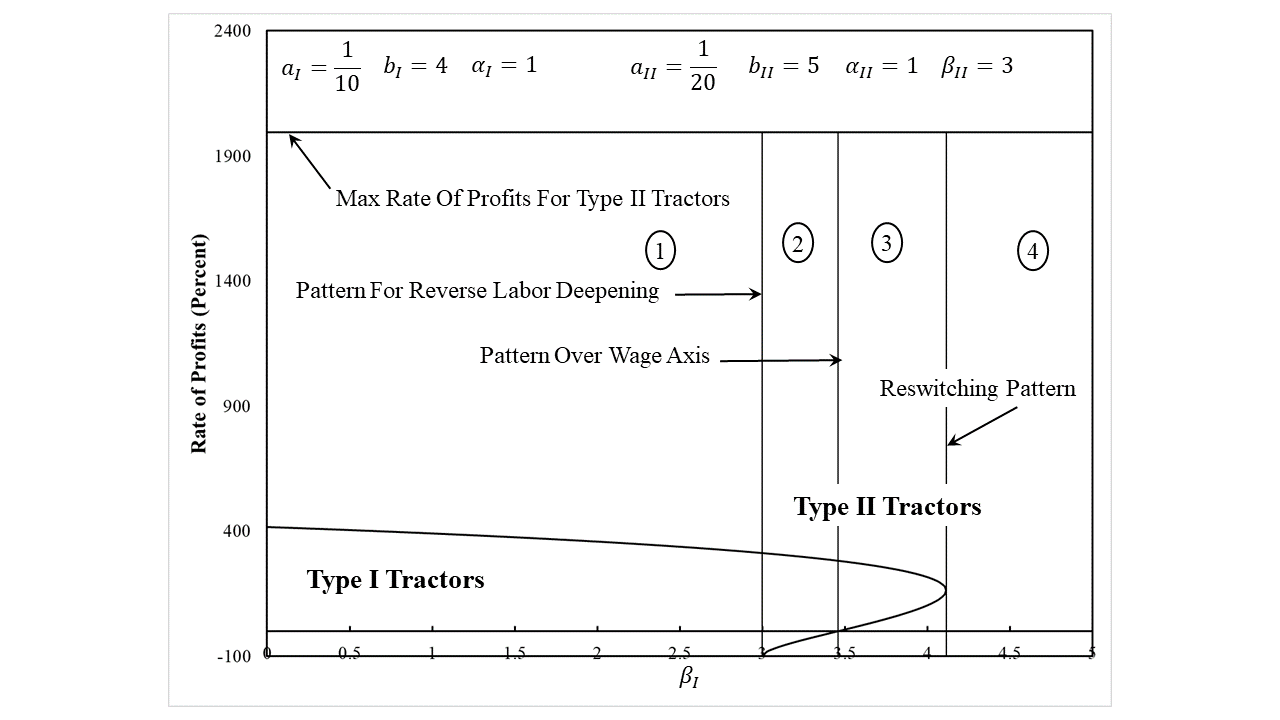
Figure 1: Variation in the Cost-Minimizing Technique with Selected Coefficient of Production

This post reports on some work with Steedman's corn-tractor model. I have yet to find an instance of triple-switching. I have found a case of reswitching, though.

Figure 1 above and Table 1 below show how switch points vary with perturbations of the labor needed to produce a bushel of corn in the corn industry with Type I tractors. Only one switch point exists in region 1. Around this switch point a lower rate of profits is associated with the production and use of Type I tractors, an increase in consumption per labor-year, and a decrease in labor inputs in the corn industry per bushel produced. In other words, this switch point conforms to obsolete marginalist intuition.

Table 1: Regions
RegionDescription
1Around switch point, Type I tractors are cost-minimizing at a lower rate of profits, higher wage.
2Reverse labor deepening. Around switch point, Type I tractors are cost-minimizing at a lower rate of profits, higher wage. Increased wage is associated with more labor employed in corn industry.
3Reswitching. Type II tractors are cost-minimizing at high and low rates of profits.
4Type II tractors are cost-minimizing throughout.

A single switch point exists in region 2 as well. This switch point is like that in region 1, except a lower rate of profits around the switch point is associated with an increase in labor inputs in the corn industry. This is a case of the reverse substitution of labor.

Region 3 is an example of reswitching. In region 4, both switch points have disappeared. Figure 2 below is much like Figure 1, but the wage is graphed on the ordinate.

Figure 2: Variation in Wage at Switch Points

I also graphed two of my fluke switch points. Figure 3 is for a switch point on the wage axis. It is at the partition between regions 2 and 3 in the above graphs. Figure 4 is for what I call a reswitching pattern. It is at the partition between regions 3 and 4.

Figure 3: Pattern over Wage Axis

Figure 4: Reswitching Pattern

Consider the switch point at the higher rate of profits in region 3. Around this switch point, a lower rate of profits is associated with adoption of the technique in which Type I tractors are produced and used. Consumption of corn per employed worker is decreased. Suppose, incoherently, that a lower rate of profits is an indication that consumers are more patient and supply more capital. The example clarifies that identifying a type of machine as more capital-using or labor-saving cannot be seen from a physical characterization of machinery alone.

I am still seeking parameters in which triple-switching occurs. To find the above case, I needed to find the roots of a fourth degree polynomial. I am looking for a case in which all roots are real, and three are positive and less than the maximum rate of profits.

It also would be nice to find reswitching in the special case in which the following is true for each type of tractor:

a/b = alpha/beta

Reswitching in this special case contradicts Samuelson's 1962 account of surrogate production functions. He claims that reswitching is impossible here. The difference is that Steedman analyzes depreciation rigorously, not with an approximation of radioactive decay.

Thursday, September 12, 2024

Ludwig Von Mises, Male Chauvinist

Ludwig Von Mises expanded his erroneous 1920 essay into a book, Socialism: An Economic and Sociological Analysis. The first edition was published in 1922 and the second edition in 1932.

Since Von Mises is attempting to be more comprehensive, he treats the socialist advocacy of free love in an early chapter. Being au courant, he writes about Freud. He argues that the bourgeois idea of marriage as a contract, binding on both husband and wife, is an improvement on what came before.

But I find it hard to get beyond passages like those below. Here, Von Mises confines women to her supposed role in propagating the human race, as in Margaret Atwood's The Handmaid's Tale:

"The radical wing of Feminism, which holds firmly to this standpoint, overlooks the fact that the expansion of woman's powers and abilities is inhibited not by marriage, not by being bound to man, children, and household, but by the more absorbing form in which the sexual function affects the female body. Pregnancy and the nursing of children claim the best years of a woman's life, the years in which a man may spend his energies in great achievements. One may believe that the unequal distribution of the burden of reproduction is an injustice of nature, or that it is unworthy of woman to be child-bearer and nurse, but to believe this does not alter the fact. It may be that a woman is able to choose between renouncing either the most profound womanly joy, the joy of motherhood, or the more masculine development of her personality in action and endeavor. It may be that she has no such choice. It may be that in suppressing her urge towards motherhood she does herself an injury that reacts through all other functions of her being. But whatever the truth about this, the fact remains that when she becomes a mother, with or without marriage, she is prevented from leading her life as freely and independently as man. Extraordinarily gifted women may achieve fine things in spite of motherhood; but because the functions of sex have the first claim upon woman, genius and the greatest achievements have been denied her." -- Ludwig von Mises, Socialism, pp. 100-101

Here, Von Mises suggests that women are not capable of the intellectual contemplation possible for men:

"It is clear that sex is less important in the life of man than of woman. Satisfaction brings him relaxation and mental peace. But for the woman the burden of motherhood begins here. Her destiny is completely circumscribed by sex; in man's life it is but an incident. However fervently and whole-heartedly he loves, however much he takes upon himself for the woman's sake, he remains above the sexual. Even woman are finally contemptuous of the man who is utterly engrossed by sex. But woman must exhaust herself as lover and as mother in the service of the sexual instinct. Man may often find it difficult, in the face of all the worries of his profession, to preserve his inner freedom and so to develop his individuality, but it will not be his sexual life which distracts him most. For woman, however, sex is the greatest obstacle.

Thus the meaning of the feminist question is essentially woman's struggle for personality. But the matter affects men not less than women, for only in co-operation can the sexes reach the highest degree of individual culture. The man who is always being dragged by woman into the lower spheres of psychic bondage cannot develop freely in the long run. To preserve the freedom of inner life for the woman, this is the real problem of women; it is part of the cultural problem of humanity." -- L. von Mises, op. cite., pp. 102-103

Here, Von Mises says that it does not matter that women cannot vote or hold elected office, as well as a lot of other vicious nonsense:

"...And now man and woman are equal before the law. The small differences that still exist in private law are of no practical significance. Whether, for example, the law obliges the wife to obey her husband is not particularly important; as long as marriage survives one party will have to follow the other and whether husband or wife is stronger is certainly not a matter which paragraphs of the legal code can decide. Nor is it any longer of great significance that the political rights of women are restricted, that women are denied the vote and the right to hold public office. For by granting the vote to women the proportional political strength of the political parties is not on the whole much altered; the women of those parties which must suffer from the changes to be expected (not in any case important ones) ought in their own interests to become opponents of women's sufferage rather than supporters. The right to public office is denied women less by the legal limitations of their rights than by the peculiarities of their sexual character. Without underestimating the value of the feminists' fight to extend woman's civil rights, one can safely risk the assertion that neither women nor the community are deeply injured by the slights to women's legal position which still remain in the legislation of civilized states.

The misconception to which the principle of equality before the law is exposed in the field of general social relationships is to be found in the special field of relations between those sexes. Just as the pseudo-democratic movement endeavours by decree to efface natural and socially conditioned inequalities, just as it wants to make the strong equal to the weak, the talented to the untalented, and the healthy to the sick, so the radical wing of the woman's movement seeks to make women the equal of men. [Footnote: To examine how far the radical demands of feminism were created by men and women whose sexual character was not normally developed would go beyond the limits set to these expositions.] Though they cannot go so far as to shift half the burden of motherhood on to men, still they would like to abolish marriage and family life so that women may have at least all that liberty which seems compatible with childbearing. Unencumbered by husband and children, woman is to move freely, act freely, and live for herself and the development of her personality.

But the difference between sexual character and sexual destiny can no more be decreed away than other inequalities of mankind. It is not marriage which keeps woman inwardly unfree, but the fact that her sexual character demands surrender to a man and that her love for husband and children consumes her best energies..." -- L. von Mises, op. cite., pp. 104-105

Von Mises' praise for Mussolini's fascism appears to be more well-known that his stated indifference to women not being allowed to vote.

Friday, September 06, 2024

Goal: Perturb Special Case Of Steedman's Corn-Tractor Model

1.0 Introduction

I would like to illustrate triple switching, in the corn-tractor model, with one of my one-dimensional diagrams. I have a triple-switching example, from Bertram Schefold, but the wage-rate of profit frontier is not visually striking in it. Such an example would not be worthy of a research paper. But perhaps I could modify a section of my recent working paper to submit somewhere. Besides, posing a new problem might motivate me to update my computing technology.

2.0 Technology

The corn-tractor model is a fixed capital model, an adaption of the Samuelson-Gargenani model. Labor and tractors are used to produce new tractors. Labor and tractors are also used to produce corn. Corn is the consumption good and the numeraire. Table 1 shows the coefficients of production for a particular type of tractor.

Table 1: Inputs for The Technology
INPUTSIndustry
TractorCorn
Laborb person-yearsbeta person-years
Tractors (of any age)a tractorsalpha tractors
Corn00
OUTPUTS1 new tractor1 bushel corn

Tractors last n years in the tractor industry and v years in the corn industry. Although not apparent in the table, this is an example of joint production. Every process for producing a new tractor also produces tractors one year older than the tractors used as inputs, except for the process using (n - 1)-year old tractors as an input. Similarly, every process for producing corn also produces tractors one year older, except for the process using (v - 1)-year old tractors. Tractors operate with constant efficiency for their physical life, albeit with different efficiencies in the two industry. As assumed in pure fixed capital models, old tractors cannot be transferred between industries.

With these assumptions, no choice of the economic life of a machine arises. The tractor will be used for its full physical life in each industry. Only three coefficients need to be specified for each type of tractor: a, beta, and (alpha b). The last is a matter of scaling, of selecting units of measure for labor or tractors, I guess. Without loss of generality, one can set alpha to unity throughout.

3.0 A Special Case

To find a triple-switching example, it is apparently sufficient to set n = v = 2. Tractors last for two years in both the tractor and the corn industry. Eventually, I want to consider two types of tractors. The choice of technique is a matter of choosing the type of tractor to produce and use. (I always find it mysterious how Steedman and his co-authors find their examples. One might think this model was thoroughly analyzed decades ago and did not have anything new to tell us.)

The remainder of this post specifies the solution, in a stationary state, for this special case.

4.0 Quantity Flows

Consider a stationary state in which employment is one person-year, across the four operated processes. Let q1 be the number of new tractors produced in each process in the tractor industry. Let q2 be the bushels corn produced in each process in the corn industry. These quantities are as follows:

q1 = alpha/{2 [2 beta + (alpha b - a beta)]}

q2 = (2 - a)/{2 [2 beta + (alpha b - a beta)]}

One can check this solution. Total employment, L, is:

L = 2 b q1 + 2 beta q2 = 1

The number of new tractors produced is (2 q1), and the number of new tractors used in production processes is the sum of (a q1) and (alpha q2). The new tractors used as inputs replace, at the end of the year, the one-year old tractors used in each industry. So this is a stationary state with employment of one person-year.

The gross output of corn is also the net output, since corn is not used as an input in production. That is, consumption per person-year in a stationary state, c, is:

c = 2 q2 = (2 - a)/[2 beta + (alpha b - a beta)]

5.0 Prices of Production

The system of equations for prices of production are set out in terms of five price variables:

  • p0: The price of a new tractor.
  • p1: The price of a one-year old tractor used in the tractor industry.
  • p2: The price of a one-year old tractor used in the corn industry.
  • w: The wage, in units of bushels per person-year, paid to the workers at the end of the year.
  • r: The rate of profits, assumed to be the same in each of the four production processes.

Sraffa shows how to eliminate the prices of old tractors from the system. This analysis derives the price of an annuity. The following variable is convenient in setting out the solution of the price equations:

denom(r) = [(alpha b - a beta) r2
+ [beta + 2 (alpha b - a beta)] r
+ 2 beta + (alpha b - a beta)

The wage, as a function of the rate of profits, is:

w = [-a r2 + (1 - 2 a) r + (2 - a)]/denom(r)

I call the above function the wage curve. The price of a new tractor, also as a function of the rate of profits, is:

p0 = b (r + 2)/denom(r)

The price of a one-year old tractor is:

p1 = p2 = b (r + 1)/denom(r)

I think that, in this model, as long as the life of a tractor is the same in producing tractors and corn, the price of an old tractor of a given age does not vary between the two industries.

The wage curve is also the tradeoff for consumption per worker and the steady state rate of growth. Accordingly, the wage at a rate of profits of zero is the same as consumption per worker, c, found as a result of the solution of the quantity equations.

6.0 Conclusion

I guess I should create a spreadsheet for this special case, but with a choice of two types of tractors. My problem is to find a set of six coefficients of production, three for each type of tractor, such that the two wage curves intersect at three points, with positive rates of profits but below the maximum. Finding such is probably tedious. Then, I would like to consider perturbations of the coefficients, maybe exponential decreases with time in labor inputs. And finally, I would like a diagram of, say the wage, for switch points and the maximum, graphed against time.

Update 9/9/2024: Added calculation and comment about price of old tractors.

Wednesday, September 04, 2024

Elsewhere

Wednesday, August 28, 2024

Austrian And Marginalist Capital Theory Without Foundation: A Summary

A mistaken theory claims prices convey information about relative scarcities. Friedrich Hayek uses an example of tin. According to this theory, a higher wage incentivizes investments in less labor-intensive techniques and to shifting production towards less labor-intensive commodities. Likewise, a lower interest rate incentivizes investments toward more capital-intensive techniques and to shifting production towards more capital-intensive commodities.

A number of attempts have been made to elaborate this theory and to formalize this vision:

  1. One can measure capital-intensity by aggregating the prices of capital goods used, per person-year of labor employed, in producing a commodity. Around switch points, a lower interest rate is associated with the adoption of a more capital-intensive technique. This approach can be seen in the mainstream economist Edwin Burmeister's work with David Champerowne's chain-index measure of capital.
  2. One can measure capital-intensity by the period of production, which is a weighted sum of the prices of dated unproduced inputs (labor and land). The weights, in Eugen Böhm-Bawerk's approach are based on a simple interest model. A lower interest-rate is associated with an increase in the period of production.
  3. Capital goods include machines that operate with constant efficiency over their physical life. Lower interest rates are associated with the adoption of techniques with longer-lived machines. Ian Steedman's corn-tractor model provides a framework to investigate this approach.
  4. Capital goods include machines that operate with variable efficiency over their physical life. Lower interest rates are associated with the lengthening of the economic life of machines.
  5. One can measure the period of production by a financial approach, as in the work of Nicolás Cachanosky and Peter Lewin. Their Duration is a rediscovery of J. R. Hicks' average period of production.

The lack of foundation of these approaches can be seen by the existence of numeric counter-examples. These counter-examples are set in a framework in which market prices are attracted by prices of production.

Examples of negative real Wicksell effects show, as acknowledged by Burmeister, that the first approach is, at best, an arbitrary special case. The existence of price Wicksell effects invalidates the second approach. Steedman shows that the third approach is, again, an arbitrary special case. Numeric examples from Bertram Schefold and others show the fourth approach relies on another special case. I have demonstrated that the issues with the fourth approach are independent of the issues with the first approach.

Saverio Fratini has shown that the fifth approach is compatible with reswitching. A more roundabout technique of production, by the measure of Duration, can result in less net output per worker. This result seems contrary to what those formalizing measures of capital-intensity intend.

One could respond to above with mysticism, maintaining the doctrines of Austrian capital theory, while refusing to state anything clearly. As I understand it, this is the approach of Jésus Huerta de Soto and others.

Monday, August 26, 2024

Ludwig Von Mises Being Wrong On Economic Calculation

I have demonstrated that Von Mises fails to identify problems with central planning. This post merely documents Von Mises being mistaken. He erroneously says that an economic decision cannot be made over alternative methods of producing a given good, without market prices for capital goods and resources.

"The director wants to build a house. Now, there are many methods that can be resorted to. Each of them offers, from the point of view of the director, certain advantages and disadvantages with regard to the utilization of the future building..; each of them requires other expenditures of building materials and labor... Which method should the director choose; He cannot reduce to a common denominator the items of various materials and various kinds of labor to be expended. Therefore he cannot compare them... In short, he cannot, in comparing costs to be expended and gains to be earned, resort to any arithmetical operation. The plans of his architects enumerate a vast multiplicity of various items in kind; they refer to the physical and chemical qualities of various materials and to the physical productivity of various machines, tools, and procedures. But all their statements remain unrelated to each other. There is no means of establishing any connection between them.

Imagine the plight of the director when faced with a project. What he needs to know is whether or not the execution of the project will increase well-being, that is, add something to the wealth available without impairing the satisfaction of wants which he considers more urgent. But none of the reports he receives give him any clue to the solution of this problem.

We may for the sake of argument at first disregard the dilemmas involved in the choice of consumers' goods to be produced. We may assume that this problem is settled. But there is the embarrassing multitude of producers' goods and the infinite variety of procedures that can be resorted to for manufacturing definite consumers' goods. The most advantageous location of each industry and the optimum size of each plant and of each piece of equipment must be determined. One must determine what kind of mechanical power should be employed in each of them, and which of the various formulas for the production of this energy should be applied. All these problems are raised daily in thousands and thousands of cases. Each case offers special conditions and requires an individual solution appropriate to these special data. The number of elements with which the director's decision has to deal is much greater than would be indicated by a merely technological description of the available producers' goods in terms of physics and chemistry. The Iocation of each of them must be taken into consideration as well as the serviceableness of the capital investments made in the past for their utilization. The director does not simply have to deal with coal as such, but with thousands and thousands of pits already in operation in various places, and with the possibilities for digging new pits, with the various methods of mining in each of them, with the different qualities of the coal in various deposits, with the various methods for utilizing the coal for the production of heat, power, and a great number of derivatives. It is permissible to say that the present state of technological knowledge makes it possible to produce almost anything out of almost everything. Our ancestors, for instance, knew only a limited number of employments for wood. Modern technology has added a multitude of possible new employments. Wood can be used for the production of paper, of various textile fibers, of foodstuffs, drugs, and many other synthetic products.

Today two methods are resorted to for providing a city with clean water. Either one brings the water over long distances in aqueducts, an ancient method long practiced, or one chemically purifies the water avaiIable in the city's neighborhood. Why does one not produce water synthetically in factories? Modern technology could easily solve the technological problems involved. The average man in his mental inertia is ready to ridicule such projects as sheer lunacy. However, thc only reason why the synthetic production of drinking water today - perhaps not at a later day - is out of the question is that economic calculation in terms of money shows that it is a more expensive procedure than other methods. Eliminate economic calculation and you have no means of making a rational choice between the various alternatives.

The socialists, it is true, object that economic calculation is not infallible. They say that the capitalists sometimes make mistakes in their calculation. Of course, this happens and will always happen. For all human action points to the future and the future is always uncertain. The most carefuIly elaborated plans are frustrated if expectations concerning the future are dashed to the ground. However, this is quite a different problem. Today we calculate from the point of view of our present knowledge and of our present anticipation of future conditions. We do not deal with the problcm of whether or not the director will be able to anticipate future conditions. What we have in mind is that the director cannot calculate from the point of view of his own present value judgments and his own present anticipations of futurc conditions, whatever they may be. If he invests today in the canning industry, it may happen that a change in consumers' tastes or in the hygienic opinions concerning the wholesomeness of canned food will one day turn his investment into a malinvestment. But how can he find out today how to build and equip a cannery most economically?

Some raiIroad lines constructed at the turn of the century would not have been built if people had at that time anticipated the impending advance of motoring and aviation. But those who at that time built railroads knew which of the various possible alternatives for the realization of their plans they had to choose from the point of view of their appraisements and anticipations and of the market prices of their day in which the valuations of the consumers were reflected. It is precisely this insight that the director will lack. He will be like a sailor on the high seas unfamiliar with the methods of navigation, or like a medieval scholar entrusted with the technical operation of a railroad engine.

We may admit that in its initial period a socialist regime couId to some extent rely upon the experience of the preceding age of capitalism. But what is to be done later, as conditions change more and morc? Of what use could the prices of 1900 be for the director in 1949? And what use can the director in 1980 derive from the knowledge of the prices of 1949?

The paradox of 'planning' is that it cannot plan, because of the absence of economic calculation. What is called a planned economy is no economy at all. It is just a system of groping about in the dark. There is no question of a rational choice of means for the best possible attainment of the ultimate ends sought. What is called conscious planning is precisely the elimination of conscious purposive action." -- Ludwig Von Mises, 1963. Human Action: A Treatise on Economics, Third revised edition. Yale University Press. (Emphasis added)

The above is from Human Action, presumably after Von Mises has had time to consider arguments about his 1920 essay. Since I do not want to argue the errors of Austrian capital theory in this post, I have elided errors on that topic in the above quotation.

Friday, August 23, 2024

Joan Robinson On Dual Labor Markets

In re-reading Robinson, I often find her succinctly summarizing a theory, often developed later. Here is a quotation from one of my favorite books by her:

"The argument is sometimes advanced that evidence shows that, in reasonably prosperous countries, the percentage of unemployment is never seen to vary very much, averaging good times with bad, over the long run ... But even for prosperous countries the evidence is largely an optical illusion. Capitalist industry does not employ the whole work force in any country. Domestic service, paid or unpaid, jobbing work and small-scale trade, and, in most countries, agriculture, hold a reservoir of labour which fills up when regular employment is not expanding as fast as the population. The question of whether people are happier in these occupations than they would be in regular employment is not to the purpose. The point at issue is that there is no justification for putting an assumption into the model to make the rate of growth of the labour force set a minimum to the rate of accumulation." -- Joan Robinson, Normal prices, republished in Essays in the Theory of Economic Growth, Macmillan: 1962.

In this article, Robinson distinguishes between economic models of the allocation of scare resources and models focused on the conditions for the reproduction of the economy.

Maybe her comment looks back on W. Arthur Lewis' 1954 article, Economic development with unlimited supplies of labour. One might also draw connections to Marx's concept of the reserve army of labor and to Rosa Luxemburg's insistence that capitalist reproduction arises only with a background of less-developed non-capitalist markets.

This comment also looks forward to Michael Reich, David Gordon, and Richard Edwards' theory of dual labor markets. In the formal or corporate sector, you can expect to have a standard work week, weekends off, benefits, some asurance that your job will exist next week, and so on. In the informal sector, not so much.

Tuesday, August 20, 2024

Monopoly Capitalism Is Inefficient

The title claim is not surprising. But it occurs to me that it follows from how I model prices of production, given stable relative profit rates among industries. I am not original with this modeling. My contribution is analying the choice of technique and exploring how this analysis varies with perturbations of relative markups.

In the price equations, s1 r, s2 r, s3 r, and so on are the rate of profits in the various industries. I call r the scale factor for the rate of profits. Given the technique and a given wage in terms of a given numeraire, one can find prices and the scale factor for the rate of profits. The scale factor is a declining function of the wage. The cost-minimizing technique at a given wage is the technique for the wage curve on the outer frontier at that wage. At a switch point, more than one technique is cost-minimizing.

In the case of competitive markets, 1 = s1 = s2 = s3 = ... The analysis of the choice of technique reduces to the usual analysis in the literature.

The cost-minimizing technique, at a given wage, varies, in general, between the competitive case and the case with with relative markups varying among industries. The cost-minimizing technique is efficient, in some sense, in the competitive case. The outer frontier is sometimes called the efficiency frontier. (I could stand to review what efficiency means in this case.)

Anyways, the above outlines an argument for the title claim based on the analysis of the choice of technique in models of the production of commodities by means of commodities.

Monday, August 12, 2024

Von Mises Wrong On Economic Calculation (Update)

1.0 Introduction

This post is an update, based on suggestions from a user on reddit. I have explained this before. Suppose one insists socialism requires central planning. In his 1920 paper, 'Economic calculation in the socialist commonwealth', Ludwig Von Mises claims that a central planner requires prices for capital goods and unproduced resources to successfully plan an economy. The claim that central planning is impossible without market prices is supposed to be a matter of scientific principle.

Von Mises was mistaken. His error can be demonstrated to follow from the theory of linear programming and duality theory. This application of linear programming reflects a characterization of economics as the study of the allocation of scarce means among alternative uses. This post demonstrates that Von Mises was mistaken without requiring, hopefully, anything more than high school mathematics to understand what is being claimed.

2.0 Technology, Endowments, and Prices of Consumer Goods as given

For the sake of argument, Von Mises assumes the central planner has available certain data. He wants to demonstrate his conclusion, while conceding as much as possible to his supposed opponent.

Accordingly, assume the central planner knows the technology with the coefficients of production in Table 1. Two goods, wheat and barley are to be produced and distributed to consumers. Each good is produced from inputs of labor, land, and tractors. The column for Process I shows the person-years of labor, acres of land, and number of tractors needed, per quarter wheat produced. The column for Process II shows the inputs, per bushel barley, for the first production process known for producing barley. The column for Process III shows the inputs, per bushel barley, for the second process known for producing barley. The remaining two processes are alternative processes for producing tractors from inputs of labor and land.

Table 1: The Technology
InputProcess IProcess IIProcess IIIProcess IVProcess V
Labora1,1a1,2a1,3a1,4a1,5
Landa2,1a2,2a2,3a2,4a2,5
Tractorsa3,1a3,2a3,300
Output1 quarter wheat1 bushel barley1 bushel barley1 tractor1 tractor

A more advanced example would have at least two periods, with dated inputs and outputs. I also abstract from the requirement that only an integer number of tractors can be produced. A contrast between wheat and barley illustrates that the number of processes known to produce a commodity need not be the same for all commodities.

Von Mises assumes that the planner knows the price of consumer goods. In the context of the example, the planner knows:

  • The price of a quarter wheat, p1.
  • The price of a bushel barley, p2.

Finally, the planner is assumed to know the physical quantities of resources available. Here, the planner is assumed to know:

  • The person-years, x1, of labor available.
  • The acres, x2, of land available.

No tractors are available at the start of the planning period in this formulation.

3.0 The Central Planner's Problem

The planner must decide at what level to operate each process. That is, the planner must set the following:

  • The quarters wheat, q1, produced with the first process.
  • The bushels barley, q2, produced with the second process.
  • The bushels barley, q3, produced with the third process.
  • The number of tractors, q4, produced with the fourth process.
  • The number of tractors, q5, produced with the fifth process.

These quantities are known as 'decision variables'.

The planner has an 'objective function'. In this case, the planner wants to maximize the objective function:

Maximize p1 q1 + p2 q2 + p2 q3

The planner faces some constraints. The plan cannot call for more employment than labor is available:

a1,1 q1 + a1,2 q2 + a1,3 q3 + a1,4 q4 + a1,5 q5x1

More land than is available cannot be used:

a2,1 q1 + a2,2 q2 + a2,3 q3 + a2,4 q4 + a2,5 q5x2

The number of tractors used in producing wheat and barley cannot exceed the number produced:

a3,1 q1 + a3,2 q2 + a3,3 q3q4 + q5

Finally, the decision variables must be non-negative:

q1 ≥ 0, q2 ≥ 0, q3 ≥ 0, q4 ≥ 0, q5 ≥ 0

The maximization of the objective function, the constraints for each of the two resources, the constraint for the capital good, and the non-negativity constraints for each of the five decision variables constitute a linear program. In this context, it is the primal linear program.

The above linear program can be solved. Prices for the resources do not enter into the problem. So I have proven that Von Mises was mistaken.

4.0 The Dual Problem

But I will go on. Where do the prices of resources and of capital goods enter? A dual linear program exists. For the dual, the decision variables are the 'shadow prices' for the resources and for the capital good:

  • The wage, w1, to be charged for a person-year of labor.
  • The rent, w2, to be charged for an acre of land.
  • The cost, w3, to be charged for a tractor.

The objective function for the dual LP is minimized:

Minimize x1 w1 + x2 w2

Each process provides a constraint for the dual. The cost of operating Process I must not fall below the revenue obtained from it:

a1,1 w1 + a2,1 w2 + a3,1 w3p1

Likewise, the costs of operating processes II, and III must not fall below operating them:

a1,2 w1 + a2,2 w2 + a3,2 w3p2

a1,3 w1 + a2,3 w2 + a3,3 w3p2

The cost of producing a tractor, with either process for producing a tractor, must not fall below the shadow price of a tractor.

a1,4 w1 + a2,4 w2w3

a1,5 w1 + a2,5 w2w3

The decision variables for the dual must be non-negative also:

w1 ≥ 0, w2 ≥ 0, w3 ≥ 0

In the solution to the primal and dual LPs, the values of their respective objective functions are equal to one another. The dual shows the distribution, in charges to the resources and the capital good, of the value of planned output. Along with solving the primal, one can find the prices of resources.

5.0 Conclusion

One could consider the case with many more resources, many more capital goods, many more produced consumer goods, and a technology with many more production processes. No issue of principle is raised. Von Mises was simply wrong.

One might also complicate the linear programs or consider other applications of linear programs. Above, I have mentioned introducing multiple time periods. How do people that do not work get fed? One might consider children, the disabled, retired people, and so on. Might one include taxes somehow? How is the value of output distributed; it need not be as defined by the shadow prices.

Or one might abandon the claim that socialist central planning is impossible, in principle. One could look at a host of practical questions. How is the data for planning gathered, and with what time lags? How often can the plan be updated? Should updates start from the previous solution? What size limits are imposed by the current state of computing? The investigation of practical difficulties is basically Hayek's program.

Wednesday, August 07, 2024

Von Mises Wrong On Economic Calculation

1.0 Introduction

I have explained this before. Suppose one insists socialism requires central planning. In his 1920 paper, 'Economic calculation in the socialist commonwealth', Ludwig Von Mises claims that a central planner requires prices for capital goods and unproduced resources to successfully plan an economy. The claim that central planning is impossible without market prices is supposed to be a matter of scientific principle.

Von Mises was mistaken. His error can be demonstrated to follow from the theory of linear programming and duality theory. This application of linear programming reflects a characterization of economics as the study of the allocation of scarce means among alternative uses. This post demonstrates that Von Mises was mistaken without requiring, hopefully, anything more than high school mathematics to understand what is being claimed.

2.0 Technology, Endowments, and Prices of Consumer Goods as given

For the sake of argument, Von Mises assume the central planner has available certain data. He wants to demonstrate his conclusion, while conceding as much as possible to his supposed opponent.

Accordingly, assume the central planner knows the technology with the coefficients of production in Table 1. Two goods, wheat and barley are to be produced and distributed to consumers. Each good is produced from inputs of labor and land. The column for Process I shows the person-years of labor and acres of land needed, per quarter wheat produced. The column for Process II shows the inputs, per bushel barley, for the first production process known for producing barley. The column for Process III shows the inputs, per bushel barley, for the second process known for producing barley.

Table 1: The Technology
InputProcess IProcess IIProcess III
Labora1,1a1,2a1,3
Landa2,1a2,2a2,3
Output1 quarter wheat1 bushel barley1 bushel barley

Von Mises assumes that the planner knows the price of consumer goods. In the context of the example, the planner knows:

  • The price of a quarter wheat, p1.
  • The price of a bushel barley, p2.

Finally, the planner is assumed to know the physical quantities of resources available. Here, the planner is assumed to know:

  • The person-years, x1, of labor available.
  • The acres, x2, of land available.

3.0 The Central Planner's Problem

The planner must decide at what level to operate each process. That is, the planner must set the following:

  • The quarters wheat, q1, produced with the first process.
  • The bushels barley, q2, produced with the second process.
  • The bushels barley, q3, produced with the third process.

These quantities are known as 'decision variables'.

The planner has an 'objective function'. In this case, the planner wants to maximize the objective function:

Maximize p1 q1 + p2 q2 + p2 q3

The planner faces some constraints. The plan cannot call for more employment than labor is available:

a1,1 q1 + a1,2 q2 + a1,3 q3x1

More land than is available cannot be used:

a2,1 q1 + a2,2 q2 + a2,3 q3x2

Finally, the decision variables must be non-negative:

q1 ≥ 0, q2 ≥ 0, q3 ≥ 0

The maximization of the objective function, the constraints for each of the two resources, and the non-negativity constraints for each of the three decision variables constitute a linear program. In this context, it is the primal linear program.

The above linear program can be solved. Prices for the resources do not enter into the problem. So I have proven that Von Mises was mistaken.

4.0 The Dual Problem

But I will go on. Where do prices of resources enter? A dual linear program exists. For the dual, the decision variables are the 'shadow prices' for the resources:

  • The wage, w1, to be paid for a person-year of labor.
  • The rent, w2, to be paid for an acre of land.

The objective function for the dual LP is minimized:

Minimize x1 w1 + x2 w2

Each process provides a constraint for the dual. The cost of operating Process I must not fall below the revenue obtained from it:

a1,1 w1 + a2,1 w2p1

Likewise, the costs of operating processes II and III must not fall below operating them:

a1,2 w1 + a2,2 w2p2

a1,3 w1 + a2,3 w2p2

The decision variables for the dual must be non-negative also:

w1 ≥ 0, w2 ≥ 0

In the solution to the primal and dual LPs, the values of their respective objective functions are equal to one another. The dual shows the distribution, in payments to the resources, of the value of planned output. Along with solving the primal, one can find the prices of resources.

5.0 Conclusion

One could consider the case with many more resources, many more produced consumer goods, and a technology with many more production processes. No issue of principle is raised. Von Mises was simply wrong.

One might also complicate the linear programs or consider other applications of linear programs. How do people that do not work get fed. One might consider children, the disabled, retired people, and so on. Might one include taxes somehow?

Or one might abandon the claim that socialist central planning is impossible, in principle. One could look at a host of practical questions. How is the data for planning gathered, and with what time lags? How often can the plan be updated? Should updates start from the previous solution? What size limits are imposed by the current state of computing? The investigation of practical difficulties is basically Hayek's program.

Thursday, August 01, 2024

Visualizing Variations In The Analysis Of The Choice Of Technique

I have another working paper, Visualizing variations in the analysis of the choice of technique, at the Centro Sraffa. The abstract follows.

Abstract: This article describes a diagram that depicts how the analysis of the choice technique varies with perturbations of selected parameters in models of the production of commodities. Fluke switch points partition the graph. Three examples are provided, of circulating capital with markup pricing, of fixed capital with structural economic dynamics, and of intensive rent with markup pricing.