Monday, May 28, 2012

Greg Mankiw As Trofim Lysenko

In speculating who will be the Treasury secretary if Mitt Romney wins the presidency, Felix Salmon writes, "[John Taylor and Glenn Hubbard], I think, would be dreadful: you really don't want your Treasury to be a political hack." A pseudonymous commentator then says:
"Is Felix really calling the creator of the Taylor rule a political hack? He’s more accomplished as an academic than anyone else mentioned in this post – arguably more accomplished as an academic than all of them put together..."
In economics, one can both continually spout lies and nonsense in the public sphere and be a very successful academic.

Noah Smith, just starting an academic career, on the other hand, characterizes the knavish Greg Mankiw as "grumpy". One needs a wide-range of euphemisms to talk about (some) supposedly leading economists.

How can economics be reformed so one would have some default reason to give economists any credibility? (Obviously, I think some economists are worth listening to.)

Sunday, May 20, 2012

And I know that soon the sky will split And the planets will shift

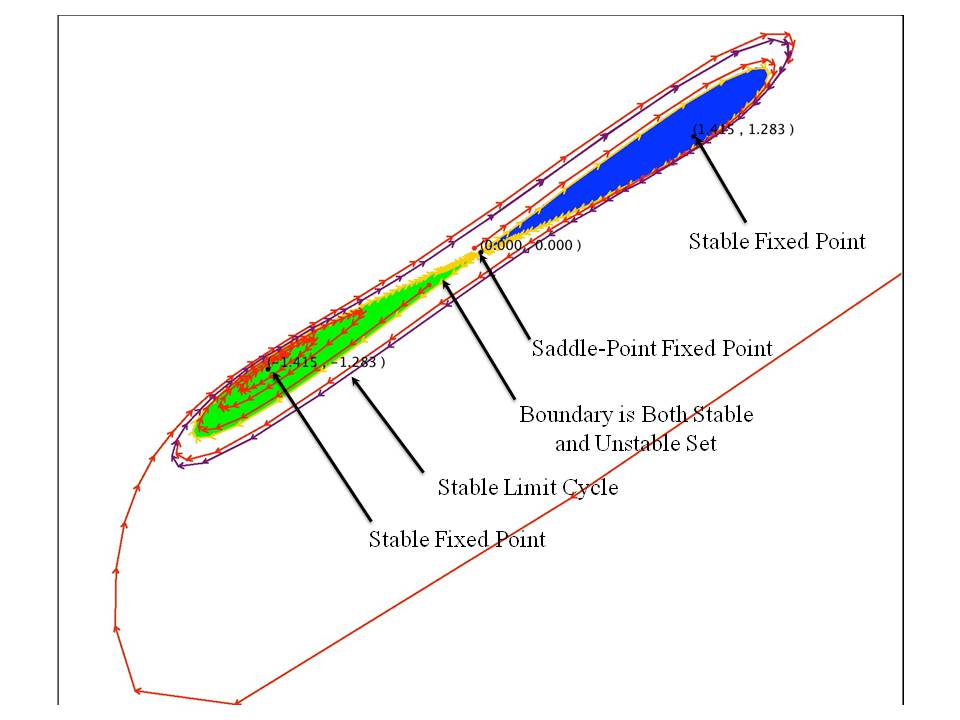
Figure 1: A Business Cycle
I have been reporting some results from a bifurcation analysis of a formalization of Kaldor's 1940 model of the business cycle. Figures 1 and 2 illustrate the appearance of a business cycle with saddle-point stability in the Kaldor model. Suppose orbits like this arose in the dynamical system governing the solar system. Then the planets might form out of a nebular cloud. And the planets would whirl around their orbits for, maybe, millions of millenia. But then the planets will move away from their orbits, as the solar system falls apart.
Figure 2: National Output in The Business Cycle

By the way, my evidence for the existence of a limit cycle with saddle-point stability consists of graphical representations like these. I have not yet been able to find a sequence of (presumably 62) points that exactly repeat. Each of these points along such a limit cycle would have a corresponding stable and unstable set. And the possibility arises of these stable and unstable sets intertwining in a complicated fashion away from the limit cycle. The title of Agliari et al.'s paper refers to such homoclinic tangles of the stable and unstable sets of points along a limit cycle with saddle point stability. The title is not referring to a homoclinic bifurcation of a limit point at the origin, albeit they point out that bifurcation also.

References

  • Agliari, A.; R. Dieci; and L. Gardini (2007). "Homoclinic Tangles in a Kaldor-Like Business Cycle Model", Journal of Economic Behavior & Organization. V. 62: 324-347.

Wednesday, May 16, 2012

You Cannot Win. You Cannot Break Even. You Cannot Get Out Of The Game.

Lars Syll has recently posted about the lack of intellectual engagement of mainstream economists with the later work of Nicholas Georgescu-Roegen. (I rely on Google Translate.) Here his a quote from an article of which Georgescu-Roegen did not think highly:
"If it is very easy to substitute other factors for natural resources, then there is in principle 'no problem.' The world can, in effect, get along without natural resources, so exhaustion is just an event, not a catastrophe." -- Robert M. Solow (1974)
Not all passages in that article are equally absurd. Who would object to the following:
"There is a limiting case, of course, in which demand goes asymptotically to zero as the price rises to infinity, and the resource is exhausted only asymptotically. But it is neither believable nor important." -- Robert M. Solow (1974)
I think the above is consistent with Solow's later view of new growth theory. Much of such work is about the behavior of models when parameters are just so. If the parameters are shifted just a bit off the knife-edge, the model does not exhibit the behavior being emphasized.

I find Georgescu-Roegen intriguing, but maybe too advanced for me. As far as the economic analysis of finite stocks of a natural resource, I also like Paul Davidson's deployment of Keynes' concept of user cost for such analysis.

I have previously noted Georgescu-Roegen's severe criticism of Brown and Robinson's 1972 paper. I now provide a link below to that paper so you can consider yourself whether or not it is just idle mathematics.

Update: Lars Syll's now has a translation of his post, "Nicholas Georgescu-Roegen and the Nobel Prize in economics".

References

  • Donald J. Brown and Abraham Robinson (1972). "A Limit Theorem on the Cores of Large Standard Exchange Economies", Proceedings of the National Academy of Sciences, V. 68, N. 5: 1258-1260.
  • Paul Davidson (1979). "Natural Resources", in A Guide to Post-Keynesian Economics. M. E. Sharpe.
  • Robert M. Solow (1974). "The Economics of Resources or the Resources of Economics", American Economic Review, V. 64, Iss. 2: 1-14.

Thursday, May 03, 2012

A Homoclinic Bifurcation

Figure 1: Ascending and Descending
I have been presenting some results from an analysis of formalizations of Kaldor's 1940 model of the business cycle. This post illustrates some possible behaviors qualitatively similar to those already reported in the literature.

Figures 2, 3, and 4 display some orbits in the (normalized) state space of the Kaldor model, with variations in one parameter determining variations in the topology of these particular phase portraits. In each figure, a movement to the right along the x axis corresponds to an increase in the value of the economy's stock of capital. A movement upward along the y axis corresponds to an increase in the national income. The propensity to save is higher for each figure in the series, but the propensity to save is always small enough that three fixed points exist for the model. In all cases, the middle fixed point has the (in) stability of a saddle point.

Figure 2: Kaldor's Model without a Business Cycle

Figure 3: A Homoclinic Bifurcation in Kaldor's Model

Figure 4: A Business Cycle in Kaldor's Model

A saddle point is such that a ball starting in the direction of the horse's head or tail rolls downward to the center. The bright yellow orbit in each of the three figures represents such a trajectory. The yellow line is known as the stable set of the corresponding fixed point. A ball would have to be balanced just so to achieve such a trajectory on an actual saddle. A ball perturbed from the center of the saddle would tend to roll downward to either side of the horse. The light blue (cyan) orbit in Figures 2 and 4 represent such a trajectory, called the unstable set of the corresponding fixed point.

A bifurcation analysis identifies qualitative changes in the phase portraits for a dynamical system with variations in the system parameters. Several bifurcations exist between Figures 2 and 3, and, I think, two bifurcations arise between Figures 3 and 4. The stable and the unstable sets of the fixed point at the origin, in some sense, have switched roles in the illustrated bifurcations. In Figure 2, the unstable set shown flows from the origin to the other two fixed points. In Figure 4, the stable set flows backwards in time from the origin to the other two fixed points. Of course, some other global behavior is an important difference among these figures. For example, a business cycle does not exist in Figure 2, while Figures 3 and 4 both display a stable business cycle. In the language of dynamical systems, this business cycle is known as a (stable) limit cycle.

The stable and the unstable sets of the origin correspond in Figure 3. Such correspondence of these sets for a given fixed point (or, say, limit cycle) is known as a homoclinic bifurcation. Homoclinic bifurcations are global phenomena and cannot be identified by a merely local stability analysis of the given fixed point. Can you see why one might draw an analogy between a homoclinic bifurcation and the M. C. Escher etching I choose to head this post with?

References

  • Agliari, A.; R. Dieci; and L. Gardini (2007). "Homoclinic Tangles in a Kaldor-Like Business Cycle Mode", Journal of Economic Behavior & Organization. V. 62: 324-347.
  • Bischi, G. I.; R. Dieci; G. Rodano; and E. Saltari (2001). "Multiple Attractors and Global Bifurcations in a Kaldor-type Business Cycle Model", Journal of Evolutionary Economics. V. 11: 257-554.

Sunday, April 29, 2012

Institutions For Learning From Economists' Mistakes

"...the functioning of even the best institutions will always depend, to a considerable degree, on its personnel... Democracy provides the institutional framework for the reform of political institutions (other than the framework). It makes possible the reform of institutions without using violence, and thereby the use of reason in the designing of new institutions and the adjusting of old ones..." -- Karl Popper (1945). The Open Society and Its Enemies, V. I, p. 110-111.
People who make a career advocating some set of ideas often find it difficult to change their minds, even when events demonstrate that consequences of those ideas are mistaken. In a democracy, various parties contend for power based on different ideas about what policies are preferable in the current situation. Turning one party out and installing another is a means to alter what ideas guide society, while allowing for the difficulties prominent advocates have in switching sides. (I think I take this idealization of the possibilities of democracy from Karl Popper. But I could not find a more appropriate quote than the above offhand.)

I take it that the global financial crisis demonstrates certain ideas about economics to be mistaken. Many seem to agree, including, notoriously, the Queen of England. I've recently read Murray Milgate noting such mistakes:

"These instances of the [International Monetary] Fund's responses to crises of various kinds reveal a seemingly unalterable instinct of Fund staff to do the nearly the exact opposite of what is required. Faced with crisis, the Fund blames the patient for the malaise and seeks solutions in terms of monetary and fiscal austerity. That the problem might reside in the nature (and regulatory framework) of international monetary and financial arrangements seems never to pass through the minds of the Fund's staff." -- John Eatwell and Murray Milgate (2012). The Fall and Rise of Keynesian Economics, Oxford University Press. Chapter 15, p. 322.
Maybe a large turnover of personnel, as Dean Baker has called for, at such organizations as the IMF and the World Bank would be desirable. And maybe a movement for new international regulatory institutions should be gaining influence.

In academia, we should perhaps be seeing a change in the relative rankings of economics departments and journals. Maybe, say, Harvard should be thought less well of, and places like the New School, the University of Massachusetts at Amherst, and the University of Utah should be gaining prominence. If this were happening, one could see the signs in citation patterns, in what experts were being quoted in the press, and in trends in the hiring patterns for recent graduates from different economic departments.

I realize Karl Popper's views on how science and democracy work often seem not to be historically accurate descriptions of incidents universally considered progress. To me, though, they provide heuristics practitioners might adopt. Are we seeing the changes we perhaps should have expected in the last few years?

Sunday, April 22, 2012

What I Am Reading

Books on my pile include:
  • Katherine Tait, My Father Bertrand Russell (Harcourt, Brace, Jovanovich, 1975).
  • Chris Mooney, The Republican Brain: The Science of Why They Deny Science - and Reality (John Wiley & Sons, 2012)
Tait describes how Russell's vision of how children should be raised erected barriers between her father, herself, and other family members. (Tait and her older brother John were by Russell's second wife, Dora Winifred Black.) If only men and women were raised rationally and to live by reason, life would be much improved. But this belief did not work out all that well for her in many ways.

And that humans do not follow reason is a theme of Mooney's. The science of motivated reasoning, behavioral economics, etc., shows that humans cannot be made to follow reasoning. I've previously noted some of the studies on which Mooney draws.

So these two books share a common anti-utopian theme.

Tuesday, April 17, 2012

A Chaotic Business Cycle

Figure 1: A Chaotic Attractor in Kaldor's Model of the Business Cycle

I might as well post another interim result from my analyses of formalizations of Kaldor's business cycle model. (Today, Noah Smith also posts about chaotic dynamics.) Figure 1 is based on Figure 3 in a 2006 paper from Orlando Gomes. Table 1 shows the parameter values for the model used to generate this figure. For these parameters, Kaldor's model has one attractor, and that attractor is chaotic. The figure shows 1,000,000 (presumably non-transient) points on a single orbit. Although maybe not apparent from the figure, the orbit rotates around the origin in a clockwise direction.

Table 1: Values of Model Parameters
ParameterValue
Speed of adjustment (α)12
Depreciation rate (δ)0.2
Propensity to Save (σ)0.13
Expected level of output (μ)200
Cost to adjust capital stock (γ)0.6
In this model, for these parameters, every business cycle looks somewhat different from the previous one. Yet the model is deterministic. Variations among business cycles, in this model, are not coming from a source of random shocks. Furthermore, the figure shows a fractal structure across business cycles that may not be apparent to agents in the model living through five or ten cycles.

In Figure 1, I've also shown the model's fixed points and indicated their stability. The stability of fixed points in a dynamical system can be analyzed by looking at the eigenvalues of a linear approximation to the system at each fixed point (Figure 2). Methods exist to determine the stability of a fixed point without actually calculating eigenvalues. But the calculation of eigenvalues and eigenvectors is needed to numerically determine the location of the stable and unstable sets at interesting fixed points (albeit I do not show such sets in Figure 1).

Figure 2: Eigenvalues and Stability

References

  • Andronov, A. A., E. A. Leontovich, I. I. Gordon, and A. G. Maier (1971). Theory of Bifurcations of Dynamic Systems On a Plane (Translated from Russian), National Aeronautics and Space Administration.
  • Gomes, Orlando (2006). "Routes to Chaos in Macroeconomic Theory", Journal of Economic Studies, V. 33, N. 6: 437-468.
  • Kuznetsov, Y. A. (1998). Elements of Applied Bifurcation Theory, Second edition. Springer-Verlag.

Friday, April 13, 2012

When Did Scientific Political Economy Start?

Johnathan Schlefer writes, "There is no invisible hand". He bases his claim on empirical observation and the Sonnenschein-Mantel-Debreu results and other investigations into the stability of general equilibrium. Some find amusing the ignorance and stupidity in the comments.

He also brings up Adam Smith's failure to support propertarian dogma. Gavin Kennedy mostly endorses Schlefer's view of Smith.

Which brings me to my question. Suppose you accept the distinction between scientific political economy and vulgar political economy. Some see both types of political economy in Adam Smith. He contains both esoteric and exoteric elements. But who would you say was the first writer on scientific political economy? I think you can find scientific elements in Quesnay. After all the study of schemes of expanded reproduction builds on Quesnay's Tableau. Maybe William Petty is the answer to my question. Or maybe one should go back all the way to Aristotle.

Tuesday, April 03, 2012

Speculation On Why Monetary Cranks Exist

I think many people, without too much thought, naturally intuit:
  • The system under which they live works fairly well.
  • Somehow, they are being exploited.
The first idea might come partly from modifying your ideas to fit your constraints. You aren't likely to drastically change the world, so you might as well accept it as it is. Another source of the first idea is the ruling ideas of society, which as the man said, are the ideas of the ruling class. Maybe the second idea comes partly from how your success isn't as much as that of others around you.

I suggest a third element, other than the above two contradictory ideas, contributes to the formation of monetary cranks. That is a surprising revelation about some details about how some institution that you interact with every day actually works. What do you mean that banks don't have money for my deposit immediately on hand? Doesn't this paper, accepted as money, represent a quantity of gold that the government is obligated to pay out? People naturally look for a concrete foundation for their practices and are left in the air when it isn't to be found.

I suggest some combine some such mishmash of ideas to conclude that the system can be set right if one particular thing is changed. And something about money is often taken to be the thing to be changed. Others might look at rent on land. I find it suggestive that Henry George's popularity is almost contemporary with closing of the American frontier.

For purposes of this discussion, I deliberately do not identify which ideas are crankish, whether it be advocacy for stamped money, social credit, or a belief that interest rates reflect the interaction of supply and demand for loanable funds. Nor, of course, does labeling an idea with an insult show why it is wrong, if it is.

Monday, March 26, 2012

Thomas Palley's Book On The Little Depression

Figure 1: A Figure Illustrating Data From A Table In Palley (2012)
I have been reading Thomas Palley's new book, From Financial Crisis to Stagnation: The Destruction of Shared Prosperity and the Role of Economics. He argues that the ongoing crisis is not just a downturn in the business cycle, but the manifestation of the exhaustion of the neoliberal paradigm for economic growth1. Palley points to underlying structural contradictions, such as the role of consumer debt in the United States of providing the mass-based aggregate demand for consumption no longer sustainable when the overwhelming majority of workers do not participate in income gains from improving productivity. The expanded power of the less-regulated financial sector fits nicely into this thesis. Palley also discusses flaws in how the United States has come to fit into the global economy.

How academic economists have forwarded flawed ideas in support of these unsustainable structures is another major theme of this book. Both the freshwater (also known as Chicago school) and saltwater (also known as MIT school) economists are neoliberals. Palley, as is typical of Post Keynesians, opposes the views of saltwater economists, who agree with freshwater economists that, if it were not for failures of competition, externalities, information asymmetries, and sticky and rigid prices, the economy would generally perform well. The disagreement, on the level of analysis, is on the empirical importance of such imperfections2. Both erroneously think that economics can be separated from politics. Palley names his contrasting, third view as "Structural Keynesianism".

Palley does not describe the ideas of economists as driving economic policy in the United States. Rather, the market capture of academic economics provides a challenging obstacle for enlightenment. Palley approvingly quotes3 both Keynes' final paragraph in the General Theory and Karl Marx from the The German Ideology, "The ideas of the ruling class are in every epoch the ruling ideas..."

I have yet to finish this book, but I still have some criticisms. I wish Palley had included more graphs in this book. It seems to me that some of his charts in Chapter 4 could more usefully be graphs. What figures he has are usually decompositions of ideas, like Ishikawa diagrams in another format. In his discussions, Palley drops some nuances4 from his text that are explained earlier. Having skipped from Chapter 2 to Chapter 11, I can see some redundancies. Also, I wish Palley had referenced more heterodox economists.

Finally, I want to note José Antonio Ocampo's cover blurb:

"This is an outstanding book: clear, concise, and comprehensive. It shows that the economic crisis is the result of economic policies derived from flawed ideas and flawed ideologies. Read it and recommend it to your friends. It provides a map to overcome the Great Stagnation and to return to shared prosperity."
Ocampo has been in the news lately; Brazil just nominated him for president of the World Bank.

Footnotes

  1. Palley dates the start of this growth model with the Reagan era. I would rather point to Nixon's abolishing of the Bretton Woods' system. I suppose one could say the last half-decade of the 1970s was a transitional period.
  2. Palley notes Post Keynesian agreements with saltwater economists on short run policy.
  3. Antonio Gramsci does not appear in the index.
  4. Such as the distinction between textbook (or bastard) Keynesianism and structural Keynesianism.

Sunday, March 18, 2012

A Nonergodic Model of the Business Cycle

Figure 1: A Fractal in the Phase Diagram for One Specification of Parameters in the Kaldor Model1

1.0 Introduction

I thought I would try to combine an ability for computers to draw fractals with an economic model that suggests practical conclusions. In this post, I merely duplicate some results in the literature. In a deterministic ergodic process, as I understand it, all trajectories pass through every state in whatever attractor may exist. Hence, the Kaldor model, like some dynamical systems arising in mathematics, is non-ergodic.

2.0 The Model

In 1940, Nicholas Kaldor proposed a model of the business cycle. It can be expressed by four equations2. National ouput evolves from the previous period as a response to aggregate demand:

Yt+1 = Yt + α(It - St),
where Yt is the value of output in year t, It is intended investment, and St is intended saving. The parameter α represents the speed of adjustment to excess aggregate demand. The evolution of the value of the capital stock depends on investment and depreciation:
Kt+1 = It + (1 - δ)Kt,
where δ is the depreciation rate of capital stock. Intended saving is directly proportional to output:
St = σYt,
where σ is the (average and marginal) propensity to save. An investment function3 is the final equation specifying the model:
It = σμ + γ(σμ/δ - Kt) + Tan-1(Yt - μ),
where μ is the expected level of output, and γ represents the costs of adjusting the capital stock. Along with some restrictions on the values of parameters, the model is now fully specified. The arc tangent function provides a s-shaped non-linear term, such that entrepreneurs increase investment when output exceeds their expectations4.

I find it convenient to define new variables normalized around a stationary state:

kt = Kt - σμ/δ
yt = Yt - μ
The model, expressed in terms of normalized capital stocks and normalized output, is:
kt + 1 = Tan-1(yt) + (1 - δ - γ)kt
yt + 1 = (1 - ασ)yt + αTan-1(yt) - αγkt
Note that the following is a solution:
For all time t, yt = kt = 0.

3.0 Some Results

The above version of the Kaldor model is a discrete-time dynamical system, defined by a map from the two-dimensional real plane (k, y) to the same space. Four5 parameters are used to define the map. Questions for the mathematician revolve around describing how the phase portrait for the system varies qualitatively with variations in the parameters. Complex and chaotic behavior can arise in the Kaldor model with appropriate choices of parameter values.

For a small enough speed of adjustment and large enough propensity to save, the dynamics is boring. All trajectories converge to the origin.

As the propensity to save decreases, the system goes through a pitchfork bifurcation, so-called because the bifurcation diagram looks like a pitchfork. The origin loses its stability, and two symmetric fixed points appear. For a small enough speed of adjustment, at least, the two symmetric fixed points exhibit local asymptotic stability. The location of these new fixed points must be found numerically. A fortiori, the computer must be used as an aid to perform a local stability analysis of these points, based on the eigenvalues of the Jacobian matrix.

As the speed of adjustment increases, the boundary between the basins of attraction becomes more complex. Figure 1 shows a case where they are entangled in a fractal-like structure, and the outer perimeter of the colored area is repelling. The limit cycle shown is a short distance outside this repelling boundary.

I have by no means exhausted the dynamics of the Kaldor model. Consider a region in which the origin is the only fixed point, and it is asymptotically stable. As the speed of adjustment increases, the system undergoes a Neimark-Sacker bifurcation, which, I gather, is the discrete-time analog to a Hopf bifurcation. Cycles exist in which the cycle is not a fixed point on the Poincaré return map, but winds around many times before repeating. And if I want my application to explore all these dynamics, I have quite a bit of programming to do. I am curious if I will be able to plot a bifurcation diagram, given that the behavior at the limit depends on the initial value.

4.0 Observations

For the parameter values illustrated in the figures, trajectories have three possible destinations:

  • A stable equilibrium with lots of capital and high output.
  • Another stable equilibrium with less capital and less output.
  • A business cycle.
Furthermore, the boundary between the basins of attraction for the stable limit points is fractal-like. These properties suggest that a random shock to the system can redirect trajectories to a very different final destination.

Although not illustrated above, the model exhibits structural instability. A perturbation of the model parameters can result in different observable behavior, of greater or less complexity.

One general way of conceptualizing business cycles is to see them as the response of a damped linear system to exogenous shocks. Their height and depth depends on the characteristics of the external impulses driving the system. The Kaldor model suggests another possibility. In this model, the properties and extent of business cycles are endogenously determined. Shocks can drive the system from one trajectory to another, but the range of possible behaviors is determined from within the system. It is my impression that the former way of understanding business cycles is dominant among mainstream macroeconomists, while the latter is closer to describing actually existing capitalist economies.

Footnotes

  1. Figure 1 is drawn with the parameter values specified in Figure 2(c) in Agliari et al (2007).
  2. Kaldor uses a nonlinear savings function and merely specifies the form of the investment function.
  3. The specification of investment independent of saving is an essential characteristic of Keynesian models.
  4. In this model, expectations are held constant.
  5. Notice the expected level of output does not appear in the two equations giving the normalized model.

Selected References

  • A. Agliari, R. Dieci, and L. Gardini (2007). Homoclinic Tangles in a Kaldor-like Business Cycle Model. Journal of Economic Behavior & Organization. Vol. 62: 324-347.
  • W. W. Chang and D. J. Smyth (1971). The Existence and Persistence of Cycles in a Non-linear Model: Kaldor's 1940 Model Rexamined. Review of Economic Studies. Vol. 38, No. 1: 37-44.
  • Richard M. Goodwin (1951). The Nonlinear Accelerator and the Persistence of Business Cycles. Econometrica. Vol. 19, No. 1: 1-17.
  • Nicholas Kaldor (1940). A Model of the Trade Cycle. Economic Journal. Vol. 50, No. 197: 78-92.
  • Yuri A. Kuznetsov (1998). Elements of Applied Bifurcation Theory, 2nd edition.

Sunday, March 11, 2012

The Wise On Roke

Ursula Le Guin sets her Earthsea trilogy on an imaginary world containing many islands1. Nine mages run a world-famous school for wizards on Roke.

ROKE is now also an acronym, for the Review of Keynesian Economics. It sounds like it prmises to be an interesting journal.

Footnotes

  1. Strangely enough, six books now comprise the Earthsea trilogy.

Friday, March 02, 2012

Elsewhere

  • Matías Vernengo provides an introduction to the capital controversy. He concludes, like others, including myself, that the neoclassical theory of supply and demand cannot explain factor incomes in a capitalist economy.
  • Philip Pilkington interviews Yanis Varoufakis, concentrating on Varoufakis' views on the errors in mainstream economics and the sociology of economics. Update: The second part of the interview is here.
  • Dan Little reviews The End of Value-Free Economics, a book edited by Vivian Walsh and Hilary Putnam. I have only skimmed the Putnam book that the essays in this book are responding to. I have read Putnam's Reason, Truth and History, which makes the case, drawing on the later Wittgenstein, that facts and values cannot be disentangled in science. And Gram and Walsh's Classical and Neoclassical Theories of General Equilibrium: Historical Origins and Mathematical Structure is a very good textbook introduction to the Sraffian revolution.
  • Open Democracy is hosting a series called "Uneconomics". Hey, one of the articles is by Philip Mirowski. Hat tip: Rod Hill and Tony Myatt.

Thursday, February 23, 2012

How To Defend Capitalism

"It is possible to defend our economic system on the ground that, patched up with Keynesian correctives, it is, as he put it, the 'best in sight'. Or at any rate that it is not too bad, and change is painful. In short, that our system is the best system that we have got.

Or it is possible to take the tough-minded line that Schumpeter derived from Marx. The system is cruel, unjust, turbulent, but it does deliver the goods, and, damn it all, it's the goods that you want.

Or, conceding its defects, to defend it on political grounds - that democracy as we know it could not have grown up under any other system and cannot survive without it.

What is not possible, at this time of day, is to defend it, in the neo-classical style, as a delicate self-regulating mechanism, that has only to be left to itself to produce the greatest satisfaction for all.

But none of the alternative defences really sounds very well. Nowadays, to support the status quo, the best course is just to leave all these awkward questions alone." -- Joan Robinson, Economic Philosophy: An Essay on the Progress of Economic Thought (1962): p. 140.

These days, economists are not trained to competently address these questions. For one thing, economists would have to read both history and philosophy as part of their academic work.

The defenses Robinson offers for capitalism do not say any particular embodiment of capitalism does not require a lot of patching up.

I think Robinson's position that markets cannot be regarded as a "delicate self-regulating mechanism" has become even stronger in the last half-century. For my purposes, never mind looking out your door at our current situation. Consider what we now know about economic theory. My point is not merely that economists have no proof of the stability of a (unique?) equilibrium in models of markets. My point is that what we know about the question suggests that markets, in such models, are not likely to approach equilibrium. I am thinking of, for instance:

  • the Sonnenschein-Mantel-Debreu theorem.
  • Franklin Fisher's demonstration that one should impose the assumption of "no favorable surprise" to ensure an approach to general equilibrium.
  • Fabio Petri's explanation that the Arrow-Debreu model cannot allow production to occur along the approach to equilibrium (since production will change part of the data defining the equilibria, namely the initial endowments).
Apparently, the situation is no better from the perspective of game theory.

I think that this perspective on equilibrium leads one to disbelieve that capitalism can be made self-regulating by establishing or restoring competitive forces that do not seem to be operative today. In short, Mark Thoma is simply wrong.

David Ruccio and "Larry, the Barefoot Bum" also have comments about Mark Thoma's editorial. I've previously noted that Marxist exploitation is compatible with perfect competition and every factor receiving the full value of their marginal product. I've also previously expressed my opinion that Marxist exploitation is not about describing an injustice when capitalism is viewed under the aspect of eternity.

References

  • Franklin M. Fisher (1983). Disequilibrium Foundations of Equilibrium Economics, Cambridge University Press.
  • Franklin M. Fisher (1989) "Games economists play: A noncooperative view", RAND Journal of Economics. V. 20, N. 1 (Spring) [To read].
  • Fabio Petri (2004). General Equilibrium, Capital and Macroeconomics: A Key to Recent Controversies in Equilibrium Theory, Edward Elgar.
  • Joan Robinson (1962). Economic Philosophy: An Essay on the Progress of Economic Thought.

Friday, February 17, 2012

The Economic Consequences Of Mr. Draghi

This post is somewhat on current events, and about topics I'm even less expert in than usual. I suggest that a certain historical analogy might be useful for understanding certain aspects of the Greek crisis1. Not that I'm willing to propose a solution. I look to, for example, Yanis Varoufakis for more informed takes on the Euro2.

John Maynard Keynes, in 1925, wrote a pamphlet, "The Economic Consequences of Mr. Churchill". Keynes' title is a suggestion of his previous best-seller, The Economic Consequences of the Peace, another work in which Keynes foresaw the dire consequence of then current events. In the case of Churchill, Sir Winton was then serving as Chancellor of the Exchequer.

Britain had gone off the gold standard during World War I. Churchill oversaw the restoration of the gold standard, with the Treasury insisting on establishing the foreign exchange value of the pound sterling to its pre-war parity in gold. Apparently, according to Keynes, the market value was about 10% below that at the time. The foreign exchange rate of a currency combines with the general price level to determine the standard of living in terms of foreign goods. If the British wanted to maintain their then-current standard of living, and Churchill insisted on the pre-war parity, then prices and costs, including wages, must drop 10%. And this process of deflation could be expected to be resisted. In fact, widespread unemployment and general labor unrest were some of the economic consequences of Mr. Churchill. I think you can see some of these consequences in the 1926 general strike in Great Britain.

Churchill refused to acknowledge the necessity of devaluing the pound. In the case of Greece, they do not have control over the value of their currency, as long as they remain on the Euro. So they cannot devalue their currency. But, as in the case of the British population in the 1920s, they are being asked for the functional equivalent - that is, for a general reduction of prices and wages throughout the country. Maybe the consequences in Greece will resemble the consequences in Britain in the 1920s. I don't see how this is likely to increase the odds of Greece fully paying back their external debts.

Footnotes:

  1. I think of this post as, perhaps, an illustration of the usefulness of studying economic history and the history of economics. Even if you conclude that my suggested analogy is too facile, you might accept that discussing it is a useful point of departure.
  2. D-Squared also has a view on the topic, given certain constraints.

Tuesday, February 14, 2012

Playing With Fractals

Figure 1: An Enlargement Of A Piece Of The Mandelbrot Set

A number of years ago, I loaned Heinz-Otto Peitgen and Peter H. Richter's 1986 book, The Beauty of Fractals: Images of Complex Dynamical Systems to a relative. This is a coffee-table book that, apparently, was issued as a companion piece to a digital art exhibition. This book was returned to me at Christmas.

So, for fun, I've been writing a fractal-drawing program. I'm not sure what the point of this is, besides reviewing certain aspects of Java programming. I don't plan on distributing my program, even if I did include some help capabilities, icons for various windows, and such like. I deliberately have not looked at any programs that may be out there on Windows, Icon, Mouse, Pointer (WIMP) platforms. I eventually did look at a free app for a touch interface. This app cued me to think about assigning colors on a logarithmic scale, with lighter shades being near the Mandelbrot set boundary.

In software development, a difficulty is often how to define what you want to do. And one can always think of additional capabilities. In my case, at some point I included capabilities to save and load the current state, to print the current canvas, and to provide user-control over the number of iterations and various colorings. I struggled with how to define coloring algorithms. I'm curious about how one might implement Sigel discs, that is, regions of convergence for limit points and cycles within a Julia set. A history capability would also be nice.

Anyways, I haven't been reading all that much economics while taking this excursion into recreational mathematics.

Figure 1: A Julia Set

Wednesday, February 08, 2012

Some Stupid Stuff From David Levine

Suppose you can get people to refer to some theory or principle that you advocate as "Motherhood and Apple Pie". A rather stupid way to argue against opponents is to rely on the mere label. So one can argue against a strawperson - one can say that one's opponents are against motherhood and apple pie. Economists happen to have this nonsensical rhetoric strategy readily available, given some of the names of their models. For example, if one were a fool or a knave, one could say that opponents of Dynamic Stochastic General Equilibrium models all preferred static, deterministic, partial equilibrium models - obviously not as good a thing.

David K. Levine insults the reader's intelligence in this way. He has an article, "Why Economists Are Right: Rational Expectations and the Uncertainty Principle in Economics" (part I, part II) in the Huffington Post. He focuses on the label "Rational Expectations:

"In simple language what rational expectations means is 'if people believe this forecast it will be true.' By contrast if a theory is not one of rational expectations it means 'if people believe this forecast it will not be true.' Obviously such a theory has limited usefulness. Or put differently: if there is a correct theory, eventually most people will believe it, so it must necessarily be rational expectations. Any other theory has the property that people must forever disbelieve the theory regardless of overwhelming evidence -- for as soon as the theory is believed it is wrong.

So does the crisis prove that rational expectations and rational behavior are bad assumptions for formulating economic policy? Perhaps we should turn to behavioral models of irrationality in understanding how to deal with the housing market crash or the Greek economic crisis? Such an alternative would have us build on foundations of sand. It would have us create economic policies and institutions with the property that as soon as they were properly understood they would cease to function." -- David K. Levine

I know of nobody who advocates constructing models based on irrational expectations. On the other hand, I can easily imagine a model in which diverse agents might have different theories of the world and rely on different heuristics. Maybe the agents in such a model might not converge on a single model for the world. (Levine does mention issues of convergence, in a wholly inadequate way, in Part II of his article. Even if one accepted his emotionally-charged story, economists still lack any general argument for convergence to a rational expectations equilibrium.) One might construct such a model of short term interest rates. The equilibrium interest rate at any moment of time would be a balance of bullish and bearish forces.

These are hardly unknown ideas in economics. I am drawing directly on Chapter 12 of Keynes' General Theory of Employment, Interest, and Money. G. L. S. Shackle called this a restless equilibrium. Paul Davidson wrote about human decision-making in an environment characterized by processes, of which some are non-ergodic. Nowadays, one might experiment with implementing agent-based models in computer simulations. I could even cite Brad DeLong, Andre Shleifer, Larry Summers, and Robert Waldmann's work on noise traders. Economists in these sort of traditions are well aware of the impact of economic theory on the behavior of economic agents. They even explain why agents might find it rewarding to knowingly persist in behavior based on assumptions that prices will continue deviating from fundamentals, if the idea of a fundamental price is even coherent. Some somewhere have even talked about "performativity".

In short, Levine has completely failed to grapple with the economics literature at all. He is merely misrepresenting the state of play to a popular audience.

So far, I have not mentioned Levine's rationalization of why economists cannot predict crashes and depressions (or even identify bubbles?). Now, clearly some economists did forecast our current hard times. Steve Keen is probably one of the most well-known. But I'll turn to another incident. On 10 July, K. Bastiaensen, P. Cauwels, D. Sornette, R. Woodard, and W.-X. Zhou predicted a crash of the Shanghai Composite index. They stated the crash, with certain confidence estimates, would come between 17 to 27 July 2009. The China Shanghai composite index was around 3,400 during the week of 27 July. And it was around 2,860 during the week of 31 August, a decline of 16%. According to Levine, these successful predictions are just a matter of those with secret methods sometimes being lucky:

"If I say every year 'there will be a crisis this year' eventually I will be right. If 100 people each pick a different year then one of them is bound to be right. A reliable method of predicting a crisis must be a rule that anyone (or at least anyone with the requisite technical expertise) can apply and reach the same correct conclusion as anyone else using the same method."
I am not totally unsympathetic to the above view. But notice that according to the theory of rational expectations, people with divergent theories, models, and heuristics do not exist. On Levine's view, how can he account for the existence of such a range of predictions? How is it that the agents in the model are possessed of superhuman powers not available to mere mortal economists looking on?

Selected References

  • K. Bastiaensen, P. Cauwels, D. Sornette, R. Woodard, and W.-X. Zhou (10 July 2009). "The Chinese Equity Bubble: Ready to Burst".
  • Paul Davidson (1983-1984). "Rational Expectations: A Fallacious Foundation for studying Crucial Decision Making Processes". Journal of Post Keynesian Economics, V. 5.

Saturday, January 28, 2012

On The Lack Of Persuasiveness Of Austrian-School Economists

Mattheus von Guttenberg exemplifies what I think are defects in many fanboys of Austrian school economics. Among these defects is an uncritical acceptance of Ludwig von Mises' characterization of his own theories. And another defect is uncritical acceptance, likewise, of what Mises, or even worse, Murray Rothbard, had to say about the mainstream economics of their day. And a third defect is to apply these characterizations to mainstream economics of our day, while remaining quite ignorant of relevant trends in contemporary economics. Without more widespread correction of such defects, advocates of the Austrian school should not be able to persuade many economists, both orthodox and heterodox, of the worth of their views.

For this post, I focus on the theory of choice.

Here are examples of arguably a weak understanding of both the Austrian school and of mainstream economic theory:

"...we're not rejecting cardinal utility functions because it's hip and counter-culture. There's a distinct reason utility functions are impossible and unrealistic, and that's because utility cannot be known or measured... The degree to which we draw swooping utility functions overlaying cost curves is a unacceptable practice borrowed from coordinate geometry. Utility, again - is ordinal, it is intrinsically subjective, and it cannot be made known by other people." -- Mattheus von Guttenberg
"The concept of diminishing marginal utility is implicit in the logic of action, the Austrians just draw it to the fore." -- Mattheus von Guttenberg
The claim that utility reaches an interval-level measurement scale is a conclusion formally drawn from the Von Neumann and Morgenstern axioms (which can be considered independently of game theory). Most introductory economic textbooks claim that utility only reaches an ordinal-level measurement scale, anyways. The introductory textbooks have a different set of axioms, where choice among a set of goods with specified probability is not formally modeled. And they assert that the utility obtained is not interpersonally comparable. Mattheus' objections are not addressed to any views prominent in mainstream economic teaching for at least half a century. And to assert that diminishing marginal utility is consistent with utility reaching only an ordinal-level scale requires an argument. (I'm actually intrigued by J. Huston McCulloch's 1977 attempt to make such an argument, the one example of which I know in the last quarter of the last century.)

Mises incorrectly asserted that much of his theory could be deduced from a single postulate.

"The only axiom is 'man acts' and we draw the entire body of economic science spanning a thousand pages." -- Mattheus von Guttenberg
"...I have always been interested in rewriting [Human Action] 'as a set of numbered axioms, postulates, and syllogistic inferences using, say, Russell's Principia.' I believe it can be done." -- Mattheus von Guttenberg
I think such a rewriting, as it starts from the above informally stated premise, would be unconvincing.

Furthermore, the current state of decision theory suggests that analyses other than Mises' approach, are consistent with this axiom. The Austrian school approach is roughly akin to Samuelson's revealed preference theory. (One important difference is that Austrian advocates have some silly things to say about the impossibility of indifference.) Anyways, the idea is that an acting human, when presented with two lists of goods, decides between them. But social choice theory, as developed by, say, Amartya Sen in the late 1960s and early 1970s, has shown how to dispense with the formalization of choice as a binary relation as a primitive notion. Instead, one can start with a choice function, that is, a mapping from each menu that an agent might be presented with to a set of best choices for that menu. The derivation of a complete and transitive binary preference relation from a choice function requires additional structure on how menu choices relate across menus. And why the imposition of those additional requirements follows from human action needs to be argued. For example, why are not increasingly prevalent models, at least in research literature, of divided selves consistent with human action?

Update (3 July 2014): The blog free radical has a blog post pointing out Austrian confusions about mainstream teaching on ordinal utility.

Tuesday, January 24, 2012

Elsewhere

Friday, January 20, 2012

Nell's Diagram Of A Capitalist Economy

Figure 1: Nell's Diagram

Over at Naked Keynesian, Matías Vernengo explains some aspects of how he teaches the surplus approach. Vernengo presents a diagram created by Garegnani. Garegnani's diagram shows the logical relations among the endogenous variables and the givens in the Classical theory of value.

I thought I would take this opportunity to present the (complementary?) diagram above. Nell's diagram shows flows among three foci: production, markets, and the social classes comprising the population of an idealized capitalist economy.

Nell represents industrial production with an icon in the lower right of his diagram. The arrows connecting the factories in a circle suggest the production of commodities by means of commodities. Sraffa's book expresses this viewpoint in rigorous theory, and Leontief applied it empirically. Gross industrial output consists of a heterogeneous odd-lot of commodities. This output is divided into:

  • The replacement of the existing means of production (represented by the previously mentioned arrows within the icon for industry)
  • The surplus (represented by the arrow labeled "Net social product").
The net social product presents itself as an immense accumulation of commodities. It is further decomposed into:
  • Necessities, consumed by the workers and the Unemployed
  • Luxuries, consumed by the owners (i.e., capitalists)
  • New capital goods, channeled back into industrial production from the markets on which industrial firms sell them.
Each component of the net social product also consists of a heterogeneous collection of commodities.

The diagram also shows money flows. The diagram illustrates the simplifying assumption that workers consume all their income. And the diagram also abstracts from the existence of government and of foreign trade. (All of these abstractions are removed in more advanced political economy, for example, in Kalecki's work.) Anyway one can identify a couple of accounting identities under these assumptions:

Total Receipts = Worker Consumption + Capitalist Consumption + Investment
Total Receipts = Wages + Profits
I like the clarity with which monetary flows and commodity flows are distinguished in this approach. It is not the case that capitalists own blast furnaces sitting in their backyard, which they then loan to firms. Mainstream economists are deliberately and consistently obfuscating on this issue, from introductory teaching to beyond. Perhaps there's a reason for this widespread confusion:
"From the point of view of Political Economy, however, the most important fact is that while wages are paid for work, and one can (and in some circumstances should) think of the wage bill, equal here to Worker Consumption, as reproducing the power to work, profits are not paid for anything at all. The flow of profit income is not an exchange in any sense. The Samuelson [circular flow] diagram...is fundamentally misleading; there is no 'flow' from 'household supply' to the factor market for capital. The only flow is the flow of profit income in the other direction. And this, of course, leads straight to that hoary but substantial claim that the payment of wages is not an exchange either, or at any rate, not a fair one. For Wages plus Profits adds up to the Net Income Product; yet profits are not paid for anything, while wages are paid for work. Hence the work of labor (using the tools, equipment, etc., replacement and depreciation of which is already counted in) has produced the entire product. Is labor not therefore exploited? Does it not deserve the whole product?" -- Edward Nell

References

  • Edward Nell (1972). "The Revival of Political Economy"