Friday, June 30, 2006

Proof Of The Falsity Of The Factor Price Equalization "Theorem" (Part 2)

3.0 Prices And The Choice Of Technique
In the previous part, I presented a specification of the technology in a numeric example created by Lynn Mainwaring. Which technique specified by this technology is cost minimizing at equilibrium prices? In this context, equilibria have the following properties:
  • The iron-producing process, at least one steel-producing process, and at least one corn-producing process are operated.
  • The costs of inputs for each process in operation does not exceed revenues.
  • No process can be used to obtain pure economic profits.

Suppose, for example, that the Alpha technique is cost minimizing. Given these properties, then the following equations must be satisfied:
(1/5) p2 (1 + r) + (1/20) w = p1

[(1/5) p1 + (1/10)](1 + r) + (1/5) w = p2

[(1/10) p1 + (1/2) p2](1 + r) + (9/20) w = 1

where
  • w is the wage (in units of bushels per person-year)
  • r is the rate of profits
  • p1 is the price of iron (in units of bushels per ton iron)
  • p2 is the price of steel (in units of bushels per ton steel)

The above equations specify that, for each process in the Alpha technique, costs of inputs in the process equal revenues. The costs do not exceed revenues. Furthermore, no process, at least in the Alpha technique, can be operated to obtain pure economic process.

Suppose, for mathematical convenience, the rate of profits is externally specified. Then the above is a system of three linear equations in three variables. It can be solved, and the solution is:
w = 2 [500 - 45(1 + r)^2 - (1 + r)^3]/[450 + 105(1 + r) - 9 (1 + r)^2]

p1 = (1/2) [100 + 80(1 + r) + 13(1 + r)^2]/[450 + 105(1 + r) - 9(1 + r)^2]

p2 = (1/2)[400 + 110(1 + r) + (1 + r)^2]/[450 + 105(1 + r) - 9(1 + r)^2]


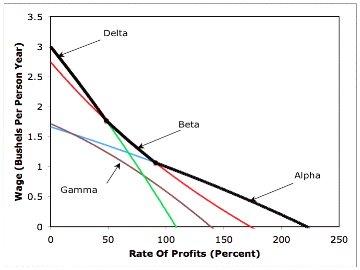
A system of equations is associated each of the remaining three techniques defined by the technology. The statement of those systems and their solutions is relegated to an appendix. The cost minimizing technique at any given rate of profits can be found from these solutions. In particular, Figure 3-1 shows a graph of the wage as a function of the rate of profits for each technique. The cost minimizing technique at a given rate of profits is the technique for which the wage is greatest. The figure shows the frontier defined by this criteria as a heavy black line. The Delta technique is cost minimizing at low rates of profits. The Beta technique is cost minimizing at intermediate rates of profits, and the Alpha technique is cost minimizing at intermediate rates of profits.

Figure 3-1: The Wage-Rate Of Profits Frontier

But what does all of this have to do with the theory of international trade? This question will be answered in the next part.

Appendix 3.A: Price Equations For Three Techniques
Appendix 3.A.1: The Beta Technique
The price equations for the Beta technique are:
(1/5) p2 (1 + r) + (1/20) w = p1

[(1/5) p1 + (1/10)](1 + r) + (1/5) w = p2

(43/25) p1 (1 + r) + (19/100) w = 1

The solution to the Beta price equations is:
w = (2)[1,250 - 50(1 + r)^2 - 43(1 + r)^3]/[153(1 + r)^2 + 215(1 + r) + 475]

p1 = (1/2)[19(1 + r)^2 + 200(1 + r) + 250]/[153(1 + r)^2 + 215(1 + r) + 475]

p2 = (1/2)[43(1 + r)^2 + 145(1 + r) + 1,000]/[153(1 + r)^2 + 215(1 + r) + 475]


Appendix 3.A.2: The Gamma Technique
(1/5) p2 (1 + r) + (1/20) w = p1

(8/25)(1 + r) + (3/50) w = p2

[(1/10) p1 + (1/2) p2](1 + r) + (9/20) w = 1

The solution to the Gamma price equations is:
w = 8[625 - 100(1 + r)^2 - 4(1 + r)^3]/[6(1 + r)^2 + 175(1 + r) + 2,250]

p1 = 2[52(1 + r)^2 + 30(1 + r) + 125]/[6(1 + r)^2 + 175(1 + r) + 2,250]

p2 = 4 [2(1 + r)^2 + 180(1 + r) + 75]/[6(1 + r)^2 + 175(1 + r) + 2,250]


Appendix 3.A.3: The Delta Technique
The price equations for the Delta technique are:
(1/5) p2 (1 + r) + (1/20) w = p1

(8/25)(1 + r) + (3/50) w = p2

(43/25) p1 (1 + r) + (19/100) w = 1

The solution to the Delta price equations is:
w = 4 [3,125 - 344(1 + r)^3]/[258(1 + r)^2 + 1,075(1 + r) + 2,375]

p1 = [152(1 + r)^2 + 150(1 + r) + 625]/[258(1 + r)^2 + 1,075(1 + r) + 2,375]

p2 = [344(1 + r)^2 + 760(1 + r) + 750]/[258(1 + r)^2 + 1,075(1 + r) + 2,375]

Proof Of The Falsity Of The Factor Price Equalization "Theorem" (Part 1)

1.0 Introduction
This sequence of posts explores a numeric example. The example was created by L. Mainwaring (1976). Mainwaring used the example to prove the factor price equalization theorem to be false. Before explaining this implication of the example, I want to consider a single country.

2.0 Technology
Consider a simple economy in which three commodities, iron, steel, and corn, are produced from inputs of labor, iron, steel, and corn. All production processes in in this example require a year to complete and exhibit Constant Returns to Scale. One process is known for producing iron, and two processes each are known for producing steel and corn. These processes are shown in Table 2-1. The inputs for each process are purchased at the beginning of year. The inputs provide their services over the course of the year, and the iron, steel, and corn inputs are totally used up each year in the production processes. The outputs become available at the end of the year.

Table 2-1: Technology
INPUTS
HIRED AT
START OF
YEAR
IRON-
PRODUCING
PROCESS
(A)
FIRST STEEL-
PRODUCING
PROCESS
(B)
SECOND STEEL-
PRODUCING
PROCESS
(C)
FIRST CORN-
PRODUCING
PROCESS
(D)
SECOND CORN-
PRODUCING
PROCESS
(E)
Labor1/20 Person-Year1/5 Person-Year3/50 Person-Year9/20 Person-Year19/100 Person-Year
Iron0 Ton Iron1/5 Ton Iron0 Ton Iron1/10 Ton Iron1 18/25 Tons Iron
Steel1/5 Ton Steel0 Ton Steel0 Ton Steel1/2 Ton Steel0 Ton Steel
Corn0 Bushel Corn1/10 Bushel Corn8/25 Bushel Corn0 Bushel Corn0 Bushel Corn
OUTPUT1 Ton Iron1 Ton Steel1 Ton Steel1 Bushel Corn1 Bushel Corn

A technique consists of three processes, where one process is used to produce iron, a second process produces steel, and the third process produces corn. As shown in Table 2-2, three techniques are available in this economy. Note that for each technique, no commodity can be produced without inputs either directly or indirectly of each other commodity For example, consider the Delta technique. Since corn is produced in this technique with process E, iron is required to be reproduced for production to continue year after year. Steel is required to reproduce iron by process A in this technique. And corn is required to produce steel by process C. In the jargon, iron, steel, and corn are all said to be “basic commodities”. Sraffa invented this terminology.

Table 2-2: Techniques And Processes
TechniqueProcesses
AlphaA, B, D
BetaA, B, E
GammaA, C, D
DeltaA, C, E

I leave as an exercise for the reader to check that, for each technique, some level of operation of the processes comprising the technique results in a positive net output. That is, after replacing the commodities used up in production, some output is left over to be used for consumption or accumulation. One method of checking this condition is to confirm the Hawkins-Simon conditions are met for each technique.

Consider cost-minimizing (or profit-maximizing) competitive firms facing this technology. Suppose that, although labor is hired at the start of the year, the workers are paid their wages at the end of the year. Iron, steel, and corn inputs are paid for at the beginning of the year, and interest (or profit) is charged on these payments. For each level of the rate of profits, which technique is cost minimizing? Is one technique not cost-minimizing at any rate of profits? I answer these questions in the next part by presenting the results of some tedious algebra.

References
  • Mainwaring, L. (1976). "Relative Prices and 'Factor Price' Equalisation in a Heterogeneous Capital Goods Model", Australian Economic Papers, Republished in Fundamental Issues in Trade Theory (Ed. by Ian Steedman), Macmillan, 1979.

Wednesday, June 21, 2006

Vacation Versus Pressure To Blog

I've seen that once I started this blog, I feel pressure to post. But as is obvious, I don't post often. It would only be polite to respond to comments. But as long as an actual discussion is going on in the comments to a post, I can get away with saying nothing. I'm fairly slow to respond to e-mail too.

I will be even more intermittent in the next few weeks. I'm taking a vacation next week, and I am thinking of taking a few days off in the week after next. So I won't be posting then.

Saturday, June 17, 2006

Lawrence Lessig Has A Blog

Lawrence Lessig is a lawyer and law professor in the United States. He is most well known, I guess, for his interest in intellectual property law. I take it that he is aware that property rights are shaped and defined by a plethora of laws and customs. I think he thinks that these laws should be judged instrumentally. So I think his views exhibit a family resemblance to those of Dean Baker and those pointed out on this blog in this series of posts.

Gramsci Quote, At Least Some Recited At Sraffa's Funeral

I know, from reading Geoff Harcourt, that at least some of this was quoted at Sraffa's funeral:
"It would be worth compiling a 'reasoned' catalogue of the men of learning whose opinions are widely quoted or contested in the book, each name to be accompanied by notes on their significance and scientific importance (this to be done also for the supporters of the philosophy of praxis who are certainly not quoted in the light of their originality and significance). In fact there are only the most passing references to the great intellectuals. The question is raised: would it not have been better to have referred only to the major intellectuals on the enemy side, leaving aside the men in the second rank, the regurgitators of second-hand phrases? One gets the impression that the author wants to combat only the weakest of their positions (or the ones which the weakest adversaries have maintained least adequately), in order to obtain facile verbal victories - for one can hardly speak of real victories. The illusion is created that there exists some kind of more than formal and metaphorical resemblance between an ideological and a politico-military front. In the political and military struggle it can be correct tactics to break through at the points of least resistance in order to be able to assault the strongest point with maximum forces that have been precisely made available by the elimination of the weaker auxiliaries. Political and military victories, within certain limits, have a permanent and universal value and the strategic end can be attained decisively with a general effect for everyone. On the ideological front, however, the defeat of the auxiliaries and the minor hangers-on is of all but negligible importance. Here it is necessary to engage battle with the most eminent of one's adversaries. Otherwise one confuses newspapers with books, and petty daily polemic with scientific work. The lesser figures must be abandoned to the infinite casebook of newspaper polemic.

A new science proves its efficacy and vitality when it demonstrates that it is capable of confronting the great champions of the tendencies opposed to it and when it either resolves by its own means the vital questions which they have posed or demonstrates, in peremptory fashion, that these questions are false problems.

It is true that an historical epoch and a given society are characterised rather by the average run of intellectuals, and therefore by the more mediocre. But widespread, mass ideology must be distinguished from the scientific works and the great philosophical syntheses which are its real cornerstones. It is the latter which must be overcome, either negatively, by demonstrating that they are without foundation, or positively, by opposing to them philosophical syntheses of greater importance and significance. Reading the Manual one has the impression of someone who cannot sleep for the moonlight and who struggles to massacre the fireflies in the belief that by so doing he will make the brightness lessen or disappear." (Gramsci 1971, pp. 432-433, "Critical Notes on an Attempt at Popular Sociology")

(The attempt being considered here is The Theory of Historical Materialism: A Manual of Popular Sociology, a book by Nikolai Bukharin.)

References
  • Harcourt, G. C. (1986). "On the Contributions of Joan Robinson and Piero Sraffa to Economic Theory", in Controversies in Political Economy: Selected Essays, New York University Press
  • Gramsci, Antonio (1971). Selections from the Prison Notebooks of Anonio Gramsci (Trans. by Quintin Hoare and Geoffrey Nowell Smith), International Publishers.

Sunday, June 11, 2006

Programs For Post-Capitalist Society

This is a topic that I could see myself exploring some time in the distant future.

The author of an utopia is promoting his vision in some virtual place that I sometimes read. I only glanced at this page, but I could not quickly find any discussion of competing programs. I think the most serious such programs around these days are:

Wednesday, June 07, 2006

More On The Incorrect Heckscher-Ohlin-Samuelson (HOS) Theory

I have some comments in "Unregulated International Trade Unjustified By Comparative Advantage (TOC)". Radek offers an admittably speculative explanation of why there is a loss from trade in my numeric example:
"Increasing returns isn't the correct term. Nonconvex production set is what I'm guessing."

I think that explanation is wrong. I pointed out in the comments that the numeric example is not a reswitching example. Radek comments on this observation:
"I think Metcalfe and Steedman emphasized reswitching as necessary for this kind of result then later folks realized that reswitching wasn't it. But like I said, I'm not too familiar and it's been awhile.

Ok - I think I found the MS article and will read up on it (JIL May'77)."

The phrase "this kind of result" is doing too much work here. As I mentioned, Metcalfe, Steedman, and others have a variety of criticisms of the logic of HOS theory. The criticism illustrated by my example is from Metcalfe and Steedman (1974). Steedman and Metcalfe (1977) is a different criticism, a criticism that stretches my knowledge of trade theory by the by. They conclude:
"We have examined a version of the familiar H-O-S analysis, with two countries, two commodities and two factors; we have made all the normal assumptions except that, instead of a common zero rate of profit, we have assumed a common positive rate of profit. Since the existence of a positive profit rate does not affect the properties of the familiar relationship between commodity-prices and factor-prices it does not affect the factor-price-equalisation and Stolper-Samuelson theorems. In general, however, nothing can be said a priori about the relationship between factor-prices and the factor-intensity of production methods, when the profit rate is positive, and it follows that nothing can be said a priori about the shape of the relative supply curve. This does not prevent the H-O-S theorem about the pattern of trade from holding in its 'quantity' form, but does make the theorem invalid in its 'price' form, does mean that trade need not 'harm' a country's scarce factor, and does mean that uniqueness of international equilibrium is to be regarded as a special case when the common rate of profit is positive." - Steedman and Metcalfe (1977)

The demonstration in Steedman and Metcalfe (1977) draws on an earlier analysis of a closed economy, Metcalfe and Steedman (1972). Here M. and S. present a reswitching example with two homogeneous unproduced inputs, labor and land. They find, at a certain given positive rate of profit, that the technique of production that minimizes cost at the higher ratio of the rent to wage will be more land-intensive. I think of this example as analogous to one of capital-reversing. It too is destructive of supply and demand explanations of prices.

I don't recall if they say so explicitly, but this article certainly gives the impression that this counter-intuitive result - at least to those who believe in the out-dated neoclassical theory of value and distribution - is due to the presence of reswitching. If I recall correctly, this result was later shown to be compatible with the absence of reswitching. I believe Steedman selected the article first demonstrating this compatibility for republication in Steedman (1989).

If I ever get around to discussing recent empirical results on the labor theory of value, I will point to some criticisms of Steedman.

Update: Radek reminds me that Montet (1979) demonstrated that the results in Metcalfe and Steedman (1972) and in Steedman and Metcalfe (1977) are compatible with the absence of reswitching.

References
  • Metcalfe, J. S. and I. Steedman (1972). "Reswitching and Primary Input Use", Economic Journal (Reprinted in Fundamental Issues in Trade Theory (edited by I. Steedman), Macmillan, 1979).
  • Steedman, I. and J. S. Metcalfe (1977). "Reswitching, Primary Inputs and the Heckscher-Ohlin-Samuelson Theory of Trade", Journal of International Economics (Reprinted in Fundamental Issues in Trade Theory (edited by I. Steedman), Macmillan, 1979).
  • Metcalfe, J. S. and I. Steedman (1974). "A Note on the Gain From Trade", Economic Record (Reprinted in Fundamental Issues in Trade Theory (edited by I. Steedman), Macmillan, 1979).
  • Montet, C. (1979). "Reswitching and Primary Input Use: A Comment", Economic Journal, V. 89, N. 355 (Sep.): 642-647.
  • Steedman, I. (editor, 1989). Sraffian Economics (2 volumes), Edward Elgar.

Monday, June 05, 2006

Capitalism Seen As Unfree In Its Infancy

A charactistic transaction under capitalism is the selling of labor power for money wages. How was this transaction perceived in capitalism's early days? Consider:
"[the commonwealth] consisteth only of freemen... Day labourers ... have no voice nor authority in our commonwealth, and no account is made of them but only to be ruled ... [those who] be hired for wages ... be called servants." -- Thomas Smith (1565)

"If the common people have no more freedom in England but only to live among their elder brothers and work for them for hire, what freedom have they in England more than we have in Turkey or France? ... The poor that have no land are left still in the straits of beggary, and they are shut out of all livelihood but what they shall pick out of sore bondage, by working for others as masters over them." -- G. Winstanley (1649)

"Rather than go with cap in hand and bended knee to gentlemen and farmers, begging and entreating to work with them for 8d. or 10d. a day, which doth give them an occasion to tyrannize over poor people (which are their fellow-creatures), if poor man would not go in such a slavish posture..." -- R. Coster (1649)

"[The relations of employer and wage labourer] approach much nearer to that of a planter and slave in our American colonies than might be expected in such a country as England." -- Josiah Tucker (1757)

"...the ingenuity and dexterity of [England's] working artists and manufacturers, which have heretofore given credit and reputation to British wares in general [whose skill was] owing to that freedom and liberty they enjoy to divert themselves in their own way... Were they obliged to toil the year round, the whole six days in the week, in a repetition of the same work, might it not blunt their ingenuity and render them stupid instead of alert and dexterous?" -- M. Postlethwayt (1774)

All quotes are secondhand from:
  • Christopher Hill (1967). "Pottage for Freeborn Englishmen: Attitudes to Wage Labour in the Sixteenth and Seventeenth Centuries," Socialism, Capitalism, & Economic Growth: Essays Presented to Maurice Dobb, Cambridge University Press.

Monday, May 29, 2006

Unregulated International Trade Unjustified By Comparative Advantage (Part 5)

5.0 Conclusions

I don’t think the interesting properties of the above example rely on the following properties:
  • The technology is discrete (generalized Leontief)
  • The circularity in production in ale and corn, in which corn and ale are, directly or indirectly, inputs into the production of ale or corn.
  • The fact that consumption goods and capital goods are the same set of goods, just used for different purposes.

Consider equilibrium prices in an autarky in which both techniques are cost minimizing and the interest rate is positive (see Appendix 4.A). The difference between the equilibrium price for ale and the slope of the Production Possibilities Frontier drives the result that international trade can leave this country worse off. And that difference can arise in models with none of those three properties listed above. The possibility of international trade leaving a country with less commodities to consume is a general possibility in models with capital goods, a positive interest rate, and the assumptions of the (mistaken) textbook argument.

So much for comparative advantage as a justification for neoliberal trade (non) policy.

By the way, the above example is only a start at explaining what Steedman and his colleagues have to say about international trade. Their comments are not all critical. Some are constructuve of alternative theories. But I would like to read the references mentioned here:
When produced inputs are introduced into HOS theory in the form that one of the two 'factors' is taken to be a given total value of capital, that theory simply disintegrates. This is so notwithstanding the apparent denial of this negative conclusion by Either (1979), who states that 'The central message ... is simple. The four basic theorems of the modern theory of international trade ... are insensitive to the nature of capital' (p. 236). In fact Ethier's paper constitutes a striking confirmation of our negative conclusion, because in order to maintain the appearance that capital has no influence on HOS trade theorems, Ethier finds himself compelled to replace the familiar theorems, which predict trade outcomes on the basis of exogeneous data, by entirely different theorems, which merely describe trade outcomes in terms of trade equilibrium prices, etc.

(... on Eithier's conjuring with HOS theorems, see Metcalfe and Steedman, 1981).


References
  • Ethier, W. J. (1979). "The Theorems of International Trade in Time-Phased Economies", Journal of International Trade, V. 9, N. 2 (May): 225-238.
  • Metcalfe, J. S. and Ian Steedman (1974). "A Note on the Gain From Trade", Economic Record (Reprinted in Fundamental Issues in Trade Theory (edited by Ian Steedman), Macmillan, 1979.)
  • Metcalfe, J. S. and Ian Steedman (1981). "On the Transformation of Theorems", Journal of International Economics, V. 11, N. 2: 267-271.
  • Steedman, Ian (1987). "Foreign Trade", The New Palgrave: A Dictionary of Economics (Edited by John Eatwell, Murray Milgate, and Peter Newman), Macmillan.

Unregulated International Trade Unjustified By Comparative Advantage (Part 4)

4.0 Prices and Profit-Maximizing Choices

The location on the PPF depends on prices. The firms in this economy take prices as given. The fractions in the example I was able to create get fairly messy.

4.1 Autarky Equilibrium

First, consider the interest rate and the prices shown in Table 4-1. Table 4-2 shows the cost of producing one unit (barrel ale or bushel corn) for each known process. I assume that wages and rents are paid at the end the production period, while capital goods are purchased at the start. Hence, Table 4-2 shows interest charges on the capital goods used as inputs into production, but not on labor and land services.

Table 4-1: A Set of Prices for an Autarkic Equilibrium
Wage:5,039/37,650 ~ 0.134 Bushels per Person-Year
Rent:1/10 Bushels per Acre
Ale:563/1,506 ~ 0.374 Bushels Per Barrel
Interest Rate:1/50 = 2%


Table 4-2: Autarky Costs and Revenues
IndustryProcessCostRevenue
Ale(1/8)(1 + 1/50) + (1)(5,039/37,650) + (9/8)(1/10) = 563/1,506563/1,506
CornA(1)(563/1,506)(1 + 1/50) + 4(5,039/37,650) + (5/6)(1/10) = 11
CornB(1/2)(563/1,506)(1 + 1/50) + 7(5,039/37,650) + (1)(1/10) = 36,973/30,1201


Notice that in Table 4-2, revenue received from producing ale exactly covers the cost. Likewise, the revenue received from producing corn with the first corn-producing process exactly covers cost. There are no pure economic profits. And the cost from producing corn with the second corn-producing process exceeds the revenues. So a cost-minimizing firm would not use the second corn-producing process. These are equilibrium prices in which corn and ale are produced with the Alpha technique. That is, with these prices, profit-maximizing firms would choose to produce such that the economy was at point a = (20 barrels ale, 50 bushels corn) on the PPF shown in Figure 3-2. This is the level of consumption with these prices.

4.2 International Trade

Now introduce the possibility of trading consumption goods on the international market. I postulate a price of ale on this market of 99/200 bushels per barrel. (In a model of a small economy, such as this example, the effects on international prices of variations of output of a small economy are assumed to be negligible.) Assume that factors of production (land, labor, and ale and corn used as capital goods) still cannot be traded internationally. This is the standard introductory assumption of the textbook and Hekscher-Ohlin-Samuelson theory. Since this example constitutes an internal critique of the HOS model, I make the model assumptions.

Table 4-3 shows the accounting for costs and revenues in this case. International trade is like a technological innovation; it introduces more processes into the table. A firm can now produce a barrel ale for consumption by first producing 99/200 bushels of corn for consumption with the cheapest corn-producing process, then trading it for a barrel ale on the international market. This possibility is shown in the second ale-producing process in the table, labeled “Trade”. Likewise, the possibility of international trade introduces a third corn-producing process. Here, 2 2/99 barrels of ale for consumption are produced and traded on the international market.

Table 4-3: International Trade With Autarky Prices
IndustryProcessCostRevenue
Ale(1/8)(1 + 1/50) + (1)(5,039/37,650) + (9/8)(1/10) = 563/1,506563/1,506
AleTrade[(1)(563/1,506)(1 + 1/50) + (4)(5,039/37,650) + (5/6)(1/10)](99/200) = 99/200563/1,506
CornA(1)(563/1,506)(1 + 1/50) + 4(5,039/37,650) + (5/6)(1/10) = 11
CornB(1/2)(563/1,506)(1 + 1/50) + 7(5,039/37,650) + (1)(1/10) = 36,973/30,1201
CornTrade[(1/8)(1 + 1/50) + (1)(5,039/37,650) + (9/8)(1/10)](200/99) = 56,300/74,5471


What would a profit-maximizing firm produce under these conditions? Notice that the cost of producing ale by first producing corn and trading it exceeds the revenue from selling ale domestically. Clearly, no firm will sell corn on the international market. But there are pure economic profits to be obtained by producing ale and trading it for corn on the international market. So all firms will rush into ale production. Since corn is then nowise produced for use as a capital good under these circumstances, these cannot be equilibrium prices.

But the managers of firms find they have a comparative advantage in producing ale.

4.3 Equilibrium with International Trade

As with invalid introductory mainstream textbooks, I ignore disequilibrium transition paths. Consider the prices in Table 4-4, in which the interest rate remains unchanged. The domestic price of ale is now equal to the (given) international price of ale. The cost accounting shown in Table 4-5 results.

Table 4-4: Equilibrium Prices with International Trade
Wage:75,759/1,100,000 ~ 0.0689 Bushels per Person-Year
Rent:36,499/137,500 ~ 0.265 Bushels per Acre
Ale:99/200 Bushels Per Barrel
Interest Rate:1/50 = 2%


Table 4-5: International Trade Equilibrium
IndustryProcessCostRevenue
Ale(1/8)(1 + 1/50) + (1)(75,759/1,100,000) + (9/8)(36,499/137,500) = 99/20099/200
AleTrade[(1/2)(99/200)(1 + 1/50) + (7)(75,759/1,100,000) + (1)(36,499/137,500)](99/200) = 99/20099/200
CornA(1)(99/200)(1 + 1/50) + 4(75,759/1,100,000) + (5/6)(36,499/137,500) = 150,239/150,0001
CornB(1/2)(99/200)(1 + 1/50) + 7(75,759/1,100,000) + (1)(36,499/137,500) = 11
CornTrade[(1/8)(1 + 1/50) + (1)(75,759/1,100,000) + (9/8)(36,499/137,500)[(200/99) = 11

No pure economic prices can be earned by operating any process under these prices. Ale and corn for use as capital goods are produced by the domestic ale-producing process and the second corn-producing process. The domestic production of this economy is at point b on the PPF graphed in Figure 3-2. And prices are such that firms would be willing to trade either consumable ale or corn internationally. The revenues just cover costs in both processes labeled “Trade” in Table 4-5.

4.4 Comparison

In the autarkic equilibrium analyzed in Section 4.2, a consumption bundle of 20 barrels ale and 50 bushels corn is available to the consumers in the economy. After trade is introduced, the firms produce a consumption bundle of 80 barrels ale and 20 bushels corn. Since the price of ale on the international market is 99/200 bushels per barrel, 60 of the 80 barrels available for consumption might be traded internationally to obtain 60 * 99/200 = 29 7/10 bushels corn. That is, after international trade, the consumers in this economy have available a consumption bundle of 20 barrels ale and 49 7/10 bushels of corn. The introduction of trade has resulted in a loss of 3/10 bushels corn in consumption. This contrasts with misleading mainstream economics textbooks in which trade due to comparative advantage moves the PPF unambiguously outward.

The equilibrium prices with trade are different than the initial prices for an equilibrium in autarky. The individuals in this economy might react to this difference in prices by consuming a different proportion of commodities. I leave it to the interested reader, if any, to demonstrate that utility functions can constructed for some economies in which the gain from utils from this exchange effect does not overcome the loss from specialization. Metcalfe and Steedman suggest postulating:
”a homothetic utility function that is the same for all income recipients who, in addition, express their preference between present and future consumption through a universal and positive rate of time preference.”

Appendix 4.A Switch Point Prices

Consider the line segment between points a and b on the Production Possibilities Frontier in Figure 3-2. Along this line segment all three production processes shown in Table 2-1 are cost-minimizing. In other words, this line segment corresponds to switch points on the so-called factor-price frontier. This appendix considers what the price of ale must be at a switch point. For all three processes to be cost-minimizing, the following system of equations must be satisfied:
(1/8)(1 + r) + w + (9/8) W = p

p(1 + r) + 4 w + (5/6) W = 1

(1/2)p(1 + r) + 7 w + W = 1

where:
  • p is the price of ale (in bushels per barrel)
  • w is the wage (in bushels per person-year)
  • W is the rent (in bushels per acre)
  • r is the interest.

Each production process provides an equation in the above system. Note that if the interest rate is specified, this is a system of three linear equations in three unknowns (p, w, and W. The system has a unique solution in terms of the interest rate:
p = (1/2) (15 + r)/(15 + 11r)

w = (1/44)(7r + 5)(r + 9)/(15 + 11r)

W = (3/11)(15 - 14r - 5rr)/(15 + 11r)

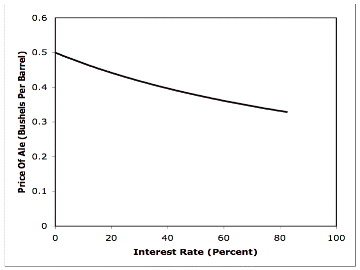
Figure 4-1 graphs the price of ale, as a function of the interest rate, at switch points where both techniques are cost-minimizing. The graph ends at an interest rate of r = (-7/5) + 2 sqrt(31)/5, which is approximately 82.7%. Above this rate, the rent is negative, an economically meaningless case.
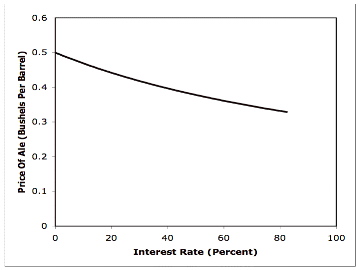
Figure 4-1: Price Of Ale At Switch Points

Notice that at an interest rate of zero, the switching price is one-half bushels per barrel. And this price is numerically identical to the slope, between points a and b, of the Production Possibilities Frontier shown in Figure 3-2. On the other hand, at positive interest rates, this switching price falls below one-half bushels per barrel. It is this deviation of this switching price from the slope of the Production Possibilities Frontier that creates the possibility that when the firms in a country specialize as according to the theory of comparative advantage, the country becomes worse off.
Sunday, May 28, 2006

Unregulated International Trade Unjustified By Comparative Advantage (Part 3)

3.0 Production Possibilities Frontier

3.1 Alpha Techniqe

Suppose 64 barrels ale are produced with the ale-producing process. And suppose 64 bushels corn are produced with the first corn-producing process. This is a matter of scaling the first two processes defined in Table 2-1. The quantity flows shown in Table 3-1 result. In a stationary state, the 64 barrels ale produced just replace the ale used up in in the corn-producing process. Likewise, eight of the 64 bushels corn produced replace the corn used up as a capital good in the ale-producing process. So the net output of this economy with these quantity flows is 56 bushels corn. These processes at this scale use all of the 320 person-years available from the labor force. They do not use all of the available land, but production cannot be increased in these proportions. The labor force provides a binding constraint.

Table 3-1: Quantity Flows for The Alpha Technique Producing Only Corn (14 2/3 Acres Land Unused)
INPUTS HIRED
AT START OF
YEAR
ALE INDUSTRYCORN INDUSTRY
Labor64 Person-Years256 Person-Years
Land72 Acres53 1/3 Acres
Ale0 Barrels64 Barrels
Corn8 Bushels0 Bushels
OUTPUTS64 Barrels Ale64 Bushels Corn
NET OUTPUTS0 Barrels Ale56 Bushels Corn

Tables 3-2 and 3-3 show the results of other levels of production with the two techniques comprising the Alpha technique. In Table 3-2, the available labor force and the available land are fully used. In Table 3-3 some labor remains unused, but the constraint imposed by the fixed amount of land is binding.

Table 3-2: Quantity Flows for The Alpha Technique Producing Both Ale and Corn
INPUTS HIRED
AT START OF
YEAR
ALE INDUSTRYCORN INDUSTRY
Labor80 Person-Years240 Person-Years
Land90 Acres50 Acres
Ale0 Barrels60 Barrels
Corn10 Bushels0 Bushels
OUTPUTS80 Barrels Ale60 Bushels Corn
NET OUTPUTS20 Barrels Ale50 Bushels Corn


Table 3-3: Quantity Flows for The Alpha Technique Producing Only Ale (149 9/59 Person-Years Labor Unused)
INPUTS HIRED
AT START OF
YEAR
ALE INDUSTRYCORN INDUSTRY
Labor113 53/59 Person-Years56 56/59 Person-Years
Land128 8/59 Acres11 51/59 Acres
Ale0 Barrels14 14/59 Barrels
Corn14 14/59 Bushels0 Bushels
OUTPUTS113 53/59 Barrels Ale14 14/59 Bushels Corn
NET OUTPUTS99 39/59 Barrels Ale0 Bushels Corn


I have shown some quantity flows with the Alpha technique being exclusively used. Figure 3-1 shows all such possible quantity flows in which at least one of the land and labor constraints is binding. The intersection of the graphed locus with the ordinate is defined by Table 3-1. The point with a net output of 20 barrels ale and 50 bushels corn is defined by Table 3-2. And the intersection with the abscissa is defined by Table 3-3. The straight line connecting the intersection with the ordinate and the point (20 barrels, 50 bushels) represents a linear combination of the quantity flows shown in Tables 3-1 and 3-2. The other line segment represents a linear combination of the quantity flows shown in Tables 3-2 and 3-3. Any point on this locus or in its interior can be achieved by this economy operating the Alpha technique, given the endowments of labor and land.

Figure 3-1: Production Possibilities Curve For Alpha Technique

3.2 The Frontier

I relegate to the appendix the specification of stationary state quantity flows for the Beta technique. The analysis of those flows produce a locus like that shown in Figure 3-1, but with different intercepts and a different point (a net ouput of 80 barrels and 20 bushels) corresponding to the full employment of both labor and land.

Figure 3-2 shows the Production Possibilities Frontier. The Alpha technique is exclusively used in the portion of the frontier to the left of point a. Less land is employed here than in the endowment of the economy; hence land services are free for this portion of the PPF. The Beta technique is exclusively used in the portion of the frontier below point b. Labor is not a binding constraint for this portion of the PPF; labor services are free. The line segment connecting points a and b represents a linear combination of the Alpha and Beta techniques. Both land and labor are binding constraints along this segment, including at points a and b.

Figure 3-2: Production Possibilities Frontier

The portion of the frontier between points a and b, inclusive, is the focus of the remainder of this series of posts. The relative combinations of ale and corn, produced net, are different along this segment because of differences in the amount of ale and corn produced by the two techniques. Notice the slope of this segment is one-half bushels per barrels. The slope reflects the rate of transformation possible in comparing two autarkic equilibria. Consider two autarkic economies in stationary states facing this technology and these endowments, and suppose both labor and land are fully employed in these economies. One more bushel of corn is consumed in one economy for every two more barrels of ale consumed in the other.

In the next post, I consider prices for this economy, without and with trade. I don't have ask good leading questions here. Consider equilibria (in which both ale and corn are produced by cost-minimizing firms) without trade:
  • If the interest rate is 2% and rent is 1/10 bushels per acre, how would you figure out what the wage and price of ale must be?
  • For every feasible interest rate, what equations must the wage, the rent, and the price of ale satisfy such that cost-minimizing firms will be willing to adopt a linear combination of both techniques? How does the price of ale for this switch point compare to the slope of the Production Possibilities Frontier between points a and b?


Appendix 3.A Quantity Flows For The Beta Technique

Table 3-4: Quantity Flows for The Beta Technique Producing Only Corn (73 1/3 Acres Land Unused)
INPUTS HIRED
AT START OF
YEAR
ALE INDUSTRYCORN INDUSTRY
Labor21 1/3 Person-Years298 2/3 Person-Years
Land24 Acres42 2/3 Acres
Ale0 Barrels21 1/3 Barrels
Corn2 2/3 Bushels0 Bushels
OUTPUTS21 1/3 Barrels Ale42 2/3 Bushels Corn
NET OUTPUTS0 Barrels Ale40 Bushels Corn


Table 3-5: Quantity Flows for The Beta Technique Producing Both Ale and Corn
INPUTS HIRED
AT START OF
YEAR
ALE INDUSTRYCORN INDUSTRY
Labor96 Person-Years224 Person-Years
Land108 Acres32 Acres
Ale0 Barrels16 Barrels
Corn12 Bushels0 Bushels
OUTPUTS96 Barrels Ale32 Bushels Corn
NET OUTPUTS80 Barrels Ale20 Bushels Corn


Table 3-6: Quantity Flows for The Beta Technique Producing Only Ale (110 Person-Years Labor Unused)
INPUTS HIRED
AT START OF
YEAR
ALE INDUSTRYCORN INDUSTRY
Labor112 Person-Years98 Person-Years
Land126 Acres14 Acres
Ale0 Barrels7 Barrels
Corn14 Bushels0 Bushels
OUTPUTS112 Barrels Ale14 Bushels Corn
NET OUTPUTS105 Barrels Ale0 Bushels Corn

Unregulated International Trade Unjustified By Comparative Advantage (Part 2)

2.0 Technology

Consider a very simple economy in which two goods, ale and corn, are produced from inputs of labor, land, and produced ale and corn. Ale and corn are each both consumption and capital goods. All production processes in this example require a year to complete and exhibit Constant Returns to Scale. One process is known for producing ale, and two processes are known for producing corn. These processes are shown in Table 1.

Table 2-1: Production Processes Known Within The Country
INPUTS HIRED
AT START OF
YEAR
ALE
PRODUCING
PROCESS
FIRST CORN-
PRODUCING
PROCESS
SECOND CORN-
PRODUCING
PROCESS
Labor1 Person-Year4 Person-Years7 Person-Years
Land9/8 Acre5/6 Acre1 Acre
Ale0 Barrels1 Barrel1/2 Barrel
Corn1/8 Bushel0 Bushels0 Bushels
OUTPUTS1 Barrel Ale1 Bushel Corn1 Bushel Corn

Assume that endowments of labor and land are given for this economy. In particular, the firms in this economy have access to 320 person-years of labor and 140 acres of (homogeneous) land.

In short, this economy uses two primary factors, labor and land, to produce a net output of two consumption goods, ale and corn. This example differs from misleading introductory textbook models of comparative advantage in that the use of produced capital goods is shown explicitly.

A technique consists of the ale-producing process and exactly one of the corn-producing processes. The technique in which the first corn-producing process is used is called the Alpha technique. The other technique is called the Beta technique. Given the technique and the required consumption goods, one can calculate the levels at which each process in the technique must operate to produce these consumption goods in a stationary state. The amount of labor and land constrains the maximum net output in a stationary state. Economies in a stationary state with this technology and these endowments can consume more ale if they consume less corn. In other words, ale and corn can be traded off in this sense. How would you construct the Production Possibilities Frontier from the above data on technology and endowments to show this trade-off? Does your construction show a linear combination of the two techniques along the frontier?

Unregulated International Trade Unjustified By Comparative Advantage (Part 1)

1.0 Introduction

Why are tariffs, protectionism, etc., bad ideas - at least according to incorrect introductory mainstream economics teaching? Because of the theory of comparative advantage. This series of five posts demonstrates this argument is logically invalid when applied to an economy with produced capital goods and a positive interest rate. I explain a numerical example illustrating the argument in Metcalfe and Steedman (1974).

That is, economists have known for almost a third of a century that the theory of comparative advantage does not justify a lack of tariffs. Most economists have just shamefully ignored this argument.

Consider equilibrium prices in an autarkic economy. These prices convey to agents seemingly possible rates of transformation between, say, corn and ale. Prices on the international market may differ from these autarkic equilibrium prices. If so, the (firms in the) country under consideration will end up specializing somewhat in the production of those commodities in which the country has a comparative advantage. And this comparative advantage is determined by comparing equilibrium autarkic prices with prices on the international market.

On the other hand, consider the Production Possibilities Frontier constructed for the economy in an autarky. The slope of this frontier at any point shows the rate of transformation in the economy between commodities when nobody in the country engages in international trade. This frontier is constructed from data on technology and information on the quantity of resources available; prices do not enter into its construction. Deviations of equilibrium autarkic prices from the slope of this frontier create the possibility that a country specializing according to the theory of comparative advantage may be worse off. The imposition of a tariff can change the incentives of agents and shift the frontier outward in such a case.

Suppose commodities are produced with inputs that are themselves the result of prior production. That is, capital goods are used in production. And suppose the rate of interest is positive. Then deviations between equilibrium autarkic prices and the slope of the Production Possibilities Frontier can arise. A country may be worse off when the firms in that country engage in international trade under such circumstances. A numerical example demonstrates this point.

References
  • Metcalfe, J. S. and Ian Steedman (1974). "A Note on the Gain From Trade", Economic Record (Reprinted in Fundamental Issues in Trade Theory (edited by Ian Steedman), Macmillan, 1979.)

Is This SF?

I have been reading Thomas More's Utopia. If one classifies it as a novel in the same category as Edward Bellamy's Looking Backward, then it seems it is science fiction. If one thinks of it as like Plato's Republic, then not so much.

More's narrator praises communism:
Now I have described to you, exactly as I could, the structure of that commonwealth which I judge not merely the best but the only one which can rightly claim the name of commonwealth. Outside Utopia, to be sure, men talk freely of the public welfare - but look after their private interests only. In Utopia, where nothing is private, they seriously concern themselves with public affairs. Assuredly in both cases they act reasonably. For outside Utopia, how many are there who do not realize that, unless they make some separate provision for themselves, however flourishing the commonwealth, they will themselves starve? For this reason, mecessity compels them to hold that they must take account of themselves rather than of the people, that is, of others.

On the other hand, in Utopia, where everything belongs to everybody, no one doubts, provided only that the public granaries are well filled, that the individual will lack nothing for his private use. The reason is that the distribution of goods is not niggardly. In Utopia there is no poor man and no beggar. Though no man has anything, yet they are all rich.

For what can be greater riches for a man than to live with a joyful and peaceful mind, free of all worries - not troubled about his food or harassed by the querulous demands of his wife or fearing poverty for his son or worrying about his daughter's dowry, but feeling secure about the livelihood and happiness of himself and his family: wife, sons, grandsons, great-grandsons, great-great-gransons, and the long line of their descendants that gentlefold anticipate? Then take into account the fact that there is no less provision for those who are now helpless but once worked than for those who are still working.

At this point I should like anyone to be so bold as to compare this fairness with the so-called justice prevalent in other nations, among which, upon my soul, I cannot discover the slightest trace of justice and fairness. What brand of justice is it that any nobleman whatsoever or goldsmith-banker or moneylender or, in fact, anyone else from among those who do no work at all or whose work is of a kind not very essential to the commonwealth, should attain a life of luxury and grandeur on the basis of his idleness or his nonessential work? In the meantime, the carter, the carpenter, and the farmer perform work so hard and continuous that beasts of burden could scarcely endure it and work so essential that no commonwealth could last even one year without it. Yet they earn such scanty fare and lead such a miserable life that the condition of beasts of burden might seem far prefereable. The latter do not have to work so incessantly nor is their food much worse (in fact, sweeter to their taste) nor do they entertain any fear for the future. The workmen, on the other hand, not only have to toil and suffer without return or profit in the present but agonize over the thought of an indigent old age. Their daily wage is too scanty to suffice even for the day: much less is there an excess and surplus that daily can be laid by for their needs in an old age...

...What is worse, the rich every day extort a part of their daily allowance from the poor not only by private fraud but by public law. Even before they did so it seemed unjust that persons deserving best of the commonwealth should have the worse return. Now they have further distorted and debased the right and, finally, by making laws, have palmed it off as justice.

This passage reminds me of the surplus approach to the theory of value and distribution:
Since they devote but six hours to work, you might possibly think the consequence to be some scarcity of necessities. But so far is this from being the case that the aforesaid time is not only enough but more than enough for a supply of all that is requisite for either the necessity or the convenience of living. This phenomenon you too will understand if you consider how large a part of the population in other countries exists without working. First, there are almost all the women, who constitute half the whole; or, where the women are busy, there as a rule the men are snoring in their stead. Besides, how great and lazy is the crowd of priests and so-called religious! Add to them all the rich, especially the masters of estates, who are commonly termed gentlemen and noblemen. Reckon with them their retainers - I mean, that whole rabble of good-for-nothing swashbucklers. Finally, join in the lusty and sturdy beggars who make some disease an excuse for idleness. You will certainly find far less numerous than you had supposed those whose labor produces all the articles that mortals require for daily use.

Now estimate how few of those who do work are occupied in essential trades. For, in a society where we make money the standard of everything, it is necessary to practice many crafts which are quite vain and superfluous, ministering only to luxury and licentiousness. Suppose the host of those who now toil were distributed over as few crafts as the few needs and conveniences demanded by nature. In the great abundance of commodities which must then arise, the prices set on them would be too low for the craftsmen to earn their livelihood by their work. But suppose all those fellows who are now busied with unprofitable crafts, as well as all the lazy and idle throng, any one of whom now consumes as much of the fruits of other men's labor as any two of the workingmen, were all set to work and indeed to useful work. You can easily see how small an allowance of time would be enugh and to spare for the production of all that is required by necessity or comfort (or even pleasure, provided it is genuine and natural).

Wednesday, May 24, 2006

Corn Models

D-Squared recommends my blog. I showed this to one of my colleagues, and he had trouble reading to the end, what with laughing and all. I suppose he liked this:
"Sraffians also have a frightening habit of creating 'simple examples' to illustrate their system; this is Sraffian for 'something which starts off by calmly claiming that there are two goods called corn and iron, and five minutes later has ballooned into a wretchedly complicated optimisation problem with no differentiable production function, no equilibrium and all sorts of strange terminology, illustrated with a graph that is if anything more incomprehensible than the model'."

D-Squared is talking about examples like in this series of posts. The equilibrium here is my add-on to Garegnani, but I suppose some find Figures 5 or 6, for example, drawn to D-Squared's specs.

When Sraffians talk about the "corn model", however, they usually are referring to something different. They are talking about the interpretation of Ricardo Sraffa puts forward in his (and Dobb's) introduction to the first volume of The Works and Correspondence of David Ricarod (otherwise known as Ricardo's On the Principles of Political Economy and Taxation).

The model on page xxxi of the introduction is easily explained. Consider an economy in which a single agricultural commodity, "corn", is produced. Suppose the capital goods used up in producing corn consist solely of corn (i.e., seed corn). And suppose workers are paid solely corn, which is treated as exogeneously specified, at least as far as the theory of value goes. Profits in agriculture, the excess of the corn produced in the year over the corn advanced for seed and wages, also consist of a physically specified quantity of corn. So you can see that the rate of profits is physically determined in agriculture. In industry, outputs and inputs are heterogeneous, since wages are still in terms of corn and outputs are some other commodity. Thus, if a tendency exists for a common rate of profits to be established among all sectors in an economy, the prices of manufactured commodities must adjust to bring the rate of profits in industry to equality with that in agriculture.

This model helps Sraffa explain Ricardo's interest in the Labor Theory of Value. Workers consume a mixture of commodities, and Malthus insisted that in no industry are the advances and output composed of the same commodity. But if one evaluated commodities in terms of the labor embodied in them, one could form a physical ratio of labor values of the ouput of agriculture (on marginal land) and the labor values of the capital advanced, including the labor value of wage goods. Thus, if the Labor Theory of Value were true, Ricardo would be able to retain the insights of the corn model.

Sraffa explicitly states the corn model "is never stated by Ricardo in any of his extant letters and papers." Sraffa hypothesizes Ricardo put forward the corn model in lost letters and papers in March 1814 or in oral conversations with Malthus. All interpretations of "what Ricardo really meant" have been hottly disputed in the last third of a century or so. Probably Samuel Hollander is the most learned opponent of Sraffa's interpretation to read. It doesn't help matters that Ricardo and Malthus, in their letters, would often formulate their claims in terms of (what they took to be) the other's system. This makes it very confusing to figure out who is claiming what, instead of merely echoing back what they think their opponent is saying. They probably sometimes confused themselves.

Tuesday, May 23, 2006

Should I Be Delighted With More To Read?

I've started to look into just a few of the many articles now on-line from the Socialist Register (announced by Crooked Timber and The Virtual Stoa).

In a 1968 piece by Ralph Miliband, "Professor Galbraith and American Capitalism", Miliband criticizes The New Industrial State. Miliband thinks the owner of firms are still in the driver's seat. According to Miliband, Galbraith's thesis of the rising power of the technostructure is false. And it serves a function as apologetics for capitalism.

In my my earlier appreciation of John Kenneth Galbraith, I tried to mention aspects of Galbraith's thought that have stood the test of time. I took no position on the technostructure.

But consider. Piketty and Saez (2006), "The Evolution of Top Incomes: A Historical and International Perspective", show that composition of income in the top 0.01% in the U. S. is increasingly salaries, and a corresponding lower proportion is returns to capital. Is this not evidence suggesting that ownership of large corporations has become of lesser importance? To conclude that technical knowledge is a more important source of power than merely being a top-level manager would take some further evidence.

Monday, May 22, 2006

Upcoming Posts, Maybe

I'm thinking about posting on:
  • Recent empirical results on the labor theory of value
  • A collection of recent papers from Ian Steedman demonstrating the falsity and incoherence of mainstream textbook partial equilibrium results
  • A numerical example demonstrating that the theory of comparative advantage (given static technology, perfect competition, etc.) does not justify unregulated international trade in consumer goods
  • Some implications of the Cambridge Capital Controversy for General Equilibrium temporary equilibrium models
  • Some errors in Austrian theory and their implications for Austrian Business Cycle Models
For the last two, I might take a while since I'm thinking of improving draft papers.

Update: I want to remind myself to post an explanation of why no such thing as the marginal productivity theory of value exists.

Sunday, May 21, 2006

Against Reification Of Property Rights (Part 3)

This continues some reflections on themes in Dean Baker's The Conservative Nanny State.

In practice, Austrian economics is frequently cited as justification for greed by many people who are just not very bright. But some of those who developed the doctrine were more sophisticated than many of those you encounter on the 'net who imagine they are followers of this school.

For Hayek, capitalism is a system in which many people work together to produce commodities, even though they may be unaware of one another's existence. This extended order did not come about through design, but through the evolution of institutions.

In The Fatal Conceit, Hayek argues that private property (which he calls "several property") is not natural, in that it is not innate or instinctual. Nor is it artificial, in that it is not consciously designed. Hayek rejects this dichotomy, as it does not apply to evolved institutions. Further, in Hayek's view, room exists for further adaptation and experimentation:
"The institutions of property, as they exist at present, are hardly perfect; indeed, we can hardly yet say in what such perfection might consist. Cultural and moral evolution do require further steps if the institution of several property is in fact to be as beneficial as it can be." -- Hayek (1988)

I take from Hayek that the distribution of income that comes out of capitalism can be said to be neither "just" nor "unjust". I think one can propose a change to property rights, in conformity to Hayek's view, with a view to affecting the distribution of income, as long as those changed rules remain impersonal:
"...in a system of free enterprise chances are not equal, since such a system is necessarily based on private property and (though perhaps not with the same necessity) on inheritance, with the differences in opportunity which these create. There is, indeed, a strong case for reducing this inequality of opportunity as far as congenital differences permit and it is possible to do so without destroying the impersonal character of the process by which everybody has to take his chance and no person's view about what is right and desirable overrules that of others." -- Hayek (1944)

Other Austrians also argue against the naturalization of property rights:
A property system may work well for a society with a specific technology, population density, and so forth, and may have to be modified as these features change. People raised in societies in which private property is highly developed may tend to hold a simplistic view of the nature of 'ownership'. Since 'ownership' (a typical bundle of rights related to some resource) becomes standardized, and incorporates the lessons of centuries of legal cases in tending to bring all the most relevant aspects of a single good under the same owner, 'ownership' comes to be seen as a straightforward, unproblematical relationship between a person and a material thing. Of course, we are all aware that ownership is frequently modified, as for instance, ownership of a piece of land by government zoning regulations, but there is a tendency to think of these regulations as leaving something called 'ownership' essentially unchanged.

Without prior education, someone coming from a technologically-advanced culture in which private property is prominent may be confused by the property rules found in more technologically primitive societies. She may find, for example, that the system of property rights in land is unlike that of private property, and she may be tempted to say that 'they don't have a concept of land ownership' or alternatively that 'their concept of land ownership is different to ours'.

The same person will, however, frequently also have an oversimple view of the meaning of 'ownership' in her own culture. Consider two adjoining pieces of land 'owned' by different individuals. Ownership of one of these pieces of land may or may not give one the right to: burn a fire sending smoke over the adjoining land; pump water from an underground reserve, lowering the water availability in the adjoining land; allow animals (mice, rats, lions) to proliferate on one's own land and thus invade the adjoining land; erect a tall building blocking out sunlight from the adjoining land; shine a light (a candle or a floodlight) that can be seen from the adjoining land; and so forth. According to such variations, the exact meaning of 'owning a piece of land' varies. (Steele 1992: 181-182)

References
  • Hayek, Friedrich A. (1944). The Road To Serfdom
  • Hayek, F. A. (1988). The Fatal Conceit: The Errors of Socialism (Ed. by W. W. Bartley III)
  • Steele, David Ramsay (1992). From Marx to Mises: Post-Capitalist Society and the Challenge of Economic Calculation, La Salle, IL: Open Court