Monday, October 02, 2006

Interest Rate Unequal To Marginal Product Of Capital (Part 2 Of 4)

2.0 Some Relationships Among Aggregate Variables
Consider a very simple capitalist economy in which the value of all net output is distributed as wages or (accounting) profits:
(1)
where Y is net output, W is total wages, and P is total profits. The term "profits" is used in some economic traditions to mean what some neoclassical economists call "interest". If this causes confusions, read "profit" as "interest" throughout this essay, except where "economic profit" is used.

If there is some homogeneous unit in which to measure the labor force (person-years), the wage w is related to total wages as in Equation 2:
(2)
where L is the number of person-years employed. Similarly, if the capital K used up in a year can be valued in the same units as output, total profits relate to the interest rate r as in Equation 3:
(3)
Equations 1, 2, and 3 are accounting identities, true by definition. No assumptions have been made yet about how any of these variables are determined.

Continuing with the manipulation of accounting identities, one can transform Equation 1 to Equation 4:
(4)
Or:
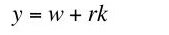
(5)
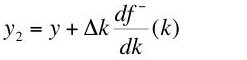
where y is net output per head and k is the value of capital per head. Note that the value of output per head, the wage, and the value of capital per head are all measured in the same units, say bushels of wheat. The interest rate is a percentage rate with no units attached (other than, perhaps, an implicit time dimension).

Some neoclassical economists relate net output to inputs of labor and capital by means of an aggregate production function, which, when written in per capita form looks like Equation 6:
(6)
The function f is supposed to satisfy certain assumptions that characterize Constant Returns to Scale and diminishing marginal returns to each factor. Given these assumptions and perfect competition, cost minimization (or the maximization of economic profit) is supposed to ensure the equilibrium conditions given by Equations 7 and 8:
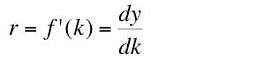
(7)
(8)
Equation 7 shows the interest rate is equal to the marginal product of capital, while Equation 8 shows an equality between the wage and the marginal product of labor [3]. I intend to challenge Equation 7 in a framework that includes Equations 5, 6, 7, and 8.

The argument for the aggregate production function, when written in per capita form, is the value of capital per head. How can the value of capital per head vary? Consider a multi-commodity model in a steady state. Suppose the same technique is adopted at different interest rates. The corresponding price structure will vary with the interest rate. Even though the same capital goods may be used at different interest rates, the value of capital per head will differ with the interest rate. This variation in the value of a given set of capital goods with the interest rate is known as a price Wicksell effect.

Typically, though, the cost-minimizing technique will also vary with the interest rate. Consider the prices ruling at a given interest rate, where that interest rate is a switch point. That is, at least two techniques are cost minimizing at the given interest rate. We can then consider variations in capital goods resulting from a variation in the usage of two cost minimizing techniques. The resulting variation in the value of capital per head at the given prices is known as a real Wicksell effect. The chain-rule for differentiation shows how the price and real Wicksell effects combine to determine the total variation in the value of capital per head with the interest rate [4].

For completeness, I note there is a third manner in which the value of capital per head can vary, namely if the composition of final output varies, for example, due to a difference in the rate of growth. This possibility is not important to my argument.

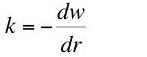
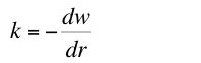
Now I want to prove a theorem by some simple formal manipulations. Given Equation 5, the marginal product of capital is equal to the interest rate (Equation 7) if and only if Equation 9 holds [5]:
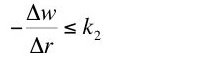
(9)
Proof: Equation 10 gives the total differential of both sides of Equation 5:
(10)
Thus, the interest rate is equal to the marginal product of capital (Equation 7) if and only if Equation 11 holds:
(11)
Equation 9 follows. Q.E.D.

A demonstration that the value of capital per head need not be equal to the additive inverse of the slope of the factor price frontier (Equation 9) demonstrates that the interest rate need not be equal to the marginal product of capital (Equation 7).

Footnotes
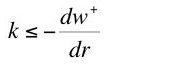
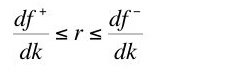
[3] A more general statement of these relations, abstracting from price Wicksell effects, is given by Equations 7' and 8' in terms of left-hand and right-hand derivatives:
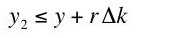
(7')
(8')
In the discrete case without price Wicksell effects, the neoclassical aggregate production function is supposed to resemble the function in Figure 1.
Figure 1: Interest Rate Bounded By Marginal Products


[4] A good explanation of price and real Wicksell effects can be found in:
  • Edwin Burmeister, "Wicksell Effects," The New Palgrave.
Burmeister writes:
"The value of capital, however, is not an appropriate measure of the 'aggregate capital stock' as a factor of production except under extremely restrictive assumptions. Wicksell (1893, 1934) originally recognized this fact, which subsequently was emphasized by Robinson (1956)."


[5] Equation 9 follows from Equation 7' at a non-switching point in the discrete case. Consider a second set of values of y, w, r, and k, related as in Equation 5:
(I)
The difference between these two sets of values is given by Equation II:
(II)
Or, in obvious notation:
(III)
Assume Equation 7' holds. Two cases arise.

Case 1: . By diminishing marginal productivity, one also has . Ignoring higher order terms, the production function is:
(IV)
From Equation 7', one has:
(V)
Or:
(VI)
Substitute from Equation III:
(VII)
A little algebra yields:
(VIII)
Take the limit as the value of capital per head approaches k from above (and therefore the interest rate approaches r from below):
(IX)


Case 2: and thus Ignoring higher order terms, one has:
(X)
The inequality in Display V follows, once again, from Display 7'. An argument parallel to the first case yields the inequality in Display XI:
(XI)
The left-hand and right-hand derivatives of the factor-price frontier are equal at a non-switching point in the discrete case. The two cases establish that that derivative is equal to the value of capital per head:
(XII)
which was to be shown.

Interest Rate Unequal To Marginal Product Of Capital (Part 1 Of 4)

"Then Buddha said: ... But tell me, Subhuti, do you really believe that having only one homogeneous capital good will permit you to derive a rate of profit purely from the technical relationship between homogeneous capital and output?

Subhuti replied: Thus it is said in some venerable books.

Buddha said: Revere them, Subhuti, but trust them not. Suppose you do get the value of the marginal product of capital in terms of output of consumer goods. In what units will it be expressed? Physical units of additional consumer goods per unit of additional homogeneous capital. But the rate of profit is a pure number. Surely you will need something more in going from the first to the second to reflect the relative price of the capital good vis-a-vis the consumer good. But the equilibrium price of capital in units of consumer goods depends on the rate of profit used for discounting, and a variation of the rate of profit can involve a variation of the value of the same physical capital in units of consumer goods. This difficulty is not eliminated by having one homogeneous good." -- Amartya Sen (1974). "On Some Debates in Capital Theory", Economica V. 41 (August)

1.0 Introduction
This essay demonstrates that the existence of price Wicksell effects can lead to the inequality of the marginal product of capital and the interest rate. The equality being challenged here should be understood as it is used in macroeconomic models with aggregate production functions. That is, macroeconomic modeling with aggregate production functions is inadequately grounded in microeconomic theory. I conclude with some rather far-reaching possibilities.

The length of my exposition here results from my attempting to clarify several points of confusion exhibited by economists responding on Usenet to previous versions. This argument is well-established in the literature [1]. I suggest that those who think this argument mistaken should take a look at some of my references. If my argument were mistaken, demonstrating the mistake would be worthy of a paper.

I claim this argument is not about index number problems or the aggregation of capital [2]. I also do not see how it relates to the aggregation of production functions. Those who believe otherwise are encouraged to be explicit about the connections. Perhaps, the question, from a neoclassical perspective, is how the services of capital goods are related to the quantity of "waiting" they supposedly represent.

Footnotes
[1] Elements of this argument can be found in Joan Robinson's 1953-1954 article "The Production Function and the Theory of Capital," Review of Economic Studies, 1953-4 and Geoff Harcourt (1972), Some Cambridge Controversies in the Theory of Capital. The closest formulation to my argument is in the following papers:
  • Amit Bhaduri (1966). "The Concept of the Marginal Productivity of Capital and the Wicksell Effect," Oxford Economic Papers, XVIII: 284-288
  • Amit Bhaduri (1969). "On the Significance of Recent Controversies on Capital Theory: A Marxian View," Economic Journal, LXXIX: 532-539
But the argument was also in Sraffa. See, for example:
  • Piero Sraffa (1962). "Production of Commodities: A Comment," Economic Journal, V. LXXII (June): 477-9.
Here is one expositor of Sraffian economics:
"Now a major problem existed because capital, unlike either labor or land, is a produced means of production and cannot be measured unambiguously in purely physical terms: the amount of capital can be measured only in value terms. The problem was to establish the idea of a market for capital, the quantity of which could be expressed independently of the price of its service (i.e. the rate of profit)... The basic deficiency with this approach is in its treatment of capital, which cannot be measured independently of the rate of profit. As observed above, the value of capital, like that of all produced commodities, depends on the rate of profit, or interest." -- J. E. Woods (1990). The Production of Commodities: An Introduction to Sraffa, Humanities Press International: 306-307

[2] The divergence between the marginal product of capital and the rate of interest
"is attributable to the fact that it is impossible to find an invariant unit in which to measure the social quantity of capital.

To put the matter another way, we may say that a change in the supply of capital - arising, for example, from new voluntary savings - alters the units in which all the previously existing capital is measured; and it is therefore incorrect to say that the supply of capital as a whole has increased by the amount of the voluntary saving. It is important to emphasize that this problem of measuring the quantity of capital is not an index-number problem. There are, to be sure, numerous index-number problems of the greatest complexity in the theory of capital. But the problem to which I now refer would exist even in the simplest economy in which all output consisted of a single type of consumer's good and firms were exactly alike." -- L. A. Metzler (1950). "The Rate of Interest and the Marginal Product of Capital," Journal of Political Economy, Vol. 53: 284-306
Metzler provides a brief literature review of awareness of this problem going back to Wicksell. My analysis is closest to his comments on Knight's capital theory, though I think my presentation is clearer.

Sunday, October 01, 2006

Do Patents And Copyrights Spur Innovation?

An expert on United States law on intellectual property tells me a National Academy of Sciences study found empirical evidence suggesting the answer is "Yes" to the question in the post title. Presumably, he was referring more to the former than the latter of:I've downloaded the executive summaries, but I doubt I will purchase these reports.

Apparently if I go longer between posts, commentators will have more to say on each one.

Thursday, September 21, 2006

Break In Blogging

I will be on travel for a week or more starting, I guess, Saturday. And I don't expect to blog in that time.

I feel I am tardy in acknowledging comments. Given this tardiness, I'm more than happy when commenters are discussing topics among themselves.

Wednesday, September 20, 2006

Does Studying Mainstream Economics Make You A Bad Person?

(I had the title and the next three paragraphs written before Radek's comments today.)

Experimental evidence on the topic suggests a disquieting affirmative answer. Specifically, I refer to "Does Studying Economics Inhibit Cooperation", by Robert H. Frank, Thomas Gilovich, and Dennis T. Regan (Journal of Economic Perspectives, V. 7, N. 2 (Spring 1993): 159-171)

I believe that more up-to-date work exists in this vein. I was able to quickly locate a reference to "Does Studying Economics Discourage Cooperation? Watch What We Do Not What We Say or How We Play", by Yetzer, Goldfarb, and Poppen (Journal of Economic Perspectives, V. 10, N. 1 (1996): 177-186). (I haven't read this.)

But look at the URL for that copy of the Frank, Gilovich, and Regan paper. Why should Richard Stallman want more people to know of their findings? What does this have to do with open-source and free (as in "freedom") software?

Perhaps if I browsed around the proceedings of one of the Wizard of OS conferences, I would see some connection between advocating open source and being anti-mainstream economics. Given the interests of at least one of my readers, I want to note that Lawrence Lessig is the keynote speaker for this year's conference, which just ended.

Monday, September 18, 2006

At SSRN And Mankiw's Blog

I have finally completed the first draft of my paper Some Fallacies of Austrian Economics. I wonder if the historical documentation is too extensive for it to be accepted by some journal somewhere. On the other hand, I suppose some Austrians might like some text between equations.

I have been amused by watching commentators on Greg Mankiw's blog be unable to register that some might doubt that minimum wages above the (?) market-clearing wage cause unemployment.

Where Do Correct Ideas Come From? Do They Drop From The Skies?

Have the ideas that mainstream economists teach and apply won out against alternatives in intellectual debate? Perhaps modern economics has been shaped by interventions with a non-cognitive basis.

Academics have one well-established method for writing books. They can try out chapters as articles, thereby seeing what reviewers find convincing and where reviewers think the argument needs strengthening. Maybe Fred Lee is working on a book about the sort of interventions mentioned above and counter-hegemonic movements within academic economics:
  • Lee, Frederick S. (2000a). "Conference of Socialist Economists and the Emergence of Heterodox Economics in Post-War Britain", Capital and Class, V. 75: 15-39
  • Lee, Frederick S. (2000b) "The Organizational History of Post Keynesian Economics in America, 1971-1995", Journal of Post Keynesian Economics, V. 23, N. 1 (Fall): 141-162
  • Lee, Frederick S. (2002). "Mutual Aid and the Making of Heterodox Economics in Postwar America: a Post Keynesian View", History of Economics Review: 45-62
  • Lee, Frederick S. (2004a). "History and Identity: The Case of Radical Economics and Radical Economists, 1945-70", Review of Radical Political Economics, V. 36, N. 2 (Sprong): 177-195
  • Lee, Frederick S. (2004b). "To Be a Heterodox Economist: The Contested Landscape of American Economics, 1960s and 1970s", Journal of Economic Issues, V. XXXVIII, N. 3 (September): 747-763
  • Lee, Frederick S. and Sandra Harley (1998). "Peer Review, the Research Assessment Exercise and the Demise of Non-Mainstream Economics", Capital and Class: 23-51
  • Mata, Tiago and Frederick S. Lee (2006). "Making Visible What is Hidden: The Role of Life Histories in Writing the History of Heterodox Economics", 19th Annual Conference of the History of Economic Thought Society of Australia, Ballarat, Victoria (4-7 July)
  • Tymoigne, Eric and Frederick S. Lee (2003-4). "Post Keynesian Economics Since 1936: A History of a Promise that Bounced?", Journal of Post Keynesian Economics, V. 26, N. 2 (Winter): 273-287

Saturday, September 16, 2006

Contradiction In Arrow-Debreu Model Of Intertemporal Equilibrium?

This post looks at just one problem with the Arrow-Debreu model.

The data of the Arrow-Debreu model of intertemporal equilibrium include the initial quantities, that is, the endowments of all commodities. This specification includes the distribution of these endowments, a statement of who owns what. Some of these endowments are unproduced natural resources which yield services over future time periods in the model. Other endowments can be conceptualized as capital goods, as produced means of production.

In the model, markets clear once, at the beginning of time. The commodities traded in markets include promises to deliver specified commodities at specified dates in the future, perhaps contingent on the state of the world. In the full model, one can purchase now a contract to have delivered any specificied commodity at any date in the future. So market-clearing in this model implies that plans are pre-coordinated. No room exists for expectations about the future to be disappointed.

Where do the capital goods in existence at the beginning of time in the Arrow-Debreu model come from? Presumably, they were manufactured in a prior time period not formally modeled. Some entrepreneurs, with plans and expectations held before the start of time, were directing production toward the time in the model. The initial capital goods embody those plans and expectations. But, in the model, the relative quantities of those goods is arbitrary. For example, an endowment can be in excess supply, with an equilibrium price of zero. This arbitrariness seems to imply that those unmodeled past expectations and plans can be mistaken.

So the Arrow-Debreu model describes a world in which agents have made mistakes in the past and some plans made in the past have been toppled. But the plans and the expectations made now will be found correct forever in the future. It is a model in which agents must both have correct expectations and in which they can have mistaken expectations.

You can find in the literature comments on Joan Robinson's puzzlement at being given the Arrow-Debreu of intertemporal equilibrium as the answer to her question about what is the general neoclassical theory of value. She complained that she wanted to have a model that she could make stand up before she knocked it down. And she would ask, if the economy was not in equilibrium yesterday, why would you expect it to be in equilibrium tomorrow?

Suppose one models the economy as starting with an arbitrary set of capital goods, that is, with a short run model. Perhaps part of the data should then be the expectations, some of which are being disappointed, with which those capital goods were manufactured.
  • Gerard Debreu, Theory of Value: An Axiomatic Analysis of Economic Equilibrium, Yale University Press, 1959.

Friday, September 15, 2006

Sraffa or Marx?

I think I'll demonstrate that a range of views exists on the relation of the ideas of Sraffa and the Sraffians to the ideas of Marx. I think Ben Fine is expressing a fairly traditional Marxist view:
"Volume III of Capital addresses the distribution of surplus value but not in the simple sense of who gets how much. Note, however, that even this superficial interpretation presupposes, correctly in line with Marx's method, that the surplus value has to be produced before it is distributed. If, though, the distribution is simply interpreted as a cake-division exercise, as in the (neo-)Ricardian (or Sraffian) interpretations, then the concepts of surplus value and profit collapse and the former simply servers as a superfluous accounting exercise. In contrast, Marx deals with distribution of surplus value as a refinement of value. The results of the previous Volumes are brought together and used to develop more complex and concrete categories in terms of the economic processes by which production and exchange are integrated." -- Ben Fine (2001)
I am amused by Alan Freeman (who is the co-inventor of a new mathematical economics interpretation of Marx):
"Variant b of step 7: the Value System is primary
We know values are primary because of all Marx's qualitative arguments concerning the nature of exchange, because of a wealth of empirical evidence, and because of many philosophical and socio-political arguments on the role of human labour. Let us therefore take the 'primary causal' role of value as an axiom. Let us postulate that, against substantial evidence from the texts, Marx unconditionally asserted that the value of every commodity is determined without the mediation of money.

This leads to a veritable garden of forking paths. We can discern at least the following variants

Variant 7b.I: philosophico-mystical
The determination of price by value takes place behind our backs. It is part of the internal workings of the capitalist system which are ever so mysterious and can only be understood by reciting das Kapital six times before breakfast and joining my group. There is no such thing as the transformation problem and it doesn't matter that the figures don't add up, but you wouldn't understand that because you are a bourgeois revisionist.

Variant 7b.II: pseudo-dialectical
The determination of prices takes place as the Sraffians describe it, and the determination of values takes place as Marx describes it. This can only be understood by reciting das Kapital twelve times before breakfast and joining my study circle. It is true that the figures don't add up, but that is because capital is inherently contradictory, and you should learn to live with it. You can't understand that because you haven't read Hegel.

Variant 7b.III: fake materialist
As Marx explains, the forces of production determine everything. This as Plekhanov explains is the basis of historical materialism. What Marx meant by the determination of value by labour time was the determination of value by technology as you will realize if you read Sraffa and buy my newspaper. The figures do add up. You do not understand this because you are not a worker." -- Alan Freeman (1996)
This is one Sraffian view:
"Therefore, to grasp the essence of the Sraffian revolution it is necessary to define more clearly Sraffa's position in regard to the classical and Marxian approach. The point is that a 'classical-Marxian approach' does not exist, if it is true that Marx considered himself to be a critic of Ricardo and Smith. In other words, was Sraffa a 'neo-Ricardian', as some orthodox Marxists and some orthodox neoclassical economists have argued? Or was he a Marxist, as many of his followers maintained?

The level of abstraction of Sraffa's model is defined, albeit with the usual cryptic conciseness, by Sraffa himself, in the subtitle of his book: Prelude to a Critique of Economic Theory. It is the same as the first chapter of Capital, which is entitled 'The commodity', and which is the real prelude to the Critique of Political Economy. In that chapter, Marx tackled the analysis of the commodity and its value, and laid down the theoretical bases of all his successive work; he attacked the 'vulgar economists', whom he accused of looking for the explanation of the value of goods in exchange relations; and he linked himself explicitly to Ricardo in looking for it, instead in the production sphere.

However, even though Marx had clearly pointed out that value is a social phenomenon, Ricardo's influence induced him to determine the value of goods by ignoring the capitalist form in which they are produced. Value, according to the theory set out in the chapter on 'Commodities', depends solely on the quantity of labour employed in its production, its social determination being reduced to the way in which society allocates working activity among the various industries. In other words, value is not influenced by the way in which production is socially structured, nor by the way in which the social classes face each other in the production sphere. Thus, for example, the value of the social product does not depend on the way in which the product is distributed - a clear reminder of the Ricardian claim to measure value by making it independent from the variations in distribution. It is obvious that, in order to reach such a result, Marx had to rely on a high level of abstraction, and it is almost paradoxical that a book on 'capital' opens with a chapter in which capital is ignored. Now, it is almost as if Sraffa had rewritten that chapter, trying to reach the maximum level of abstraction, from returns to scale, growth, disequilibrium adjustments, even from the specific institutional structure to which the type of capitalist set-up may conform historically - exactly as in the chapter on 'Commodities'. However, he made it clear once and for all that the only thing which it is impossible to ignore in determining the value of commodities produced in a capitalist economy, is the fact that they are produced in capitalist conditions: that it is meaningless to abstract from the wage, as Marx did in that chapter. In other words, Sraffa took Marx seriously in his treatment of value as a social phenomenon - so seriously that he distanced himself from Ricardo more than Marx did himself.

It seems possible to conclude that, while on the subject of the determination of profit, Sraffa's theory does not bring to light any basic analytical differences between Ricardo and Marx, on the subject of value his work can be read in only one way: the Prelude to a Critique of Economic Theory seems to us just like a first chapter of Capital which Marx would have written if he had been a little less Ricardian and a little more Marxist." -- Ernesto Screpanti and Stefano Zamagni (2005, p. 445-446)
References
  • Fine, Ben (2001). "The Continuing Imperative of Value Theory", Capital and Class, V. 75: 41-52
  • Freeman, Alan (1996). "The Psychopathology of Walrasian Marxism", in Marx and Non-Equilibrium Economics (Edited by Alan Freeman and Guglielmo Carchedi), Edward Elgar
  • Screpanti, Ernesto and Stefano Zamagni (2005). An Outline of the History of Economic Thought, Second Edition, Oxford University Press

Wednesday, September 13, 2006

Expertise Devalued At Wikipedia

I have some knowledge about how 20th century English-speaking mathematical economists have treated the labor theory of value. The transformation problem is a central focus of discussions of whether the theory is internally consistent.

I have previously mentioned my dissatisfaction with the evolution of the Wikipedia entry on the Labor Theory of Value. But consider the transformation problem.

At one point, (29 July 2005) the entry was mainly written by Mario Ferretti. Although he describes neither the New Interpretation nor the Temporal single system approach adequately for my taste, I have no doubt about his expertise on linear production models. He's written, for example, "The Neo-Ricardian Critique: An Anniversary Assessment", (University of Rome seminar, 26 October 2004). This is not the post for me to go into where I agree and disagree.

Look at the current entry on the transformation problem. Basically, Ferretti's work has been stripped out.

One could talk about the difficulties of including mathematics in work that will be read by a general audience. And some supposed Marxists are impatient with the transformation problem - I also find some just don't understand the topic. But, once again, the evolution of this article doesn't seem right to me.

I might as well mention an article I'm happier with. I have some disagreements with Radek on General Equilibrium. But overall I think the evolution of this article, primarily with his rewriting, has resulted in a better organized and better referenced article than my previous attempt.

I'm not a registered Wikipedia user. If I were, I would probably vote for Aaron Swartz.

Tuesday, September 12, 2006

An Ideal Of Discussion

“Socrates: I imagine, Gorgias, that you, too, have taken part in many discussions and have discovered in the course of them this peculiar situation arising: people do not find it easy by an exchange of views to arise at a mutually satisfactory definition for the subjects under discussion, and in this way bring the argument to an agreeable end. Rather, when they disagree on any point, and one declares the other to be guilty of incorrect or vague statements, they grow angry and imagine that everything that is said proceeds from ill will, not from any concern about the matters under discussion. Some of these arguments end most disgracefully, breaking up in mutual vituperation to such an extent that the bystanders are annoyed at themselves for having become auditors of such people. Now why do I say this? Because at the moment you seem to me to be making statements which do not follow from, and are not consistent with, what you first said about rhetoric. I hesitate, therefore, to embark on a refutation in the fear that you may imagine that I am speaking, not with a view to illuminating our subject, but to discredit you. Now if you are the sort of person I am, I shall gladly continue the questions and answers; if not I shall let them go. And what sort of person am I? One of those who are happy to be refuted if they make a false statement, happy also to refute anyone else who may do the same, yet not less happy to be refuted than to refute. For I think the former a greater benefit, in proportion it is of greater benefit to be oneself delivered from the greatest harm than to deliver another. No worse harm, it is true, can befall a man than to hold wrong opinions on the matters now under discussion between us. If, then, you declare yourself to be such a person as I am, let us continue the discussion; but if you think we ought to let it go, let us at once dismiss it and close the interview.” -- Plato, Gorgias (457-458)

Sraffian Triumphalism

This is from the sort of professional literature I read:
"Convincing conditions of sufficient generality which ensure a well-behaved technology have not been proposed. We therefore should not seek for those special assumptions under which neoclassical theory might work but for a different theory of distribution and employment altogether. Keynesian modifications of neoclassical full employment theory are still being discussed by the mainstream economists. I am reminded here of the Ptolemaic world system: if planets do not move in circles although circles are thought to describe their behaviour, epicycles are invented. Why do we not turn to the ellipses straightaway, as Kepler did, forgetting about the circles and the harmonies of spheres, which would mean in our context: why do we not turn to a theory of value which does not presuppose full employment as the natural state?" --Bertram Schefold (1990, p. 383)
"...since both groups of versions of marginalist equilibrium theory - the long-period versions and the neo-Walrasian versions - encounter what appear to be radical and insurmountable difficulties, one must conclude that at present there is no defensible neoclassical theory (in the sense of explanation) of prices and distribution. The onus is on the neoclassicals to show that this is not so. Unless and until they succeed, it seems reasonable to turn to different, non-neoclassical approaches to value and distribution (and employment and growth)." --Fabio Petri (1999, p. 55-56)
"A growing number of contemporary economists recognizes the need to overcome the cowardly protectionism through which the academy endeavors to defend itself from criticism deriving from the facts as well as from the innovations that originate from other social sciences." --Ernesto Screpanti and Stefano Zamagni (2005, p. 513)
"Sraffa ... provided a logically self-consistent solution to the problem of exchange values to which Ricardo - and, following him, Marx - had given an insufficient answer, constituting one of the causes that led to the abandonment of the classical framework and the rise of the marginalist approach; and he showed that to this problem the marginalist approach offered a solution that was only apparently more 'scientific', but that in reality was vitiated in its foundations in so far as the theory of value and distribution is concerned." --Alessandro Roncaglia (2006, p. 460)
References
  • Petri, Fabio (1999). "Professor Hahn on the 'neo-Ricardian' Criticism of Neoclassical Economics", in Value, Distribution and Capital: Esays in Honour of Pierangelo Garegnani (edited by Gary Mongiovi and Fabio Petri), Routledge
  • Roncaglia, Alessandro (2006). The Wealth of Ideas: A History of Economic Thought, Cambridge University Press
  • Schefold, Bertram (1990). "Joint Production, Intertemporal Preferences and Long-Period Equilibrium: A Comment on Bidard", Political Economy, Studies in the Surplus Approach, V. 6: pp. 139-163 (republished in Normal Prices, Technical Change and Accumulation, by Bertram Schefold, Macmillan)
  • Screpanti, Ernesto and Stefano Zamagni (2005). An Outline of the History of Economic Thought (Second Edition), Oxford University Press

Thursday, September 07, 2006

Disconnect Of Monetary And Price Theory In Neoclassical Economics

Friedrich Hayek, John Maynard Keynes, and Gunnar Myrdal found themselves in the 1930s addressing the same problem in price theory. I refer not to the practical difficulty in accounting for the Great Depression, but the lack of integration between monetary theory and the theory of value and distribution:

Here's Hayek:
"What I complain of is not only that this theory [Fisher's monetarism] in its various forms has unduly usurped the central place in monetary theory, but that the point of view from which it springs is a positive hindrance to further progress. Not the least harmful effect of this particular theory is the present isolation of the theory of money from the main body of general economic theory.

For so long as we use different methods for the explanation of values as they are supposed to exist irrespective of any influence of money, and for the influence of money on prices, it can never be otherwise." (Hayek 1935, p. 2-3)
Here's Keynes:
"So long as economists are concerned with what is called the Theory of Value, they have been accustomed to teach that prices are governed by the conditions of supply and demand; and, in particular, changes in marginal cost and the elasticity of short-period supply have played a prominent part. But when they pass in volume II, or more often in a separate treatise, to the Theory of Money and Prices, we hear no more of these homely but intelligible concepts and move into a world where prices are governed by the quantity of money, by its income-velocity, by the velocity of circulation relative to the volume of transactions, by hoarding, by forced saving, by inflation and deflation et hoc genus omne; and little or no attempt is made to relate these vague phrases to our former notions of the elasticities of supply and demand. If we reflect on what we are being taught and try to rationalize it, in the simpler discussions it seems that the elasticity of supply must have become zero and demand proportional to the quantity of money; whilst in the more sophisticated we are lost in a haze where nothing is clear and everything is possible. We have all of us become used to finding ourselves sometimes on the one side of the moon and sometimes on the other, without knowing what route or journey connects them, related, apparently, after the fashion of our waking and our dreaming lives.

One of the objects of the foregoing chapters has been to escape from this double life and to bring the theory of prices as a whole back to close contact with the theory of value. The division of Economics between the Theory of Value and Distribution on the one hand and the Theory of Money on the other hand is, I think, a false division..." (Keynes 1936, p. 292-293)
And here's Myrdal:
"It is a peculiarity of all systematic treatises on orthodox economic theory that there is no inner connexion and integration of monetary theory with the central theory of prices. Usually the monetary theory is only a rather loose appendix to the theory of price formation. The central economic problems - according to the classical theory, those of production, of barter-exchange and of distribution - are treated, without exception, as problems of exchange value, or, in other words as problems of relative prices. Obviously, by regarding the central economic problems in this way one entirely detaches their fundamental treatment from any monetary considerations." (Myrdal 1939, p. 10)

I put the above quotes into my latest iteration of this paper.

I think that, despite later work by, for example, Don Patinkin or Eugene Fama or with models of overlapping generations, mainstream economists still fail to satisfactorily integrate monetary and price theory. I an influenced in this view by a Frank Hahn paper and comments of various Post Keynesians, such as Paul Davidson.

References
  • Hahn, F. H. (1965). "On Some Problems of Proving the Existence of an Equilibrium in a Monetary Economy" in The Theory of Interest Rates (Ed. by F. H. Hahn and F. Brechling), Macmillan.
  • Hayek, F. A. (1935). Prices And Production, Second Edition, London: George Routledge and Sons.
  • Keynes, J. M. (1936). The General Theory of Employment Interest and Money, New York: Harcourt, Brace and Co.
  • Myrdal, G. (1939). Monetary Equilibrium, New York: Sentry Press.

Monday, September 04, 2006

Two Papers Just Published

Han and Schefold
When I listed some papers that I guess contain empirical or applied evidence of Sraffa effects, Han and Schefold's paper was only in draft form. It has now been published:
  • Han, Zonghie and Bertram Schefold (2006). "An Empirical Investigation of Paradoxes: Reswitching and Reverse Capital Deepening in Capital Theory", Cambridge Journal of Economics, V. 30: 737-765.


Walker Reviews Petri
Donald Walker reviews Petri's 2004 book. Walker finds Petri's criticisms of general equilibrium theory, including the Arrow-Debreu model of intertemporal equilibrium well-taken. But he is more skeptical about Petri's proposed solution, adopting a modern classical long period approach. Does anybody know of other reviews of this book?
  • Walker, Donald A. (2006). "A Review of General Equilibrium, Capital, and Macroeconomics: A Key to Recent Controversies in Equilibrium Theory, by Fabio Petri" History of Political Economy: 562-565.

Friday, September 01, 2006

Classic Cowles Commission Conference On Activity Analysis

Gabriel Mihalache notes that the Cowles Commission has made available for free downloading the 1951 proceedings of Activity Analysis of Production and Allocation. I have never read this before, but I have seen frequent references to this conference. All sorts of interesting people participated. For example, you can find contributions from Dantzig, Georgescu-Roegen, Samuelson, Arrow, Herbert Simon, and Morgenstern. I once had the privilege of working with a professor who, when an undergaduate at Columbia, learned linear algebra in a class taught by Koopmans.

I've previously downloaded various papers available from the Cowles Commission. They sponsored so much important work, I'm not even going to try to mention selections.

If you want to look at dead tree editions, another classic contribution from that milieu is Robert Dorfman, Paul A. Samuelson, and Robert M. Solow's Linear Programming and Economic Analysis.

Luigi L. Pasinetti's Lectures on the Theory of Production is a later and great textbook in the Sraffian tradition that contains something of a response to Dorfman, Samuelson, and Solow. (Amazon has mischaracterized it.)

Wednesday, August 30, 2006

I Couldn't Make This Up

Right on cue, Greg Mankiw exemplifies the intellectual impoverishment of mainstream teaching in economics.

I hadn't previously read Gabriel Mihalache's blog. I'm inclined to be more tolerant of this nonsense, given this acknowledgement. (Is it clear that the equations in this post are clickable?)

Based on the comments on this post, I may have more readers than the amount of comments suggests.

Monday, August 28, 2006

Foley On Incoherence Of Marginalist Project

Here are two long quotations from Duncan K. Foley, "Value, Distribution and Capital: A Review Essay", Review of Political Economy, V. 13, N. 3, 2001.
"The strongest and most important point that has come out of the classical critique of marginalism and neoclassical economics is its refutation of the capital scarcity theory of the rate of profit.

The notion that the profit rate can be coherently viewed as being determined by a 'marginal product of capital' given by technology and input availabilities is one of the more confused and ideologically muddied chapters in the history of economics. A cost-minimizing firm facing a wage, cost of capital, and prices of capital goods determined by markets will adapt its relative use of labor and capital to those prices. The value of capital goods is a rational and appropriate measure of capital input to the firm when the prices of capital goods are determined by market forces outside the firm's control. When a cost-minimizing firm faces a range of technical methods of production that approximate a smooth continuum of capital-labor ratios, cost-minimization entails setting the marginal value product of each input equal to its price. (There is, of course, vigorous debate in all schools of economic thought over how well the assumptions of a cost-minimizing firm facing market prices for inputs fits the behavior of real capitalist firms.) In this scenario, however, it is the wage and the cost of capital that determine the marginal value products of labor and capital, not the other way around.

The vision of the marginalists and their neoclassical followers was that this uncontroversial theorem of cost minimization could somehow be transformed into a theory of the wage and profit rate, and hence into a theory of distribution. Their hopes of accomplishing this transformation stemmed from their anthropomorphic vision of the economy and its markets as analogous to the allocation of scarce resources by a single decision maker with a well-defined objective function, who, at least under the assumptions of concavity of the objective function and convexity of resource constraints, can impute shadow prices (Lagrange multipliers) to the resources. This program, despite firing the imaginations of many talented economists, has never managed to disentangle the problems of aggregation of disparate preferences, treatment of time and information, definition of resource limitations, and dynamic stability of market clearing that are inherent in carrying it out to arrive at the robust, unified, and transparent account of distribution it sought. Economics owes a particular debt of gratitude (which it shows precious few signs of recognizing, to tell the truth) to Sraffa and his followers for their dogged insistence on bringing to light the ramifying incoherence of this marginalist project...

...The Cambridge capital debate centered initially on one aspect of this tangle of confusions, the neoclassical hope that the value of capital goods would somehow behave like a single scarce input in equilibrium. The interchanges of this debate, including an important paper by Garegnani (1970), showed unambiguously that the neoclassical construction would work in general only under assumptions on production so stringent as to amount to the assumption of a single capital good. Other work related to the Cambridge debate, for example that of Luigi Pasinetti (1974) and Stephen Marglin (1984), also underlined the other side of Sraffa's critique, the necessity of taking some distributional variable, either the wage or profit rate, as the boundary condition in production models, rather than stocks of individual capital goods. This path clarifies the real relationship between input prices and marginal productivities (if indeed they exist), which is that input prices determine marginal productivities through the cost-minimizing choice of technology.

Neoclassical economists have a hard time keeping their minds clear on this point. They are distracted by the fact that it is possible to embed a Sraffian production system in a general equilibrium model with given stocks of inputs and calculate equilibrium prices and rates of return without any reference to the value of capital goods. They read this model as supporting the scarcity theory of profit rates, although it fact it only reproduces its own assumption of the full employment of all inputs except those that have zero prices in equilibrium. The equilibrium allocation can equally well be viewed as one in which given input prices determine cost-minimizing choices of technique that happen to be compatible with arbitrarily given supplies of inputs. In the absence of a compelling dynamic theory that shows how the market might find these prices, which neoclassical theory has pretty well given up hope for, Sraffa's critique carries the day.

It would have been a good thing if the Cambridge capital controversy had managed to drive a stake through the heart of the scarcity theory of the rate of profit, but it hasn't. I think this has been because the classical critique tells economists what they shouldn't do (assume full employment and market clearing in order to determine prices) but doesn't tell them very clearly what they should do as an alternative, either at the purely theoretical level or in econometric studies."
Those who have followed this series of posts with attention will understand, to some extent, Foley's statement that "input prices determine marginal productivities through the cost-minimizing choice of technology."

Thursday, August 24, 2006

Marginal Productivity Not A Theory Of Distribution (Part 4)

6.0 Conclusions
Let me recap. In the first part, I laid out a model of the economy. In the second part, I derived marginal productivity conditions and noted equations for equilibrium prices. In the third part, I outlined how to construct the factor price frontier, and asserted that that analysis is equivalent to marginal productivity analysis when they both are applicable.

Marginal productivity is not a theory of income distribution. I consider it an analysis, like the construction of the factor price frontier, of the choice of technique.

Consider two nested models of production. In the first, the coefficients of production are fixed. Equilibrium conditions in the production model would consist of the system of equations arising from the condition that no pure economic profit exists. These equilibrium conditions and the choice of the numeraire determine, with one degree of freedom, the wage, the interest rate, and prices. No marginal productivity conditions exist, for interior solutions, in this model.

In the more general model, one allows coefficient of production to vary, instead of taking them as given parameters. Marginal productivity equilibrium conditions arise for each coefficient of production. The model still has a single degree of freedom.

If one took the wage as given from outside, the model shows how firms choose processes in which the present value of the marginal product of labor is equal to the wage. The wage is not determined by the value of the marginal product of labor. Rather, it is more appropriate to say the value of the marginal product of labor is determined by the wage.

Samuelson, however, when calculating the marginal product of labor, noted that the interest rate could be taken as given instead. The factor price frontier shows possible distributions of income, given the possible coefficients of production. But marginal productivity cannot determine a specific location on the frontier. By taking an important distributive variable, the interest rate, as given, an economist, in theory, can determine the location on that frontier and the value of the marginal product of labor. (Notice that in case of reswitching, one cannot even map from the chosen technique, out of the set of all possible techniques, to the wage and the value of the marginal product of labor.)

Interestingly enough, Walras understood that marginal productivity is not a theory of income distribution:
"[The theory of marginal productivity] introduces into the problem of production a system of equations...in which the number of equations is equal to the number of coefficients of production and in which these coefficients are represented as unknowns...[The theory] makes possible a definitive criticism and refutation of the English theory of rent, by showing that the consideration of marginal productivity is relevant to the determination of coefficients of production, but is not relevant to the determination of the price of services." (Leon Walras, Elements of Pure Economics, Appendix III, (Translated by William Jaffe), 1954.)

Occasionally, you may see somebody saying that changes in technology or relative physical productivity are what drives changes in income distribution, at least in theory:
"To a good neoclassical economist, the statement that the relative price of a factor of production--like the labor of the elite top 1% of America's wage and salary distribution--has risen is the same thing as the statement that the relative productivity of that factor of production has risen." -- Brad DeLong
Does DeLong get neoclassical economics correct?

For now, that's all.

Wednesday, August 23, 2006

Marginal Productivity Not A Theory Of Distribution (Part 3)

5.0 The "Factor Price Frontier"
This post builds on an analysis of marginal productivity in an economic model.

One can rewrite Equation 17 as Equation 20:
(20)

Or:
(21)

The matrix inverse exists for all r between zero and some maximum, inclusive, for each technique if both goods are basic and the economy is viable.

Let e be a column vector denoting the numeraire. Post-multiplying, one obtains:
(22)

Hence, the wage-rate of interest curve for a given technique is:
(23)

This is a downward sloping curve in w-r space, and it cuts both axis.

One can plot the wage-rate of interest curve for each technique. A technique is a set of coefficients of production, a0 and A. The coefficients of production a01, a11, a21, for the wheat industry lie on the unit-isoquant production function for wheat. Likewise, the coefficients of production a02, a12, a22, for the corn industry lie on the unit-isoquant production function for corn. Given a common numeraire used in plotting each curve, these curves fall in the same space, as in this example.

Consider the frontier formed by the outer envelope of all these curves. That is, for a given interest rate, the wage on the factor price frontier is the maximum wage from out of the wages on all the wage-interest rate curves at that rate of interest. Similarly, for a given wage, the factor price frontier shows the maximum rate of interest. And the coefficients of production used in constructing wage-rate of interest curves on the frontier for, say, a given rate of interest can be chosen by competitive profit-maximizing (or cost-minimizing) firms paying the given rate of interest and the equilibrium wage thereby determined.

The coefficients of production found in this analysis of the factor price frontier are the same as those that arise in the marginal productivity analysis. When the production functions are well-behaved and continuously differentiable, no point on the frontier is a switch point, and the optimizing coefficients of production vary continuously with the interest rate. Since the two analyses, of the factor price frontier and of marginal productivity, are equivalent, the wage is equal to the present value of the marginal product of labor for every point on the frontier.

The analyses of the factor price frontier, however, can be used to determine the cost-minimizing coefficients of production when the industry-specific production functions are not smooth. That is, the factor price frontier can be constructed when the set of possible coefficients of production is discrete. In this sense, the analysis of the factor price frontier, inasmuch as it applies to both continuously differentiable production functions and a discrete model of production, is more general than an analysis confined to cases where derivatives exist. (This is not a radical conclusion; post (Second World) war mainstream economists do not confine themselves to calculus-based results; they have long used topological arguments.)

Tuesday, August 22, 2006

Marginal Productivity Not A Theory Of Distribution (Part 2)

3.0 Marginal Conditions Arising From Profit Maximization

Previously, I outlined a model on an economy in which wheat and corn are produced in yearly production cycles. If the profit-maximizing competitive firm produces wheat, it must solve the following mathematical programming problem:
Given w, P(1), P(2)
Choose a01, a11, a21 to
To Maximize
(6)
Such that


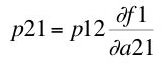
The solution gives the following marginal productivity equations:
(7)

(8)

(9)

In competitive equilibrium, the price of every input is equal to the value of the marginal product for each product.

Pure economic profit must be nonnegative, for if it were negative the firm would have chosen not to produce at all. It works out that pure economic profit cannot be positive either. Equation 10 states that pure economic profit is zero in the wheat-producing industry:
(10)

An analogous set of three marginal productivity equations and a zero economic profit condition arises from analyzing corn-producing firms.

4.0 Interest Rates In Steady States
Consider the following definitions:
(11)

(12)

These are known as the own rates of interest of wheat and corn, respectively.

In a long run equilibrium, the quantities of wheat and corn inputs are not given. Assume they have been adjusted such that relative spot prices of corn, wheat, and labor remain unchanged from year to year. Almost all economists up until the late 1920s, as far as I am aware, thought of this constancy of relative prices, or an equivalent condition, as a defining property of long run equilibrium.

(It was about then that short-run notions of temporary and intertemporal equilibrium were introduced, and the economists' conceptions became more complex. Mistakes were made by the early neoclassicals. Walras thought he could take endowments of produced goods as given, but still consider an equilibrium with steady-state prices. Others mistakenly wanted to take the quantity of "capital" as given, but have its form, in terms of composition of wheat and corn, be endogenously determined.)

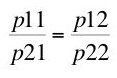
Certainly, we need to introduce some condition relating industries. Anyways, If you think about the condition of stationary spot prices, you will see that if no pure economic profits are possible, relative forward and relative spot prices must be equal:
(13)

Otherwise, an agent could buy or sell wheat or corn in the forward market for a year and make a pure economic profit on the spot market at the end of the year.

Therefore:
(14)

Or:
(15)

where r is the common own rate of interest for all commodities. It is not a parameter of some unobservable utility function, although it may become equal to some such parameter in equilibrium in special cases. Such a special case could be created by closing this model with utility-maximization by a infinitely-lived representative agent.

The condition of unchanging relative spot prices allows us to remove P(2) from our equations. We have:
(16)

The condition of no economic profit gives the following system of two equations:
(17)

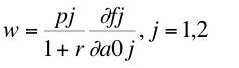
where I have dropped the time index on the price vector as being no longer needed. The marginal productivity equations become:
(18)

(19)

So we have a system of eight Equations - the two price equations (17), and the six marginal productivity equations (18) and (19). There are ten choice variables to be determined by the model:
  • The wage w
  • The common own rate of interest r
  • Two prices, P = (p1, p2)
  • Six production coefficients a0 and A
I assume it's obvious that the above model generalizes to an n good model. There are two degrees of freedom. One is closed by selecting the numeraire.

There is no equation equating r to some mystical, mythical, marginal product of capital.

In the next part, I outline the construction of the so-called factor price frontier.

Marginal Productivity Not A Theory Of Distribution (Part 1)

1.0 Introduction
What is held constant when defining the marginal product of labor? A correct answer, in the context of a neoclassical long period theory, is the interest rate. This is part of the answer Paul Samuelson gave to Joan Robinson in the early 1960s when she visited MIT. My exposition of this answer is indebted to an explanation of Frank Hahn's.

2.0 The Model Economy
Consider an economy that produces wheat and corn in yearly production cycles. At the start of the year, a firm producing wheat buys inputs of labor, corn, and wheat. The production process takes a year. The firm's output of wheat is available at the end of the year. Likewise, a firm buying corn purchases inputs of labor, corn, and wheat at the start of the year and has outputs of corn at the end of the year.

In neoclassical theory, goods are differentiated by their availability at different times. So there will be five prices to consider for a yearly production cycle:
  • w, the wage, which I arbitrarily assume here is paid at the beginning of the year.
  • P(1) = (p11, p21), the row vector of spot prices of wheat and corn for immediate delivery at the beginning of the year.
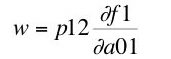
  • P(2) = (p12, p22), the vector of forward prices of wheat and corn for delivery at the end of the year. For example, p12 is the price that must be paid at the start of the year for a contract in which the buyer will receive a bushel of wheat at the end of the year.

Now consider a competitive firm producing wheat. Assume the firm faces a constant returns to scale production function:
(1)


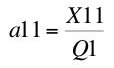
where Q1 is the output of bushels wheat, L01 is inputs of labor, X11 is inputs of wheat, and X21 is inputs of corn. Since I assume Constant Returns to Scale, I can separate questions of scale and relative proportions:
(2)


where
(3)


(4)


(5)


I make the usual assumption that diminishing marginal returns exist for each input in both production functions.

In the next part, I derive the marginal productivity equations for a competitive wheat-producing firms.

Monday, August 21, 2006

Some of Samuelson on the Subject of Sraffa

Samuelson in 1966:
”Such an unconventional behavior of the capital/output ratio is seen to be definitely possible. It can perhaps be understood in terms of so-called Wicksell and other effects. But no explanation is needed for that which is definitely possible: it demonstrates itself. Moveover, this phenomenon can be called ‘perverse’ only in the sense that the conventional parables did not prepare us for it….

…Nevertheless we must accept nature as she is. In a general blueprint technology model of Joan Robinson and M.I.T. type, it is quite possible to encounter switch points … in which lower profit rates are associated with lower steady-state capital/output ratios…

…Pasinetti, Morishima, Bruno-Burmeister-Sheshinski, Garegnani merit our gratitude for demonstrating that reswitching is a logical possibility in any technology, indecomposable or decomposable.”
In 1971:
”In this age of Leontief and Sraffa there is no excuse for mystery or partisan polemics in dealing with the purely logical aspects of the problem.”
In 1975:
”…one who believes technology to be more like my 1966 reswitching example than like its orthodox contrast, will have a more sanguine view about how successful militant power by organized labor can be in causing egalitarian shifts in the distribution of income away from property even in the long run.”
In 1976:
”Those who have followed the literature of the past 20 years know that these many properties of the Clarkian paradigm do not all hold generally. In every Cambridge, and wherever informed economic theory is taught, there is no 1976 disagreement on this this.”
In 1987:
”Oscar Lange once wrote, sardonically but seriously, that Ludwig von Mises, the enemy of socialism, deserved a statue in the socialist Hall of Fame for compelling Abba Lerner and Lange (to say nothing of earlier Pareto, Barone and Fred Taylor) to work out how socialists might devise efficient decentralizing-pricing planning algorithms. One can insist, seriously, that a neoclassical Hall of Fame deserves Sraffa’s statue…

…Did any scholar have so great an impact on economic science as Piero Sraffa did in so few writings? One doubts it. And there cannot be many scholars in any field whose greatest works were published in their second half century of life.

Piero Sraffa was much respected and much loved. With each passing year, economists perceive new grounds for admiring his genius.”
In 2001:
”The Nobel Prize of Piero Sraffa and Joan Robinson that Stockholm never awarded might have pleased at least one of them. Its citation would have included: ‘Their investigations uncovered a fatal normative flaw in Bohm-Bawerkian and modern mainstream capital theory’…

…As my exposition will reveal, the fatal flaw in question can exist even when a scalar ‘leets’ is the sole producible input; it can exist even when precise neoclassical marginal products do exist and do serve to pin down unequivocally the distribution of incomes between propertyless workers and affluent capitalists. The statues of Piero and Joan belong in the pantheon of neoclassicism itself…

…this defense does not validate an inverse [interest rate, consumption per person-hour] tradeoff… Adam Smith’s Invisible Hand does ensure Equation (5) above but cares nought for Equation (6). This is why books entitled Economics in One Lesson must evoke from us the advice: ‘Go back for the second lesson’.”
But doubtless tyro economists are taught today all about the contributions of an economist who had an age co-named after him. Apparently these contributions lead to the acceptance that class struggle can affect distribution under neoclassical theory. To the thesis that mainstream capital theory is “fatally flawed”. To an understanding of what capital-reversing and reswitching of techniques are. And to a realization that these phenomenon are compatible with the assumptions of mainstream economics.
  • Samuelson, P. A. (1966). “A Summing Up”, Quarterly Journal of Economics, V. 80, N. 4 (Nov): 568-583
  • Samuelson, P. A. (1971). “Understanding the Marxian Notion of Exploitation: A Summary of the So-Called Transformation Problem Between Marxian Values and Competitive Prices”, Journal of Economic Literature, V. 9, N. 2 (Jun.): 399-431”
  • Samuelson, P. A. (1975). “Steady-State and Transient Relations: A Reply on Reswitching”, Quarterly Journal of Economics, V. 89, N. 1 (Feb.): 40-47
  • Samuelson, P. A. (1976). “Interest Rate Determinations and Oversimplifying Parables: A Summing Up” in Essays in Modern Capital Theory (edited by M. Brown, K. Sato, and P. Zambreka), Amsterdam: North-Holland
  • Samuelson, P. A. (1987). “Sraffian Economics” in The New Palgrave: A Dictionary of Economics (edited by J. Eatwell, M. Milgate, and P. Newman),London: Macmillan
  • Samuelson, P. A. (2001). “A Modern Post-Mortem on Bohm’s Capital Theory: Its Vital Normative Flaw Shared By Pre-Sraffian Mainstream Capital Theory”, Journal of the History of Economic Thought, V. 23, N. 3: 301-317

Sunday, August 20, 2006

To Show The Fly The Way Out Of The Flybottle

"There is a sense in which [William] James was not a philosopher at all. He once said to me: 'What a curse philosophy would be if we couldn't forget all about it!' In other words, philosophy was not to him what it has been to so many, a consolation and sanctuary in a life which would have been unsatisfying without it. It would be incongruous, therefore, to expect of him that he would build a philosophy like an edifice to go and live in for good. Philosophy to him was rather like a maze in which he happened to find himself wandering, and what he was looking for was the way out." --George Santayana (quoted in Cornel West, The American Evasion of Philosophy: A Genealogy of Pragmatism, 1989)

Friday, August 18, 2006

Value in Ricardo

In his Principles, Ricardo distinguishes between "market prices" and "natural prices", a distinction he takes from Adam Smith and Smith's predecessors. Market prices are the prices that prevail at any given time on the market. According to classical economists, they include transient and random variations. Natural prices act as centers of gravitational attraction for market prices. At any time, market prices are tending towards natural prices, in some sense. But does the mature Ricardo distinguish, as Karl Marx later does, between natural prices and value, where value is the quantity of labor embodied in a commodity when outputs are at levels consistent with natural prices? (Smith refers to this level as the level of "effectual demand".)

This is an area where Ricardo is notoriously difficult to understand. Consider, however, this passage from towards the end of the first chapter of the third edition of Ricardo's Principles, that is, after Ricardo has explained that natural prices will generally not be proportional to labor values:
"It is not by the absolute quantity of produce obtained by either class, that we can correctly judge of the rate of profit, rent, and wages, but by the quantity of labour required to obtain that produce. By improvements in machinery and agriculture, the whole produce may be doubled; but if wages, rent, and profit be also doubled, these three will bear the same proportions to one another as before, and neither could be said to have relatively varied. But if wages partook not of the whole of this increase; if they, instead of being doubled, were only increased one-half; if rent, instead of being doubled, were only increased three-fourths, and the remaining increase went to profit, it would, I apprehend, be correct for me to say, that rent and wages had fallen while profits had risen; for if we had an invariable standard by which to measure the value of this produce, we should find that a less value had fallen to the class of labourers and landlords, and a greater to the class of capitalists, than had been given before. We might find, for example, that though the absolute quantity of commodities had been doubled, they were the produce of precisely the former quantity of labour. Of every hundred hats, coats, and quarters of corn produced, if
The labourers had before . . . . 25

The landlords . . . . . . . . 25

And the capitalists . . . . . . 50
...And if, after these commodities were double the quantity, of
every 100
The labourers had only . . . . . 22

The landlords . . . . . . . . 22

And the capitalists . . . . . . 56
In that case I should say, that wages and rent had fallen and profits risen; though, in consequence of the abundance of commodities, the quantity paid to the labourer and landlord would have increased in the proportion of 25 to 44. Wages are to be estimated by their real value, viz. by the quantity of labour and capital employed in producing them, and not by their nominal value either in coats, hats, money, or corn. Under the circumstances I have just supposed, commodities would have fallen to half their former value, and if money had not varied, to half their former price also. If then in this medium, which had not varied in value, the wages of the labourer should be found to have fallen, it will not the less be a real fall, because they might furnish him with a greater quantity of cheap commodities than his former wages." (Ricardo 1821)
Furthermore, Sraffa had the good fortune to discover a paper that Ricardo had been working on in the last month of his life, the manuscript "Absolute Value and Exchangable Value". Sraffa has this to say about that manuscript:
"Yet this paper has importance since it develops an idea which existed previously in Ricardo's writings only in occasional hints and allusions: namely, the notion of a real or absolute value underlying and contrasted with exchangeable or relative value." (Sraffa 1951)
Thus, there is textual evidence that, in some places, Ricardo distinguished between price, whether market or natural, and value.

Others have noticed:
"The Marxian reading of Ricardo has fared somewhat better. Marx claimed that Ricardo's treatment of value in the third edition of the Principles was marred by serious confusion: in some places Ricardo used 'value', 'absolute value' or 'real value' to denote 'necessary labour time'; but in others 'value' signified (relative) cost of production. Furthermore, it was Marx's judgement that Ricardo occasionally and falsely identified his 'value' concepts. However, in the opinion of later authorities, including Marshall, Stigler and Steedman, this reading is wholly untenable: Ricardo's 'value' concept was unambiguously one of cost of production.

It is certainly true, and acknowledged by all, that Ricardo had a 'value' concept in the sense of (relative) cost of production. But to claim that this was his only 'value' concept has been to perpetuate a one-sided distortion. Even before his embrace of the labour theory, Ricardo had used 'value' in a manner suggesting an 'absolute' entity associated with the facility or difficulty of producing an individual commodity. Once he made the labour theory his own, that association was with the quantity of labour expended in production, at various times denoted by such terms as 'natural value', 'real value', 'positive value' and even, at the expense of great confusion, 'value' itself. This 'labour quantity' species of 'value' both existed in Ricardo's schema and came to be invested with unique significance, especially in the later writings. Perhaps it is appropriate to remind ourselves that soon after the publication of the third edition of the Principles, on which Marx was commenting, Ricard had written to Trower: 'In speaking of exchange value you have not any idea of real value in your mind, I invariably have.' Much needlessly spilled ink might have been saved if Ricardo had made a similar announcement in his Principles.

To an extent, therefore, Marx's interpretation is superior to his critics: Ricardo sometimes did use 'value' in a manner associated with quantity of labour expenditure (as previous commentors, including Trower, the author of the Observations, Samuel Bailey and, in his Unsettled Questions, John Stuart Mill, had observed.)" (Terry Peach, Interpreting Ricardo, Cambridge University Press, 1993.)

Tuesday, August 15, 2006

Why I Care About Ito Calculus And How I'll Find Out More

Consider the indexed collection of random variables {X(t) | t a non-negative real}. This is a stochastic process in continuous time. A realization of it is just a time series. It makes sense to me to differentiate or integrate such a realization with respect to time. (As I remember it, though, a realization of a Wiener process is (almost always?) continuous and non-differentiable.) But what it would mean to talk about the derivative or integral of the stochastic process itself? As I understand it, this, along with Stochastic Differential Equations, is the subject of Ito or stochastic calculus.

Recently, physicists have been writing on economics. Generally, econophysicists distrust neoclassical economics and think they can do it better. Joseph L. McCauley's Dynamics of Markets: Econophysics and Finance (Cambridge University Press, 2004) is a recent textbook on econophysics. I find it difficult to read precisely where it draws on Ito calculus.

Luckily I have a resource to help me acquire some mathematical background for McCauley's text. Cosma Shalizi explains the fundamentals of Ito Calculus in Lectures 18-20 of his notes for Advanced Probability II or Almost None of Stochastic Processes.

Monday, August 14, 2006

Textbooks For Teaching Non-Neoclassical Economics

Does an ideological or normative bias exist in mainstream teaching or practice? I think Gunnar Myrdal's The Political Element in the Development of Economic Theory is still worth reading on this topic. Much good stuff has been written on this topic since, too.

In my "Creating Two-Good Reswitching Examples", I list some textbooks for teaching the Cambridge Capital Controversy:
  • S. Ahmad (1991). Capital in Economic Theory: Neo-classical, Cambridge, and Chaos, Edward Elgar
  • C. Bidard (2004). Prices, Reproduction, Scarcity, Cambridge University Press
  • E. Burmeister (1980). Capital Theory and Dynamics, Cambridge University Press
  • R. M. Goodwin (1970). Elementary Economics from the Higher Standpoint, Cambridge University Press
  • S. Keen (2001). Debunking Economics: The Naked Emperor of the Social Sciences Pluto Press
  • H. D. Kurz and N. Salvadori (1995). Theory of Production: A Long-Period Analysis, Cambridge University Press
  • L. L. Pasinetti (1977). Lectures on the Theory of Production, Columbia University Press
  • J. Robinson and J. Eatwell (1973). Introduction to Modern Economics, McGraw-Hill
  • V. Walsh and H. Gram (1980). Classical and Neoclassical Theory of General Equilibrium: Historical Origins and Mathematical Structure, Oxford University Press.
  • J. E. Woods (1990). The Production of Commodities: An Introduction to Sraffa, Humanities Press International
These textbooks exhibit a range of rigor, level of mathematics, and assumptions about background. Burmeister's sympathies are clearly with the neoclassicals.

The above list reflects my focus on the CCC. But other focii are possible. Apparently David Krep's A Course in Microeconomic Theory is an introductory graduate text organized by game theory. In his competition, game theory is confined to selected chapters, instead of being an organizing principle.

I have seen references to some considerably less mainstream textbooks. Robin Hahnel's The ABC's of Political Economy: A Modern Approach and Hugh Stretton's Economics: A New Introduction are two I have seen some say nice things about.

There are more textbooks for Post Keynesians. A Marxist would have another list of textbooks. So a supply has been available for economists to teach something different. I suggest if the demand had been seen, even more textbooks would be forthcoming; one can find parts of ones put up here and there on the Web. David Colander is worth reading on the question of why mainstream economists do not alter their teaching, but I've already gone on long enough.

Saturday, August 12, 2006

Wikipedian Edit War Over Labor Theory Of Value

This last week has seen an edit war over the Wikipedia Entry On The Labor Theory Of Value (LTV). The warriors are one "Cplot" and "Economizer". I helped write an earlier entry. It was not me, however, who introduced the link to my LTV FAQ. The ostensive issue in this argument is how the first paragraph of the entry should define the LTV.

I don't have a decided opinion on either side in this controversy. Economizer does cite the first sentence in my FAQ. On the other hand, Economizer cites only published literature almost half a century old. I'm grateful to have Donald Gordon's 1959 AER article, "What Was the Labor Theory of Value?" brought to my attention. Cplot is correct that this article could be cited on either side of the issue. It draws on what was recent work by Stigler at the time. Sraffa only appears in a footnote as an editor of Ricardo's collected works.

Cplot is correct in noting that some use the word value to mean the labor embodied in a commodity, with no claim that this quantity is proportional to prices. And one is incorrect to hold both of the following simultaneously:
  • The LTV is the theory that prices tend to be proportional to quantities of embodied labor
  • Marx and the major classical economists believed in the LTV
Cplot might acknowledge, though, that some thought the LTV was a useful simplification. I can see the point, if you want to argue about how central the LTV is to Marx, not to define the theory as a person of straw that Marx explicitly repudiated.

I think the point of the LTV is not to explain prices. It can be used to emphasize:
  • The division of labor, not only within a factory, but among all industries or sectors of an economy
  • Some of the conditions for smooth reproduction of an economy
  • The claim that the source of the returns to capital and land is value added by labor not paid out to workers.
The technical name for the latter claim, that workers are not fully renumerated for their value-added, is exploitation. Marx seemed to be proud of his introduction of the distinction between "labor" and "labor power" in articulating this theory.

The Wikipedia entry on LTV illustrates an issue with Wikipedia. I have seen how this entry is always being changed, sometimes drastically. It will never approach a steady state.

Update (18 August): For general, mostly negative, comments on Wikipedia, listen to Jason Scott's talk, "The Great Failure of Wikipedia".

Thursday, August 10, 2006

Towards A Critique Of Austrian Business Cycle Theory

I suppose I ought to point out this paper, which I updated as of today. I think I still have a ways to go.

Stiglitz: Competitive Economies Almost Never Efficient

From Steve Keen's debunking economics page, I find that Stanley Alcorn and Ben Solarz report on "The Autistic Economist" in the Yale Economic Review. A couple of quotes:
"The First Fundamental Theorem of Welfare Economics [asserts] that every competitive equilibrium is efficient. Based on the work in information economics for which he won the Nobel Prize, Stiglitz finds that this most basic claim is not robust to the removal of the assumption that information is perfect... 'Quite contrary to that theorem', Stiglitz concluded, 'competitive economies are almost never efficient.'"

They also quote Stiglitz as saying that "[Economics as taught] in America's graduate schools... bears testimony to a triumph of idology over science." According to the authors:
"Economics courses at the undergraduate level typically place little-to-no emphasis on learning the tools of economic science, instead focusing on teaching algebraic simplifications of actual economic work, and then assigning problem sets in which students plug in values for the different variables. It is good practice, perhaps, for a few specific mathematical techniques, namely constrained maximization, but it is hardly a training in how to think creatively about dealing with the economy. The bedrock of economics as it is taught is not the subject matter - the economy - or even the approach - the neoclassical school of thought - but ideology, as Stiglitz said. The repetition of simplified and vulgarized economic conclusions is the main task of introductory, intermediate, and even some advanced economics courses, and little else sticks with the students."

I haven't read much of Stiglitz on information asymmetries. I do have this article handy:
  • David M. G. Newbery and Joseph E. Stigliz (1982). "The Choice of Techniques and the Optimality of Market Equilibrium with Rational Expectations", Journal of Political Economy, V. 90, N. 2 (Apr.): 223-246

Monday, August 07, 2006

Technical Inquiry

I know Russell Standish has responded to a comments on an article he co-wrote with Steve Keen. And I have had some comments on even older posts. But how would you, dear reader, know this?

I believe changes to my blog are being published to a RSS feed. But how can I easily create some sort of default button to put on the right to let readers push to obtain the RSS feed?

And I have seen some blogs list recent comments on the right. How can I do this? Is there some HTML that I can include in my template?

Thanks in advance.

Friday, August 04, 2006

Cookbooks For Workshops Of The Future

I previously mentioned some programs for post-capitalist societies that I think worth exploring. I think I should add John Roemer's A Future for Socialism to my to-read-someday list (Cosma Shalizi gives it a review).

(I draw heavily on Roemer's Analytical Foundations of Marxian Economic Theory in my 2005 Manchester School paper. But that book has little to say about what comes after capitalism. Bertram Schefold reviews Roemer's Analytical Foundations in the September 1983 issue of the Journal of Economic Literature. Duncan Foley reviews Roemer's Future in the June 1996 issue of the JEL.)

The most convincing argument against socialist central planning, in principle, comes from Enrico Barone's "The Ministry of Production in the Collectivist State" (Il Giornale degli Economisti, 1908). Barone argues that all the categories of capitalism must reappear under socialism:
"From what we have seen and demonstrated hitherto, it is obvious how fantastic those doctrines are which imagine that production in the collectivist regime would be ordered in a manner substantially different from those of 'anarchist' production."

"If the Ministry of Production proposes to obtain the collective maximum - which it obviously must, whatever law of distribution may be adopted - all the economic categories of the old regime must reappear, though maybe with other names: prices, salaries, interest, rent, profit, saving, etc. Not only that; but always provided that it wishes to obtain that maximum with the services of which the individuals and the community dispose, the same two fundamental conditions which characterize free competition reappear, and the maximum is more nearly obtained the more perfectly they are realized. We refer, of course, to the conditions of minimum cost of production and the equalization of price to cost of production." -- E. Barone

Ludwig Von Mises' best contribution to economics was to popularize and promote Barone's argument. Barone, however, does not have a propagandizing organization to promote him. So one cannot find a current willing first hand account of being initiated into an intellectual school with Barone as a member.

Tuesday, August 01, 2006

Amusing Myself By Critiquing Austrians

Occassionally, for amusement I point out errors in posts on forums in which some of the more dogmatic adherents of Austrian economics hang out. Since I wrote the first draft of the Wikipedia entry on Austrian economics, it should be clear that I find something worthwhile in the writings of some Austrian economists. (I also started the Wikipedia entry on Joseph Schumpeter.) But so many of the adherents of Austrianism you can meet on the Internet only produce “irritable mental gestures which seek to resemble ideas”, as Lionel Trilling said about conservatism.

Anyways, you can see some contributions of mine in the comments in the following, if anybody cares:


One of my favorite polemical thrusts by Piero Sraffa is this: "Dr. Hayek, who extols the imaginary achievements of the 'subjective method' in economics, often succeeds in making patent nonsense of it."