Friday, July 28, 2006

Can One Respect Henry Hazlitt?

I describe Henry Hazlitt as an author whose work goes well beyond ignorance and as somebody who does not know what he is talking about. Let me give an example. Here's Keynes giving us the theory he wants to attack:
"The classical theory of employment - supposedly simple and obvious - has been based, I think, on two fundamental postulates, though practically without discussion, namely: I. The wage is equal to the marginal product of labour That is to say, the wage of an employed person is equal to the value which would be lost if employment were to be reduced by one unit (after deducting any other costs which this reduction of output would avoid); subject to the qualification that the equality may be disturbed in accordance with certain principles, if competition and markets are imperfect. II. The utility of the wage when a given volume of labour is employed is equal to the marginal disutility of that amount of employment. That is to say, the real wage of an employed person is that which is just sufficient (in the estimation of the employed persons themselves) to induce the volume of labour actually employed to be forthcoming; subject to the qualification that the equality for each individual unit of labour may be disturbed by combination between employable units analogous to the imperfections of competition which qualify the first postulate. Disutility must be here understood to cover every kind of reason which might lead a man, or a body of men, to withhold their labour rather than accecpt a wage which has to them a utility below a certain minimum... ...Subject to these qualifications, the volume of employed resources is duly determined, according to the classical theory, by the two postulates. The first gives us the demand schedule for employment, the second gives us the supply schedule; and the amount of employment is fixed at the point where the utility of the marginal product balances the disutility of the marginal employment." -- J. M. Keynes (1936). The General Theory of Employment Interest and Money
Here's Hazlitt, with my interjections, revealing an ignorance of the theory he wants to defend:
"'The classical theory of employment - supposedly simple and obvious - has been based,' Keynes thinks, 'on two fundamental postulates, though practically without discussion' (p. 5). The first of these is 'I. The wage is equal to the marginal product of labor.' (His italics, p. 5) This postulate is correctly and clearly stated. It is not, of course, part of the classical theory of employment. That adjective should be reserved, in accordance with custom and in the interests of precision, for theory prior to the subjective-value or 'marginalist' revolution of Jevons and Menger.”
Hazlitt is correct (and unoriginal) in asserting that Keynes’ usage of “classical” is confusing.
”But the postulate has become part of 'orthodox' theory since its formulation by the 'Austrian' school and, particularly in America, by John Bates Clark. Having written this simple postulate, Keynes adds eight lines of 'explanation' which are amazingly awkward and involved and do more to obfuscate than to clarify.”
Let me put aside arguments about who originated the theory of marginal productivity. Keynes’ qualitifications are obviously getting at imperfections of competition. For example, if the firm is a monopolist in the product market, the wage, when the firm is in equilibrium, is equal to the marginal value product of labor, not the value of the marginal product of labor. Because Hazlitt is incompetent, he finds Keynes’ qualifications “awkward”.
”He then proceeds to state the second alleged 'fundamental postulate' of the 'classical theory of employment,' to wit: ‘II. The utility of the wage when a given volume of labor is employed is equal to the marginal disutility of that amount of employment.' (His italics, p. 5.) He adds, as part of his explanation: 'Disutility must be here understood to cover every kind of reason which might lead a man, or a body of men, to withhold their labor rather than accept a wage which had to them a utility below a certain minimum' (p. 6). 'Disutility' is here so broadly defined as to be almost meaningless. It may be seriously doubted, in fact, whether this whole second 'fundamental postulate,' as Keynes frames and explains it, is or ever was a necessary part of the 'classical' or traditional theory of employment. Keynes does name and (later) quote A. C. Pigou as one whose theories rested on it. Yet it may be seriously questioned whether this 'second postulate' is representative of any substantial body of thought, particularly in the complicated form that Keynes states it.”
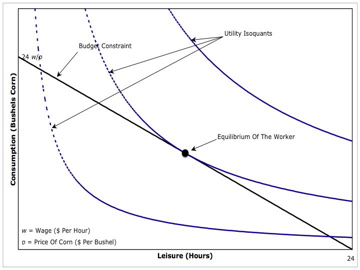
Keynes is here describing the neoclassical theory of the worker trading off leisure with the consumption he can purchase with his wages. Figure 1, which formulates the theory in terms of the utility of leisure, rather than the disutility of labor, may remind you of the textbook theory. Once again, Hazlitt’s ignorance of varieties of this theory reveals nothing more than his incompetence.
Figure 1: Equilibrium Of The Utility-Maximizing Worker
”The 'orthodox' marginal theory of wages and employment is simple. It is that wage-rates are determined by the marginal productivity of workers; that when employment is 'full' wage-rates are equal to the marginal productivity of all those seeking work and able to work; but that there will be unemployment whenever wage-rates exceed this marginal productivity.”
Note that here Hazlitt describes the marginal productivity of labor as being “determined” for a specific volume of labor, the “full” employment level. When the level of employment of labor is less than “full”, the wage can still be equal to the marginal productivity of workers, as calculated for that lower level of employment. Obviously, then, the equality of the wage and the marginal productivity of labor is not enough to determine either wages or employment. Some other relationship must be put forward, in neoclassical theory, to help determine these quantities. That is where the theory of the supply of labor, summarized in the figure, comes in.
“Wage-rates may exceed this marginal productivity either through an increase in union demands or through a drop in this marginal productivity. (The latter may be caused either by less efficient work, or by a drop in the price of, or demand for, the products that workers are helping to produce.) That is all there is to the theory in its broadest outlines. The 'second postulate,' in the form stated by Keynes, is unnecessary and unilluminating.”
I have shown the role the second postulate fills in neoclassical theory. Hazlitt, being incompentent, isn’t able to even count variables and equations.
”Subject to certain qualifications, Keynes contends, 'the volume of employed resources is duly determined, according to the classical theory, by the two postulates [which Keynes has named]. The first gives us the demand schedule for employment; the second gives us the the supply schedule; and the amount of employment is fixed at the point where the utility of the marginal product balances the disutility of the marginal employment' (p. 6). Is this indeed the 'classical' theory of employment? The first postulate - that 'the wage is equal to the marginal product of labor' - does not merely give us the 'demand schedule' for labor; it tells us the point of intersection of both the 'demand schedule' and the 'supply schedule.' The demand schedule for workers is the wage-rate that employers are willing to offer for workers.”
In neoclassical theory, this schedule “is the wage-rate that employers are willing to offer workers” at each level of employment within the possible range of levels. The ‘first postulate’ can, at best, determine the schedule, but not the location at which the labor market is in equilibrium.
”The 'supply schedule' of workers is fixed by the wage-rate that workers are willing to take. This is not determined, for the individual worker, by the 'disutility' of the employment - at least not if 'disutility' is used in its common-sense meaning. Many an individual unemployed worker would be more than willing to take a job at a rate below a given union scale if the union members would let him, or if the union leader would consent to reduce the scale." -- Henry Hazlitt, The Failure of the "New Economics": An Analysis of the Keynesian Fallacies, D. Van Nostrand Company, 1959.
Hazlitt just does not understand the theory he wants to defend. As far as I am concerned, Hazlitt’s entire book attacking Keynes is as incompetent as the above. It might take me some time to further document this claim, if anybody wants me to, since my local library has apparently disposed of the above quoted book. (I copied from an old Usenet post of mine to create this post.)

Tuesday, July 25, 2006

Response To Comments On Steve Keen's Work

Introduction

In comments on a previous post, Radek comments on some work of Steve Keen's. Since I've let something like a week go by, I thought I ought to raise this response to a post.

I respond more to people I disagree with. But I think I ought to note that, like DSquared, I respect Solow, while disagreeing with him. My favorite polemic from the Cambridge Capital Controversy is this:
“I have long since abandoned the illusion that participants in this debate actually communicate with each other. So I omit the standard polemical introduction, and get down to business at once.” –- Robert M. Solow (1962)

But back to Keen. What I appreciate most in Keen’s book is his attempt to convey to the introductory student and common reader that good reason exists to doubt (mainstream) economics, no matter how much (mainstream) economists attempt to blind one with “science”. Keen claims very little originality for most of what he has to say. As one can see, I have some disagreements with Keen’s attempts at popularization. But the discussion in this post only concerns two out of fourteen chapters in Keen’s book. And Radek does not even concede any virtues in those chapters.

Also, I can do without accusations that Keen is a “hack”, whether “a pretty skillful hack” or not; a “charlatan”; a liar; “dishonest and embarrassing”; “engages in” “dishonest rhetorical trick[s]”. For me, Guiness stout and Monty Python fall in the same category: things I’m still unsure what I think of. But I’m fairly sure abuse is not an argument.

Profit Not Maximized When Price Equal Marginal Revenue

Chapter 4, “Size Does Matter”, seems to be the most argued about chapter of Debunking Economics. It surprised me too.

Atomistic competition, in which one has a continuum of infinitesimal agents, is a standard assumption in economics. Keen and Standish (2006) point out that the assumption of atomistic competition is that one firm does not change its level of production in reaction to another firm's variation in production levels. Keen (2001) points out that Stigler shows that, under atomistic competition, the demand curve for a consumption good faced by the firm has the same slope as the demand curve for the market. I find Keen is not original in noting that atomistic competition is incompatible with the usual textbook U-shaped average cost curves:
"Of course, global increasing returns to scale (or more modestly, situations in which efficient scale is reached at a level of output which is noninfinitesimal relative to the total size of the market) remains a problem. Also, we do not deny the descriptive reality of the latter situation." -- Duffie and Sonnenschein (1989)

Radek ignores all this motivation for Keen’s simulations, and I find it difficult to argue with Keen’s claims. And they wreck havoc on mainstream introductory textbooks in microeconomics.

I have done work with simulations in quite different contexts. In my experience with certain researchers, they wanted to see their analytical arguments confirmed by both simulations, in which they could control the environment to which their arguments are applied, and practical applications. I think Radek should welcome my simulation. If he looks, he will see that I allow the user to vary the order in which firms make decisions. So I agree with Radek in that I think Keen can be challenged here. I also seem to recall an impression that step size matters to convergence in my simulation. I still think I would need to do further work to substantiate these worries.

The Sonnenschein-Mantel-Debreu Results

Keen brings up the SMD results in Chapter 2 of Debunking Economics. Duffie and Sonnenschein (1999) characterize these results as stating that "the class of excess demand functions generated by economies has no structure beyond Walras' law and homogeneity" (p. 574). They point out the implication that "the equilibrium price set may be an essentially arbitrary subset of the set of relative prices" (p. 574).

Radek states, "SMD is not about aggregating individual utilities in the sense that Keen's talking about." I find Keen to only be echoing the professional literature on this point. Think, for example, of Kirman’s (1992) analysis of representative agent models, which are widespread in New Classical Economics. Keen’s point is that Margaret Thatcher was wrong in asserting that “There is no such thing as society”. Would Radek accept Kirman’s claims, which I think are along the same lines:
"The problem seems to be embodied in what is an essential feature of a centuries-long tradition in economics, that of treating individuals as acting independently of each other...

If we look back briefly to the result that underlies the whole problem expressed here it is clear that in the standard framework we have too much freedom in constructing individuals. The basic artifact employed is to find individuals each of whose demand behavior is completely independent of the others... making individual behavior dependent or similar may open the way to obtaining meaningful restrictions...

If we are to progress further we may well be forced to theorise in terms of groups who have collectively coherent behaviour. Thus demand and expenditure functions if they are to be set against reality must be defined at some reasonably high level of aggregation. The idea that we should start at the level of the isolated individual is one which we may well have to abandon. There is no more misleading description in modern economics than the so-called microfoundations of macroeconomics which in fact describe the behaviour of the consumption or production sector by the behaviour of one individual or firm. If we aggregate over several individuals, such a model is unjustified...

It is clear that making assumptions on the distribution of agents' characteristics amounts, in some sense, to making assumptions about the organization of society...

In conclusion, then, it is worth repeating that recent theoretical work has shown how little the Walrasian model has to say about aggregate behavior. Economists therefore should not continue to make strong assertions about this behaviour based on so-called general equilibrium models which are, in reality, no more than special examples with no basis in economic theory as it stands."-- Alan Kirman (1989)

Radek comments:
So how 'huge' are SMD results - the fact that one may have multiple equilibria. Well, here I think there's often a good bit of intellectual dishonesty among critics of GE. On one hand they criticise GE for being 'unrealistic' on the other they wave SMD theorem as proof that GE is 'untenable' (again, whatever that means). But seriously, why should you expect the Real World to have a unique equilibrium? Particularly in the presence of wealth effect, which are the driving force behind SMD theorem, and the whole point of doing GE in the first place? Personally I think the possibility of multiple equilibria is a REALISTIC feature of general equilibrium theory and a point in favor of it rather than against it.

One would be in trouble if the theorem predicted a continuum of equilibria, or that the First Theorem no longer applied but that's not the case. One can still do local comperative statics and all them multiple equilibria are still Pareto efficient.

I find the above confused. Tony Lawson is the scholar to read when it comes to “realism” and Post Keynesianism. I don’t say every Post Keynesian agrees with him. But one who wants to engage Post Keynesian discussions of realism of assumptions must read at least some of Lawson. I don’t know what it means to say “the Real World” has multiple or unique equilibria. I think equilibria are properties of models, not characteristics of actually existing capitalist economies, independently of how they are described.

I don't care for Radek’s sort of abusive attack on people who say they are echoing the experts in a field, especially when the attackers do not cite any examples of who they are talking about. I think a good appreciation of the SMD results might require a historical perspective on what (some) economists were (and still are?) claiming about General Equilibrium and what the experts in the field now claim:
"It follows from the preceding observation that the Walrasian theory and the existence theorems do not tell us how to relate tastes, technology, and the distribution of wealth to a single set of relative values. Rather, they tell us that there is at least one vector (and possibly many more) of relative values compatible with the data of the model. In the absence of uniqueness, the comparative statics of how prices and allocations will change with a change in the parameter values is not a well-defined exercise. The finiteness result alluded to above may be of some help here, but what is really needed is a completion of the Walrasian theory that describes the particular choices that are made from the equilibrium set. Such a completion will almost surely require a theory that deals explicitly with the adjustment to equilibrium. If forces are not in balance, what changes will take place in order to bring them into balance?" -- Duffie and Sonnenschein (1989)

I suggested to Keen, prior to the publication of his book, that the assumptions that all agents have identical and homothetic utility functions are merely sufficient, not necessary, conditions to get well-behaved utility functions. On this logical point, I agree with Radek. But Keen has convinced me with his book and later work that, in practice, (mainstream) economists do widely adopt these assumptions in applied work, with little justification.

References
  • Duffie, Darrell and Hugo Sonnenschein (1989). "Arrow and General Equilibrium Theory", Journal of Economic Literature, V. 27, N. 2 (June): 565-598.
  • Keen, Steve (2001). Debunking Economics: The Naked Emperor of the Social Sciences, Zed Books.
  • Keen, Steve and Russell Standish (2006). "Profit Maximization, Industry Structure, and Competition: A Critique of Neoclassical Theory", Physica A
  • Kirman, Alan (1989). "The Intrinsic Limits of Modern Economic Theory: The Emperor has No Clothes", Economic Journal, V. 99, N. 395: 126-139.
  • Kirman, Alan P. (1992). "Whom or What Does the Representative Individual Represent?" Journal of Economic Perspectives, V. 6, N. 2 (Spring): 117-136.
  • Solow, Robert M. (1962). “Substitution and Fixed Proportions in the Theory of Capital”, Review of Economic Studies, V. 29, N. 3 (Jun): 207-218.
Monday, July 17, 2006

Dsquared Howls

In comments on this post, dsquared writes:
I saw the finest minds of my generation wrecked by the Solow model,
starving hysterical naked and calling a residual a theory.

Sunday, July 16, 2006

Income Inequality And Current Events

I recently posted about income inequality and immobility. Apparently, I'm up on what's being discussed among some:

DeLong makes the point that increasing inequality preceded the large-scale introduction of personal computers. The thesis of skills-biased technological change is thus undermined. DeLong does not reference James Galbraith (1998) for this point.

When it comes to explaining personal or functional income distribution, neoclassical economics is intellectually bankrupt. Warren Buffet (CNN, June 2005) understands: "It's class warfare, my class is winning, but they shouldn't be."
References
  • Galbraith, James K. (1998). Created Unequal: The Crisis in American Pay, New York: The Free Press

Thursday, July 13, 2006

Keen And Ormerod, Econophysics, And The Distribution Of Income

This humble blog is all about documenting fallacies in mainstream economics. Very little of what I have to say is new, and some have tried to popularize some of these criticisms. I think, in particular of Paul Ormerod (1994) and Steve Keen (2001). Ormerod and Keen have some similarities. Both:
  • Have written popular books (Ormerod 1994 and Keen 2001) explaining that neoclassical economics is incorrect
  • Mention Lipsey and Lancaster's theory of the second best
  • Emphasize that mainstream economists studying the theory of General Equilibrium have demonstrated the theoretical untenability of neoclassical economics
  • Recommend an approach to economics based on the mathematics of complexity theory
  • Publish original criticisms of mainstream economics first in their popular books (Ormerod 1999 and Keen 2001) and then later in a physics journal (e.g., Keen and Standish (2006) and Ormerod and Mounfield (2000))

They differ in that they express different opinions on Piero Sraffa in their popular books. Keen (2001) praises Sraffa, while Ormerod (1999) snarks.

I find that Ormerod and Keen have teamed up with two other authors for a recent paper (Gallegati et al. 2006). This paper contains an approving reference to Sraffa. A major theme of this paper is to question whether the evidence for power laws, in particular in the tails of certain distributions of certain economic variables, is as definite as seems to be claimed sometimes in the econophysics literature.

References
  • Gallegati, Mauro, Steve Keen, Thomas Lux, and Paul Ormerod (2006). "Worrying Trends in Econophysics", Physica A
  • Keen, Steve (2001). Debunking Economics: The Naked Emperor of the Social Sciences, Zed Books
  • Keen, Steve and Russell Standish (2006). "Profit Maximization, Industry Structure, and Competition: A Critique of Neoclassical Theory", Physica A
  • Ormerod, Paul (1994). The Death of Economics, London: Faber & Faber
  • Ormerod, Paul (1999). Butterfly Economics: A New General Theory of Social and Economic Behavior, Pantheon
  • Ormerod, Paul and Craig Mounfield (2000). "Random Matrix Theory and the Failure of Macro-Economic Forecasts", Physica A

Sunday, July 09, 2006

Reversal Of Great Compression In Income Distribution In U.S.A.

I recently posted about income (im)mobility in the United States. One interested in that subject is probably also interested in the deteriorating (that is, increasingly unequal) distribution of wealth and income in the U.S. On the latter subject, my current favorite reference is a paper by Piketty and Saez, recently presented at the annual conference of the American Economic Association.

Piketty and Saez construct some time series from census data, tax data, and national income accounts. They use census data to find the total number of tax units in a country. A tax unit might be an individual, or it might be a household. Tax data is used to find top incomes and their decomposition by source. National income accounts and their predecessors are used to convert top incomes into shares. Piketty and Saez are sensitive to issues of tax evasion and avoidance.

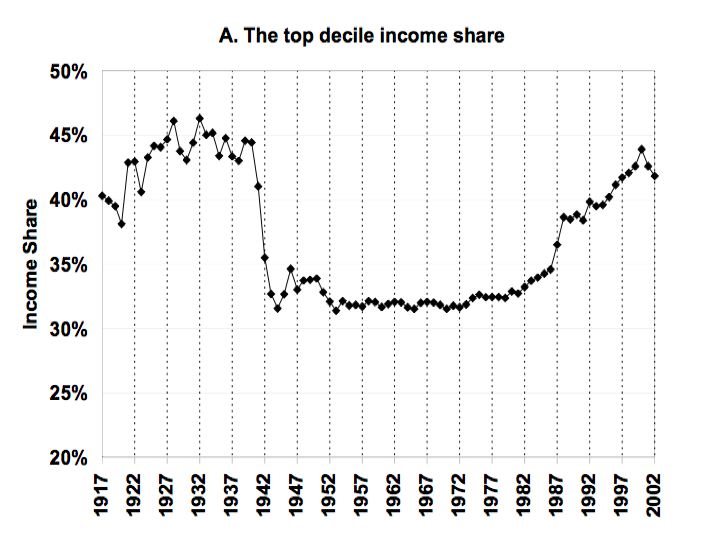
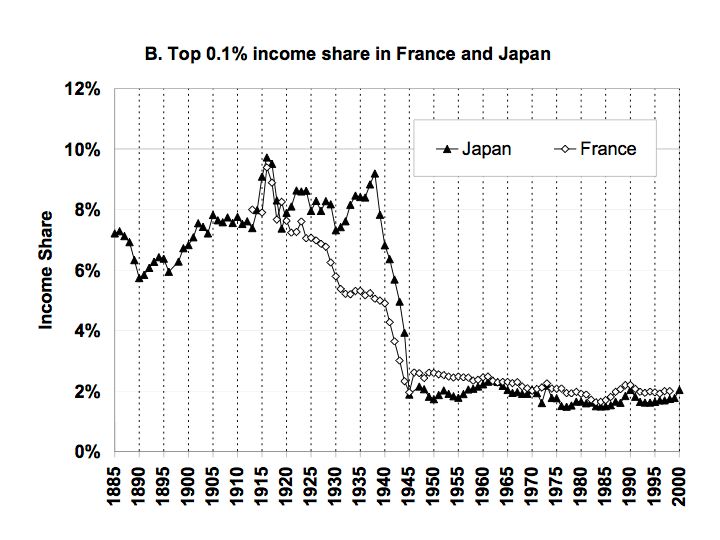
The figures below are selected results from Piketty and Saez. Rank tax units, each year for, say, the United States, by income obtained. For Figure 1, look at the upper 10% (a decile) of these tax units. The figure shows the trend in the percentage of income obtained by these tax units over almost a century. If income were distributed perfectly equal, the graph would show a straight line at 10% on the vertical axis. Since income is not equally distributed in the United States, the time series is above 10%. The graph starts at 20% to emphasize the observed fluctuations in the proportion of income obtained by the top decile. Notice that Figures 2 and 3 show international comparisons for the top one thousandth, not the top tenth.

Figure 1: Income Share Of Top Decile In United States


Figure 2: Income Share Of Top 0.1% In U.S.A., U.K., And Canada


Figure 3: Income Share Of Top 0.1% In Japan And France


Piketty and Saez show that what Claudia Goldin and Robert Margo name “the great compression” in income distribution has been reversed in the United States. It has not been reversed in Japan and France, though.

Since Piketty and Saez are exploring the upper end of income distribution, they do not document the contrast between the “picket fence” and “staircase” pattern in income distribution. Since this contrast is a basic fact about the United States, I summarize it here. As above, suppose all households or individuals are ranked by annual income for each year. Divide this population into five groups, that is, into quintiles. So the poorest fifth is the first quintile, and the richest fifth is the fifth quintile. Calculate the average (mean) income of each quintile for each year.

You will find that during the post (Second World) War “golden age” (extending roughly until sometime in the 1970s), the average income of all quintiles increased roughly at the same rate. When the increase of the average income by quintile is graphed versus quintile, one obtains a picket fence pattern. On the other hand, one obtains a staircase pattern during the last third of a century or so. The average income of the first quintile seems to have even fallen; middle quintiles increase their income only slightly; and the rich increase their income even more. In the golden age, all groups obtain some of the advantage of increasing productivity, while in current period the rich are able to increasingly monopolize gains in productivity.

Piketty and Saez show this staircase pattern extends dramatically into the upper limits. Those last few steps have grown bigger and bigger.

Reference
  • Piketty, Thomas and Emmanuel Saez (2006). "The Evolution of Top Incomes: A Historical and International Perspective", Proceedings of the American Economic Association (Jan.)

Tuesday, July 04, 2006

Among Developed Countries, Income Mobility Almost Least In United States

In a previous post, I provided a summary table from a 1997 study on income mobility in the United States. Tom Hertz, with American University, provides a more recent analysis. I select a couple of his results to highlight here.

Hertz looks at how one’s place in the United States income distribution is transmitted to one’s children. He analyzes data on “4,004 children observed in the Panel Study of Income Dynamics (PSID) in their parents’ households in the 1968 survey… The children are then observed again as adult heads of households, or spouses thereof, in” biannual surveys in recent years. The sample was corrected to preserve its original representative demographics. Both parents and grown children are observed near their “prime earning age”.

Table 1 summarizes some of Hertz’s results. Define the “rich” (not shown here) to be those in the top 5% of households, by income. Hertz finds the odds of becoming rich are less than 2% for children of parents in any of the first three quintiles of household income. The odds of becoming rich are approximately 20 times greater if you are born into a rich household than if you are born into a household in the bottom quintile.

Table 1: At Least 65% Of Grown Up Children Are In A Household Within One Quintile Of Their Parents’ Household
Parental 1967-1971
Quintile
1994-2000
Quintiles
1st
Quintile
2nd
Quintile
3rd
Quintile
4th
Quintile
5th
Quintile
1st Quintile41.5%24%15.5%13.2%5.9%
2nd Quintile22.625.823.118.510.0
3rd Quintile18.725.824.119.616.9
4th Quintile11.119.020.725.124.0
5th Quintile6.111.117.223.741.9


Hertz also provides an international comparison of intergenerational mobility, but I do not understand the source of his data. Hertz looks at the intergenerational elasticity of earnings, that is, the percent increase in expected earnings associated with a one percent increase in parents’ earnings. Table 2 provides his results. Hertz summarizes his findings:
By international standards, the United States has an unusually low level of intergenerational mobility: our parents’ income is highly predictive of our incomes as adults. Intergenerational mobility in the United States is lower than in France, Germany, Sweden, Canada, Finland, Norway and Denmark. Among high-income countries for which comparable estimates are available, only the United Kingdom has a lower rate of mobility than the United States.

Table 2: The U.K. and the U.S. Have Least Mobility
CountryIntergenerational Elasticity Of Earnings
United Kingdom0.5
United States0.47
France0.41
Germany0.32
Sweden0.27
Canada0.19
Finland0.18
Norway0.17
Denmark0.15


Reference
  • Hertz, Tom (2006). Understanding Mobility in America, Center for American Progress (26 April).

Monday, July 03, 2006

Coase In The Dark On Lighthouses

The "nobel" laureate, Ronald Coase, has some views on public finance and lighthouses. He mentions these views, for example, in a 1997 interview with Reason.

The most recent unrefuted view in the peer-reviewed journal literature, as far as I know, is that Coase is wrong on the facts:
"In 'The Lighthouse in Economics' (Coase, R. H., Journal of Law and Economics, vol. 17, no. 2, 357-76, 1974), Coase reached the conclusion that in England there existed a relatively efficient privately financed lighthouse system, which would refute economists' traditional statements concerning the production of public goods. The purpose of this paper is to challenge his conclusion. We first show that, from a methodological and theoretical perspective, 'The Lighthouse' is consistent with 'The Problem of Social Cost' (Coase, R. H. Journal of Law and Economics, vol. 3, 1-44, 1960). Then, applying Coase's own method (historical case studies), we attempt to re-examine the respective roles and efficiencies of private initiative and government." -- Elodie Bertrand (2006).

This is not a topic that I have a strong opinion on. But I find that some of the more stupid worshippers of Mammon one might meet on the Internet have a tendency to bring Coase up.

Reference
  • Bertrand, Elodie (2006). "The Coasean Analysis Of Lighthouse Financing: Myths And Realities", Cambridge Journal of Economics, V. 30: 389-402.

Sunday, July 02, 2006

Proof Of The Falsity Of The Factor Price Equalization "Theorem" (Part 3)

4.0 International Trade
Suppose a number of otherwise identical countries differ in endowments of factors of production. And suppose these countries do not permit trade in factors of production among themselves. For example, workers are not permitted to emigrate from one country and into another. And capitalists cannot invest in foreign countries. But suppose all produced commodities can be traded among these countries on an international market. Then, according to many counfused mainstream economists, the prices of the factors of production will tend towards equality among these countries. For example, the wage will be the same everywhere. In some sense, trade in produced commodities can replace trade in factors of production. If these countries were to allow foreign investment, after trade in produced commodities had already been established, then, according to these confused mainstream economists, the same equilibrium would only be achieved quicker. I expect these confused mainstream economists would qualify this story in practice by relating wages to variations in productivity among countries no longer considered identical, transportation costs, etc.

The above story relies on the factor price theorem, which is most conveniently set out in the case where only two countries exist. This supposed theorem has some conditions, and all these conditions are met by the Mainwaring example being analyzed in this series of posts:
  • Both countries produce the same commodities. In this case, the commodities consist of iron, steel, and corn.
  • Each country has a given endowment of factors, identical in quality but of different relative quantities. For my purposes, I do not need to specify explicitly the quantity of labor available in each country nor to discuss the endowment of the value of capital.
  • Both countries have identical technology.
  • There are no factor reversals. I rely on Mainwaring for the truth of this assumption in this case. I have neither checked it nor fully attempted to understand its statement.
  • All consumers have identical and homothetic utility functions. As with the assumption on endowments, my purposes do not require an explicit specification of utility functions.
  • All commodities that can enter into final output are traded on international markets in which one price rules for each commodity. In this case, the prices of iron, steel, and corn are established on international markets.
  • There are no transportation costs.
  • Perfect competition prevails in all markets.
Keith Acheson has described how to investigate the factor price equalization theorem in the context of a linear model of production:
"From the price equations it is clear that a set of product prices implies a particular wage and rate of interest. For factor price equalization it is critical to investigate the conditions necessary for this to be a one-to-one relationship, so that a common set of product prices in any two countries will necessarily be associated with same wage and interest rate." - Keith Acheson (1970)
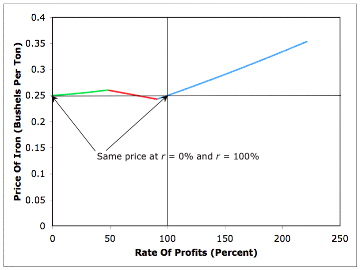
In two previous posts, I worked through the analysis of the choice of technique in a three commodity example created by Lynn Mainwaring. Figure 4-1 shows the price of iron at all feasible levels of the rate of profits in this example. Figure 4-2 shows the corresponding price of steel. I have picked out the prices at two rates of profits in the figure. These points are further detailed in Table 4-1. Suppose the prices on the international markets for iron, steel, and corn are 1/4 bushels per ton iron, 1/2 bushels per ton steel, and unity (by definition), respectively. Let the wage in the first country be three bushels corn per person year and the rate of profits be 0%. Let the wage in the second country be one bushel per person year and the rate of profits be 100%. The analysis of the choice of technique shows that this is an equilibrium.

Figure 4-1: The Price Of Iron


Figure 4-2: The Price Of Steel


Table 4-1: Two Equilibria
p1 = 1/4, p2 = 1/2, r = 0%, w = 3, Delta technique adopted
p1 = 1/4, p2 = 1/2, r = 100%, w = 1, Alpha technique adopted

Thus, in Mainwaring's example an equilibrium exists in which:
  • There is one price on the international market of each produced commodity.
  • The wage and the return to financial capital differ between countries.
The above, then, proves that the factor price equalization theorem is false. I suggest, furthermore, that the variation in prices with the rate of profits suggests that the dynamics of international markets can be interesting.

5.0 Conclusion
So that's the theory at a very abstract level. If a country trades produced goods on "free" markets, opening its financial markets to international investors can dramatically change the dynamics of income distribution, or so the theory suggests. As I understand it, mainstream economists, who often get their sums wrong, think the theory implies opening financial markets will only lead to equilibrium with common factor prices, perhaps corrected for differences in productivity, transport costs, and so on, being established quicker.

Why do mainstream economists continue to teach and to try to apply theories show to be false more than a generation ago?

References
  • Acheson, K. (1970). "The Aggregation of Heterogeneous Capital Goods and Various Trade Theorems", Journal of Political Economy, V. 78, N. 3 (May-June): 565-571.
  • Mainwaring, L. (1976). "Relative Prices and 'Factor Price' Equalisation in a Heterogeneous Capital Goods Model", Australian Economic Papers, Republished in Fundamental Issues in Trade Theory (Ed. by Ian Steedman), Macmillan, 1979.

Friday, June 30, 2006

Proof Of The Falsity Of The Factor Price Equalization "Theorem" (Part 2)

3.0 Prices And The Choice Of Technique
In the previous part, I presented a specification of the technology in a numeric example created by Lynn Mainwaring. Which technique specified by this technology is cost minimizing at equilibrium prices? In this context, equilibria have the following properties:
  • The iron-producing process, at least one steel-producing process, and at least one corn-producing process are operated.
  • The costs of inputs for each process in operation does not exceed revenues.
  • No process can be used to obtain pure economic profits.

Suppose, for example, that the Alpha technique is cost minimizing. Given these properties, then the following equations must be satisfied:
(1/5) p2 (1 + r) + (1/20) w = p1

[(1/5) p1 + (1/10)](1 + r) + (1/5) w = p2

[(1/10) p1 + (1/2) p2](1 + r) + (9/20) w = 1

where
  • w is the wage (in units of bushels per person-year)
  • r is the rate of profits
  • p1 is the price of iron (in units of bushels per ton iron)
  • p2 is the price of steel (in units of bushels per ton steel)

The above equations specify that, for each process in the Alpha technique, costs of inputs in the process equal revenues. The costs do not exceed revenues. Furthermore, no process, at least in the Alpha technique, can be operated to obtain pure economic process.

Suppose, for mathematical convenience, the rate of profits is externally specified. Then the above is a system of three linear equations in three variables. It can be solved, and the solution is:
w = 2 [500 - 45(1 + r)^2 - (1 + r)^3]/[450 + 105(1 + r) - 9 (1 + r)^2]

p1 = (1/2) [100 + 80(1 + r) + 13(1 + r)^2]/[450 + 105(1 + r) - 9(1 + r)^2]

p2 = (1/2)[400 + 110(1 + r) + (1 + r)^2]/[450 + 105(1 + r) - 9(1 + r)^2]


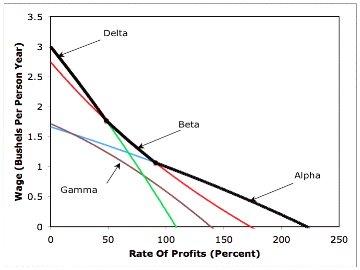
A system of equations is associated each of the remaining three techniques defined by the technology. The statement of those systems and their solutions is relegated to an appendix. The cost minimizing technique at any given rate of profits can be found from these solutions. In particular, Figure 3-1 shows a graph of the wage as a function of the rate of profits for each technique. The cost minimizing technique at a given rate of profits is the technique for which the wage is greatest. The figure shows the frontier defined by this criteria as a heavy black line. The Delta technique is cost minimizing at low rates of profits. The Beta technique is cost minimizing at intermediate rates of profits, and the Alpha technique is cost minimizing at intermediate rates of profits.

Figure 3-1: The Wage-Rate Of Profits Frontier

But what does all of this have to do with the theory of international trade? This question will be answered in the next part.

Appendix 3.A: Price Equations For Three Techniques
Appendix 3.A.1: The Beta Technique
The price equations for the Beta technique are:
(1/5) p2 (1 + r) + (1/20) w = p1

[(1/5) p1 + (1/10)](1 + r) + (1/5) w = p2

(43/25) p1 (1 + r) + (19/100) w = 1

The solution to the Beta price equations is:
w = (2)[1,250 - 50(1 + r)^2 - 43(1 + r)^3]/[153(1 + r)^2 + 215(1 + r) + 475]

p1 = (1/2)[19(1 + r)^2 + 200(1 + r) + 250]/[153(1 + r)^2 + 215(1 + r) + 475]

p2 = (1/2)[43(1 + r)^2 + 145(1 + r) + 1,000]/[153(1 + r)^2 + 215(1 + r) + 475]


Appendix 3.A.2: The Gamma Technique
(1/5) p2 (1 + r) + (1/20) w = p1

(8/25)(1 + r) + (3/50) w = p2

[(1/10) p1 + (1/2) p2](1 + r) + (9/20) w = 1

The solution to the Gamma price equations is:
w = 8[625 - 100(1 + r)^2 - 4(1 + r)^3]/[6(1 + r)^2 + 175(1 + r) + 2,250]

p1 = 2[52(1 + r)^2 + 30(1 + r) + 125]/[6(1 + r)^2 + 175(1 + r) + 2,250]

p2 = 4 [2(1 + r)^2 + 180(1 + r) + 75]/[6(1 + r)^2 + 175(1 + r) + 2,250]


Appendix 3.A.3: The Delta Technique
The price equations for the Delta technique are:
(1/5) p2 (1 + r) + (1/20) w = p1

(8/25)(1 + r) + (3/50) w = p2

(43/25) p1 (1 + r) + (19/100) w = 1

The solution to the Delta price equations is:
w = 4 [3,125 - 344(1 + r)^3]/[258(1 + r)^2 + 1,075(1 + r) + 2,375]

p1 = [152(1 + r)^2 + 150(1 + r) + 625]/[258(1 + r)^2 + 1,075(1 + r) + 2,375]

p2 = [344(1 + r)^2 + 760(1 + r) + 750]/[258(1 + r)^2 + 1,075(1 + r) + 2,375]

Proof Of The Falsity Of The Factor Price Equalization "Theorem" (Part 1)

1.0 Introduction
This sequence of posts explores a numeric example. The example was created by L. Mainwaring (1976). Mainwaring used the example to prove the factor price equalization theorem to be false. Before explaining this implication of the example, I want to consider a single country.

2.0 Technology
Consider a simple economy in which three commodities, iron, steel, and corn, are produced from inputs of labor, iron, steel, and corn. All production processes in in this example require a year to complete and exhibit Constant Returns to Scale. One process is known for producing iron, and two processes each are known for producing steel and corn. These processes are shown in Table 2-1. The inputs for each process are purchased at the beginning of year. The inputs provide their services over the course of the year, and the iron, steel, and corn inputs are totally used up each year in the production processes. The outputs become available at the end of the year.

Table 2-1: Technology
INPUTS
HIRED AT
START OF
YEAR
IRON-
PRODUCING
PROCESS
(A)
FIRST STEEL-
PRODUCING
PROCESS
(B)
SECOND STEEL-
PRODUCING
PROCESS
(C)
FIRST CORN-
PRODUCING
PROCESS
(D)
SECOND CORN-
PRODUCING
PROCESS
(E)
Labor1/20 Person-Year1/5 Person-Year3/50 Person-Year9/20 Person-Year19/100 Person-Year
Iron0 Ton Iron1/5 Ton Iron0 Ton Iron1/10 Ton Iron1 18/25 Tons Iron
Steel1/5 Ton Steel0 Ton Steel0 Ton Steel1/2 Ton Steel0 Ton Steel
Corn0 Bushel Corn1/10 Bushel Corn8/25 Bushel Corn0 Bushel Corn0 Bushel Corn
OUTPUT1 Ton Iron1 Ton Steel1 Ton Steel1 Bushel Corn1 Bushel Corn

A technique consists of three processes, where one process is used to produce iron, a second process produces steel, and the third process produces corn. As shown in Table 2-2, three techniques are available in this economy. Note that for each technique, no commodity can be produced without inputs either directly or indirectly of each other commodity For example, consider the Delta technique. Since corn is produced in this technique with process E, iron is required to be reproduced for production to continue year after year. Steel is required to reproduce iron by process A in this technique. And corn is required to produce steel by process C. In the jargon, iron, steel, and corn are all said to be “basic commodities”. Sraffa invented this terminology.

Table 2-2: Techniques And Processes
TechniqueProcesses
AlphaA, B, D
BetaA, B, E
GammaA, C, D
DeltaA, C, E

I leave as an exercise for the reader to check that, for each technique, some level of operation of the processes comprising the technique results in a positive net output. That is, after replacing the commodities used up in production, some output is left over to be used for consumption or accumulation. One method of checking this condition is to confirm the Hawkins-Simon conditions are met for each technique.

Consider cost-minimizing (or profit-maximizing) competitive firms facing this technology. Suppose that, although labor is hired at the start of the year, the workers are paid their wages at the end of the year. Iron, steel, and corn inputs are paid for at the beginning of the year, and interest (or profit) is charged on these payments. For each level of the rate of profits, which technique is cost minimizing? Is one technique not cost-minimizing at any rate of profits? I answer these questions in the next part by presenting the results of some tedious algebra.

References
  • Mainwaring, L. (1976). "Relative Prices and 'Factor Price' Equalisation in a Heterogeneous Capital Goods Model", Australian Economic Papers, Republished in Fundamental Issues in Trade Theory (Ed. by Ian Steedman), Macmillan, 1979.

Wednesday, June 21, 2006

Vacation Versus Pressure To Blog

I've seen that once I started this blog, I feel pressure to post. But as is obvious, I don't post often. It would only be polite to respond to comments. But as long as an actual discussion is going on in the comments to a post, I can get away with saying nothing. I'm fairly slow to respond to e-mail too.

I will be even more intermittent in the next few weeks. I'm taking a vacation next week, and I am thinking of taking a few days off in the week after next. So I won't be posting then.

Saturday, June 17, 2006

Lawrence Lessig Has A Blog

Lawrence Lessig is a lawyer and law professor in the United States. He is most well known, I guess, for his interest in intellectual property law. I take it that he is aware that property rights are shaped and defined by a plethora of laws and customs. I think he thinks that these laws should be judged instrumentally. So I think his views exhibit a family resemblance to those of Dean Baker and those pointed out on this blog in this series of posts.

Gramsci Quote, At Least Some Recited At Sraffa's Funeral

I know, from reading Geoff Harcourt, that at least some of this was quoted at Sraffa's funeral:
"It would be worth compiling a 'reasoned' catalogue of the men of learning whose opinions are widely quoted or contested in the book, each name to be accompanied by notes on their significance and scientific importance (this to be done also for the supporters of the philosophy of praxis who are certainly not quoted in the light of their originality and significance). In fact there are only the most passing references to the great intellectuals. The question is raised: would it not have been better to have referred only to the major intellectuals on the enemy side, leaving aside the men in the second rank, the regurgitators of second-hand phrases? One gets the impression that the author wants to combat only the weakest of their positions (or the ones which the weakest adversaries have maintained least adequately), in order to obtain facile verbal victories - for one can hardly speak of real victories. The illusion is created that there exists some kind of more than formal and metaphorical resemblance between an ideological and a politico-military front. In the political and military struggle it can be correct tactics to break through at the points of least resistance in order to be able to assault the strongest point with maximum forces that have been precisely made available by the elimination of the weaker auxiliaries. Political and military victories, within certain limits, have a permanent and universal value and the strategic end can be attained decisively with a general effect for everyone. On the ideological front, however, the defeat of the auxiliaries and the minor hangers-on is of all but negligible importance. Here it is necessary to engage battle with the most eminent of one's adversaries. Otherwise one confuses newspapers with books, and petty daily polemic with scientific work. The lesser figures must be abandoned to the infinite casebook of newspaper polemic.

A new science proves its efficacy and vitality when it demonstrates that it is capable of confronting the great champions of the tendencies opposed to it and when it either resolves by its own means the vital questions which they have posed or demonstrates, in peremptory fashion, that these questions are false problems.

It is true that an historical epoch and a given society are characterised rather by the average run of intellectuals, and therefore by the more mediocre. But widespread, mass ideology must be distinguished from the scientific works and the great philosophical syntheses which are its real cornerstones. It is the latter which must be overcome, either negatively, by demonstrating that they are without foundation, or positively, by opposing to them philosophical syntheses of greater importance and significance. Reading the Manual one has the impression of someone who cannot sleep for the moonlight and who struggles to massacre the fireflies in the belief that by so doing he will make the brightness lessen or disappear." (Gramsci 1971, pp. 432-433, "Critical Notes on an Attempt at Popular Sociology")

(The attempt being considered here is The Theory of Historical Materialism: A Manual of Popular Sociology, a book by Nikolai Bukharin.)

References
  • Harcourt, G. C. (1986). "On the Contributions of Joan Robinson and Piero Sraffa to Economic Theory", in Controversies in Political Economy: Selected Essays, New York University Press
  • Gramsci, Antonio (1971). Selections from the Prison Notebooks of Anonio Gramsci (Trans. by Quintin Hoare and Geoffrey Nowell Smith), International Publishers.

Sunday, June 11, 2006

Programs For Post-Capitalist Society

This is a topic that I could see myself exploring some time in the distant future.

The author of an utopia is promoting his vision in some virtual place that I sometimes read. I only glanced at this page, but I could not quickly find any discussion of competing programs. I think the most serious such programs around these days are:

Wednesday, June 07, 2006

More On The Incorrect Heckscher-Ohlin-Samuelson (HOS) Theory

I have some comments in "Unregulated International Trade Unjustified By Comparative Advantage (TOC)". Radek offers an admittably speculative explanation of why there is a loss from trade in my numeric example:
"Increasing returns isn't the correct term. Nonconvex production set is what I'm guessing."

I think that explanation is wrong. I pointed out in the comments that the numeric example is not a reswitching example. Radek comments on this observation:
"I think Metcalfe and Steedman emphasized reswitching as necessary for this kind of result then later folks realized that reswitching wasn't it. But like I said, I'm not too familiar and it's been awhile.

Ok - I think I found the MS article and will read up on it (JIL May'77)."

The phrase "this kind of result" is doing too much work here. As I mentioned, Metcalfe, Steedman, and others have a variety of criticisms of the logic of HOS theory. The criticism illustrated by my example is from Metcalfe and Steedman (1974). Steedman and Metcalfe (1977) is a different criticism, a criticism that stretches my knowledge of trade theory by the by. They conclude:
"We have examined a version of the familiar H-O-S analysis, with two countries, two commodities and two factors; we have made all the normal assumptions except that, instead of a common zero rate of profit, we have assumed a common positive rate of profit. Since the existence of a positive profit rate does not affect the properties of the familiar relationship between commodity-prices and factor-prices it does not affect the factor-price-equalisation and Stolper-Samuelson theorems. In general, however, nothing can be said a priori about the relationship between factor-prices and the factor-intensity of production methods, when the profit rate is positive, and it follows that nothing can be said a priori about the shape of the relative supply curve. This does not prevent the H-O-S theorem about the pattern of trade from holding in its 'quantity' form, but does make the theorem invalid in its 'price' form, does mean that trade need not 'harm' a country's scarce factor, and does mean that uniqueness of international equilibrium is to be regarded as a special case when the common rate of profit is positive." - Steedman and Metcalfe (1977)

The demonstration in Steedman and Metcalfe (1977) draws on an earlier analysis of a closed economy, Metcalfe and Steedman (1972). Here M. and S. present a reswitching example with two homogeneous unproduced inputs, labor and land. They find, at a certain given positive rate of profit, that the technique of production that minimizes cost at the higher ratio of the rent to wage will be more land-intensive. I think of this example as analogous to one of capital-reversing. It too is destructive of supply and demand explanations of prices.

I don't recall if they say so explicitly, but this article certainly gives the impression that this counter-intuitive result - at least to those who believe in the out-dated neoclassical theory of value and distribution - is due to the presence of reswitching. If I recall correctly, this result was later shown to be compatible with the absence of reswitching. I believe Steedman selected the article first demonstrating this compatibility for republication in Steedman (1989).

If I ever get around to discussing recent empirical results on the labor theory of value, I will point to some criticisms of Steedman.

Update: Radek reminds me that Montet (1979) demonstrated that the results in Metcalfe and Steedman (1972) and in Steedman and Metcalfe (1977) are compatible with the absence of reswitching.

References
  • Metcalfe, J. S. and I. Steedman (1972). "Reswitching and Primary Input Use", Economic Journal (Reprinted in Fundamental Issues in Trade Theory (edited by I. Steedman), Macmillan, 1979).
  • Steedman, I. and J. S. Metcalfe (1977). "Reswitching, Primary Inputs and the Heckscher-Ohlin-Samuelson Theory of Trade", Journal of International Economics (Reprinted in Fundamental Issues in Trade Theory (edited by I. Steedman), Macmillan, 1979).
  • Metcalfe, J. S. and I. Steedman (1974). "A Note on the Gain From Trade", Economic Record (Reprinted in Fundamental Issues in Trade Theory (edited by I. Steedman), Macmillan, 1979).
  • Montet, C. (1979). "Reswitching and Primary Input Use: A Comment", Economic Journal, V. 89, N. 355 (Sep.): 642-647.
  • Steedman, I. (editor, 1989). Sraffian Economics (2 volumes), Edward Elgar.

Monday, June 05, 2006

Capitalism Seen As Unfree In Its Infancy

A charactistic transaction under capitalism is the selling of labor power for money wages. How was this transaction perceived in capitalism's early days? Consider:
"[the commonwealth] consisteth only of freemen... Day labourers ... have no voice nor authority in our commonwealth, and no account is made of them but only to be ruled ... [those who] be hired for wages ... be called servants." -- Thomas Smith (1565)

"If the common people have no more freedom in England but only to live among their elder brothers and work for them for hire, what freedom have they in England more than we have in Turkey or France? ... The poor that have no land are left still in the straits of beggary, and they are shut out of all livelihood but what they shall pick out of sore bondage, by working for others as masters over them." -- G. Winstanley (1649)

"Rather than go with cap in hand and bended knee to gentlemen and farmers, begging and entreating to work with them for 8d. or 10d. a day, which doth give them an occasion to tyrannize over poor people (which are their fellow-creatures), if poor man would not go in such a slavish posture..." -- R. Coster (1649)

"[The relations of employer and wage labourer] approach much nearer to that of a planter and slave in our American colonies than might be expected in such a country as England." -- Josiah Tucker (1757)

"...the ingenuity and dexterity of [England's] working artists and manufacturers, which have heretofore given credit and reputation to British wares in general [whose skill was] owing to that freedom and liberty they enjoy to divert themselves in their own way... Were they obliged to toil the year round, the whole six days in the week, in a repetition of the same work, might it not blunt their ingenuity and render them stupid instead of alert and dexterous?" -- M. Postlethwayt (1774)

All quotes are secondhand from:
  • Christopher Hill (1967). "Pottage for Freeborn Englishmen: Attitudes to Wage Labour in the Sixteenth and Seventeenth Centuries," Socialism, Capitalism, & Economic Growth: Essays Presented to Maurice Dobb, Cambridge University Press.

Monday, May 29, 2006

Unregulated International Trade Unjustified By Comparative Advantage (Part 5)

5.0 Conclusions

I don’t think the interesting properties of the above example rely on the following properties:
  • The technology is discrete (generalized Leontief)
  • The circularity in production in ale and corn, in which corn and ale are, directly or indirectly, inputs into the production of ale or corn.
  • The fact that consumption goods and capital goods are the same set of goods, just used for different purposes.

Consider equilibrium prices in an autarky in which both techniques are cost minimizing and the interest rate is positive (see Appendix 4.A). The difference between the equilibrium price for ale and the slope of the Production Possibilities Frontier drives the result that international trade can leave this country worse off. And that difference can arise in models with none of those three properties listed above. The possibility of international trade leaving a country with less commodities to consume is a general possibility in models with capital goods, a positive interest rate, and the assumptions of the (mistaken) textbook argument.

So much for comparative advantage as a justification for neoliberal trade (non) policy.

By the way, the above example is only a start at explaining what Steedman and his colleagues have to say about international trade. Their comments are not all critical. Some are constructuve of alternative theories. But I would like to read the references mentioned here:
When produced inputs are introduced into HOS theory in the form that one of the two 'factors' is taken to be a given total value of capital, that theory simply disintegrates. This is so notwithstanding the apparent denial of this negative conclusion by Either (1979), who states that 'The central message ... is simple. The four basic theorems of the modern theory of international trade ... are insensitive to the nature of capital' (p. 236). In fact Ethier's paper constitutes a striking confirmation of our negative conclusion, because in order to maintain the appearance that capital has no influence on HOS trade theorems, Ethier finds himself compelled to replace the familiar theorems, which predict trade outcomes on the basis of exogeneous data, by entirely different theorems, which merely describe trade outcomes in terms of trade equilibrium prices, etc.

(... on Eithier's conjuring with HOS theorems, see Metcalfe and Steedman, 1981).


References
  • Ethier, W. J. (1979). "The Theorems of International Trade in Time-Phased Economies", Journal of International Trade, V. 9, N. 2 (May): 225-238.
  • Metcalfe, J. S. and Ian Steedman (1974). "A Note on the Gain From Trade", Economic Record (Reprinted in Fundamental Issues in Trade Theory (edited by Ian Steedman), Macmillan, 1979.)
  • Metcalfe, J. S. and Ian Steedman (1981). "On the Transformation of Theorems", Journal of International Economics, V. 11, N. 2: 267-271.
  • Steedman, Ian (1987). "Foreign Trade", The New Palgrave: A Dictionary of Economics (Edited by John Eatwell, Murray Milgate, and Peter Newman), Macmillan.