Monday, December 26, 2011

"Perverse" Price Wicksell Effects Swamping "Normal" Real Wicksell Effects

1.0 Introduction

Capital-reversing can arise in a couple of ways without reswitching. This post steps through a case in which positive price Wicksell effects can dominate negative real Wicksell effects. Around each switch point, firms choose to adopt a more capital-intensive technique of production for slightly lower interest rates. So real Wicksell effects agree, in this example, with the incoherent and outdated intuition of applied neoclassical economics. Nevertheless, due to the re-evaluation of a given set of capital goods at different interest rates, one can find a pair of points such that cost-minimizing firms adopt a more capital-intensive technique, from the given technology, at the higher interest rate. And this pair of points can span at least one switch point. Basically, I created a simple example to replicate graphs like those in Appendix D in Lazzarini (2011).

A case of a positive price Wicksell and negative real Wicksell effect is one case in my suggested taxonomy of Wicksell effects. Burmeister provides one possible neoclassical response to this sort of example. Burmeister advocated the use of David Champernowne’s (unobservable) chain-index measure of capital.

2.0 The Technology

Consider a very simple economy in which a single consumption good, corn, is produced. Entrepreneurs know of the two processes for producing corn shown in the last two columns of Table 1. One corn-producing process produces corn from inputs of labor time and steel. The other corn-producing process uses inputs of labor time and tin. The entrepreneurs know of two other processes, also shown in Table 1. Additional steel can be produced from inputs of labor time and steel. Similarly, labor time and tin can produce more tin.

Table 1: The CRS Technology
InputsSteel
Industry
Tin
Industry
Corn
Industry
Labor1 Person-Year1 Person-Yr1 Person-Yr2 Person-Yrs
Steel1/2 Ton0 Ton1/4 Ton0 Ton
Tin0 Kg.9/20 Kg.0 Kg.1/3 Kg.
Output:1 Ton Steel1 Kg. Tin1 Bushel Corn1 Bushel Corn

All processes exhibit Constant Returns to Scale (CRS). Each process requires a year to complete. Their outputs become available at the end of the year, and they totally use up their inputs of capital goods over the course of the year.

3.0 Quantity Flows

Two techniques are available for producing a bushel of corn as net output.

The first technique, to be called the steel technique, operates the first process to produce 1/2 ton steel and the first corn-producing process to produce one bushel corn. 1/4 ton of the output of the steel-producing process replaces the steel-capital used up in producing steel. The other 1/4 ton output from the steel-producing process replaces the 1/4 ton steel used up in producing corn. In effect, 1 1/2 person-years labor are used in the steel technique for each bushel corn producing in a self-sustaining way.

In the tin technique, 20/33 kilograms tin are produced with the tin-producing process, and one bushel corn is produced with the second corn-producing process. 2 20/33 person-years labor are used in the tin technique for each bushel of corn in the economy’s net output.

Note that the production of corn with the steel system provides more consumption per worker-year than is provided with the tin system. Under the false and exploded neoclassical theory, one would expect the steel system to require more capital per worker. One would also expect it to be adopted at a low interest rate, since the low interest would be signaling a relative lack of scarcity of capital.

4.0 Price Equations

Next, I consider constant prices consistent with the adoption of each technique. Firms will not adopt a technique unless the interest rate (also known as the rate of profits) is earned for each process in use in a technique. For definitiveness, I assume that wages are paid at the end of the year out of output and that a bushel corn is the numeraire.

4.1 Steel Technique

Given these assumptions, the following system of two equations must hold when the steel technique is in use:

(1/2)ps(1 + r) + w = ps
(1/4)ps(1 + r) + w = 1
where ps is the price of a ton of steel, w is the wage, and r is the interest rate.

Above is a system of two equations in three variables. This system has one degree of freedom. Two variables can be found as functions of the one remaining variable. For example, the wage and the price of steel can be expressed as (rational) functions of the rate of profits. And that price of steel can be used to find the value of capital. The resulting capital-output ratio is:

vs(r) = 2/(3 - r)
where vs is the ratio of the value of capital to the value of output in the steel technique.

4.2 Tin Technique

The following system of two equations must hold when the tin technique is in use:

(9/20)pt(1 + r) + w = pt
(1/3)pt(1 + r) + 2 w = 1
where pt is the price of a kilogram of tin.

The ratio of the value of capital to the value of output in the tin technique, vt, expressed as a function of the interest rate, is:

vt(r) = 200/(473 - 187 r)

5.0 Choice of Technique

The trade off between the wage and the rate of profits, for a given technique, is the wage curve for that technique. Figure 1 shows the wage curves for the two techniques, as well as the wage frontier formed as an outer envelope of the wage curves for all the techniques that comprise the technology. Given the interest rate, the cost-minimizing firm adopts the technique whose wage curve is on the frontier at that point. At the switch point, two techniques are simultaneously cost minimizing.

Figure 1: The Wage-Rate of Profits Frontier

The wage curve for a given technique expresses the wage as a function of the rate of profits. The rate of profits at which the switch point occurs is found by equating the wage for two techniques. In the numerical example analyzed in this post, the following quadratic equation arises:

(41/240)(1 + r)2 - (13/15)(1 + r) + 1 = 0
The switch point occurs at a rate of profits of approximately 77.46%.

6.0 Conclusion

The above analysis has shown for the example:

  • Which technique is cost-minimizing at any given interest rate up to a maximum.
  • The ratio of the value of capital to output for each technique for each interest rate.
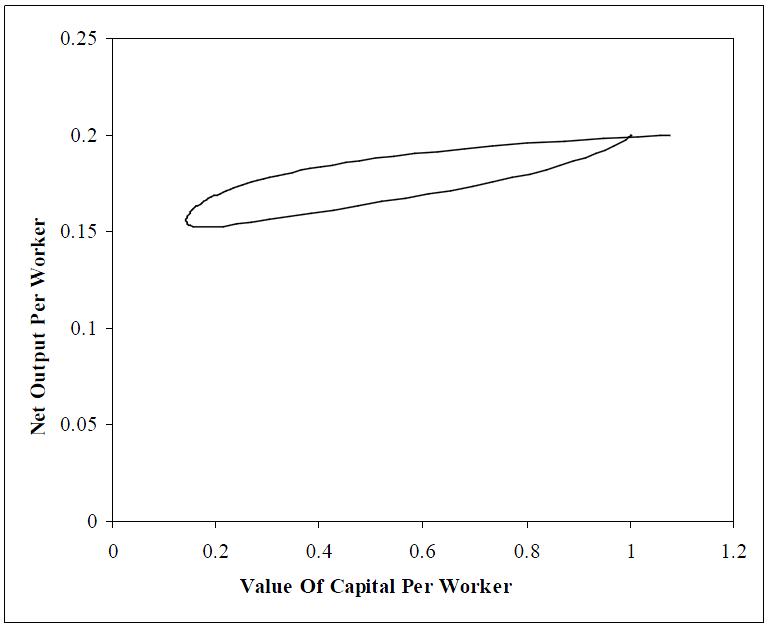
Thus, as shown in Figure 2, one can find the capital-output ratio for the cost-minimizing technique for each economically feasible interest rate. The price Wicksell effect exhibits the revaluation of given capital goods at different interest rates, while the real Wicksell effect results from the adoption of different capital goods at a given interest rate. Both effects are illustrated in Figure 2.

Figure 2: The Rate of Profits Versus Capital-Intensity

This example has shown that capital-reversing can exist around a switch point even in the absence of reswitching.

References

  • Edwin Burmeiser (1980). Capital Theory and Dynamics, Cambridge University Press.
  • Andrés Lazzarini (2011). Revisiting the Cambridge Capital Theory Controversies: A Historical and Analytical Study, Pavia University Press.

Friday, December 23, 2011

Pecan Pie

9 inch pie8 inch pie
3 large eggs2
2/3 cup sugar1/2 cup
1/3 teaspoon salt1/4 teaspoon
1/3 cup butter, melted1/4 cup
1 cup maple syrup3/4 cup
1 cup chopped pecans3/4 cup

Add ingredients in order, stirring thoroughly after each ingredient. Pour into pastry-lined pie pan. Bake at 375 degrees for 40-50 minutes, until set and pastry is nicely browned. Cool. Serve cold or slightly warm.

Friday, December 16, 2011

Elsewhere

  • Dan Berrett, in The Chronicle of Higher Education, reports that "Economists push for a broader range of viewpoints". The Institute for New Economic Thinking, Econ4, a couple of professors at the University of Massachusetts at Amherst, and Stephen Marglin are all mentioned.
  • Daron Acemoglu recommends five books1 on inequality in the distribution of income or wealth. Is he basically confused about the logic of the theory of marginal productivity?
  • Bryan Caplan parades his ignorance of Keynes on wages. According to Caplan, "nominal wage rigidity is the driving force of the Keynesian model" and if employment increases, wages must fall. But:
    • Keynes explicitly argues, in chapter 19 of the General Theory that his analysis applies if money wages are flexible.
    • At the time of the publication of the General Theory, Keynes had "always regarded decreasing physical returns in the short period as one of the very few incontrovertible propositions in our miserable subject". So he believed then that less unemployment would be associated with lessened real wages. He changed his mind2 in responding to empirical evidence from John T. Dunlop and Laurie Tarshis. Empirical evidence for reverse L-shaped cost curves in industry has held up since then.
Footnotes

1. My list includes, at least:

  • James K. Galbraith (1998). Created Unequal: The Crisis in American Pay. Free Press.
  • Stephen A. Marglin (1984). Growth, Distribution, and Prices. Harvard University Press
2. References (which I know of from the secondary literature):
  • John T. Dunlop (1938). "The Movement of Real and Money Wage Rates", Economic Journal. v. 48 (Sept.): 413-434.
  • J. M. Keynes (1939). "Relative Movements of Real Wages and Output", Economic Journal, v. 49 (March): 34-51.
  • Lorie Tarshis (1939). "Changes in Real and Money Wages", Economic Journal, v. 49 (March): 150-154.

Wednesday, December 14, 2011

A Serendipitous Juxtaposition

Tuesday, Peter Dorman, at Econospeak, considers why reactionaries in the United States are not embarrassed when caught at their constant lying. He says the contemporary right-wingers' pride in lying is ultimately derived from Leo Strauss. According to Dorman, Strauss taught:
"The cartoon version of Strauss, which is broadly correct, goes like this: The great philosophers of the past, each in their way, were led by the force of logic and experience to a dangerous insight, that no social or cultural arrangement can substitute for the necessity of virtue, and that only a small minority of individuals are truly virtuous... Those who perceive this truth must write deceptively, since the unworthy masses, if they sense that they are being judged unworthy, will persecute the truth-teller. Strauss provided readings of the canonical texts that claimed to show they functioned on two levels, as decoys for the average reader and secret wisdom for the initiate." -- Peter Dorman

And on Monday, Dani Rodrik, at Project Syndicate notes the difference between discourse among elite economists and what they tell introductory students and the general public:

"As the late great international economist Carlos Diaz-Alejandro once put it, 'by now any bright graduate student, by choosing his assumption...carefully, can produce a consistent model yielding just about any policy recommendation he favored at the start.' And that was in the 1970's! An apprentice economist no longer needs to be particularly bright to produce unorthodox policy conclusions.

Nevertheless, economists get stuck with the charge of being narrowly ideological, because they are their own worst enemy when it comes to applying their theories to the real world. Instead of communicating the full panoply of perspectives that their discipline offers, they display excessive confidence in particular remedies - often those that best accord with their own personal ideologies...

...In my book The Globalization Paradox, I contemplate the following thought experiment. Let a journalist call an economics professor for his view on whether free trade with country X or Y is a good idea. We can be fairly certain that the economist, like the vast majority of the profession, will be enthusiastic in his support of free trade.

Now let the reporter go undercover as a student in the professor’s advanced graduate seminar on international trade theory. Let him pose the same question: Is free trade good? I doubt that the answer will come as quickly and be as succinct this time around. In fact, the professor is likely to be stymied by the question. 'What do you mean by "good?"' he will ask. 'And good for whom?'

The professor would then launch into a long and tortured exegesis that will ultimately culminate in a heavily hedged statement: 'So if the long list of conditions I have just described are satisfied, and assuming we can tax the beneficiaries to compensate the losers, freer trade has the potential to increase everyone's well-being.' If he were in an expansive mood, the professor might add that the effect of free trade on an economy’s growth rate is not clear, either, and depends on an altogether different set of requirements.

A direct, unqualified assertion about the benefits of free trade has now been transformed into a statement adorned by all kinds of ifs and buts. Oddly, the knowledge that the professor willingly imparts with great pride to his advanced students is deemed to be inappropriate (or dangerous) for the general public." -- Dani Rodrik

This bifurcated discourse in economics creates a problem for critics. They can point out that most introductory mainstream teaching and applied policy advice of mainstream economists is self-contradictory and theoretically and empirically unfounded. Defenders of orthodox economists can then accuse the critics of attacking a strawperson. The failure to take their own advanced teaching seriously leads orthodox economists to disappear as a target, in some sense. Maybe the question is one of professional ethics.

Friday, December 09, 2011

On Hayek's Lack Of Impact On Macroeconomics

I'm agreeing with, for example, Brad DeLong, Paul Krugman, and David Warsh. I'm disagreeing with, for example, Peter Klein, Mario Rizzo, Alex Tabarrok, and Steven Horwitz. I suppose I'm also disagreeing with Nicholas Wapshott. Refutations of Austrian Business Cycle Theory (ABCT) are relevant today because of confusions propagated in popular literature.

Keynes argued with many while writing the General Theory. Why not say Keynes versus Dennis Robertson is "the clash that defined modern economics"? I think one could argue that Hayek influenced mainstream macroeconomics through J. R. Hick's exposition of temporary equilibrium in Value and Capital, but this seems a quite attenuated influence.

Keynesians can accept that Hayek had the better of the early 1930s debate with Keynes over Keynes's Treatise on Money. The Treatise is not the General Theory. But Sraffa and Kaldor embarrassed Hayek in his attempt to develop the ABCT. I think the two most important errors in the ABCT are:

  • The natural rate of interest is undefined in intertemporal General Equilibria (also known as, more or less, "plan coordination").
  • No simple relation exists between the optimal allocation of resources among orders of goods and interest rates.
In short, both Hayek's monetary theory and his capital theory are incorrect.

Qualitative stories about the embodiment in capital goods of misaligned plans are, perhaps, the best one can get from Hayek's capital theory. Ludwig Lachmann and Peter Lewin are my favorite Austrian-school economists to read on this point. (Did Lachmann have any enduring effect on mainstream economics?) But it is hard to quantitatively estimate the effects of such misalignments, and I don't find convincing that recovering from these misalignments are the source of the largest worldwide business cycles that we have seen. Anyways, I prefer Joan Robinson on capital theory in disequilibrium.

The importance one should assign the clash between Hayek and Keynes in the history of macroeconomics seems to me to depend crucially on the impact of Hayek on mainstream views of Keynes' General Theory. But Hayek had no such impact. Hayek tried to address the General Theory in his Pure Theory of Capital. But Hayek's book was ignored at the time and is generally considered a failure. About the only thing else Hayek had to say about Keynes's General Theory occurred in interviews and other transient popular pieces. So, whatever you may think about the worth of Hayek's writings, where can you locate their impact?

Monday, December 05, 2011

Walras's Law Is False

1.0 Introduction

I have asserted that the distribution of income is determined by political power, not by intertemporal utility-maximization. Interest rates are not the result of individual decisions trading off consumption at future dates against consumption now.

Is it not a consequence of this view that Walras's law does not apply to capitalist economies?

2.0 On the Derivation of Walras's Law

Walras's law states that the sum of excess demand across all goods is zero:

p z(p) = p1z1(p) + p2z2(p) + ... + pnzn(p) = 0
The excess demand for the jth good is the difference between the demand and supply of that good at the set of prices at which these functions are being evaluated:
zj(p) = dj(p1, p2, ..., pn) - sj(p1, p2, ..., pn)
And supply and demand functions for each market are found by summing over the supplies and demands for all individuals. But individual supply and demand functions are derived from the theory of utility-maximization, given the initial distribution of the endowments of all goods.

3.0 Macroeconomic Reasoning With Walras's Law

Don Patinkin considered an economy in which n - 1 commodities and "money" are traded.

"For the amount of excess demand for money equals the aggregate value of the amounts of excess supplies of commodities." -- Don Patinkin, Money, Interest, and Prices (2nd edition, Harper and Row, 1965)
I believe Patinkin's approach can be seen as building on J. R. Hicks's Value and Capital (2nd edition, Oxford University Press, 1946). Hicks included demands for both money and other securities in his General Equilibrium approach.

One can argue that the world economy is currently in a disequilibrium; both labor and produced commodities are in excess supply. Thus, by Walras's law, there must be an excess demand for money. And it is the job of monetary authorities, such as the United States's Federal Reserve, to meet that demand, by flooding the market with money while this disequilibrium exists. At least, this is the argument of prominent mainstream "Keynesians", such as Brad DeLong and Paul Krugman (suggestions for links to their blogs here are welcome).

4.0 Conclusion

Keynes's emphasis on fundamental uncertainty is arguably incompatible with the explanation of the demand for money by intertemporal utility-maximizing in a model of General Equilibrium. Thus, the above justification of "Keynesian" monetary policy, based on Walras's law, does not harmonize with Keynes's theory.

Tuesday, November 29, 2011

Krugman Wrong, Robinson Correct

In last Friday's column in the New York Times, Paul Krugman writes:
"After all, in an idealized market economy each worker would be paid exactly what he or she contributes to the economy by choosing to work, no more and no less. And this would be equally true for workers making $30,000 a year and executives making $30 million a year." -- Paul Krugman
Elsewhere, Rod Hill and Tony Myatt quote Joan Robinson:
"There is the problem of the relative levels of different types of earned income. Here we have the famous marginal productivity theory... The real wage of each type of labour is supposed to measure its marginal product to society. The salary of a professor of economics measures his contribution to society and the wage of a garbage collector measures his contribution. Of course this is a very comforting doctrine for professors of economics but I fear that once more the argument is circular. There is not any measure of marginal products except the wages themselves. In short, we have not got a theory of distribution. We have nothing to say on the subject which above all others occupies the minds of the people whom economics is supposed to enlighten." -- Joan Robinson
I like to refute the existence of the so-called marginal productivity theory of distribution with reswitching examples. In such examples, at least two vastly different distributions of income between wages and profits are associated with a single technique. Presumably in Krugman's morality play, the owner of each factor of production would be making the same "contribution" to the economy, whichever income distribution happened to prevail. Furthermore, it can be the case that a higher wage results in more labor being hired by cost-minimizing competitive firms. A similar point can be made with models with heterogeous labor.

I welcome Krugman's support for (some) good policies - including in the referenced newspaper column, despite his archaic knowledge of economics.

Saturday, November 26, 2011

Mark Blaug (1927 - 2011)

Was any historian of economics more prominent throughout the last half century? As I understand it, David Ricardo was an early area of concentration for Blaug, even influencing him in naming his son. It's been decades since I read Blaug's 1958 book on Ricardo, and I recall it hardly at all. As you can see, he wrote it just after Sraffa had provided a trove of new materials and scholarship on Ricardo, but before the novelty of Sraffa's interpretation was widely apparent. Blaug's work spans changes in standards in history, including the development of more contextualized, thick, postmodern histories.

The first edition of Blaug's Economic Theory in Retrospect was published in 1962, and later editions came out in 1968, 1978, 1985, and 1997. I can comment on the fourth edition. I particularly like the suggested readings at the end of each chapter, which, as far I can see, provide tasteful selections of competing interpretations. And I appreciate the reading guides to various classic books. The fourth edition guides are to Smith's The Wealth of Nations, Ricardo's Principles, J. S. Mill's Principles, Marx's Capital, Marshall's Principles, Wicksteed's Common Sense of Political Economy, Wicksell's Lectures. I find the book too Whiggish for my tastes, and I have differences with Blaug throughout. Nevertheless, I can say Blaug seems equally at home in writing about any economist in the period from before Smith to after Keynes.

Blaug has been quarreling with Sraffians for decades. Consequently, I have previously had something to say about his work. The current issue of the History of Political Economy contains a posthumous article by Garegnani and an article by Kurz and Salvadori, both counter-attacking Blaug's most recent attack on Sraffians. A demand for empirical demonstrations of Sraffa effects is a defense of neoclassical economics I have never found plausible. The Cambridge critique is a logical demonstration of the incoherence of neoclassical theory. I think this defense on the basis of supposed empiricism was introduced by C. E. Ferguson, but Blaug may have been the most consistent advocate of this point of view.

Blaug has also been a critic of trends in mainstream economics, especially the effects of the formalist revolution, which he dates to the 1950s. I found particularly surprising a recent article praising Henry George.

I have nothing to say about the economics of art and the economics of education, apparently two fields in which Blaug had a lot to say.

References

  • Mark Blaug (1958). Ricardian Economics: A Historical Study, Yale University Press.
  • Mark Blaug (1975). The Cambridge Revolution: Success or Failure? A Critical Analysis of Cambridge Theories of Value and Distribution, Institute of Economic Affairs.
  • Mark Blaug (1985). Economic Theory in Retrospect, Fourth edition, Cambridge University Press. [This is the version I have most convenient. I believe there is a fifth edition.]
  • Mark Blaug (1987). "Classical Economics", in The New Palgrave (ed. by J. Eatwell, M. Milgate, and P. Newman), Macmillan.
  • Mark Blaug (1998). Economics Through the Looking Glass: The Distorted Perspective of the New Palgrave Dictionary of Economics, Institute of Economic Affairs.
  • Mark Blaug (1997). "Ugly Currents in Modern Economics", Policy Options (September): pp. 3-8.
  • Mark Blaug (1998). "The State of Modern Economics: Disturbing Currents in Modern Economics", Challenge (May-June).
  • Mark Blaug (1999). "Misunderstanding Classical Economics: The Sraffian Interpretation of the Surplus Approach", History of Political Economy, V. 31, n. 2: pp. 213-236.
  • Mark Blaug (2000). "Henry George: Rebel with a Cause", European Journal History of Economic Thought, V. 7, n. 2 (Summer): pp. 270-288.
  • Mark Blaug (2001). "No History of Ideas, Please, We're Economists", Journal of Economic Perspectives, V. 15, n. 1 (Winter): pp. 145-164.
  • Mark Blaug (2002). "Kurz and Salvadori on the Sraffian Interpretation of the Surplus Approach", History of Political Economy, V. 34, n. 1: pp. 237-247.
  • Mark Blaug (2003). "Rational vs. Historical Reconstruction - A Counter-note on Signorino's Note on Blaug", European Journal of History of Political Economy, V. 10, n. 4 (Winter): pp. 607-608.
  • Mark Blaug (2003). "The Formalist Revolution of The 1950s", Journal of History of Economic Thought, V. 25, n. 2: pp. 145-156.
  • Mark Blaug (2009). "The Trade-Off between Rigor and Relevance: Sraffian Economics as a Case in Point", History of Political Economy, V. 41, n. 2: pp. 219-247.
  • Pierangelo Garegnani (2002). "Misunderstanding Classical Economics? A Reply to Blaug", History of Political Economy, V. 34, n. 1 (Spring): pp. 241-254.
  • Pierangelo Garegnani (2011). "On Blaug Ten Years Later", History of Political Economy, V. 43, n. 3: pp. 591-605.
  • Heinz D. Kurz and Neri Salvadori (2002). "Mark Blaug on the 'Sraffian Interpretation of the Surplus Approach'", History of Political Economy, V. 34, n. 1 (Spring): pp. 225-236.
  • Heinz D. Kurz and Neri Salvadori (2011). "In Favor of Rigor and Relevance: A Reply to Mark Blaug", History of Political Economy, V. 43, n. 3: pp. 607-616.
  • Carlo Panico (2002). "Misunderstanding the Sraffian Reading of the Classical Theory of Value and Distribution: A Note", in Competing Economic Theories: Essays on Memory of Giovanni Caravale (ed. by Nisticò and D. Tosato), Routledge.

Tuesday, November 22, 2011

Two Updates

A couple of weeks ago, I mentioned the Harvard students walkout on Mankiw's introductory economics class. Gabriel Bayard and Rachel Sandalow-Ash, apparently two Harvard undergrads, had an article in the Harvard Crimson a couple of tuesdays ago. This article has better points than the "Open Letter to Greg Mankiw" closer to the date of the walkout. Daniel MacDonald has other links.

Last October, I briefly surveyed some experimental evidence, including a paper by Romer and Romer, demonstrating the existence of the Keynesian multiplier. Christina Romer has a more comprehensive presentation of the evidence. (Hat tip: Paul Krugman.)

Thursday, November 17, 2011

Keynes Versus Hayek On The Radio

Yesterday, National Public Radio concluded a three part series. Each day surveyed a thinker have shaped the past and may shape the future. I'll ignore the first part, since it was about a deluded non-philosopher. Tuesday, NPR covered Friedrich Hayek. Yesterday, they discussed John Maynard Keynes.

Saturday, November 12, 2011

"He's Mixin' Up The Truth With Something Funny, I Start To See"

I consider the following propositions to be well-established:
  1. Adam Smith did not use the phrase "The invisible hand" to refer to the optimality properties of a static general equilibrium supposedly brought about by the workings of competitive markets.
  2. Thomas Carlyle did not coin the phrase "The dismal science" to refer to Thomas Malthus's anti-utopian theory of population. According to that theory, human population responds endogenously to increased prosperity, thereby making impossible any rapidly established, long-lasting general rise in per capita income beyond the custom and habits of mankind.
  3. John Maynard Keynes, in The General Theory of Employment, Interest, and Money, did not explain widespread and persistent unemployment by sticky, rigid, or slowly adjusting money wages and prices - a pre-Keynesian theory that, in fact, he opposed.
Many economists, I claim, teach the opposite of these propositions. Here, for example, is Tyler Cowen falsely characterizing Keynes' theory (at least, if "Keynesian" is supposed to refer to that theory):
"You can even give this all a Keynesian take... Since 1997-2000, there is downward pressure on lots of wages, but morale matters and labor market incumbents retain a favored position. Though some wages fall, employers resist that downward pressure, and pass along a lot of the burden of adjustment to new job seekers. Even if that original downward pressure on wages is smallish, new job seekers have to make big adjustments in their career plans, majors, ambitions, etc. to get through the door at all. They didn't." -- Tyler Cowen
It seems to be a quixotic and never-ending task to oppose demonstrably false statements about economics, often made by economists. Gavin Kennedy illustrates such a quest in defense of my first proposition.

Thursday, November 10, 2011

Sausage With Pepper And Onions

Note to myself: I liked this recipe. Next time, consider making it with only two peppers. On the other hand, despite the leftover sauce, having a slightly different pepper taste with each bite is neat. Maybe I'll look for other recipes at that site.

(The sides in this case are mashed sweet potatoes and a cut-up Granny Smith apple with a little bit of sugar sprinkled and mixed in. I like a mixture of cut-up apples and pears, too.)

Sunday, November 06, 2011

Elsewhere

  • Arjo Klamer has a blog, mainly in dutch. In one post in English, he argues that the award of the Nobel to Sargent and Sims symbolizes the failure of economics.
  • The U.S. Solidarity Economy Network (SEN) looks like an interesting site to explore. They attempt "to connect a diverse array of individuals, organizations, businesses and projects in the shared work of building and strengthening regional, national and international movements for a solidarity economy."
  • A group anti-Mankiw blog has been created to respond to the bushwa Mankiw posts on his blog. (Hat tip to Daniel MacDonald, who has quite a bit to say about walking out on Mankiw's class and the incoherence of his textbook.)
  • Corey Robin has a blog. His book, The Reactionary Mind: Conservatism from Edmund Burke to Sarah Palin, argues that what unites conservatives is reacting against attempts of oppressed groups (slaves vs. masters, workers vs. capitalists, women vs. men) to assert agency. The reaction is important - conservatives are often modernizers and derisive of the abilities of the ruling classes that they are attempting to defend. His book is analytical, not mocking, and not arguing for what is to be done.

Wednesday, November 02, 2011

Walkout On Mankiw's Blather

Apparently, some Harvard students are planning on an organized walkout on Mankiw's introductory economics class today. This action is planned in solidarity with the Occupy Wall Street movement.

Stephen Marglin is one Harvard economist I respect. I find the Harvard Crimson has been, with difficulty*, scanning back issues. Apparently, they rewrote the same article about Marglin every few years for a while there: 1975, 1980, 1982, 2009. Here's a 2009 article about his controversial introductory economics class.

Update: CNN and the Crimson report on the results. An open letter to Greg Mankiw, from one of the organizers, explains the action. Some Harvard student has a response at the same site.

* Substituting "Mary" for "Marx" is probably a scanning error.

Sunday, October 30, 2011

Corporate Governance

Most arguments about the state versus the market seem fundamentally misguided to me, begging, as they do, false premises. Many have noted that the state underlies the ability to trade goods on the market. What attributes of a bundle of property rights are alienable, what contracts can be enforced, default conditions, etc. are all defined by laws enforced by the state.

But I want to consider a reverse interaction between state and market, so to speak. I focus here on how many private actions are not only of public concern, but even are made as part of a political process. Market actors often take actions that in other systems would be delegated to the state. Consider proposals for voting on at the annual meeting of a corporation, which can be of two types:

Many resolutions are about pay, or the process for setting pay, appointing independent directors to the committees that set executive compensation, etc. Both Lenin and Hayek consider the question of "who-whom?" as political, even if we leave much of the answer to the result of the interactions of private actors. But many laws you might see debated in Washington, I think, resemble certain shareholder resolutions. My impression is that such resolutions might treat working conditions in China that must be satisfied for parts built into products distributed in the United States, environmentally responsible methods of production, etc. Many of these political resolutions for controlling corporate behavior may have low likelihood of enactment. They are, I think, more about raising consciousness.

I think it would be interesting to find a database of proxy resolutions. One could then confirm my claim above about many being political. Could one classify proxies, especially shareholder-sponsored ones, into various categories? Could the number in such categories be used in some sort of Instrumental Variable (IV) analysis or correlated over time with anything of interest? Broadbridge Financial Solutions provides support to many companies in electronic voting of shareholder proxies at corporate annual meetings. As far as I could see, they only provide access to the statement of proxy resolutions to shareholders of the company to which the resolution applies. Other possible sources of proxy resolutions are the SEC and organizations that track socially responsible investing.

Thursday, October 27, 2011

Vatican: Abolish IMF

"The Pontifical Council for Justice and Peace released a document Oct. 24 calling for a radical reform of the world's financial and monetary systems. It also proposed the creation of a global political authority to manage the economy and a new world economic order based on ethics.

The note entitled 'Towards reforming the international financial and monetary systems in the context of the global public authority' was presented to journalists..."-- staff for the National Catholic Reporter

Wednesday, October 26, 2011

Two Sraffian Propositions

A Wage-Rate Of Profits Fontier

One might infer the following from Sraffa's book, The Production of Commodities by Means of Commodities: A Prelude to a Critique of Economic Theory:

  • The distribution of income is not determined by the supply and demand for factors of production. Instead, it is determined by power, politics, and the evolution of social norms.
  • The returns to capital are not determined by consumers rationally choosing to trade-off consumption today for consumption sometime in the future.
Sraffa's models, I think, are consistent with these ideas, even if they cannot be formally derived from his propositions as a matter of mathematical proof. Various empirical findings published lately support these ideas1. I refer, specifically, to the arguments in Hacker & Pierson (2010)2 and to the research3 summarized in Chapter 10, "Why is saving for the future so arbitrary?" of Akerlof and Shiller (2009).

Footnotes:

1One might even argue that certain empirical trends (and an emerging worldwide political movement) should be giving Sraffian research more salience.
2Over a decade ago, James Galbraith provided empirically-supported arguments about the importance of politics in determining income distribution.
3Over a decade and a half ago, Paul Davidson was citing a 1982 study by Danziger, Van der Haag, Smolensky, and Taussig on savings during retirement. Their empirical results were not consistent with a model of lifecycle saving built on a foundation of intertemporal utility-maximizing.

Bibliography

  • George A. Akerlof and Robert J. Shiller (2009). Animal Spirits: How Human Psychology Drives the Economy and Why It Matters for Global Capitalism, Princeton University Press.
  • Paul Davidson (1994). Post Keynesian Macroeconomic Theory: A Foundation for Successful Economic Policies for the Twenty-first Century, Edward Elgar.
  • James K. Galbraith (1998). Created Unequal: The Crisis in American Pay, Free Press.
  • Jacob S. Hacker & Paul Pierson (2010). Winner-Take-All Politics: How Washington Made the Rich Richer - And Turned Its Back on the Middle Class, Simon & Schuster.

Tuesday, October 18, 2011

Pierangelo Garegnani (1930 – 14 October 2011)

Figure 1: A Production Function In Garegnani (1970)

I think the following are some of Garegnani's major claims about economics:

  • Classical economics provides an alternative theory to marginalist economics (misleadingly called "Neoclassical economics")
  • The givens of the classical theory of value and distribution are:
    • The gross quantities of output,
    • The production technique, and
    • The rate of profits or the wage.
  • These givens are to be explained within the discipline of political economy.
  • The classical theory of value and distribution can be combined with a Keynesian theory of effective demand.
  • The marginalists, from about 1870 to about 1930, shared with the classical economists a common method of trying to explain long-period prices and distribution.
  • Yet, the marginalist theory was incoherent because of their reliance on a given quantity of capital.
  • Hayek and Hicks, among others, initiated a major change in method with their creation of (very short period) theories of intertemporal and temporary equilibrium.
  • These new-fangled theories remain vulnerable to capital-theoretic critiques.
I give a very limited biography of articles in which Garegnani puts forth these theses, in English. As I understand it, his 1960 doctoral thesis was only published in Italian. His 1970 Review of Economic Studies article refutes the neoclassical long period theory of value and distribution, in general, and Samuelson's attempted defense with the pseudo-production function, more specifically. Joan Robinson took the opportunity of his 1978 and 1979 articles to break with Sraffianism on the ground that Garegnani's models were not located in historical time.

I include in the bibliography a festschrift published in his honor.

Selected Bibliography

  • Pierangelo Garegnani (1970). "Heterogeneous Capital, the Production Function and the Theory of Distribution", Review of Economic Studies V. 37, N. 3 (July): 407-436.
  • -- (1976) "On a Change in the Notion of Equilibrium in Recent Work on Value", in Essays in Modern Capital Theory (ed. by M. Brown, K. Sato, and P. Zarembka), North Holland. (Reprinted in J. Eatwell and M. Milgate (editors) (1983) Keynes's Economics and the Theory of Value and Distribution, Oxford.)
  • -- (1978) "Notes on Consumption, Investment, and Effective Demand, Part I", Cambridge Journal of Economics, V. 2: 335-353.
  • -- (1979) "Notes on Consumption, Investment, and Effective Demand, Part II", Cambridge Journal of Economics, V. 2:3: 63-82.
  • -- (1984). "Value and Distribution in the Classical Economists and Marx", Oxford Economic Papers, V. 36, N. 2 (June): 291-325.
  • -- (1990). "Quantity of Capital", in The New Palgrave: Capital Theory (Ed. by J. Eatwell, M. Milgate, and P. Newman), Macmillan Press.
  • -- (1990b). "Sraffa: Classical versus Marginalist Analysis", in Essays on Piero Sraffa: Critical Perspectives on the Revival of Classical Theory (Ed. by K. Bharadwaj and B. Schefold), Unwin-Hyman.
  • -- (2010). "On the Present State of the Capital Controversy", Sraffa's Production of Commodities by Means of Commodities,1960-2010: Critique and Reconstruction of Economic Theory, Roma (2-4 December).
  • Gary Mongiovi and Fabio Petri (editors) (1999). Value, Distribution and Capital: Essays in honour of Pierangelo Garegnani, Routledge.

Update (21 October): Some other obituaries: Tyler Cowen, at Daily Kos, Barkley Rosser, David Ruccio, Matias Vernengo. In other languages than mine: Sergio Cesaratto, Revista Circus, Giorgio Napolitano, Antonella Stirati

Sunday, October 16, 2011

A Modest Proposal To A Random Cop

Suppose I walked up to some random strangers on the street and sprayed them with pepper spray. I'm fairly sure that I would be breaking some serious laws. And if I did that in front of a crowd of police officers, I would be quickly arrested. So why don't you arrest an officer if he does that in a totally unprovoked situation?

If some policeman were to consider this, I suspect that they know it would not be good for their career. And they know that there are some (presumably ineffective) Internal Review Board processes. But if you did arrest another officer for committing a crime right in front of you when the whole world is watching, you would have another career. For example, you could be invited to lectures at many colleges for some years.

I think that any cop that does this would want to be smiling, quiet, and polite through the whole process. I recently asked a Military Policeman at some bar if he had ever prohibited a general from entrance onto his facility. (I know there are processes and paperwork to get a visit approved.) He told me, "No, but I did forbid a major the other month." And he told me that his amusement with the major's assertions was increased by smiling the whole while.

Wednesday, October 12, 2011

Current Mentions Of Keynes In The Press

  • John Cassidy's article, "The Demand Doctor: How right was John Maynard Keynes" is in The New Yorker, 10 October 2011 (pp. 46-57).
  • Thomas Geoghegan's article "What would Keynes do?" is in The Nation, 17 October 2011 (pp. 11-17).
  • Robert Solow's article, "Working in the Dark", is a review of Sylvia Nasar's book, Grand Pursuit: The Story of Economic Genius. It is in the 28 September 2011 issue of The New Republic.
Off topic reminders to myself: