Saturday, June 30, 2012

Market For Numéraire Capital In General Equilibrium Models

"It is sometimes suggested that, because in the Walrasian model the existence of heterogeneous capital goods is recognized, Walras's analysis must be free of the error of employing the concept of quantities of 'capital in general'; but that is not so. In Walras's theory, the rate of interest is determined as the price which equates the quantity demanded and the quantity supplied of 'commodity E'. Commodity E represents the value of a certain set of producers' goods; ownership of commodity E is a title to the return on these items. Saving (demand for E), a function of the rate of interest, is represented as the purchase by rentiers of a quantity of commodity E (entitlement to the return on real assets of corresponding value); commodity E is issued by firms (supply of E) wishing to raise funds for the purchase of capital goods to the value of E issued; the quantity of E issued is also a function of the rate of interest. This is merely a version of the neoclassical productivity and thrift theory of interest." -- Roy H. Grieve, (2012). The Marginal Productivity Theory of the Price of Capital: An Historical Perspective on the Origins of the Codswallop, Real-World Economics Review, Issue no. 60.

I liked the recent article from which the above quote is taken. In this post, I make a few observations on the market for "capital in general". Grieve refers to, most specifically, the following passage:

"242. In order to efect the introduction of this new element rationally, we need only imagine a commodity (E) consisting of perpetual net income of which both the price pe = 1/i and quantity demanded de are expressed in units of numéraire. i is the rate of perpetual net income. If the net income were not perpetual, its price would be pe' < 1/i, which would [still] be a function of i.

A fairly exact counterpart of the ideal commodity (E) is to found in the perpetual net income whose variable rate i, once it has been determined for a certain period of time, serves as a basis for the computation of life insurance rates. Insurance companies are intermediaries between those who create savings, positive or negative, and the market for capital goods. Thus insurance companies require net income in order to pay death benefits and endowments to some; while they supply net income by paying annuities to others. If, all things considered, their reserves increase, the country is producing new capital goods; in the contrary case it is consuming existing capital goods.

In speaking here of the price of (E), I am simply reviving the old concept of number of years' purchase (twenty years' purchase, twenty-five years' purchase), which is the reciprocal of the more recent concept of rate (5 per cent = 1/20, 4 per cent = 1/25). I find it helpful to use these two concepts concurrently in developing a scientific theory of capital formation. Now, in light of these definitions, we may regard every member of an exchange economy as having, over a given period of time, a certain want for (E), that can be expressed by a function r = φe(q) which decreases as q increases, and as possessing a certain quantity of (E),

qe = qtpt + ... + qpπp + ... + qkπk + qk'πk' + qk''πk'' + ...

which, within certain limits can be increased by demand, or decreased by offer, so that

φe(qe + de) = peφa(da)

is the condition of maximum satisfaction... This condition combined with the equation of exchange

otpt + ... + oppp + ... + okpk + ok'pk' + ok''pk'' + ...
= da + dbpb + dcpc + ddpd ... + depe

and with the other equations of maximum satisfaction, gives us the following [individual] demand for net income...:

de = fe(pt,...,pp,...,pk,pk',pk'',...,pb, pc, pd,...,pe)
The sum total of all individual demands for net income will be
De = Fe(pt,...,pp,...,pk,pk',pk'',...,pb, pc, pd,...,pe)

This sum, De, is positive and equal to Ed for pe = 0; and then it decreases as pe increases while all other prices of services and products are assumed to be determined and constant, until it falls to zero for pe = Ep; after which [as pe increases still further], it becomes negative, first increasing and then decreasing (in absolute value) until it returns to zero again at pe = ∞. Moreover, the algebraic sum of the individual excess of income over consumption will be

E = Depe
= Fe(pt,...,pp,...,pk,pk',pk'',...,pb, pc, pd,...,pe)pe
= Fe(pt,...,pp,...,pk,pk',pk'',...,pb, pc, pd,...,i)

which is subtracted from income and added to capital ['au fonds'], thus constituting positive savings. As 1/i increases from zero to Ep, or alternatively as i decreases from ∞ to 1/Ep, E first increases from zero and decreases to zero again. Since we have chosen to put the offers of services on the left-hand side of the equation of equation when they are considered as positive quantities, and to put the demand for products on the right-hand side when they too are considered as positive quantities, we shall add the demand for new capital goods to the latter items and always assume it to be positive. In making this assumption we are restricting ourselves to a study of the production of new capital goods in a progressive society; and we are neglecting the study of consumption of existing capital goods in a retrogressive society.

If we let Dk, Dk', Dk'', ... designate the respective quantities of new capital goods (K), (K'), (K'') ... produced, we have the equation

DkPk + Dk'Pk' + Dk''Pk'' + ... = E."
-- Léon Walras, Element of Pure Economics or the Theory of Social Wealth (Translated by William Jaffé), Lesson 23, Section 242.

A lot of Walras is like these "thickets of algebra". (See the appendix below for some guidance to the notation taken from previous sections of the book.) Walras' book contains many concepts not explored by neoclassical economists until much later. For example, he is fairly explicit about the idea of human capital earlier in this chapter.

This section is part of a model of static equilibrium, not a steady state. Capital accumulation is going on at the instant in time for which the equilibrium is defined, but capital goods are not necessarily being produced in proportions to allow this equilibrium to be reproduced, either on the current or an expanded scale. The given data for this model include the initial quantities and distribution of land, population, and capital goods. At this point in his exposition of a succession of models, Walras has not yet introduced money into his exposition. Furthermore, he takes coefficients of production as givens. In later models, he relaxes both these assumptions. (For Walras, the values that variable coefficients take on is to be explained by the theory of marginal productivity.)

But what does it matter that Walras has a model in which a market for capital in general is included? For his model is logically overdetermined and therefore inconsistent, in general. The problem arises from given initial quantities of capital goods, the possibility that these capital goods must be themselves among the produced commodities, and an equilibrium condition that the same rate of profits must be earned for all commodities being produced.

A more apposite question might be how can a market for capital in general be included in the Arrow-Debreu model of intertemporal equilbria or in the Hicksian model of temporary equilibrium. I think the aggregation needed to specify the numéraire quantities of savings and investment at each time does not yield new independent equations in these models. On the other hand, agents must be willing to own all capital goods in equilibrium. And, some have claimed, that looking at savings and investment can tell us something about (in)stability in such models, either of tâtonnement or of equilibrium paths. Is this currently a live topic of debate?

But, in my opinion, none of these neoclassical models of General Equilibrium can possibly describe actually existing capitalist economies. They cannot possibly describe processes set in historical time, where the plans of separate agents do not exhibit a tendency to become coordinated. I find weird some of the defenses I have seen of General Equilibrium against Sraffians. Some have claimed that capital-reversing is neither necessary nor sufficient to demonstrate instability. One proves this by showing examples of instability without capital-reversing and of stability with capital-reversing. But, since the analysis demonstrates that instability can arise in general, no reason has been given to think actual capitalist economies will exhibit tendencies towards a General Equilibrium. Why study states in a model that will never be realized?


Appendix
  • φe(q) is the marginal utility ("rareté") that a given individual obtains from the quantity q of perpetual net income.
  • (A), (B), (C), ... denote different produced commodities.
  • da denotes the quantity demanded by a given individual of the commodity (A).
  • pb denotes the (relative) price of the commodity (B) in terms of the numéraire (A).
  • (T), (T'), (T''), ... denote different qualities of land.
  • qt denotes the (yearly) services provided by the (given) acres of land of the tth quality that a given individual owns.
  • ot denotes the (yearly) services offered by a given individual on the market for the acres of land of the tth quality that the individual owns.
  • pt denotes the rental price of an acre of the tth quality of land.
  • (P), (P'), (P''), ... denote different qualities of labor.
  • qp denotes the (yearly) labor available of the pth quality from a given individual.
  • op denotes the labor offered on the market by a given individual for the pth quality of labor.
  • pp denotes the (gross) wage for a person-year for the pth quality of labor.
  • πp denotes the wage for a person-year for the pth quality of labor, net of, for example, education expenses needed to maintain the human capital.
  • (K), (K'), (K''), ... denote the (yearly) services of different kinds of capital goods.
  • qk denotes the (yearly) services available for the kth kind of capital goods owned by a given individual.
  • ok denotes the (yearly) services offered by a given individual on the market for the kth kind of capital good.
  • pk denotes the (gross) rental price for the services of the kth kind of capital good.
  • πk denotes the rental price for the services of the kth kind of capital good, net of depreciation and insurance charges.
  • Pk denotes the price for a (physical) unit (not its services) of the kth kind of capital good.

Friday, June 22, 2012

Americans Don't Know What They Have Or How To Get What They Want


I think I would rather have seen this distribution with income distribution, not wealth. Maybe if the distribution was not so extreme, some might estimate it better. Anyways, Americans think that wealth is distributed more evenly in their country than is the case. But they would like it even more evenly distributed than they believe it is. The above is based on "a nationally representative online sample..., randomly drawn from a panel of more than 1 million Americans." The survey contained 5,522 responses, completed in December of 2005.

(When you buy a book - namely Chris Hayes' new book - the week it comes out, some of the URLs might still work.)


Reference

Tuesday, June 19, 2012

Elsewhere

Some conversations I have been following:

Friday, June 15, 2012

Labor Intensities In Producing Capital And Consumer Goods

Figure 1: Rate of Profits Versus Capital Per Worker

1.0 Introduction

If you study mainstream economics, you get used to economists making arbitrary special-case assumptions. For example, assume that more labor-intensive processes are used in producing capital goods than in producing consumer goods. Less means of production are used, in some sense, in producing means of production than in producing commodities directly for the consumer. Or assume the opposite, that less labor-intensive processes are used in producing capital goods. I do not care; either assumption is ad hoc. One can find textbook authors aware of the arbitrary nature of their assumptions:

"Thus, if the consumer good is more capital intensive, ... If the consumer good is more labour-intensive, i.e. the investment good is more capital intensive ... Rybczynski’s theorem ...

It must be admitted that the condition on relative capital-intensities is not very plausible, not very intuitive, and not really verified or refuted empirically."

-- A. K. Dixit, The Theory of Equilibrium Growth (Oxford, 1976): 127-130.

This post explores, in a simple two-sector model, the consequences of these different assumptions. I here emphasize the direction of price Wicksell effects. I have explored price Wicksell effects before. I find the possibility of positive real Wicksell effects more intriguing. Perhaps, however, variations in the direction of price Wicksell effects leads to the impossibility of being able to impose any well-founded limitation on the direction of real Wicksell effects.

2.0 The Technique In Use

Consider an economy in which two commodities, steel and corn, are produced. Steel is a capital good. It’s only use is as an input in the production of commodities. Corn is a consumer good. The entrepreneurs know only one process for producing each. That is, the technique of production is given in this model. Table 1 defines the coefficients of production, a0,1, a0,2, a1,1, and a1,2. Assume each process exhibits Constant Returns to Scale (CRS). In each process, a certain amount of labor works with steel to produce the output. Doubling, say, the inputs of labor and steel doubles the output.

Table 1: The Technology
Steel
Industry
Corn
Industry
Labora0,1 person-yearsa0,2 person-years
Steela1,1 tonsa1,2 tons
Outputs1 ton steel1 bushel corn

The assumptions explored in this post can be stated in terms of relative ratios of coefficients of production (Table 2). One compares the ratio of physical inputs of labor and the capital good in each industry in producing one unit, gross, of the output of that industry. Three special cases thereby arise. For notational convenience below, define the following function of the coefficients of production:

d(r) = a0,2 - (a0,2a1,1 - a0,1a1,2)(1 + r)
Table 2: Arbitrary Special Cases
Case DescriptionAssumptionConsequence
1Corn More
Labor-Intensive
a0,1/a1,1 < a0,2/a1,2Positive Price
Wicksell Effect
2Equal Organic
Compositions of Capital
a0,1/a1,1 = a0,2/a1,2Zero Price
Wicksell Effect
3Steel More
Labor-Intensive
a0,1/a1,1 > a0,2/a1,2Negative Price
Wicksell Effect


3.0 Quantity Flows

The given coefficients of production can be used to calculate the scale at which each industry must be operated to produce a given net output. Table 3 shows the quantity flows needed to produce one bushel of corn, net. For these quantity flows, the steel, a1,2/(1 - a1,1) tons, productivity consumed in producing steel and corn is replaced at the end of the year by the output of the steel industry. The total labor input across industries is d(0)/(1 - a1,1) person-years per bushel corn produced.

Table 3: Quantity Flows to Produce Net Output of One Bushel Corn
Steel
Industry
Corn
Industry
Labora0,1a1,2/(1 - a1,1) person-yearsa0,2 person-years
Steela1,1a1,2/(1 - a1,1) tonsa1,2 tons
Outputsa1,2/(1 - a1,1) ton steel1 bushel corn


4.0 Prices

Consider steady states prices. This system of prices is consistent with the smooth reproduction of the economy. The assumption that the same rate of profits is realized in both industries yields the following system of price equations:

a1,1ps(1 + r) + a0,1w = ps
a1,2ps(1 + r) + a0,2w = 1
where:
  • ps is the price of steel (in units of bushels per ton).
  • w is the wage (in units of bushels per person-year).
  • r is the rate of profits

I have chosen a bushel corn, that is, a unit of the consumer good, as the numeraire. It is assumed that wages are paid out of the harvest at the end of the year, not advanced at the beginning of the year.

The price equations comprise a system of two equations in three variables. For a given rate of profits, the system is linear. Consequently, the system can be inverted:

w(r) = [1 - a1,1(1 + r)]/d(r)
ps(r) = a0,1/d(r)

In effect, the price equations have one degree of freedom.

The downward-sloping wage-rate of profits curve (Figure 2) is one manifestation of the class struggle between workers and capitalist. The maximum rate of profits, (1 - a1,1)/a1,1, corresponds to a wage of zero. When the workers receive the entire net output, they get the maximum wage, (1 - a1,1)/d(0). (In drawing the graphs in this post, I have chosen numerical values to fix the intercepts in Figure 2.) The convexities of the wage-rate of profits curves in Figure 2, however, follow from the special-case assumptions. The curve is a straight line for a generic numeraire only in the case of constant organic compositions of capital. It is concave to the origin when the production of consumer goods is more labor-intensive, in some sense, than the production of means of production. It is convex in the third case. (In the general n-good case, the concavity of the wage-rate of profits curve for a technique varies along its extension.)

Figure 2: Wage-Rate of Profits Curves

According to capitalist apologetics, that is, vulgar political economy, capital goods represent deferred consumption ("waiting" or a lengthened "period of production", depending on your taste). At any rate, a physical quantity of capital goods can be evaluated in numeraire units. Capital per worker, k(r), in the production of a unit of the consumer good (Figure 1) is thus:

k(r) = ps(r)a1,2/d(0)

The value of capital per worker is independent of the distribution of income only for constant organic compositions of capital. The slopes, whether increasing or decreasing, follow from the special case assumptions. I gather that the convexities shown in Figure 1 are also not consequences of the specific numeric examples. The variation in the price, with the distribution of income, of a given set of capital goods is known as the price Wicksell effect. A curve sloping upward to the right in Figure 1 is a positive Wicksell effect. A curve sloping downward to the right is a negative Wicksell effect.


5.0 Conclusion

The above analysis can be used to recount various fables. For example, suppose a large part of the workforce spontaneously decides to emigrate. One might expect that labor has become relatively scarcer, with respect to capital, whatever that means. In other words, there is more capital per worker. And that, given diminishing marginal productivity of labor, the real wage, when adjusted to changed conditions, will be higher. In this two-good model, a higher wage is associated with a higher price for the commodity produced by the relatively more labor-intensive industry. Which commodity that is, if any, depends on the special case assumptions.

But does this story make sense? In the first case, more capital per worker is associated with a higher rate of profits and, thus, a lower wage. One requires arbitrary ad-hoc assumptions for price signals to inform entrepreneurs of relative factor scarcities.

Obviously, more than one commodity is consumed in, say, the United States, and some consumer goods may also be used as capital goods. I leave it for others to explore whether National Income and Product Accounts (NIPA) can be used for some sort of notional vertical integration. Can which special case obtains, at a given time in a given country, be determined? If so, what does that tell one?

Saturday, June 09, 2012

Quelle Merde

I will not be surprised if my translations are bad. Some Austrian fanboys brought up my name in comments on a blog in French:

"You would like me to say, where you can find the same criticism as put forward by Hazlitt? Well, not to my knowledge. Where Keynes Went Wrong, by Hunter Lewis mentions Hazlitt several times, but I haven’t read the book. (Minarchiste, he’s read it.)

About Hazlitt, I do not know of many critiques of his book. The only one that I know, and that seems to be frequently cited (at least, on my voyages on blogs in the U.S.) is that of Robert Vienneau. I am just going to read it. He (Vienneau) says that Hazlitt did not know anything of the theory that he defends, nor does he understand Keynes in his book containing his landmark criticism."

-- Meng Hu, 11 April 2012 at 20:41.
A thank you follows:

"(Thank you for your link to ’robertvienneau’)..."

-- Baraglioul, 11 April 2012 at 21:40.
An attempt at a substantial comment follows:

"As for me, I did not understand where Vienneau was coming from. When he says:

’Obviously, then, the equality of the wage and the marginal productivity of labor is not enough to determine either wages or employment. ’

He continues saying that the adjustment of wages to productivity does not determine employment or wages. I thought that as productivity increases, so does the wage, and that a wage higher than productivity leads to unemployment. Thus, he has a need to review the foundations, or he is intellectually dishonest.

Then, he continues:

’In neoclassical theory, this schedule "is the wage-rate that employers are willing to offer workers" at each level of employment within the possible range of levels. The "first postulate" can, at best, determine the schedule, but not the location at which the labor market is in equilibrium.’

Again, it seems to me that he has strayed completely. Hazlitt was entirely correct. The fact is that the first postulate (’The wage equals the marginal productivity of labor’) indicates precisely the spot where the labor market is in equilibrium. Why? Because as Hazlitt himself explains (and cited elsewhere by Vienneau, ironically) the increase in marginal productivity, in line with the wage rate, leads to the reduction in what Keynes calls the marginal disutility of work.

Finally, earlier he wrote:

’Keynes’ qualifications are obviously getting at imperfections of competition. For example, if the firm is a monopolist in the product market, the wage, when the firm is in equilibrium, is equal to the marginal value product of labor, not the value of the marginal product of labor.’

I wonder again at what he does not express. Why build his reasoning from a hypothesis of a monopoly situation? What monopoly? How? Why? In principle, markets (really free) lead to neither monopoly nor sustainable cartels. In fact, according to Keynesian logic, the market is always failing, and they base their reasoning on this failure, without at first explaining why or how it fails. ’The market fails because human nature is also’ unbalanced. In short, a dogma."

-- Meng Hu, 12 April 2012 at 00:25.

Another commenter tries to say something substantial:

"It seems to me that Hazlitt’s remarks actually present some weaknesses, but

  1. Keynes’ reasoning is even more fallacious
  2. Vienneau does not correctly identify Hazlitt’s weaknesses
  3. Vienneau supports a theory that is also erroneous
  4. Vienneau writes in bad faith, since, even if he were entirely correct on his point, it has no relevance to the extremely severe criticism that Hazlitt addresses to the General Theory.

Two small examples follow for ensuring that one is clear on the idea of the disutility of labor.

Example 1: If the best remuneration proposed to you is 10 euros per hour, and if you would prefer to do nothing rather than take the trouble to work for such a meager salary, your disutility of labor would exceed 10 euros.

Example 2: If someone offers you a wage rate of 100 euros per hour and they engage themselves to pay you for all the hours that you have done, without limitation, well, you are going to work more hours in a day ... In consequence, when the marginal utility of a gain of 100 euros becomes less than an hour of leisure, you stop working.

More observations:

  • In contrast to what Keynes says, the utility of the wage does not become equal but less than the disutility of work when a person decides to stop laboring.
  • The (marginal) disutility of work, in contrast to (marginal) productivity, depends on the volume of labor that has been provided by oneself, and not on the aggregate quantity of labor. I truly have the impression that Keynes, at certain moments, slips from one to the other. It seems to me that Vienneau is playing with the same sophistical fallacy, in particular when he writes that the amount of employment is fixed at the point where the utility of the marginal product balances the disutility of the marginal employment: he mixes up the idea of a volume of individual labor with another idea concerning the aggregate volume of labor.
  • In reality, this question rarely arises for employees since employment contracts do not permit the wage to be molded to how many hours one will provide for himself. For example, if you are considering an employment contract of 35 hours at 5,000 euros per month, to take or leave, all that one can say is that for you, the marginal utility of 5,000 euros is more than the marginal disutility of 35 hours of work.

That having been said, I believe, Hazlitt’s text presents three weaknesses.

On the one hand, his critique of Keynes is not severe enough. He writes, Disutility is here so broadly defined as to be almost meaningless. But Keynes’ definition cannot properly be said to be ’too large’. It is at best extremely misleading. (see the reference to the volume of labour actually employed).

On the other hand, although he is critical of the definition given by Keynes, he fails to state what is the correct definition.

Finally, at times, Hazlitt seems to totally deny that the disutility of labor plays a role in the marginalist theory (Yet it may be seriously questioned whether this ’second postulate’ is representative of any substantial body of thought, particularly in the complicated form that Keynes states it.)

In fact, one would say that this notion plays an essential role, but that that role is subordinate to that of the ’first postulate’, since the measure of disutility affects the [reservation?] demand for labor by employees, which is one of the factors considered in the ’first postulate’. The ’second postulate’ is somehow included in the first. Vienneau is correct to say that the ’second postulate’ plays a part, but he fails to specify that that role is already integrated in the ’first postulate’. He is thus formally wrong when he writes, Obviously, then, the equality of the wage and the marginal productivity of labor is not enough to determine either wages or employment."

-- Baraglioul, 12 April 2012 at 16:18.
Somewhere below, one of these commenters continues:

" ’(By the way, if you could provide references.)’

I know of no empirical study that has contradicted the Austrian theory [of the business cycle], but Vienneau has attempted a theoretical refutation, if you are interested.

’It is that most of these people, being economic professors at an university, are supposed to produce work regularly.’

I had a similar discussion on an old forum. Some tried to explain why the Austrians are so marginalized, where they suspected that the reason comes from the fact that when a school (here, the Austrian school) has nothing new to say, it stagnates and has reached its limits. Like you, I think that this is due to economists considering economics to be a science like other sciences, and not a human science. In science it is imperative to produce new research - this is a little myth of progress.

The article from Daniel Sanchez (which I had not known) is interesting. The passage that I especially concentrated on is:

’If economic data do not seem to demonstrate the playing out of a certain market process described by economic theory (assuming the theory is sound and the data are correct), that would indicate that circumstances must have been dominated by another market process (also described by pure economic theory), another set of factors, or the interplay of several market processes/sets of factors.

The economic historian uses data to determine which economic laws are most relevant in any given episode. If, for example, the economic historian discovers trustworthy data that show that after an increase in the supply of a certain good the price for that good increased, instead of falling, that would not testify against the law of supply. That would instead be an indication that other relevant factors are at work, like perhaps a precipitous drop in the supply of another good for which the first good can serve as a substitute.’

Human action is effectively very complex, never mechanical An earlier regularity cannot predict a subsequent regularity except under a hypothetical invariant uniformity that prevails in the succession of natural phenomena. This condition cannot exist. There is no regularity or constant relation in human action. It is in this sense that the author differentiates between an economist and an economic historian.

Certainly, the mainstream sees things differently, and what they call ’empirical studies’ is perhaps pretention that reduces free will to a giant equation and thus human action to a constant variable. Even a non-economist knows that such an equation does not exist. When certain Austrians have begun to use empiricism, it is perhaps an attempt to reconcile with the mainstream.

As for the fiscal stimulus, I found [via Mario Rizzo] this quotation from Keynes. This is troubling:

’Organized public works, at home and abroad, may be the right cure for a chronic tendency to a deficiency of effective demand. But they are not capable of sufficiently rapid organisation (and above all cannot be reversed or undone at a later date), to be the most serviceable instrument for the prevention of the trade cycle’"

-- Meng Hu, 14 April 2012 at 22:52
After many comments, one of the above fools writes:

"A little rude? He [Michael Brady] deserves it. How many times has he belittled the Austrians in his unreadable sentences with the words: ’ignorant’, ’idiot’, ’nonsensical’, ’absurd’, ’incompetent’, etc., etc. It is exactly like that other clown, as already shown, yes, Robert Vienneau, who when he devotes time to posting on the Austrians, in practically each sentence, you find adjectives like ’stupid’, ’scam’, etc. With these people here, I do not hold back.

I think that the myth that has developed among non-Austrians that Austrians never know mathematics is explained by the reluctance of the Austrians to use models to ’validate’ their theories. As I told you the other day, it is always the case that they are stuck in theory."

-- Meng Hu, 7 May 2012 at 15:51.

Thursday, June 07, 2012

What is Schlefer Talking About Here?

Recent Books for the Current Conjuncture
"One problem is that, following Jevons, I have been discussing goods in isolation... The problem with this story is that the marginal utility you derive from an additional gallon of gasoline depends not only in the amount of gasoline you already have but also on the other goods you own. An additional gallon of gasoline gives you far more utility if you own an Airstream camper than if you own only a motorcycle.

Once economic theory accepts this principle, Jevons's assumption of declining marginal utility no longer seems persuasive, and - trust me, again - it does not even guarantee that individuals maximize utility40. Theorists patched up this problem by inventing a more intricate assumption about preferences. (I'll spare readers by not delving into it.)

40 This result is well known, but, for example, see Nicholson 1989, 90, footnote 10."
--Jonathan Schlefer, The Assumptions Economists Make (Harvard University Press, 2012): pp. 87.

I do not have ready access to Nicholson's microeconomics textbook. Is Schlefer talking about diminishing marginal rates of substitution? Complementary goods? Is there a reference showing how choosing goods such that marginal rates of substitution and prices ratios are equated (other than at corners) does not maximize utility? What is this more intricate assumption? I'm fairly sure that he is not talking about Giffin goods here; that's the next page.

I was surprised to find that this was a Post Keynesian book.

Saturday, June 02, 2012

A Poincaré Return Map

Figure 1: Definition of A Poincaré Return Map

1.0 Introduction

Poincaré return maps are a useful tool for analyzing the local stability of limit cycles of a dynamical system. In this post, I explain how I define such a map for the Kaldor model of business cycles. I use the Poincaré return map to explain both the existence of a certain limit cycle with saddle-point stability and aspects of a sequence of bifurcations in the model. (My analysis of the Kaldor model also includes these two posts.) I have questions both about the rigorous definition of the Poincaré return map for a discrete-time system and about the consistency of my results with those in Agliari et al. (2007).

2.0 The Domain

The domain of the Poincaré return map, as I define it for the Kaldor model, is a line segment in the phase space. The upper left part of Figure 1 illustrates the phase space. The abscissa is the normalized value of the capital stock, and the ordinate is national income. Notice the line segment sloping upward to the right. It starts at the fixed point at the origin, and goes through the fixed point in the first quadrant. The domain for the map, as illustrated, is the line segment starting at this fixed point and continuing the ray from the origin an arbitrary distance upward. The argument of the Poincaré return map is then the distance along this line segment, with a value of zero corresponding to the fixed point.

Aside: The domain of the Poincaré return map can be used to define a split function1, useful in locating a homoclinic bifurcation of the origin, in the Kaldor model. (See Figure 3 here.) Let

  • xs be the point in the domain of the Poincaré return function for the first crossing of the stable set of the origin with this domain, when the orbits comprising the stable set are followed backward in time.
  • xu be the point in the domain of the Poincaré return function for the first crossing of the unstable set of the origin with this domain, when the orbits comprising the stable set are followed forward in time.
Define:
β = xu - xs
β is a function of the parameters of the Kaldor model. This is a split function, and its value is zero when a homoclinic bifurcation of the origin occurs. End of aside.

3.0 Definition of the Value of the Function

The Poincaré return map defines a discrete time dynamical system with one dimension less than the dynamical system, either continuous or discrete time, for which it is defined. The argument defines a point on the line segment in phase space corresponding to the domain of the map. Imagine an orbit in phase space starting at that point. Follow this orbit until, in this case, it crosses the extended line segment, defining the domain, from above. The point of intersection for this first crossing defines the value of the Poincaré return map for the given argument. It is the distance along this line segment from the fixed point in the first quadrant.

Since the Kaldor model is a discrete time dynamical system, an orbit starting on the line segment defining the domain of the map will likely not have a point on this line segment for the first crossing of the domain. This is not a problem for the numerical computation of the map; the computer program can calculate the intersection of the domain with the two points on the orbit straddling the line segment for the domain. I think this calculation of such intersections is the cause of the small wave-like ripples in the plot of the Poincaré return map in Figure 1. This likely failure of the points on an orbit to lie on the line segment defining the domain for a given positive number of crossing does raise a question in my mind about how to rigorously define the Poincaré return map for a discrete time dynamical system. Perhaps the map is only well-defined for a discrete set of parameter and argument values. I also wonder if the map will miss interesting orbits in phase space2.

A line sloping upward at 45 degrees is plotted in red in Figure 1 along with the Poincaré return map. Intersections of the map with this line are fixed points for the Poincaré return map. A fixed point corresponds to a limit cycle in phase space. The slope of the map at these intersections reflects the stability of the corresponding limit cycle:

  • If the Poincaré return map is tangent to the 45o line, the corresponding limit cycle in phase space has the stability of a saddle-point.
  • If the Poincaré return map slopes upward steeper than the 45o line at the point of intersection, the corresponding limit cycle is unstable.
  • If the 45o line slopes upward steeper than the Poincaré return map at the point of intersection, the corresponding limit cycle is stable.
4.0 A Fold Bifurcation

I ignored my qualms about the definition of the Poincaré return map and proceeded with an analysis of limit cycles in the Kaldor model. Figure 2 shows the location of fixed points of the map for an increasing savings rate and certain specified values of the remaining model parameters. No limit cycles exist for small values of the savings rate. A business cycle with the stability of a saddle point appears at a certain value of the savings rate. This limit cycle bifurcates into a stable and an unstable business cycle for higher values of the savings rate. Thus, Figure 2 is a bifurcation diagram for a fold bifurcation of the dynamical system defined by the Poincaré return map.

Figure 2: A Fold Bifurcation of The Poincaré Return Map

5.0 Questions

It seems to me that the above explains3 how a stable and unstable limit cycle arise in the Kaldor model, for example in Figure 3. Agliari et al. (2007) give a different explanation involving Arnold tongues and homoclinic bifurcations of the points comprising certain low-period orbits in phase space with saddle point stability. They claim that a number of such low-period orbits, with changing stability, appear in a sequence of bifurcations in the Kaldor model4. I do not see such orbits in the Poincaré return map for the region of parameter space that I have analyzed here. Figure 2 illustrates a local stability analysis, and homoclinic bifurcations seem to be only apparent in a global analysis. I do not understand how my analysis relates to theirs, albeit Agliari et al. state that much of the complexity that they analyze disappears in a final bifurcation in the sequence they describe.

Figure 3: A Stable and Unstable Limit Cycle in the Kaldor Model

Footnotes

  1. Figure 6.4, p. 198, in Section 6.1 of Kuznetsov (1998) illustrates a split function.
  2. Figure 4.10, p. 129, in Section 4.6 of Kuznetsov (1998) illustrates points in a low-period stable limit cycle and a saddle cycle alternating in a orbit arising in a Neimark-Sacker bifurcation. It is not clear to me how both orbits would show up in my numerically-calculated plots of the Poincaré return map.
  3. Figure 5-13, in Section 5.3 of Kuznetsov (1998) illustrates a fold bifurcation of a Poincaré return map and its connection with limit cycles in phase space.
  4. These bifurcations, I guess, are related to a Neimark-Sacker bifurcation of the fixed point at the origin.
References
  • Agliari, A.; R. Dieci; and L. Gardini (2007). "Homoclinic Tangles in a Kaldor-Like Business Cycle Mode", Journal of Economic Behavior & Organization. V. 62: 324-347.
  • Kuznetsov, Y. A. (1998). Elements of Applied Bifurcation Theory, Second edition. Springer-Verlag.

Monday, May 28, 2012

Greg Mankiw As Trofim Lysenko

In speculating who will be the Treasury secretary if Mitt Romney wins the presidency, Felix Salmon writes, "[John Taylor and Glenn Hubbard], I think, would be dreadful: you really don't want your Treasury to be a political hack." A pseudonymous commentator then says:
"Is Felix really calling the creator of the Taylor rule a political hack? He’s more accomplished as an academic than anyone else mentioned in this post – arguably more accomplished as an academic than all of them put together..."
In economics, one can both continually spout lies and nonsense in the public sphere and be a very successful academic.

Noah Smith, just starting an academic career, on the other hand, characterizes the knavish Greg Mankiw as "grumpy". One needs a wide-range of euphemisms to talk about (some) supposedly leading economists.

How can economics be reformed so one would have some default reason to give economists any credibility? (Obviously, I think some economists are worth listening to.)

Sunday, May 20, 2012

And I know that soon the sky will split And the planets will shift

Figure 1: A Business Cycle
I have been reporting some results from a bifurcation analysis of a formalization of Kaldor's 1940 model of the business cycle. Figures 1 and 2 illustrate the appearance of a business cycle with saddle-point stability in the Kaldor model. Suppose orbits like this arose in the dynamical system governing the solar system. Then the planets might form out of a nebular cloud. And the planets would whirl around their orbits for, maybe, millions of millenia. But then the planets will move away from their orbits, as the solar system falls apart.
Figure 2: National Output in The Business Cycle

By the way, my evidence for the existence of a limit cycle with saddle-point stability consists of graphical representations like these. I have not yet been able to find a sequence of (presumably 62) points that exactly repeat. Each of these points along such a limit cycle would have a corresponding stable and unstable set. And the possibility arises of these stable and unstable sets intertwining in a complicated fashion away from the limit cycle. The title of Agliari et al.'s paper refers to such homoclinic tangles of the stable and unstable sets of points along a limit cycle with saddle point stability. The title is not referring to a homoclinic bifurcation of a limit point at the origin, albeit they point out that bifurcation also.

References

  • Agliari, A.; R. Dieci; and L. Gardini (2007). "Homoclinic Tangles in a Kaldor-Like Business Cycle Model", Journal of Economic Behavior & Organization. V. 62: 324-347.

Wednesday, May 16, 2012

You Cannot Win. You Cannot Break Even. You Cannot Get Out Of The Game.

Lars Syll has recently posted about the lack of intellectual engagement of mainstream economists with the later work of Nicholas Georgescu-Roegen. (I rely on Google Translate.) Here his a quote from an article of which Georgescu-Roegen did not think highly:
"If it is very easy to substitute other factors for natural resources, then there is in principle 'no problem.' The world can, in effect, get along without natural resources, so exhaustion is just an event, not a catastrophe." -- Robert M. Solow (1974)
Not all passages in that article are equally absurd. Who would object to the following:
"There is a limiting case, of course, in which demand goes asymptotically to zero as the price rises to infinity, and the resource is exhausted only asymptotically. But it is neither believable nor important." -- Robert M. Solow (1974)
I think the above is consistent with Solow's later view of new growth theory. Much of such work is about the behavior of models when parameters are just so. If the parameters are shifted just a bit off the knife-edge, the model does not exhibit the behavior being emphasized.

I find Georgescu-Roegen intriguing, but maybe too advanced for me. As far as the economic analysis of finite stocks of a natural resource, I also like Paul Davidson's deployment of Keynes' concept of user cost for such analysis.

I have previously noted Georgescu-Roegen's severe criticism of Brown and Robinson's 1972 paper. I now provide a link below to that paper so you can consider yourself whether or not it is just idle mathematics.

Update: Lars Syll's now has a translation of his post, "Nicholas Georgescu-Roegen and the Nobel Prize in economics".

References

  • Donald J. Brown and Abraham Robinson (1972). "A Limit Theorem on the Cores of Large Standard Exchange Economies", Proceedings of the National Academy of Sciences, V. 68, N. 5: 1258-1260.
  • Paul Davidson (1979). "Natural Resources", in A Guide to Post-Keynesian Economics. M. E. Sharpe.
  • Robert M. Solow (1974). "The Economics of Resources or the Resources of Economics", American Economic Review, V. 64, Iss. 2: 1-14.

Thursday, May 03, 2012

A Homoclinic Bifurcation

Figure 1: Ascending and Descending
I have been presenting some results from an analysis of formalizations of Kaldor's 1940 model of the business cycle. This post illustrates some possible behaviors qualitatively similar to those already reported in the literature.

Figures 2, 3, and 4 display some orbits in the (normalized) state space of the Kaldor model, with variations in one parameter determining variations in the topology of these particular phase portraits. In each figure, a movement to the right along the x axis corresponds to an increase in the value of the economy's stock of capital. A movement upward along the y axis corresponds to an increase in the national income. The propensity to save is higher for each figure in the series, but the propensity to save is always small enough that three fixed points exist for the model. In all cases, the middle fixed point has the (in) stability of a saddle point.

Figure 2: Kaldor's Model without a Business Cycle

Figure 3: A Homoclinic Bifurcation in Kaldor's Model

Figure 4: A Business Cycle in Kaldor's Model

A saddle point is such that a ball starting in the direction of the horse's head or tail rolls downward to the center. The bright yellow orbit in each of the three figures represents such a trajectory. The yellow line is known as the stable set of the corresponding fixed point. A ball would have to be balanced just so to achieve such a trajectory on an actual saddle. A ball perturbed from the center of the saddle would tend to roll downward to either side of the horse. The light blue (cyan) orbit in Figures 2 and 4 represent such a trajectory, called the unstable set of the corresponding fixed point.

A bifurcation analysis identifies qualitative changes in the phase portraits for a dynamical system with variations in the system parameters. Several bifurcations exist between Figures 2 and 3, and, I think, two bifurcations arise between Figures 3 and 4. The stable and the unstable sets of the fixed point at the origin, in some sense, have switched roles in the illustrated bifurcations. In Figure 2, the unstable set shown flows from the origin to the other two fixed points. In Figure 4, the stable set flows backwards in time from the origin to the other two fixed points. Of course, some other global behavior is an important difference among these figures. For example, a business cycle does not exist in Figure 2, while Figures 3 and 4 both display a stable business cycle. In the language of dynamical systems, this business cycle is known as a (stable) limit cycle.

The stable and the unstable sets of the origin correspond in Figure 3. Such correspondence of these sets for a given fixed point (or, say, limit cycle) is known as a homoclinic bifurcation. Homoclinic bifurcations are global phenomena and cannot be identified by a merely local stability analysis of the given fixed point. Can you see why one might draw an analogy between a homoclinic bifurcation and the M. C. Escher etching I choose to head this post with?

References

  • Agliari, A.; R. Dieci; and L. Gardini (2007). "Homoclinic Tangles in a Kaldor-Like Business Cycle Mode", Journal of Economic Behavior & Organization. V. 62: 324-347.
  • Bischi, G. I.; R. Dieci; G. Rodano; and E. Saltari (2001). "Multiple Attractors and Global Bifurcations in a Kaldor-type Business Cycle Model", Journal of Evolutionary Economics. V. 11: 257-554.

Sunday, April 29, 2012

Institutions For Learning From Economists' Mistakes

"...the functioning of even the best institutions will always depend, to a considerable degree, on its personnel... Democracy provides the institutional framework for the reform of political institutions (other than the framework). It makes possible the reform of institutions without using violence, and thereby the use of reason in the designing of new institutions and the adjusting of old ones..." -- Karl Popper (1945). The Open Society and Its Enemies, V. I, p. 110-111.
People who make a career advocating some set of ideas often find it difficult to change their minds, even when events demonstrate that consequences of those ideas are mistaken. In a democracy, various parties contend for power based on different ideas about what policies are preferable in the current situation. Turning one party out and installing another is a means to alter what ideas guide society, while allowing for the difficulties prominent advocates have in switching sides. (I think I take this idealization of the possibilities of democracy from Karl Popper. But I could not find a more appropriate quote than the above offhand.)

I take it that the global financial crisis demonstrates certain ideas about economics to be mistaken. Many seem to agree, including, notoriously, the Queen of England. I've recently read Murray Milgate noting such mistakes:

"These instances of the [International Monetary] Fund's responses to crises of various kinds reveal a seemingly unalterable instinct of Fund staff to do the nearly the exact opposite of what is required. Faced with crisis, the Fund blames the patient for the malaise and seeks solutions in terms of monetary and fiscal austerity. That the problem might reside in the nature (and regulatory framework) of international monetary and financial arrangements seems never to pass through the minds of the Fund's staff." -- John Eatwell and Murray Milgate (2012). The Fall and Rise of Keynesian Economics, Oxford University Press. Chapter 15, p. 322.
Maybe a large turnover of personnel, as Dean Baker has called for, at such organizations as the IMF and the World Bank would be desirable. And maybe a movement for new international regulatory institutions should be gaining influence.

In academia, we should perhaps be seeing a change in the relative rankings of economics departments and journals. Maybe, say, Harvard should be thought less well of, and places like the New School, the University of Massachusetts at Amherst, and the University of Utah should be gaining prominence. If this were happening, one could see the signs in citation patterns, in what experts were being quoted in the press, and in trends in the hiring patterns for recent graduates from different economic departments.

I realize Karl Popper's views on how science and democracy work often seem not to be historically accurate descriptions of incidents universally considered progress. To me, though, they provide heuristics practitioners might adopt. Are we seeing the changes we perhaps should have expected in the last few years?

Sunday, April 22, 2012

What I Am Reading

Books on my pile include:
  • Katherine Tait, My Father Bertrand Russell (Harcourt, Brace, Jovanovich, 1975).
  • Chris Mooney, The Republican Brain: The Science of Why They Deny Science - and Reality (John Wiley & Sons, 2012)
Tait describes how Russell's vision of how children should be raised erected barriers between her father, herself, and other family members. (Tait and her older brother John were by Russell's second wife, Dora Winifred Black.) If only men and women were raised rationally and to live by reason, life would be much improved. But this belief did not work out all that well for her in many ways.

And that humans do not follow reason is a theme of Mooney's. The science of motivated reasoning, behavioral economics, etc., shows that humans cannot be made to follow reasoning. I've previously noted some of the studies on which Mooney draws.

So these two books share a common anti-utopian theme.

Tuesday, April 17, 2012

A Chaotic Business Cycle

Figure 1: A Chaotic Attractor in Kaldor's Model of the Business Cycle

I might as well post another interim result from my analyses of formalizations of Kaldor's business cycle model. (Today, Noah Smith also posts about chaotic dynamics.) Figure 1 is based on Figure 3 in a 2006 paper from Orlando Gomes. Table 1 shows the parameter values for the model used to generate this figure. For these parameters, Kaldor's model has one attractor, and that attractor is chaotic. The figure shows 1,000,000 (presumably non-transient) points on a single orbit. Although maybe not apparent from the figure, the orbit rotates around the origin in a clockwise direction.

Table 1: Values of Model Parameters
ParameterValue
Speed of adjustment (α)12
Depreciation rate (δ)0.2
Propensity to Save (σ)0.13
Expected level of output (μ)200
Cost to adjust capital stock (γ)0.6
In this model, for these parameters, every business cycle looks somewhat different from the previous one. Yet the model is deterministic. Variations among business cycles, in this model, are not coming from a source of random shocks. Furthermore, the figure shows a fractal structure across business cycles that may not be apparent to agents in the model living through five or ten cycles.

In Figure 1, I've also shown the model's fixed points and indicated their stability. The stability of fixed points in a dynamical system can be analyzed by looking at the eigenvalues of a linear approximation to the system at each fixed point (Figure 2). Methods exist to determine the stability of a fixed point without actually calculating eigenvalues. But the calculation of eigenvalues and eigenvectors is needed to numerically determine the location of the stable and unstable sets at interesting fixed points (albeit I do not show such sets in Figure 1).

Figure 2: Eigenvalues and Stability

References

  • Andronov, A. A., E. A. Leontovich, I. I. Gordon, and A. G. Maier (1971). Theory of Bifurcations of Dynamic Systems On a Plane (Translated from Russian), National Aeronautics and Space Administration.
  • Gomes, Orlando (2006). "Routes to Chaos in Macroeconomic Theory", Journal of Economic Studies, V. 33, N. 6: 437-468.
  • Kuznetsov, Y. A. (1998). Elements of Applied Bifurcation Theory, Second edition. Springer-Verlag.

Friday, April 13, 2012

When Did Scientific Political Economy Start?

Johnathan Schlefer writes, "There is no invisible hand". He bases his claim on empirical observation and the Sonnenschein-Mantel-Debreu results and other investigations into the stability of general equilibrium. Some find amusing the ignorance and stupidity in the comments.

He also brings up Adam Smith's failure to support propertarian dogma. Gavin Kennedy mostly endorses Schlefer's view of Smith.

Which brings me to my question. Suppose you accept the distinction between scientific political economy and vulgar political economy. Some see both types of political economy in Adam Smith. He contains both esoteric and exoteric elements. But who would you say was the first writer on scientific political economy? I think you can find scientific elements in Quesnay. After all the study of schemes of expanded reproduction builds on Quesnay's Tableau. Maybe William Petty is the answer to my question. Or maybe one should go back all the way to Aristotle.

Tuesday, April 03, 2012

Speculation On Why Monetary Cranks Exist

I think many people, without too much thought, naturally intuit:
  • The system under which they live works fairly well.
  • Somehow, they are being exploited.
The first idea might come partly from modifying your ideas to fit your constraints. You aren't likely to drastically change the world, so you might as well accept it as it is. Another source of the first idea is the ruling ideas of society, which as the man said, are the ideas of the ruling class. Maybe the second idea comes partly from how your success isn't as much as that of others around you.

I suggest a third element, other than the above two contradictory ideas, contributes to the formation of monetary cranks. That is a surprising revelation about some details about how some institution that you interact with every day actually works. What do you mean that banks don't have money for my deposit immediately on hand? Doesn't this paper, accepted as money, represent a quantity of gold that the government is obligated to pay out? People naturally look for a concrete foundation for their practices and are left in the air when it isn't to be found.

I suggest some combine some such mishmash of ideas to conclude that the system can be set right if one particular thing is changed. And something about money is often taken to be the thing to be changed. Others might look at rent on land. I find it suggestive that Henry George's popularity is almost contemporary with closing of the American frontier.

For purposes of this discussion, I deliberately do not identify which ideas are crankish, whether it be advocacy for stamped money, social credit, or a belief that interest rates reflect the interaction of supply and demand for loanable funds. Nor, of course, does labeling an idea with an insult show why it is wrong, if it is.

Monday, March 26, 2012

Thomas Palley's Book On The Little Depression

Figure 1: A Figure Illustrating Data From A Table In Palley (2012)
I have been reading Thomas Palley's new book, From Financial Crisis to Stagnation: The Destruction of Shared Prosperity and the Role of Economics. He argues that the ongoing crisis is not just a downturn in the business cycle, but the manifestation of the exhaustion of the neoliberal paradigm for economic growth1. Palley points to underlying structural contradictions, such as the role of consumer debt in the United States of providing the mass-based aggregate demand for consumption no longer sustainable when the overwhelming majority of workers do not participate in income gains from improving productivity. The expanded power of the less-regulated financial sector fits nicely into this thesis. Palley also discusses flaws in how the United States has come to fit into the global economy.

How academic economists have forwarded flawed ideas in support of these unsustainable structures is another major theme of this book. Both the freshwater (also known as Chicago school) and saltwater (also known as MIT school) economists are neoliberals. Palley, as is typical of Post Keynesians, opposes the views of saltwater economists, who agree with freshwater economists that, if it were not for failures of competition, externalities, information asymmetries, and sticky and rigid prices, the economy would generally perform well. The disagreement, on the level of analysis, is on the empirical importance of such imperfections2. Both erroneously think that economics can be separated from politics. Palley names his contrasting, third view as "Structural Keynesianism".

Palley does not describe the ideas of economists as driving economic policy in the United States. Rather, the market capture of academic economics provides a challenging obstacle for enlightenment. Palley approvingly quotes3 both Keynes' final paragraph in the General Theory and Karl Marx from the The German Ideology, "The ideas of the ruling class are in every epoch the ruling ideas..."

I have yet to finish this book, but I still have some criticisms. I wish Palley had included more graphs in this book. It seems to me that some of his charts in Chapter 4 could more usefully be graphs. What figures he has are usually decompositions of ideas, like Ishikawa diagrams in another format. In his discussions, Palley drops some nuances4 from his text that are explained earlier. Having skipped from Chapter 2 to Chapter 11, I can see some redundancies. Also, I wish Palley had referenced more heterodox economists.

Finally, I want to note José Antonio Ocampo's cover blurb:

"This is an outstanding book: clear, concise, and comprehensive. It shows that the economic crisis is the result of economic policies derived from flawed ideas and flawed ideologies. Read it and recommend it to your friends. It provides a map to overcome the Great Stagnation and to return to shared prosperity."
Ocampo has been in the news lately; Brazil just nominated him for president of the World Bank.

Footnotes

  1. Palley dates the start of this growth model with the Reagan era. I would rather point to Nixon's abolishing of the Bretton Woods' system. I suppose one could say the last half-decade of the 1970s was a transitional period.
  2. Palley notes Post Keynesian agreements with saltwater economists on short run policy.
  3. Antonio Gramsci does not appear in the index.
  4. Such as the distinction between textbook (or bastard) Keynesianism and structural Keynesianism.

Sunday, March 18, 2012

A Nonergodic Model of the Business Cycle

Figure 1: A Fractal in the Phase Diagram for One Specification of Parameters in the Kaldor Model1

1.0 Introduction

I thought I would try to combine an ability for computers to draw fractals with an economic model that suggests practical conclusions. In this post, I merely duplicate some results in the literature. In a deterministic ergodic process, as I understand it, all trajectories pass through every state in whatever attractor may exist. Hence, the Kaldor model, like some dynamical systems arising in mathematics, is non-ergodic.

2.0 The Model

In 1940, Nicholas Kaldor proposed a model of the business cycle. It can be expressed by four equations2. National ouput evolves from the previous period as a response to aggregate demand:

Yt+1 = Yt + α(It - St),
where Yt is the value of output in year t, It is intended investment, and St is intended saving. The parameter α represents the speed of adjustment to excess aggregate demand. The evolution of the value of the capital stock depends on investment and depreciation:
Kt+1 = It + (1 - δ)Kt,
where δ is the depreciation rate of capital stock. Intended saving is directly proportional to output:
St = σYt,
where σ is the (average and marginal) propensity to save. An investment function3 is the final equation specifying the model:
It = σμ + γ(σμ/δ - Kt) + Tan-1(Yt - μ),
where μ is the expected level of output, and γ represents the costs of adjusting the capital stock. Along with some restrictions on the values of parameters, the model is now fully specified. The arc tangent function provides a s-shaped non-linear term, such that entrepreneurs increase investment when output exceeds their expectations4.

I find it convenient to define new variables normalized around a stationary state:

kt = Kt - σμ/δ
yt = Yt - μ
The model, expressed in terms of normalized capital stocks and normalized output, is:
kt + 1 = Tan-1(yt) + (1 - δ - γ)kt
yt + 1 = (1 - ασ)yt + αTan-1(yt) - αγkt
Note that the following is a solution:
For all time t, yt = kt = 0.

3.0 Some Results

The above version of the Kaldor model is a discrete-time dynamical system, defined by a map from the two-dimensional real plane (k, y) to the same space. Four5 parameters are used to define the map. Questions for the mathematician revolve around describing how the phase portrait for the system varies qualitatively with variations in the parameters. Complex and chaotic behavior can arise in the Kaldor model with appropriate choices of parameter values.

For a small enough speed of adjustment and large enough propensity to save, the dynamics is boring. All trajectories converge to the origin.

As the propensity to save decreases, the system goes through a pitchfork bifurcation, so-called because the bifurcation diagram looks like a pitchfork. The origin loses its stability, and two symmetric fixed points appear. For a small enough speed of adjustment, at least, the two symmetric fixed points exhibit local asymptotic stability. The location of these new fixed points must be found numerically. A fortiori, the computer must be used as an aid to perform a local stability analysis of these points, based on the eigenvalues of the Jacobian matrix.

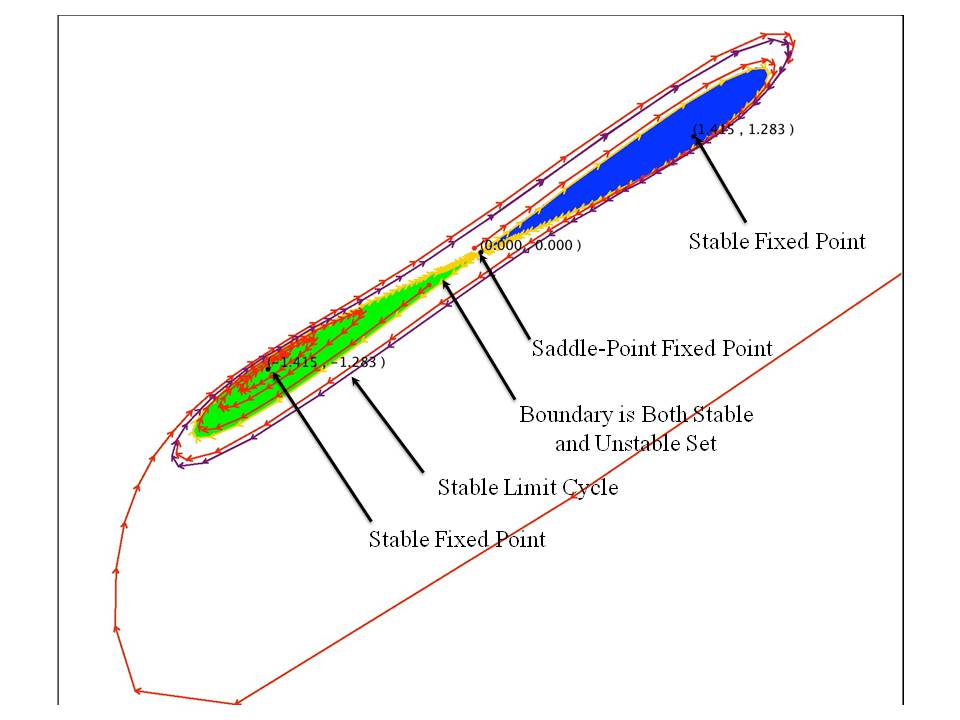
As the speed of adjustment increases, the boundary between the basins of attraction becomes more complex. Figure 1 shows a case where they are entangled in a fractal-like structure, and the outer perimeter of the colored area is repelling. The limit cycle shown is a short distance outside this repelling boundary.

I have by no means exhausted the dynamics of the Kaldor model. Consider a region in which the origin is the only fixed point, and it is asymptotically stable. As the speed of adjustment increases, the system undergoes a Neimark-Sacker bifurcation, which, I gather, is the discrete-time analog to a Hopf bifurcation. Cycles exist in which the cycle is not a fixed point on the Poincaré return map, but winds around many times before repeating. And if I want my application to explore all these dynamics, I have quite a bit of programming to do. I am curious if I will be able to plot a bifurcation diagram, given that the behavior at the limit depends on the initial value.

4.0 Observations

For the parameter values illustrated in the figures, trajectories have three possible destinations:

  • A stable equilibrium with lots of capital and high output.
  • Another stable equilibrium with less capital and less output.
  • A business cycle.
Furthermore, the boundary between the basins of attraction for the stable limit points is fractal-like. These properties suggest that a random shock to the system can redirect trajectories to a very different final destination.

Although not illustrated above, the model exhibits structural instability. A perturbation of the model parameters can result in different observable behavior, of greater or less complexity.

One general way of conceptualizing business cycles is to see them as the response of a damped linear system to exogenous shocks. Their height and depth depends on the characteristics of the external impulses driving the system. The Kaldor model suggests another possibility. In this model, the properties and extent of business cycles are endogenously determined. Shocks can drive the system from one trajectory to another, but the range of possible behaviors is determined from within the system. It is my impression that the former way of understanding business cycles is dominant among mainstream macroeconomists, while the latter is closer to describing actually existing capitalist economies.

Footnotes

  1. Figure 1 is drawn with the parameter values specified in Figure 2(c) in Agliari et al (2007).
  2. Kaldor uses a nonlinear savings function and merely specifies the form of the investment function.
  3. The specification of investment independent of saving is an essential characteristic of Keynesian models.
  4. In this model, expectations are held constant.
  5. Notice the expected level of output does not appear in the two equations giving the normalized model.

Selected References

  • A. Agliari, R. Dieci, and L. Gardini (2007). Homoclinic Tangles in a Kaldor-like Business Cycle Model. Journal of Economic Behavior & Organization. Vol. 62: 324-347.
  • W. W. Chang and D. J. Smyth (1971). The Existence and Persistence of Cycles in a Non-linear Model: Kaldor's 1940 Model Rexamined. Review of Economic Studies. Vol. 38, No. 1: 37-44.
  • Richard M. Goodwin (1951). The Nonlinear Accelerator and the Persistence of Business Cycles. Econometrica. Vol. 19, No. 1: 1-17.
  • Nicholas Kaldor (1940). A Model of the Trade Cycle. Economic Journal. Vol. 50, No. 197: 78-92.
  • Yuri A. Kuznetsov (1998). Elements of Applied Bifurcation Theory, 2nd edition.

Sunday, March 11, 2012

The Wise On Roke

Ursula Le Guin sets her Earthsea trilogy on an imaginary world containing many islands1. Nine mages run a world-famous school for wizards on Roke.

ROKE is now also an acronym, for the Review of Keynesian Economics. It sounds like it prmises to be an interesting journal.

Footnotes

  1. Strangely enough, six books now comprise the Earthsea trilogy.

Friday, March 02, 2012

Elsewhere

  • Matías Vernengo provides an introduction to the capital controversy. He concludes, like others, including myself, that the neoclassical theory of supply and demand cannot explain factor incomes in a capitalist economy.
  • Philip Pilkington interviews Yanis Varoufakis, concentrating on Varoufakis' views on the errors in mainstream economics and the sociology of economics. Update: The second part of the interview is here.
  • Dan Little reviews The End of Value-Free Economics, a book edited by Vivian Walsh and Hilary Putnam. I have only skimmed the Putnam book that the essays in this book are responding to. I have read Putnam's Reason, Truth and History, which makes the case, drawing on the later Wittgenstein, that facts and values cannot be disentangled in science. And Gram and Walsh's Classical and Neoclassical Theories of General Equilibrium: Historical Origins and Mathematical Structure is a very good textbook introduction to the Sraffian revolution.
  • Open Democracy is hosting a series called "Uneconomics". Hey, one of the articles is by Philip Mirowski. Hat tip: Rod Hill and Tony Myatt.