Monday, April 29, 2013

Suggestions For Adding To The Stack

I probably will not order the first two. But I think their existence is of interest. And I do not currently have access to the third.

  • Norbert Häring and Niall Douglas (2012) Economists and the Powerful: Convenient Theories, Distorted Facts, Ample Rewards, Anthem Press.
  • Kalle Lasn (2013) Meme Wars: The Creative Destruction of Neoclassical Economics, Seven Stories Press.
  • Tobias Galla and J. Doyne Farmer (22 January 2013). Complex Dynamics in Learning Complicated Games, Proceedings of the National Academy of Sciences of the United States of America, V. 110, No. 4: pp. 1232-1236
  • Sergio Parrinello (2000). The "Institutional Factor" in the Theory of International Trade: New vs. Old Trade Theories.

I suppose I might try to find the paper, by Benjamin Page, Larry Bartels, and Jason Seawright, that Paul Krugman references in his New York Times column last Friday. By the way, Krugman is basically worrying that economics is "vulgar political economy", a technical term introduced by Karl Marx. But Krugman cannot reference Marx or acknowledge Marx was maybe correct about something.

In my draft paper on the failure of the theory of comparative advantage to justify free trade, I am currently ignoring Krugman and new trade theory. The fourth reference above might be usefully footnoted in my article. I believe Parrinello also has an article in a recent festschrift volume for Ian Steedman.

I recently stumbled across Rob Beamish's 1992 book, Marx, Method, and the Division of Labor. This book traces the development of a concept, the division of labor, in Marx's manuscripts and published work, including the manuscripts I mentioned in a previous post. Furthermore, Beamish argues that if historical materialism is true, it must apply to the development of Marx's ideas.

Wednesday, April 24, 2013

Choice of Technique, A Two Good Model, Cobb-Douglas Production Functions

Figure 1: Wage-Rate of Profits Curves and their Frontier
1.0 Introduction

This post is a generalization of a neoclassical one-good model. It advances a comparison of Sraffian analysis of the choice of the cost-minimizing choice of the technique and neoclassical analyses, correctly understood, of marginal productivity. Accordingly, all production functions are smooth in this example. If substitutability is seen as a technological property of production functions, then the single capital good and labor can be substituted in each of the two industries in this model.

2.0 The Technology

Consider a simple economy in which steel and corn are produced from inputs of steel and labor. The steel used as an input in production is totally used up in yearly cycles, and the outputs become available at the end of the year. In other words, this is a model without fixed capital, and all production processes require a year to complete.

2.1 Production Functions

The production function for steel is:

Q1 = F1(X1, L1) = A1 X1α1 L1(1 - α1)

where:

  • Q1 is (gross) output of steel (in tons).
  • X1 is steel (tons) used as a capital good in the steel industry.
  • L1 is labor (person-years) used as an input in the steel industry.

and A1 and α1 are positive constants such that:

0 < α1 < 1

The production function for corn is:

Q2 = F2(X2, L2) = A2 X2α2 L2(1 - α2)

where:

  • Q2 is (gross) output of corn (in bushels).
  • X2 is steel (tons) used as a capital good in the corn industry.
  • L2 is labor (person-years) used as an input in the corn industry.

and A2 and α2 are positive constants such that:

0 < α2 < 1
2.2 A Set of Coefficients of Production

An alternative specification of this Constant-Returns-to-Scale (CRS) technology is as a set of coefficients of production a01(s1), a02(s2), a11(s1), a12(s2) from the set:

{ (a01(s1), a02(s2), a11(s1), a12(s2)) | 0 < s1, 0 < s2}

where:

a01(s1) = [1/(A1s1)][1/(1 - α1)]
a02(s2) = [1/(A2s2)][1/(1 - α2)]
a11(s1) = s1(1/α1)
a12(s2) = s2(1/α2)

and

  • a01(s1) is the labor required, in the steel industry, per ton steel produced.
  • a02(s2) is the labor required, in the corn industry, per bushel corn produced produced.
  • a11(s1) is the steel input required, in the steel industry. per ton steel produced (gross).
  • a12(s2) is the steel input required, in the corn industry, per bushel corn produced.
2.0 Quantity and Price Equations, Given the Technique

Consider a stationary state in which the firms employ one person-year of labor each year, and prices are stationary. For notational convenience below, define the following function:

f(R) = (a01a12 - a02a11)R + a02
2.1 Quantity Relations

The amount of steel produced each year, measured in tons, is:

q1 = a12/f(1)

The amount of corn produced each year, measured in bushels, is:

q2 = (1 - a11)/f(1)

These quantities must satisfy two equalities. First, the amount of labor employed is unity:

1 = a01q1 + a02q2

Second, consider the following equation:

q1 = a11q1 + a12q2

The left-hand side of the above equation denotes the quantity of steel produced each year and available, as output from the steel industry, at the end of each year. The right-hand side denotes the sum of steel used as inputs in the steel and corn industries, respectively. These inputs must be available at the start of each year. Hence, the above equation is a necessary condition when the economy is in a self-sustaining, stationary state.

2.2 Price Relations

I take the consumption good, corn, as the numeraire. The price of steel, in units of bushels per ton, is

p = a01/f(1 + r),

where r is the rate of profits. The wage is:

w = [1 - a11(1 + r)]/f(1 + r)

The above equation is known as the wage-rate of profits curve.

The price of steel, the wage, and the rate of profits must satisfy two equations. The condition that the price of steel just cover the cost of producing steel is:

pa11(1 + r) + a01w = p

The left-hand side of the above equation shows the cost of producing a ton of steel. Costs are inclusive of normal profits, so to speak, on the cost advanced to purchase physical inputs at the start of the year. In this case, those inputs consist of steel, the single capital good in this model. Although labor is hired at the start of the year to work throughout the year, the price equations in this model show labor being paid out of the harvest gathered at the end of the year.

The condition that the price of corn just cover the cost of producing corn yields a similar equation:

pa12(1 + r) + a02w = 1
2.3 The Capital-Labor Ratio

"Capital" is an ambiguous term. It denotes both physically-existing means of production. And it denotes the value of those means of production, when embedded in certain social relations. For example, in this model, the distribution of the capital goods over the two industries is assumed to be appropriate to the continued self-reproduction of the economy. In a sense, the plans of entrepreneurs and firms managers are coordinated.

At any rate, the relationships described so far allow one to express the value of capital, in numeraire units, per person-years, given the technique:

k = p q1
k = a01a12/[f(1)f(1 + r)]

The capital-labor ratio (in units of bushels per person-years) does not appear in any legitimate marginal product. Nevertheless, I find it a useful quantity for further analysis in multicommodity models.

3.0 The Chosen Technique

The cost-minimizing technique differs with the rate of profits. For analytical convenience, I take the rate of profits as exogenous in this model. One could, instead, if one so chose, take the wage as given and find the rate of profits endogenously. At any rate, this model is open, and the distribution of income is not determined in the model. The equations below set out each of the four coefficients of production in this model as functions of the rate of profits:

a01 = (1/A1)[1/(1 - α1)] [(1 + r)/α1]1/(1 - α1)]
a02 = (1/A2)
x {(1 - α2)/[(α1)1/(1 - α1)](1 - α12]}α2
x [(1 + r)/A1]2/(1 - α1)]
a11 = α1/(1 + r)
a12 = (1/A2)
x [(α1)1/(1 - α1)](1 - α12/(1 - α2)](1 - α2)
x [A1/(1 + r)](1 - α2)/(1 - α1)
3.1 Steel as a Basic Commodity and the One-Good Case

I have previously set out an analysis of the choice of technique for a one-good model with an aggregate Cobb-Douglas production function. In the two-good model set out in this post, the coefficients of production for steel, a01 and a11, when the cost-minimizing technique is chosen, are the same as the coefficients of production in that one-good model. This is not surprising.

In the model in this post, steel enters, as an input, into the production of both steel and corn, for all possible techniques. On the other hand, corn never enters as an input into the production of any commodity. In the technical terminology of post-Sraffian economics, steel is always a basic commodity, and corn is never a basic commodity. Thus, the production of steel can be analyzed, in some sense, prior to the analysis of the production of corn.

3.2 A One-Good Special Case

Consider the special case in which:

α1 = α2 = α
A1 = A2 = A

In effect, steel and corn are the same commodity. The coefficients of production, for the cost-minimizing technique are:

a02 = a01 = (1/A)[1/(1 - α)] [(1 + r)/α][α/(1 - α)]
a12 = a11 = α/(1 + r)

So this case reduces to the one-good model, as it should. This concludes my analysis of this special case.

4.0 The Chosen Technique on Unit Isoquants and Marginal Productivity Conditions

The coefficients of production are such that the steel industry lies on its unit isoquant:

1 = F1(a11, a01)

Likewise, the corn industry lies on its unit isoquant:

1 = F2(a12, a02)

Since the coefficients of production in Section 3 above are for the cost-minimizing technique, all valid marginal productivity relationships must hold. I have chosen to express each marginal productivity condition in numeraire units per unit input. And, the cost of an input and its marginal product are equated here at the end of the year.

Following these conventions, the following display equates the cost of steel to the value of the marginal product of steel in the steel industry:

p(1 + r) = pF1(a11, a01)/∂a11

Likewise, the following display equates the cost of steel to the value of the marginal product of steel in the corn industry:

p(1 + r) = ∂F2(a12, a02)/∂a12

Since wages are paid out of the harvest, the rate of profits does not appear in my statement of marginal productivity conditions for labor. The following display equates the wage and the value of the marginal product of labor in the steel industry:

w = pF1(a11, a01)/∂a01

Likewise, the following display equates the wage and the value of the marginal product of labor in the corn industry:

w = ∂F2(a12, a02)/∂a02

I have checked the above equations for the isoquants and the four marginal productivity equations. This is quite tedious.

Above, I have listed six equations, two expressing the condition that the coefficients of production lie upon unit isoquants and four marginal productivity equations. These six equations are sufficient to determine the six unknowns (w, p, a01, a02, a11, and a12) in terms of the model parameters and the externally specified rate of profits. In other words, this model illustrates that marginal productivity is a theory of the choice of technique, not of the (functional) distribution of income.

5.0 The Wage-Rate of Profits Frontier

An alternate analysis of the choice of technique can be based on the wage-rate of profits frontier. And this analysis yields the same answer as the above analysis based on marginal productivity.

Recall, from Section 2.2, that a technique can be specified as an ordered pair chosen from the specified index set. The index variables for the cost-minimizing technique, as a function of the rate of profits are:

s1 = [α1/(1 + r)]α1
s2 = (1/A2)α2
x [(α1)1/(1 - α1)](1 - α12/(1 - α2)][(1 - α22]
x [A1/(1 + r)][(1 - α22/(1 - α1)]

I think it of interest to note that both the optimal process for producing steel and the optimal process for producing corn, in a stationary state, vary continuously with the rate of profits. This is not a generic result for a discrete technology. In a discrete technology, the cost-minimizing techniques at a switch point typically differ in the process used in only one industry; a small variation in the rate of profits thus affects only the specification of a process in one industry.

5.1 First Order Conditions

Since the coefficients of production are functions of the index variables, the wage-rate of profits curve for a technique can be viewed as a function of:

  • The index variables s1 and s2,
  • The rate of profits r, and
  • The model parameters α1, A1, α2, and A2.

A necessary condition for a technique to be cost-minimizing, at a given rate of profits, is that the wage be a maximum. This maximum is taken from the wage on each wage-rate of profits curve, over all techniques. In the current context, with a model with smooth production functions, the first derivative of the wage-rate of profits frontier, with respect to each index variable, must be zero at the maximum:

w/∂s1 = 0
w/∂s2 = 0

Note that the above is a system of two equations in the two unknown index variables. I did not actually calculate the above derivatives for this model. Perhaps Figure 1 provides some confidence in this mathematics. I deliberate drew three wage-rates of profits curves on the frontier and one off of it.

5.2 Second Order Conditions

The FOCs determine a critical point. The calculus is consistent with such a critical point being a local maximum, a local minimum, or a saddle point. The following are sufficient conditions, in this context, for a critical point to be a local maximum:

2w/∂s12 < 0
2w/∂s22 < 0
D(s1, s1) > 0

where D(s1, s1) is defined by:

D(s1, s1) = [∂2w/∂s12][∂2w/∂s22] - [∂2w/∂s1s2]2

Of the three SOCs, either the first or the second is redundant.

6.0 Conclusion

I still have some ideas for future work with this model. But I think this is enough for one blog post. I hope the above presentation suggests that marginal productivity is not a theory of distribution, in general. One cannot validly hold, for example, that real wages are determined by the marginal product of labor. Furthermore, the Sraffian analysis of the choice of technique is analytically equivalent to the determination of the choice of technique, given, for example, the rate of profits, by marginal productivity.

Sunday, April 21, 2013

Who Is Joshua Clover?

Joshua Clover has a great one-page article on Krugman in this week's Nation. I'd like to quote the whole thing. But I'll make do with extracts:

"Consider the phenomenon of Paul Krugman, of late taking a curious turn... ...Krugman [is] advantageous[ly] position[ed] as a public intellectual famously handy with hard data and rigorous analyses. Ask Thomas Friedman: anyone can be a blowhard on matters global. Few can do the math.

...as a star economist, [Krugman's] historical role has been to reinvigorate the duel between liberal Keynesians and the recently regnant monetarists of various stripes...

...For the record, I greatly preferred the Backstreet Boys to 'N Sync...

The oppositions Republican/Democrat and monetarist/Keynesian are in this regard pure pop. They are, as you will have noticed some time ago, choices only in the most straitened sense: minimally distinct management strategies for capitalism. Their present distinction lies in whether crisis is best managed by allowing the owners of capital everything they want immediately, or at pace lest they choke on something...

And yet. In December, Krugman wrote two blog entries in swift succession: 'Rise of the Robots' and 'Human Versus Physical Capital'. Inequality, his charts informed him, was itself a consequence of the opposition between capital and labor—specifically the increasing domination of capital in the form of machines—as labor is expelled from the production process. That ratio turns out to be basically the same measure as productivity, sine qua non of economic progress.

Moreover, in a development Krugman couldn't quite bring himself to declare, his charts suggest that a generally declining labor share since the 1970s has also spelled bad news for overall profitability outside the finance sector. The productivity race wasn't just unfortunate for the unemployed; it was for capital a poison pill of its own making. Thus Krugman's comedy: always on the verge of discovering the arguments of a 150-year-old book; always turning away at the last second. In Krugman's words, 'I think our eyes have been averted from the capital/labor dimension of inequality, for several reasons. It didn't seem crucial back in the 1990s, and not enough people (me included!) have looked up to notice that things have changed. It has echoes of old-fashioned Marxism—which shouldn't be a reason to ignore facts, but too often is. And it has really uncomfortable implications.'

Does it? I suppose so. And that uncomfort is what pop, for all its pleasures, must defer. Pop must affirm the way things are, no matter how often it choruses the word 'change.' You cannot be Paul Krugman, Pop Star, and at the same time discover that capital is built to break us, and itself—even if your charts so testify. So you will not be shocked to discover Krugman stepped back from this realization and continued about his business, scarcely speaking of it again. There are some things you do not say. They are not popular."

"Technology and Wages, the Analytics" was another Krugman post in the same period, along the same lines. I've already commented on that one.

Thursday, April 18, 2013

Choice Of Technique With A Smooth Aggregate Production Function

Figure 1: Coefficients of Production for the Technology
1.0 Introduction

This post advances, somewhat, my start at a reconsideration of the dynamics of Overlapping Generations Models (OLGs). Only the production side of a stationary state is considered here. Furthermore, only a very special case - namely, a one-good model - is analyzed here.

I guess the most exciting aspect of this post is an illustration of the claim that the construction of the wage-rate of frontier is useful for the analysis of the choice of technique for "smooth" production functions, not just for discrete technologies. I have never understood, for at least a quarter of a century, why some economists seem to talk as if a fundamental distinction exists between such models. In some contexts, some conclusions differ. But it seems to me to be silly to say that the Cambridge Capital Controversy turns around an empirical question on the degree of substitutability of inputs in production.

2.0 Specification of Technology

Consider a simple economy in which corn is produced from inputs of labor and corn. Assume the existence of Constant Returns to Scale (CRS). A technique is specified by an ordered pair of coefficients of production, where each ordered pair is from a set containing a continuum of such ordered pairs:

{ [a0(s), a1(s)] | 0 < s < 1}

where:

a0(s) = 1/(A s)1/(1 - α)
a1(s) = s1/α

and α and A are specified positive parameters such that:

0 < α < 1

Figure 1 graphs the coefficients of production as a function of the index s. All graphs are draw for a value of α of 1/4 and of A of 5.

3.0 Derivation of the Cobb-Douglas Production Function

The above specification of the technology shows, for a unit output of corn, a smooth trade-off of inputs of labor and corn inputs. This specification of technology allows for the derivation of a conventional production function. The following is an equation for a unit isoquant for this technology:

1 = A [a1(s)]α [a0(s)]1 - α

Define:

  • Q is (gross) corn (bushels) output.
  • L is labor (person-years) input.
  • X is (seed) corn input.

From CRS, it follows:

Q = A [Q a1(s)]α [Q a0(s)]1 - α

Or:

Q = A Xα L1 - α

The last equation above is how the (in)famous Cobb-Douglas production function is typically represented. So the specification of technology used in this post is a (non-unique) representation of a Cobb-Douglas production function.

4.0 Analysis of the Choice of Technique

For a given technique, Sraffa's price equations become one equation:

a1(s)(1 + r) + a0(s) w = 1

where:

  • r is the rate of profits
  • w is the yearly wage (in units of bushels per person-year).

The price equation embeds the assumptions that production of corn requires a year to complete and that labor is paid out of the yearly harvest. One can derive a wage-rate of profits curve from the price equations:

w(r, s) = [1 - a1(s)(1 + r)]/a0(s)

In this case, each wage-rate of profits curve is a straight line. Figure 2 shows three selected wage-rate of profits curves.

Figure 2: Wage-Rate of Profits Curves and Their Frontier

Figure 2 shows, in violet, the outer wage-rate of profits frontier. When firms choose the cost-minimizing technique in a steady state, the economy will lie on this curve. (In this case, with a continuum of techniques, each point on the frontier is a non-switch point.) A closed-form expression for the wage-rate of profits frontier is easily derived. The First Order Condition (FOC) for the choice of technique can be expressed as equating the derivative, with respect to the index variable, of the wage-rate of profits curve to zero:

dw/ds = 0

The FOC yields an equation which can be solved for the index variable:

s(r) = [α/(1 + r)]α

So the coefficients of production, for the cost-minimizing technique, can be found as functions (Figure 3) of the rate of profits:

a0(r) = [1/A1/(1 - α)] [(1 + r)/α]α/(1 - α)
a1(r) = α/(1 + r)

Thus, the desired expression for the wage-rate of profits frontier is:

w(r) = (1 - α) A1/(1 - α) [α/(1 + r)]α/(1 - α)

In this special case, the desired amount of labor per unit output is higher, the lower the wage. Likewise, the desired amount of the capital good per unit output is lower, the higher the rate of profits. These results do not generalize to multi-commodity models.

Figure 3: Optimal Coefficients of Production
5.0 Capital Intensity

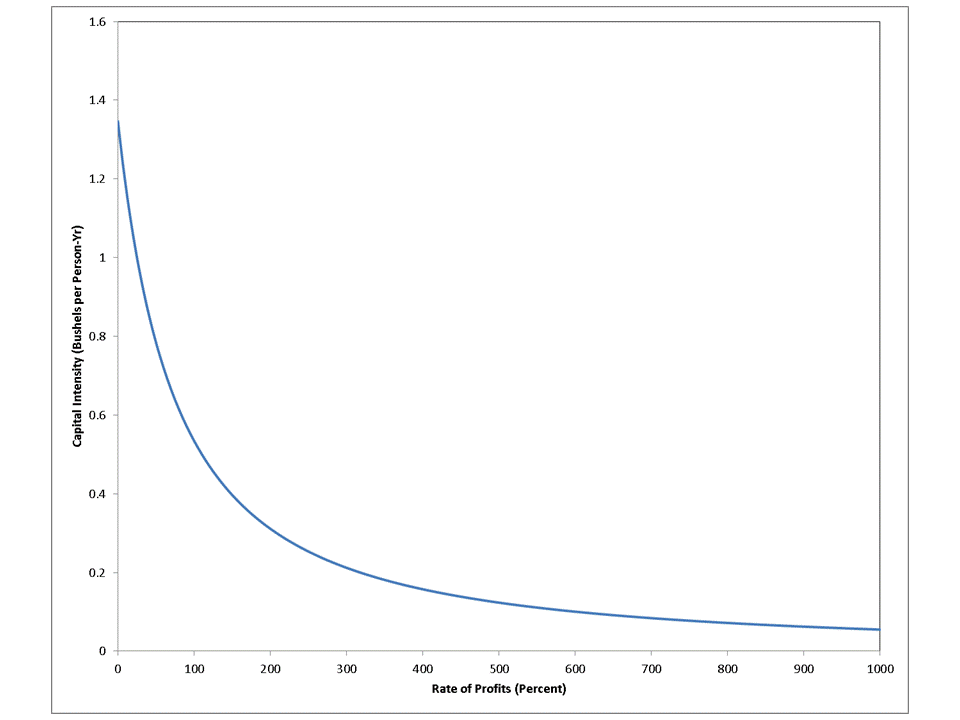
In this special case, the ratio of the value of capital goods to labor can be calculated in physical terms, without addressing a question of valuation. That is, the capital-labor ratio, as a function of the rate of profits (Figure 4), is easily derived:

I(r) = a1(s(r))/a0(s(r)) = [α A/(1 + r)]1/(1 - α)

In this special case, the capital-labor ratio is a downward-sloping, single-vauled function of the rate of profits. These properties do not generalize, either.

Figure 4: Capital Intensity

Tuesday, April 16, 2013

"Economics Textbooks - Decades of Scientific Fraud"

Lars Syll has written a post, titled "Economics Textbooks - Decades of Scientific Fraud". If you had not already read it, could you guess what it is about from the title?

I would expect likely guesses to be non-unique. It is not about:

  • How the Cambridge Capital Controversy demonstrates that textbook teaching on labor markets and, for example,on the minimum wage is nonsense.
  • The incoherence of textbook teaching on the justification for lack of tariffs by the theory of comparative advantage.
  • The textbook misrepresentations of the theories of various economists, including John Maynard Keynes.

You can extend the above list at your leisure.

In many ways, economics seems to me to be an extraordinary subject. Good arguments have existed for decades for discarding most of mainstream teaching and practice. As far as I can see, the bulk of these arguments, including their very existence, are just ignored by most mainstream economists. I am willing to entertain demonstrations of the fallacy of theories taught in almost all mainstream textbooks for decades. I think my willingness to explore other demonstrations than those I have been previously aware of is partly due to my belief that most economists are socialized into willful ignorance.

I can see why some young mainstream economists may resist the notion that they have been taught, mostly, lies and nonsense. And so they may look in the research literature for arguments against the arguments and demonstrations that I accept, or at least try to explore. Since my favorite positions were established after long controversy, you can find neoclassical counter-arguments, of a sort. For example, one might cite, in response to the Cambridge Capital Controversy:

  • Edwin Burmeister's championing of Champernowne's chain index measure of capital1.
  • Frank Hahn's advocacy, including in response to the Cambridge Capital Controversy, of General Equilibrium Theory2.

In response to the application of the CCC to the theory of international trade, one might cite:

  • Christopher Bliss's suggestion that the necessary existence of gains from trade follows from including an assumption that all produced goods, not just consumer goods, be traded internationally.
  • Wilfred Ethier's claim that the endowment of capital be calculated in equilibrium prices in models of international trade.
  • A suggestion that the theory of international trade be organized around comparisons of intertemporal equilibrium paths3.

One might think a conclusion is more justified from the weight of the evidence when multiple arguments reach that conclusion. So one might react to existence of such controversies in the research literature as allowing one to support mainstream teaching. However, one would be wrong in this attitude. If you look at these responses in some detail, you will find that the orthodox economists do not end up at the textbook position, but at some other point. But, as far as I can tell, neither side ends up being transitioned from the research literature to conventional teaching. Would you not be more confident in adopting some such conventional counter-argument to one of my favorite arguments if it were widely taught? Otherwise, should you not suspect yourself of adopting an idiosyncratic misinterpretation of the theory?

Footnotes
  1. This chain index is endogenous, not exogenous, as needed for much of neoclassical theory. Furthermore, Burmeister accepts the validity of demonstrations of reswitching and capital-reversing.
  2. A focus on intertemporal and temporary equilibria is a rather drastic change of theory from the traditional neoclassical focus on a comparison of long run equilibria. The latter comparisons seem to be to provide the (exploded) foundation for most mainstream policy advice.
  3. Avinash Dixit (May 1981). The Export of Capital Theory, Journal of International Economics. V. 11, Iss. 2: pp. 279-294.

Friday, April 12, 2013

Perfect Competition Is The Same As Monopoly If You Do The Math Right

1.0 Introduction

This post summarizes one aspect of a theorem presented and proved by Roy Radner (1980). I have previously expressed skepticism about the claim in the post title. I have also heard that, in game theory, anything can happen, but nothing need happen. So, I suppose, one should not be surprised in stumbling over a proof of the existence of almost any market behavior in the literature on game theory. But I was surprised.

2.0 Selected Assumptions

2.1 Non-Cooperative Firms

In the model considered here, no mechanism exists to enforce agreements among firms. In the jargon, only (extensions of) Cournot-Nash equilibria are considered here.

2.2 Firm Managers Making Approximately Optimal Output Decisions

Although not commonly stated, the textbook presentation of perfect competition assumes the managers of the firms are systematically mistaken about their optimum decisions. A homogeneous product is assumed to be produced by a finite number of firms in the industry, and the total industry output is finite. Managers are assumed to disregard any strategic reaction by other firms to variation in their own firm's output and to take the price of their product as given. But, for a given consumer demand function, the firm's (notional) variation in output results in a variation in prices. So the decisions of the managers can only be approximately optimal, in textbook theory.

Radner proposes the notion of an epsilon-equilibrium to formalize this idea that firm strategies are only approximately optimal. In such an equilibrium each firm's strategy is such that, for example, average profit is within epsilon of the maximum average profit achieved by an optimal strategy, given the strategies of all other firms. As is typical in mathematical analysis, one should think of ε as a given (small) parameter.

2.3 Sequential Market Interactions

Firms are not considered as deciding on a single quantity to produce in this model. Rather, each firm decides on a sequence of T quantity outputs, one for each of T successive periods. The parameter T is known as the lifetime of the industry. Each firm decides on the output in a given period as a function of the outputs of all firms in all previous periods. A strategy is a sequence of such functions, one for each firm. The firm chooses a strategy to maximize its average or total discounted profit over the lifetime of the industry.

2.4 Replication

The theorem outlined here is used to compare epsilon-equilibria for different (finite) numbers of firms in the industry. Radner defines the replication case to apply when the demand price is an unchanged function of the average output per firm. In some sense, the number of consumers increases, in the model, with the number of firms.

3.0 An Informally Stated Theorem

Theorem: Consider the model with the above assumptions. Let the number of firms increase, along with the lifetime of the industry, such that the number of firms remains small enough, when compared to the lifetime of the industry. For any finite number of firms, equilibria exist in which the firms act as a cartel, and the cartel lasts for any given duration, provided the lifetime of the industry is taken large enough.

4.0 Conclusion

I think of the point of this post to explore the result of tweaking textbook assumptions in the theory of perfect competition. Apparently, the results are sensitive to the exact statement and combination of assumptions. I gather that further research in microeconomic theory has confirmed that whether or not equilibria converge, as the number of firms increase, to the perfect competition model is a fine point. That is, equilibria may or may not converge to a model with a continuum of firms. Radner seems to feel exploring certain sets of assumptions is of more interest than other sets. I have chosen to emphasize a set of assumptions in which any finite number of firms may act like a monopoly, in a precise sense.

Another approach might be better in empirically describing firms in actually-existing capitalism.

Reference
  • Roy Radner (1980). Collusive Behavior in Noncooperative Epsilon-Equilibria of Oligopolies with Long but Finite Lives, Journal of Economic Theory, V. 22: pp. 136-154

Wednesday, April 10, 2013

A Numeric Example Of The Loss From Trade

Ratio of the Value of Capital to Labor

This post summarizes a numeric example in which at least one country is unambiguously worse off under free trade. This example illustrates the model I developed in a draft paper. The example in this post differs from the one in my paper; interest rates of concern here are more reasonable values.

The model is of two small open economies facing identical technologies for producing two consumer goods. The model assumptions are:

  1. Two countries, A and B, can produce the same two commodities, wine and silk, for consumption.
  2. The entrepreneurs in each country know the given flow-input, point-output technology (Table 1). Wine and silk each require two years of labor input per unit output. For example, the grapes for a unit of wine require 10 person-years of unassisted labor to be expended in the first year. One hundred eighty eight person-years of labor work up these grapes into wine produced for consumption at the end of the second year.
  3. Each country has a given endowment of labor, the only non-produced factor of production in each country. The labor force is fully employed in each country.
  4. Only commodities produced for consumption can be traded internationally. Laborers neither immigrate nor emigrate. Capital cannot be traded internationally.
  5. Wine and silk are produced with different factor-intensities, silk being more capital-intensive and wine being more labor-intensive. No factor-intensity reversals exist.
  6. All consumers, in all countries, have identical homothetic utility functions.
  7. Perfect competition obtains in all markets; transport costs are negligible; and free trade exists in all commodities produced for consumption, unless otherwise specified.

These are textbook assumptions. The numeric example proves mainstream textbooks are simply incorrect, since the opposite answer is obtained.

Table 1: The Technology
Country ACountry B
Wine Productionl1,A = 10 person-yrs per unit winel1,B = 10 person-yrs per unit wine
l2,A = 188 person-yrs per unit winel2,B = 188 person-yrs per unit wine
Silk Productionl3,A = 100 person-yrs per unit silkl3,B = 100 person-yrs per unit silk
l4,A = 89 person-yrs per unit silkl4,B = 89 person-yrs per unit silk
EndowmentslTotal,A = 4,158 person-yearslTotal,B = 3,969 person-years

The firms in both countries face given prices of wine and silk on the international market, as shown in Table 2. The domestic interest rate and the corresponding wage vary between the two countries. As shown in my paper, one can use this price system to determine which commodity, if any, firms in each country would find it most profitable to specialize in the production of. If the interest rate were zero, each country would attempt to specialize in the producing silk. For the price of silk to be a switching price, where firms would find it profitable to specialize in the production of both wine and silk, the interest rate must be 10% for the example. For the interest rates shown, country A specializes in the production of wine, and country B specializes in the production of silk.

Table 2: The Selected Price System
Country ACountry B
Price of Silk:p = 1 units wine per unit silk
Interest Rate:rA = 20%rB = 5%
Wage:wA = (1/200) units wine per person-yrwB = (1/194) units wine per person-yr

Given the technology, endowments, an equilibrium price system, and tastes, one can calculate how much wine and silk will be produced and consumed in each country, both when neither country can trade consumer goods on international markets and when both can. Table 3 shows the resulting patterns of consumption among stationary states in the two countries. The consumers in country A are unambiguously worse off in a stationary state with specialization and free trade.

Table 3: Results for the Numeric Example
AutarkySpecialization
Wine ConsumptionCountry A 10 1/2 Units wine10 1/2 Units wine
Country B10 1/44 Units wine10 1/2 Units wine
Total20 23/44 Units wine22 Units wine
Silk ConsumptionCountry A11 Units silk10 1/2 Units silk
Country B10 1/2 Units silk10 1/2 Units silk
Total21 1/2 Units silk22 Units silk

Figure 1, constructed for the example, shows that the endowment of capital cannot be taken as a parameter in the illustrated model. Because of price Wicksell effects, the quantity of capital varies with the interest rate, even for a given pattern of specialization. Yet confused textbook writers often present the Heckscher-Ohlin-Samuelson model in a two-country, two-commodity, two-factor framework, with the factors of production incorrectly labeled as "labor" and "capital".

So much for the orthodox theory of free trade. Neo-Ricardians proved, more than a third of century ago, that the neoclassical theory of international trade is defective in other ways, too.

Monday, April 08, 2013

Political Elites Bowing Down Before The Ones They Serve

Table 1: Politicians in State Legislatures Ignorant of Strength of Constituent Support for Universal Health Care

Table 2: Politicians in State Legislatures Ignorant of Strength of Constituent Support for Gay Marriage

In 2012, Broockman and Skovron surveyed candidates for office in state legislatures throughout the United States. Nearly 2,000 candidates replied. About half of those responding won their races, about half are Democrats, and about half are Republicans. The survey asked the respondents to estimate their constituents' support for the following three policy proposals:

  • Implement a universal healthcare program to guarantee coverage to all Americans, regardless of income.
  • Same sex couples should be allowed to marry.
  • Abolish all federal welfare programs.
Broockman and Skovron also estimated the actual support for these proposals in each of the respondents' districts. Estimates of actual support come out of a multi-level regression and poststratification (MRP) model. The paper contains a neat map of greater Los Angeles showing the results of the MRP model for districts there.

Figures 1 and 2, above, compare the actual support for the first two policy proposals, respectively, to estimated support. If estimates matched actual values, they would lie on the 45 degree line, shown in grey on the graphs. A striking finding is that members of state legislatures tend to think their districts are more conservative than they are. The bias is more extreme for conservative politicians: "Nearly half of sitting conservative officeholders appear to believe that they represent a district that is more conservative ... than the most conservative legislative district in the entire country." Furthermore, politicians learn next to nothing about their constituents' views in running for office.

Broockman and Skovron use these results as a starting point for speculating on how constituents can control their representatives, given these systematic biases in the representatives understanding of opinions among their constituents. As I understand it, this approach fits into a large question within political science, as studied in the United States: How can democracy work even as good as it does in the United States, given the widespread ignorance of the most basic facts about the political system on the part of populace in the United States, including voters? Broockman and Skovron have added a new question: How can democracy work in the United States, given not only ignorance among the populace, but also systematic ignorance on the part of elected officials?

I would like to suggest two hypotheses for explaining these results. First, I suggest legislatures are accurately reflecting the views of their constituents, at least those constituents who matter. Martin Gilens finds that only the policy views of the rich influence what policy gets implemented, at least on the Federal level. Andrew Gelman has shown that the rich tend to be more reactionary in their views.

Second, I would like to suggest that norms of politeness in the United States interacts with conservative minds such that conservatives are systematically underexposed to liberal views among their constituents. I draw on Jonathan Haidt's work here. In some work, he defines five dimensions of moral intuitions:

  1. Harm/care
  2. Fairness/reciprocity
  3. In-group/loyalty
  4. Authority/respect
  5. Purity/sanctity
(Quite a bit of literature exists on the different cognitive styles of conservatives and liberals. Liberals tend to have more activity in the anterior cingulate cortex, and conservatives tend to have a more active amygdala.) Liberals tend to worry more about harm and fairness, while conservatives equally emphasize all five dimensions.

My hypothesis is that conservatives tend to hear those articulating liberal, or even more left views, as being rude. If you are not comforting the comfortable, these days, you are branding yourself as not a member of an in-group that conservatives are loyal to, showing disrespect for our elites, and demonstrating personal impurity. So whether or not they understand liberal views, conservatives are unlikely to perceive such views as any more than eccentricities.

I suppose one could test my first hypothesis by comparing politicians' estimates of their constituents' views with the actual views of those constituents in the top 10% or 1%, by income or wealth. I'm not sure how one would empirically assess my second hypothesis, relating norms of politeness to political views. However one did this, I would think my second hypothesis would apply in a more extreme fashion to rural districts, as compared with urban districts. I do not know how this would apply in suburban districts.

I've probably made my usual share of spelling and grammar mistakes above. But I get to conclude this post, as if it were a journal publication, not a off-the-cuff blog post. More research is needed.

References

Wednesday, March 27, 2013

What If? An Alternative History For Karl Marx

Some Works By Marx Not Available Until The 20th Century

1.0 Introduction

Surprisingly, current understanding, among scholars, of the thought of Karl Marx is dependent on major primary texts that were unavailable until well after Marx died in 1883. I have in mind, especially, The Economic and Philosophic Manuscripts of 1844, The German Ideology, and The Grundrisse der Kritik der Politischen Ökonomie. These were originally written in 1844, 1845, and from 1857 to 1858, respectively. But they were left to "the gnawing criticism of the mice" during Marx and Engels' lifetime. They only became available after the 1930s, with subsequent translations to English and other languages.

For this post, I want to focus on the 1844 Manuscripts and the Grundrisse. My claim is that their interpretation reflected 20th century contexts. I wonder what would have been the effect if the Grundrisse had become more widely known before the 1844 Manuscripts. Perhaps then scholars would have been more inclined to read Marx's thought as a continuous development, without hypothesizing a break between the "Young Marx" and a later emphasis on a later analysis emphasizing objectivity. I am intrigued by possible connections between Marx's early ideas on alienation, later ideas on commodity fetishism and vulgar political economy, and Lukas' discussion of reification. (These are all topics where I have no issue acknowledging that my understanding is partial.)

2.0 The 1944 Manuscripts

For me, I was surprised to see that a large part of these manuscripts were taken up by annotated comments on such writers on classical political economy as Adam Smith and David Ricardo. As pointed out by Mandel, Marx rejected the labor theory of value in these manuscripts. Nevertheless, he had lots to say about the labor process, and in particular the estrangement or alienation of labor under capitalism.

I think some of these remarks draw on Aristotle, as well as Hegel. Recall that Marx was a classical scholar. His doctoral thesis was on the Difference Between the Democritean and Epicurean Philosophy of Nature. Marx, like Aristotle, was concerned with how human beings could be at their best, how they could achieve self-actualization, or how they could live in a way consistent with their "species being". But Marx stood Aristotle's attitude to labor on its head. (I think I read this point in something by Hannah Arendt.)

For Marx, humans fully achieve their potential in creation, that is, in production. But, under capitalism, the laborer produces under the capitalist's direction, and his output is alienated from him. He does not own what he produces. His product is sold on a market. The means of production and the objects produced by the workers confront the worker as an active outside force, not something in which he can take pride. Capitalism warps the worker.

2.1 For the Young Marx

Suppose you were writing in the late 1950s or the 1960s. And you found socialism attractive. Then you might want to consider Marx's ideas. In this period, you would have witnessed, among other events, Khrushchev's "secret speech" denouncing the Stalinist cult of personality, the 1956 Soviet invasion of Hungary, and the 1968 suppression of the Prague Spring. Many a socialist in the west would want to reject the Soviet Union and their official philosophy. One could still champion the humanism of the young Marx and leave the Soviet ideologues to a teleology taken from the later Marx. Thus, one would be inclined to read an epistemic break into Marx.

2.2 Against the Young Marx

On the other hand, suppose you were an intellectual associated with an orthodox communist party in a western country, namely France. Arguing for an epistemic break in the development of Marx's thought is still an attractive reading. And so I come to Louis Althusser's structuralist reading of Marx. He agrees the young Marx is a humanist, but finds attractive the mature Marx. And so he champions an anti-humanism. As I understand, this reading emphasizes historical and dialectical materialism. It opposes subjectivism, voluntarism, and a naive empiricism. I do not understand much about Althusser. But I can see the point of view that there is no true human nature to be freed by a better society after the revolution. Rather, human beings are always an element embedded in a larger social structure. One will be constrained in the formation of ones beliefs and in ones actions by some such larger structures. These structures can be altered, maybe drastically, but it is pointless to try to imagine humans without society. For Althusser, Marx founded a science of history, just like Euclid founded a science of geometry and Galileo founded a science of a new physics. Maybe I'll reread Althusser, and try to understand the problematic he claims Marx was addressing in his later work. (He is one author I can see the point of an ad hominem against based on his personal life.)

3.0 The Grundrisse

The Grundrisse throws a spanner into this idea of a break in Marx's thought. It is a working out of ideas, some which were later given expression in Capital. Yet it contains much emphasis on human subjectivity and Hegelian themes of the early Marx. I like Marx's exposition of his method in the introduction. He explains that in discovering a set of concepts to explain a society in history, one will make many abstractions. In presenting these concepts, one will start from these abstractions and present one's theory in an order fairly close to the opposite of the order of discovery. Empirical phenomena will be overdetermined and refract an organic mixture of many abstractions. In the Grundrisse one can also see Marx develop his ideas on historical materialism without worry about Prussian censorship. (A Contribution to the Critique of Political Economy did go through such censorship.) Also, in the introduction, Marx has a polemic against basing economics on myths of Robinson Crusoe.

Antonio Negri produced one study of the Grundrisse that I have stumbled through. (I do not think much of the translation.) Negri is part of an Italian political movement to the left of what was the Italian Communist Party (PCI). During the 1970s, leading lights of western communist parties, such as Enrico Berlinguer, insisted on the autonomy of individual communist parties and their ability to take a line independent of any direction from Moscow. This movement became known as Eurocommunism. Once also saw the Italian Communist Party making a "historic compromise" with more centrist parties, in a maneuver to get into, at least, regional governments.

Negri and the autonomia movement (a kind of anarchism) remained more radical. Negri sees in the Grundrisse a theory of the independent agency of the working class. Unlike in his reading of Capital, labor need not merely react to the initiatives of the capitalists. For Negri, the Grundrisse is more open, with less deterministic accounts of how the contradictions of capitalism will be resolved in specific historical circumstances.

4.0 Conclusion

Confining myself to works translated into English, I have outlined how the reception of certain works by Marx, first made available in the twentieth century, may have been impacted by the order in which they were considered and the political context of certain scholars. So I wonder what would have happened if they became available in another order. Is scholarship on Marx now possible without being bent by one's opinion about no-longer-actually existing socialism? By current political controversies?

Secondary References
  • Louis Althusser (1969). For Marx (trans. by Ben Brewster).
  • Erich Fromm (1961). Marx's Concept of Man [To Read. Does this emphasize the humanism of the young Marx?]
  • Ernest Mandel (1971). The Formation of the Economic Thought of Karl Marx, 1843 to Capital (Trans by Brian Pearce). Monthly Review Press [A study of the development of Marx's ideas by a follower of Trotsky]
  • Antonio Negri (1991). Marx Beyond Marx: Lessons on the Grundrisse, New York: Autonomedia
  • Bertell Ollman (1976). Alienation: Marx's Conception of Man in Society, 2nd edition. Cambridge University Press. [To Read]
  • Paul Walton and Stuart Hall (editors) (197x). Situating Marx: Evaluations and Departures. Human Context Books [Proceedings of a symposium in Britain on the Grundrisse]

Monday, March 25, 2013

On The Loss From Trade

Capital-Labor Ratio for a Country Engaged in International Trade

I have made a new paper available at my SSRN site. Here is the abstract:

Consider models of international trade in which capital goods are produced, not given as an unproduced endowment. A positive interest rate, in such a model, acts as a price distortion. Consequently, the gains of trade, when comparing stationary states with and without trade, can be negative. Previous authors have drawn this result in models with production depicted as a circular process, even though their point does not depend on this modeling choice. The principle contributions of this paper are to provide a demonstration of the possibility of such a loss from trade in a simplified model with "a one-way avenue ... lead[ing] from 'Factors of production' to 'Consumption goods'" and to illustrate the model with a concrete numerical example. The theory of comparative advantage is not sufficient to justify the advocacy of free trade in consumer goods, even under textbook assumptions.

I have not yet decided where to submit this paper.

Friday, March 22, 2013

Aspects of the Keen-Stigler Critique of Perfect Competition

It seems to me that this echoes part of Steve Keen's point in Debunking Economics and, further, Keen's Physica A paper with Russell Standish:

"...the analysis has rested on one or another of several finite general-equilibrium models which share assumptions that together imply market power on the part of all households and firms and which also share the assumption of price taking by all households and firms.

The possible inconsistency of these assumptions has long been overlooked - since the pioneering work of Walras (1874) and continuing through to the modern period dominated by Arrow and Debreu (1954) and McKenzie (1954). Only very recently has it attracted attention; see Kemp (2005) and Kemp and Shimomura (2005). here I note only that the internal consistency in the models relied on can be maintained by adding the additional assumption that each household is incompletely informed (about the economy of which it is a member) or incompletely rational (unable to appreciate the implications of membership for its market power) or both." -- Murray C. Kemp (2010).

I learned from Keen that the textbook presentation of perfect competition assumes a curious mixture of omniscience on the part of firm managers and an inability to learn from systematic errors1. As far as I know, no introductory or intermediate microeconomics textbook clearly states these assumptions.

Kemp is concerned with perfect competition in the theory of international trade, for example, in the theory of the small open economy. Is there literature assuming that each country produces infinitesimal quantities of whatever commodities they produce, analogous to the literature on the assumption that each firm in a market for a specific commodity produces an infinitesimal quantity? I do not see how such an assumption2 can be consistent with the use of U-shaped cost curves in the textbook treatment of perfect competition. In the long-run, we are taught, the firm produces at the minimum point of the U-shape average cost curve. The existence of the downward-sloping portion of these U-shaped curves implies that the level of production in the long-run must be a strictly positive, non-infinitesimal quantity3.

Footnotes
  1. I have recently learned that the literature on limiting behavior in models of mechanism design may be of relevance here. (Al Roth's whining and boundary patrolling is not encouraging.)
  2. It would be some combination of mistaken to intellectually dishonest to cite Aumann (1964) in defense of an argument in which perfect competition is supposedly found as the limit in a model with a finite number of firms, as the number of firms increases without bound. Aumann explicitly argues that perfect competition cannot be derived as such a limit, and the cardinality of a continuum is bigger than the cardinality of the set of natural numbers.
  3. It would be intellectually dishonest to "address" the logical inconsistencies of the theory of perfect competition described in this post by insulting Keen, based on his further arguments about monopoly. Those further arguments in Keen and Standish, for example, seem to assume firms treat variables over which they do not have control as decision variables. I do not find the logical aspects of those further arguments compelling, although I do find of interest their simulations, in which they do not make this error. But this footnote deals with a change of subject from this post.
References
  • Steve Keen, Russell Standish (2006). Profit Maximization, Industry Structure, and Competition: A Critique of Neoclassical Theory, Physica A: pp. 81-85
  • Murray C. Kemp (2005). Trade Gains" The End of the Road?, Singapore Economic Review, V. 50: pp. 361-368 [To read].
  • Murray C. Kemp (2010). Normative Trade Theory under Gossenian Assumptions, in Economic Theory and Economic Thought: Essays in Honour of Ian Steedman (ed. by J. Vint et al.), Routledge.
  • Murray C. Kemp and K. Shimomura (2005). Price Taking in General Equilibrium, American Journal of Applied Sciences, V. 6: pp. 95-97. [To read]

Monday, March 18, 2013

"Governance" As Used In Current Literature On Management

1.0 Introduction

One might study economics because one wants to explore the ruling ideas of the ruling class in our society. The literature directed to professional management provides another locus for exploring such ideas. I find it intriguing when such literature parallels selected ideas being developed by leftists.

One such idea is that corporations often make political decisions. The allocation of resources, particularly for investment, is a political decision. Some of these investment decisions in the United States are left to centers of private power, that is, businesses. Of course, some investment decisions, particularly in basic research, are made by government. And universities are important here.

I think the use of the "governance" in the literature on management fairly explicitly states a recognition of the political nature of management decisions in large corporations. Some work of the economist Michael Jensen can be seen as concerned with corporate governance. Some literature also discusses subsidiary governance in the corporation. I here provide some examples.

2.0 Governance of Information Technology (IT)

I start with IT governance:

"Effective governance addresses three questions:

  1. What decisions must be made?
  2. Who should make these decisions?
  3. How will we make and monitor these decisions

...For our purposes here, governance is not about creating bureaucracy but determining what decisions must be made, by whom, and how they will be monitored. Providing clarity to the organization about the results of governance decisions and, more importantly, the process of decision making streamlines communications and removes ambiguity...

...It is reasonable to question why 'business needs' appear to be only a subset of the considerations for decisions when surely they should drive all IT decisions? ...Remember that this chapter is about how decisions on business needs will be made alongside other IT decisions. The assumption is that the real, major business decisions are being made in the context of a corporate governance model (which is at a hierarchically higher level in the organization than the IT governance model)." -- Harris et al. (2008): pp. 59-63.

Harris et al. go on to define a number of political structures for IT governance, including monarchies, feudalism, federalism, duopoly, and anarchy.

3.0 information Security Governance

I can cite a number of references (Allen 2005, Allen et al. 2008, Bowen et al. 2006, Westby and Allen 2007) addressing enterprise or information security. Perhaps information security governance should be as a subset of IT governance:

"Information security governance can be defined as the process of establishing and maintaining a framework and supporting management structure and processes to provide assurance that information security strategies are aligned with and support business objectives, are consistent with applicable laws and regulations through adherence to policies and internal controls, and provide assignment of responsibility, all in an effort to manage risk." -- Bowen et al. (2006): p. 2
4.0 Conclusions

Doubtless those concerned with other issues and technology areas of importance in corporate management can find definitions and literature on governance for their areas. Leftists and students of management agree: politics includes corporate decisions.

References
  • Julia H. Allen. Governing for Enterprise Security, CMU/SEI-2005-TN-023, Software Engineering Institute, Carnegie Mellon University (June 2005).
  • Julia H. Allen, Sean Barnum, Robert J. Ellison, Gary McGraw, and Nancy R. Mead (2008). Software Security Engineering: A Guide for Project Managers, Addison Wesley.
  • Pauline Bowen, Joan Hash, and Mark Wilson. Information Security Handbook: A Guide for Managers, NIST Special Publication 800-100, Computer Security Division, Information Technology Laboratory, National Institute of Standards and Technology (October 2006).
  • Michael D. S. Harris, David Herron, and Stasia Iwanicki (2008). The Business Value of IT: Managing Risks, Optimizing Performance, and Measuring Results, CRC Press.
  • Jody R. Westby and Julia H. Allen. Governing for Enterprise Security (GES) Implementation Guide CMU/SEI-2007-TN-020, Software Engineering Institute, Carnegie Mellon University (August 2007).

Thursday, March 14, 2013

Benedetto Croce As A Precursor To Ludwig Von Mises

Table 1: Comparison of Croce and Mises
CroceMises
Subject:Pure economicsPraxeology
Principle:Economic PrincipleHuman Action
Distinguished from
Psychology:
By conscious choice.
Distinguished from
Applications:
By formal deduction, not
empirically testable.

1.0 Introduction

I have previously argued that Von Mises was not original in asserting the impossibility of socialist central planning. I have recently stumbled across a book by Benedetto Croce. This is a collection of articles critiquing and reviewing the views of other Italian scholars on Marxism and marginalist economics. I claim that Croce's take on the methodology of marginalist economics is close to an advocacy of praxeology, but without the use of the word. Before elaborating this claim, I will first summarize Croce's interpretation of Marxism, in the light of the then new-fangled marginalist analysis.

2.0 Croce On Marx

Volume 1 of Marx's Capital contains a formal model, as well as many historical analyses. For Croce, this overarching formal model is an abstract description of a pure capitalist economy. All commodities are assumed to be produced with labor hired by capitalists. In the model, there are no old master's (e.g., paintings by Rembrandt) or rare wines of a given vintage. Such commodities are not and cannot be made any more. Likewise, no self-employed artisans exist in the model.

The volume 1 analysis focuses on explaining the origin of the returns to capital. Distinctions among profits, interest, and rent are abstracted from in the category of surplus value. For purposes of explaining the source of surplus value, the assumption is made that all commodities sell at their (labor) value. Labor value are not prices, even prices of production.

Volume 3 of Capital looks at prices. Croce accepts the marginalist explanations of prices. Since prices are to be explained at a more concrete level of abstraction, marginalism is compatible with the Volume 1 analysis, according to Croce.

This compatibility raises a question for Croce. How should the volume 1 analysis now be interpreted, in the light of this acceptance of marginalism as a descriptive theory? Croce claims that the value of labor power - that is, wages in the volume 1 analysis - should be compared with what the returns to the workers would be in a post-capitalist communist society, in which the means of production are collectively owned. For Croce, surplus value is the difference between the latter and the former quantities.

I do not think Croce's interpretation can be textually justified. He was writing, however, at a time when marginalism was the new theory. It was not clear then that this theory could be rejected because of its inability to explain returns to capital. Vilfedo Pareto and Maffeo Pantaleoni were certainly serious economists, and well worth engaging with. Given this historical setting, Croce's interpretation has a certain amount of ingenuity. Kozo Uno also argued that the formal analysis in volume 1 is based on a abstract description of a pure capitalist economy. I find this idea plausible. Furthermore, Marx definitely and quite explicitly works at multiple levels of abstractions.

3.0 Pure Economics and Praxeology

I now select some quotations from Croce, perhaps not the best, to illustrate parallels between Croce's conception of marginalism and ideas later put forth by Von Mises. In this conception, economic theory is to be formally deduced from an axiomatic description of choice. Neither applications nor psychology can test economic theory; it is not capable of being empirical falsified. (For the purposes of this post, I put aside the controversy over socialist calculation. Croce has some comments on Pareto on socialism.)

3.1 The Economic Principle

Croce talks about the economic principle as a foundation for pure economics:

"And what can an economic principle be if not an hypothetical maxim: the man who wishes to secure this or that object of subjective satisfaction must employ these or those means..." -- Benedetto Croce
And again:
"The economic axiom is a very general and purely a formal principle of conduct. It is inconceivable that anyone should act without applying, well or ill, the very principle of every action, i.e., the economic principle." -- Benedetto Croce
3.2 Applications Cannot Provide Empirical Tests of Economic Science

Croce think of pure economics as being capable of being applied, but not of being tested empirically:

"...this social economics, to which [Stammler] aspires, will either be just economic science applied to definite social conditions, in the sense now indicated, or it will be a form of historical knowledge. No third thing exists." -- Benedetto Croce
3.3 Human Action is Conscious Action

Croce talks about human action, that is human activity:

"[value] denot[es] a very simple fact, a summum genus, i.e. the fact of the very activity of man. Activity is value. For us nothing is valuable except what is an effort of imagination, of thought, of will, of our activity in any of its forms... There is nothing in the universe that is valuable, except the value of human activity... Value is observed immediately in ourselves, in our consciousness." -- Benedetto Croce

Like Mises, human action is defined by conscious choice:

"If we speak of conscious choice, we have before us a mental fact, if of unconscious choice, we have before us a natural fact; and the laws of the former are not those of the latter. I welcome [Pareto's] discovery that economic fact is the fact of choice; but I am forced to mean by choice, voluntary choice. Otherwise we should end by talking not only of the choices of a man who is asleep (when he moves from side to side), but of those of animals, and why not? of plants and why not again? of minerals; passing rapidly along the steep slope down which my friend Professor C. Trivero has slipped..." -- Benedetto Croce

As with applications, the empirical science of psychology cannot falsify the foundation of formal deductions from the supposed fact of human activity:

"[Graziadei] fails to see how the purist theory of value dovetails in with the doctrines of Psychophysics and Psychology. I can well believe it! Psychophysics and Psychology are natural sciences and cannot throw light on economic fact which is mental and of value. I may be allowed to point out, that, even three years ago, I gave a warning against the confusion of economics with psychology." -- Benedetto Croce

And again:

"...economics... is the science of man, of a form of the conscious activity of man - the same attitude which it rightly takes up in relation to the empirical natural sciences." -- Benedetto Croce
References
  • Benedetto Croce (1914). Historical Materialism and the Economics of Karl Marx (Trans. by C. M. Meredith), London: George Allen & Unwin Ltd.
  • Riccardo Faucci and Stefano Perri (1995). "Socialism and Marginalism in Italy, 1880-1910", in Socialism and Marginalism in Economics, 1870-1930 (ed. by Ian Steedman), London: Routledge. [TO READ]
  • Ludwig Von Mises (1966). Human Action: A Treatise on Economics, Revised Third Edition. [I AM NOT GOING TO REREAD]

Monday, March 11, 2013

Marxian Exploitation As Descriptive

1.0 Introduction

Marx explains returns to capital by his theory of surplus value. For Marx, surplus value arises from the exploitation of workers. Capitalists hire labor power, and the use value of labor power is the ability for the workers to labor under the direction of the capitalists. Suppose the produced commodities (which include the means of production) and labor power are both sold at their (labor) value. Surplus value is the difference between the value added by the workers and the value of their labor power.

I think this account of exploitation is intended by Marx to be descriptive. It is not, for Marx, the basis of a normative judgement of capitalism. I have previously documented that many scholars and activists, over more than a century, have shared my view. In this post, I note two more references putting forth a view consistent with mine.

2.0 Allen Wood

Allen Wood (1972) argues that Marx did not condemn capitalism as unfair. Marx considered justice to be assessed from a juridical point of view. According to the theory of historical materialism, this point of view belongs to superstructure, as opposed to the base. Thus, it can be, at most, a partial and one-sided point of view. And Marx cannot accept criticisms of capitalism from this point of view. Wood notes that, in Marx's account of capitalism, workers are described as subservient to capitalists. Once capitalist leads to sufficient economic development, this subservience and other brutal characteristics of capitalism are unnecessary. For Wood, one does not need to develop a philosophically sophisticated theory of justice to condemn capitalism on this basis. So, he thinks, he has offered an internally consistent reading of Marx on justice.

3.0 William Baumol

William Baumol (1983) also argues that Marx did not think capitalism was unfair. In this article, he notes that Marx did not take wages to trend towards a physical subsistence level. Marx argued against the Iron Law of Wages. Baumol objects, in general, to the widespread use of strawpersons among economists. Many economists assigns positions to their predecessors which they rejected, repetitively. In fact, these predecessors often argued the exact opposite of these strawpersons.

References
  • William J. Baumol (May 1983). Marx and the Iron Law of Wages, American Economic Review. V. 73, N. 2: pp. 303-308.
  • Allen W. Wood (Spring 1972). The Marxian Critique of Justice, Philosophy and Public Affairs. V. 1, N. 3: pp. 244-282.

Friday, March 08, 2013

G. C. Harcourt On The Intellectual Dishonesty Of Mainstream Economists

1.0 A Harcourt Quotation

I think of Geoff Harcourt as being known for, at least:

  • Surveys of the Cambridge Capital Controversies (CCC)
  • Maintaining good relationships with neoclassical economists, while advocating Post Keynesianism.

Given the second, the charge of intellectual dishonesty in the following surprised me:

"With the deaths in the 1980s of Joan Robinson, Piero Sraffa, Nicholas Kaldor and Richard Kahn, the bulk of the profession has started to behave as if they and their work never existed. Aggregate production function models and accompanying marginal productivity results, together with the long-period method, are being applied in the work which reflects the new interest in growth theory of the late 1980s and early 1990s associated, for example, with the contributions of Lucas and Romer. The intellectual dishonesty - or, at best, ignorance - which characterizes these developments is breathtaking in its audacity and arrogance, reflecting the ruthless use of power by mainstream economists in dominant positions in the profession...

...So the simple theory did not provide coherent results and the logically immune theory was not applicable. Here the matter rested: Cambridge (UK) won, but who cares, let us assume that they never existed - a good economist's ploy...

...Thus the current position is an uneasy state of rest, under the foundations of which a time bomb is ticking away, planted by a small, powerless group of economists who are either ageing or dead." -- G. C. Harcourt. Capital Theory Controversies, in The Elgar Companion to Radical Political Economy (ed. by Philip Arestis and Malcolm Sawyer), Edward Elgar (1994).

2.0 Nonsense About Minimum Wages

Since mid February, many economists in the USA have been discussing Obama's proposal that the Federal minimum wage be raised to $9 an hour. I find most of this discussion nonsensical. It would only make sense if an internally consistent theory existed in which higher wages, imposed from outside the labor market, led to less employment. The failure of empirical data to conform to this theory would then be explained by relaxing certain assumptions of the theory, such as perfect competition, or introducing other imperfections, such as information asymmetries and principal agent problems.

But, as should be well known among economists by now, no such theory exists. Peter Cooper has more on this point, in the context of current discussions on minimum wages.

3.0 A Krugman Quotation

If we accept Colin Rogers' take on the CCC, the Wicksellian concept of the natural rate of interest cannot be sustained. Neither can the claim that interest rates are to be explained by the supply and demand for loanable funds. So I do not know what Krugman is writing about towards the end of this paragraph:

"The interest-rate story is fairly simple. As some of us have been trying to explain for four years and more, the financial crisis and the bursting of the housing bubble created a situation in which almost all of the economy's major players are simultaneously trying to pay down debt by spending less than their income. Since my spending is your income and your spending is my income, this means a deeply depressed economy. It also means low interest rates, because another way to look at our situation is, to put it loosely, that right now everyone wants to save and nobody wants to invest. Se we're awash in desired savings with no place to go, and those excess savings are driving down borrowing costs." -- Paul Krugman (8 March 2013). "The Market Speaks", The New York Times: p. A25.

In other contexts, Krugman is willing, I think, to point out that his former boss, Ben Bernanke, sets the interest rate undergirding the whole structure of interest rates.

(I find much of Krugman's columns uninteresting these days. Since I regularly read his blog, I often know his points beforehand. This is not to say that his column is not worthwhile, abstracting from the mistakes in mainstream economics that he seems to feel it necessary to repeat.)

Tuesday, March 05, 2013

The State Is "The Executive Committee Of The Bourgeoisie"

Figure 1: 2012 Qualified Dividends and Capital Gain Tax Worksheet

The tax system in the United States favors income from property, while taxing wages more heavily. Property income includes interest, dividends, and capital gains, for instance. This post provides empirical evidence for this claim by documenting such favoritism in current selected Federal income tax forms.

The Federal system already imposes a heavy burden on wages, even prior to the calculation of income tax. Taxes to fund Social Security and Medicare (also known as Federal Insurance Contributions Act (FICA) taxes) are paid out of wages, up to a cap. But FICA taxes are not taken out of property income.

Americans who pay income taxes must file various forms, of which the 1040 form is a master form, in some sense. (The 1040A and 1040EZ forms apply to people with simpler situations.) The instructions for the 1040 form include various tables and methods for calculating taxes, depending on your situation. Figure 1, above, shows the Qualified Dividends and Capital Gain Tax Worksheet for calculating taxes on income earned last year. As I understand it, qualified dividends are dividends on stock held for more than a year. Capital gains are the (nominal) profits made by selling assets previously acquired. That is, they are the difference between the selling price of an asset and the price for which an asset was bought.

Notice that Lines 16 and 18 call out either a table or a Tax Computation worksheet. Figure 2, below, presents this Tax Computation Worksheet.

Figure 1: 2012 Tax Computation Worksheet

One can step through these worksheets and determine marginal tax rates on various forms of income, given certain assumptions. My notes on Figure 1 point out that the marginal tax rate on qualified dividends and capital gains is typically 15%. You can see in Figure 2 that the marginal tax rate on, for example, wages is progressive. The marginal tax rate increases with income, for various filing statuses. But, as I understand it, nowhere is it as low as 15%. So the structure of the Federal income tax, for taxes being paid this year for income earned last year, rewards those earning income from property and punishes labor.